Extruct AI vs Warpleads: Which B2B Data Tool Wins in 2026?
Extruct AI builds researched company lists with AI agents. Warpleads exports contact volume in bulk. They solve opposite halves of the same pipeline problem — here's which one your team actually needs.
Extruct AI vs Warpleads comes down to one question: do you need better targeting, or more contacts? Extruct AI researches companies with AI agents. Warpleads exports leads in bulk. Here is how the two compare, and what both still leave you to fix.
TL;DR
- They are not really competitors. Extruct AI is an AI research agent. It builds and enriches company lists with custom attributes. Warpleads is a contact volume play — a B2B database built around unlimited or high-cap lead exports.
- Pick Extruct AI when a database field cannot hold your ICP: "companies that just launched a partner program," or "SaaS vendors with a SOC 2 badge in the footer."
- Pick Warpleads when your ICP is already obvious and your bottleneck is raw list size at a predictable monthly cost.
Two more things worth knowing before you choose:
- Both leave the same gap. Neither is a verification-first vendor. Company research and bulk export both hand you addresses you should re-verify before the first send.
- Most teams end up with two tools plus a verifier. A researcher or exporter for targeting, and something like Tomba for finding and validating the actual mailbox.
What is Extruct AI?#
Extruct AI is an AI-agent-driven company research platform. Instead of filtering a static database by industry code and headcount, you describe the company profile you want in plain language. Agents then research the web to build the list, and fill in columns you define yourself.
The mental model is a spreadsheet where every column is a research question rather than a stored field. You get a grid, you add a column called "Does this company sell to healthcare?", and the agent reads the site, the press, and the public footprint to answer it per row. That is very different from a database lookup. It is also why Extruct shows up in RevOps conversations about "unstructured ICP" work.
Where this pays off:
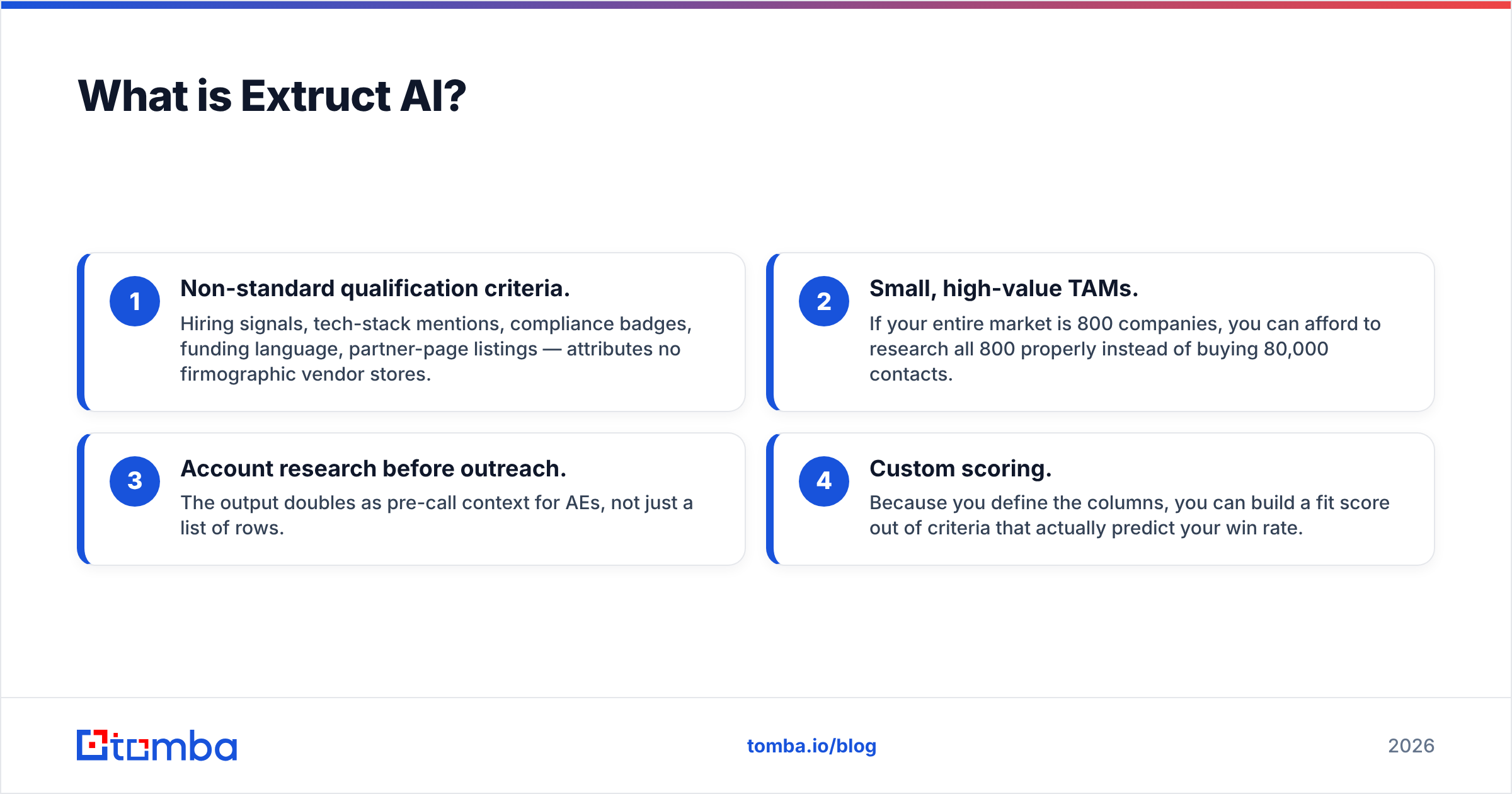
- Non-standard qualification criteria. Hiring signals, tech-stack mentions, compliance badges, funding language, partner-page listings — attributes no firmographic vendor stores.
- Small, high-value TAMs. If your entire market is 800 companies, you can afford to research all 800 properly instead of buying 80,000 contacts.
- Account research before outreach. The output doubles as pre-call context for AEs, not just a list of rows.
- Custom scoring. Because you define the columns, you can build a fit score out of criteria that actually predict your win rate.
The trade-off is honest and predictable. Agent research is slower and costs more per row than a database query. The output is also company-level, so you still need contact data at the end of it.
What is Warpleads?#
Warpleads sits at the opposite end. It is a B2B lead database built around export volume — the "unlimited exports" angle that has become its calling card. You filter by the usual firmographic and role criteria. Then you pull large CSVs without the per-credit anxiety that most contact databases create.
It also bundles a bulk email finder for enriching lists you already have. That puts it in the same shopping cart as tools people weigh against a Findymail alternative or a Seamless.AI alternative.
What Warpleads is good at is not subtle, and that is a compliment. If you run high-volume outbound across many inboxes, the biggest operational drag is credit math. Plans that split list size from cost change how boldly you can test segments. You can burn a 20,000-row experiment on a hunch without a finance conversation.
What it is not: a research tool. It answers "who matches these filters," not "which of these companies just did something interesting."

Extruct AI vs Warpleads: how do they actually compare?#
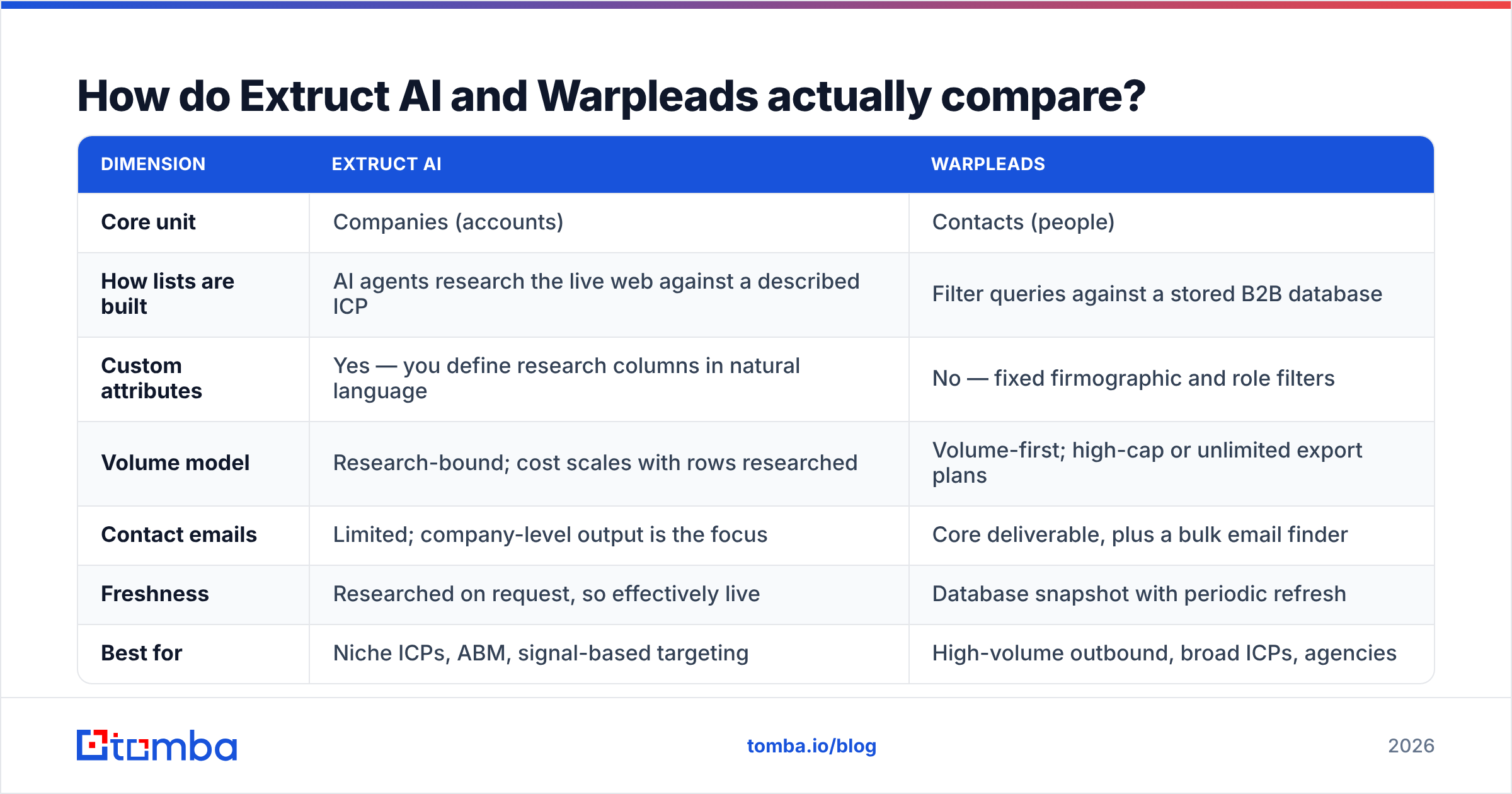
| Dimension | Extruct AI | Warpleads |
|---|---|---|
| Core unit | Companies (accounts) | Contacts (people) |
| How lists are built | AI agents research the live web against a described ICP | Filter queries against a stored B2B database |
| Custom attributes | Yes — you define research columns in natural language | No — fixed firmographic and role filters |
| Volume model | Research-bound; cost scales with rows researched | Volume-first; high-cap or unlimited export plans |
| Contact emails | Limited; company-level output is the focus | Core deliverable, plus a bulk email finder |
| Freshness | Researched on request, so effectively live | Database snapshot with periodic refresh |
| Best for | Niche ICPs, ABM, signal-based targeting | High-volume outbound, broad ICPs, agencies |
| Speed to first list | Minutes to hours depending on depth | Seconds |
| Typical buyer | RevOps, founder-led sales, ABM teams | SDR teams, lead-gen agencies, cold email operators |
| Weak spot | Not a contact database | No account-level reasoning or custom research |
Read that table as a fork in the road, not a scoreboard. Score both on one rubric and the winner is simply the tool you wrote the rubric for. That is the trap most "X vs Y" pages fall into.
Which is better for pricing and cost predictability?#
Pricing moves on both sides. Tiers also change with feature packaging. Treat what follows as a shape rather than a quote, and check the vendor pages before you budget.
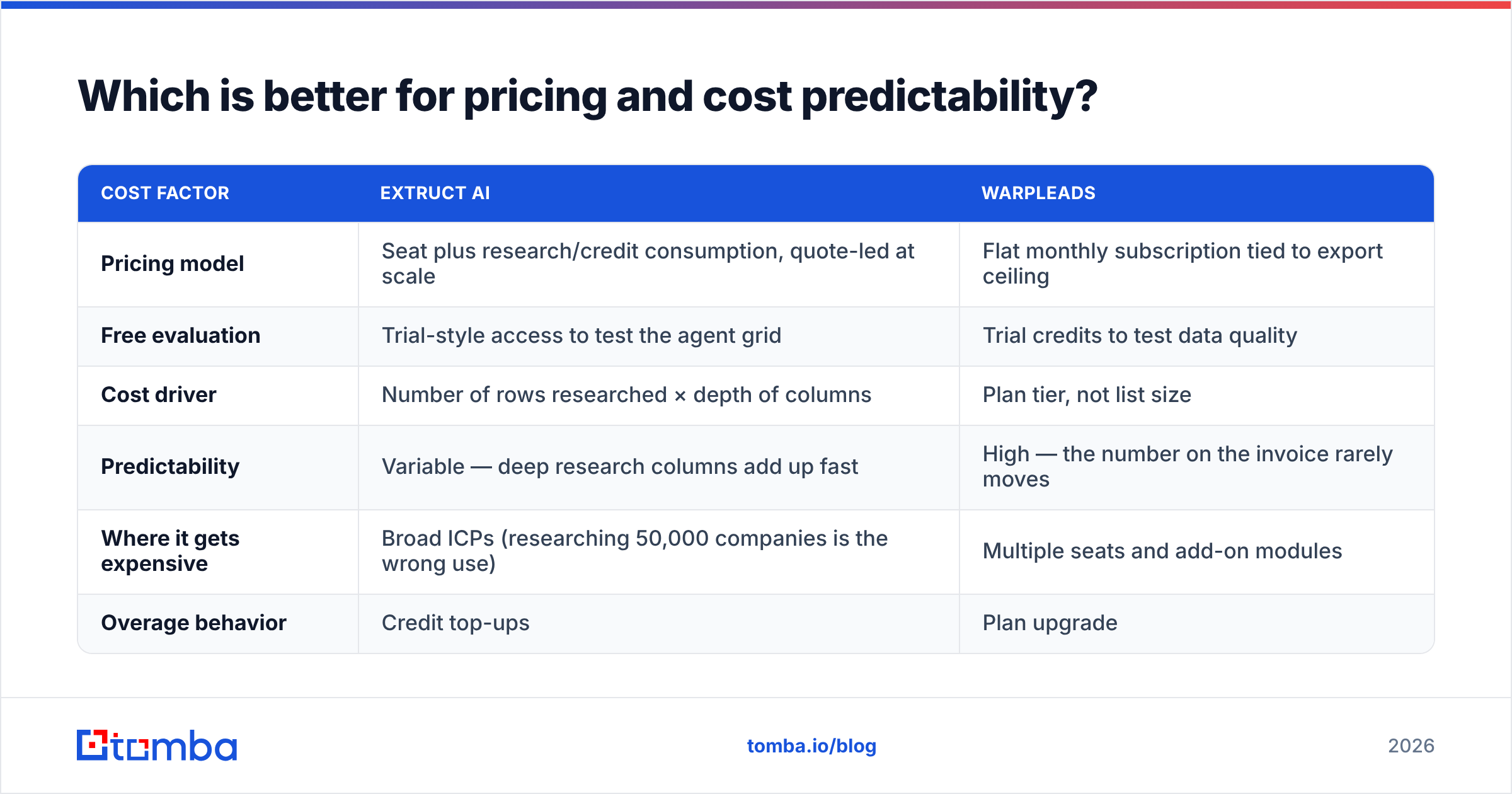
| Cost factor | Extruct AI | Warpleads |
|---|---|---|
| Pricing model | Seat plus research/credit consumption, quote-led at scale | Flat monthly subscription tied to export ceiling |
| Free evaluation | Trial-style access to test the agent grid | Trial credits to test data quality |
| Cost driver | Number of rows researched × depth of columns | Plan tier, not list size |
| Predictability | Variable — deep research columns add up fast | High — the number on the invoice rarely moves |
| Where it gets expensive | Broad ICPs (researching 50,000 companies is the wrong use) | Multiple seats and add-on modules |
| Overage behavior | Credit top-ups | Plan upgrade |
The practical read: Warpleads is cheaper per contact; Extruct AI is cheaper per qualified account. If you need 40,000 rows this month, Warpleads wins on cost and it is not close. If you need 400 rows that are actually right, research prices for 400 rows beat export prices for 40,000 rows you then have to disqualify by hand.
For reference, contact-data pricing in this category tends to cluster in a similar band. Tomba pricing runs a free tier at 25 searches/month, Starter at $49/mo, Growth at $99/mo, and Pro at $249/mo. That is roughly where most email-finding tools land before enterprise packaging kicks in. If a vendor sits far outside that band, ask what you are paying for.
What do both tools leave you to solve?#
Deliverability. Neither product is a verification-first vendor, and that is the seam where cold email campaigns quietly die.
Here is the failure mode in order:
- Extruct AI gives you the right 300 companies — with excellent context and no mailbox you can actually send to.
- Warpleads gives you 30,000 contacts — accurate at snapshot time, but B2B data decays somewhere in the 2–3% per month range as people change jobs, which compounds to a meaningful chunk of a list annually.
- You import both into your sequencer and discover the hard way that a chunk of the addresses are catch-all, role-based, or long dead.
- Your bounce rate crosses 3–5%, mailbox providers start throttling, and your sender reputation takes a hit that outlasts the campaign.
- You blame the copy. It was the data.
The fix is boring and it works. Run every list through an email verifier before it touches a sequencer. Treat catch-all domains as their own bucket instead of pretending they are valid. Bulk pipelines make this cheap — a bulk email finder pass over a 30,000-row Warpleads export costs less than one throttled sending domain.

Which one should you pick?#
The Extruct AI vs Warpleads choice comes down to five questions. Answer them honestly and the decision makes itself.
- Can a database filter express your ICP? If "SaaS, 50–200 employees, US" genuinely describes your best customers, you do not need AI research. Go Warpleads. If your best customers share a behavior rather than a firmographic, go Extruct AI.
- What is your monthly send volume? Under ~2,000 emails/month, targeting quality dominates and research pays for itself. Above ~20,000, volume economics dominate and a research tool will bankrupt you per row.
- Who does the work? Extruct AI rewards someone who will iterate on prompts and columns. Warpleads rewards someone who wants a CSV in 90 seconds. Match the tool to the operator you actually have.
- What is your ACV? Deep account research is justified above roughly $15–20K ACV. Below that, the math on per-account research rarely closes.
- Do you already have a verifier? If not, that is your first purchase regardless of which of these two you buy. Neither one removes the need.
A pattern worth stealing: use Extruct AI to define and validate the account list, use Warpleads (or a database of your choice) to pull contacts inside those accounts, then verify everything before it ships. Each tool does the job it is actually built for.
How do they compare to the wider market?#
Neither tool exists in isolation. Buyers evaluating this pair usually also look at Apollo, Clay, Ocean.io, and BookYourData depending on which half of the problem is louder.
- Clay overlaps heavily with Extruct AI on the "enrich with anything" promise, with a steeper learning curve and a bigger integration surface.
- Apollo overlaps with Warpleads on volume, with a sequencer bundled in — see the Apollo alternative breakdown if that comparison is live for you.
- BookYourData is a solid option when you want verified contact lists with a straightforward pay-as-you-go model rather than a subscription commitment — a different, cleaner buying motion than either tool here.
- Ocean.io attacks lookalike-account discovery specifically, which is a narrower slice of what Extruct AI does.
Cross-check any shortlist against real reviews on G2 before you commit. Category pages age fast, and a tool that was thin eighteen months ago may not be now. Product velocity is high in this market, so last year's verdict is unreliable.
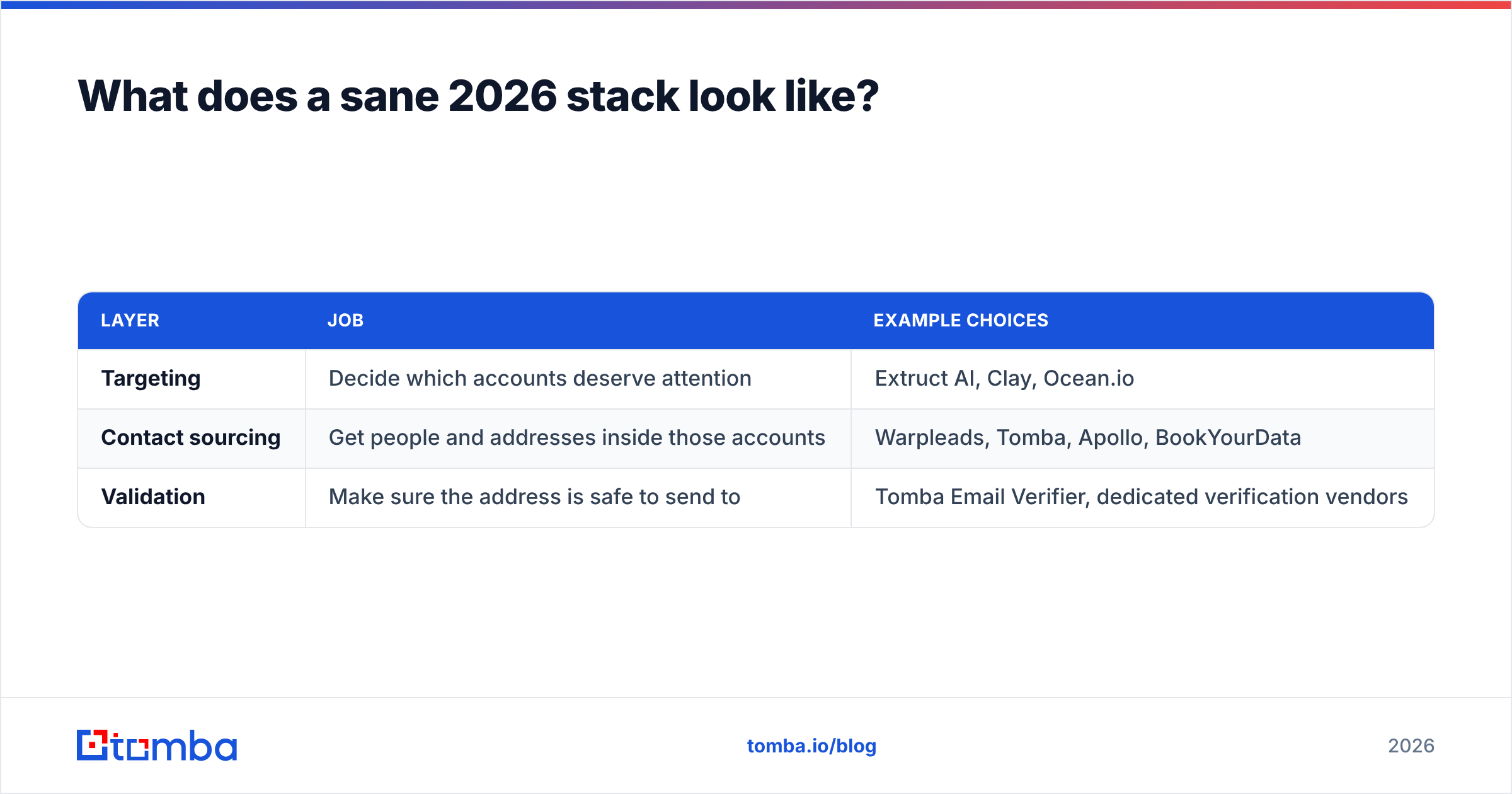
What does a sane 2026 stack look like?#
Three layers, and you should be able to name the vendor in each:
| Layer | Job | Example choices |
|---|---|---|
| Targeting | Decide which accounts deserve attention | Extruct AI, Clay, Ocean.io |
| Contact sourcing | Get people and addresses inside those accounts | Warpleads, Tomba, Apollo, BookYourData |
| Validation | Make sure the address is safe to send to | Tomba Email Verifier, dedicated verification vendors |
The mistake teams make is buying one tool and expecting it to cover all three. That is how you end up with a beautifully researched list you cannot email, or a 50,000-row export that torches a sending domain in week one.
Want the sourcing and validation layers from one place? That is the specific gap Tomba fills. Find email addresses by domain, name, or company, then verify them and handle catch-all domains. Push the results into your CRM through the Tomba API or a spreadsheet add-in. It does not try to be your research agent or your sequencer. It makes sure the addresses in the middle are real.
The verdict#
Extruct AI wins on precision. Warpleads wins on volume. Neither wins on deliverability. That is the short Extruct AI vs Warpleads answer.
Running a focused ABM motion into a defined market where every account matters? Extruct AI's research-column model gives you targeting no static database can match, and the deal size justifies the cost per account.
Running high-volume outbound where the bottleneck is list size and credit anxiety? Warpleads' export model removes a real operational tax, and you will move faster for less money.
What neither answers is whether the mailbox on the other end still exists. Pair whichever you choose with a verification step, and treat that step as non-negotiable rather than a nice-to-have.
Ready to close the gap? Start with the Tomba Email Finder — free for 25 searches a month, $49/mo on Starter, with domain search, catch-all handling, bulk processing, and verification built into the same workflow. Run your next Extruct AI account list or Warpleads export through it before your first send, and watch your bounce rate stop being a topic of conversation.
Related guides#
Ready to find emails that actually work?
Join 150,000+ professionals who stopped guessing and started sending. Free credits on signup — no credit card required.
Get the Tomba newsletter
Practical outbound tactics and product updates — once every two weeks.
About the author