FAC Intelligence vs GrowMeOrganic: Which Wins in 2026?
FAC Intelligence vs GrowMeOrganic: one is a data-intelligence platform sold by a sales team. The other is a self-serve prospecting suite. Here is how they differ on data, exports, pricing and outreach.
FAC Intelligence vs GrowMeOrganic is a comparison of two very different tools. One sells market data through a sales team. The other sells self-serve prospecting on a card. This guide shows where each one fits, what each one costs, and when neither is the right call.
TL;DR
- They are not the same category of product. The FAC Intelligence vs GrowMeOrganic split is simple. FAC Intelligence is a B2B data and market-intelligence layer, sold through a sales call. GrowMeOrganic is a self-serve prospecting suite: scrape, find emails, verify, sequence, send.
- GrowMeOrganic wins on price and speed. You can sign up, install the Chrome extension, and send your first sequence the same afternoon.
- FAC Intelligence wins on account choice. It helps you answer "which accounts should we target?" It does not exist to hand you 5,000 emails.
- Neither is a clean win for pure contact data. Both bundle email finding into a wider workflow. You pay for modules you may never open.
- Verify every address before you send. Bundled finders check less than a dedicated verifier. Bounce rate is the number that kills sending domains.
What are FAC Intelligence and GrowMeOrganic?#
Start with the honest framing. These two tools land on the same shortlist because both promise more qualified leads. They do not solve the same problem.
GrowMeOrganic is a self-serve B2B prospecting platform. The pitch is unlimited-style usage on a flat monthly fee. You get a LinkedIn and Sales Navigator extractor, a contact database, an email finder, basic verification, a drip sender, and scrapers for sources like Google Maps. It is built for founders, agencies and small SDR teams. One subscription replaces four. You can review the current feature list on growmeorganic.com and cross-check user sentiment on G2.
FAC Intelligence sits on the data-intelligence side of the market. Tools in this category map companies, sectors, registry data and buying signals. Teams use them for research, account selection and territory planning. The buying motion is a demo and a quote, not a credit card. FAC Intelligence does not publish a self-serve price list today. Treat any number you see in a third-party listicle as unverified until it comes from their own quote.
That buying motion tells you most of what you need. One tool you evaluate in an afternoon. The other you evaluate in a procurement cycle. So the FAC Intelligence vs GrowMeOrganic choice is really a question about how fast you need to move.

FAC Intelligence vs GrowMeOrganic: how do the features compare?#
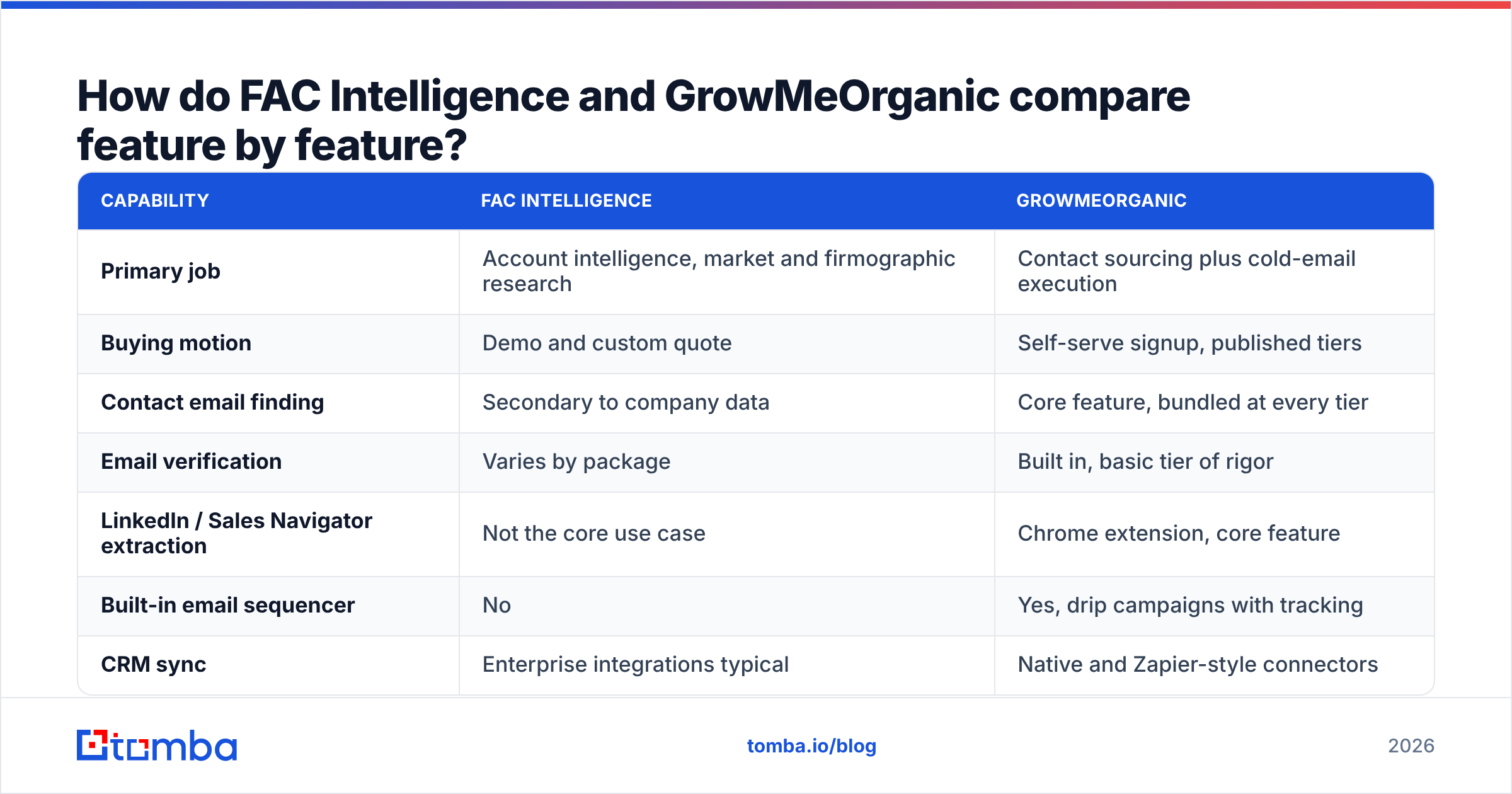
Here is the practical breakdown. Where a capability depends on your negotiated plan, the table says so rather than inventing a number.
| Capability | FAC Intelligence | GrowMeOrganic |
|---|---|---|
| Primary job | Account intelligence, market and firmographic research | Contact sourcing plus cold-email execution |
| Buying motion | Demo and custom quote | Self-serve signup, published tiers |
| Contact email finding | Secondary to company data | Core feature, bundled at every tier |
| Email verification | Varies by package | Built in, basic tier of rigor |
| LinkedIn / Sales Navigator extraction | Not the core use case | Chrome extension, core feature |
| Built-in email sequencer | No | Yes, drip campaigns with tracking |
| CRM sync | Enterprise integrations typical | Native and Zapier-style connectors |
| API access | Usually available on higher packages | Available, but not the main entry point |
| Best-fit team size | Mid-market to enterprise revenue teams | Founders, agencies, 1–10 seat SDR teams |
| Time to first sent email | Weeks (procurement + onboarding) | Same day |
The pattern is clear. GrowMeOrganic compresses the whole outbound stack into one login. FAC Intelligence sits one step earlier in the funnel. It helps you decide which companies deserve outbound at all.
If you already know your ICP cold and just need contacts, an intelligence layer is overkill. If your reps burn quota on accounts that were never going to buy, more email addresses will not fix that.
How accurate is the data on each platform?#
Accuracy is where all-in-one suites get uncomfortable. It deserves a real answer, not a vendor claim.
Two numbers matter, and they are not the same:
- Hit rate — of 1,000 contacts you request, how many come back with an email at all?
- Deliverable rate — of the emails returned, how many actually accept mail?
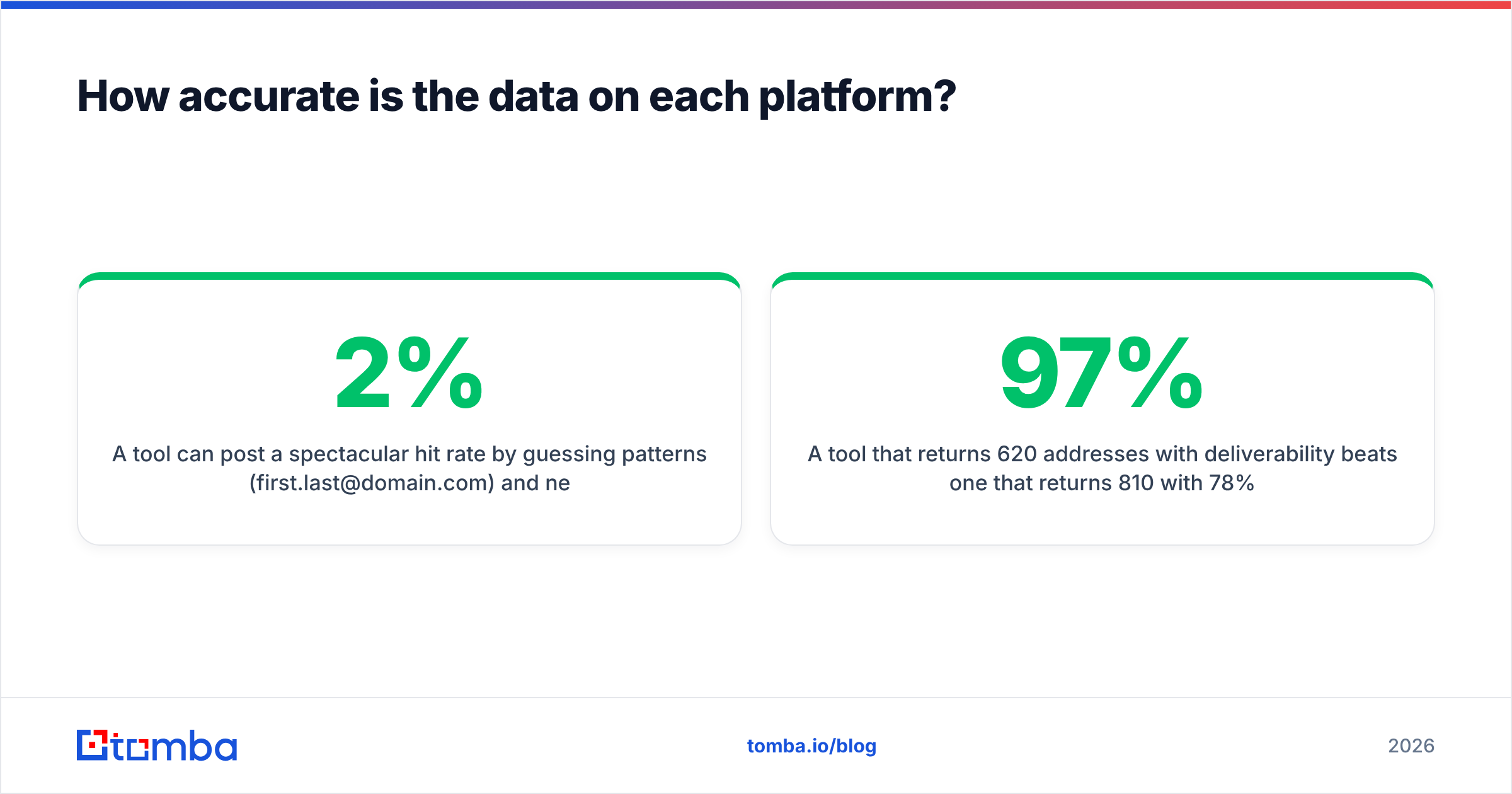
A tool can post a great hit rate by guessing patterns (first.last@domain.com). If it never confirms those guesses, the first number climbs and the second one falls. Bundled finders inside outreach suites often work this way. Their incentive is to keep your sequence full, not to keep your bounce rate under 2%.

Here is how to test either tool honestly, before you commit budget:
- Build a 100-row control list. Use contacts you can confirm yourself: customers, partners, people who have emailed you.
- Run the same list through each platform and record the hit rate.
- Push every returned address through an independent email verifier. Do not use the vendor's own checker. Self-grading is not a benchmark.
- Segment the failures. Catch-all domains, role addresses (
info@,sales@) and stale contacts fail for different reasons. Each needs a different fix. - Send a small warm batch. Try 50 emails over three days, then read the actual bounce log.
A tool that returns 620 addresses at 97% deliverability beats one that returns 810 at 78%. The second option looks better on the invoice. It looks much worse on your domain reputation. That is why email deliverability belongs in the evaluation, not just coverage.
What does each one actually cost?#
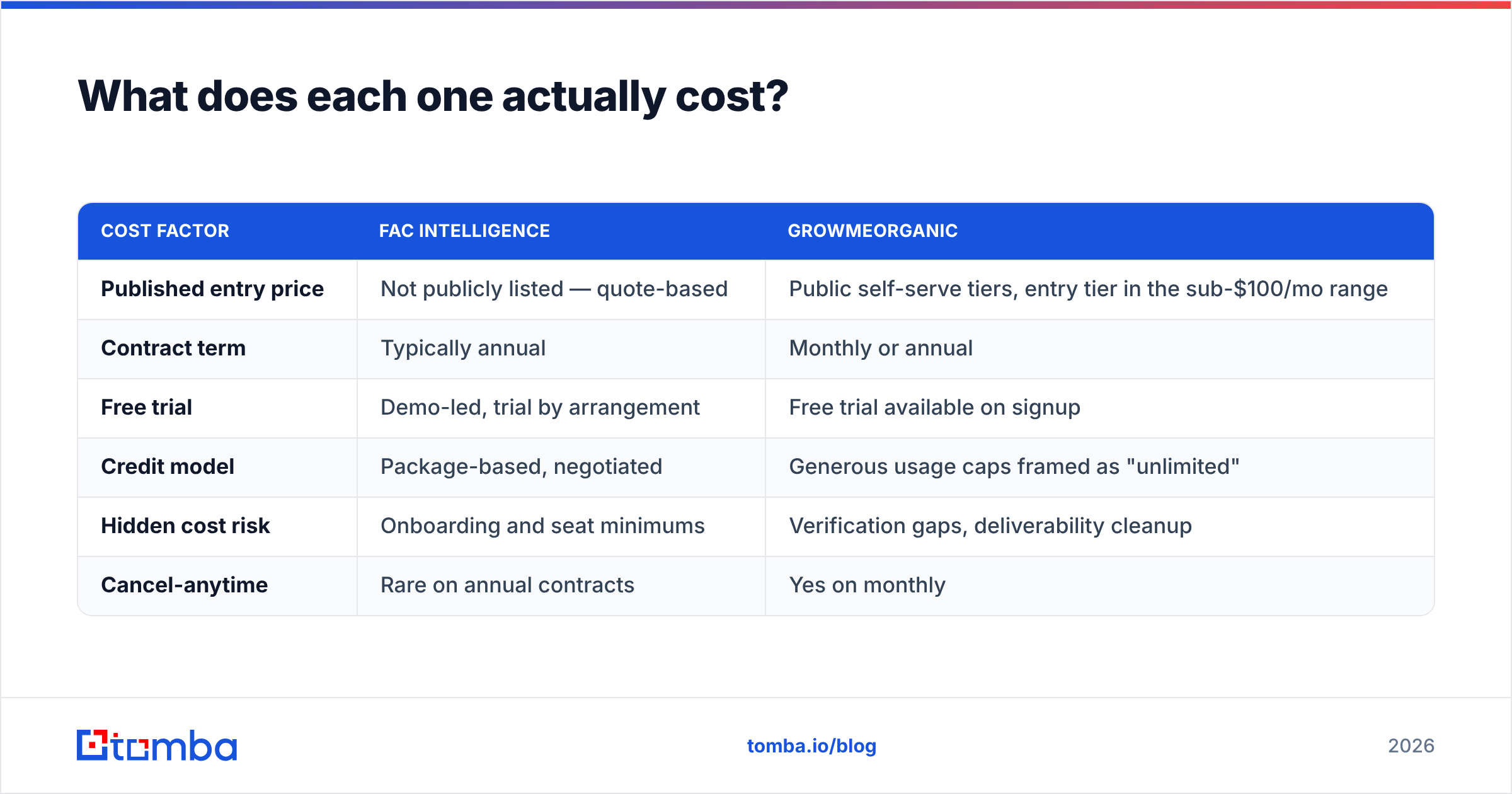
Cost is where FAC Intelligence vs GrowMeOrganic gets asymmetric. Any post that hands you two neat side-by-side prices for these tools is guessing.
| Cost factor | FAC Intelligence | GrowMeOrganic |
|---|---|---|
| Published entry price | Not publicly listed — quote-based | Public self-serve tiers, entry tier in the sub-$100/mo range |
| Contract term | Typically annual | Monthly or annual |
| Free trial | Demo-led, trial by arrangement | Free trial available on signup |
| Credit model | Package-based, negotiated | Generous usage caps framed as "unlimited" |
| Hidden cost risk | Onboarding and seat minimums | Verification gaps, deliverability cleanup |
| Cancel-anytime | Rare on annual contracts | Yes on monthly |
Always confirm live numbers on the vendor's own pricing page. Check recent reviews on Capterra as well. Pricing pages in this category change more often than blog posts do.
People underestimate the hidden-cost line. "Unlimited" plans with weak verification move the cost from your software budget to your deliverability. Replacing a burned sending domain, warming up a new one, and losing three weeks of pipeline costs far more than a verification subscription.

Which tool should you pick for your use case?#
Match the tool to the bottleneck you actually have.
- You are a solo founder or a two-person agency. Pick GrowMeOrganic. One subscription, one login, sequences included. An intelligence layer is a luxury when you have 40 target accounts.
- You run a 5–15 rep SDR team with a defined ICP. Use GrowMeOrganic for execution. Add a dedicated finder and verifier for data quality. Do not let the sequencer's built-in finder be your only source of truth.
- You are mid-market or enterprise and your problem is territory design. Pick FAC Intelligence. When the expensive mistake is targeting the wrong 500 companies, account intelligence pays back faster than more contact records.
Three more cases sit outside the FAC Intelligence vs GrowMeOrganic choice:
- You are a RevOps or data team feeding a warehouse. Neither tool works as the primary system. You want an email finder API and enrichment endpoints you can call from a pipeline, not a UI-first suite.
- You need verified contacts in a specific niche, right now. A dedicated data provider is the faster path. Vendors like BookYourData sell pre-built, targeted lists, and they sit comfortably alongside a finder for on-demand lookups.
- You are replacing three tools with one. Map every workflow before you sign. All-in-ones cut cost, but they rarely match the best tool in each slot.

Where does each platform fall short?#
Being neutral means saying the awkward part out loud for both.
GrowMeOrganic's weak points:
- Verification depth. Basic checks catch syntax errors and dead domains. They struggle with catch-all servers, and those are the biggest source of "valid" addresses that still bounce. A dedicated catch-all verifier exists as a separate product for a reason.
- Database freshness in long-tail markets. Coverage is strong in US and Western European tech. It thins out in regional, non-English markets.
- Extension-based workflows break when the source platform changes its layout. Anything built on LinkedIn scraping carries that risk.
- The sequencer is competent, not exceptional. If cold email is your main channel at volume, a specialist sending platform will beat it.
FAC Intelligence's weak points:
- Opacity. No published pricing means no fast comparison. It also filters out smaller teams.
- Time to value. Demo, quote, contract, onboarding. You are weeks from your first sent email. That is fine for annual planning and painful for a Q3 pipeline gap.
- Contact-level data is the supporting act, not the headline. If you need 5,000 verified addresses this month, this is an expensive way to get them.
- Overlap risk. If you already run a warehouse with firmographic feeds, you may pay twice for the same signal.
Is there a better middle path?#
Often, yes. It is usually two tools, not one.
The most durable outbound stacks keep data and execution apart. You buy contact data from a provider whose only job is accuracy. You send from a platform whose only job is deliverability and reply handling. Weld the two together and you lose the ability to swap out the weak half.
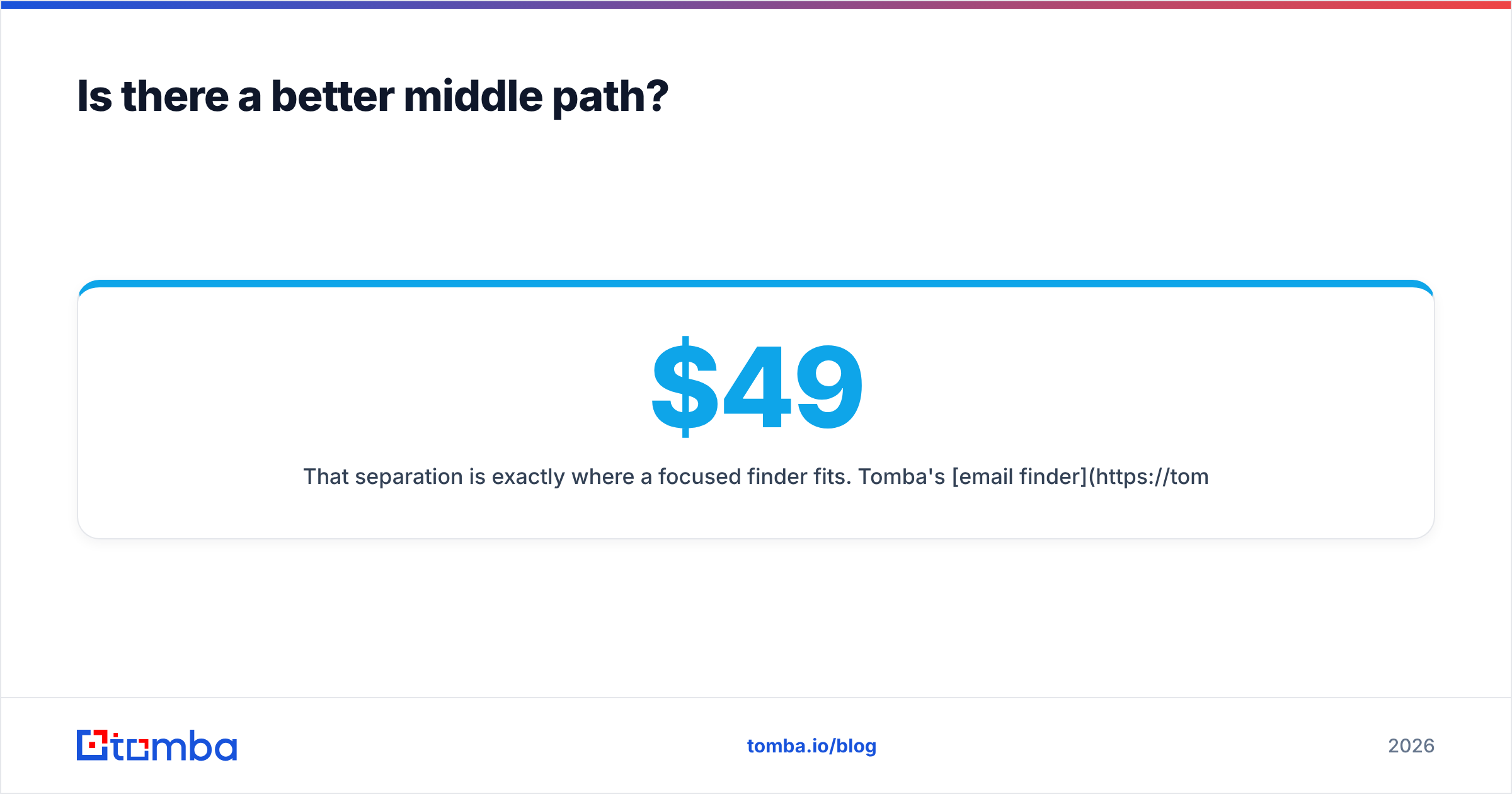
That split is where a focused finder fits. Tomba's email finder covers the data half. Find addresses by domain, name, or company. Verify them before export. Run the whole thing through an API or a bulk upload instead of a browser extension. Tomba pricing starts with a free tier at 25 searches a month, then Starter at $49/mo, Growth at $99/mo, Pro at $249/mo, and custom Enterprise plans. Keep GrowMeOrganic's sequencer if you like it, and stop leaning on its finder for accuracy.
For teams doing account research first, the logic runs in reverse. Use whatever intelligence source fits your market to build the account list. Then resolve contacts through a dedicated finder, rather than paying enterprise rates for contact records.
What is the verdict on FAC Intelligence vs GrowMeOrganic?#
Pick GrowMeOrganic if you are self-serve, budget-conscious, and moving fast. You get prospecting plus sending under one login. Add an independent verifier before your first campaign. That one step avoids the failure mode that catches most of its users.
Pick FAC Intelligence if your bottleneck is account selection rather than contact volume. You also need budget for an annual contract and patience for a procurement cycle.
Pick neither as a single solution if you are building a data pipeline, need API-first access, or care more about deliverable rate than raw record count. In that case, split the stack: a specialist data source, a specialist sender, and a verifier between them.
The question is never "which tool is better." It is "which part of my funnel is broken." Answer that first, and the shortlist writes itself.
Ready to fix the data half of your stack? However the FAC Intelligence vs GrowMeOrganic call goes, start with the Tomba Email Finder. Search by domain, name, or company. Verify every address before it hits your sequencer. Pull results through the API, a bulk upload, or a spreadsheet add-on. The free tier gives you 25 searches a month, no card required. Run your control list through it, compare the deliverable rate, and let the numbers decide.
Related guides#
Ready to find emails that actually work?
Join 150,000+ professionals who stopped guessing and started sending. Free credits on signup — no credit card required.
Get the Tomba newsletter
Practical outbound tactics and product updates — once every two weeks.
About the author