FAC Intelligence vs Seamless.AI: Which B2B Data Wins?
One vendor sells an AI research engine with quote-only pricing. The other sells 1.3B contacts on an annual contract. Here is how FAC Intelligence and Seamless.AI actually compare on accuracy, cost, and exit risk in 2026.
TL;DR
- Seamless.AI is the bigger, louder option: a very large contact database, a Chrome extension, and an aggressive sales motion built around annual contracts and credit packs. Volume is its strength; bounce rates and contract flexibility are its weak spots.
- FAC Intelligence is the smaller, quieter option: an AI-assisted research and enrichment angle aimed at teams that want fewer, better-qualified records. It publishes almost no public pricing, so every deal is a sales call.
- Neither tool wins on "who has more rows." The number that decides your ROI is deliverable, verified emails per dollar — not total database size.
- If you mostly need accurate work emails on demand with transparent per-month pricing, a focused email finder plus verification will usually beat both on cost per usable contact.
- Read the contract terms before the feature list. Auto-renewal, credit expiry, and seat minimums cost more teams more money than any missing feature.
What are FAC Intelligence and Seamless.AI?#
They solve the same job from opposite ends.
Seamless.AI is a US-based B2B contact database and prospecting platform. It sells access to a very large pool of company and people records — the company has publicly claimed north of a billion contacts — plus a browser extension that pulls emails and phone numbers while you browse LinkedIn or a company site. The pitch is coverage: whoever you want to reach, there is probably a row for them. You can see the current product lineup on the official Seamless.AI site.
FAC Intelligence sits at the other end. It positions itself as an intelligence and enrichment layer rather than a giant static list — research signals, firmographic context, and contact discovery aimed at teams doing account-based work rather than spray-and-pray volume. At the time of writing it publishes no standard public price list, which tells you most of what you need to know about the buying process: expect a demo, a discovery call, and a custom quote.
That difference in go-to-market matters more than any single feature. One vendor wants you inside a self-serve funnel that upgrades into an annual contract. The other wants a scoped enterprise conversation. Your procurement patience should decide which door you knock on first.
How accurate is the data in each tool?#
This is the only question that pays your bills, and it is the hardest one to get a straight answer to.
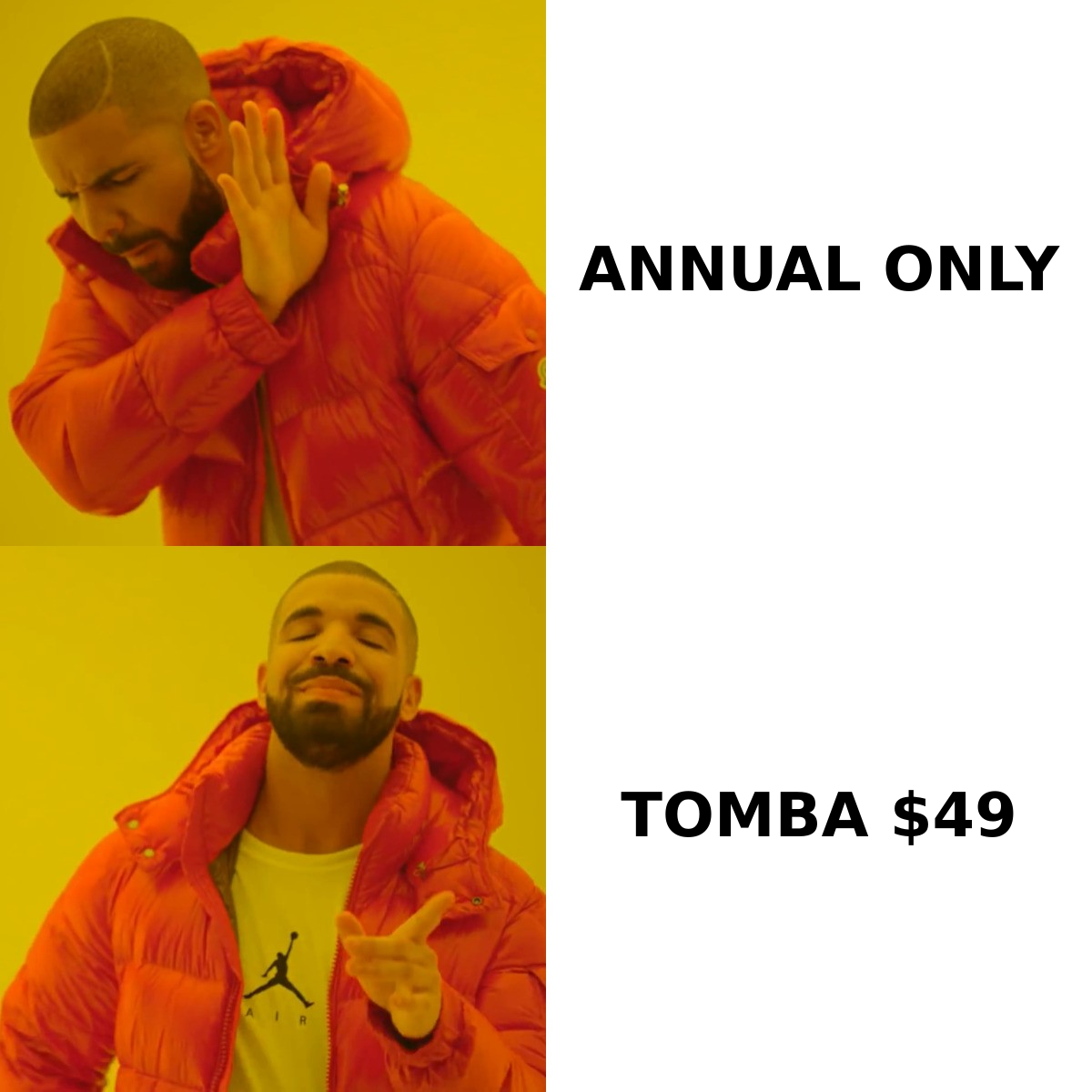
Every vendor in this category quotes an accuracy figure. Almost none of them define the denominator. "95% accurate" can mean:
- 95% of records that our system returns with high confidence — a self-selected subset, which is easy to hit and nearly meaningless.
- 95% of all returned records pass an SMTP check — much harder, much more honest.
- 95% of records matched a third-party reference file — matching a stale file proves consistency, not deliverability.
Seamless.AI's model leans on real-time crawling and pattern inference. That gives it reach into contacts other databases miss, but pattern-guessed emails are exactly the ones that bounce. Independent user reviews on G2 repeatedly flag the same tension: great coverage, inconsistent hit quality, and a lot of credits burned on records the user then has to verify elsewhere.
FAC Intelligence's smaller, research-led approach usually inverts that trade: fewer contacts per account, higher confidence on each one. That is a genuinely good fit for a six-person ABM team working 200 named accounts. It is a bad fit for a team that needs 8,000 contacts by Friday.

Whichever you pick, run your own test before you sign anything:
- Pull 100 records from a segment you actually sell to — not the vendor's demo account, not a Fortune 500 list where every tool looks good.
- Verify them independently with a separate email verifier so the grader isn't the same system that produced the answer.
- Count the catch-alls separately. A catch-all domain accepts everything, so "valid" there means "unknown." Treat it as its own bucket, not a win.
- Divide the cost of those 100 credits by the number of confirmed-deliverable emails. That number is your real price per contact, and it is usually 2–4x the sticker price.
- Send to a 50-address sample and record the actual bounce rate. Anything above 3% will start damaging your sender reputation.
Teams that skip step 5 find out about their data quality from Google Postmaster Tools three weeks later, which is the expensive way to learn it.
FAC Intelligence vs Seamless.AI: how do they compare on paper?#
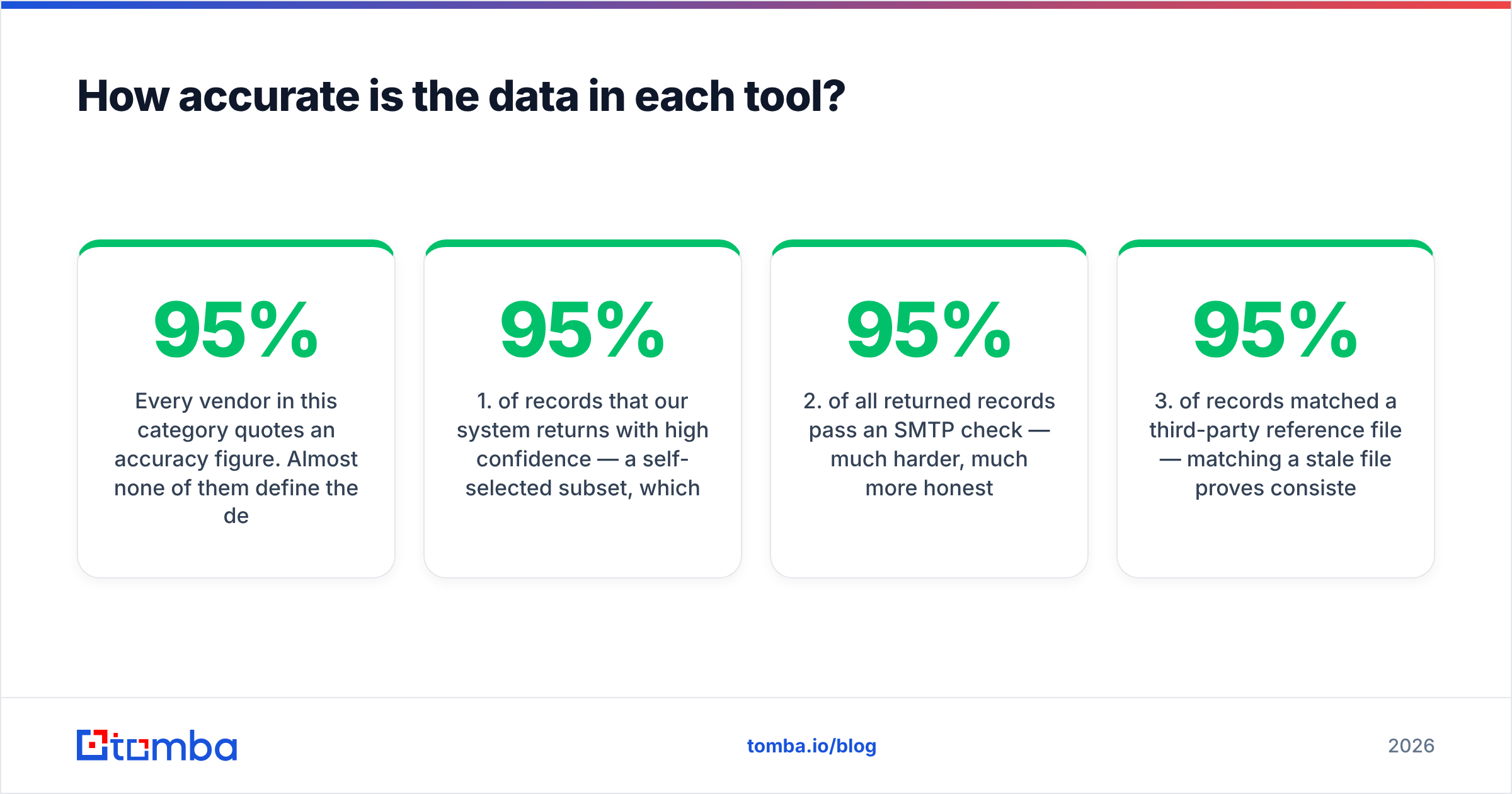
Here is the honest side-by-side, with a transparent-pricing reference point in the third column so you can see what the market rate looks like when nobody is hiding it behind a demo request.
| Factor | FAC Intelligence | Seamless.AI | Tomba |
|---|---|---|---|
| Primary strength | AI-assisted research and account intelligence | Very large contact database plus Chrome extension | Accurate work-email discovery and verification |
| Public pricing | Not published — quote only | Not fully published; free trial credits, then sales-led | Published: Free (25 searches/mo), Starter $49/mo, Growth $99/mo, Pro $249/mo |
| Free tier | Demo/trial by request | Limited trial credits | Yes — 25 searches per month, no card |
| Contract norm | Annual, custom scope | Commonly annual with auto-renew | Monthly or annual, cancel anytime |
| Built-in verification | Enrichment-side scoring | Basic; most users verify externally | Native verifier plus catch-all handling |
| Phone numbers | Yes, on enterprise scope | Yes, mobile data is a headline feature | Yes, via phone finder |
| Bulk workflow | Managed / API | CSV and integrations | Bulk finder and bulk verify |
| API access | Yes, enterprise tier | Yes, higher tiers | Yes, on all paid plans |
| Best for | ABM teams working named accounts | High-volume SDR floors that need reach | Teams that need deliverable emails at a predictable price |

Two things stand out in that table.
First, neither of the two headline vendors will tell you the price without a conversation. That is a legitimate business model, but it costs you two weeks and a calendar invite before you can even build a business case. If you are evaluating four tools in a month, that friction is real.
Second, the feature rows are closer than the marketing suggests. Both find emails. Both find phones. Both integrate with your CRM. The differences that actually change outcomes are accuracy, credit mechanics, and how easy it is to leave.
Which one is cheaper in practice?#
Cheaper depends entirely on how credits behave, not on the monthly number.
Ask every vendor these five questions in writing before you sign:
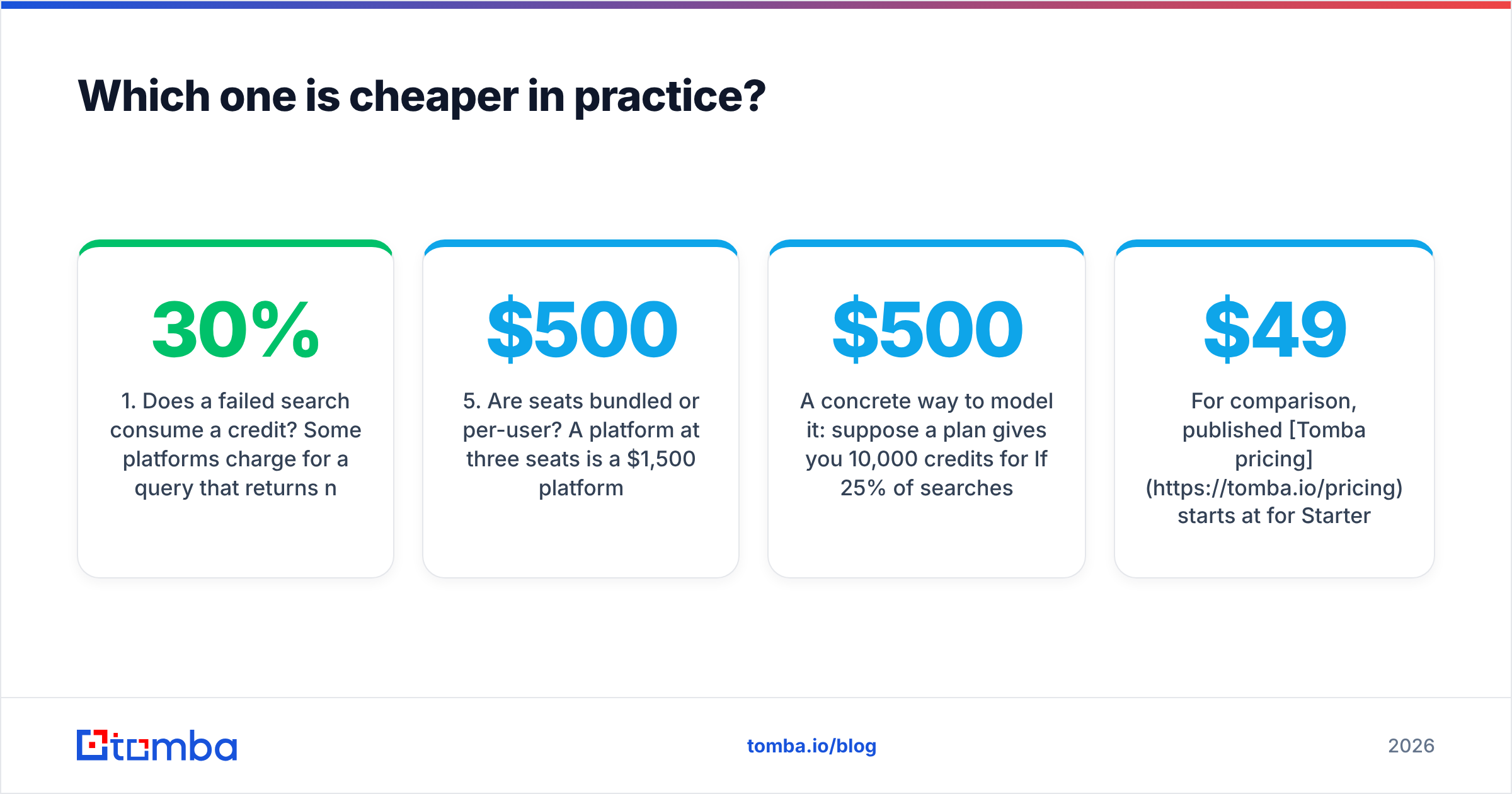
- Does a failed search consume a credit? Some platforms charge for a query that returns nothing useful. Over a quarter, that alone can inflate your effective cost by 20–30%.
- Do unused credits roll over, or expire monthly? Expiring credits mean you pay for peak capacity every month while using average capacity.
- Is the contract annual with auto-renewal, and what is the cancellation notice window? The most common complaint pattern across this category — including in public Seamless.AI reviews — is not about data. It is about renewal terms that surprised the buyer.
- What happens to exported data if you leave? Some agreements restrict continued use of exported records after termination.
- Are seats bundled or per-user? A $500/mo platform at three seats is a $1,500/mo platform.
A concrete way to model it: suppose a plan gives you 10,000 credits for $500/mo. If 25% of searches return nothing, 20% of returned emails are unverifiable catch-alls, and 8% bounce, you end up with roughly 5,200 usable, deliverable contacts. Your real cost is about $0.096 per usable contact, not the $0.05 the pricing page implies. Run that same math on every vendor and the ranking often flips.
For comparison, published Tomba pricing starts at $49/mo for Starter and $99/mo for Growth, with a free tier at 25 searches per month so you can run the accuracy test above before spending anything. Transparent pricing does not automatically make a tool better — but it does let you do this math on a Tuesday afternoon instead of after a discovery call.

Is FAC Intelligence better than Seamless.AI for outbound teams?#
It depends on the shape of your motion, and the answer is genuinely different for three common team profiles.
- High-volume SDR floor (20+ reps, 2,000+ touches/week). Seamless.AI's coverage and browser extension fit the workflow better. You will need a separate verification step in the pipeline, and you should budget for it rather than pretend it is optional. Plan on a real email deliverability process behind it: warmed domains, list hygiene, suppression rules.
- ABM team working 100–400 named accounts. FAC Intelligence's research-led angle is the better philosophical match. You are not paying for reach, you are paying for context on accounts you already know you want. The quote-only pricing hurts less here because the contract is a considered annual purchase anyway.
- Founder-led sales, small agency, or a lean growth team. Both are probably wrong. You need per-contact accuracy, no annual lock-in, and a bill you can predict. That is where a focused email-finding stack with a free email checker and self-serve limits wins on total cost, even if the database is smaller.
There is a fourth profile worth naming: teams that need verified, list-purchase-style data for a defined campaign rather than an always-on seat. Vendors like BookYourData serve that use case well with pay-as-you-go list building, and it is a legitimately different product category from either tool in this comparison. Do not force a subscription model onto a one-off campaign need.
What do reviewers complain about most?#
Patterns across public review sites are consistent enough to be useful.
For Seamless.AI, the recurring themes are: strong coverage and a genuinely useful extension; frustration with data that needs external verification; and — by far the loudest signal — friction around annual contracts, auto-renewal, and getting out of them. That last category is a commercial problem, not a product one, but it costs money either way. Read the order form, not the landing page.
For FAC Intelligence, the public review footprint is thin, which is itself a data point. A small review corpus means you cannot triangulate claims from strangers; you have to do your own due diligence. Ask for references in your industry, ask for a scoped pilot with a real segment, and insist on running your own accuracy test on your own accounts rather than accepting a curated demo dataset.
For any vendor with limited public reviews, three protections matter more than usual: a written accuracy SLA with a defined denominator, a pilot clause that lets you exit at 30 or 60 days, and no auto-renewal on the first term. If a vendor will not put a pilot exit in writing, that is your answer.
How should you actually run the evaluation?#
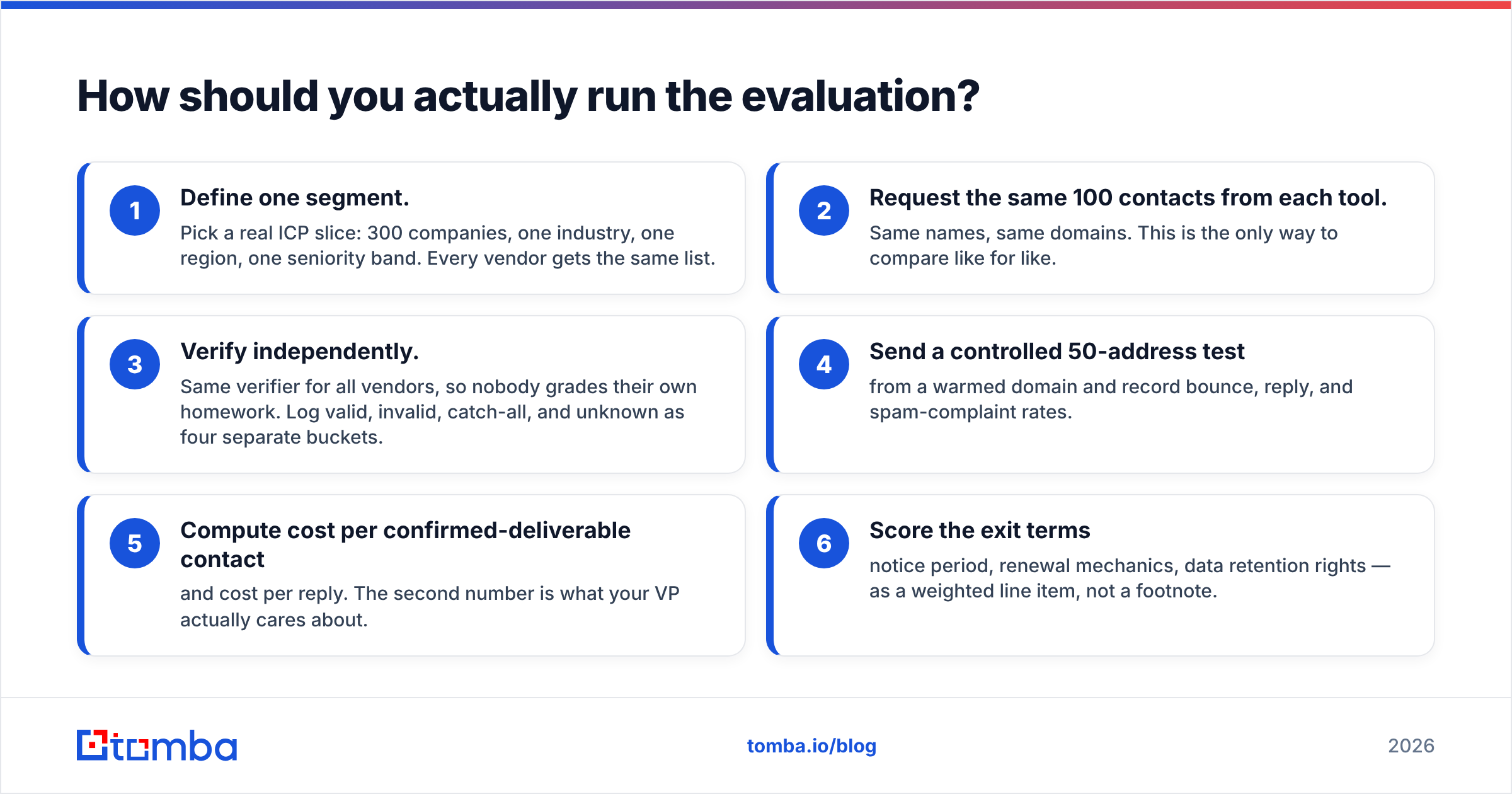
Give yourself two weeks and a scorecard. Not a feature checklist — a scorecard with numbers on it.
- Define one segment. Pick a real ICP slice: 300 companies, one industry, one region, one seniority band. Every vendor gets the same list.
- Request the same 100 contacts from each tool. Same names, same domains. This is the only way to compare like for like.
- Verify independently. Same verifier for all vendors, so nobody grades their own homework. Log valid, invalid, catch-all, and unknown as four separate buckets.
- Send a controlled 50-address test from a warmed domain and record bounce, reply, and spam-complaint rates.
- Compute cost per confirmed-deliverable contact and cost per reply. The second number is what your VP actually cares about.
- Score the exit terms — notice period, renewal mechanics, data retention rights — as a weighted line item, not a footnote.
Teams that run this process almost always find the ranking they expected from marketing materials was wrong by at least one position. If you already have a data workflow in a spreadsheet, running the same test through a Google Sheets integration or a bulk email finder makes step 2 a ten-minute job instead of a two-day one.
One more discipline: keep a permanent suppression list of every hard bounce from the test. Whichever vendor you pick, you will re-encounter those addresses, and burning them twice is how good domains go bad. Industry guidance from vendors like HubSpot on list hygiene is unglamorous and correct — the boring hygiene work protects the expensive data investment.
The verdict#
Seamless.AI wins on reach; FAC Intelligence wins on focus. If your pipeline problem is "we don't have enough contacts," Seamless.AI's database is the more likely fix, provided you add a verification step and read the renewal clause twice. If your problem is "we know exactly which 250 accounts matter and we need real intelligence on them," FAC Intelligence's research-led model is the better philosophical fit — accept that you will go through a sales process to find out the price.
If neither problem describes you — if what you actually need is accurate work emails, on demand, at a price you can see on a webpage — start smaller. Use the Tomba Email Finder to pull and verify contacts by domain, name, or company, with a free tier of 25 searches a month and paid plans from $49/mo with no annual lock-in. Run the 100-contact accuracy test above against whatever you are considering, keep the tool with the best cost per confirmed-deliverable contact, and put the difference into your outbound sequencing instead of your data bill.
Related guides#
Ready to find emails that actually work?
Join 150,000+ professionals who stopped guessing and started sending. Free credits on signup — no credit card required.
Get the Tomba newsletter
Practical outbound tactics and product updates — once every two weeks.
About the author