Fac Intelligence vs Smarte: B2B Data Compared for 2026
Fac Intelligence and Smarte both sell B2B contact data, but they solve different problems. Here is an honest breakdown of coverage, verification, pricing transparency, and which one fits your outbound motion.
TL;DR
- Fac Intelligence and Smarte are not the same category of product. Smarte is a full sales-intelligence platform (contact + company data, intent signals, CRM enrichment). Fac Intelligence positions itself narrower, around B2B contact discovery and account research.
- Neither publishes transparent self-serve pricing. Both run quote-based, seat-and-credit sales motions, which means your real cost depends on how well you negotiate — not on a published number.
- Accuracy is the only metric that matters, and neither vendor's marketing number should be trusted. Run a 200-contact bake-off against your own ICP before you sign anything.
- If you want per-lookup transparency instead of an annual contract, a self-serve email finder like Tomba starts free and scales at $49/mo — no procurement cycle.
- The right answer is usually a stack, not a winner. Platform for account intelligence, cheap API for the last-mile email and phone lookups.
What are Fac Intelligence and Smarte?#
Both tools sit in the same broad bucket — B2B data and sales intelligence — but they came at the problem from different angles, and that shows up in how they price and who buys them.
Smarte is the more established of the two. It is a sales and marketing intelligence platform built around a global contact and company database with a heavy emphasis on GDPR/CCPA-compliant sourcing, especially for EMEA and APAC records. The pitch is breadth: find accounts, find contacts inside those accounts, pull direct dials and business emails, layer on technographic and intent signals, then push it all into your CRM. It targets mid-market and enterprise revenue teams who want one contract instead of five point tools.
Fac Intelligence plays a tighter game. It leans toward contact discovery and account research for outbound teams — the workflow of "here is a company, get me the right people and their contact details." It is less of a full GTM platform and more of a data-acquisition layer, which makes it lighter to adopt but also means you will still need a sequencer, a verifier, and a CRM around it.
That distinction matters more than any feature checklist. If you compare them purely on "does it have emails," they look identical. If you compare them on "what problem am I actually buying away," they diverge fast.
How do Fac Intelligence and Smarte compare head-to-head?#
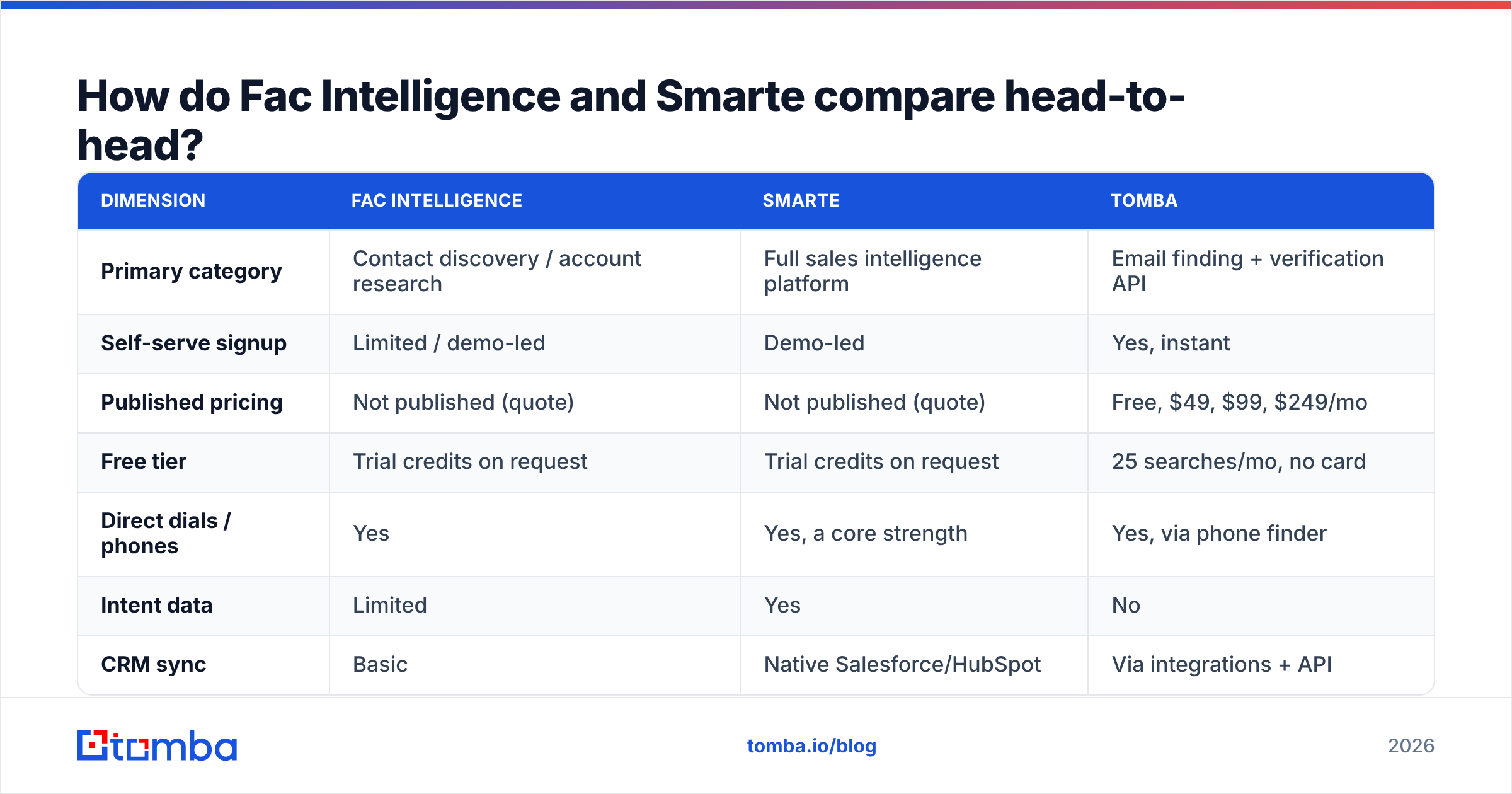
Here is the honest side-by-side. Where a vendor does not publish a number, this table says so rather than inventing one — a habit worth carrying into your own evaluation spreadsheet.

| Dimension | Fac Intelligence | Smarte | Tomba |
|---|---|---|---|
| Primary category | Contact discovery / account research | Full sales intelligence platform | Email finding + verification API |
| Self-serve signup | Limited / demo-led | Demo-led | Yes, instant |
| Published pricing | Not published (quote) | Not published (quote) | Free, $49, $99, $249/mo |
| Free tier | Trial credits on request | Trial credits on request | 25 searches/mo, no card |
| Direct dials / phones | Yes | Yes, a core strength | Yes, via phone finder |
| Intent data | Limited | Yes | No |
| CRM sync | Basic | Native Salesforce/HubSpot | Via integrations + API |
| Catch-all handling | Unclear | Standard verification | Dedicated catch-all verifier |
| Best for | Lean outbound teams | Mid-market/enterprise RevOps | Developers, agencies, lean GTM |
| Contract shape | Annual-leaning | Annual, seat-based | Monthly, cancel anytime |
Three things jump out of that grid.
First, both incumbents hide price behind a form. That is a deliberate strategy, not an oversight — it lets the vendor size the quote to your company's revenue. It also means two companies buying the same seat count can pay wildly different amounts. If you are a five-person team, you are usually on the wrong side of that spread.
Second, Smarte carries more surface area. Intent signals, technographics, native CRM sync, and territory-level coverage in EMEA/APAC are real differentiators if you sell internationally. Fac Intelligence is lighter, which is a feature if all you need is contacts.
Third, neither is a verification tool. Both ship "verified" records, but neither is architected as a standalone email verifier that you can point at a list you bought elsewhere, scraped, or inherited from a departing rep. That gap is the single most common reason teams end up running two vendors.
Which one has more accurate data?#
Nobody can answer this for you, and any blog post that claims a definitive winner is guessing.
Here is why. B2B contact accuracy is not a global property of a database — it is a function of the intersection between that database and your ideal customer profile. A provider that is 94% accurate on US SaaS VPs can be 60% accurate on German manufacturing plant managers. Vendors quote the first number and stay quiet about the second.

What you can control is the test. Run this before any contract:
- Pull 200 real prospects from your CRM — ones you already have verified contact details for, closed-won accounts ideally. This is your answer key.
- Strip the emails and phones, keep only name + company domain, and feed the list to each vendor's trial.
- Score three buckets, not one: match rate (did it return anything?), accuracy (was it right?), and freshness (is the person still there?). A tool with 90% match rate and 70% accuracy is worse than one with 65% match and 96% accuracy, because bounces cost you domain reputation.
- Test your hardest segment on purpose. Non-English names, sub-50-employee companies, and catch-all domains are where databases quietly fall apart.
- Check the catch-alls separately. Roughly a fifth of B2B domains accept every address at the SMTP layer, so "valid" means nothing without a dedicated catch-all verifier pass.
If Fac Intelligence wins your bake-off on cost-per-usable-contact, buy Fac Intelligence. If Smarte's EMEA coverage is the difference between a working pipeline and an empty one, that's your answer. The test costs you two days and saves you a year of a bad contract.
What does each one actually cost?#
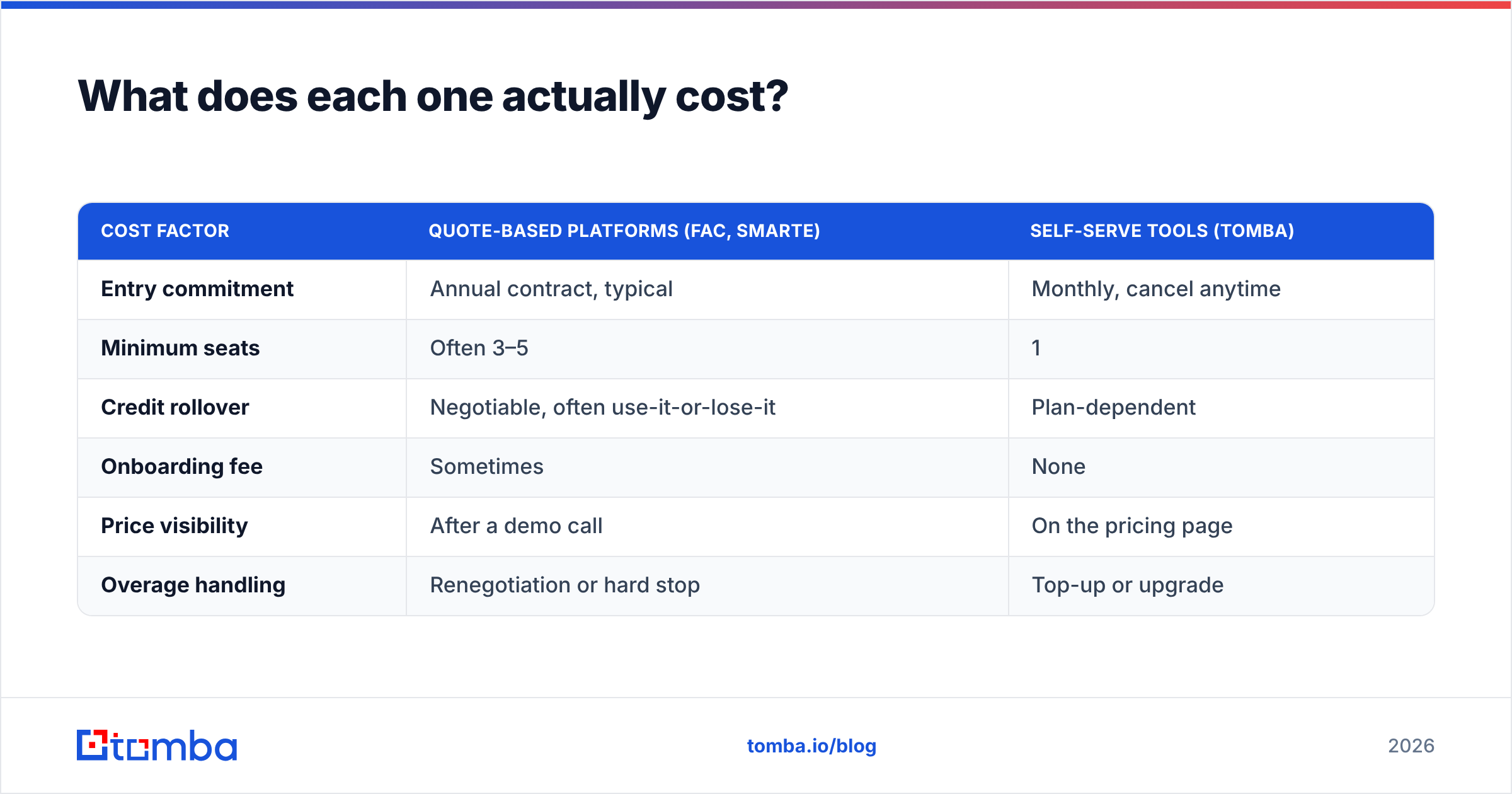
Neither vendor lists prices publicly, so treat any specific figure you see online as unverified. What you can plan around is the shape of the deal.
| Cost factor | Quote-based platforms (Fac, Smarte) | Self-serve tools (Tomba) |
|---|---|---|
| Entry commitment | Annual contract, typical | Monthly, cancel anytime |
| Minimum seats | Often 3–5 | 1 |
| Credit rollover | Negotiable, often use-it-or-lose-it | Plan-dependent |
| Onboarding fee | Sometimes | None |
| Price visibility | After a demo call | On the pricing page |
| Overage handling | Renegotiation or hard stop | Top-up or upgrade |
The hidden cost in quote-based data platforms is rarely the sticker price. It is the shelfware tax: you buy 50,000 credits because the annual tier made the per-credit math look good, then you burn 18,000 and let the rest expire. Two renewals later you are paying enterprise money for mid-market usage.
Run the arithmetic in cost-per-usable-contact, not cost-per-credit. A $12,000 annual contract that produces 6,000 contacts you actually email is $2 per contact. A $99/mo plan that produces 400 usable contacts a month is $0.25. The gap is usually that large, and it usually favors the transparent tool until you genuinely need intent data and enterprise CRM governance.
For reference on how peers price and rate these platforms, G2's sales intelligence category and Capterra's lead-generation listings both carry enough recent reviews to spot patterns in renewal complaints — which is where pricing pain surfaces first.
Is Fac Intelligence better than Smarte for outbound teams?#
It depends entirely on where your bottleneck is. Four scenarios cover most teams:
- You sell into North America, SMB to mid-market, and need volume. Fac Intelligence's narrower scope is an advantage — you are not paying for intent data you will never open. Pair it with a verifier and a sequencer and you have a complete stack for less.
- You sell internationally, especially EMEA or APAC. Smarte's compliance posture and regional coverage are the stronger fit. GDPR-sourced EU records are genuinely hard to build, and this is where thin databases show their seams.
- You have a RevOps function and a Salesforce instance you care about. Smarte again. Native CRM enrichment and dedupe rules save more hours than a slightly better match rate.
- You are a founder, agency, or two-person GTM team. Neither. A quote-based annual contract is the wrong instrument for your stage. Start with a self-serve domain search and per-lookup pricing, and revisit platforms when your seat count justifies a procurement cycle.
Worth noting: this is not a two-horse race. BookYourData is a solid option if you prefer buying pre-built, pay-as-you-go lists with a bounce guarantee rather than running searches yourself — a genuinely different purchase model that suits teams who want data delivered, not discovered. Evaluate it alongside the other two rather than assuming the comparison is binary.

What do both tools miss that you still have to solve?#
Every contact database has the same three blind spots, and budgeting for them upfront prevents an expensive surprise in month three.
- Decay. B2B contact data goes stale at roughly 25–30% per year through job changes alone. Whatever you buy, you are renting accuracy, not owning it. Build a quarterly re-verification pass into your process.
- Catch-all domains. Large enterprises frequently accept all inbound addresses at the SMTP layer, so a "deliverable" flag is meaningless. You need a separate catch-all check or you will torch your sender reputation sending to addresses that silently vanish.
- The last mile. Neither platform sends your email, warms your domain, or writes your sequence. Deliverability is a separate discipline — see the Wikipedia primer on sales intelligence for how narrow the "data" slice of the funnel actually is.
The teams that get outbound working treat data as one component with a clear interface, not as a platform that owns the whole motion. That framing also makes vendor swaps painless — if your data source is an API call, replacing it is a config change, not a migration.
How should you structure your final decision?#
Score both vendors on five weighted criteria and let the spreadsheet decide rather than the demo:
- Accuracy on your ICP (40%) — from your own 200-contact bake-off, not the vendor deck.
- Cost per usable contact (25%) — total annual spend divided by contacts you actually emailed.
- Workflow fit (15%) — does it drop into your CRM and sequencer without a services engagement?
- Contract flexibility (10%) — can you leave in 12 months, or are you auto-renewing?
- Support and data-request turnaround (10%) — how fast do they fix a bad record?
If both vendors land within ten points of each other, buy the cheaper one on the shorter contract. A marginal accuracy advantage never survives contact with a real territory, and flexibility is worth more than a feature you have not used yet.
Where does Tomba fit in this comparison?#
Tomba is not trying to be a full sales-intelligence platform, and pretending otherwise would be dishonest. It does not sell intent data or run account scoring. What it does is the part every outbound stack needs regardless of which platform you sign: find the address, verify it, and get out of the way.
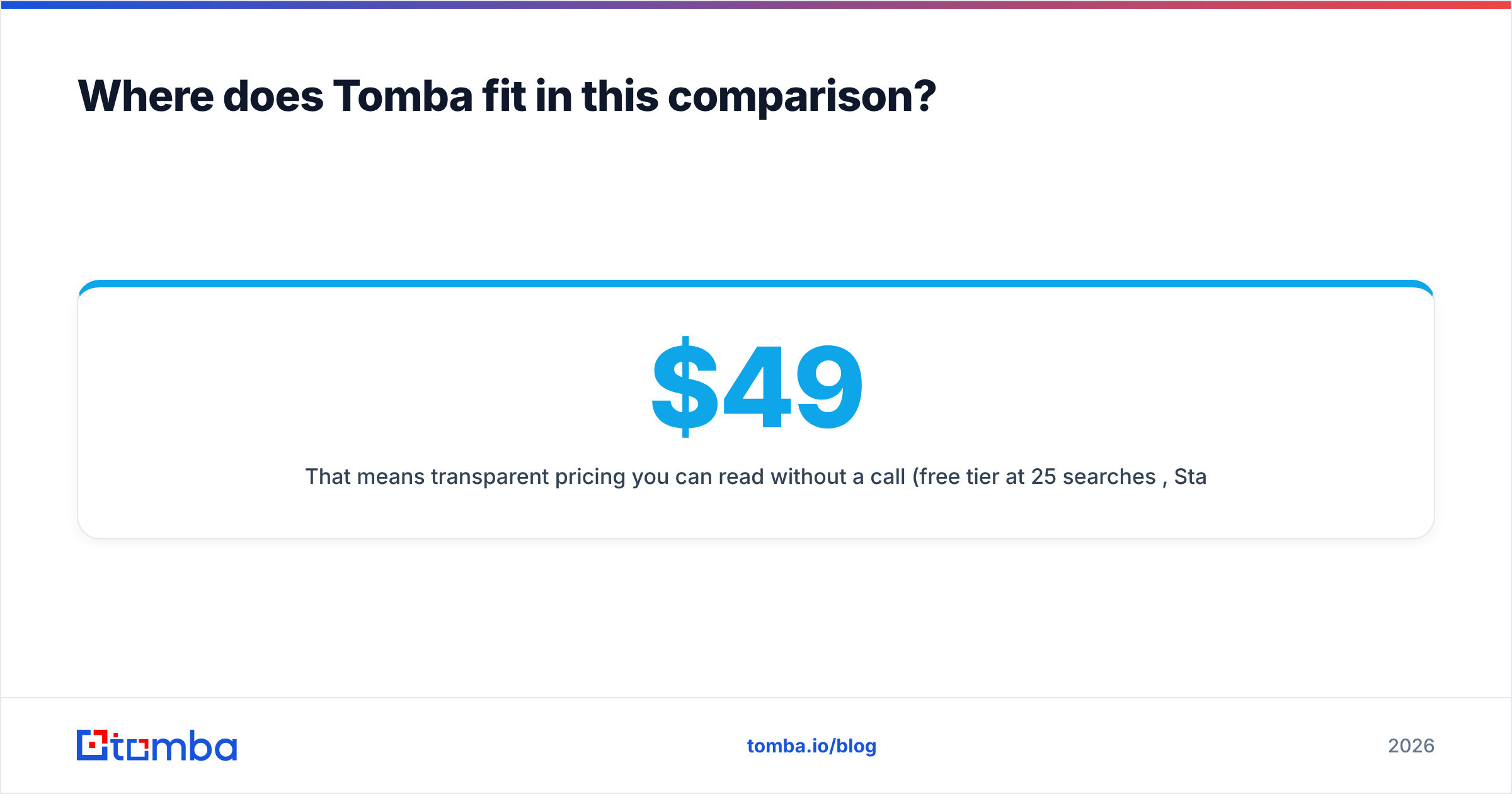
That means transparent pricing you can read without a call (free tier at 25 searches/mo, Starter at $49/mo, Growth at $99/mo, Pro at $249/mo), a clean email finder API with real SDKs, bulk lookups for list work, and a dedicated catch-all verifier for the domains that break other tools. Plenty of teams run Smarte for account intelligence and Tomba for last-mile contact resolution — the two are complements, not substitutes.
Start with the free tier of the Tomba Email Finder. Run the same 200-contact bake-off you are running against Fac Intelligence and Smarte, compare cost per usable contact across all three, and let the numbers pick your stack. Twenty-five free searches is enough to know whether you need an annual contract at all.
Related guides#
Ready to find emails that actually work?
Join 150,000+ professionals who stopped guessing and started sending. Free credits on signup — no credit card required.
Get the Tomba newsletter
Practical outbound tactics and product updates — once every two weeks.
About the author