7 Best Fibbler Alternatives in 2026 for B2B Email Finding
Fibbler is thin on public documentation and hard to benchmark. Here are seven email-finding alternatives compared on accuracy, verification depth, pricing, and API access — with a clear pick for each buying situation.
TL;DR
- Fibbler has almost no public benchmark data, no widely cited accuracy numbers, and a thin third-party review footprint — which is the real reason most teams start shopping for Fibbler alternatives.
- The only two metrics that matter when you switch: verified-hit rate (how many of your target contacts come back with a deliverable address) and cost per usable contact — not the headline credit price.
- Best all-round replacement for most B2B teams: Tomba — free tier, $49/mo Starter, native verification, and a documented API.
- Best for pre-built, human-verified lists: BookYourData. Best for all-in-one prospecting + sequencing: Apollo. Best for pure list hygiene: ZeroBounce or Clearout.
- Never migrate on a feature grid alone. Run the same 100-row test list through two or three finalists and compare bounce rates before you commit a year of budget.
Why are people looking for Fibbler alternatives?#
Because they can't verify the claims.
Most email-finding tools live or die on one number: how often the address they return actually accepts mail. Established vendors publish that number, get audited by review platforms, and expose an API you can test before you pay. Fibbler is difficult to evaluate on any of those axes — public documentation is sparse, independent reviews on platforms like G2 are limited, and there is no widely circulated third-party accuracy benchmark to check against.
That is not automatically a verdict on the product. Small tools can be excellent. But it does mean the burden of proof falls entirely on you, and that changes the buying math. When you cannot verify a vendor's data quality externally, you have to run your own test — and once you're running your own test, you may as well test three or four tools at once.
The other trigger is more practical. Teams outgrow lightweight finders in a predictable order:
- You start needing verification, not just discovery. A found address and a deliverable address are different things. Once you're sending more than a few hundred emails a month, unverified data starts damaging your sender reputation.
- You start needing bulk. Finding one email in a browser tab is fine. Finding 4,000 for a campaign requires CSV upload, dedupe, and a queue.
- You start needing an API. The moment your CRM, enrichment workflow, or internal tool needs contacts on demand, a UI-only product becomes a bottleneck.
- You start needing coverage outside the US. Many finders are heavily indexed on North American SaaS. EMEA and APAC hit rates fall off a cliff.
- You start needing a paper trail. GDPR and CCPA questions arrive from legal, and "where did this data come from?" needs a real answer.
What should you actually compare when evaluating email finders?#
Ignore credit counts for a moment. Compare these six things.
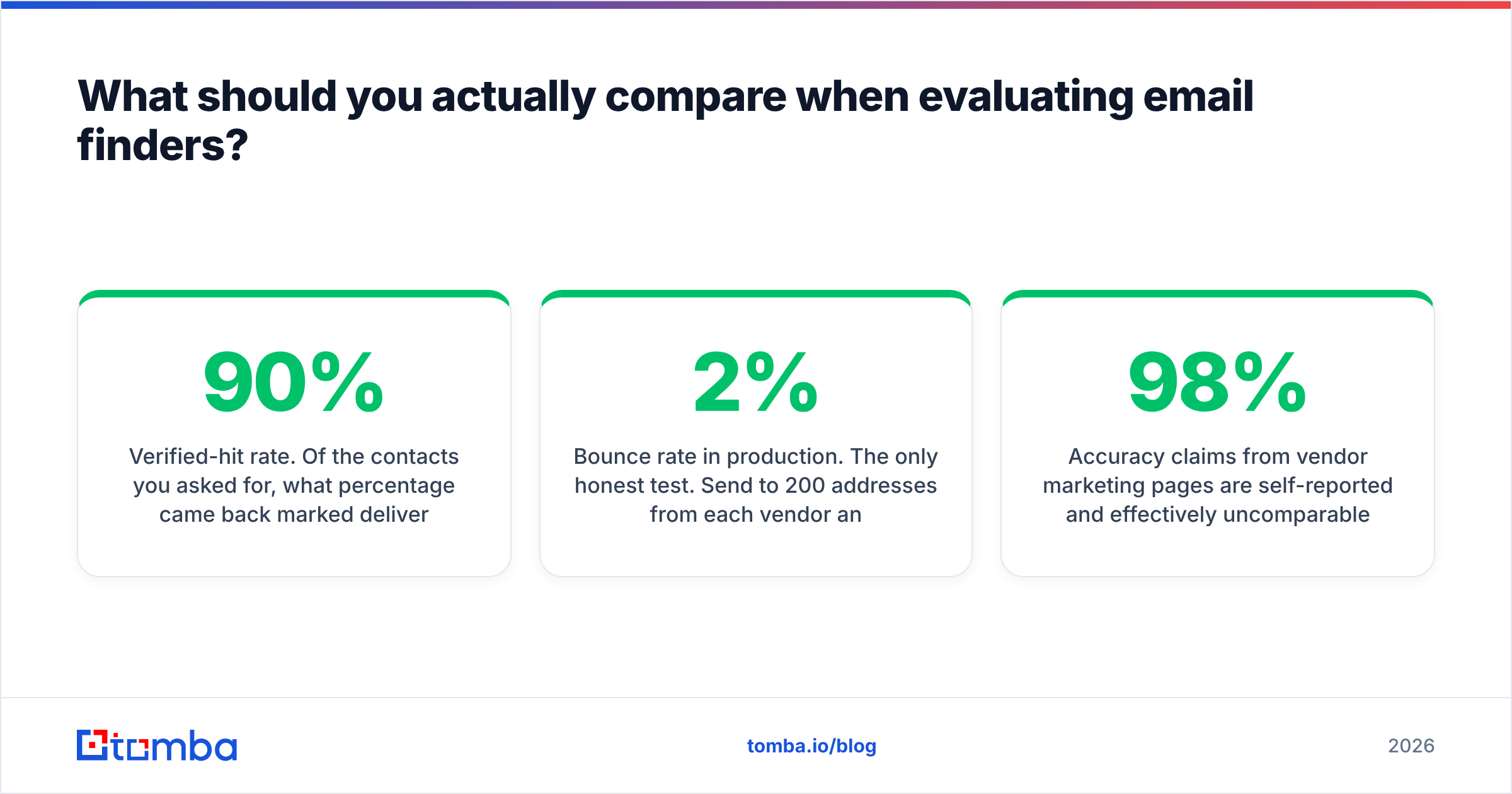
- Verified-hit rate. Of the contacts you asked for, what percentage came back marked deliverable? A tool that returns 90% of addresses but only 50% verified is worse than one returning 65% all-verified.
- Bounce rate in production. The only honest test. Send to 200 addresses from each vendor and count hard bounces. Under 2% is good, under 1% is excellent.
- Catch-all handling. Roughly a third of B2B domains are catch-all, meaning the mail server accepts everything and verification via SMTP ping is meaningless. Tools that silently mark catch-alls as "valid" are inflating their own numbers. A dedicated catch-all verifier is the honest approach.
- Cost per usable contact. Take the monthly price, divide by the number of contacts that actually pass verification. This number frequently reorders the whole shortlist.
- API and automation surface. REST API, rate limits, SDKs, spreadsheet add-ons, native CRM connectors. If you're going to automate, this matters more than the UI.
- Data provenance. Where the records come from, how often they're refreshed, and whether the vendor documents it.

Accuracy claims from vendor marketing pages are self-reported and effectively uncomparable. A 98% figure measured on 500 US tech companies means nothing for your list of German logistics firms. Treat published accuracy as a starting hypothesis, then test it against your own ICP.
Which Fibbler alternatives are worth shortlisting in 2026?#
Seven tools cover the realistic range of needs, from solo founder to RevOps team.
1. Tomba — best all-round replacement#
Tomba is the closest like-for-like swap for a general-purpose email finder, with the difference that verification is built into the same platform rather than bolted on. The email finder handles name-plus-domain lookups, domain search pulls every discoverable address at a company, and the email verifier checks deliverability before you export.
Pricing is transparent: a free tier with 25 searches/month, Starter at $49/mo, Growth at $99/mo, Pro at $249/mo, and custom Enterprise. Full Tomba pricing is public, and every tier includes API access — which is unusual, since several competitors gate the API behind their top plan.
Strong for: teams that want find + verify + enrich in one place, developers who want a clean email finder API, and anyone who needs Sheets, Excel, or CRM integrations without extra middleware. Weaker for: teams that want sequencing and dialing in the same tool — Tomba is a data layer, not a sales engagement platform.
2. BookYourData — best for pre-built, verified lists#
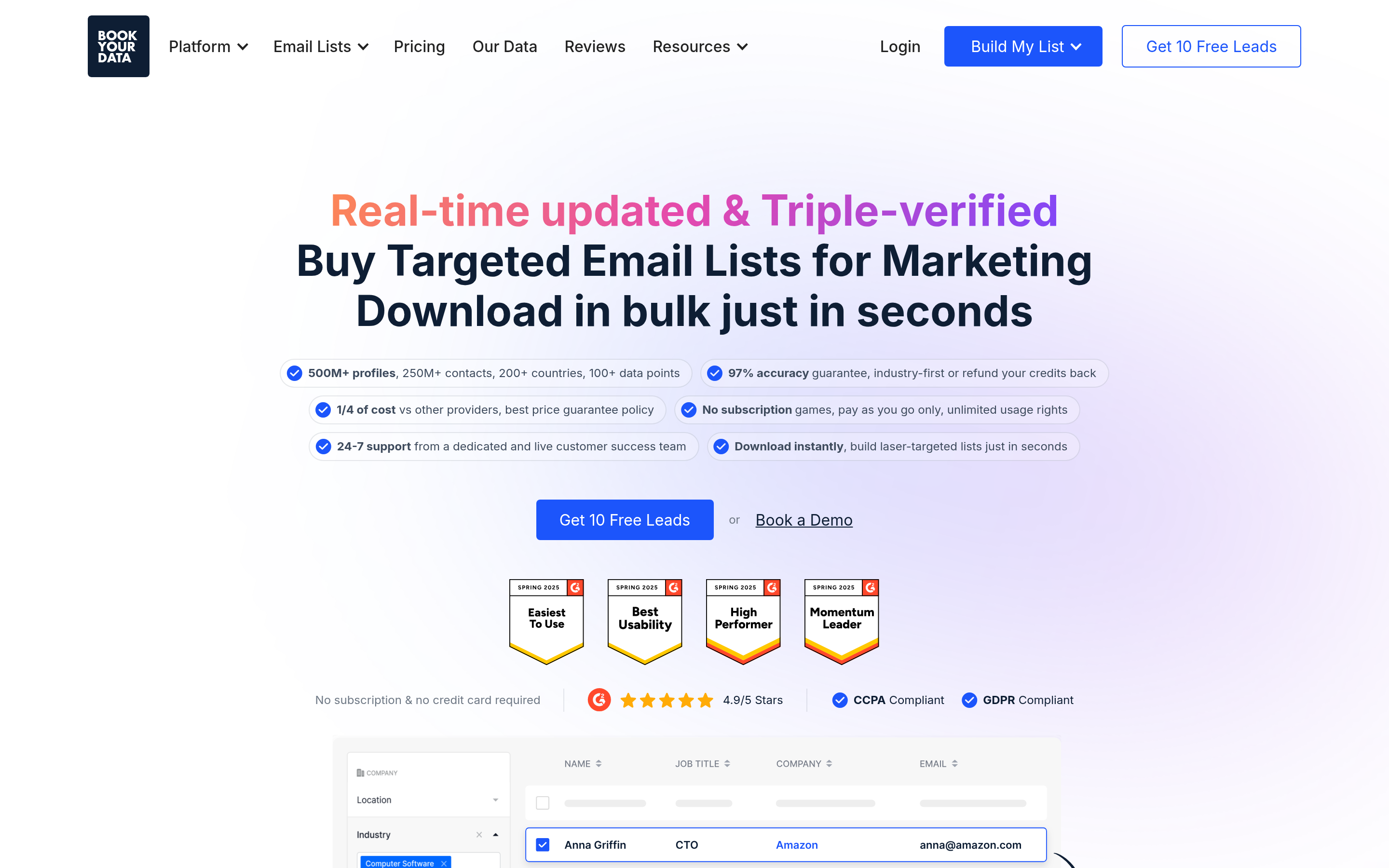
BookYourData takes a different route: instead of hunting contacts one at a time, you filter a large B2B database by industry, title, geography, and company size, then buy the segment outright. Records are verified before delivery, and the pay-as-you-go model means you're not locked into a subscription you underuse.
Strong for: campaigns where you know the segment precisely and want a clean list today rather than a scraping workflow. Also a good fit for agencies buying per-client. Weaker for: continuous, name-by-name enrichment inside a CRM workflow — that's a different job.
3. Apollo — best all-in-one prospecting platform#
Apollo bundles a contact database, sequencing, dialer, and basic CRM into one subscription. If your team is small enough that consolidating tools saves real money, that bundling is the pitch.
Strong for: SDR teams that want database and outreach under one login. Weaker for: data quality purists. Apollo's coverage is broad but community-contributed in parts, and many teams run an Apollo alternative alongside it purely for verification. Pricing also escalates quickly once you add seats.
4. Hunter — best for simple domain-level lookups#
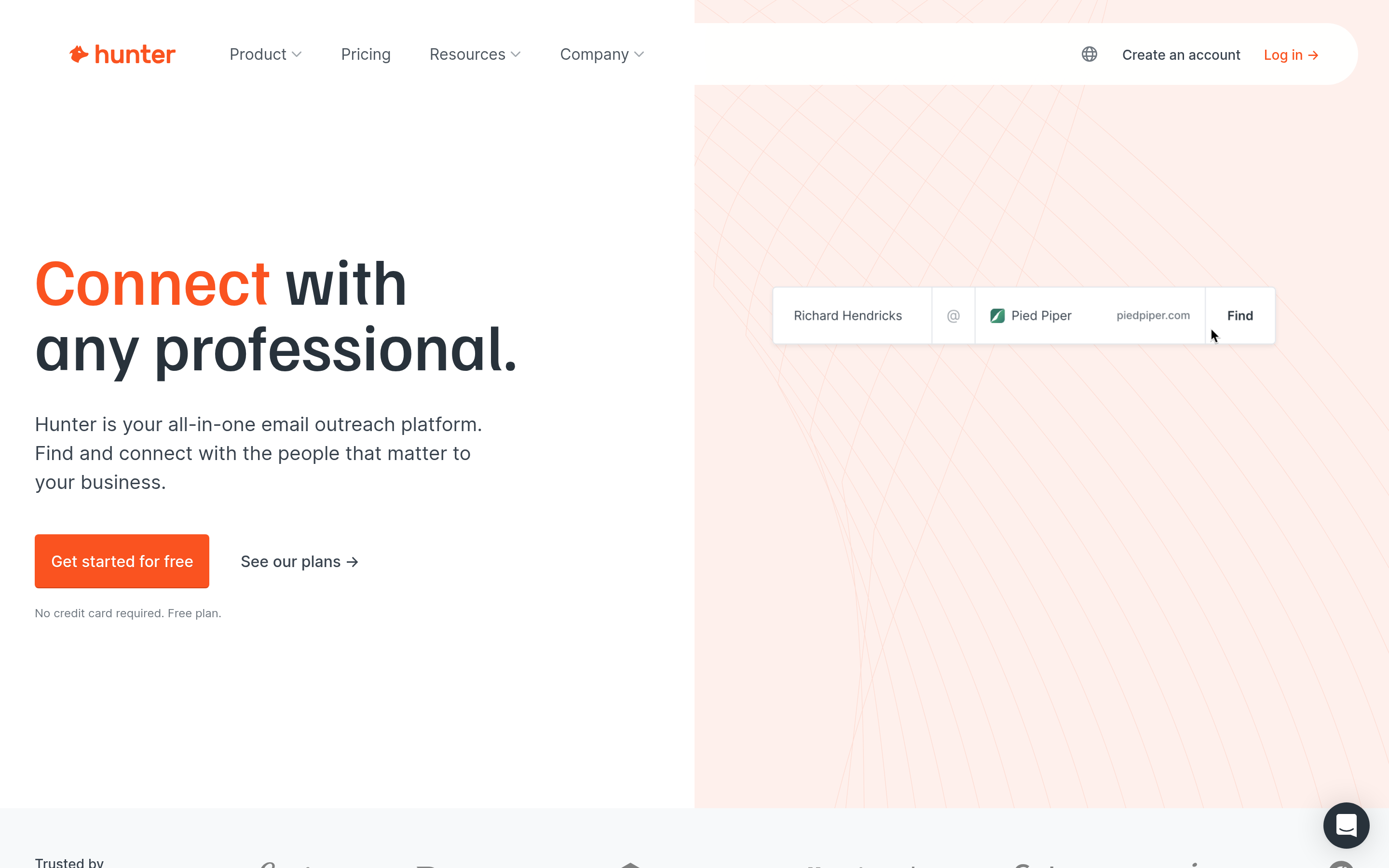
Hunter is the well-known name in this category, with a clean UI, a Chrome extension, and a straightforward domain search. It does one job predictably.
Strong for: founders and marketers doing light, occasional prospecting. Weaker for: high-volume operations. Credit costs add up, and enrichment depth beyond email is limited.
5. RocketReach — best for contact breadth beyond email#
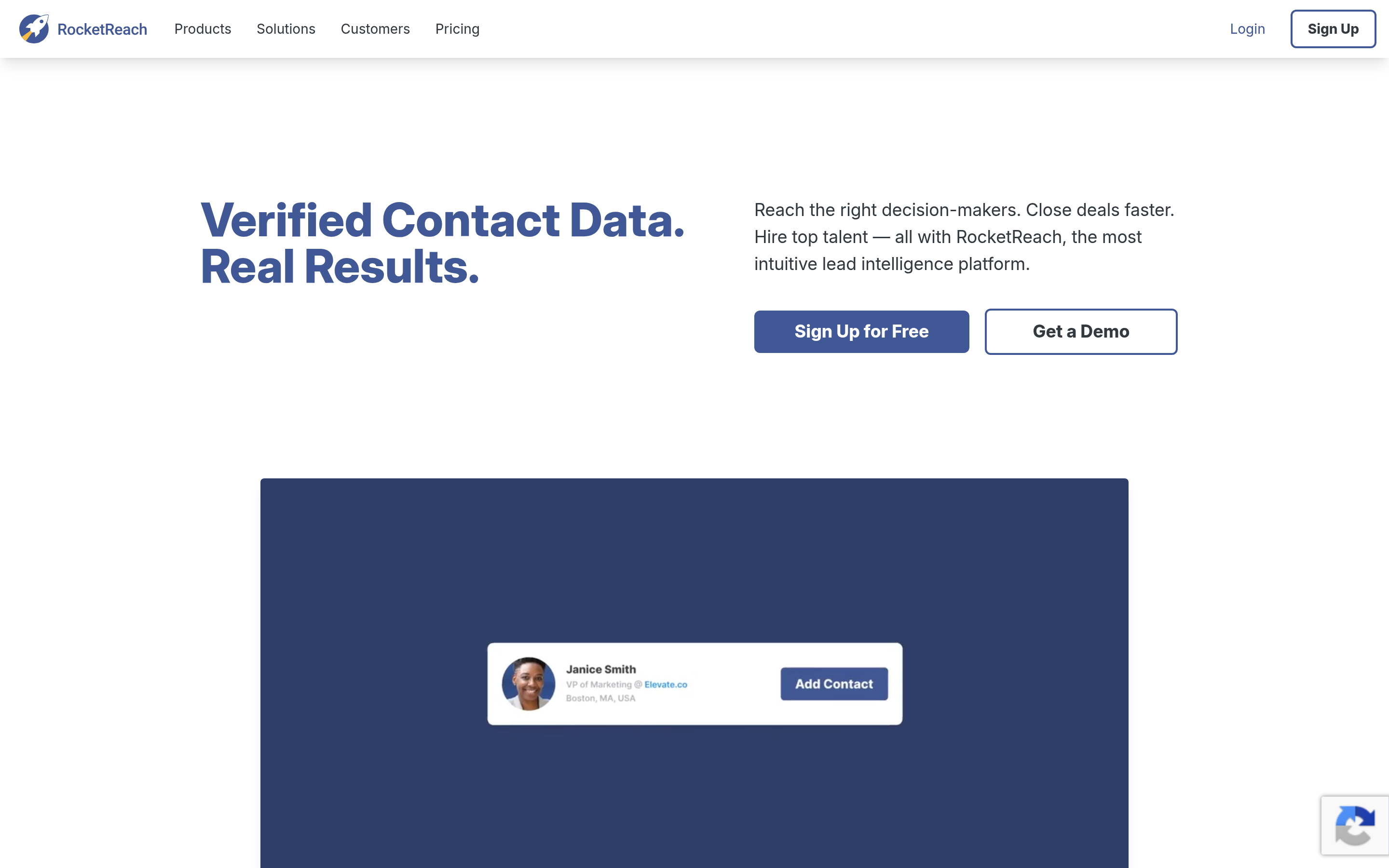
RocketReach leans into multi-channel: emails, phone numbers, and social profiles in a single record. Coverage of senior titles at larger companies is a genuine strength.
Strong for: recruiters and enterprise sellers who need a phone number as often as an email. Weaker for: budget-sensitive teams — per-lookup economics are on the expensive side, and a RocketReach alternative with a phone finder built in often costs less for the same output.
6. Findymail — best for lower bounce rates on niche lists#
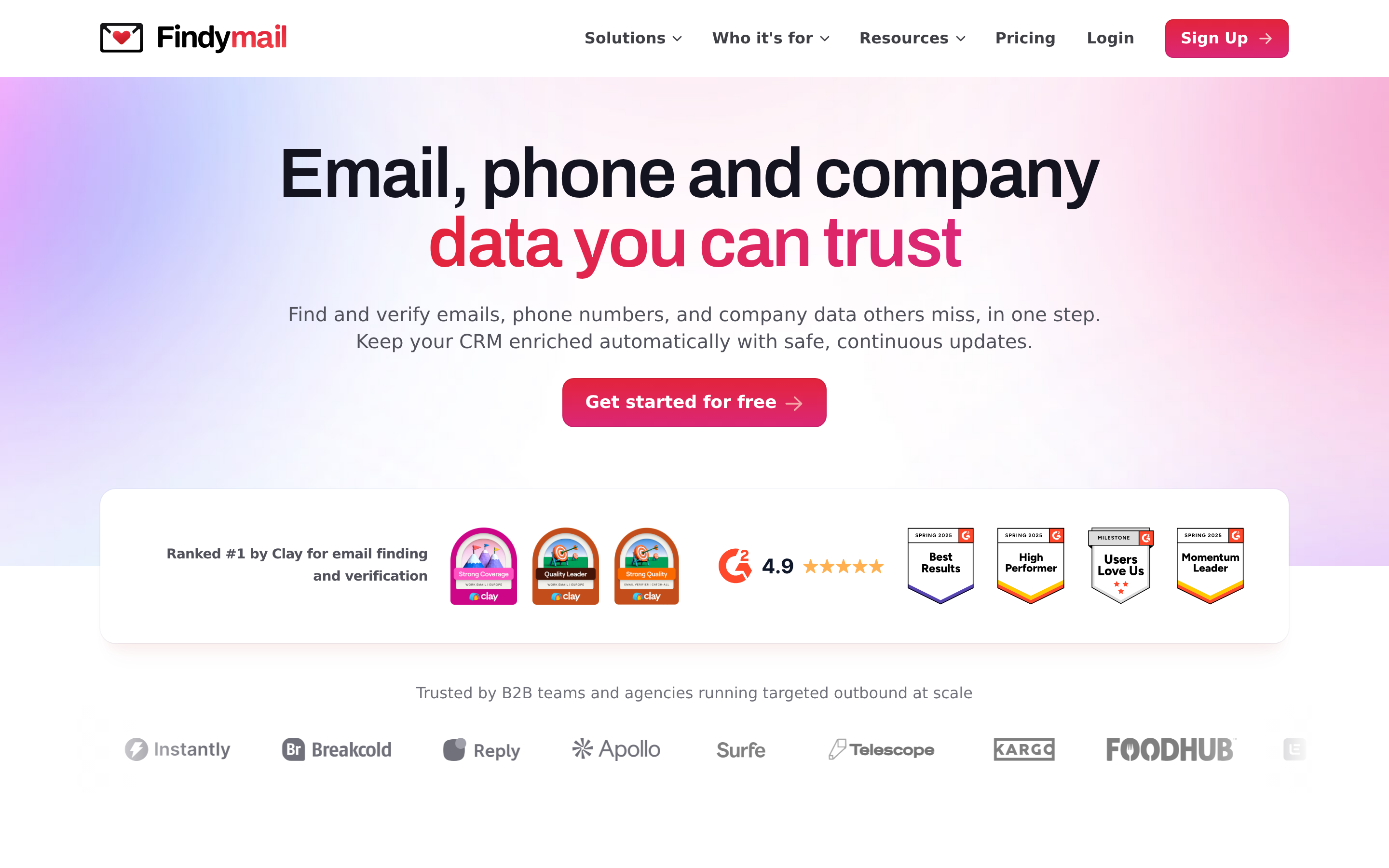
Findymail's positioning is a hard bounce guarantee and refunds on invalid data. That focus tends to produce smaller result sets with higher confidence.
Strong for: agencies where a bounce is a client-facing problem. Weaker for: discovery volume — you'll find fewer contacts overall.
7. ZeroBounce or Clearout — best for verification only#
Neither is a finder. Both are hygiene layers for a list you already have. If your actual problem is "my bounce rate is 7%" rather than "I can't find contacts," start here instead of buying another database.
Strong for: cleaning imported lists, CRM hygiene projects, re-permissioning old data. Weaker for: net-new prospecting — you have to source the addresses somewhere else first.
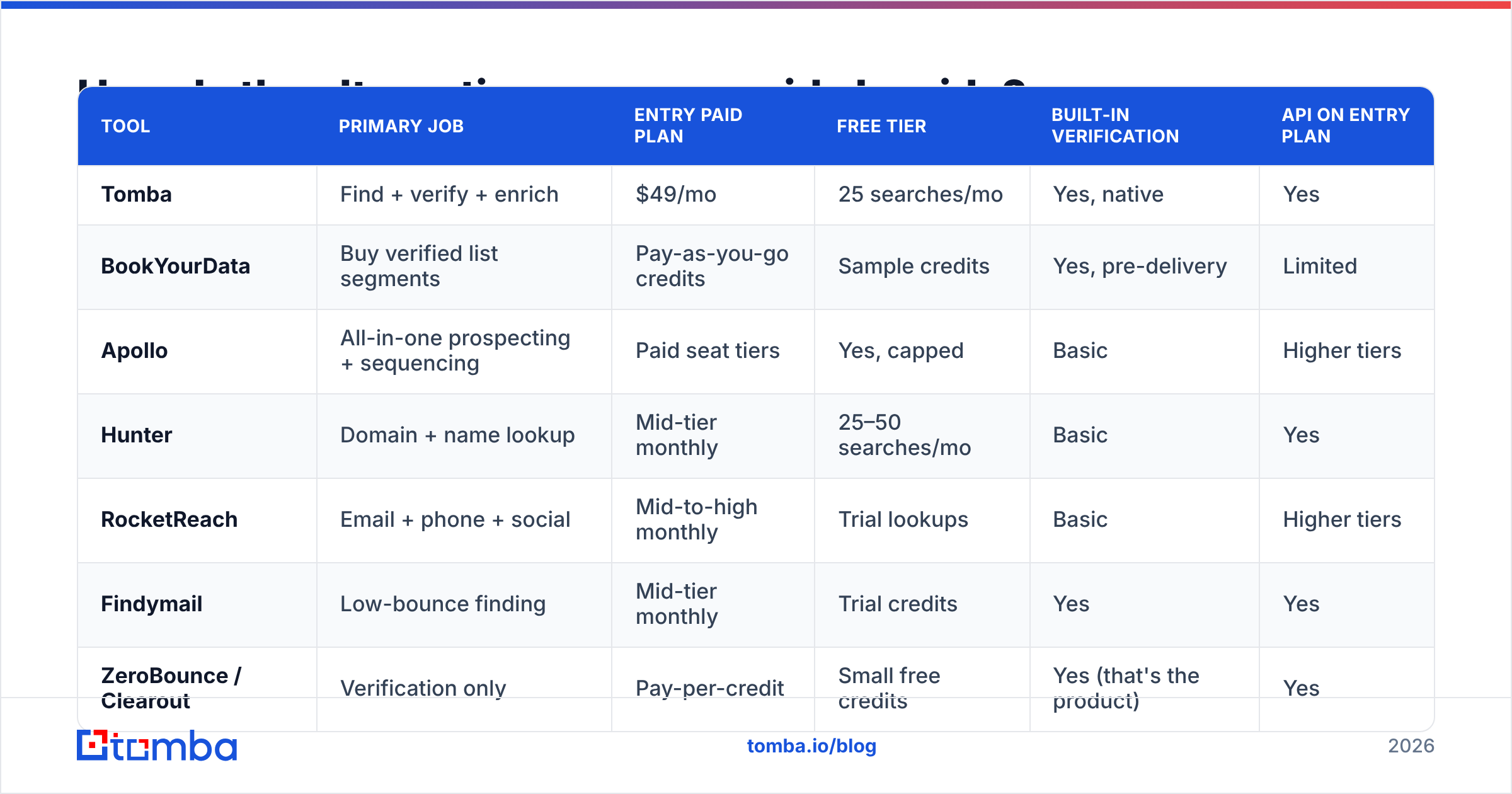
How do the alternatives compare side by side?#
| Tool | Primary job | Entry paid plan | Free tier | Built-in verification | API on entry plan |
|---|---|---|---|---|---|
| Tomba | Find + verify + enrich | $49/mo | 25 searches/mo | Yes, native | Yes |
| BookYourData | Buy verified list segments | Pay-as-you-go credits | Sample credits | Yes, pre-delivery | Limited |
| Apollo | All-in-one prospecting + sequencing | Paid seat tiers | Yes, capped | Basic | Higher tiers |
| Hunter | Domain + name lookup | Mid-tier monthly | 25–50 searches/mo | Basic | Yes |
| RocketReach | Email + phone + social | Mid-to-high monthly | Trial lookups | Basic | Higher tiers |
| Findymail | Low-bounce finding | Mid-tier monthly | Trial credits | Yes | Yes |
| ZeroBounce / Clearout | Verification only | Pay-per-credit | Small free credits | Yes (that's the product) | Yes |

Vendor list prices change often and regional pricing varies, so confirm current figures on each vendor's own pricing page before you budget. The Tomba figures above are exact and current; the others are bands, not quotes.
Is switching from Fibbler actually worth the migration cost?#
Only if one of three things is true.
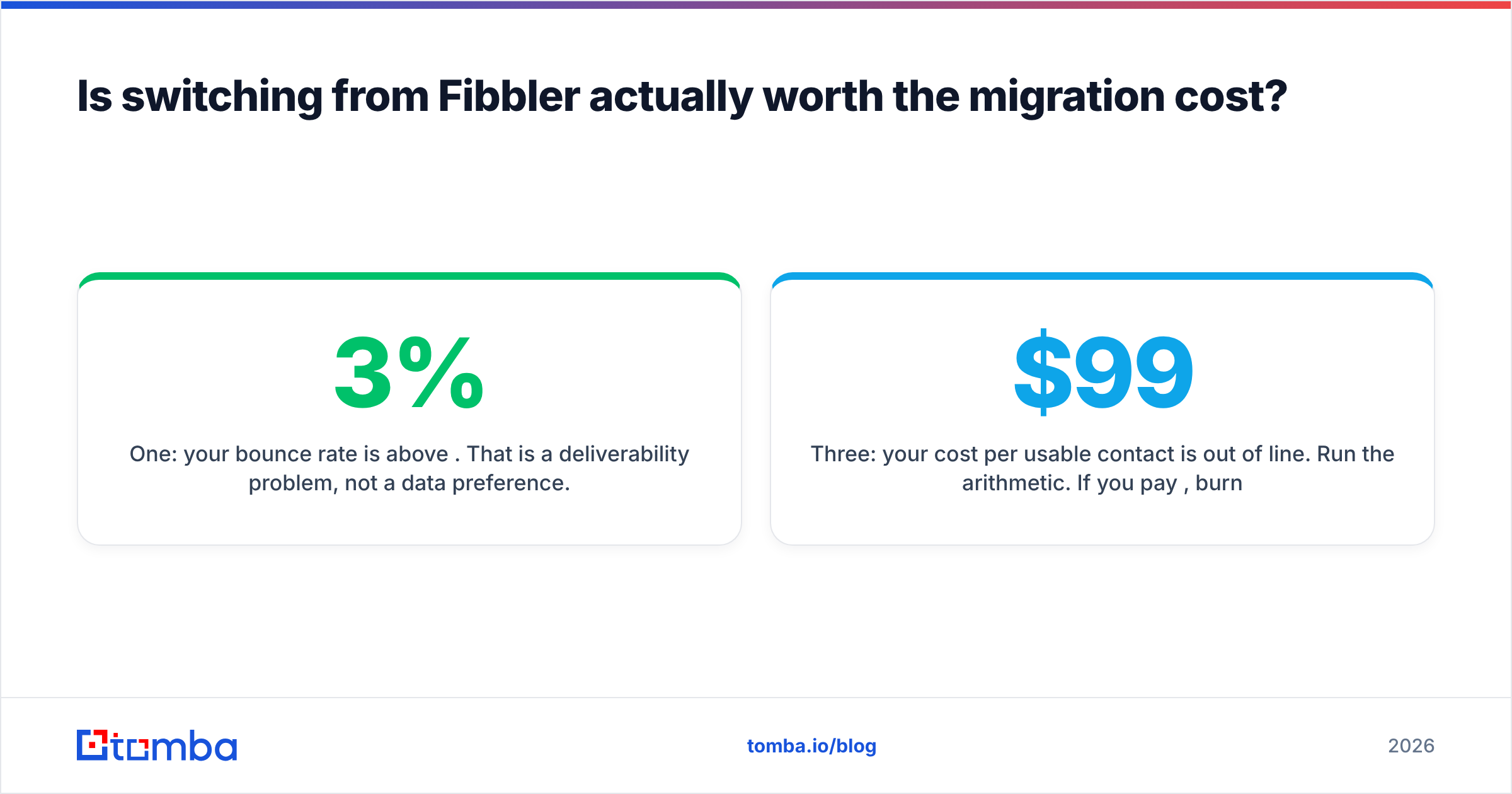
One: your bounce rate is above 3%. That is a deliverability problem, not a data preference. Mailbox providers read bounces as a spam signal, and Google and Microsoft both tightened bulk-sender enforcement in recent years — Google's own sender guidelines spell out the thresholds. At that point, switching to a tool with native verification pays for itself in reply rate alone. If you're not sure where you stand, check your domain's email deliverability fundamentals first — SPF, DKIM, and DMARC misconfiguration causes bounces that no data vendor can fix.
Two: you need automation your current tool can't do. A UI-only finder becomes a person-shaped bottleneck the moment you want contacts flowing into HubSpot or Salesforce automatically. Migrating to a tool with a real API and native integrations removes a recurring manual task, which compounds.
Three: your cost per usable contact is out of line. Run the arithmetic. If you pay $99/mo, burn 2,000 credits, and end up with 700 contacts that actually pass verification, that's roughly $0.14 per usable contact. Compare that number — not the credit price — across vendors.
If none of those apply, staying put is a legitimate answer. Tool churn has its own cost: retraining, re-integrating, re-mapping fields, and a month of degraded output while everyone adjusts.
How should you run a fair head-to-head test?#
Do this before signing anything. It takes about two hours.
- Build a 100-row control list. Real prospects from your actual ICP — company domain, first name, last name. Include a deliberate mix: 60 core-market accounts, 20 outside your primary geography, 20 at companies under 50 employees. That mix exposes coverage gaps that a clean US-SaaS-only list will hide.
- Run the identical list through each finalist's free tier. Most give you enough credits to cover 25–50 rows, which is sufficient for a signal. Use bulk upload where available so you're testing the workflow you'd actually use, not the demo path.
- Record three numbers per tool: rows returned, rows returned and marked verified, and rows flagged catch-all or risky. Do not merge the second and third.
- Spot-check 10 addresses manually. Cross-reference against LinkedIn, the company's team page, or a press release. This catches tools that generate plausible pattern guesses and label them as found.
- Send a small real campaign — 50 addresses per tool. Count hard bounces after 48 hours. This is the only number that reflects reality.
- Compute cost per usable contact and rank. The winner is frequently not the tool with the highest raw hit rate.
One caveat on step 5: keep the sends small and spaced out, especially on a newer domain. Testing data quality by torching your own sending reputation defeats the purpose.
What's the right pick for each situation?#
- Solo founder, low volume, tight budget — start on a free tier. Tomba's 25 searches/month or Hunter's free plan will cover early validation without a card.
- SDR team of 3–10 running steady outbound — Tomba Growth at $99/mo for data, paired with whatever sequencer you already use. Keep data and sending separate so you can swap either one without a full migration.
- Agency running campaigns for multiple clients — BookYourData for defined segment buys, plus a verification layer for anything sourced elsewhere. Per-client cost attribution stays clean.
- RevOps automating enrichment inside the CRM — API-first, every time. Check rate limits and webhook support before you look at anything else.
- Recruiting or enterprise sales needing phones — RocketReach, or a finder with an integrated phone lookup so you're not paying two subscriptions for one record.
Ready to test a Fibbler alternative properly?#
Stop comparing feature grids and start comparing bounce rates. Take your 100-row control list, run it through the Tomba Email Finder free tier — 25 searches, no card — and put the results next to whatever you're using now. Check the verified-hit rate, check the catch-all flags, then send a small test batch and count what actually lands.
If the numbers hold up, Starter is $49/mo with API access included from day one. If they don't, you've lost an afternoon and gained a benchmark you can use against every other vendor on this list. Either way you'll be deciding on evidence instead of a marketing page.
Related guides#
Ready to find emails that actually work?
Join 150,000+ professionals who stopped guessing and started sending. Free credits on signup — no credit card required.
Get the Tomba newsletter
Practical outbound tactics and product updates — once every two weeks.
About the author