FindEmails.com (Toofr) vs Warpleads: Which Wins in 2026?
FindEmails.com (formerly Toofr) is a veteran single-lookup email finder. Warpleads is a volume-first export machine. We compare accuracy, credit math, export limits and real cost per usable contact.
TL;DR
- FindEmails.com (formerly Toofr) is the older, simpler tool: paste a name and domain, get one email back, verified with a confidence score. Good for low-volume, high-intent lookups.
- Warpleads is built around the opposite promise: large exports from a prospect database plus bulk enrichment, aimed at teams sending thousands of cold emails a month.
- The two are not really substitutes. One optimises precision per lookup, the other optimises rows per dollar. Picking wrong is how you end up paying for 40,000 contacts you never email.
- Neither publishes an independently audited accuracy number. Run your own 200-lead bake-off before you commit to an annual plan — the method is at the end of this post.
- If you need both — accurate single lookups and bulk throughput on one API — a platform like Tomba Email Finder covers the middle ground at $49/mo Starter with a free tier to test first.
What are FindEmails.com and Warpleads?#
Think of these two as a locksmith versus a hardware wholesaler. The locksmith opens one specific door you already care about. The wholesaler ships you a pallet of locks and lets you sort out which fit.
FindEmails.com started life as Toofr, one of the earliest self-serve email finders, and still carries that DNA. You give it a first name, last name and company domain; it generates candidate permutations, tests them against mail servers and public sources, and returns the most likely address with a confidence score. The interface is deliberately plain. There is a CSV upload for batches, an API, and not much else. The rebrand to FindEmails.com kept the engine and dropped the odd name.
Warpleads is a newer entrant positioned around export volume. Its pitch is a large B2B contact database you can filter and export in bulk, combined with on-demand enrichment for lists you bring yourself. The mental model is closer to Apollo or a data broker than to a permutation-based finder: you're buying access to rows, not paying per successful guess.
That difference in architecture drives everything else — pricing shape, accuracy profile, and who each tool actually suits.
How do FindEmails.com and Warpleads differ structurally?#
Here's the split that matters more than any feature checklist:
- Discovery model — FindEmails.com is generative: it constructs likely addresses and validates them. Warpleads is retrieval-first: it looks up records that already exist in its database, then enriches gaps.
- Failure mode — A generative finder fails by returning nothing (or a low-confidence guess) for obscure domains. A database tool fails by returning a stale record that looked fine six months ago.
- Unit of cost — FindEmails charges around the successful lookup. Warpleads charges around the exported row, which makes per-lead cost look dramatically lower at volume.
- Coverage skew — Permutation engines do relatively well on small companies with predictable patterns (
first@,first.last@). Databases skew toward mid-market and enterprise where more people have been scraped, job-boarded and conference-listed. - Refresh cadence — This is the quiet one. Ask both vendors how often a record is re-verified. A database that refreshes annually is a liability in a market where roughly a fifth of B2B contacts change roles each year.
Which one actually returns valid emails?#
Neither vendor publishes a third-party audit, so treat every marketing number — theirs, everyone's — as a claim rather than a measurement.
What you can reason about is shape. Permutation-and-verify tools like FindEmails.com tend to report high accuracy because they only return what passed SMTP validation; the honest cost is a lower hit rate, since anything unverifiable comes back empty. Database-export tools tend to report high hit rates because almost every row comes back populated; the honest cost is that "populated" and "deliverable" are different things.

The practical consequence: with a bulk export, always run the list through an independent email verifier before it touches your sending domain. A 6% bounce rate on a 10,000-contact export is 600 hard bounces, which is more than enough to trip Google and Microsoft's spam thresholds and drag your whole domain's reputation down.
Two things distort accuracy comparisons and you should control for both:
- Catch-all domains. Any provider can "verify" an address at a catch-all domain because the server accepts everything. Whether the mailbox exists is a separate question — which is why catch-all verification is a distinct product category.
- Role accounts.
info@,sales@,support@are technically valid and commercially useless for one-to-one outbound. Some tools count them toward hit rate. Exclude them from your test set.

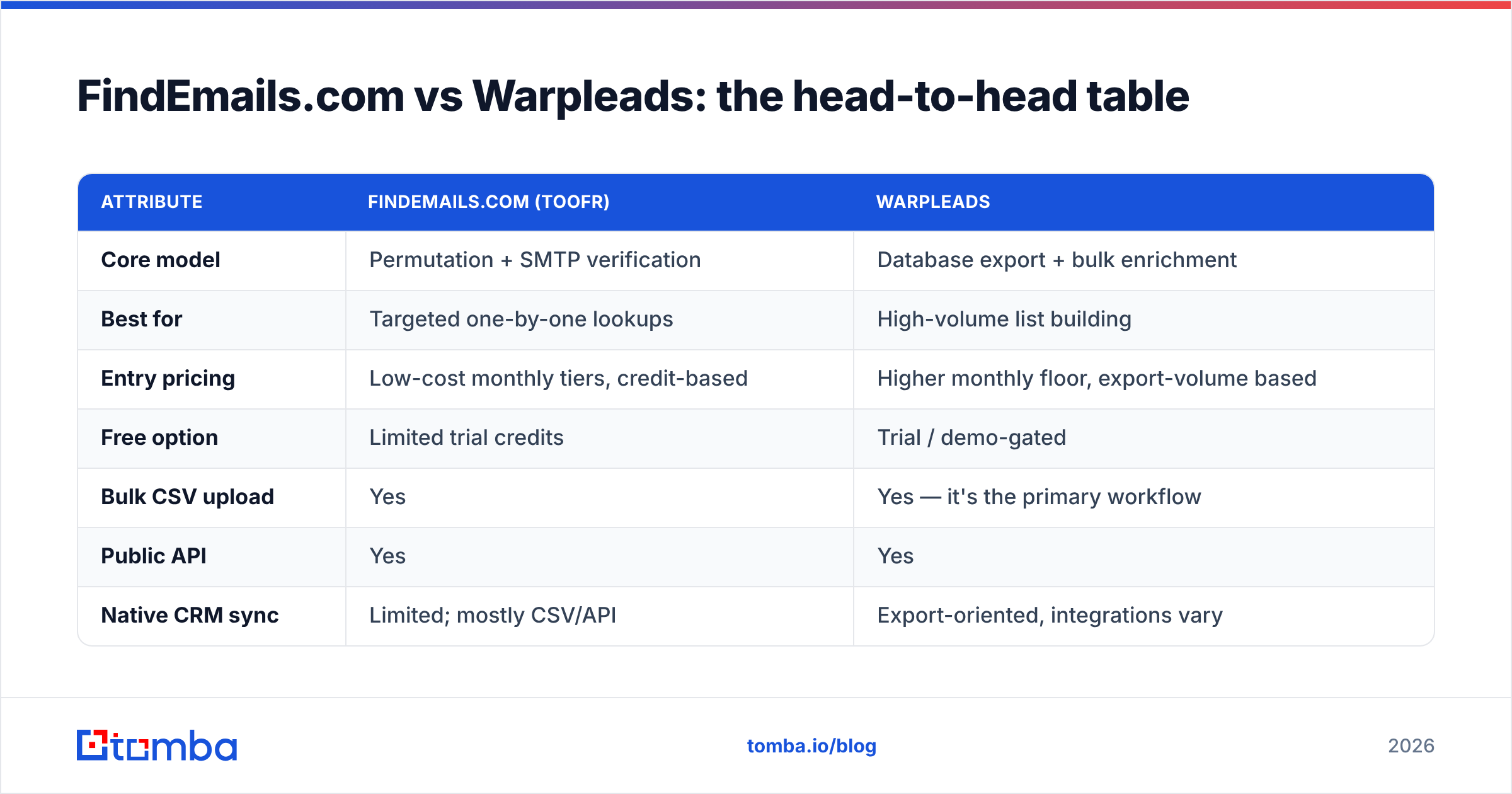
FindEmails.com vs Warpleads: the head-to-head table#
Pricing and limits change frequently on both products — check the vendors' own pages before you buy. This reflects the publicly advertised shape of each offer at the time of writing.
| Attribute | FindEmails.com (Toofr) | Warpleads |
|---|---|---|
| Core model | Permutation + SMTP verification | Database export + bulk enrichment |
| Best for | Targeted one-by-one lookups | High-volume list building |
| Entry pricing | Low-cost monthly tiers, credit-based | Higher monthly floor, export-volume based |
| Free option | Limited trial credits | Trial / demo-gated |
| Bulk CSV upload | Yes | Yes — it's the primary workflow |
| Public API | Yes | Yes |
| Native CRM sync | Limited; mostly CSV/API | Export-oriented, integrations vary |
| Phone numbers | Not a core feature | Available on some plans |
| Verification included | Yes, built into the lookup | Enrichment-side; re-verify recommended |
| Typical buyer | Founder, solo AE, recruiter | SDR team, agency, high-volume outbound |

How should you compare the real cost per usable contact?#
Sticker price per lead is the most misleading number in this category. The metric that matters is cost per contact you actually email and that actually lands.
The formula:
Real CPL = (monthly cost) / (exported rows x hit rate x deliverability x ICP match)Work an example. Suppose a $99/mo plan gives you 10,000 exported rows. That reads as $0.0099 per lead. Now apply reality: 78% of rows have an email at all, 88% of those pass verification, and — the killer — only 30% genuinely match your ideal customer profile after you filter by seniority, geography and tech stack. You're at 2,059 usable contacts, or $0.048 each. Five times the sticker price, and that's before anyone writes a subject line.
Now run the same maths on a precision tool. If a $49/mo plan returns 1,000 verified lookups on names you hand-picked from LinkedIn, ICP match is close to 100% by construction. That's roughly $0.049 per usable contact — statistically indistinguishable from the "cheap" bulk option, with far less list hygiene work.
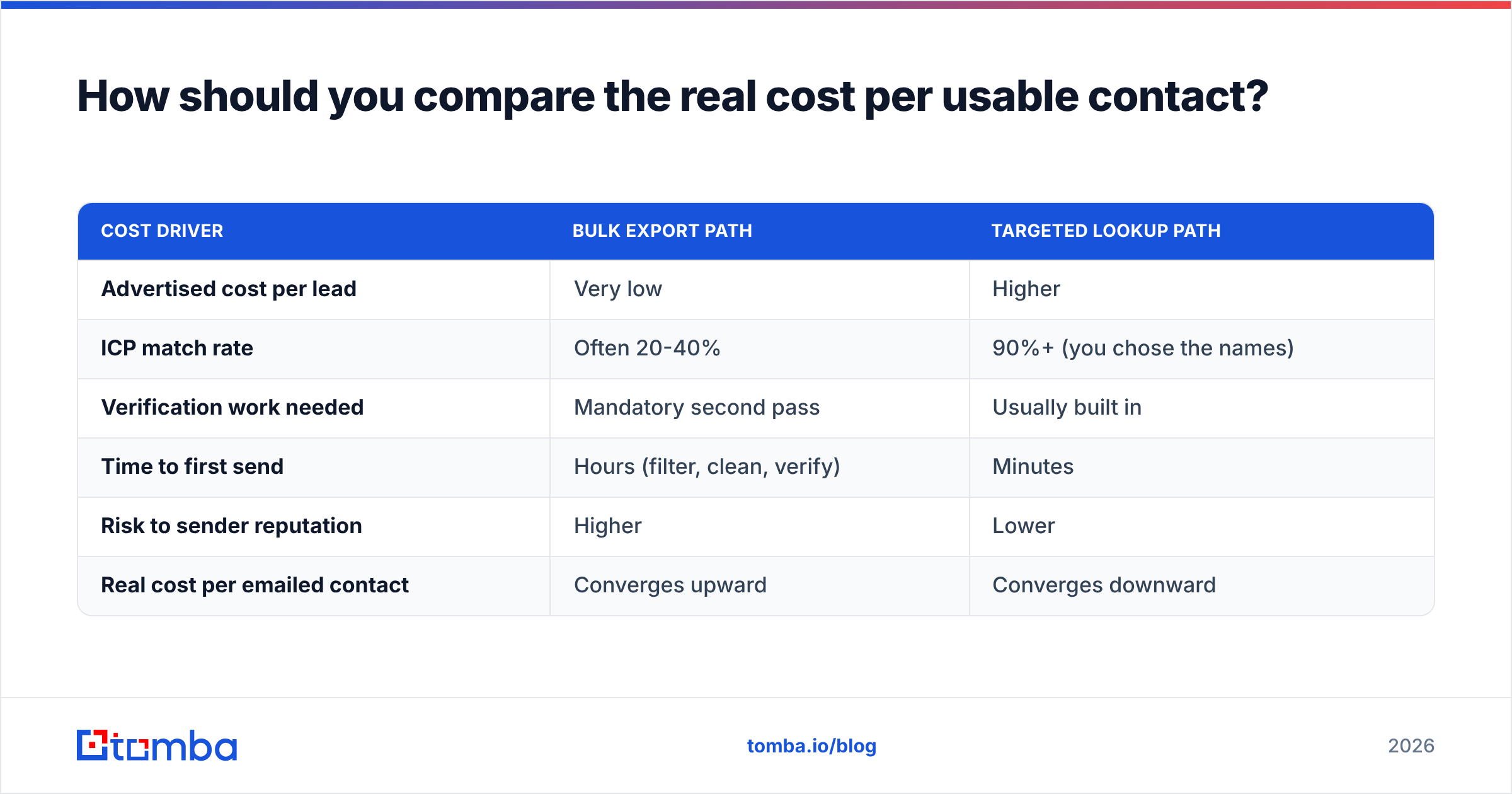
| Cost driver | Bulk export path | Targeted lookup path |
|---|---|---|
| Advertised cost per lead | Very low | Higher |
| ICP match rate | Often 20-40% | 90%+ (you chose the names) |
| Verification work needed | Mandatory second pass | Usually built in |
| Time to first send | Hours (filter, clean, verify) | Minutes |
| Risk to sender reputation | Higher | Lower |
| Real cost per emailed contact | Converges upward | Converges downward |
The conclusion isn't "bulk is bad." It's that bulk only wins when your ICP is genuinely broad — think horizontal SaaS selling to any company with 50+ employees. The narrower your ICP, the faster bulk economics collapse.
Who should choose FindEmails.com?#
Pick FindEmails.com (Toofr) if most of these describe you:
- You source names manually. You browse LinkedIn, conference speaker lists or podcast guests, then need the address for a specific human.
- Your list is under ~1,000 contacts a month. Below that volume, database access is overkill and you're paying for rows you'll never touch.
- You value a confidence score over a guaranteed row. An honest "we couldn't find this" beats a plausible-looking guess that bounces.
- You want minimal tooling. No sequencer, no CRM, no dashboard sprawl — a lookup box and an API key.
Where it disappoints: coverage on non-US and non-English-speaking companies is thinner, and the product hasn't evolved much in the way modern GTM stacks expect — no native visitor identification, thin enrichment, no MCP or agent-friendly tooling.
Who should choose Warpleads?#
Pick Warpleads if:
- You send at scale. Thousands of cold emails a month across multiple domains, where list volume is the binding constraint.
- You run an agency or lead-gen service. Predictable per-row cost across many client campaigns is the whole business model.
- Your ICP is broad enough that a filtered database export lands mostly on-target.
- You already own a verification step. Bulk exports without an independent verification pass are a deliverability accident waiting to happen.
Where it disappoints: if you need one specific person at one specific account — the classic ABM motion — a database is the wrong instrument. Either the record exists or it doesn't, and there's no permutation fallback to save you.
What alternatives should be on your shortlist?#
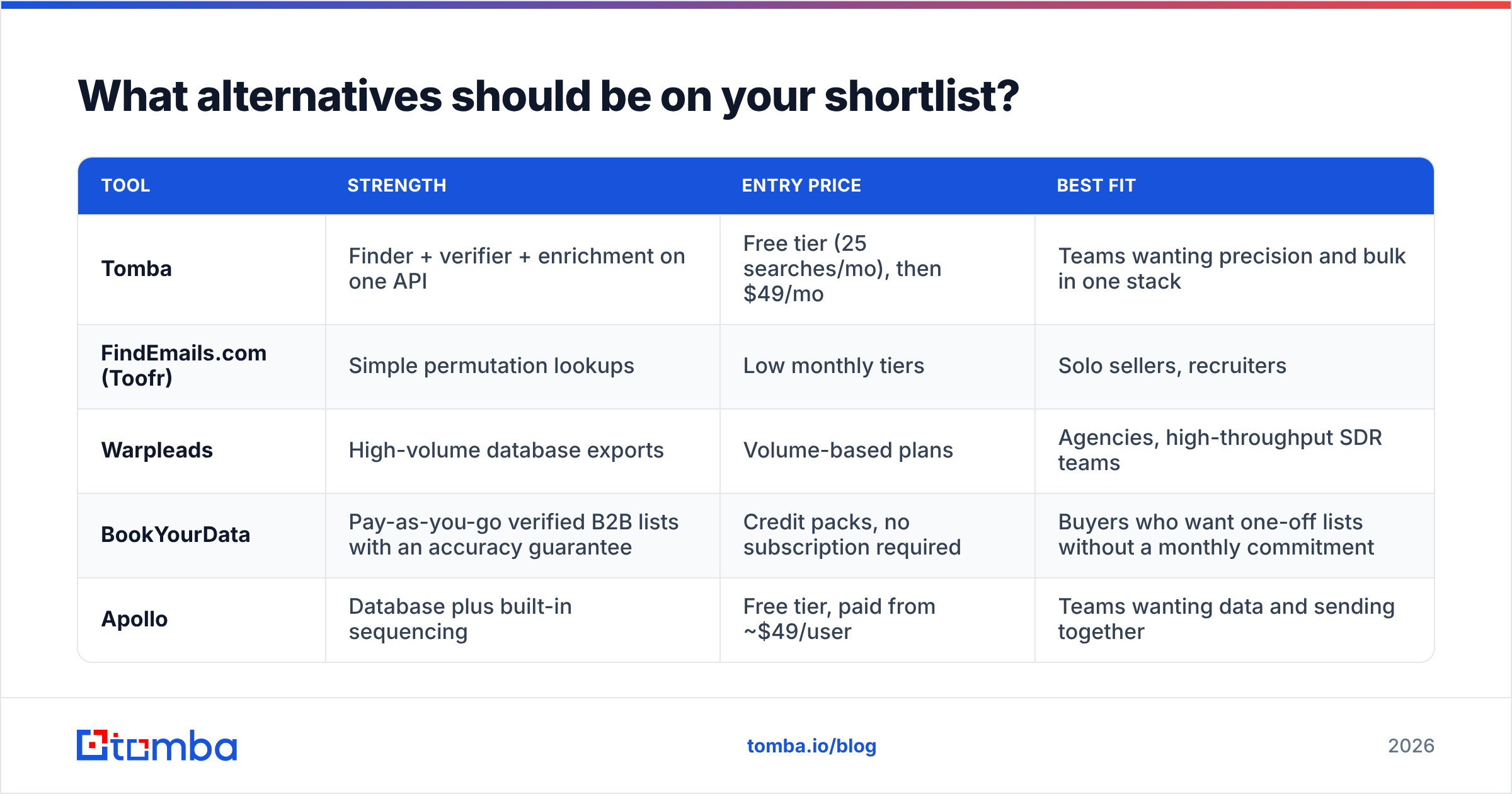
Both products sit in a crowded category. Before committing to either, it's worth testing at least one platform that spans both motions, and one specialist in whatever your weakest link is.
| Tool | Strength | Entry price | Best fit |
|---|---|---|---|
| Tomba | Finder + verifier + enrichment on one API | Free tier (25 searches/mo), then $49/mo | Teams wanting precision and bulk in one stack |
| FindEmails.com (Toofr) | Simple permutation lookups | Low monthly tiers | Solo sellers, recruiters |
| Warpleads | High-volume database exports | Volume-based plans | Agencies, high-throughput SDR teams |
| BookYourData | Pay-as-you-go verified B2B lists with an accuracy guarantee | Credit packs, no subscription required | Buyers who want one-off lists without a monthly commitment |
| Apollo | Database plus built-in sequencing | Free tier, paid from ~$49/user | Teams wanting data and sending together |
BookYourData deserves a specific mention if you dislike subscriptions — its pay-as-you-go credit model and stated accuracy guarantee make it a reasonable way to buy a single campaign's worth of contacts without a recurring commitment, which is a genuinely different purchase shape from either tool in this comparison. Apollo's own G2 reviews are a useful sanity check on how "database + sequencer" bundles actually perform in practice.
On the Tomba side, the relevant difference is architectural: the same account covers single lookups, domain search, bulk processing via bulk email finder, and verification — so you're not paying two vendors and reconciling two credit systems. Tomba pricing runs Free (25 searches/mo), Starter $49/mo, Growth $99/mo, Pro $249/mo, with Enterprise custom.
How do you run a fair 200-lead bake-off?#
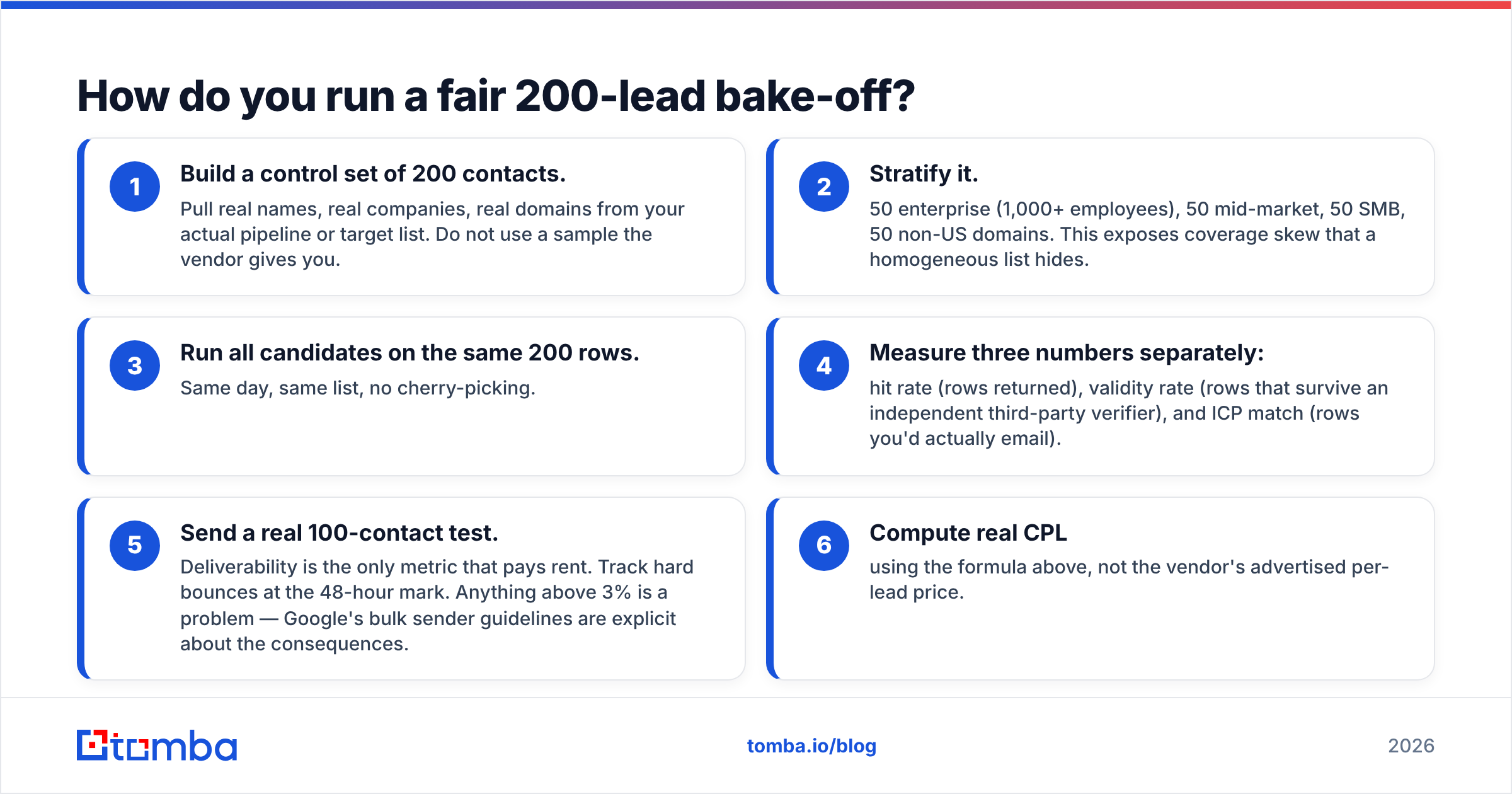
Do not decide this from a comparison post — including this one. Run the test. It takes about ninety minutes.
- Build a control set of 200 contacts. Pull real names, real companies, real domains from your actual pipeline or target list. Do not use a sample the vendor gives you.
- Stratify it. 50 enterprise (1,000+ employees), 50 mid-market, 50 SMB, 50 non-US domains. This exposes coverage skew that a homogeneous list hides.
- Run all candidates on the same 200 rows. Same day, same list, no cherry-picking.
- Measure three numbers separately: hit rate (rows returned), validity rate (rows that survive an independent third-party verifier), and ICP match (rows you'd actually email).
- Send a real 100-contact test. Deliverability is the only metric that pays rent. Track hard bounces at the 48-hour mark. Anything above 3% is a problem — Google's bulk sender guidelines are explicit about the consequences.
- Compute real CPL using the formula above, not the vendor's advertised per-lead price.
Score the results in a spreadsheet with those columns. In most bake-offs we've seen described publicly, no single tool wins every stratum — the enterprise winner and the SMB winner are usually different products, which is itself a useful finding. It often justifies a primary tool plus a fallback API call for misses.
The verdict#
FindEmails.com wins on precision-per-lookup for small, hand-picked lists. Warpleads wins on rows-per-dollar for broad, high-volume outbound. If you try to force either tool into the other's job, you'll conclude it's bad when it's simply mismatched.
The uncomfortable middle — you need both accurate single lookups and bulk throughput, on one bill, with one API — is where neither is a clean answer. That's the gap worth testing a consolidated platform against.
If that describes you, start with the Tomba Email Finder. The free tier gives you 25 searches a month, which is enough to run the 200-lead stratified test on a sample before spending anything, and the same key covers verification, domain search and bulk jobs through the Tomba API. Run your own numbers, keep whichever tool wins your stratum, and re-test in six months — this category moves fast enough that today's winner isn't automatically next year's.
Related guides#
Ready to find emails that actually work?
Join 150,000+ professionals who stopped guessing and started sending. Free credits on signup — no credit card required.
Get the Tomba newsletter
Practical outbound tactics and product updates — once every two weeks.
About the author