Finderio vs Goava (2026): Which Sales Data Tool Wins?
Finderio sells cheap email lookups inside a 500-app bundle. Goava sells Nordic sales intelligence with a quote-based contract. They solve different problems — here is which one actually fits your outbound motion, and when neither does.
Finderio vs Goava looks like a head-to-head fight. It is not. One tool finds email addresses. The other picks which companies to call. This Finderio vs Goava comparison covers what each one does, what they cost, and when a dedicated email finder beats both.
TL;DR
- Finderio (finder.io) is an email-finding tool inside the 500apps suite. It is cheap per seat. The data is broad but shallow. Best for solo founders and small teams who just need an address for a name and a domain.
- Goava is a Nordic sales intelligence platform. It tracks company signals, recommends accounts with AI, and syncs to your CRM. It is not an email finder. It is an account-picking engine for teams selling into Sweden, Norway, Denmark and Finland.
- The two rarely compete. Finderio answers "what is this person's email?" Goava answers "which company should I call this month?"
- Pricing works differently. Finderio is a low per-user bundle price. Goava is a quote-based annual contract. You cannot compare them line by line.
- Is your bottleneck verified contact data at volume, not account discovery? Then a dedicated finder with a real API and per-credit pricing (Tomba, Hunter, Findymail) beats both on cost per usable email.
Finderio vs Goava: what are these two tools?#
They are different categories wearing the same "prospecting tool" label.
Finderio — at finder.io — is the email discovery module in the 500apps ecosystem. Give it a name and a company domain. It returns a likely email address with a confidence score. It also handles bulk uploads and basic verification. The pitch is the bundle: you pay one per-user fee and get dozens of business apps. The email finder is one tile on that dashboard.
Goava — at goava.com — is a Swedish sales intelligence platform. It runs on Nordic company registries, financial filings and web signals. The core product tells a rep which accounts to work next. It scores them on company size, tech usage, hiring activity and financial health. It syncs into Upsales, HubSpot, Salesforce, Lime and SuperOffice, so reps never leave the CRM.
Put plainly: Finderio is a wrench. Goava is a map of the neighbourhood. Asking which one is better only makes sense once you know whether you are lost or your pipe is leaking.

Finderio vs Goava: feature by feature#
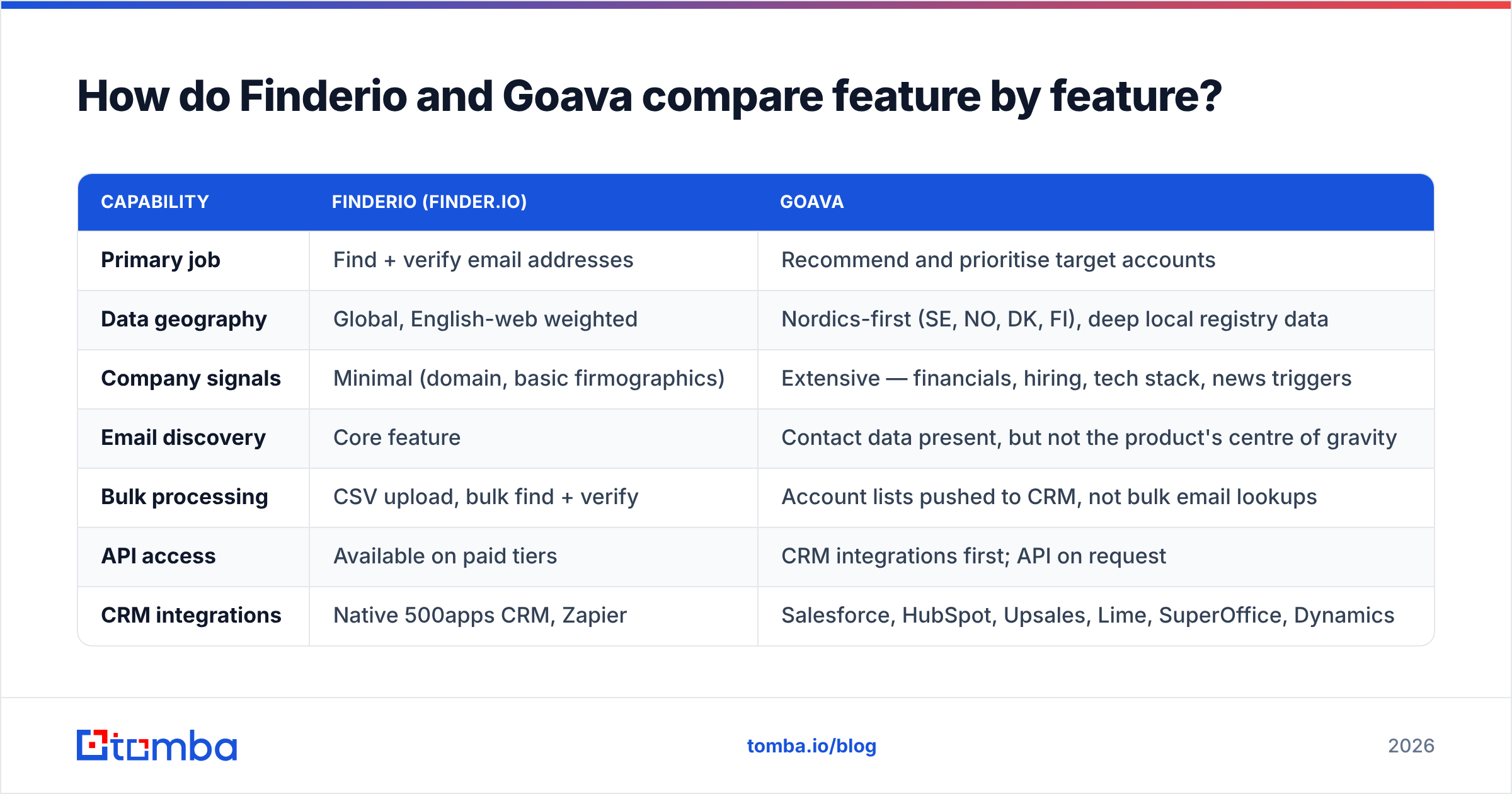
| Capability | Finderio (finder.io) | Goava |
|---|---|---|
| Primary job | Find + verify email addresses | Recommend and prioritise target accounts |
| Data geography | Global, English-web weighted | Nordics-first (SE, NO, DK, FI), deep local registry data |
| Company signals | Minimal (domain, basic firmographics) | Extensive — financials, hiring, tech stack, news triggers |
| Email discovery | Core feature | Contact data present, but not the product's centre of gravity |
| Bulk processing | CSV upload, bulk find + verify | Account lists pushed to CRM, not bulk email lookups |
| API access | Available on paid tiers | CRM integrations first; API on request |
| CRM integrations | Native 500apps CRM, Zapier | Salesforce, HubSpot, Upsales, Lime, SuperOffice, Dynamics |
| Pricing model | Low per-user bundle fee | Quote-based annual contract |
| Free option | Limited trial credits | Demo / trial by request |
| Best fit | Solo founders, small agencies, budget teams | Nordic mid-market and enterprise sales orgs |
Two things jump out of that table.
First, the overlap is thin. If you already know your accounts and just need addresses, Goava is an expensive fix. If you need to work out which 200 Swedish manufacturers are worth calling this quarter, Finderio has nothing to say.
Second, you buy them in different ways. Finderio is a self-serve credit card purchase. Goava is a demo, a scoping call and an annual commitment. That alone rules one of them out for most teams under ten people.
Which one gives you better data quality?#
It depends on what "data" means to you. This is where most comparison posts get lazy.
Here is the honest split. Ask any vendor these four questions:
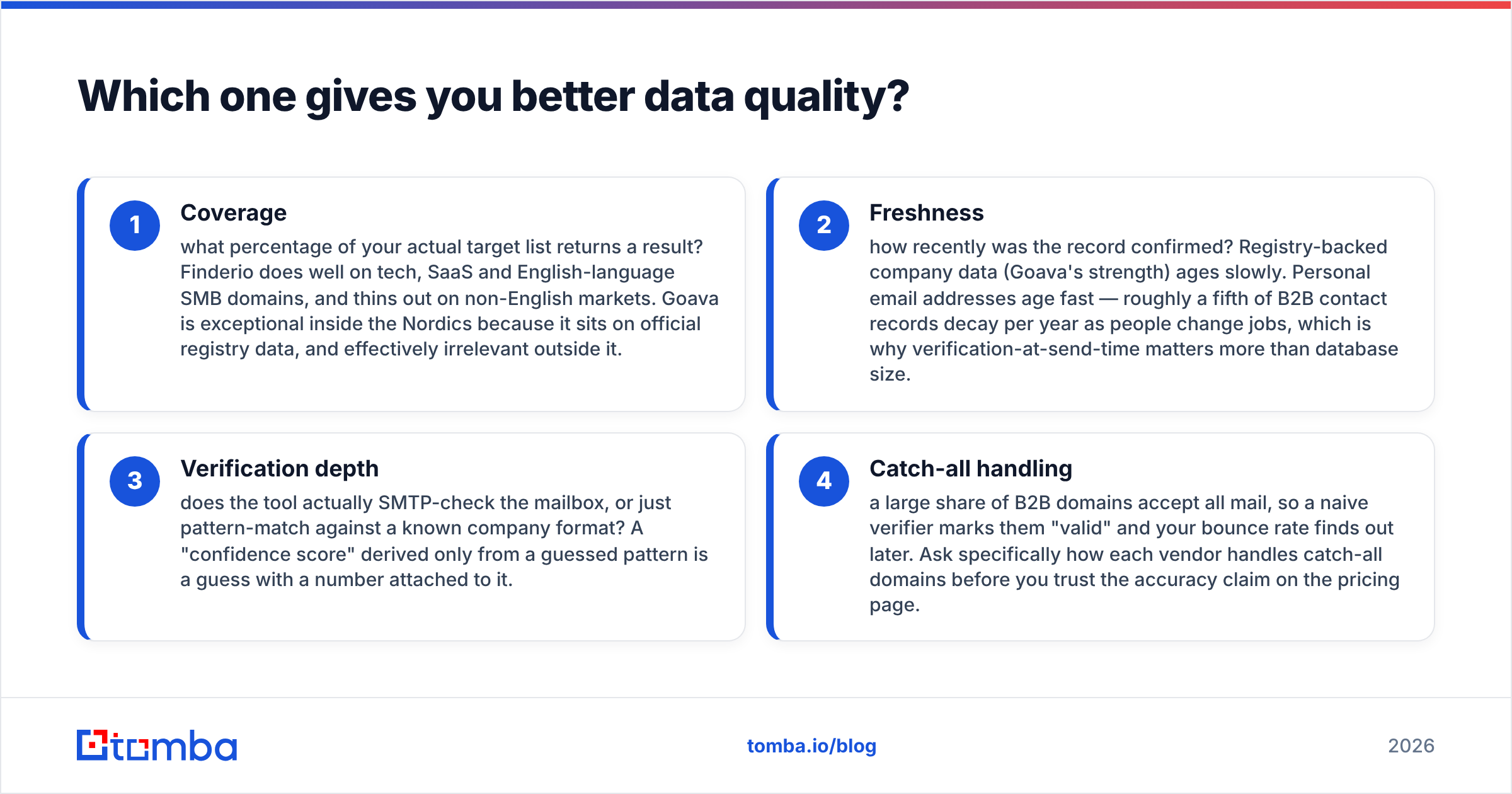
- Coverage — how much of your target list returns a result? Finderio does well on tech, SaaS and English-language SMB domains. It thins out in non-English markets. Goava is excellent inside the Nordics, because it sits on official registry data. Outside the region it is close to useless.
- Freshness — when was the record last confirmed? Company data from registries ages slowly, and that is Goava's strength. Personal email addresses age fast. Roughly a fifth of B2B contact records decay each year as people change jobs. That is why checking an address at send time matters more than database size.
- Verification depth — does the tool really check the mailbox, or does it just guess the company's email pattern? A confidence score built on a guess is still a guess with a number on it.
- Catch-all handling — many B2B domains accept all mail. A naive verifier marks them "valid" and your bounce rate finds out later. Ask each vendor how it handles catch-all domains before you trust the accuracy claim on the pricing page.

Neither Finderio nor Goava publishes audited accuracy benchmarks. Treat any headline percentage as marketing until you run your own test. That test is cheap. Take 100 contacts you can check by hand. Run them through each tool. Count the hits. Coverage rate and bounce rate on a real list beat any vendor claim.
Want to spot-check addresses while you run that test? A free email checker covers a sample of 100 without spending credits.
Finderio vs Goava pricing in 2026#
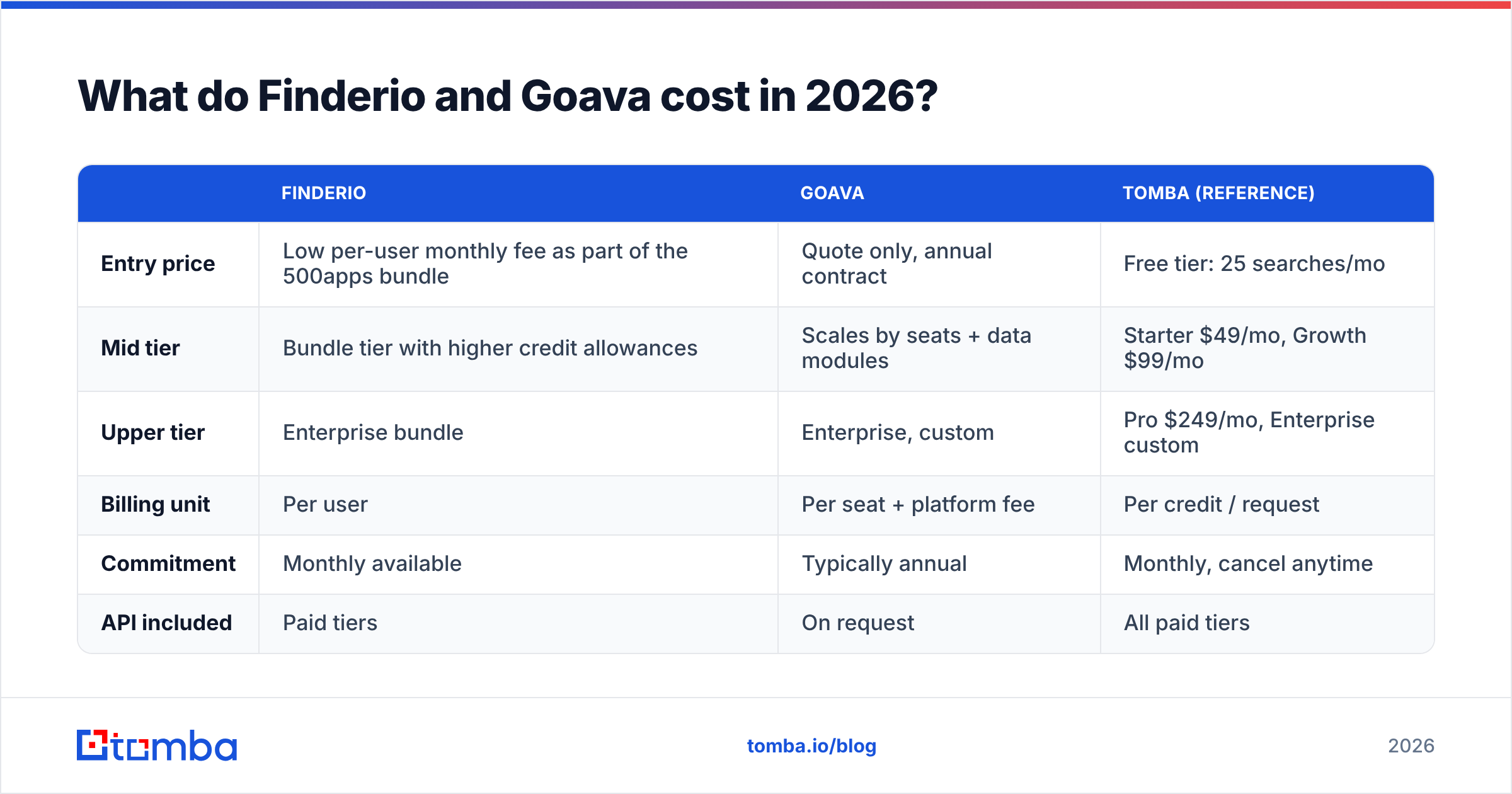
| Finderio | Goava | Tomba (reference) | |
|---|---|---|---|
| Entry price | Low per-user monthly fee as part of the 500apps bundle | Quote only, annual contract | Free tier: 25 searches/mo |
| Mid tier | Bundle tier with higher credit allowances | Scales by seats + data modules | Starter $49/mo, Growth $99/mo |
| Upper tier | Enterprise bundle | Enterprise, custom | Pro $249/mo, Enterprise custom |
| Billing unit | Per user | Per seat + platform fee | Per credit / request |
| Commitment | Monthly available | Typically annual | Monthly, cancel anytime |
| API included | Paid tiers | On request | All paid tiers |
Check current numbers on each vendor's own pricing page before you budget. Bundle vendors reshuffle tiers often. Quote-based vendors have no public number at all. Tomba's figures above come from the published Tomba pricing page.
The structure matters more than the numbers. Per-user pricing punishes you for adding reps. Per-credit pricing punishes you for volume. Three SDRs burning 10,000 lookups a month? Per-credit wins. Twenty reps doing thirty lookups each? Per-user wins. Do that math before you sit through a demo.
Quote-based pricing has a third quirk. Your price depends on how badly the rep thinks you want it. That is not a criticism. It is how enterprise software works. Just bring a number to the call.
Is Goava worth it outside the Nordics?#
Mostly no, and Goava is fairly upfront about that.
Its edge is Nordic registry depth. Swedish, Norwegian, Danish and Finnish companies file detailed public accounts. Goava turns that into scoring no global database can match in the region. Ask a global provider for the profit trend of a 40-person Swedish engineering firm and you get silence. Ask Goava and you get a chart.
Move the same question to Ohio or Bavaria and the edge disappears. Outside the Nordics you pay a premium for a data layer that competes with general providers, and often loses.
So the honest rule:
- Selling into the Nordics, mid-market or up, with a CRM your reps already live in? Goava earns its price by cutting account-selection time.
- Selling anywhere else? Look at broader intelligence platforms. Or skip that layer and put the budget into contact data and outreach.
Is Finderio good enough on its own?#
For a solo founder sending 50 emails a week, probably yes. For a team running structured outbound, the ceiling arrives fast.
Where Finderio holds up:
- Cheap per seat. Bundle economics make it easy to expense.
- Extra apps included. CRM, forms and helpdesk come with the same subscription. That suits early teams cutting tool count.
- Simple interface. Name plus domain, one result. No training needed.
Where it starts to hurt:
- Bundle depth. A suite of fifty apps rarely has a best-in-class one. Email finding needs constant crawling, verification servers and catch-all logic. That is costly to run as one tile among fifty.
- Slow fixes. Small modules inside big bundles get attention last.
- Automation ceiling. If your workflow is "enrich 5,000 rows nightly from a script", you need an API built, documented and priced for that job.
That last point is where most teams move on. Once prospecting becomes a pipeline instead of a person clicking, you need a real email finder API with clear rate limits, webhooks and per-request pricing.
What should you actually buy for outbound in 2026?#
Stop treating this as one purchase. An outbound data stack has three layers. Mixing them up is why teams overspend.
- Account selection — which companies deserve attention. Goava plays here, in the Nordics. So do 6sense, Vainu and Demandbase globally. Skip this layer if you can list your ICP by hand.
- Contact discovery — which people at those companies, and how to reach them. Finderio plays here, weakly. Dedicated finders play here properly. You cannot skip this layer. No amount of account intelligence helps if you cannot reach a decision maker.
- Verification and hygiene — keeping bounce rates under 2% so your domain survives. Run every list through an email verifier before it touches a sending tool. Handle catch-all domains on purpose, not by hoping.
Most teams over-invest in layer one and under-invest in layers two and three. Then they wonder why reply rates are flat. A perfect account list sent to a 30%-bounce contact file is worse than no list at all. You have also damaged your sender reputation on the way.

For layers two and three, the test is short. Run 100 known contacts through the vendor, including the one publishing this post. Measure coverage. Send to the results. Measure bounces. Divide total cost by delivered emails. That number is the only metric that survives a quarter.
Finderio vs Goava vs a dedicated finder: which fits you?#
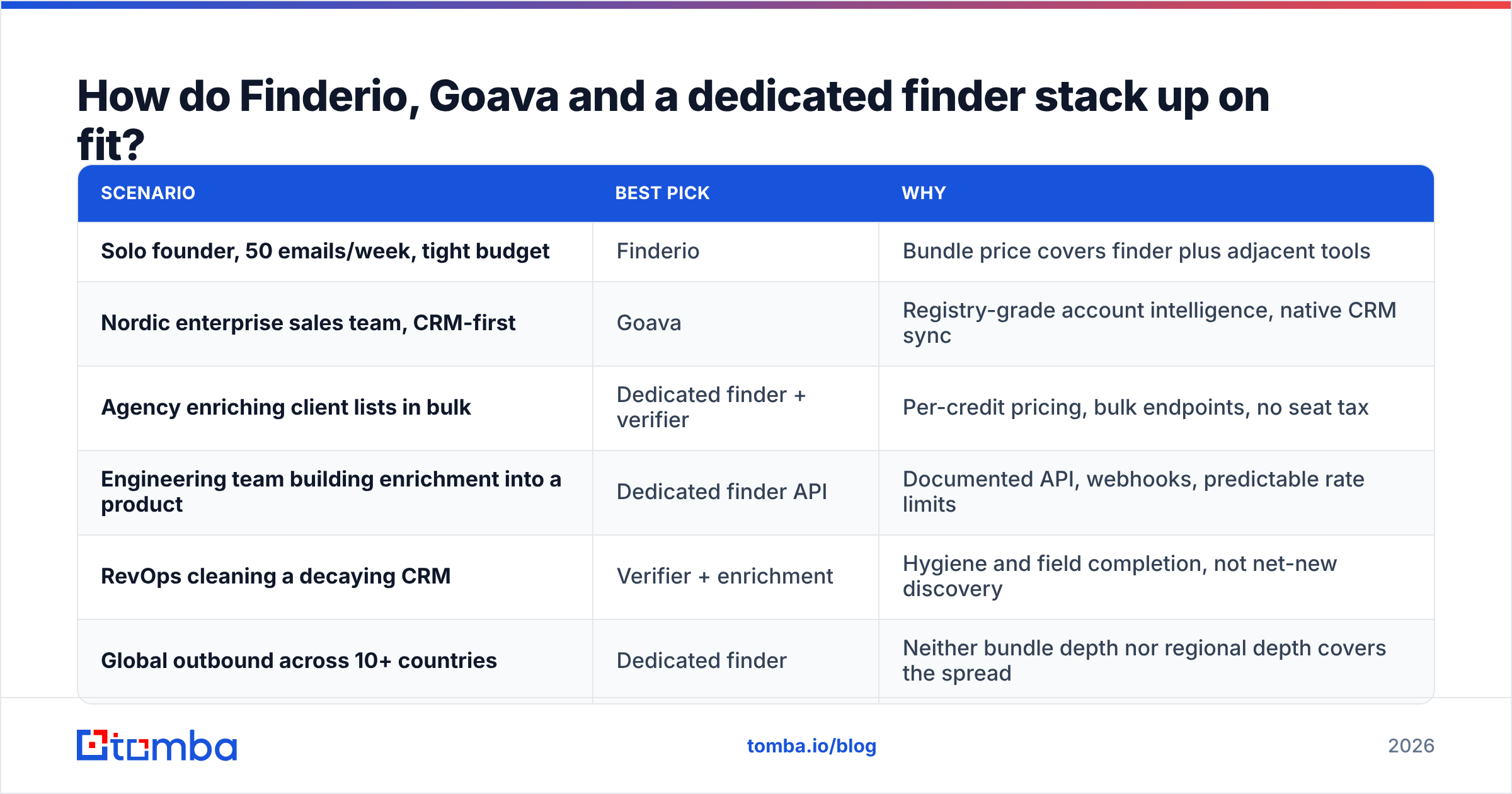
| Scenario | Best pick | Why |
|---|---|---|
| Solo founder, 50 emails/week, tight budget | Finderio | Bundle price covers finder plus adjacent tools |
| Nordic enterprise sales team, CRM-first | Goava | Registry-grade account intelligence, native CRM sync |
| Agency enriching client lists in bulk | Dedicated finder + verifier | Per-credit pricing, bulk endpoints, no seat tax |
| Engineering team building enrichment into a product | Dedicated finder API | Documented API, webhooks, predictable rate limits |
| RevOps cleaning a decaying CRM | Verifier + enrichment | Hygiene and field completion, not net-new discovery |
| Global outbound across 10+ countries | Dedicated finder | Neither bundle depth nor regional depth covers the spread |
Read that table honestly. Finderio and Goava each own exactly one row. That is not a slight. Specialist tools should own narrow rows. It does mean the Finderio vs Goava question usually resolves to "neither, for my use case". The real decision sits in the third column.
What about third-party reviews?#
Read current user reviews before you commit to either one. G2 and Capterra both list sales intelligence and lead intelligence software. Review volume tells you something on its own. Thin review counts usually mean a small install base. That tends to mean slower roadmaps and fewer integrations.
Look for reviews that mention bounce rates, contract renewals and support response time. Those three predict your second year far better than a feature list does.
The bottom line#
Finderio and Goava are not really rivals. They are two answers to two different bottlenecks, sold to two different buyers at two different prices. Pick Goava if Nordic account intelligence is your constraint and you have budget for an annual contract. Pick Finderio if you are early, price-sensitive, and an approximate email address is good enough.
Is your real constraint the volume of verified, deliverable contact data? For most outbound teams it is. Then neither tool is the efficient answer. You want a specialist: clear per-credit pricing, a real API, honest catch-all handling, and a free tier to test with.
Start with Tomba Email Finder on the free tier. You get 25 searches a month, no card. Run the 100-contact test against whatever you use now. Coverage rate and bounce rate will tell you more in an afternoon than three demos will in a month. If the numbers hold up, Starter is $49/mo, and every paid plan includes API access.
Related guides#
Ready to find emails that actually work?
Join 150,000+ professionals who stopped guessing and started sending. Free credits on signup — no credit card required.
Get the Tomba newsletter
Practical outbound tactics and product updates — once every two weeks.
About the author