Finder.io vs Seamless.AI (2026): Which Email Finder Wins?
Finder.io is cheap and bundled. Seamless.AI is aggressive and sales-gated. We compare data accuracy, real pricing, export limits, and API depth so you can pick the right email finder in 2026.
Finder.io vs Seamless.AI is a choice between a cheap bundle and a sales-led database. One publishes its price. The other makes you ask for it. Here is the short version.
TL;DR
- Finder.io is the cheap, bundled option. It ships inside the 500apps suite, so you pay a flat per-user price. You get an email finder plus 40-odd other apps you probably won't open. Good for solo founders on a tight budget. Thin on verification depth.
- Seamless.AI is the aggressive, sales-gated option. It runs a large self-reported contact database with a Chrome extension and "real-time" search. Volume is strong. Pricing is quote-only past the free tier, and export limits surprise people.
Then come the three questions that actually decide it:
- Accuracy is the whole ballgame. Neither tool publishes an audited bounce rate. Test both on 200 of your own target domains before you sign anything.
- Pricing transparency is the biggest split. Finder.io publishes a number. Seamless.AI mostly doesn't. If procurement hates "contact sales," that alone decides it.
- Want published pricing plus a real verification layer? A dedicated finder-verifier like Tomba ($49/mo Starter, 25 free searches a month) does the same job without the bundle bloat or the sales call.
What are Finder.io and Seamless.AI?#
They solve the same problem: turn a name and a company into a working email address. They come at it from opposite directions.
Finder.io is 500apps' entry in the email discovery category. It does domain search, single lookup, bulk upload, and basic validation. It is sold as part of an all-apps subscription, not as a standalone product. That bundling is the whole pitch. You are not buying an email finder; you are buying a suite that includes one. Check the current terms on the Finder.io site before you trust the bundle math. 500apps has repackaged its plans more than once.
Seamless.AI is a B2B contact database with a search engine on top. It markets "real-time people search," which means it builds and scores records at query time instead of serving a static table. It leans hard on its Chrome extension for LinkedIn prospecting, plus integrations with Salesforce, HubSpot, and Outreach. You can see how the market rates it on G2. The reviews are polarized in a way that is genuinely useful.
The practical difference: Finder.io acts like a utility, Seamless.AI acts like a platform. Utilities are cheap and boring. Platforms cost more and try to become your workflow.

Finder.io vs Seamless.AI: how do they compare head-to-head?#
Here is the honest side-by-side. Treat every price as "verify before you buy." Both vendors have changed packaging lately, and the real Seamless.AI number depends on what a rep quotes you.
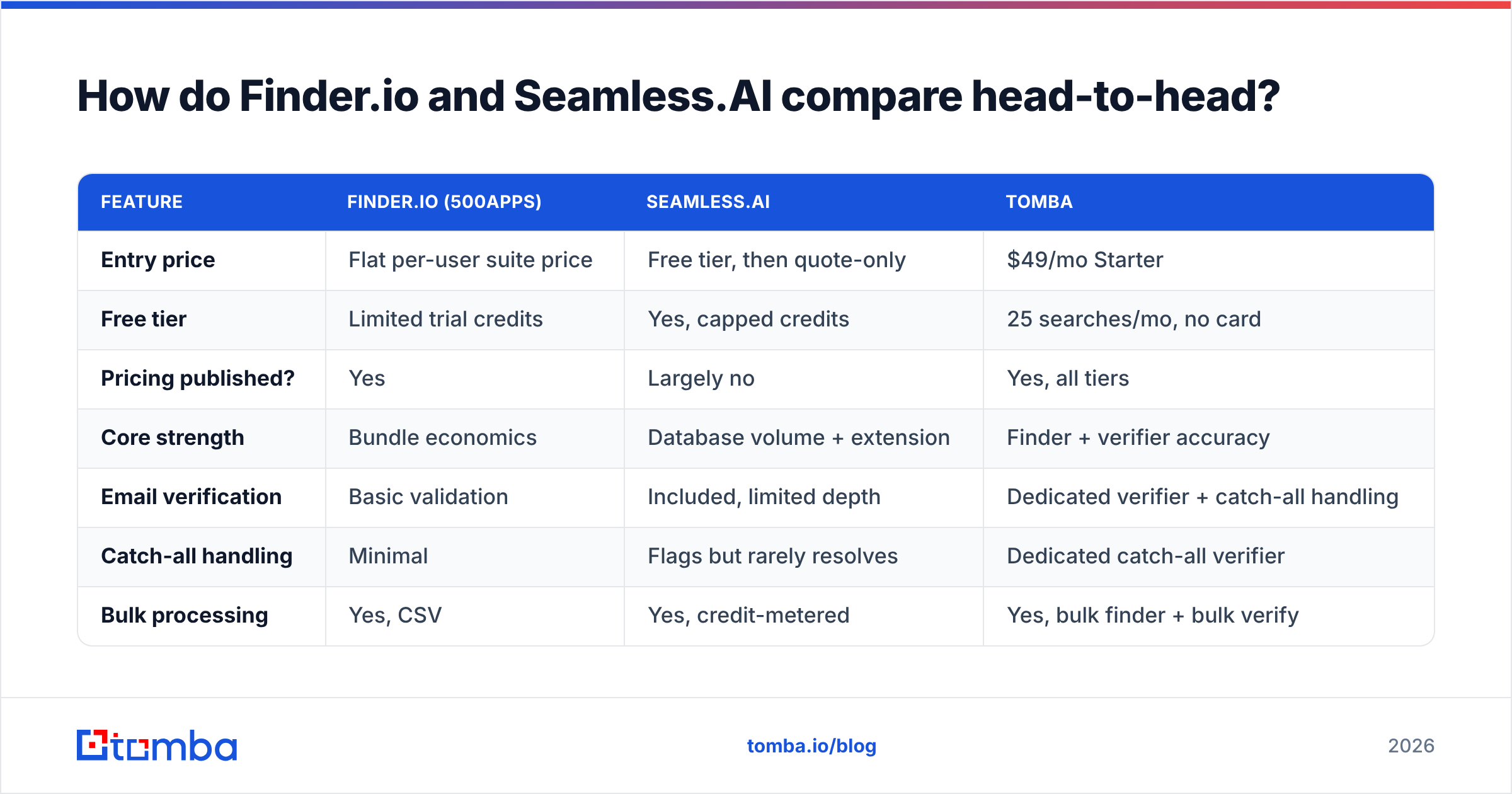
| Feature | Finder.io (500apps) | Seamless.AI | Tomba |
|---|---|---|---|
| Entry price | Flat per-user suite price | Free tier, then quote-only | $49/mo Starter |
| Free tier | Limited trial credits | Yes, capped credits | 25 searches/mo, no card |
| Pricing published? | Yes | Largely no | Yes, all tiers |
| Core strength | Bundle economics | Database volume + extension | Finder + verifier accuracy |
| Email verification | Basic validation | Included, limited depth | Dedicated verifier + catch-all handling |
| Catch-all handling | Minimal | Flags but rarely resolves | Dedicated catch-all verifier |
| Bulk processing | Yes, CSV | Yes, credit-metered | Yes, bulk finder + bulk verify |
| API | Available | Available on higher tiers | Full REST API, CLI, MCP server |
| Phone numbers | Limited | Yes (mobile + direct) | Phone finder + validator |
| CRM integrations | 500apps ecosystem first | Salesforce, HubSpot, Outreach | HubSpot, Salesforce, Pipedrive, Zapier, Make |
| Contract friction | Low | High — annual push common | Low, monthly plans |
Two rows matter more than the rest: pricing published and catch-all handling. The first decides how fast you can buy. The second decides how many of your sends land.

Whose data is actually more accurate?#
Neither vendor publishes a third-party audit of accuracy. Anyone quoting one at you is quoting marketing.
What you can judge is method, and the methods differ:
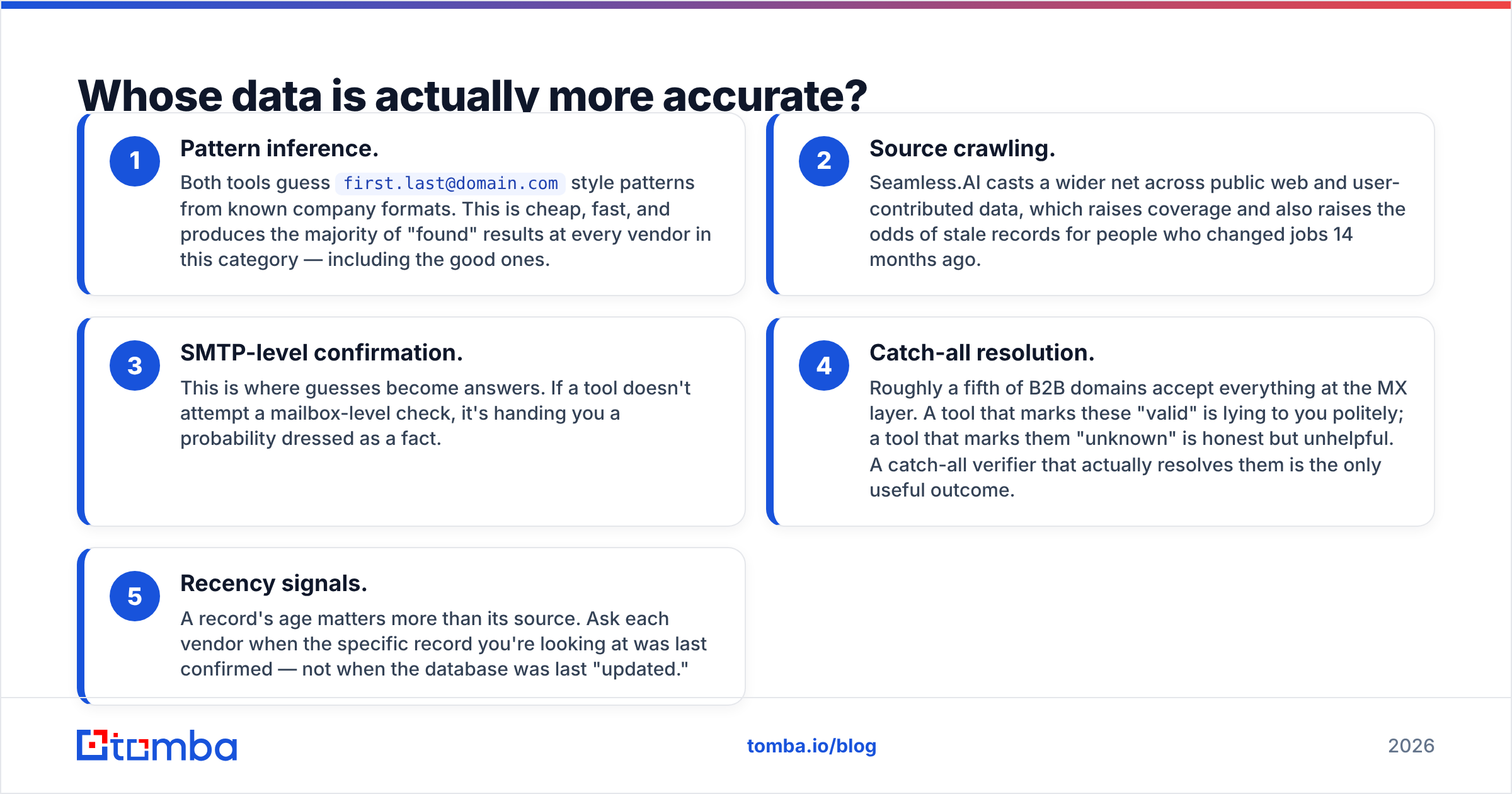
- Pattern inference. Both tools guess
first.last@domain.compatterns from known company formats. It is cheap and fast. It also produces most "found" results at every vendor in this category, including the good ones. - Source crawling. Seamless.AI casts a wider net across the public web and user-contributed data. That lifts coverage. It also lifts the odds of stale records for people who changed jobs a year ago.
- SMTP-level confirmation. This is where a guess becomes an answer. If a tool never attempts a mailbox-level check, it hands you a probability dressed as a fact.
The last two are the ones vendors gloss over:
- Catch-all resolution. About a fifth of B2B domains accept every address at the MX layer. A tool that marks these "valid" is lying to you politely. A tool that marks them "unknown" is honest but unhelpful. A catch-all verifier that resolves them is the only useful outcome.
- Recency signals. A record's age matters more than its source. Ask each vendor when that specific record was last confirmed, not when the database was last "updated."

The test that settles it takes an afternoon. Pull 200 contacts from your real ICP, not Fortune 500 logos. Run them through both tools. Then push every result through an independent email verifier. Count three things: found rate, verified-valid rate, and catch-all rate. Found rate is vanity. Verified-valid rate is the only number that predicts your bounce rate.
Expect the gap to be smaller than the marketing claims and bigger than you would like. Tools that bolt verification onto a finder tend to lose 10-25 points between "found" and "confirmed deliverable."
What does each one really cost?#
This is where the two products split hardest.
Finder.io publishes a flat per-user price tied to the 500apps bundle. On paper the economics are great: email finding plus CRM plus helpdesk plus a dozen other tools, for less than most standalone finders charge. The catch is depth. Bundled tools are built to be adequate, not best in class. The finder is one product among many fighting for the same team's attention.
Seamless.AI runs a free tier with capped credits, then moves you to a rep. Review threads flag three things again and again. Credits burn faster than expected. Export caps are tighter than the credit count implies. Annual contracts get pushed hard during the trial. None of that is disqualifying, and plenty of teams get value. But you cannot budget for Seamless.AI from its website. You budget for it after a call.
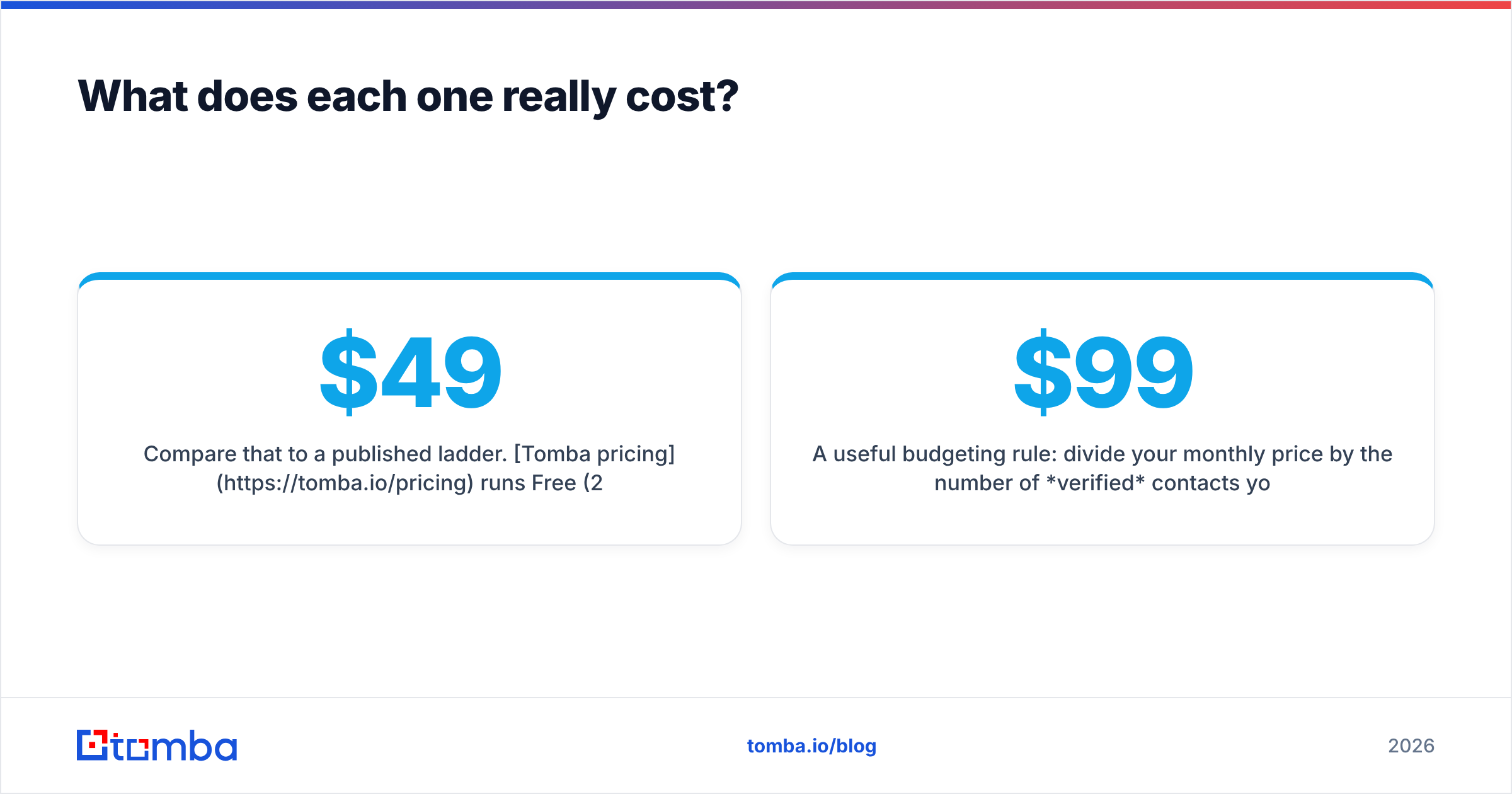
Compare that to a published ladder. Tomba pricing runs Free (25 searches/mo), Starter $49/mo, Growth $99/mo, and Pro $249/mo, with Enterprise custom. You can model your cost per verified contact in a spreadsheet before you talk to anyone. That matters when you are justifying spend to a CFO who is already annoyed about the last tool.
A useful budgeting rule: divide your monthly price by the number of verified contacts you export, not credits granted. A $99 plan that yields 1,800 deliverable addresses beats a $60 plan that yields 700. Credits are the vendor's unit. Deliverable contacts are yours.

Which is better for list building at scale?#
It depends on your shape of work.
Seamless.AI wins on volume prospecting. Say you are an SDR living in LinkedIn Sales Navigator, pulling a few hundred contacts a week with phone numbers attached. Its extension plus database breadth is genuinely useful, and the workflow is fast. The tradeoff: you will verify externally anyway, and you will negotiate your renewal every year.
Finder.io wins on cost floor. Say you are one or two people, you send 200 emails a month, and the finder is a supporting act. The bundle price is hard to argue with. You will not get deep catch-all resolution or a strong API. You are also not paying enterprise rates to look up 40 emails a week.
Neither wins on programmatic workflows. To enrich records inside your own pipeline — a signup form, a scraping job, a CRM sync — you want a documented email finder API with clear rate limits and per-request pricing. A seat-based platform is a structurally different product. It is where a lot of teams end up after their second renewal.
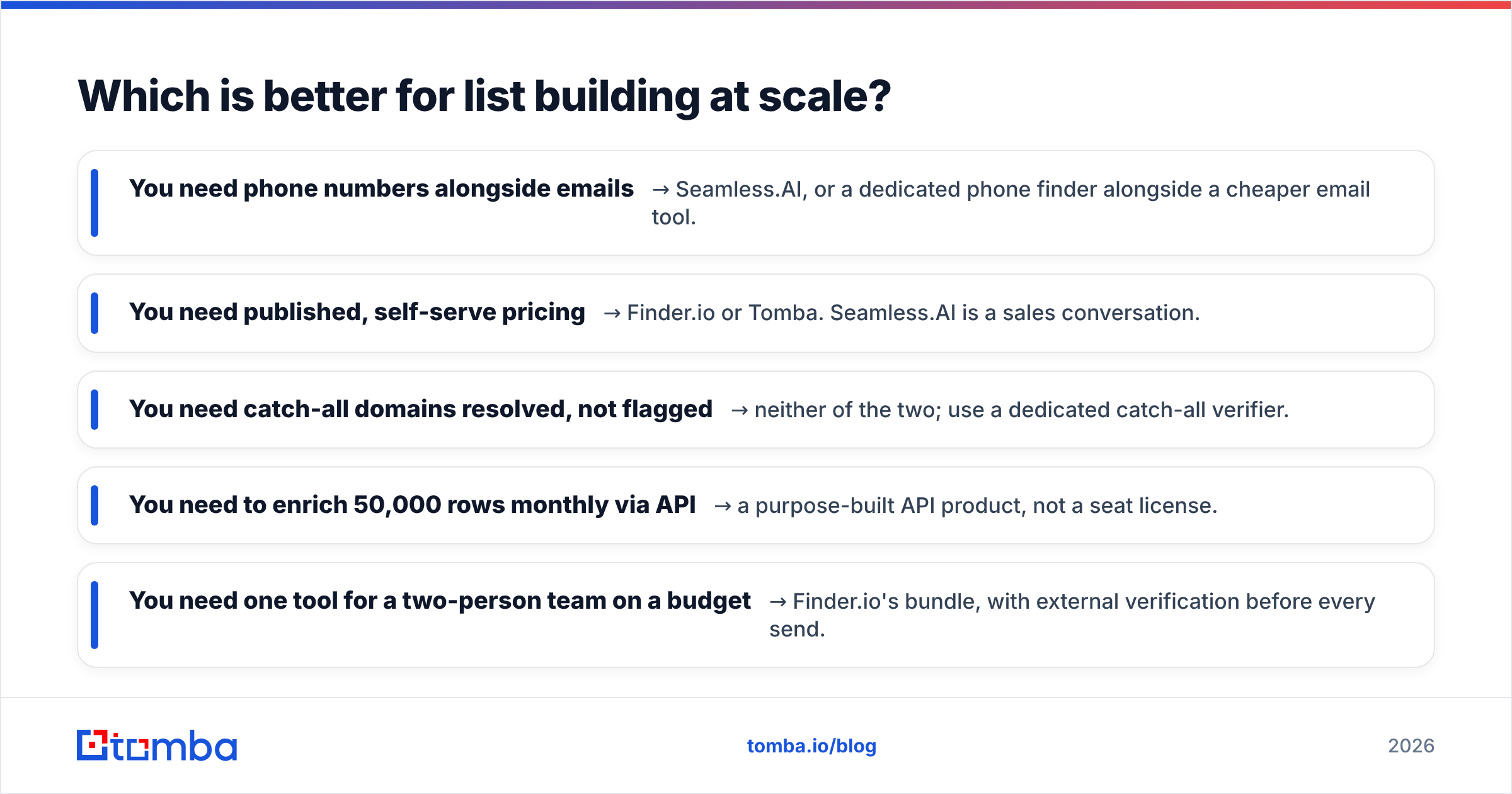
A quick decision list:
- Phone numbers alongside emails → Seamless.AI, or a dedicated phone finder next to a cheaper email tool.
- Published, self-serve pricing → Finder.io or Tomba. Seamless.AI is a sales conversation.
- Catch-all domains resolved, not flagged → neither of the two. Use a dedicated catch-all verifier.
- 50,000 rows enriched monthly via API → a purpose-built API product, not a seat license.
- One tool for a two-person team on a budget → Finder.io's bundle, with external verification before every send.
What do real users actually complain about?#
Reading review sites with a skeptical eye is the cheapest research you will do.
Seamless.AI complaints cluster around commercial friction. Contract terms. Trouble downgrading. Credits spent on searches that returned nothing usable. Data that was right for the company and wrong for the person. The praise is about speed and coverage. Reps do find people faster.
Finder.io complaints cluster around depth. Fewer records for niche or non-US domains. Thinner verification. Support spread across a whole app suite instead of one product. The praise is entirely about price.
A pattern runs through the category: cheap tools fail on coverage, expensive tools fail on commercial terms, and almost all of them fail on catch-all domains. Any comparison that skips catch-alls has not run a real test.
Want to sanity-check a record before committing budget? Run a few through a free email checker and see whether the vendor's confidence score survives an independent check. For background on why deliverability slips even with "valid" addresses, HubSpot's research on email engagement is a fair neutral start.
Finder.io vs Seamless.AI: which should you pick in 2026?#
Pick Finder.io if you are cost-constrained, low-volume, and already running an external verification step. The bundle economics are real, and the tool is fine for what it is. Just do not expect it to carry a serious outbound program.
Pick Seamless.AI if you staff SDRs, you need phones and emails in one place, and you live in the Chrome extension. You also need budget flexibility to survive a quote-based renewal. Go in with a hard credit cap and read the auto-renewal clause.
Pick neither if you want a finder with a serious verification layer, transparent pricing, and an API you can automate against. That is a different category. It is where most teams land after they burn a quarter on bounces.
The most common mistake here is not picking wrong. It is picking one tool and skipping verification. Every finder on the market returns pattern guesses among its results, including the good ones. Sending to unverified guesses is how you torch a sending domain in six weeks. Whatever you pick, put a verification step between discovery and send.
Ready to test the alternative?#
Want the coverage without the sales call? Start with the Tomba Email Finder. You get 25 free searches a month with no card. Published pricing starts at $49/mo when you outgrow it. Verification, including proper catch-all handling, is built into the same platform instead of bolted on afterward. Run your 200-contact test, compare verified-valid rates side by side, and let the bounce numbers decide.
Related guides#
Ready to find emails that actually work?
Join 150,000+ professionals who stopped guessing and started sending. Free credits on signup — no credit card required.
Get the Tomba newsletter
Practical outbound tactics and product updates — once every two weeks.
About the author