FindThatLead vs LakeB2B (2026): Which Data Source Wins?
FindThatLead sells self-serve email discovery. LakeB2B sells curated, human-verified list builds. Here's how the two compare on accuracy, pricing, and which one actually fits your pipeline in 2026.
FindThatLead vs LakeB2B is not really a feature fight. One is a tool you run yourself. The other is a list a vendor builds for you. This guide shows which model fits your outbound, and what each one really costs.
TL;DR
- FindThatLead is a self-serve prospecting tool. Search by domain, run bulk lookups, scrape LinkedIn, send basic campaigns. You do the work, and credits burn in real time.
- LakeB2B is a data services company. You brief them, they deliver a custom list. That list often ships with human verification, intent overlays, and added company details. You buy an outcome, not a UI.
- They are not really the same product. Choosing between them is choosing between "I prospect continuously" and "I need 20,000 targeted records for a campaign."
- On raw email accuracy for self-serve lookups, dedicated finders like Tomba and Findymail usually beat both. FindThatLead's guessing is permissive, and any purchased list decays 2–3% per month from day one.
- Whatever you choose, run the output through an email verifier before it touches your sending domain. Neither vendor's "verified" label replaces your own bounce control.
What are FindThatLead and LakeB2B, actually?#
They solve the same business problem — getting contactable B2B leads — through opposite delivery models.
FindThatLead is a Barcelona-based SaaS platform launched in 2015. You log in, type a domain or a LinkedIn URL, and it returns email addresses. It bundles a Chrome extension, a bulk CSV processor ("Prospector"), a lead search filtered by industry/location/role, and a lightweight cold-email sender. Credits are consumed per search. It is built for founders, solo SDRs, and small agencies who prospect in bursts.
LakeB2B is a data provider and marketing services firm. It has sold B2B contact databases since the mid-2000s. You don't build a list on a slick dashboard. You talk to a rep, describe your ICP — industry, employee count, tech stack, job function, geography — and they build and deliver a file. They also sell healthcare-specific data (NPI-level physician records), intent data, added company details, and done-for-you campaign execution. Minimum orders and negotiated pricing are the norm.
The distinction matters more than any feature checklist. One is a tool you operate. The other is a vendor you brief.
FindThatLead vs LakeB2B: how do they compare head-to-head?#
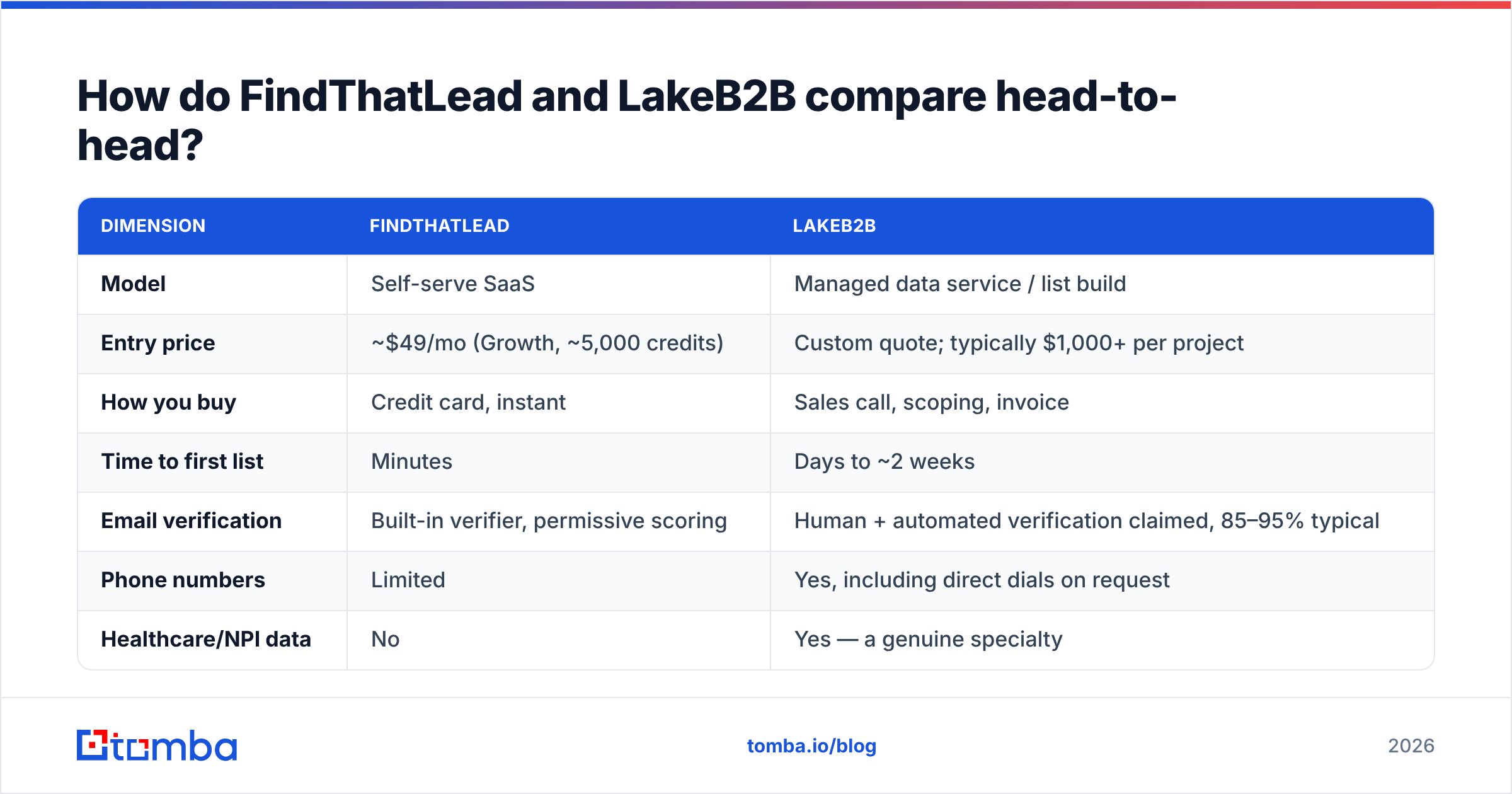
| Dimension | FindThatLead | LakeB2B |
|---|---|---|
| Model | Self-serve SaaS | Managed data service / list build |
| Entry price | ~$49/mo (Growth, ~5,000 credits) | Custom quote; typically $1,000+ per project |
| How you buy | Credit card, instant | Sales call, scoping, invoice |
| Time to first list | Minutes | Days to ~2 weeks |
| Email verification | Built-in verifier, permissive scoring | Human + automated verification claimed, 85–95% typical |
| Phone numbers | Limited | Yes, including direct dials on request |
| Healthcare/NPI data | No | Yes — a genuine specialty |
| Intent data | No | Yes (third-party overlays) |
| API access | Yes, basic | Enterprise/custom |
| Best for | Continuous, low-volume prospecting | One-off, high-volume, niche-vertical campaigns |
| Worst for | Large targeted list builds | Iterative day-to-day prospecting |
Read that table as two different budget lines. FindThatLead comes out of a $50–$150/month tooling budget. LakeB2B comes out of a campaign budget with a four-figure floor and a procurement conversation attached.
Which one has better data accuracy?#
Short answer: FindThatLead is more open about being uncertain. LakeB2B is more accurate in the markets it specializes in — but you can only prove that after you've paid.
FindThatLead's finder works the way most email finders work. It learns a company's pattern (first.last@, finitial+last@), applies it to the name you supply, then runs an SMTP-level check. The difference is where it draws the confidence line. It will return a "verified" result on domains where a catch-all setup makes real verification impossible. That inflates your apparent hit rate and hurts your actual deliverability. If you use it, treat any catch-all domain as unverified. Route it through a dedicated catch-all verifier before you send.
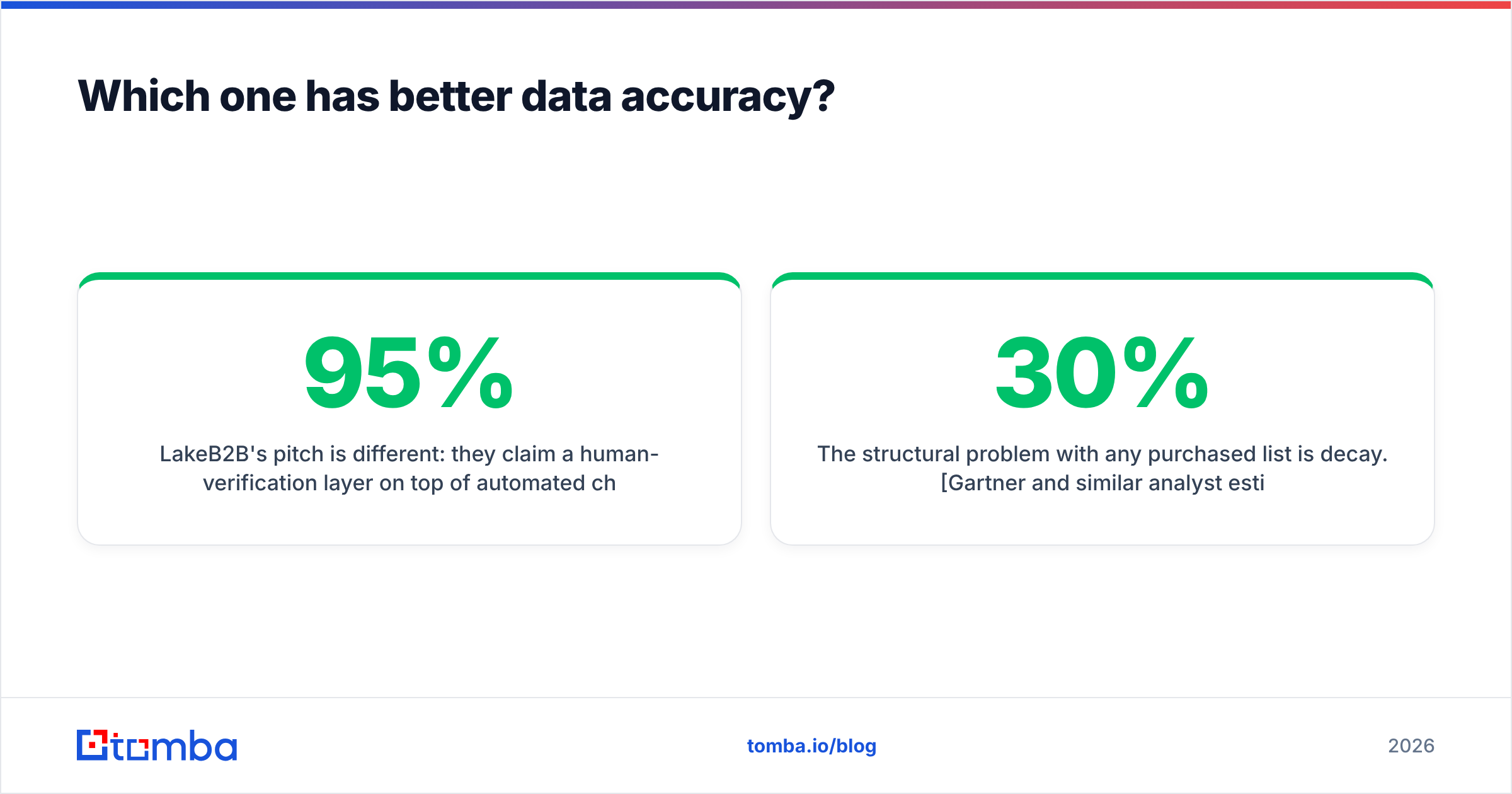
LakeB2B's pitch is different. They claim a human-verification layer on top of automated checks, with accuracy guarantees in the 85–95% range and a replacement policy on bounces above that threshold. In healthcare, records are tied to NPI numbers and license registries rather than scraped web patterns. The claim holds up better there than in general tech or SMB segments. Outside those strong verticals, you are buying from the same shared pool most list brokers draw on, and freshness varies by segment.
The structural problem with any purchased list is decay. Gartner and similar analyst estimates put B2B contact churn around 25–30% per year. That is roughly 2.5% of your file going stale every month. A list that was 92% accurate at delivery is clearly worse by the time you finish a six-week sequence. Live lookup tools avoid most of this, because you query at the moment you need the record.
When should you pick FindThatLead?#
Pick FindThatLead when your prospecting is continuous and low-volume, and when a fast feedback loop matters more than full coverage.
- You're a founder or solo SDR building 20–100 contacts a week and want results in the same session you started.
- You already have a target account list and just need contacts at those domains. Domain search style workflows are the tool's strongest use.
- You want prospecting and sending in one place. The built-in cold-email sender is basic, but it removes a tool from the stack for very small teams.
- You prospect from LinkedIn. The extension is a fine capture layer for profiles you're already viewing.
- Your budget caps out around $100/month. Below that ceiling, a managed data vendor won't even take the call.
Where it breaks: coverage on non-US/EU domains is thin. Credits can evaporate on failed searches in some plan setups. And the campaign sender lacks the deliverability tooling — inbox rotation, warmup, fine-grained throttling — that a real sequencer like Instantly or Smartlead provides.
When should you pick LakeB2B?#
Pick LakeB2B when the list itself is the deliverable and the vertical is one they know.
- Healthcare, pharma, or life-sciences targeting. NPI-anchored physician and facility data is genuinely hard to assemble yourself. This is where LakeB2B earns its premium.
- You need 10,000+ records with specific company filters that self-serve tools can't express. Think SIC-level industry codes, installed technology, revenue bands, and seniority, all combined.
- You have a campaign budget, not a tooling budget. If the list is a line item in a $50k ABM program, a $5k data spend is proportionate.
- You want more than emails — direct dials, mailing addresses, employee counts, and intent signals on one file.
- You need someone accountable. A contract with a replacement clause is a different risk posture than a credit balance in a SaaS app.
Where it breaks: you cannot iterate. If your ICP guess is wrong, you find out after you've bought 20,000 records for it. There's no "let me just check three domains real quick." And like every list vendor, the file you receive is a snapshot. From delivery day forward, it only gets worse.
It's worth saying plainly: LakeB2B sits in the same category as providers like BookYourData, which also sell pay-as-you-go verified B2B contacts with accuracy guarantees. If you like the managed-list model but want to skip the long sales cycle and the four-figure minimum, that self-serve-list middle ground is worth a look first.
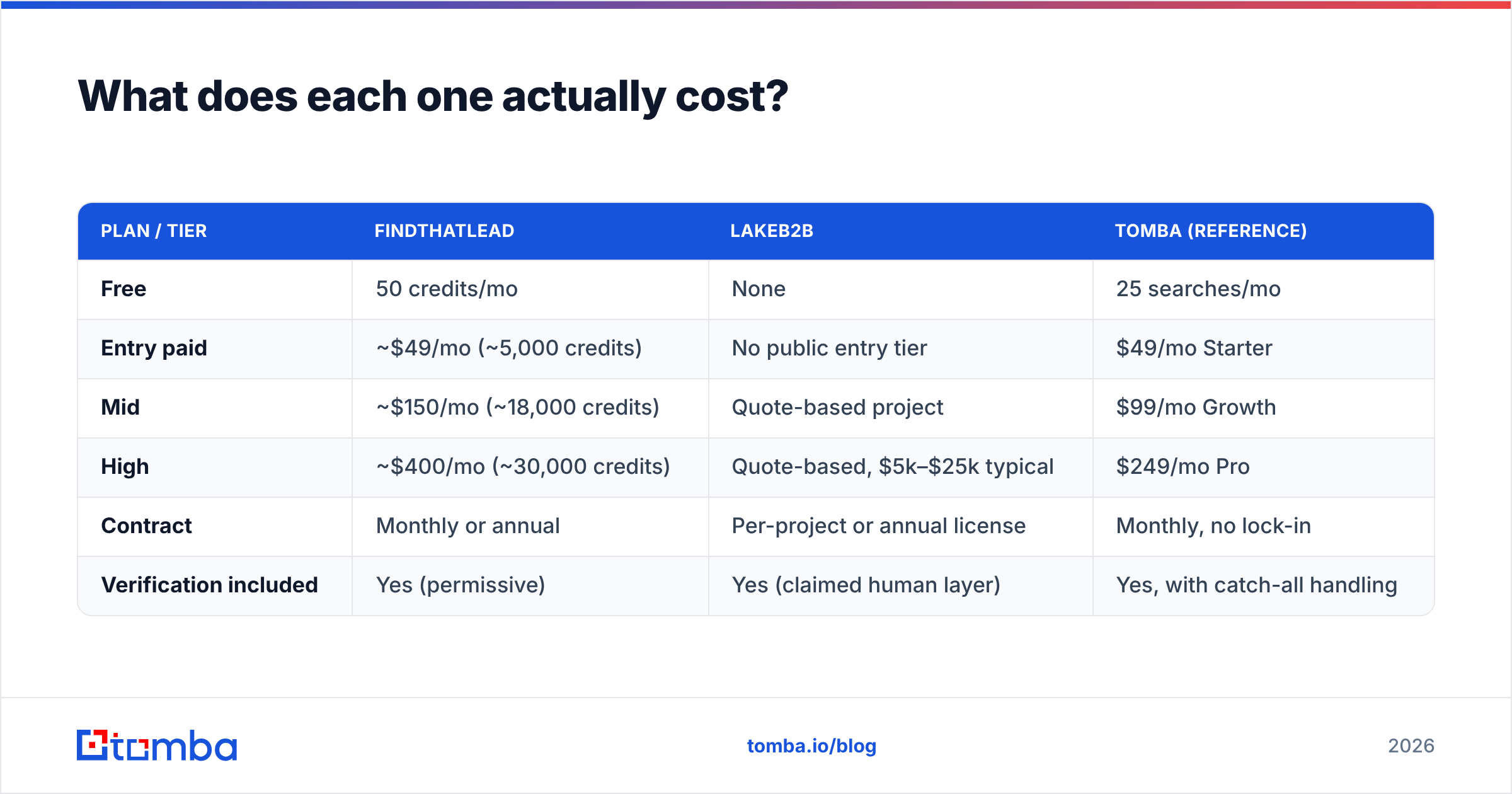
What does each one actually cost?#
| Plan / tier | FindThatLead | LakeB2B | Tomba (reference) |
|---|---|---|---|
| Free | 50 credits/mo | None | 25 searches/mo |
| Entry paid | ~$49/mo (~5,000 credits) | No public entry tier | $49/mo Starter |
| Mid | ~$150/mo (~18,000 credits) | Quote-based project | $99/mo Growth |
| High | ~$400/mo (~30,000 credits) | Quote-based, $5k–$25k typical | $249/mo Pro |
| Contract | Monthly or annual | Per-project or annual license | Monthly, no lock-in |
| Verification included | Yes (permissive) | Yes (claimed human layer) | Yes, with catch-all handling |
Two cost traps to price in.
FindThatLead: credits are the unit, not results. A search that returns nothing can still cost you. On lower-coverage domains — anything outside mainstream US/EU tech — your real cost per usable email can be 2–4x the headline rate.
LakeB2B: the quote is only the beginning. Add the internal hours to dedupe against your CRM, suppress existing customers, re-verify before sending, and handle the 8–15% that bounces anyway. Budget a re-verification pass on any purchased list as a required step, not an optional one. A bulk verification run on a 20,000-record file costs a fraction of what a 12% bounce rate does to your sender reputation.

Is there a better option than either?#
Yes, for most teams — because most teams don't need either extreme.
The honest read on FindThatLead vs LakeB2B: one is a competent budget tool with loose verification, the other is a strong vertical specialist with an enterprise sales motion. If you're a mid-market SDR team running continuous outbound into general B2B, you fall in the gap between them.
What that middle looks like in practice:
- A live-lookup finder with strict verification for day-to-day prospecting. You query when you need the record, so decay is irrelevant. Accuracy-first tools — Tomba, Findymail, Prospeo — return fewer results than FindThatLead, but a higher share of them land.
- A real sequencer for sending. Never send meaningful volume from a finder's bundled campaign feature. Deliverability is its own discipline.
- Bulk enrichment for account lists you already have. If your GTM team hands you 3,000 target companies, contact enrichment against that list beats both a generic self-serve search and a broker's pre-built file.
- A managed list only for genuinely hard verticals. Healthcare, government, regulated finance. If you can build the list yourself with filters, build it yourself.
One rule applies no matter which vendor you pick: verification is your job, not theirs. Every provider grades its own homework. Google and Microsoft have both tightened bulk-sender rules. Google's sender guidelines now cap spam complaints at 0.3% and require authentication for bulk senders. A list that bounces at 10% will torch a domain before you learn whether the messaging worked.
How do you decide in the next ten minutes?#
Answer three questions.
- Is the list a project or a habit? Project → LakeB2B, or a self-serve list vendor. Habit → FindThatLead, or better, a stricter finder.
- Is your vertical healthcare or similarly regulated? Yes → LakeB2B's specialization is real and worth the sales call. No → their edge over cheaper providers narrows fast.
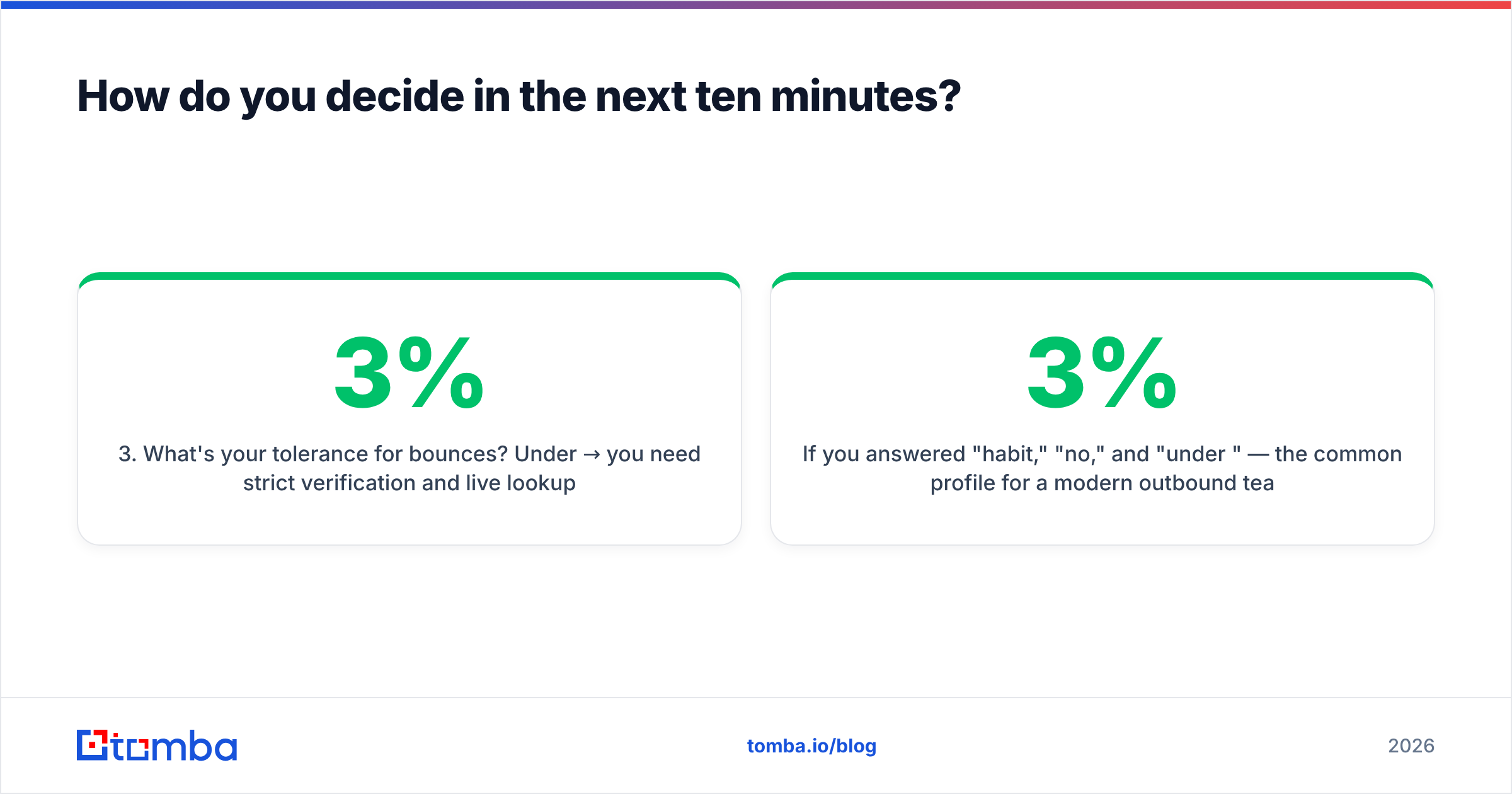
- What's your tolerance for bounces? Under 3% → you need strict verification and live lookup, so neither of these should be your primary source. Under 8% → either works with a re-verification pass on top.
If you answered "habit," "no," and "under 3%" — the common profile for a modern outbound team — you're not shopping for FindThatLead or LakeB2B. You're shopping for an accuracy-first finder plus a verification layer. Compare on cost-per-valid-email, not cost-per-credit.
Ready to test a stricter alternative?#
Before you commit budget to either vendor, run a controlled test. Take 50 target contacts you can confirm yourself — customers, partners, people who've replied to you — and run them through each option. Measure the share of correct addresses, not the share of addresses returned. That one test settles FindThatLead vs LakeB2B better than any comparison post, including this one.
Tomba's Email Finder is a useful third data point for that test. You get 25 free searches a month with no card, verification and catch-all handling inside the same lookup, and transparent pricing from $49/mo when you scale up. If it returns fewer emails than FindThatLead on your sample but a higher share are correct, you've learned exactly what you needed. And if a broker's file beats both in your vertical, that's a legitimate answer too. Run the test with your own data before you sign anything.
Related guides#
Ready to find emails that actually work?
Join 150,000+ professionals who stopped guessing and started sending. Free credits on signup — no credit card required.
Get the Tomba newsletter
Practical outbound tactics and product updates — once every two weeks.
About the author