FindThatLead vs Span Global Services: Which B2B Data Wins?
One is a self-serve email finder you run yourself. The other is a managed list vendor that quotes you a file. Here's how FindThatLead and Span Global Services actually compare on accuracy, pricing, contracts, and outbound fit.
FindThatLead vs Span Global Services is a choice between two very different ways to buy B2B contact data. One is a tool you run yourself. The other is a vendor you brief. This guide compares both on accuracy, pricing, contracts, and cold email fit.
TL;DR
- FindThatLead is a self-serve prospecting tool. You search a domain or upload names, it returns emails, and you pay a monthly subscription for credits.
- Span Global Services is a managed data vendor. You describe an audience, a rep quotes you, and you receive a file.
- The two are not really competitors on features. They compete on how you want to acquire contact data: run it yourself, or buy it as a service.
Pricing and data freshness split them further:
- FindThatLead publishes pricing (roughly $49–$399/mo depending on credits). Span Global Services does not publish pricing. Every engagement is a custom quote, usually with a minimum record count.
- Bought lists decay the moment they are delivered. Live lookup tools decay slower, because you pull records at the time you need them. That only holds if you verify before you send.
- If you send cold email in any volume, the safest setup is live finding plus independent verification, not a static file. That is why many teams run a finder and a verifier instead of either extreme.
FindThatLead vs Span Global Services: what is each one?#
FindThatLead is a Barcelona-based prospecting suite that launched in 2015. Its core is an email finder. Give it a domain, a first and last name, or a LinkedIn profile, and it returns a likely business email with a confidence score.
Around that core it stacks a lead search (filter by role, location, industry), a bulk CSV processor, an email verifier, and a basic cold-email sender. You can see the current feature set on findthatlead.com. It is a credit-based SaaS: you buy a plan, you burn credits, you top up.
Span Global Services is a US-based B2B data and marketing services company. It sells targeted mailing lists, email lists, and data append services — technology user lists, healthcare lists, industry lists, and custom-built segments.
You tell a sales rep what audience you want. They scope it, they quote it, and you receive a data file or a managed campaign. Their public site is spanglobalservices.com. There is no self-serve signup, no dashboard to log into, and no published price card.
So the honest framing of FindThatLead vs Span Global Services is not "which tool has better filters." It is simpler than that: do you want a tool you operate, or a vendor you brief?
FindThatLead vs Span Global Services: how do the data models differ?#
This is the part most comparison posts skip. It is also the part that decides whether you are still happy in six months.
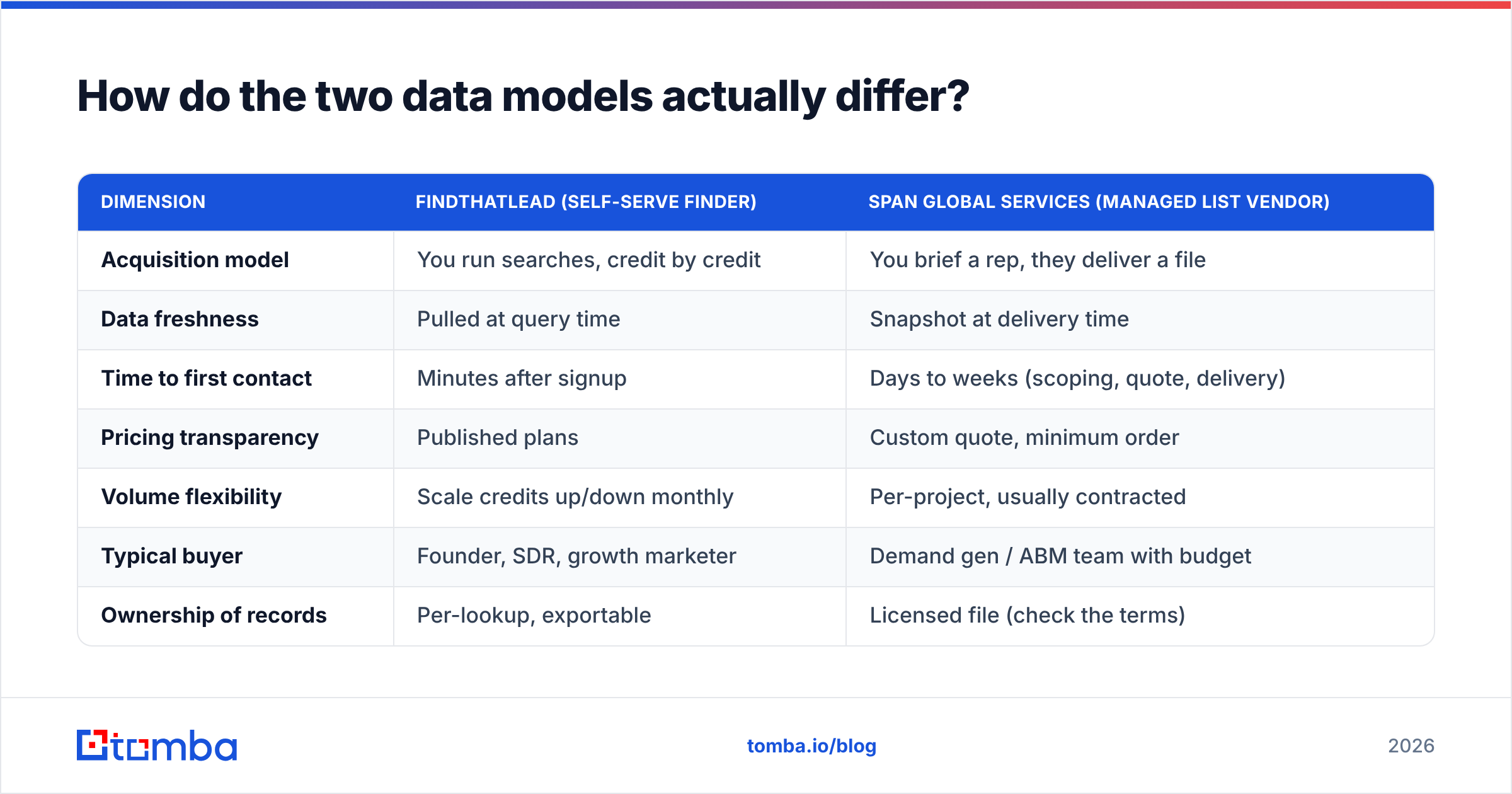
| Dimension | FindThatLead (self-serve finder) | Span Global Services (managed list vendor) |
|---|---|---|
| Acquisition model | You run searches, credit by credit | You brief a rep, they deliver a file |
| Data freshness | Pulled at query time | Snapshot at delivery time |
| Time to first contact | Minutes after signup | Days to weeks (scoping, quote, delivery) |
| Pricing transparency | Published plans | Custom quote, minimum order |
| Volume flexibility | Scale credits up/down monthly | Per-project, usually contracted |
| Typical buyer | Founder, SDR, growth marketer | Demand gen / ABM team with budget |
| Ownership of records | Per-lookup, exportable | Licensed file (check the terms) |
| Verification | Built-in verifier, self-run | Vendor-claimed pre-verification |
The two columns fail in opposite directions. A self-serve finder fails on coverage. Some domains return nothing, and you burn credits finding that out.
A managed list fails on decay and control. You get 20,000 rows, you cannot inspect how each one was sourced, and by the time your campaign launches, a chunk of the contacts have changed jobs.
B2B contact data goes stale fast. Industry estimates put annual B2B database decay at 22–30%, driven mostly by job changes. Both vendors face that math. Only one of them lets you re-pull a record the day you need it.
Which one gives you more accurate data?#
Neither company publishes an audited, third-party accuracy benchmark. So treat every marketing number as a vendor claim until your own bounce data backs it up. That applies to FindThatLead's confidence scores and to Span Global's "verified" labels alike.
What you can compare is the mechanism:
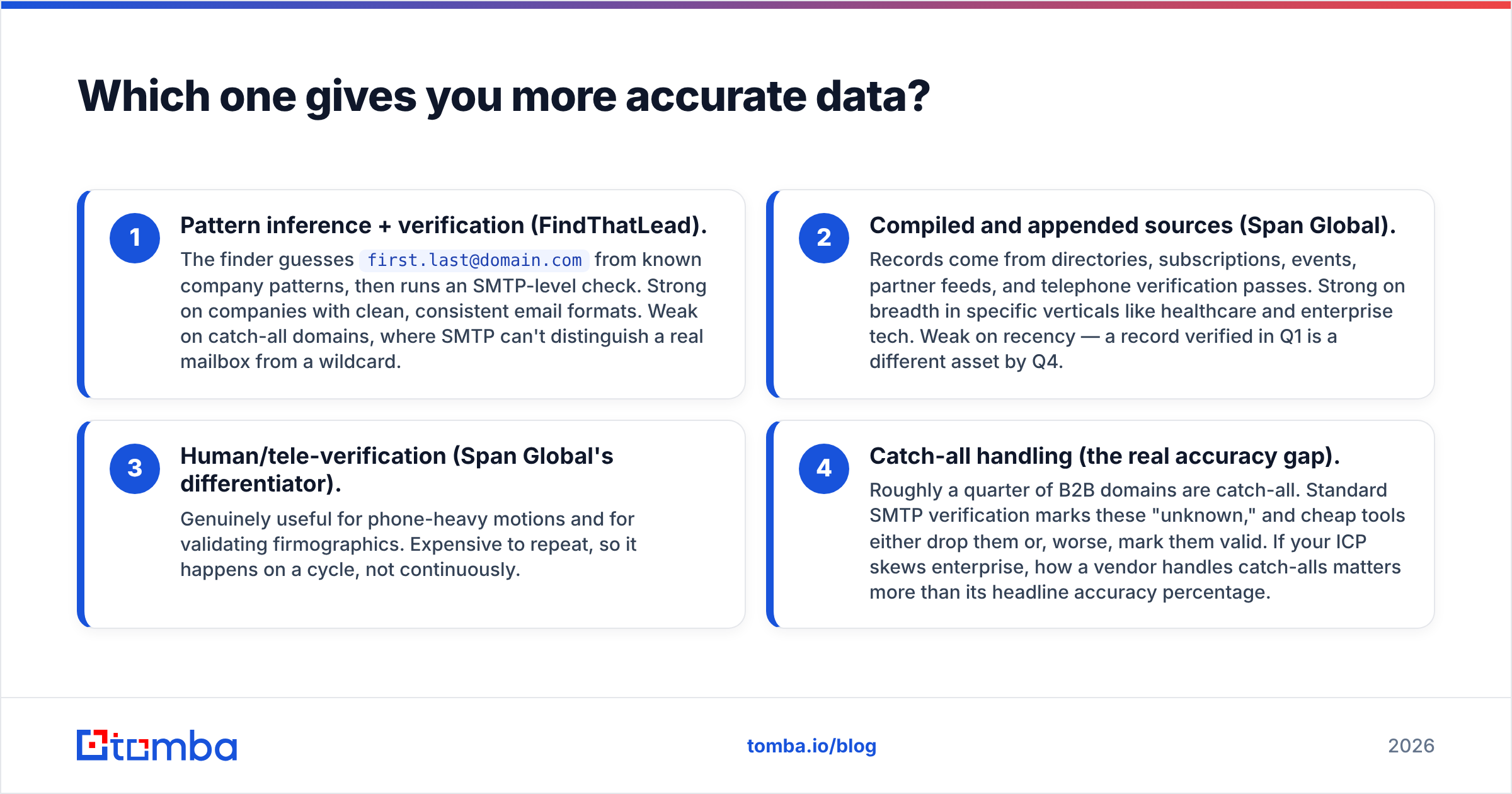
- Pattern inference plus verification (FindThatLead). The finder guesses
first.last@domain.comfrom known company patterns, then runs an SMTP-level check. It is strong on companies with clean, consistent email formats. It is weak on catch-all domains, where SMTP cannot tell a real mailbox from a wildcard. - Compiled and appended sources (Span Global). Records come from directories, subscriptions, events, partner feeds, and phone verification passes. Strong on breadth in verticals like healthcare and enterprise tech. Weak on recency: a record verified in Q1 is a different asset by Q4.
Two more factors decide the FindThatLead vs Span Global Services accuracy question:
- Human tele-verification (Span Global's differentiator). Genuinely useful for phone-heavy motions and for checking firmographics. It costs a lot to repeat, so it happens on a cycle, not continuously.
- Catch-all handling (the real accuracy gap). Roughly a quarter of B2B domains are catch-all. Standard SMTP checks mark these "unknown." Cheap tools either drop them or, worse, mark them valid. If your ICP skews enterprise, catch-all handling matters more than a headline accuracy percentage.

The practical rule is short: whatever source you buy from, verify before you send. Running a bought file through a separate email verifier routinely strips 8–20% of rows. That is not a knock on the vendor. It is the decay clock. It is also the cheapest insurance you can buy against a hit to your domain reputation.
FindThatLead vs Span Global Services: how do pricing and contracts compare?#
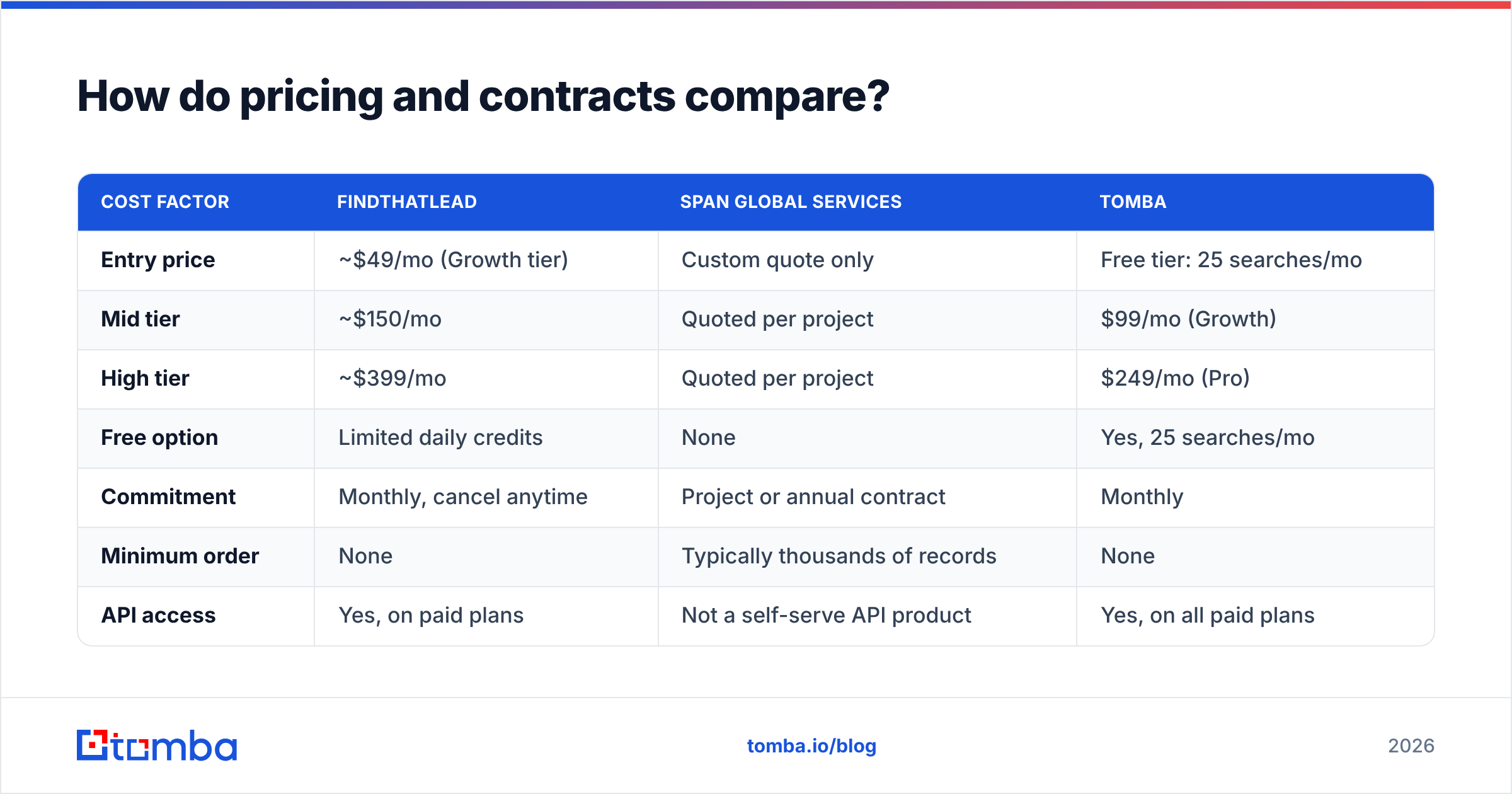
FindThatLead publishes plans. Span Global Services does not. That gap is the single biggest practical difference for a small team.
| Cost factor | FindThatLead | Span Global Services | Tomba |
|---|---|---|---|
| Entry price | ~$49/mo (Growth tier) | Custom quote only | Free tier: 25 searches/mo |
| Mid tier | ~$150/mo | Quoted per project | $99/mo (Growth) |
| High tier | ~$399/mo | Quoted per project | $249/mo (Pro) |
| Free option | Limited daily credits | None | Yes, 25 searches/mo |
| Commitment | Monthly, cancel anytime | Project or annual contract | Monthly |
| Minimum order | None | Typically thousands of records | None |
| API access | Yes, on paid plans | Not a self-serve API product | Yes, on all paid plans |
Two caveats. First, both vendors change pricing, so check findthatlead.com and get a live quote from Span Global before you budget.
Second, list pricing is usually quoted per record. That means "cheap" and "expensive" flip with volume. Five hundred records from a list broker can cost more per contact than a full month of a self-serve tool. Two hundred thousand records may come out cheaper per row than any credit plan.

For a like-for-like reference point on credit-based plans, Tomba pricing starts free at 25 searches/mo. Paid tiers run $49 (Starter), $99 (Growth), and $249 (Pro), with the API included rather than gated behind an upgrade.
What does the buying process actually feel like?#
FindThatLead: sign up, run a domain search, see results in under five minutes. If it does not work for your ICP, you cancel next month. Total risk: one subscription cycle.
Span Global Services: fill in a request form, take a discovery call, describe your audience, then wait for a count and a quote. After that you negotiate, sign, and receive the file. Total risk: a contract and a delivery you can only partly inspect before you pay.
That is not a bad thing on its own. It is how the list industry has always worked. For a $2M ABM program with a defined healthcare or enterprise-IT audience, a specialist broker often beats a generic tool. But it is a procurement motion, not a product trial.
If you want third-party signal on FindThatLead vs Span Global Services before either commitment, G2 carries reviews for both categories. It is the fastest way to see whether other buyers in your segment got what they were promised.
FindThatLead vs Span Global Services: which wins for cold outbound?#
For most cold-email teams, FindThatLead wins — with one condition.
Cold outbound punishes stale data harder than any other channel. Google and Yahoo's bulk sender rules pushed spam-complaint thresholds down to 0.3%. Hard bounces above roughly 2% start to erode sender reputation. A 20,000-row purchased file, sent cold, is the classic way to torch a sending domain in week one.
A live finder avoids that failure mode by design. You pull 200 contacts for this week's sequence, verify them, send, then pull the next 200. Small batches, fresh records, contained blast radius.
Here is the condition. FindThatLead's own verification is a convenience feature, not a replacement for a dedicated verification pass, and catch-all domains are where that shows. If you send at volume, run a second check with a catch-all verifier before anything hits your sequencer.
Span Global still wins on one outbound scenario: direct mail and phone-led campaigns in regulated verticals. Postal data and tele-verified numbers are what list brokers are built for. A self-serve email finder will not give you a validated mailing address at scale.
Where does each option break down?#
FindThatLead — weak spots
- Coverage gaps on small companies, non-Western domains, and privacy-heavy regions. You burn credits on empty results.
- Credit opacity. Different actions use different credit amounts, so forecasting monthly spend takes a couple of cycles.
- Bundled sender is basic next to a dedicated sequencer. Most teams end up paying for both.
- Catch-all ambiguity. Results marked "risky" still need an outside opinion.
Span Global Services — weak spots
- No self-serve entry. You cannot test the data before a sales call.
- Snapshot decay. The file is accurate on delivery day and degrades from there, with no re-pull option.
- Opaque provenance. You are trusting the compilation process. GDPR-covered audiences need a documented lawful basis, and you must ask about it directly.
- Minimums. A 300-contact pilot is usually not a supported purchase.

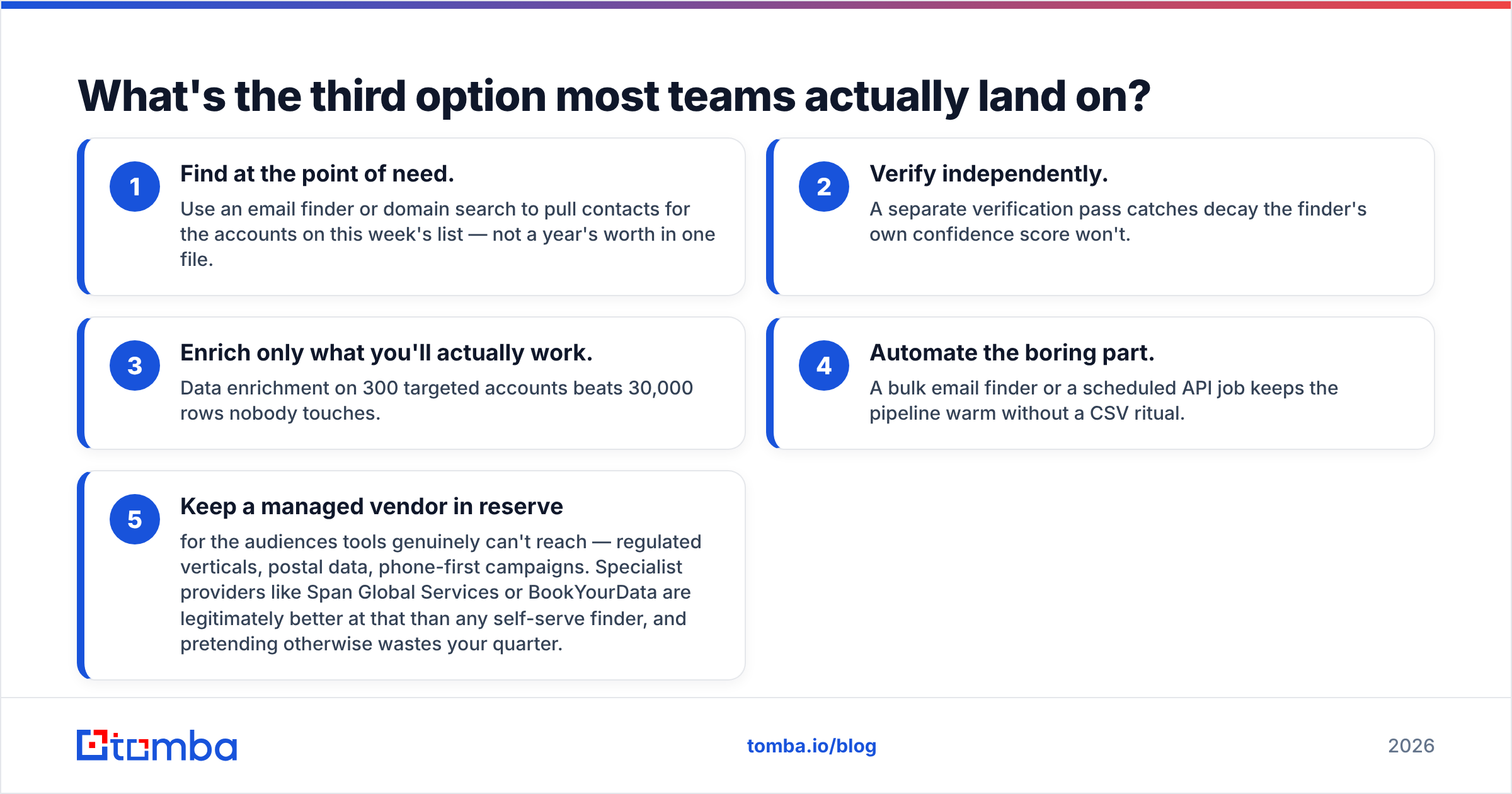
What's the third option most teams actually land on?#
The pattern that survives contact with reality is live find, independent verify, enrich on demand. It does not require picking a side in this comparison.
- Find at the point of need. Use an email finder or domain search to pull contacts for this week's accounts, not a year's worth in one file.
- Verify independently. A separate pass catches decay that the finder's own confidence score will not.
- Enrich only what you will work. Data enrichment on 300 targeted accounts beats 30,000 rows nobody touches.
- Automate the boring part. A bulk email finder or a scheduled API job keeps the pipeline warm without a CSV ritual.
- Keep a managed vendor in reserve for audiences tools cannot reach: regulated verticals, postal data, phone-first campaigns. Providers like Span Global Services or BookYourData are better at that than any self-serve finder.
That last point matters. This is not a "tools always beat lists" argument. It is that for the 80% of B2B outbound that is email-led and account-based, the self-serve model gives you fresher data, faster iteration, and no procurement cycle.
How should you decide?#
Answer three questions honestly, and the FindThatLead vs Span Global Services call gets easy.
1. Can you test before you commit? If the answer for a vendor is no, that is a real cost, not a formality. Self-serve tools let you test against your own ICP in an afternoon.
2. How fast does your audience change? Startup and mid-market contacts change roles constantly, so a static file is a depreciating asset. Enterprise contacts in regulated industries move more slowly, which makes a compiled list easier to defend.
3. What channel are you running? Email-led means a live finder plus a verifier. Phone or direct mail means a specialist data vendor earns its quote. Multi-channel means both, but never let a list feed your email sends unverified.
The bottom line#
FindThatLead vs Span Global Services comes down to two ends of the same problem. FindThatLead is fast, transparent, and self-serve, and it fits email-led outbound where freshness beats breadth. Span Global Services is a managed, quoted, vertical-strong data service. It makes sense when you need postal or phone data at scale in a defined industry, and when you have the budget and timeline for a procurement cycle.
If your motion is cold email and your bottleneck is finding verified addresses for accounts you have already chosen, skip the file and run lookups on demand. Start free with the Tomba Email Finder: 25 searches a month at no cost, $49/mo when you outgrow it, with the API, Chrome extension, and catch-all handling included rather than sold separately. Pull the contacts, verify them, send to a clean list, and keep your sending domain out of the spam folder.
Related guides#
Ready to find emails that actually work?
Join 150,000+ professionals who stopped guessing and started sending. Free credits on signup — no credit card required.
Get the Tomba newsletter
Practical outbound tactics and product updates — once every two weeks.
About the author