FindThatLead vs ZeroBounce (2026): Which Tool Should You Pick?
FindThatLead finds emails. ZeroBounce verifies them. They are not the same product — and picking the wrong one costs you either bounced sends or an empty pipeline. Here is the honest breakdown.
TL;DR
- FindThatLead and ZeroBounce solve different halves of the same problem. FindThatLead sources emails from names, domains, and LinkedIn. ZeroBounce checks whether an email you already have will bounce.
- If you have zero contacts, ZeroBounce alone does nothing for you. If you have a 50k-row list bought from a data broker, FindThatLead alone won't save your sender reputation.
- On pure verification, ZeroBounce is the stronger, more mature product — SOC 2, GDPR posture, deliverability toolkit, and one of the largest published accuracy claims in the category.
- On pure discovery, FindThatLead is cheaper per credit than most finders but has a smaller verified database and thinner API tooling than category leaders.
- Most teams end up paying for both. A combined finder + verifier like Tomba collapses that into one credit pool at $49/mo on Starter — which is the real reason this comparison matters.
Why is FindThatLead vs ZeroBounce a confusing comparison?#
Because they aren't direct competitors, and most "vs" articles pretend they are.
Think of it like a kitchen. FindThatLead is the grocery run — it goes out and brings back ingredients you didn't have. ZeroBounce is the food-safety check — it tells you which of the ingredients already in your fridge have gone bad. You can't cook dinner with only one of them if your fridge is empty and half-spoiled.
Technically: FindThatLead is a prospecting and email-discovery tool. You feed it a first name, last name, and domain — or a LinkedIn URL, or a company domain — and it returns likely business email addresses, usually with a confidence score. It also bolts on a light cold-email sender and lead search.
ZeroBounce is an email validation and deliverability platform. You feed it a list of addresses you already own and it returns a status per address: valid, invalid, catch-all, abuse, spam trap, disposable, role-based. Around that core it sells inbox placement testing, blacklist monitoring, email scoring, and an activity-data product.
The confusion happens because both companies use the phrase "email accuracy" in their marketing. They mean two different things by it. FindThatLead's accuracy is did we guess the right address. ZeroBounce's accuracy is did we correctly predict whether this mailbox exists.

What does FindThatLead actually do well?#
FindThatLead's strongest use case is bulk domain-to-contact expansion for SMB outbound.
Where it earns its keep:
- Lead Search by filters — you pick industry, country, and company size and it returns a contact list. This is the closest FindThatLead gets to a database product, and it's genuinely fast for building a first-pass ICP list.
- Domain Search — drop in
stripe.com, get back the emails it has indexed for that domain, with roles where available. Comparable in shape to any domain search tool. - Chrome extension — pulls contact data while you browse LinkedIn or a company site. Useful for one-off, high-intent lookups rather than volume.
- Built-in sender — a basic cold-email sequencer sits inside the product, so a solo founder can go from search to send without a second subscription.
- Spanish-market coverage — FindThatLead is a Barcelona company and its European, especially Iberian, coverage is noticeably better than US-centric finders.
Where it struggles: catch-all domains. Like most finders, FindThatLead returns pattern-guessed addresses on domains that accept everything, and its own verification layer can't confirm them. That's the single biggest source of bounces in finder-only workflows, and it's why catch-all verification exists as a separate discipline.
What does ZeroBounce actually do well?#
ZeroBounce is the more technically serious product of the two — but only inside its lane.
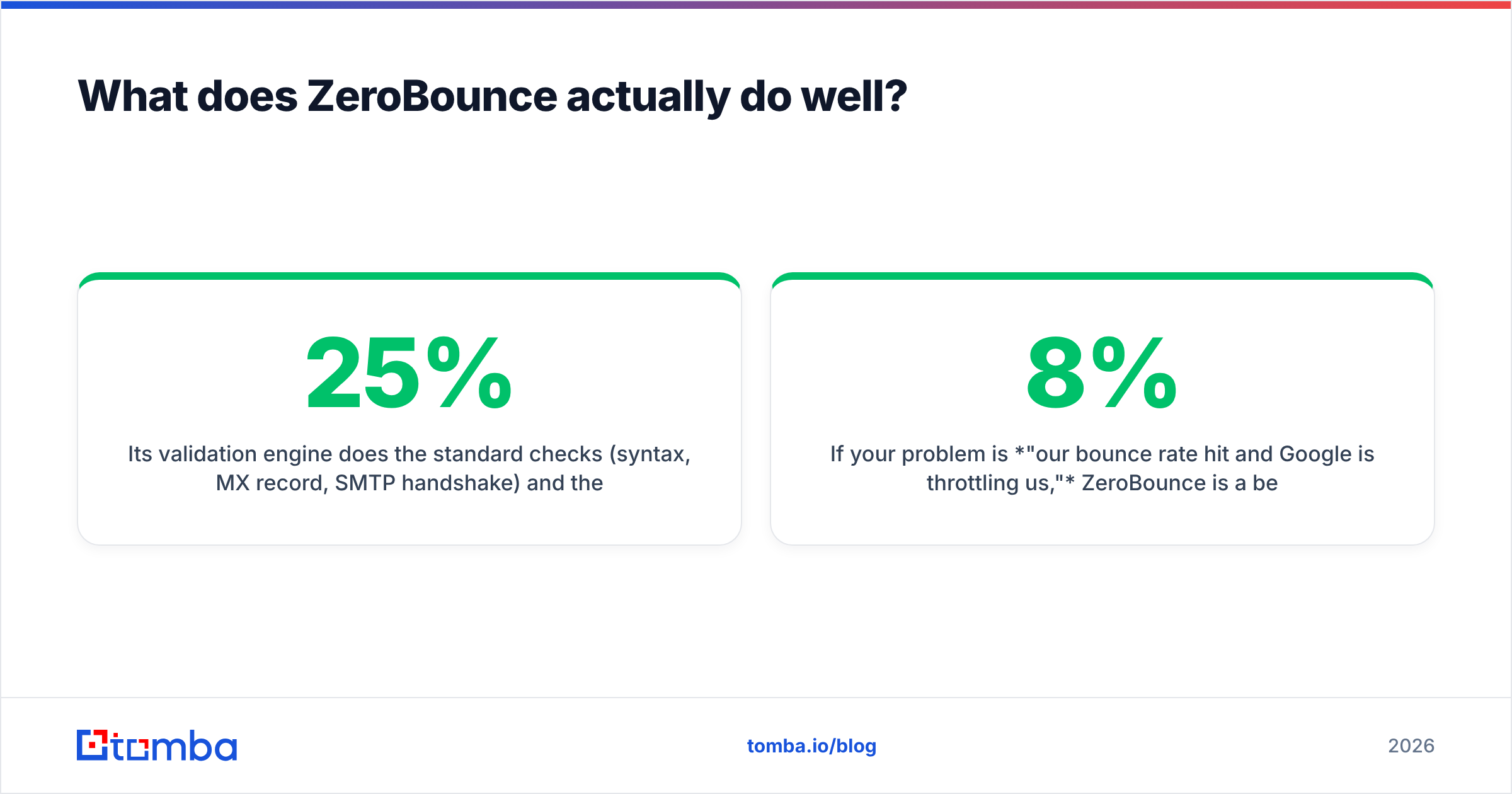
Its validation engine does the standard checks (syntax, MX record, SMTP handshake) and then layers on the parts that actually differentiate verifiers: known spam-trap databases, disposable-domain lists, abuse-reporter flags, and role-account detection. It also assigns an AI-driven quality score to catch-all addresses that a binary verifier would just shrug at — which is meaningful, because catch-alls are typically 15-25% of a B2B list.
The surrounding deliverability suite is where ZeroBounce pulls away from cheaper verifiers:
- Inbox placement tests — send a seed campaign, see which providers put you in spam.
- Blacklist monitor — watches your sending IP and domain across major RBLs.
- Email server tester — validates your SMTP config, SPF, DKIM, and DMARC alignment.
If your problem is "our bounce rate hit 8% and Google is throttling us," ZeroBounce is a better answer than any finder. Bounce rate above 2% is where mailbox providers start treating you as a list-buyer, per Google's bulk sender guidelines, and a verifier is the direct fix.
What ZeroBounce does not do: give you a single new contact. There is no discovery motion in the core product.
How do FindThatLead and ZeroBounce compare on features and price?#
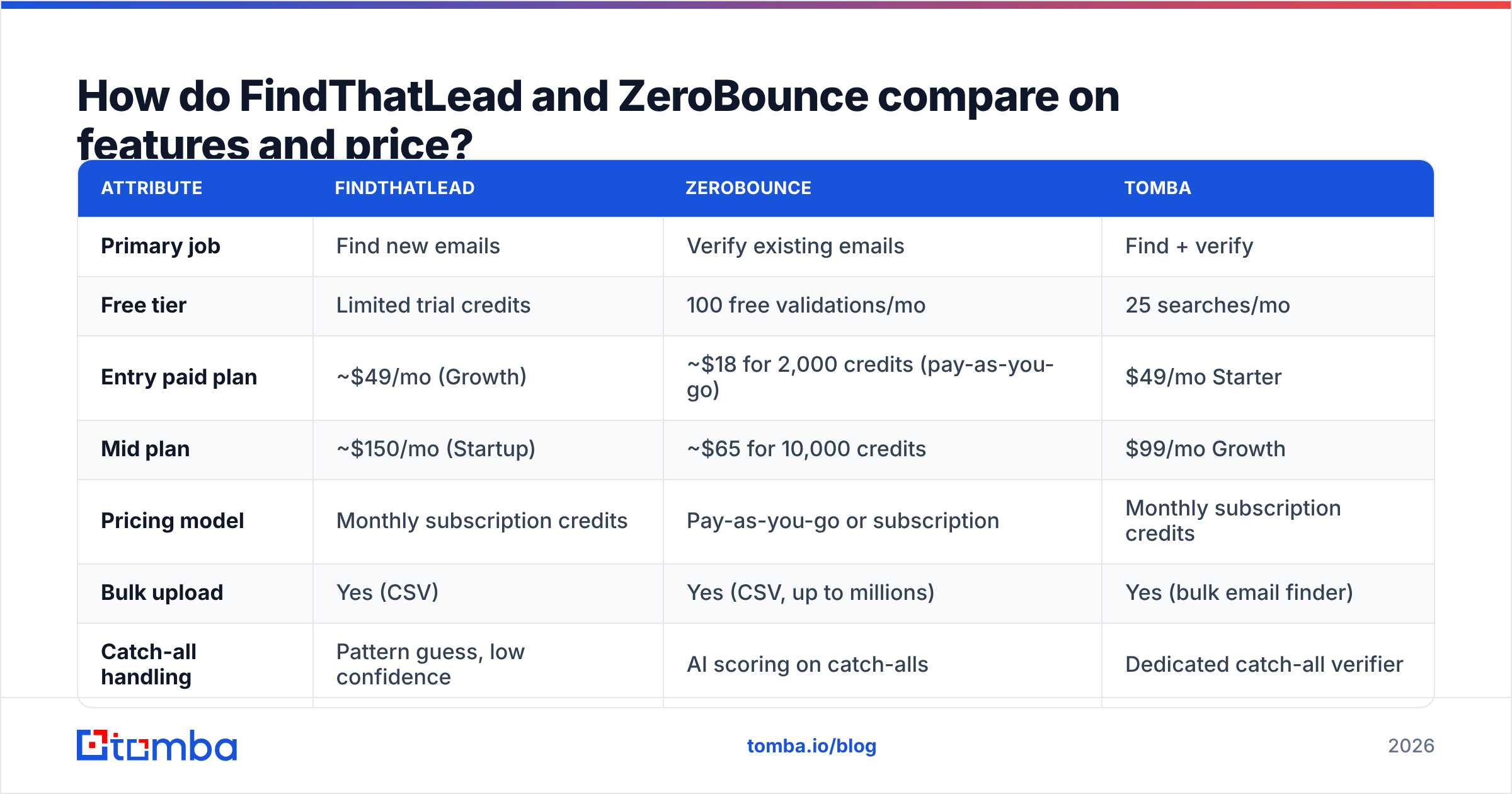
Here is the head-to-head. Prices are entry-level published rates and shift with promotions — check each vendor before you commit.
| Attribute | FindThatLead | ZeroBounce | Tomba |
|---|---|---|---|
| Primary job | Find new emails | Verify existing emails | Find + verify |
| Free tier | Limited trial credits | 100 free validations/mo | 25 searches/mo |
| Entry paid plan | ~$49/mo (Growth) | ~$18 for 2,000 credits (pay-as-you-go) | $49/mo Starter |
| Mid plan | ~$150/mo (Startup) | ~$65 for 10,000 credits | $99/mo Growth |
| Pricing model | Monthly subscription credits | Pay-as-you-go or subscription | Monthly subscription credits |
| Bulk upload | Yes (CSV) | Yes (CSV, up to millions) | Yes (bulk email finder) |
| Catch-all handling | Pattern guess, low confidence | AI scoring on catch-alls | Dedicated catch-all verifier |
| Spam-trap detection | No | Yes | Partial |
| Phone numbers | No | No | Yes (phone finder) |
| Built-in email sender | Yes (basic) | No | No (integrations instead) |
| API | REST, limited docs | REST, well documented, high volume | REST + CLI + MCP |
| Chrome extension | Yes | No | Yes |
| Deliverability toolkit | No | Yes (inbox placement, blacklist) | No |
| Best for | SMB list building, EU/ES markets | List hygiene at scale, ESP compliance | Teams needing both in one pool |
The table makes the structural point: the FindThatLead and ZeroBounce columns barely overlap. You are not choosing between them so much as deciding which problem you have first.

Which one is more accurate?#
Wrong question — but here's the honest answer to the version of it people mean.
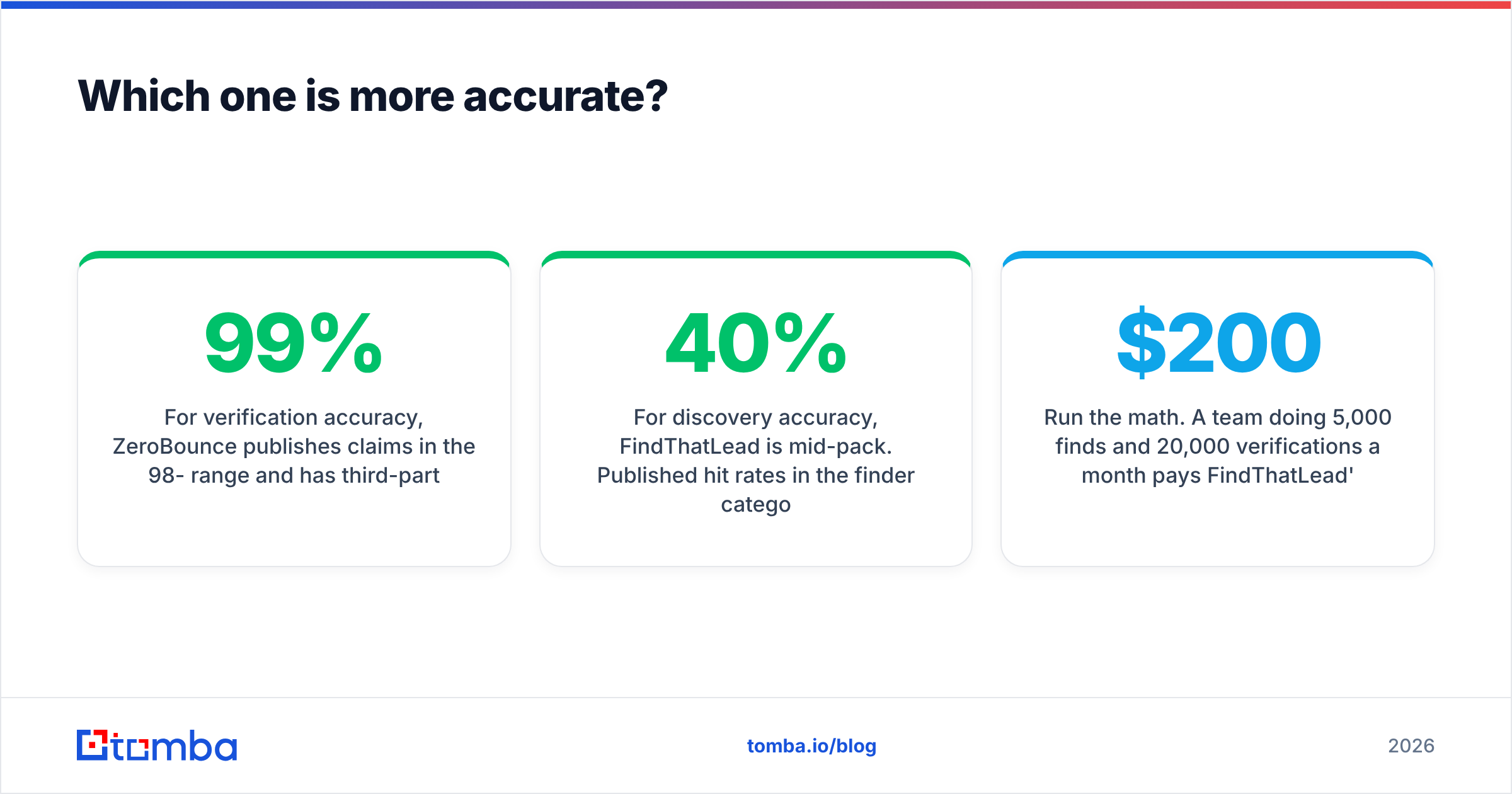
For verification accuracy, ZeroBounce publishes claims in the 98-99% range and has third-party validation on G2 supporting that it performs at the top of the verifier category. Independent testing across verifiers generally shows the leaders clustering within a few percentage points of each other on clean lists, with the real separation showing up on catch-all and greylisted domains. That's where ZeroBounce's scoring layer earns its premium.
For discovery accuracy, FindThatLead is mid-pack. Published hit rates in the finder category range roughly from 40% to 75% depending on the list, and FindThatLead sits comfortably in the middle for US/UK data with a bump for Spanish-language markets. Its weakness is that a returned address isn't necessarily a verified one — you'll want to run results through an email verifier before sending, which means a second tool and a second bill.
That second bill is the part most teams underestimate.
Sorry — that image reference should be plain. Here it is correctly:

Run the math. A team doing 5,000 finds and 20,000 verifications a month pays FindThatLead's mid plan plus ZeroBounce's 20k credit bundle. You're past $200/mo before you've sent a single sequence, and you're reconciling two credit balances, two dashboards, and two API keys.
When should you pick FindThatLead?#
Pick FindThatLead if all of these are true:
- You have no list. Discovery is your bottleneck, not hygiene.
- You're a solo founder or a 2-5 person team. The built-in sender means you skip a separate sequencer subscription.
- Your ICP is European, especially Spanish-speaking. Coverage advantage is real here.
- Volume is modest — under roughly 3,000 finds a month, where the credit price stays reasonable.
- You can tolerate a 5-8% bounce rate or you're willing to bolt a verifier on top.
Skip it if you need phone numbers, deep firmographic enrichment, or a production-grade API. Its documentation and rate limits lag behind what engineering teams expect in 2026.
When should you pick ZeroBounce?#
Pick ZeroBounce if all of these are true:
- You already have contacts — from a CRM, a webinar list, a legacy database, or an acquisition.
- Your bounce rate is hurting you. Sending domain reputation damage compounds; a verifier is the fastest single lever. Read up on sender reputation if you're not sure this is your problem.
- Compliance matters. ZeroBounce's SOC 2 Type II and GDPR posture clears procurement at companies where cheaper verifiers don't.
- You need deliverability diagnostics, not just a valid/invalid flag.
- Volume is spiky. The pay-as-you-go model means you're not paying for idle months.
Skip it if your actual complaint is "we don't have enough leads." No amount of validation creates contacts that don't exist in your CRM.
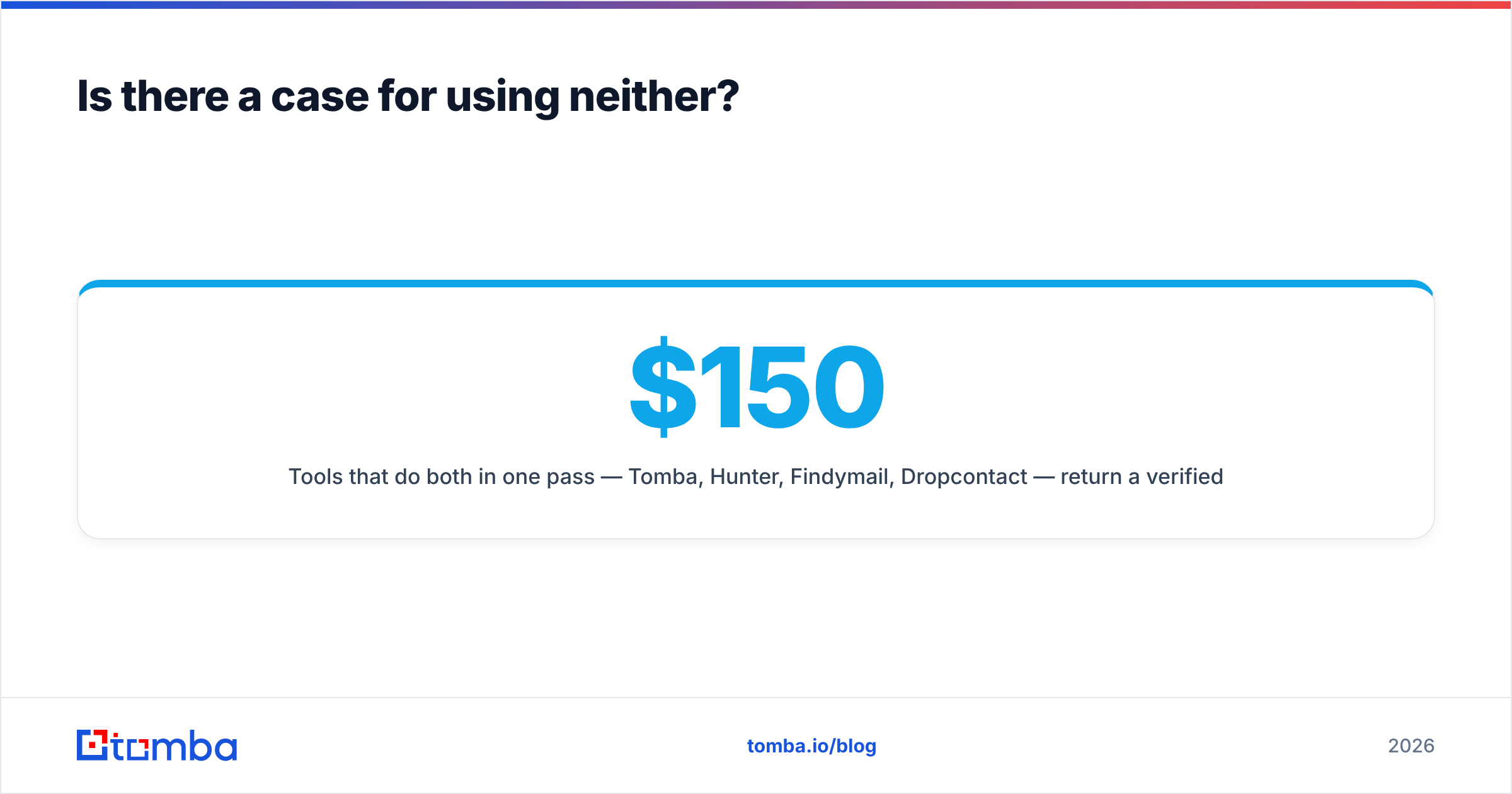
Is there a case for using neither?#
Yes — if the two-tool tax annoys you more than either individual product pleases you.
The consolidation argument is straightforward. Finders and verifiers share infrastructure: the same MX lookups, the same SMTP handshakes, the same pattern databases. When they're split across two vendors, you pay twice for overlapping work and you lose the feedback loop where verification results improve the finder's confidence scoring.
Tools that do both in one pass — Tomba, Hunter, Findymail, Dropcontact — return a verified address as the output of a single credit spend rather than as two sequential purchases. On Tomba specifically, a search returns a confidence-scored address that's already been checked, and the same credit pool covers domain search, data enrichment, and phone finder. Compare that to running FindThatLead ($150) plus ZeroBounce ($65) at similar volumes against Tomba's Growth tier at $99/mo.
Worth naming honestly: if your primary need is a large pre-built B2B contact database rather than on-demand lookup, neither of these tools is the right shape. Providers like BookYourData sell verified, pay-as-you-go contact lists with a bounce guarantee, which is a genuinely different purchase from a lookup API and a better fit for teams that want volume on day one.
What does a sane workflow look like in 2026?#
Whatever tools you pick, the sequence is the same:
- Define the ICP tightly before you spend a single credit. Broad lists are where verification bills explode.
- Source contacts — via a finder, a database, or a LinkedIn email extractor. Cap the batch at what you can actually send to in two weeks.
- Verify everything before it enters your sender. Non-negotiable. Even finder-verified addresses decay roughly 2-3% per month as people change jobs.
- Segment catch-alls separately. Send to them from a secondary domain, or don't send to them at all until you've scored them.
- Warm the sending domain and keep daily volume under your provider's throttle. Use a free email checker for spot-checks before committing a full list.
- Re-verify quarterly. A list you validated in January is measurably worse by April.
Steps 2 and 3 are where the FindThatLead vs ZeroBounce decision lands. Everything else is process, and process is what actually determines whether your bounce rate stays under 2%.
The verdict#
If you must pick one: choose ZeroBounce if you have a list and a deliverability problem; choose FindThatLead if you have neither a list nor a budget for a premium finder. ZeroBounce is the better-built product, but only for the narrower job.
If you can avoid picking one: don't run both. The combined cost, the split credit pools, and the reconciliation overhead are worse than most teams model in advance. A single platform that finds and verifies in the same call removes an entire category of operational friction — and at scale, it removes a line item too.
Try Tomba's Email Finder on the free tier — 25 searches a month, no card — and run the same 25 prospects you'd give FindThatLead. Then check the returned addresses against whatever verifier you're already paying for. If Tomba's verified output matches, you've just found the version of this workflow that costs one subscription instead of two.
Related guides#
Ready to find emails that actually work?
Join 150,000+ professionals who stopped guessing and started sending. Free credits on signup — no credit card required.
Get the Tomba newsletter
Practical outbound tactics and product updates — once every two weeks.
About the author