Findymail vs Goava (2026): Which Prospecting Tool Wins?
Findymail finds and verifies work emails at scale. Goava scores and surfaces Nordic accounts worth calling. They solve different halves of outbound — here's which one your team actually needs in 2026.
Findymail vs Goava is the wrong fight. One tool finds work emails. The other picks the Nordic accounts worth a call. This guide shows which half of your outbound is broken — and which tool fixes it.
TL;DR
- Findymail vs Goava is not a fair fight. Findymail is a contact-data tool. Give it a name and a company, get back a verified work email. Goava is a Nordic sales-intelligence platform. It tells you which firms to chase in Sweden, Norway, Denmark and Finland.
- Pick Findymail if your problem is "I have 3,000 prospects and no emails." It plugs into Clay, Lemlist, Instantly and HubSpot. It also guarantees against bounces.
- Pick Goava if your problem is "we sell to Nordic mid-market and our list is stale." Goava's edge is Nordic registry data, financials, tech signals and account scores. Not email lookups.
- Most Nordic teams that buy Goava still add an email finder. Goava's contact coverage thins out fast below the C-suite.
- Budget: Findymail is self-serve, from about $49 a month. Goava is quote-based and sold per seat, usually for a year. Expect a demo first.
Findymail vs Goava: what does each tool do?#
Findymail is a B2B email finder and verifier. It is built for cold outreach. You feed it a name plus a domain, a LinkedIn URL, or a company list. It returns a work email it says won't bounce.
Two things sell it. First, the bounce guarantee: bad results give your credits back. Second, it fits the modern outbound stack, above all Clay and the sequencer layer. Pricing is public, and you can sign up without a sales call. See the vendor's own page at findymail.com.
Goava is a sales-intelligence platform for the Nordics. Its core product, Goava Discover, reads company registries, financial filings, hiring data, website tech signals and news. It covers Swedish, Norwegian, Danish and Finnish firms.
Goava then scores those firms against your current customers. It tells reps who to call this week. It also pushes that data into HubSpot, Salesforce, Pipedrive and Lime. Details on goava.com.
So the honest way to read "Findymail vs Goava" is not which tool is better. It is which layer of your pipeline is broken.
Findymail vs Goava: how do the basics compare?#
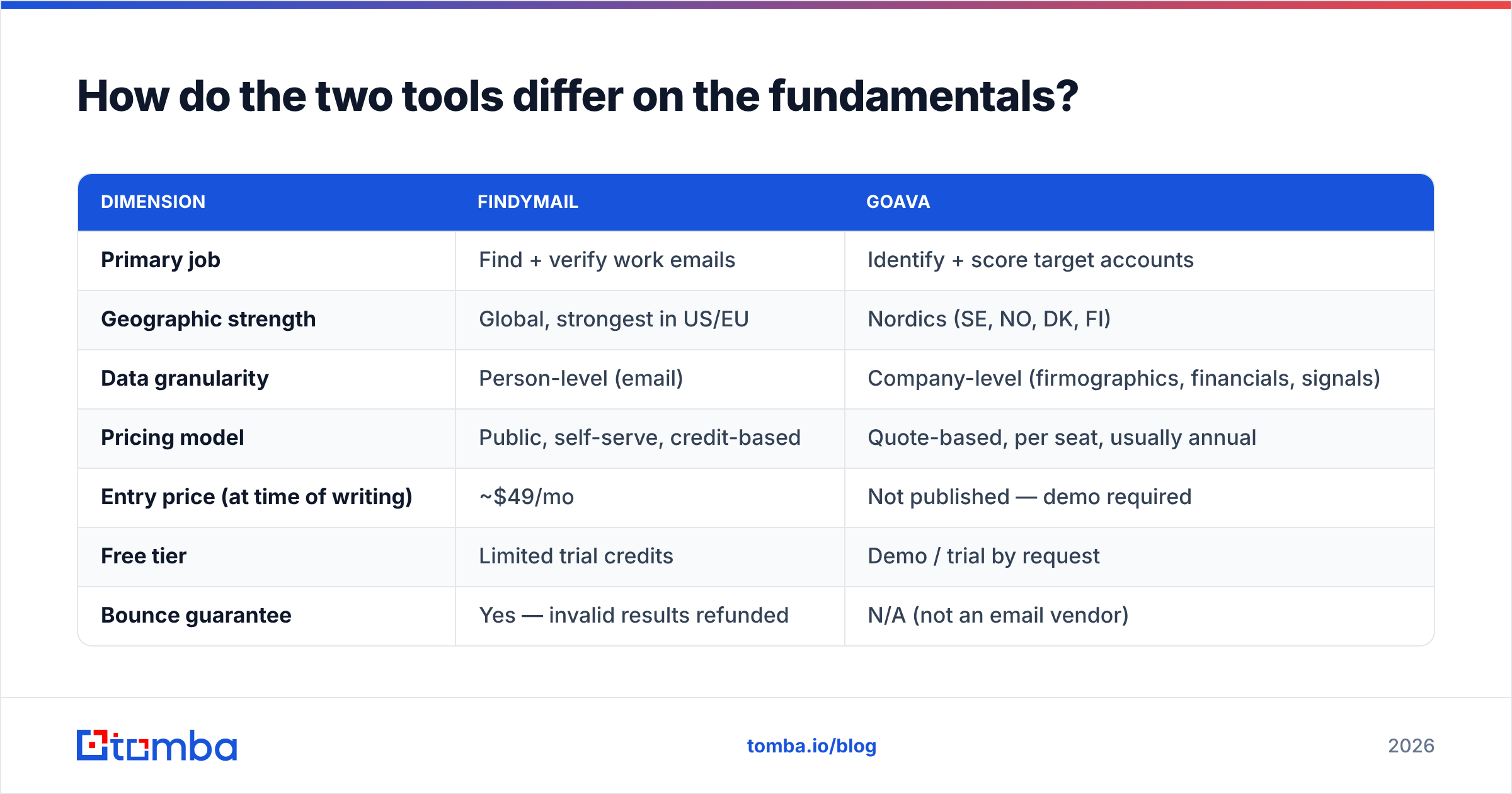
| Dimension | Findymail | Goava |
|---|---|---|
| Main job | Find and verify work emails | Find and score target accounts |
| Best region | Global, strongest in US and EU | Nordics (SE, NO, DK, FI) |
| Data level | Person (email) | Company (size, money, signals) |
| Pricing | Public, self-serve, credits | Quote-based, per seat, yearly |
| Entry price | About $49 a month | Not published — demo first |
| Free tier | A few trial credits | Demo or trial on request |
| Bounce guarantee | Yes — bad results refunded | Not an email vendor |
| API | Yes | Yes, plus CRM sync |
| Typical buyer | Outbound operator, agency | Nordic sales team or manager |
| Time to value | Minutes | Days or weeks |
The table makes the split clear. Findymail answers "what's the email?" Goava answers "who is worth an email?" Buy one and expect the other's job to be done, and you will blame the wrong tool.

Findymail vs Goava: which problem are you solving?#
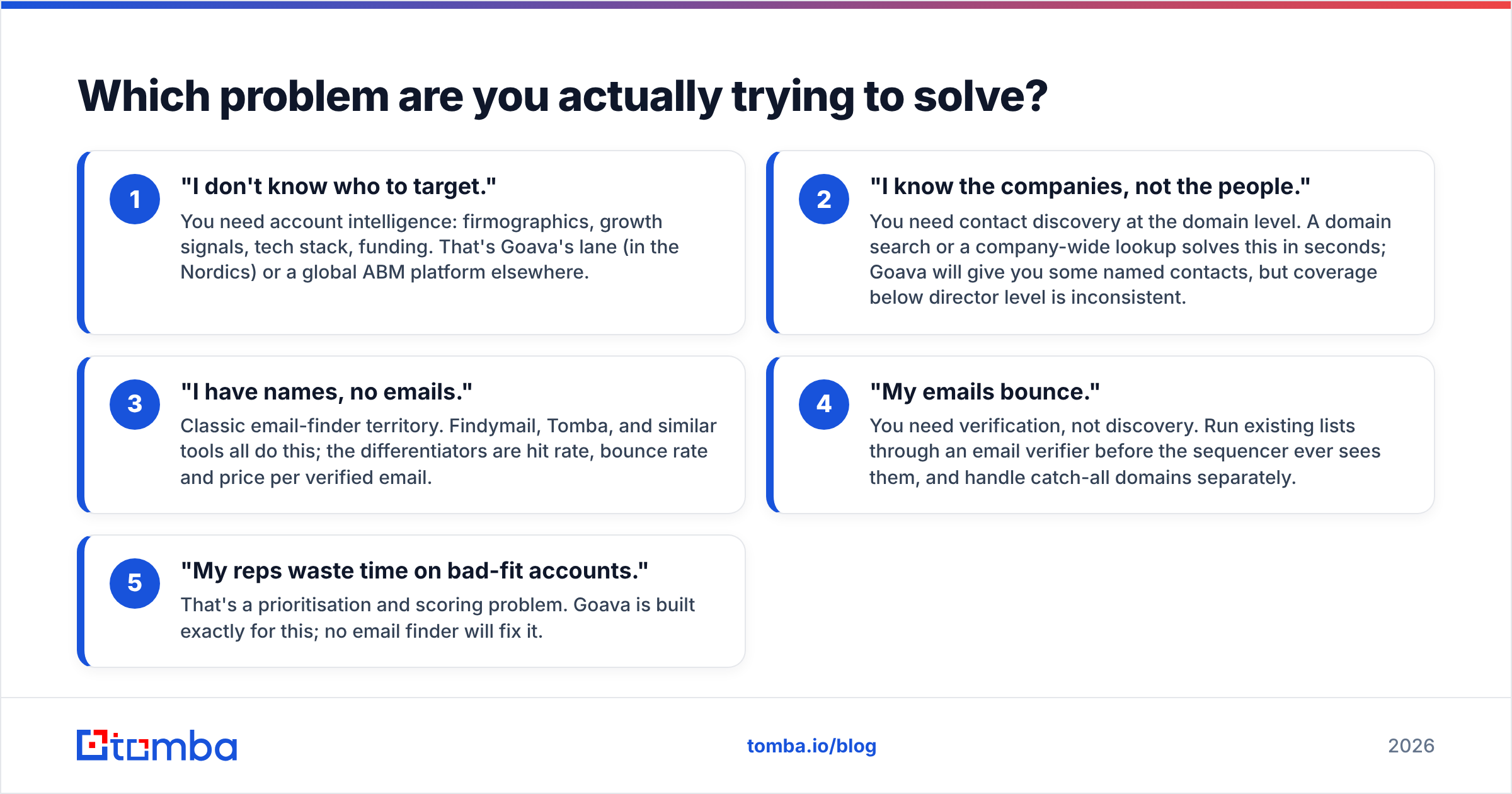
Before you compare features, sort your bottleneck into one of these five buckets. It is the most useful step in the whole review:
- "I don't know who to target." You need account data: size, growth, tech stack, funding. That is Goava's lane in the Nordics. Elsewhere you need a global ABM tool.
- "I know the firms, not the people." You need contacts at the domain level. A domain search does this in seconds. Goava will name some contacts, but coverage below director level is patchy.
- "I have names, no emails." This is email-finder work. Findymail, Tomba and others all do it. What differs is hit rate, bounce rate and price per verified email.
- "My emails bounce." You need checks, not search. Run old lists through an email verifier before the sequencer sees them. Handle catch-all domains on their own.
- "My reps waste time on bad-fit accounts." That is a scoring problem. Goava is built for it. No email finder will fix it.
Buckets 1 and 5 point to Goava. Buckets 2, 3 and 4 point to a data tool like Findymail.
Plenty of teams have gaps in both columns. That is why both products often sit inside the same Nordic sales team rather than compete.
Is Findymail worth the money?#
Findymail has a good name among outbound teams. It earned it by staying narrow. It is not a sequencer, a CRM or an intent tool. What you get:
- A bounce guarantee. If an email hard-bounces or fails a check, the credit comes back. That changes how you budget. You pay for valid emails, not tries.
- Clay-native workflows. Findymail is a first-class data source inside Clay. That is where a lot of list building now happens.
- LinkedIn list export. Push Sales Navigator lists through it and get emails out the other side.
- Simple credit pricing. Public tiers. No haggling.
The trade-offs are just as clear. Coverage is strongest in North America and Western Europe. Nordic small firms with odd domains are hit or miss, as they are for most vendors.
There is no phone data to speak of, and no account scoring. Credits burn per lookup, so a sloppy list drains the budget fast. Clean and de-dupe the list before you enrich it, not after.
Comparing Findymail with true rivals is a different job. There the numbers to watch are hit rate, price per verified email and API fit. Our list of Findymail alternatives covers that field, including where Tomba and others land on cost per usable contact.
Is Goava worth it for Nordic targeting?#
Goava does something a global tool struggles to copy. Swedish and Norwegian company records are public and rich: revenue, headcount, board members, filings. Goava has spent years turning that into a scoring layer.
If you sell to Nordic firms, that is real signal. Apollo, ZoomInfo and Clearbit-style databases handle it poorly, or not at all.
What Goava does well:
- Scores accounts against your own customers. Upload closed-won deals. It finds look-alikes in the Nordic market.
- Triggers on signals. Hiring bursts, new filings, new tech on the site, press mentions.
- Lands in the CRM. The data shows up in HubSpot or Salesforce, where reps already work.
- Reads the local language. Swedish news and filings are parsed properly, not machine-mangled.
Now the trade-offs. Goava is bound to one region by design. A Nordic firm selling into DACH or the US gets far less from it.
Pricing is opaque, per seat, and sold by the year. That is a real barrier for a three-person team. Onboarding is a project, not a signup.
And here is the part that matters most for this comparison: contact-level email coverage is the weakest piece. You will get the CEO and maybe the CFO of a 40-person firm. You often won't get the Head of Ops you actually want to reach.
That gap is why so many Goava customers run an email finder next to it.

Findymail vs Goava: what does each one cost?#
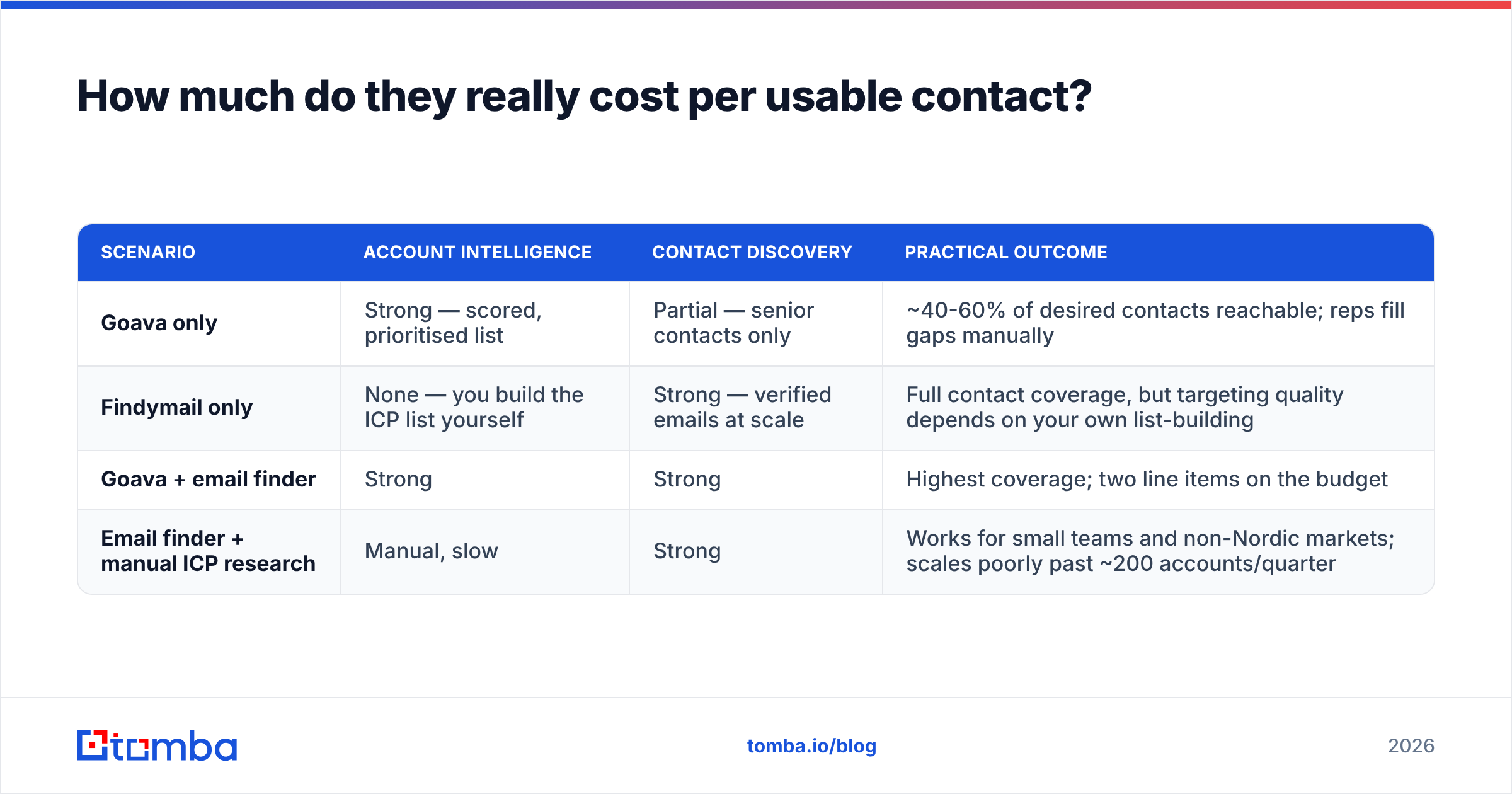
The two tools sit in different categories, so a straight price match is impossible. You can still model the math. Say a Nordic SaaS team targets 500 new accounts a quarter, at three contacts each. That is 1,500 contacts.
| Scenario | Account data | Contact data | Outcome |
|---|---|---|---|
| Goava only | Strong — scored list | Partial — senior only | 40-60% of contacts reachable; reps fill the gaps |
| Findymail only | None — you build the list | Strong — verified at scale | Full contacts, but your own targeting |
| Goava plus a finder | Strong | Strong | Best coverage; two line items |
| Finder plus manual research | Slow and manual | Strong | Fine for small teams; scales poorly |
The cost most teams forget is rep time spent hunting emails by hand. Take 1,500 contacts and a 40% coverage gap. At three minutes per missing address, that is about 30 hours a quarter.
That is far more than any email-finder plan in this class. So the "platform plus finder" stack often wins on total cost, even though the invoice looks like double paying.
One more cost hides in plain sight: catch-all domains. Many European corporate domains accept all mail at the SMTP layer. A naive checker marks them "unknown". You then skip real prospects, or send blind and burn sender reputation.
So ask any finder how it treats catch-alls. A dedicated catch-all verifier step is worth more than a point of headline accuracy.
Findymail vs Goava: which should you pick in 2026?#
Here is the call, stated plainly.
Choose Goava if you sell to Nordic firms. Your reps struggle to pick accounts, not to find emails. You have budget for a yearly per-seat deal, and you want the data inside your CRM. Nothing global matches its depth on Swedish and Norwegian records.
Choose Findymail if your list building is already solved. You live in Clay or a sequencer. You want verified emails, a bounce guarantee and self-serve prices. It is a good, focused tool.
Choose both if you run structured outbound at a Nordic mid-market team. This is the most common end state. It is not a failure of either product.
Choose neither if your market is global. Then you want one platform with a wider surface: domain search, checks, catch-all handling, phone numbers and enrichment in a single credit pool. Stitching three vendors together costs more than it saves. Worth a look: Tomba, BookYourData (strong on hand-checked lists sold as data, not as a tool), and the wider field on G2's lead-intelligence category.
What does a sane combined stack look like?#
If you pick both, wire them in this order. Do not run them side by side.
- Goava sets the account list. Scored, filtered, synced to the CRM. Nothing gets enriched until an account clears the score. That is how you stop burning credits on bad-fit firms.
- Domain-level contact search runs next. For each account that qualifies, pull every role you care about. A bulk email finder run is the cheapest way to do it.
- Checks run before the sequencer, always. Catch-alls included. Anything risky gets held, not sent.
- Enrichment fills the rest. Job title, seniority, LinkedIn, phone where you need it, via data enrichment. Empty tokens kill personalisation.
- Everything writes back to one CRM record. Split the data across two systems and reps will trust neither.
Steps 2 to 4 are where the choice between Findymail, Tomba and the rest really bites. Compare price per verified contact, not price per lookup. Check the published Tomba pricing tiers (Free at 25 searches a month, Starter $49, Growth $99, Pro $249) against Findymail's credit tiers on the same basis.
The bottom line#
Findymail vs Goava is a category mismatch dressed up as a duel. Goava tells you which Nordic accounts deserve your quarter. Findymail tells you how to reach the people inside them. The only real mistake is buying the wrong one for your gap.
Say your gap is contact data. You know who to target. You just need verified work emails across regions, formats and catch-all domains. Start with the Tomba Email Finder.
The free tier gives you 25 searches a month, so you can test hit rate on your own list first. Checks come out of the same credit pool, not a separate bill. The Tomba API drops into Clay, HubSpot or your own scripts in an afternoon. Run 100 of your hardest prospects through it, measure the bounce rate, and let the numbers pick your vendor.
Related guides#
Ready to find emails that actually work?
Join 150,000+ professionals who stopped guessing and started sending. Free credits on signup — no credit card required.
Get the Tomba newsletter
Practical outbound tactics and product updates — once every two weeks.
About the author