Findymail vs Smarte: Which B2B Email Data Tool Wins in 2026?
Findymail sells verified-only accuracy. Smarte sells global coverage and mobile numbers. We compare credits, pricing, exports, and API access to show which one actually fits your outbound motion.
TL;DR
- Findymail is a narrow, opinionated email finder: it only returns addresses it believes are valid, refunds credits on bounces, and integrates tightly with Lemlist, Instantly, and Smartlead. Great for pure cold-email teams.
- Smarte is a broader GTM data platform: contact records, mobile numbers, firmographics, intent signals, and a Chrome extension, with strong non-US coverage across EMEA and APAC.
- Pricing transparency splits them. Findymail publishes self-serve tiers starting around $49/mo; Smarte routes most buyers through sales for a quote, which slows evaluation.
- Neither is a full replacement for the other. If your bottleneck is "I have a list of names and need clean emails," Findymail wins. If it's "I don't know who to target yet," Smarte does more.
- A third option matters here: if you want verified emails and phone numbers and published pricing and a real API, evaluate Tomba alongside both before you commit to an annual contract.
What Are Findymail and Smarte, Exactly?#
They get compared constantly, but they're solving different halves of the same problem.
Findymail launched as a reaction to a specific frustration: email finders that return a guess, charge you a credit for it, and let you eat the bounce. Its pitch is verified-only output. If the tool can't confirm the address, it doesn't sell it to you, and bounced addresses get credited back. It also handles LinkedIn Sales Navigator list exports, which is how most of its users actually feed it. See the vendor's own positioning at findymail.com.
Smarte (often written SMARTe) is a B2B go-to-market data platform. It sells access to a contact and company database with emails, direct dials and mobile numbers, technographics, and buying-intent signals, plus a browser extension that reveals contacts while you browse LinkedIn or a company site. Its differentiator is geographic reach: coverage outside North America is a recurring point of praise in reviews on G2. The product overview lives at smarte.io.
So the honest framing of findymail vs smarte isn't "which tool is better." It's "is your constraint enrichment or discovery?"

How Do Findymail and Smarte Compare Feature by Feature?#
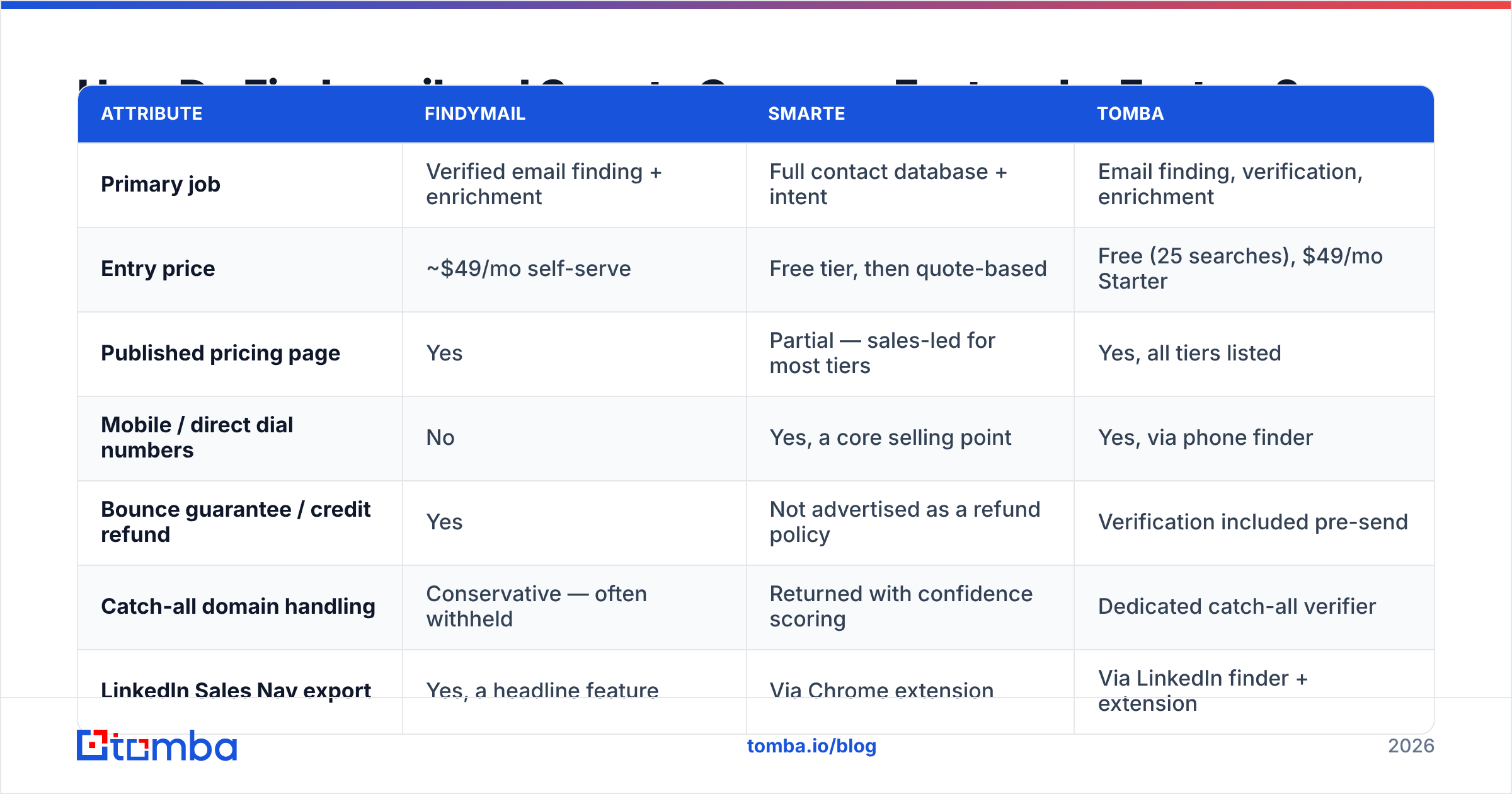
Here's the head-to-head on the attributes that actually change your workflow. Treat pricing as directional — both vendors adjust tiers, and Smarte's are largely quote-driven.
| Attribute | Findymail | Smarte | Tomba |
|---|---|---|---|
| Primary job | Verified email finding + enrichment | Full contact database + intent | Email finding, verification, enrichment |
| Entry price | ~$49/mo self-serve | Free tier, then quote-based | Free (25 searches), $49/mo Starter |
| Published pricing page | Yes | Partial — sales-led for most tiers | Yes, all tiers listed |
| Mobile / direct dial numbers | No | Yes, a core selling point | Yes, via phone finder |
| Bounce guarantee / credit refund | Yes | Not advertised as a refund policy | Verification included pre-send |
| Catch-all domain handling | Conservative — often withheld | Returned with confidence scoring | Dedicated catch-all verifier |
| LinkedIn Sales Nav export | Yes, a headline feature | Via Chrome extension | Via LinkedIn finder + extension |
| API access | Yes | Yes, typically higher tiers | Yes, on all paid plans |
| Best-fit geography | Strong US/EU on known domains | Strong EMEA + APAC coverage | Global, domain-pattern driven |
| Free tier to test | Limited trial credits | Yes, limited credits | Yes, 25 searches/mo |
The pattern is clear. Findymail optimizes for precision on a list you already have. Smarte optimizes for breadth when you're still building the list. Tools like Tomba sit between the two, pairing a bulk email finder with verification in one workflow.
Which One Has Better Data Accuracy?#
Accuracy claims from vendors are close to worthless in isolation, because every vendor measures a different thing. What matters is how the tool behaves when it isn't sure.
Findymail's design choice is to withhold. If it can't validate the mailbox, you don't get a result and you don't burn a credit. The practical effect: your hit rate looks lower on paper, but your bounce rate stays low. Teams sending from a handful of warmed domains love this, because a 4% bounce rate on a fresh domain is an expensive mistake.
Smarte's design choice is to return more, with metadata around it. You get a record with a confidence indicator and you decide. That's the right call for a research or ABM workflow where a probable email plus a mobile number plus a job change signal is more useful than a strict yes/no. It's the wrong call if you're piping records straight into a sequencer without a verification step.

Three things drive real-world accuracy more than any vendor benchmark:
- Domain pattern confidence. Tools that have seen thousands of verified addresses at
acme.comwill inferfirst.last@acme.comreliably. Tools seeing the domain for the first time are guessing. - Catch-all handling. Roughly one in five B2B domains accepts everything at the SMTP layer. A tool that reports "valid" on a catch-all is lying to you by omission. This is why a dedicated catch-all verifier matters more than headline accuracy percentages.
- Recency of the underlying record. B2B contact data decays roughly 25–30% per year through job changes alone. A 2023 record verified once in 2023 is not a 2026 record.
If you're running a bake-off, do it right: take 200 contacts you can independently confirm, run the same list through both tools, and measure three numbers — match rate, bounce rate, and cost per delivered email. That last metric is the only one that maps to pipeline.
How Does Pricing Actually Compare?#
This is where the two tools diverge most, and it's a bigger deal than most comparison posts admit.
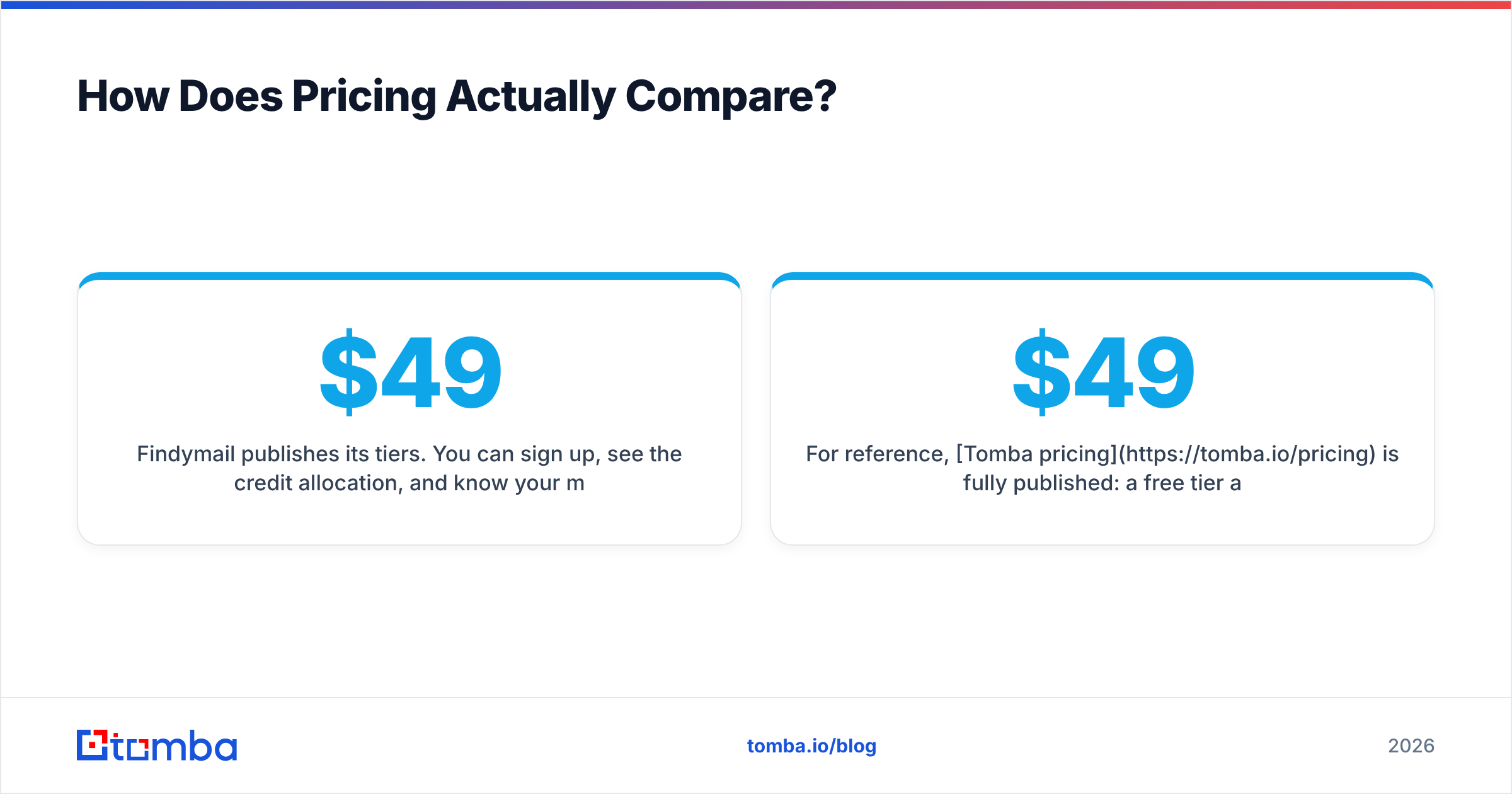
Findymail publishes its tiers. You can sign up, see the credit allocation, and know your monthly cost before talking to anyone. Entry pricing lands around $49/mo, scaling into the $99 and $249 ranges as credit volume grows. Credits are consumed per successful find, and bounces are refunded.
Smarte offers a free tier with limited credits, then moves most serious buyers into a quoted plan — often annual, often per-seat, often with a credit pool negotiated separately. That model is normal for data platforms, but it has consequences:
- Evaluation takes longer. You need a demo before you know the number.
- Seat costs compound. A five-person SDR team on a per-seat platform pays very differently than one ops person running batch enrichment.
- Annual commitment reduces flexibility. If your ICP shifts in Q2, you're still paying for the geography you bought in Q1.
Neither model is wrong. Sales-led pricing usually buys you coverage, support, and compliance documentation that self-serve tools don't staff for. But if you're a small team that needs to test a channel this month, "book a call" is friction you may not want.
For reference, Tomba pricing is fully published: a free tier at 25 searches/month, Starter at $49/mo, Growth at $99/mo, Pro at $249/mo, and custom Enterprise. Credits are shared across finding, verification, and enrichment rather than siloed per product — which matters when your mix shifts month to month.

Which Tool Fits Your Workflow Better?#
Forget features for a moment and match the tool to how your team actually works.
Choose Findymail if:
- Your primary input is a Sales Navigator search or an existing list of names + companies.
- You send from a small number of domains and bounce rate is a board-level metric.
- You're already in Lemlist, Instantly, or Smartlead and want a drop-in enrichment step.
- You want to start today without a procurement conversation.
Choose Smarte if:
- You're prospecting into EMEA or APAC where US-centric databases thin out fast.
- Mobile numbers and direct dials are part of your sequence, not just email.
- You need intent or technographic filters to build the list in the first place.
- You have a RevOps function that can absorb a platform rollout and per-seat licensing.
Consider a third option if:
- You want published pricing and phone data and verification in one place.
- You need an email finder API that developers can wire into an internal tool without an enterprise contract.
- Your volume is spiky and you don't want to buy annual seats for a quarterly campaign.
There are other credible tools in this space worth benchmarking too — BookYourData, for example, takes a pay-as-you-go, verified-list approach that suits teams who'd rather buy a clean list once than subscribe. Different model, legitimately good fit for some buyers.

What Do Both Tools Get Wrong?#
Every vendor comparison should include this section, and most skip it.
Findymail's limits. No phone data means a second vendor if you run multichannel. Coverage falls off on smaller international domains where there's less public signal to learn from. And the conservative approach that keeps bounces low also means you'll finish a list with genuine gaps — you'll get 60–70% coverage on a mixed list and have to source the rest elsewhere.
Smarte's limits. The quote-based motion is a real barrier for teams under 10 people. Database platforms also carry a staleness problem that no amount of filtering fixes: a record marked "verified" six months ago is a coin flip today unless it's re-checked at send time. And broad databases invite bad habits — it's easy to build a 40,000-contact list you have no business emailing.
The shared blind spot. Neither tool exempts you from verification discipline. Whichever you pick, re-verify before every send, not at purchase time. That's a five-minute step with an email verifier and it's the difference between landing in the inbox and burning a domain you spent eight weeks warming.
What's the Verdict on Findymail vs Smarte in 2026?#
Findymail wins on precision and speed to value. Smarte wins on coverage and multichannel data.
If someone forced a single answer: most small-to-mid outbound teams sending email-first sequences will get more value, faster, from Findymail. The self-serve signup, the bounce refund, and the Sales Nav export cover the 80% case without a procurement cycle.
Teams selling globally, running phone plus email, or needing intent data to build the target list at all will find Findymail too narrow and should evaluate Smarte properly — including asking hard questions about record recency and per-region fill rates during the demo. Don't accept a global accuracy number; ask for fill rate in your target countries and job titles.
And if the comparison exposed that you actually need pieces of both — verified emails, phone numbers, transparent pricing, and API access without an annual commitment — that's the profile a consolidated tool serves better than either specialist.
Getting Started Without Locking In#
Run a 200-contact bake-off before you sign anything. Same list, both tools, measure match rate, bounce rate, and cost per delivered email. Add a third tool to the test if you want a real baseline rather than a two-way comparison that flatters whichever vendor you already leaned toward.
If you want that third data point, Tomba's Email Finder gives you 25 free searches a month with no card — enough to run a meaningful sample against the same list you're testing Findymail and Smarte on. Verification, catch-all checks, domain search, and phone lookup run on the same credit pool, so the number you see at $49/mo is the number you pay. Test all three, keep the one that produces the lowest cost per reply, and let the data pick the winner instead of the sales deck.
Related guides#
Ready to find emails that actually work?
Join 150,000+ professionals who stopped guessing and started sending. Free credits on signup — no credit card required.
Get the Tomba newsletter
Practical outbound tactics and product updates — once every two weeks.
About the author