Findymail vs VC-Backed Email Finders: 2026 Comparison
Findymail is bootstrapped and credit-honest. Apollo, ZoomInfo and Lusha are VC-backed and built for scale. Here is how the two models differ on accuracy, credits, contracts and real 2026 cost.
TL;DR
- Findymail is a small, bootstrapped, verification-first email finder. Its headline promise is that you are not charged for emails it cannot find or verify. Great for lean outbound teams that live inside LinkedIn Sales Navigator.
- VC-backed platforms (Apollo.io, ZoomInfo, Lusha, Seamless.AI, Clearbit-now-inside-HubSpot) sell breadth: giant prebuilt databases, intent signals, sequencers, dialers, CRM sync. You pay for the platform, usually per seat, usually annually.
- The real split is not "who finds more emails." It is credit honesty and contract shape. Bootstrapped tools charge per verified result; VC-backed tools charge per seat and per export, and they meter aggressively.
- Accuracy differences between serious vendors are smaller than the marketing suggests — typically a 5–15 point spread on the same test list. Cost differences are 3–10x.
- If you want per-verified-result pricing plus API depth and a real free tier, Tomba sits between the two models: $49/mo Starter, 25 free searches to test, and no seat tax.
What does "Findymail vs VC-backed" actually mean?#
It is a comparison of two business models, not two feature lists.
Findymail is a bootstrapped product built by a very small team. No board, no growth targets set by a fund, no enterprise sales motion. The product does one job — turn a name, domain, or LinkedIn profile into a deliverable email — and it charges you only when it succeeds.
"VC-backed" is the rest of the category: Apollo.io (hundreds of millions raised), ZoomInfo (public, formerly DiscoverOrg), Lusha, Seamless.AI, LeadIQ, and Clearbit, which HubSpot acquired and folded into its Breeze data layer. These companies are funded to become platforms. That funding shapes everything you experience as a buyer: seat-based pricing, annual commitments, aggressive export limits, upsell paths into sequencing and intent data, and a database that must keep growing whether or not the records stay accurate.
Neither model is inherently better. But they fail differently, and the failure modes matter more than the feature grids.
How do the two models differ in practice?#
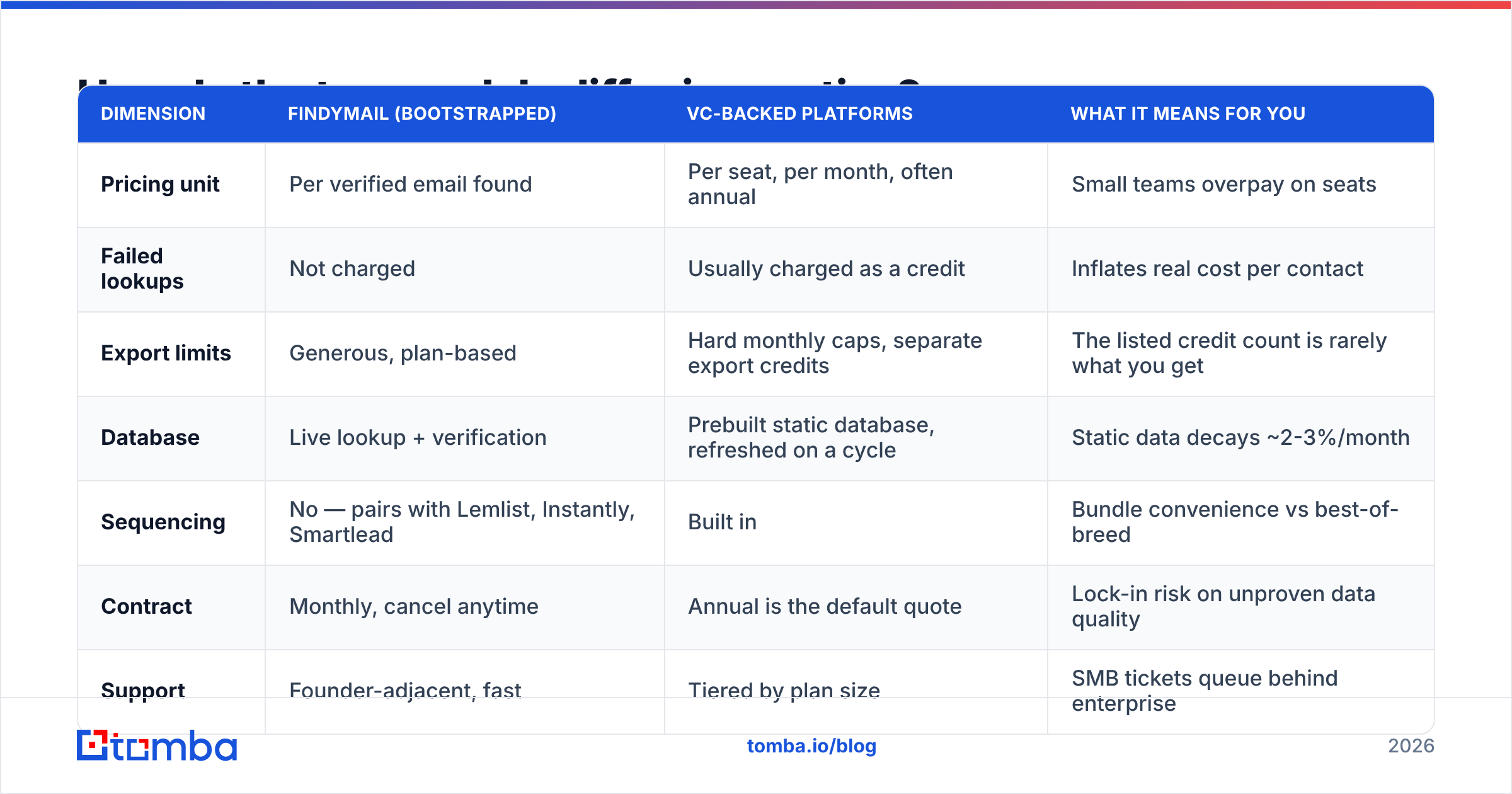
| Dimension | Findymail (bootstrapped) | VC-backed platforms | What it means for you |
|---|---|---|---|
| Pricing unit | Per verified email found | Per seat, per month, often annual | Small teams overpay on seats |
| Failed lookups | Not charged | Usually charged as a credit | Inflates real cost per contact |
| Export limits | Generous, plan-based | Hard monthly caps, separate export credits | The listed credit count is rarely what you get |
| Database | Live lookup + verification | Prebuilt static database, refreshed on a cycle | Static data decays ~2-3%/month |
| Sequencing | No — pairs with Lemlist, Instantly, Smartlead | Built in | Bundle convenience vs best-of-breed |
| Contract | Monthly, cancel anytime | Annual is the default quote | Lock-in risk on unproven data quality |
| Support | Founder-adjacent, fast | Tiered by plan size | SMB tickets queue behind enterprise |
| API depth | Basic, functional | Deep but gated to higher tiers | Matters if you are building workflows |
The row that costs teams the most money is "failed lookups." A platform that charges a credit whether or not it returns a valid address effectively doubles your cost per usable contact when hit rate sits near 50%. That is the whole reason the bootstrapped tools built their pricing the way they did.

Which one is more accurate?#
Accuracy claims in this category are close to meaningless unless you know the test list. Every vendor benchmarks on data that flatters its own coverage. A tool tuned for US SaaS mid-market will crush a US SaaS mid-market list and fall apart on European manufacturing or APAC logistics.

Here is what actually separates results in a fair head-to-head:
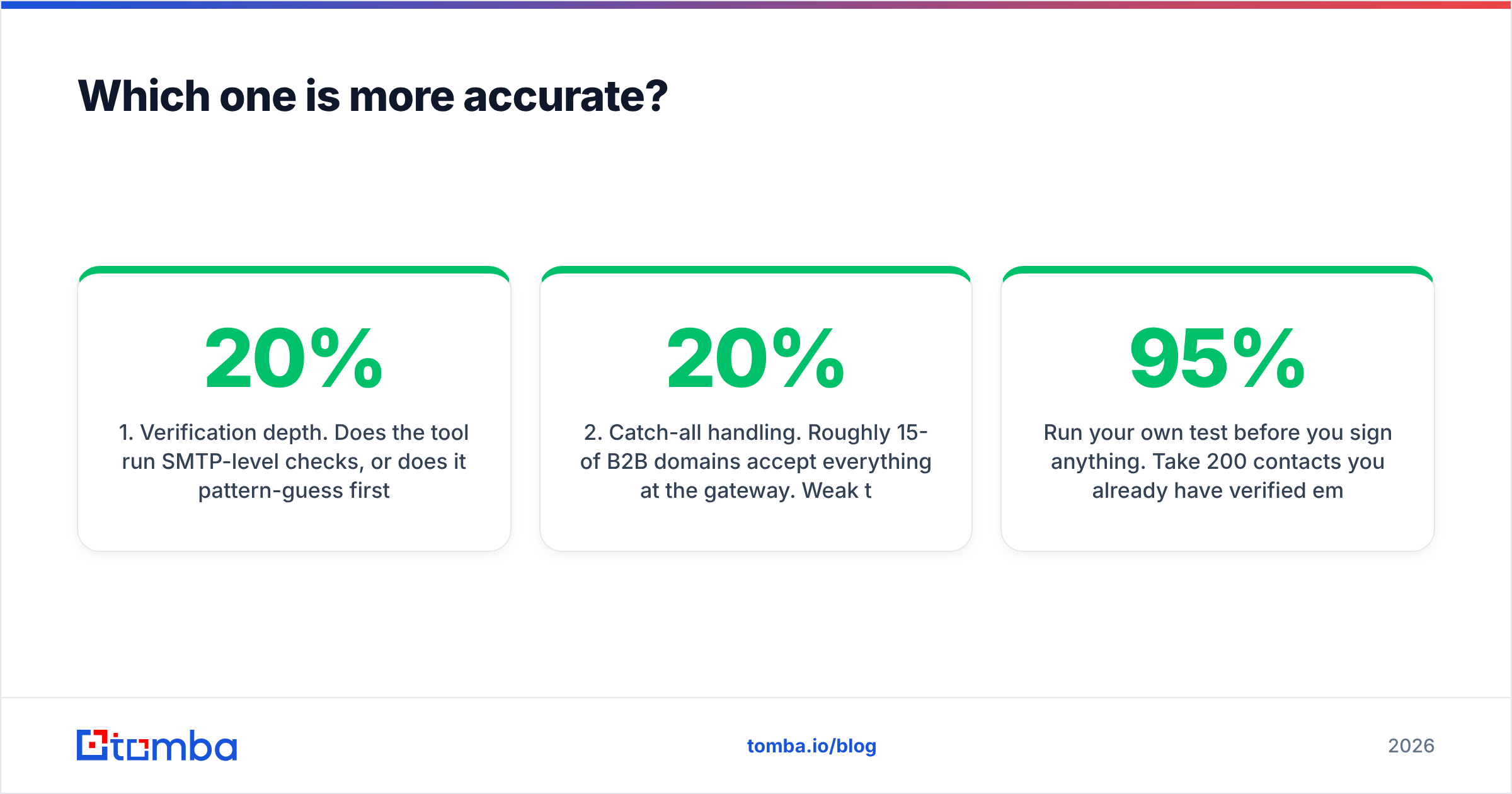
- Verification depth. Does the tool run SMTP-level checks, or does it pattern-guess
first.last@domain.comand ship it? Pattern guessing produces addresses that look right and bounce at 20%+. - Catch-all handling. Roughly 15-20% of B2B domains accept everything at the gateway. Weak tools mark these "valid" and let you find out on send. Strong tools flag them separately — that is why a dedicated catch-all verifier exists as its own product surface.
- Recency of the source record. A giant database with a 90-day refresh cycle is worse than a live lookup against a company's current web presence and public sources.
- Role-account filtering.
info@,sales@,support@inflate hit-rate stats and destroy reply rates. - Honest nulls. The most underrated accuracy feature is a tool that says "not found" instead of returning a guess. Findymail built its brand on this. VC-backed tools are structurally incentivised not to, because a null is a credit they cannot bill.
Run your own test before you sign anything. Take 200 contacts you already have verified emails for, strip the emails, and run the list through each finalist. Measure three numbers: found rate, verified-valid rate, and bounce rate on actual send. Marketing pages will tell you 95%+. Your list will tell you 55-75% for anyone honest.
What does each option really cost in 2026?#
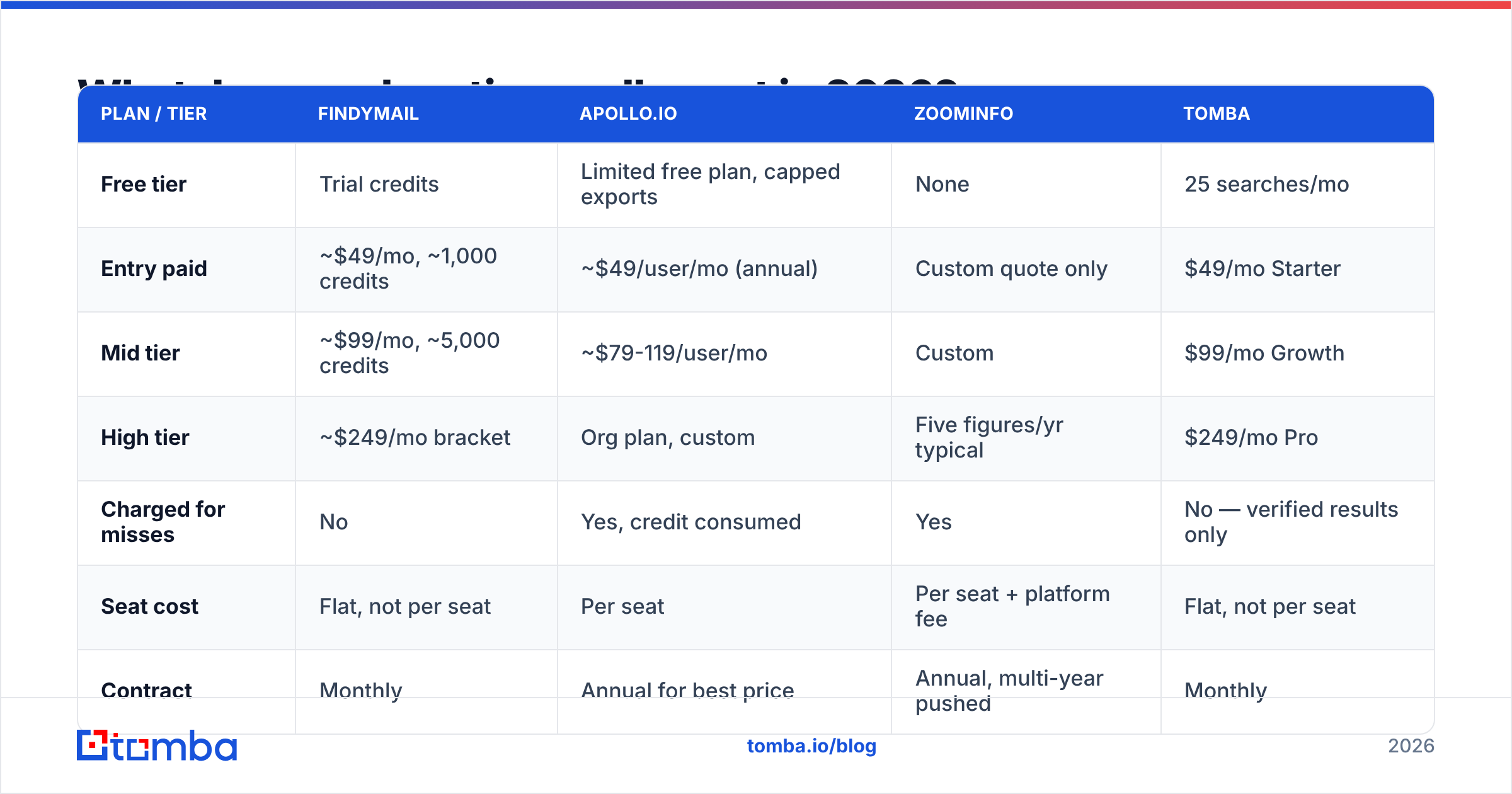
Published prices change often — check each vendor's page before you budget. As of writing, the shape looks roughly like this:
| Plan / tier | Findymail | Apollo.io | ZoomInfo | Tomba |
|---|---|---|---|---|
| Free tier | Trial credits | Limited free plan, capped exports | None | 25 searches/mo |
| Entry paid | ~$49/mo, ~1,000 credits | ~$49/user/mo (annual) | Custom quote only | $49/mo Starter |
| Mid tier | ~$99/mo, ~5,000 credits | ~$79-119/user/mo | Custom | $99/mo Growth |
| High tier | ~$249/mo bracket | Org plan, custom | Five figures/yr typical | $249/mo Pro |
| Charged for misses | No | Yes, credit consumed | Yes | No — verified results only |
| Seat cost | Flat, not per seat | Per seat | Per seat + platform fee | Flat, not per seat |
| Contract | Monthly | Annual for best price | Annual, multi-year pushed | Monthly |

Two things this table hides, and both favour the bootstrapped model:
Seat multiplication. A five-person SDR team on a $79/seat platform is $4,740/year before anyone exports a single contact. The same team on a flat $99/mo plan is $1,188/year total. That is not a rounding difference — it is a different budget line.
Export gating. Several VC-backed platforms separate "credits" from "exports." You can view a contact in-app for one price and download it for another. Read the fine print on the specific tier you are quoted, not the pricing page summary. If you want to see how flat, non-seat pricing reads without the asterisks, the Tomba plans page is a useful control sample.
Which should you choose for your team?#
Pick by shape of team, not by feature count.
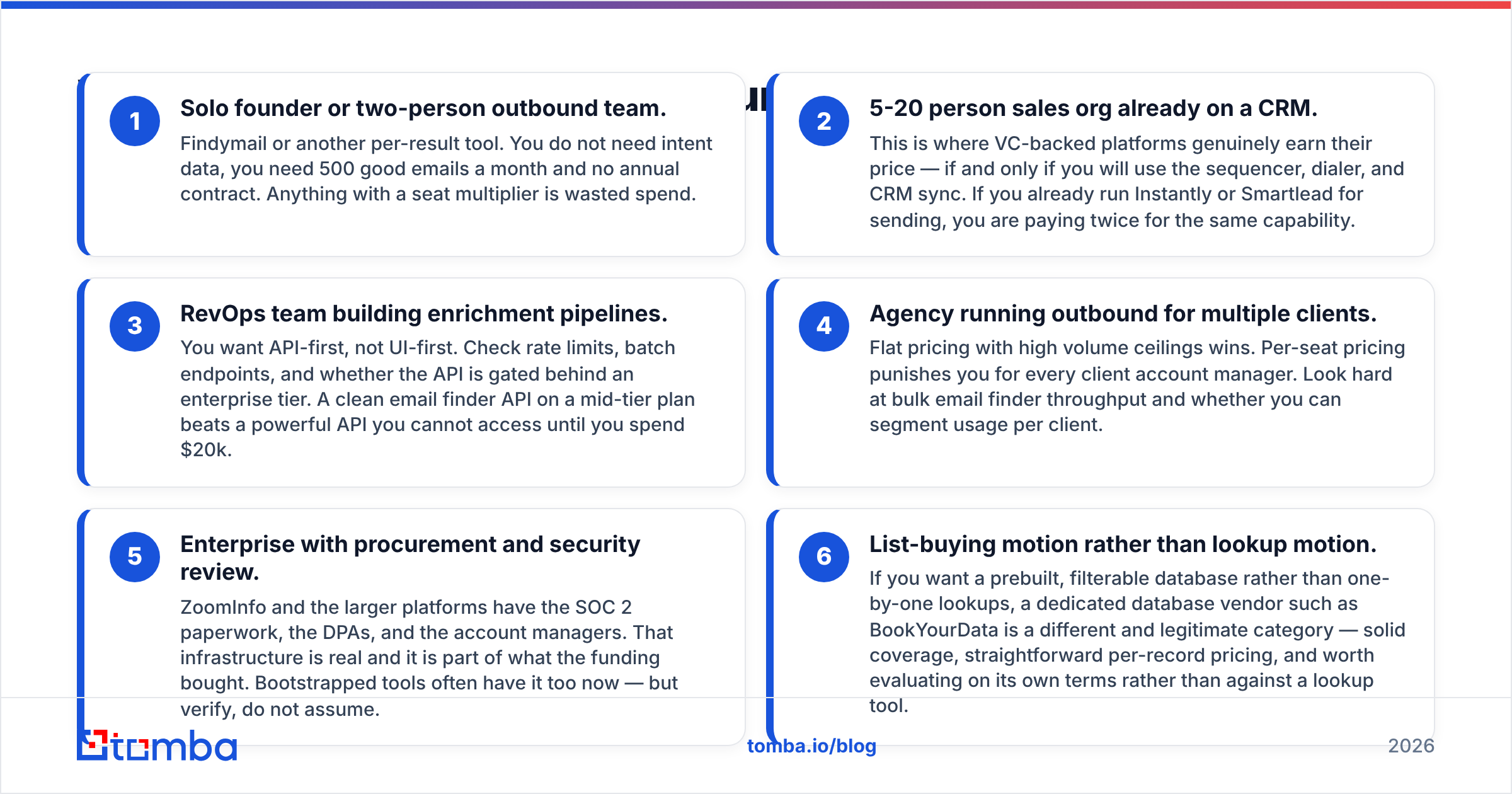
- Solo founder or two-person outbound team. Findymail or another per-result tool. You do not need intent data, you need 500 good emails a month and no annual contract. Anything with a seat multiplier is wasted spend.
- 5-20 person sales org already on a CRM. This is where VC-backed platforms genuinely earn their price — if and only if you will use the sequencer, dialer, and CRM sync. If you already run Instantly or Smartlead for sending, you are paying twice for the same capability.
- RevOps team building enrichment pipelines. You want API-first, not UI-first. Check rate limits, batch endpoints, and whether the API is gated behind an enterprise tier. A clean email finder API on a mid-tier plan beats a powerful API you cannot access until you spend $20k.
- Agency running outbound for multiple clients. Flat pricing with high volume ceilings wins. Per-seat pricing punishes you for every client account manager. Look hard at bulk email finder throughput and whether you can segment usage per client.
- Enterprise with procurement and security review. ZoomInfo and the larger platforms have the SOC 2 paperwork, the DPAs, and the account managers. That infrastructure is real and it is part of what the funding bought. Bootstrapped tools often have it too now — but verify, do not assume.
- List-buying motion rather than lookup motion. If you want a prebuilt, filterable database rather than one-by-one lookups, a dedicated database vendor such as BookYourData is a different and legitimate category — solid coverage, straightforward per-record pricing, and worth evaluating on its own terms rather than against a lookup tool.

Is bundling worth the premium?#
Sometimes. The honest case for VC-backed platforms is consolidation: one vendor, one invoice, one login, one support contact, and native CRM sync that someone else maintains. If your ops team is one overloaded person, that is worth real money.
The honest case against is that bundles are rarely best-in-class at every layer. Most teams that buy an all-in-one platform end up using it for data and running sends through a specialist tool anyway, because deliverability is a different discipline than data. Public review data on G2 shows this pattern clearly — the most common complaint on bundled platforms is not "the data is bad," it is "we only use a third of what we pay for."
A practical middle path: buy data on per-result pricing, buy sending from a sending specialist, and connect them. That stack usually costs less than one bundled seat count and each piece is replaceable without renegotiating a contract. If you go that route, run every list through an email verifier before it hits your sequencer — the finder's confidence score and your ESP's tolerance are not the same thing.
How do you run a fair bake-off in one week?#
- Day 1. Build a 200-row gold-standard list: contacts you have already emailed successfully in the last 90 days. Strip the emails.
- Day 2. Sign up for free tiers or trials on all finalists. Do not talk to sales yet — you want the self-serve product experience.
- Day 3. Run the identical list through each tool. Log found rate, "valid" rate, catch-all flags, and role accounts.
- Day 4. Compare against your gold standard. Count exact matches, near misses, and confident-but-wrong results. Confident-but-wrong is the number that predicts bounces.
- Day 5. Send a small warmed campaign (50 addresses per tool) and record hard bounces. Track your sender reputation before and after.
- Day 6-7. Price the winner at your real 12-month volume, with seat counts, export limits, and overage rates written down. Then negotiate.
That process costs you a week and routinely saves five figures. It also settles the "Findymail vs VC-backed" question with your data instead of someone's benchmark deck. For a broader vendor landscape, Capterra category listings are a reasonable starting shortlist before you narrow to three.
What is the verdict?#
If you are under 10 people and outbound is a channel rather than a machine, the bootstrapped model wins on economics and honesty. You get charged for results, you can cancel monthly, and you are not funding a sequencer you will not use.
If you have a real sales org, an ops owner, and a budget that expects intent data and CRM-native workflows, a VC-backed platform is defensible — provided you audit seat counts annually and actually use the bundled layers.
If you want the credit honesty of the bootstrapped model with the API depth and tooling breadth of the platform model, that middle lane now exists and it is where most teams should look first in 2026.
Ready to test it against your own list?#
Tomba's email finder is built for that middle lane: find by domain, name, or company; verified results only; flat pricing that does not multiply by headcount; and 25 free searches a month so you can run the bake-off above before you spend anything. Starter is $49/mo, Growth is $99/mo, and the API, bulk processing, and catch-all verification are part of the product rather than an enterprise upsell. Load your 200-row gold-standard list, compare the numbers to whatever you are paying today, and let the bounce rate decide.
Related guides#
Ready to find emails that actually work?
Join 150,000+ professionals who stopped guessing and started sending. Free credits on signup — no credit card required.
Get the Tomba newsletter
Practical outbound tactics and product updates — once every two weeks.
About the author