FINTRX vs GetProspect: Which B2B Data Tool Wins in 2026?
FINTRX sells private wealth intelligence. GetProspect sells emails at volume. They get compared constantly, yet they solve different problems. Here is the honest breakdown of coverage, accuracy, and real cost.
FINTRX vs GetProspect is a match-up that comes up a lot, and it is usually the wrong fight. One tool sells deep private wealth data. The other sells B2B emails in bulk. Here is how they compare on coverage, accuracy, price, and fit.
TL;DR
- FINTRX is a private wealth intelligence platform. It covers family offices, RIAs, and the people who allocate capital inside them.
- GetProspect is a general-purpose B2B email finder. It ships with a LinkedIn extension and a free tier.
- They are not really competitors. Both sell "contact data," but one is a vertical database and the other is a horizontal lookup engine.
- FINTRX is quote-only and priced like enterprise research software. GetProspect publishes its plans and starts free, so it is the cheaper experiment by a wide margin.
- Sell to wealth managers and allocators? FINTRX firm-level context is hard to replicate. Sell to everyone else? A vertical database is wasted budget.
- The most common real stack is neither alone. Teams pair a targeting source with a separate verification layer, because bounce rate kills sending domains — not record count.
What are FINTRX and GetProspect, actually?#
Different categories wearing similar labels.
FINTRX is a private wealth data and research platform. Its coverage is narrow on purpose: family offices, registered investment advisors, wealth management firms, and the professionals inside them. It also carries context on those firms — AUM bands, mandate focus, allocation history, and filings. You do not buy FINTRX to find a VP of Engineering at a SaaS company. You buy it when you are raising a fund, distributing an alternative investment product, or selling services into the private wealth channel. The point is knowing which of 3,000 family offices actually backs your asset class.
GetProspect is the opposite shape. It is a B2B email finder and list-building tool. Search by company, domain, job title, or industry. Scrape a LinkedIn search with the Chrome extension. Export a CSV and push it into your sequencer. Coverage is horizontal — every industry, every company size. Depth per record is shallow: name, title, company, email, sometimes a phone number.
Think of it like a library versus a phone book. The library has fewer entries, but each one comes with a full dossier. The phone book has everyone and tells you almost nothing beyond how to reach them.
That split drives every other difference below.
FINTRX vs GetProspect: how do they compare feature by feature?#
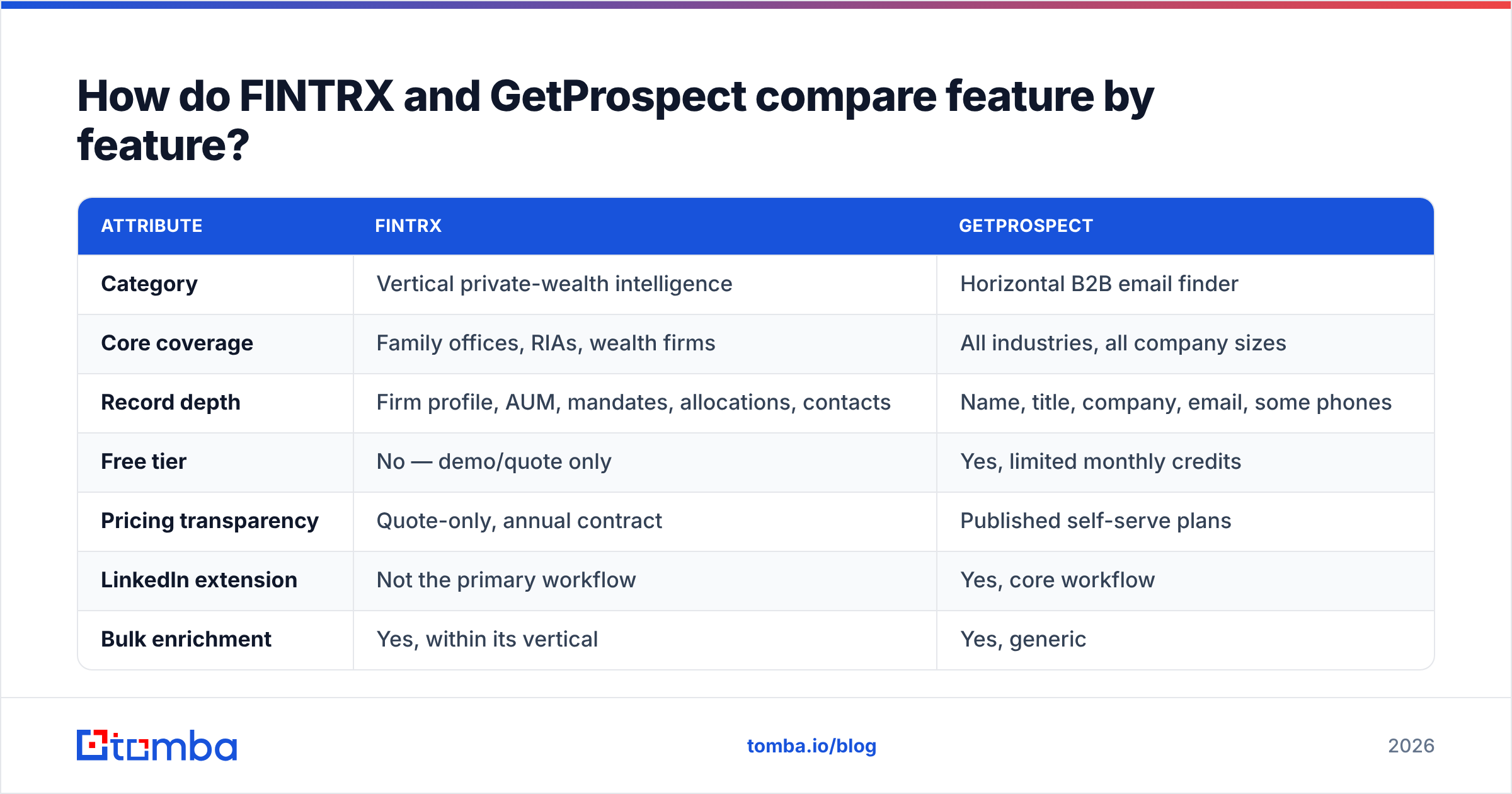
Here is the head-to-head on the attributes that actually change a buying decision.
| Attribute | FINTRX | GetProspect |
|---|---|---|
| Category | Vertical private-wealth intelligence | Horizontal B2B email finder |
| Core coverage | Family offices, RIAs, wealth firms | All industries, all company sizes |
| Record depth | Firm profile, AUM, mandates, allocations, contacts | Name, title, company, email, some phones |
| Free tier | No — demo/quote only | Yes, limited monthly credits |
| Pricing transparency | Quote-only, annual contract | Published self-serve plans |
| LinkedIn extension | Not the primary workflow | Yes, core workflow |
| Bulk enrichment | Yes, within its vertical | Yes, generic |
| Built-in verification | Limited | Basic, single-vendor |
| API access | Available on enterprise terms | Available on paid plans |
| Best fit | Capital raising, wealth channel sales | SMB and mid-market outbound at volume |
| Time to first list | Days (onboarding, training) | Minutes |
The row that matters most is "time to first list." FINTRX is a research subscription. You get onboarding, a CSM, and a workflow you have to learn. GetProspect is a self-serve utility. You can be productive in it before lunch. Neither approach is wrong. They price and sell accordingly.

Who should actually buy FINTRX?#
FINTRX earns its price in a few specific situations. Outside them, you pay for coverage you never touch.
- You are raising capital. Fund managers, GPs, and IR teams need to map which family offices wrote checks into private credit, real assets, or venture recently. Generic B2B databases do not carry allocation context.
- You distribute investment products. Selling into the RIA channel takes firm-level AUM, custodian, and mandate detail. FINTRX is built for that kind of segmentation.
- You sell services to wealth firms. Think compliance software, portfolio accounting, or outsourced CIO work. The buyer universe is a few thousand firms. Knowing their setup beats knowing 500 million emails.
- You need a defensible research trail. Regulated teams must show where a contact came from and when it was last confirmed. A curated vertical database handles that better than scraped data.
- You have budget and a long sales cycle. A five-figure annual contract only works when deal values are high and the target list is finite.
If your ICP is "marketing directors at ecommerce brands," none of this applies. Stop reading about FINTRX.
Who should actually buy GetProspect?#
GetProspect fits the volume end of the market.
- Solo founders and small teams who need a few thousand verified contacts a month without a procurement cycle.
- Agencies running client outbound where the ICP changes every engagement and vertical depth does not matter.
- Recruiters and LinkedIn-first prospectors who work inside search results and want a one-click export.
- Anyone testing a new segment before spending real budget. The free tier makes testing cheap.
The limits are predictable. Horizontal databases are strong on mid-to-large companies with a public web presence. They are weak on small firms, non-English markets, and roles that rarely publish an email pattern. That is not a GetProspect flaw. It is true for every general-purpose finder, which is why data sources matter more than raw record counts.
How accurate is the data on each side?#
Each category measures accuracy differently. Comparing the headline numbers straight across is a mistake.
For FINTRX, accuracy means research freshness. Is this family office still allocating to this strategy? Is the CIO still in seat? Is the AUM band current? Human research teams and filings confirm that, and it decays slowly. A firm's mandate does not change every month.
For GetProspect, accuracy means email deliverability. Will this address accept mail today? That decays fast. B2B contact data goes stale at roughly 2–3% per month from job changes alone. Any list older than a quarter needs a re-check before it touches a sending domain.
So whichever tool you buy, you still need a verification step you control. Vendors mark addresses as valid using their own single-vendor logic. Catch-all domains are the usual trap: the server accepts everything, then bounces later. Run exports through an independent email verifier and a catch-all verifier before import. It takes ten minutes and protects months of domain reputation.
A rough target for cold outbound in 2026: keep hard bounces under 2%, ideally under 1%. Google and Microsoft both tightened bulk-sender rules. One bad send at 8% bounce can undo a quarter of warmup.
What does each one really cost?#
Sticker price is only half the number. Here is the fuller cost picture.
| Cost factor | FINTRX | GetProspect | Dedicated finder (e.g. Tomba) |
|---|---|---|---|
| Entry price | Quote-only, annual, typically five figures | Free tier, then published monthly plans | Free tier (25 searches/mo), Starter $49/mo |
| Contract length | Annual commitment standard | Monthly or annual | Monthly or annual |
| Credit model | Seat + access based | Credit based | Credit based, Tomba pricing is public |
| Verification included | Limited | Basic | Verifier, catch-all check, bulk tools |
| Hidden cost | Unused coverage outside your vertical | Re-verification of stale exports | Minimal — verification is native |
| Cancel risk | Locked for the term | Low | Low |
Always confirm current numbers on each vendor's own pricing page before you budget. Plans move, and quote-based products do not publish one at all. Peer reviews on G2 help you spot where customers say the contract friction sits.
The math is uncomfortable. Spend five figures on a vertical database, then send to unverified addresses, and you have thrown precision targeting at a broken channel. Budget for both layers, or neither one works.

FINTRX vs GetProspect: which one is better?#
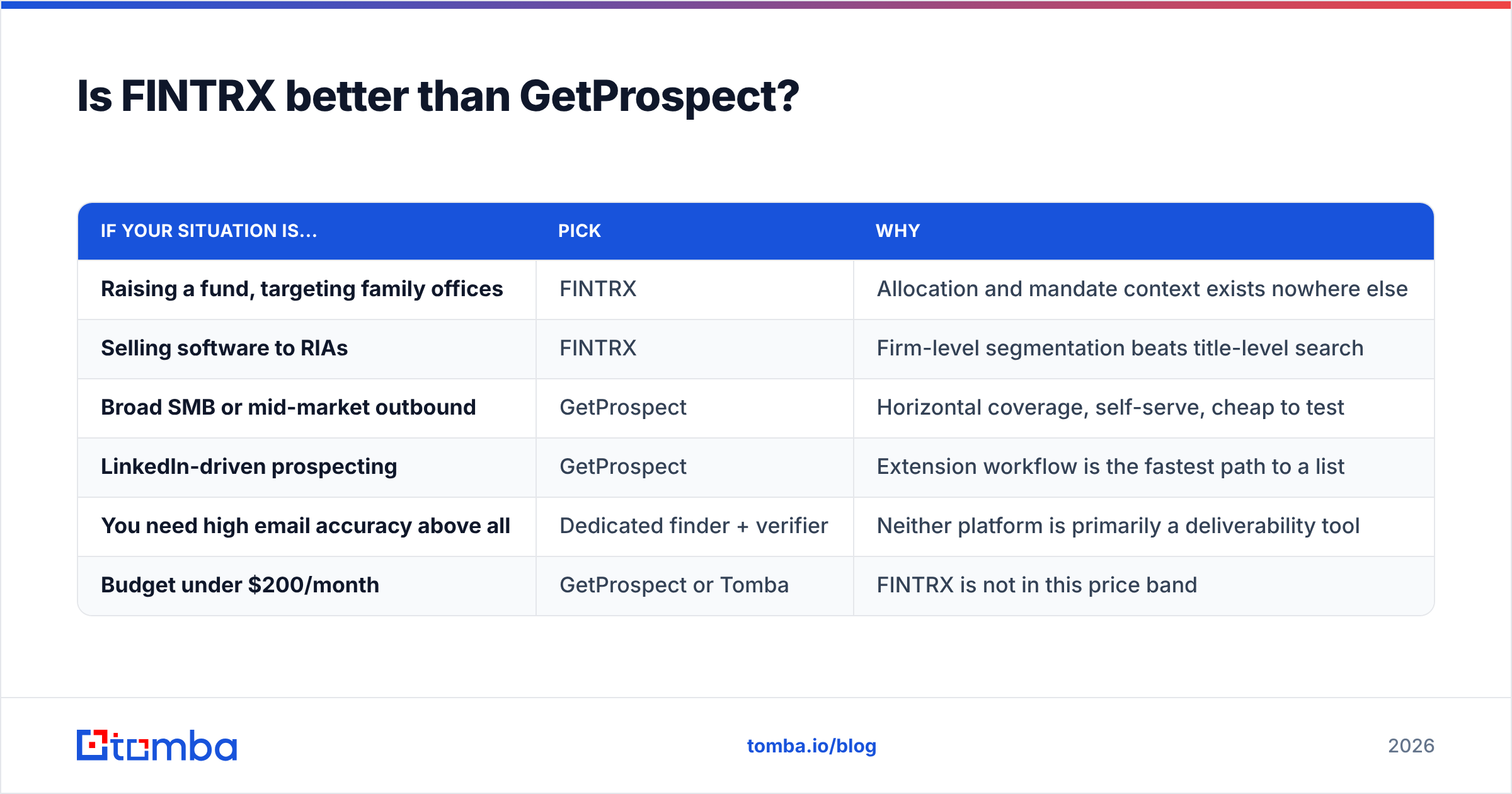
Only in the sense that a scalpel beats a hammer — for surgery.
| If your situation is... | Pick | Why |
|---|---|---|
| Raising a fund, targeting family offices | FINTRX | Allocation and mandate context exists nowhere else |
| Selling software to RIAs | FINTRX | Firm-level segmentation beats title-level search |
| Broad SMB or mid-market outbound | GetProspect | Horizontal coverage, self-serve, cheap to test |
| LinkedIn-driven prospecting | GetProspect | Extension workflow is the fastest path to a list |
| You need high email accuracy above all | Dedicated finder + verifier | Neither platform is primarily a deliverability tool |
| Budget under $200/month | GetProspect or Tomba | FINTRX is not in this price band |
Notice that two rows point somewhere else entirely. That is not a rhetorical trick. It reflects how most teams actually build their stack.
Where does a dedicated email finder fit in this stack?#
In the gap both platforms leave open: turning a target list into addresses that deliver.
The pattern that works looks like this:
- Pick your targeting source. FINTRX if your universe is private wealth. LinkedIn, a horizontal database, or your own CRM if it is not.
- Resolve contacts at the domain level. Run each target company through domain search. You see the real email pattern and the people published against it, instead of guessing.
- Verify before you import. Every address goes through verification. Flag catch-all domains separately rather than dumping them into the main list.
- Enrich what survives. Add role, seniority, and firmographics with data enrichment so your sequencer can personalize beyond first name.
- Re-check quarterly. Anything older than 90 days gets re-verified before you send to it again.
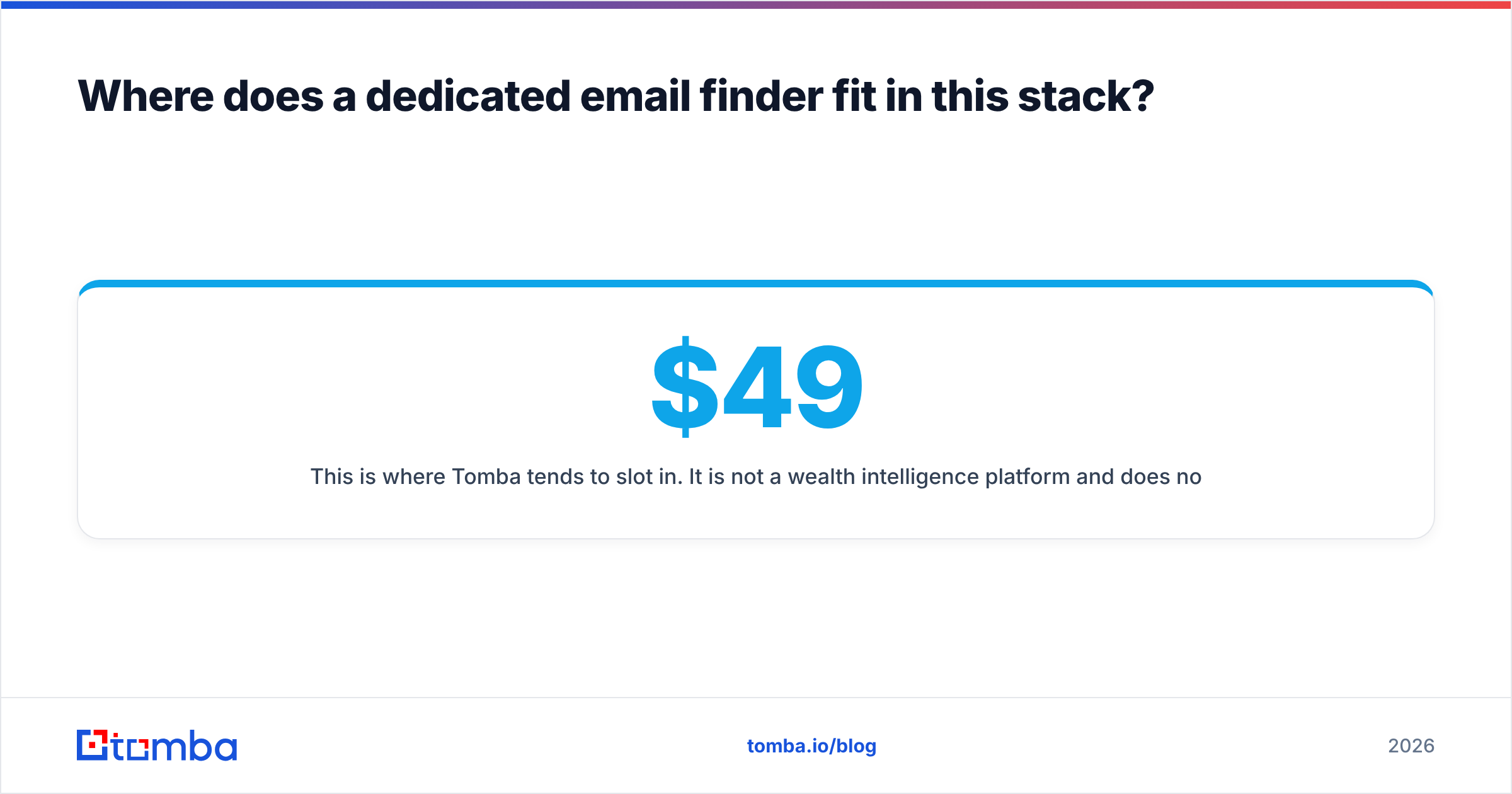
This is where Tomba tends to slot in. It is not a wealth intelligence platform and does not pretend to be. It will never tell you which family office backed private credit last year. It handles the finding and verification layer instead. The free tier covers 25 searches a month. Starter is $49/mo, Growth $99/mo, and Pro $249/mo, with an API and bulk tools when you outgrow the UI. Teams that already pay for a vertical database often add a finder-plus-verifier layer underneath it rather than replacing it, because the two costs solve different failure modes.
Other specialist vendors serve this middle ground well too. BookYourData, for example, suits teams that prefer buying pre-verified lists outright. The right answer depends on whether your workflow is list-purchase or lookup.
What should you do in 2026?#
Answer one question honestly. Is your total market fewer than 10,000 firms, and are those firms in private wealth?
If yes, book the FINTRX demo. The depth is real and the vertical curation is genuinely hard to copy. Deal sizes in that channel justify an annual contract. Ask about refresh cadence on contact-level records, and whether email verification is included.
If no, skip the vertical database. Start with the GetProspect free tier or a similar horizontal tool. Prove the segment converts first. Then invest in the layer that moves reply rate: clean, verified, current addresses.
Either way, treat verification as its own line item. Do not trust it as a checkbox from whoever sold you the list. Sender reputation is the one asset in outbound you cannot buy back.
Ready to fix the layer both platforms leave to you? Try the Tomba Email Finder free — 25 searches a month, no card required. Find the address, verify it before you send, and keep your domain out of the spam folder. When volume grows, Starter is $49/mo and the API handles the rest.
Related guides#
Ready to find emails that actually work?
Join 150,000+ professionals who stopped guessing and started sending. Free credits on signup — no credit card required.
Get the Tomba newsletter
Practical outbound tactics and product updates — once every two weeks.
About the author