FinTRX vs Jet Leads Pro: Which B2B Data Tool Wins in 2026?
FinTRX sells deep wealth-management intelligence. Jet Leads Pro sells niche aviation-adjacent lead lists. They are not the same product — and picking wrong costs you a year of budget. Here is the honest breakdown.
FinTRX vs Jet Leads Pro is not a fair fight, because they are not the same kind of tool. One sells deep wealth data. The other sells fast lead lists. Here is how to pick.
TL;DR
- FinTRX is a research tool for the private wealth world: family offices, RIAs, and the people who work there. It is deep, narrow, and priced like enterprise software.
- Jet Leads Pro sits at the other end. It is a small list vendor aimed at high-net-worth and jet-buyer prospecting. Cheaper, faster to start, much thinner.
- Neither one is a general B2B contact database. If your buyer is "SaaS ops manager in Germany," both are wrong.
- FinTRX hides its price behind a demo. Jet Leads Pro shares little. Budget time for sales calls before you can compare.
- Most teams pair a niche list with a general email finder and a verifier. Niche vendors rarely refresh emails fast enough for a real send.
What are FinTRX and Jet Leads Pro?#
They solve different problems that look alike on a landing page.
FinTRX is a research platform built around private wealth. Its core asset is a curated database of family offices, registered investment advisors, and the people who staff them. It also tracks what matters in that world: AUM bands, custodian ties, past deals, and advisor moves between firms. Buyers are mostly asset managers, funds, fintech vendors, and teams raising money. Its own site (fintrx.com) calls it private wealth intelligence, not a mass-market prospecting tool. That framing is fair.
Jet Leads Pro plays in the niche list market. You get ready-made or on-demand contact lists for wealthy people, private jet buyers, and luxury buyers. The pitch is speed and price. You get a list, you get contact fields, you start sending. Vendors like this usually license data from other sources. Few of them run a large research team.
The core split is simple. FinTRX sells a service you log into. Jet Leads Pro sells records you export. That one difference drives every trade-off below.
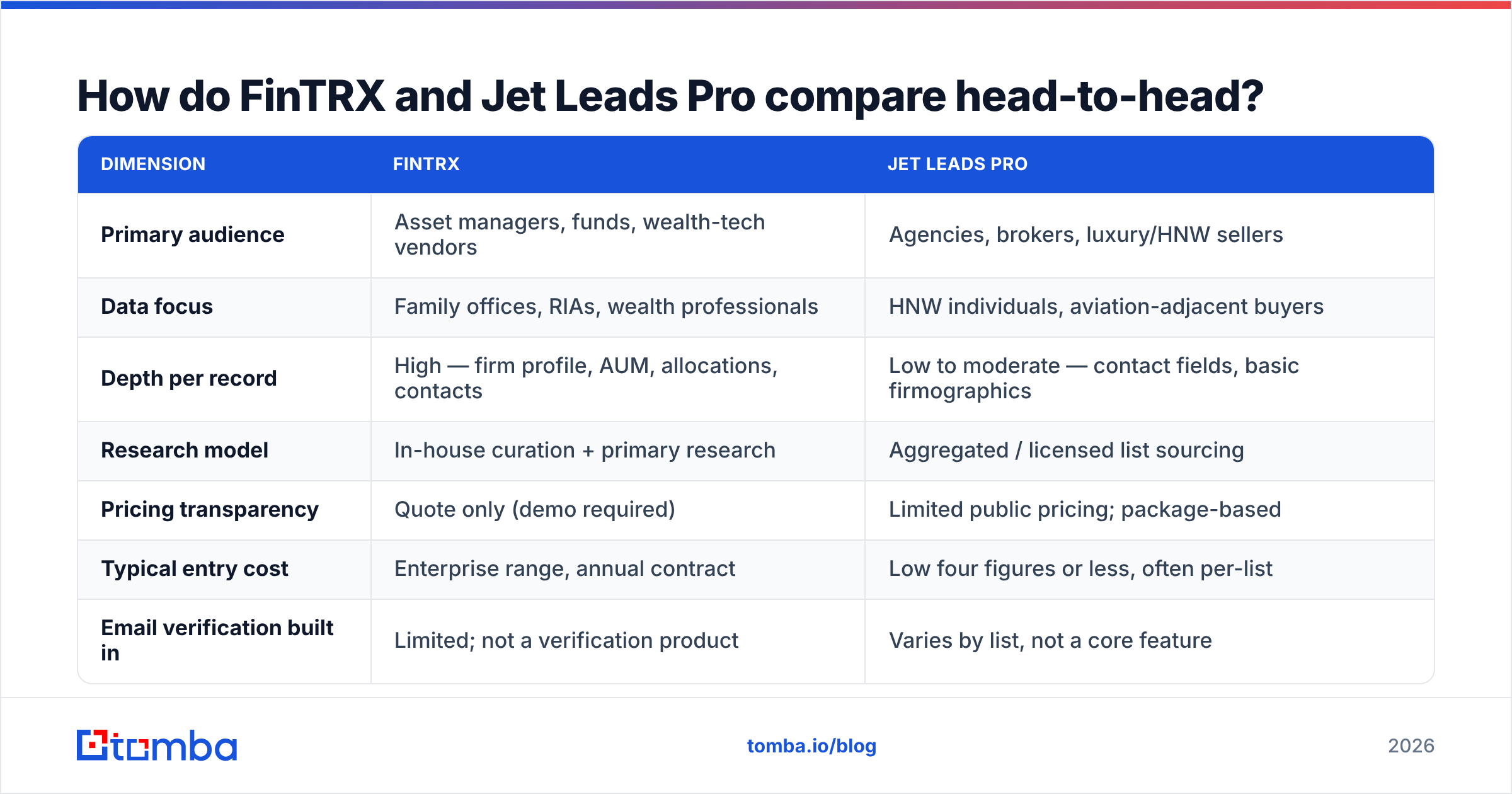
FinTRX vs Jet Leads Pro: how do they compare head-to-head?#
Here is the table most buyers need. Where a vendor hides a number, we say so instead of guessing.
| Dimension | FinTRX | Jet Leads Pro |
|---|---|---|
| Primary audience | Asset managers, funds, wealth-tech vendors | Agencies, brokers, luxury/HNW sellers |
| Data focus | Family offices, RIAs, wealth professionals | HNW individuals, aviation-adjacent buyers |
| Depth per record | High — firm profile, AUM, allocations, contacts | Low to moderate — contact fields, basic firmographics |
| Research model | In-house curation + primary research | Aggregated / licensed list sourcing |
| Pricing transparency | Quote only (demo required) | Limited public pricing; package-based |
| Typical entry cost | Enterprise range, annual contract | Low four figures or less, often per-list |
| Email verification built in | Limited; not a verification product | Varies by list, not a core feature |
| CRM integrations | Native connectors + exports | Mostly CSV export |
| API access | Available on higher tiers | Rare / not core |
| Best for | Long, relationship-led capital raising | Volume outreach to a niche audience |
| Worst for | Small teams doing broad outbound | Anyone needing verified, refreshed emails at scale |
Read the table with one filter: how long is your sales cycle? FinTRX earns its price when one deal is worth six or seven figures. In that world you need to know which allocator moved firms last quarter. Jet Leads Pro earns its price when you need 3,000 plausible names this week. Your math has to survive a weak hit rate.

What data does FinTRX actually give you?#
This is where FinTRX pulls ahead, so it deserves detail. The platform is built around five things:
- Firm data — family office and RIA profiles with AUM, entity type, and custodian ties. You cannot scrape this from a website.
- People data — advisors, CIOs, principals, and gatekeepers at those firms, with role history that shows job moves.
- Deal signals — what a firm has backed before. For anyone raising money, that is the real filter.
- Relationship maps — who overlaps with whom. This turns a cold list into a warm intro.
- Workflow tools — saved searches, list building, CRM push, and alerts. The research stays live instead of going stale.
That fifth point is the real product. A one-off export of family office contacts is near worthless six months later. Staff turnover is high, and firm structures shift. A yearly plan exists to hold that decay in check.
The trade-off is scope. FinTRX will not find the VP of Engineering at a mid-size logistics firm. It is not trying to. If your target list spans more than one industry, you still need a general B2B database beside it.
What does Jet Leads Pro do differently?#
Jet Leads Pro competes on friction, not depth. Skip the demo. Skip the annual contract. Pick a segment, get records, load them into a sequencer the same day.
That model has real upsides:
- No buying cycle. Test the data with a small order instead of a signed year-long deal.
- Segment focus. Small vendors often hold data the big ones lack, mostly in luxury, jet, and private-client markets.
- Clear unit cost. Per-list pricing is easy to model against campaign returns.
And real downsides:
- Unknown source. Bought lists rarely name the upstream source or the last check date. That is the top driver of bounce rate.
- No refresh. A record bought in January is a January record. Nobody keeps it fresh.
- Thin context. You get a name and an email. You do not get the detail that makes a pitch land.
- Legal risk. Buying data on private people raises GDPR and CCPA questions. Get written answers on lawful basis and opt-out before you send.
Neither is a moral failing. It is a category gap. Curated research costs money because people maintain it. Bought lists are cheap because nobody does.
How much do FinTRX and Jet Leads Pro cost in 2026?#
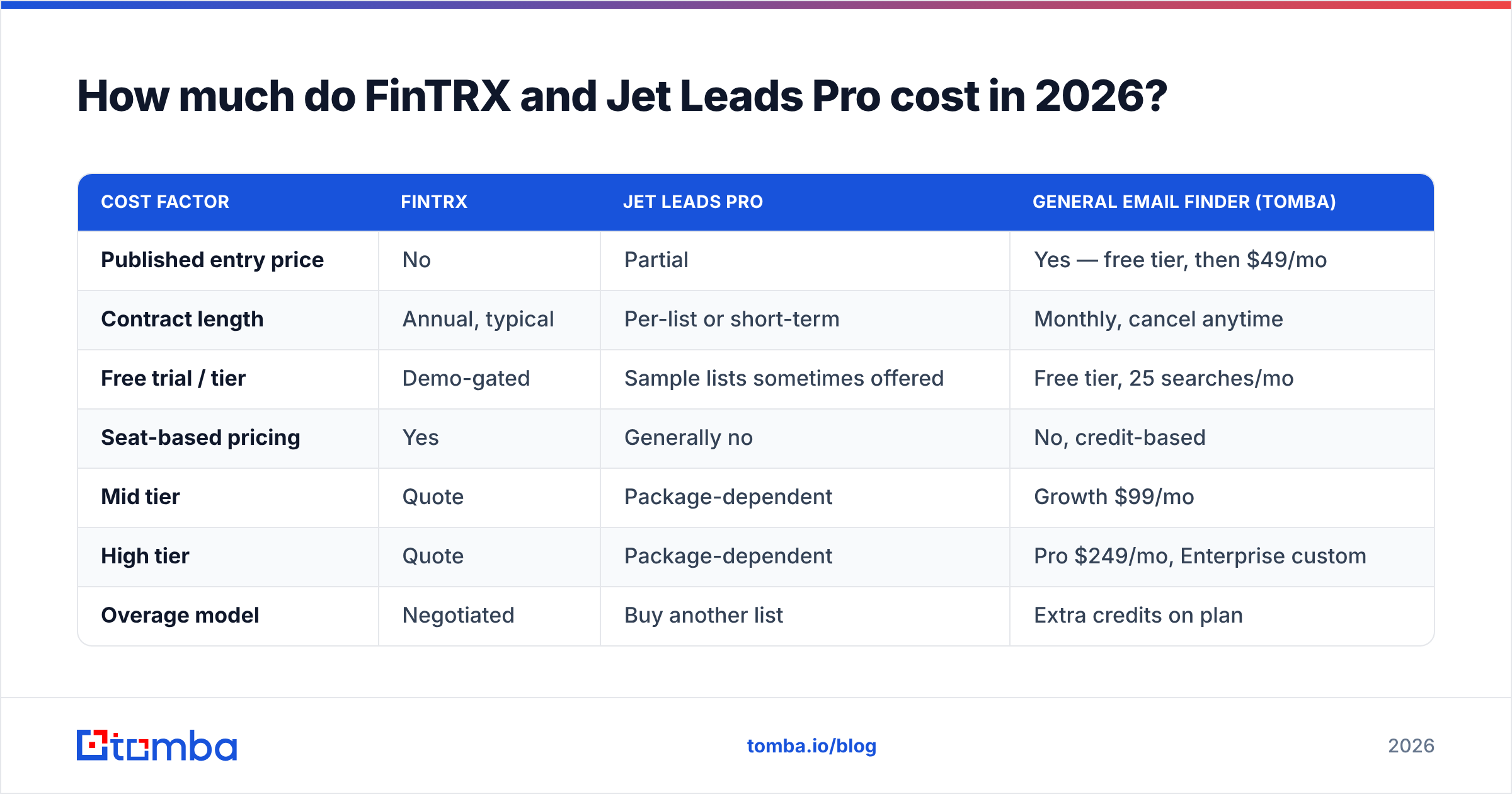
Both vendors hide pricing. That is normal in data, and annoying for buyers. Here is what you can plan around, with a general contact tool for context:
| Cost factor | FinTRX | Jet Leads Pro | General email finder (Tomba) |
|---|---|---|---|
| Published entry price | No | Partial | Yes — free tier, then $49/mo |
| Contract length | Annual, typical | Per-list or short-term | Monthly, cancel anytime |
| Free trial / tier | Demo-gated | Sample lists sometimes offered | Free tier, 25 searches/mo |
| Seat-based pricing | Yes | Generally no | No, credit-based |
| Mid tier | Quote | Package-dependent | Growth $99/mo |
| High tier | Quote | Package-dependent | Pro $249/mo, Enterprise custom |
| Overage model | Negotiated | Buy another list | Extra credits on plan |
The honest read: FinTRX is a yearly budget line that needs a sponsor. Jet Leads Pro is a credit-card buy. A tool like Tomba sits in a third bucket. It is plumbing you run all the time to keep any contact data usable, with public Tomba pricing that starts free and moves to $49/mo when you outgrow it.
When you ask for quotes, put these four questions in writing:
- When were these records last checked? If they cannot answer, assume the data is old.
- What is the bounce guarantee, and what is the remedy? "Best effort" is not a guarantee.
- Do all records include an email, or only some? Many wealth platforms are thin on direct emails.
- Can I export, or is it view-only? View-only kills automation.
Which one has better data accuracy — and how do you check?#
Do not take either vendor's accuracy claim on faith. You do not have to. Run the same test on both before you sign.
The 200-record test. Ask each vendor for a 200-record sample that matches your exact target. Then:
- Dedupe first. Overlap inside one sample is a bad sign about their pipeline.
- Run every email through an outside email verifier. Do not use the vendor's own check. That is grading their own homework.
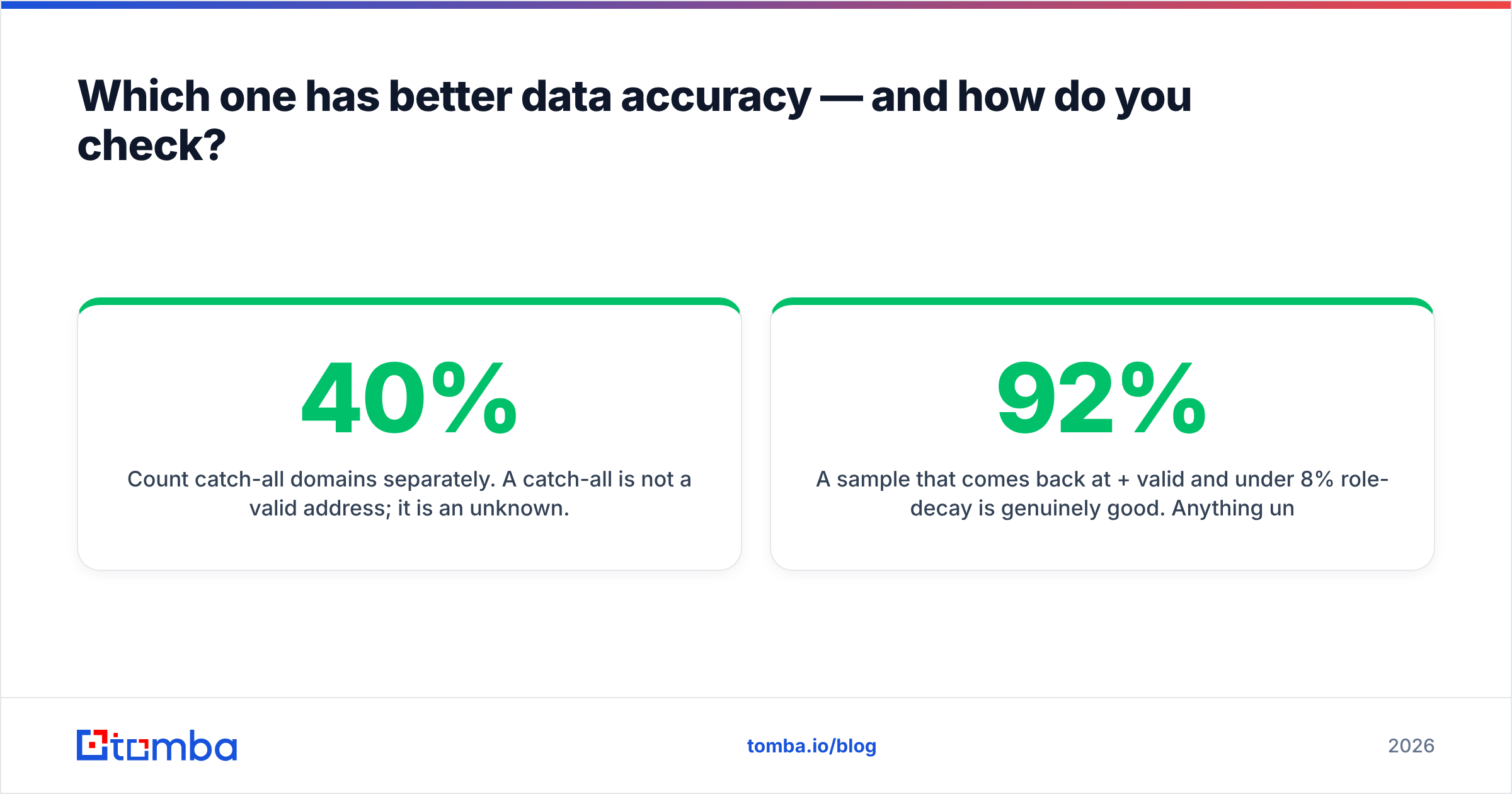
- Count catch-all domains on their own. A catch-all is not a valid address. It is an unknown. If 40% of a sample is catch-all, your real list is far smaller than the record count.
- Spot-check 20 records by hand. Open LinkedIn. Confirm the person still holds the role. Role decay is the quiet killer in family office and RIA data.
- Send a 50-address warm test from a spare domain, then count hard bounces.
A sample that comes back 92% valid, with under 8% role decay, is genuinely good. Under 80% valid means you are buying a cleanup project. The test costs you an afternoon. It often saves five figures. User reviews on G2 are a decent sanity check too. But reviews measure mood, not bounce rate. Only your own test does that.
Do you still need an email finder alongside FinTRX or Jet Leads Pro?#
Yes, in almost every setup. Buyers tend to miss this part.
Niche databases answer one question: who should I talk to? They do not answer the next one: what is this person's work email today? Those are different problems with different refresh rates. FinTRX invests in depth. List vendors invest in volume. Neither invests much in ongoing email checks, because that is its own product category.
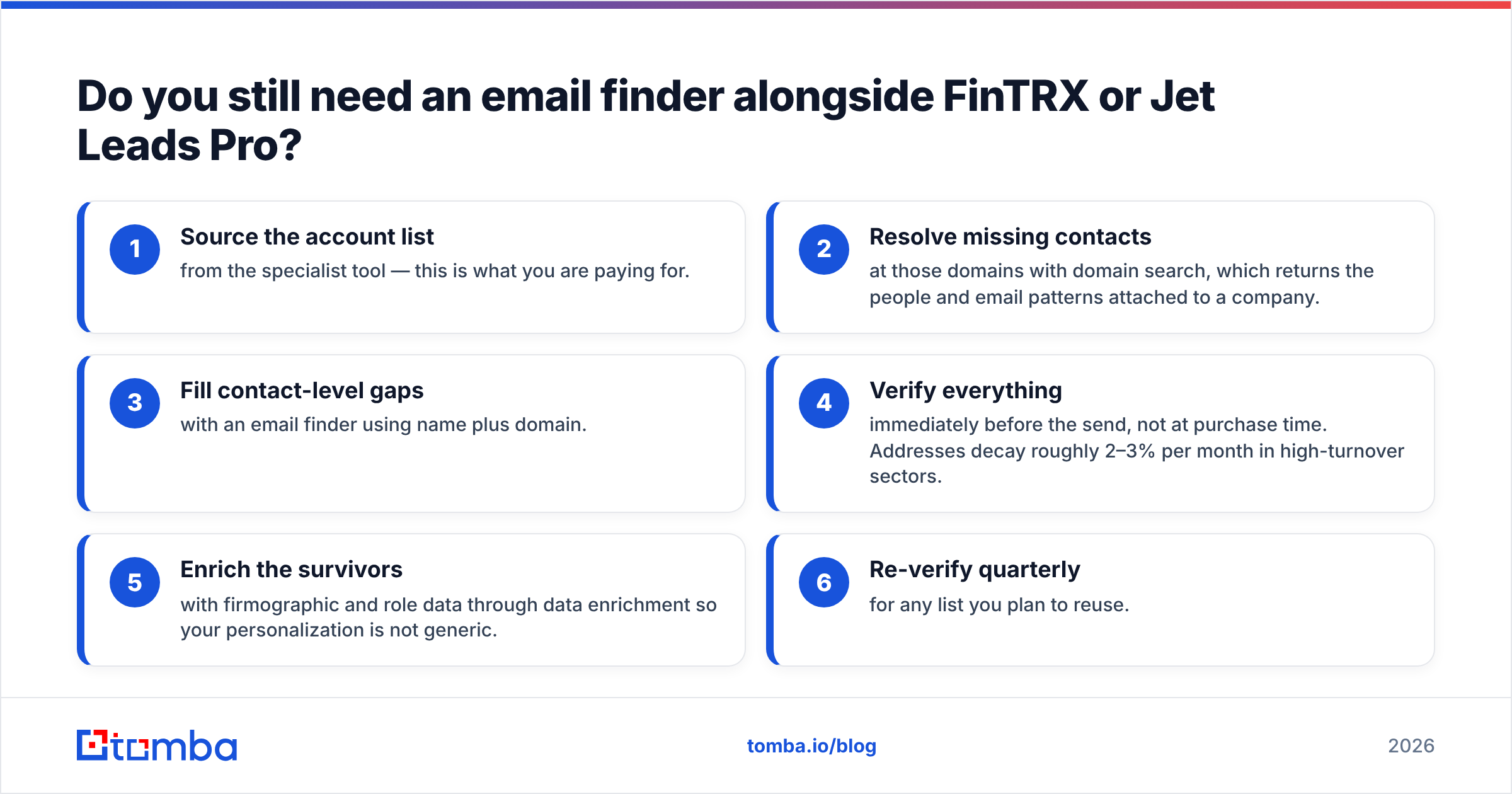
Most teams land on this stack:
- Source the account list from the niche tool. That is what you pay it for.
- Find missing contacts at those domains with domain search. It returns the people and email patterns tied to a company.
- Fill the gaps with an email finder, using a name plus a domain.
- Verify right before the send, not at purchase time. Addresses decay 2–3% per month in high-turnover markets.
- Enrich the survivors with firm and role data through data enrichment, so your pitch is not generic.
- Re-check quarterly on any list you plan to reuse.
If you run outbound at real volume, wire steps 2–4 into your CRM with the Tomba API. The manual version works up to about 500 records a month. After that it quietly becomes someone's full-time job.
Which should you choose in 2026?#
Match the tool to the motion, not to the price tag.
- Choose FinTRX if you raise capital or sell to RIAs and family offices. One relationship can justify a yearly deal. The deal history has no cheap stand-in. Push hard on export terms.
- Choose Jet Leads Pro if your buyers really are jet or luxury buyers and your cycle is short. Treat each list as raw material. Verify it before it touches a sending domain.
- Choose neither if your target is standard B2B: mid-market software, agencies, manufacturing, or services. You pay a niche premium for data a general tool covers better and cheaper.
- Choose both, plus checks, if you run a hybrid motion. Use niche data for the top 200 named accounts. Use general finding and checks for the rest.
- Start with the cheap test either way. A 200-record sample beats any sales call.
One more thing. The biggest driver of cold-email results here is not the database you picked. It is whether the addresses were checked the week you sent. It is also whether your sending setup was healthy. Teams often spend $30,000 on data, then burn it with a cold domain and a 4% bounce rate.
Ready to make either database deliverable?#
Whichever platform you pick, the records still need work. They must be found, filled in, and checked before they earn a send. That is what the Tomba Email Finder does. Find work emails by domain, name, or company. Confirm they are live before your sequencer touches them. Start free at 25 searches a month. Run the 200-record test on your FinTRX vs Jet Leads Pro sample, and let the bounce rate pick your vendor. If the numbers hold, plans start at $49/mo and scale with your pipeline, not your buying calendar.
Related guides#
Ready to find emails that actually work?
Join 150,000+ professionals who stopped guessing and started sending. Free credits on signup — no credit card required.
Get the Tomba newsletter
Practical outbound tactics and product updates — once every two weeks.
About the author