FinTRX vs Kipplo: Which B2B Data Platform Wins in 2026?
FinTRX sells depth in wealth management. Kipplo sells breadth and speed for general B2B outbound. Here's an honest look at coverage, pricing, workflow fit, and when neither is the right buy.
TL;DR
- FinTRX is a vertical database. It exists to map registered investment advisors, family offices, broker-dealers, and the people inside them. If you sell into wealth management, that depth is hard to replicate.
- Kipplo is a horizontal prospecting tool. It targets the general B2B motion — build a list, get contact details, push to your sequencer. Breadth over specialization.
- They are not really competitors. Comparing them head-to-head only makes sense if you're a fintech or wealthtech vendor deciding whether to pay a premium for vertical data or go generalist and filter manually.
- Price gap is the deciding factor for most teams. Vertical wealth-management data carries seat-based enterprise pricing. General prospecting data is credit-based and an order of magnitude cheaper.
- A third path exists: use a firmographic source you already trust for account selection, then attach verified contact data per-account with a per-credit tool like Tomba at $49/mo. Most teams overpay for contact rows they never touch.
What is FinTRX and who actually buys it?#
FinTRX is a private wealth data platform. Its core asset is a curated dataset of RIAs, family offices, broker-dealer reps, and the advisors and decision-makers attached to them — with the regulatory and AUM context that generic databases don't carry. Think of it as the difference between a phone book and a title-search company: both tell you who lives at an address, but only one tells you the lien history.
The buyers are narrow and specific:
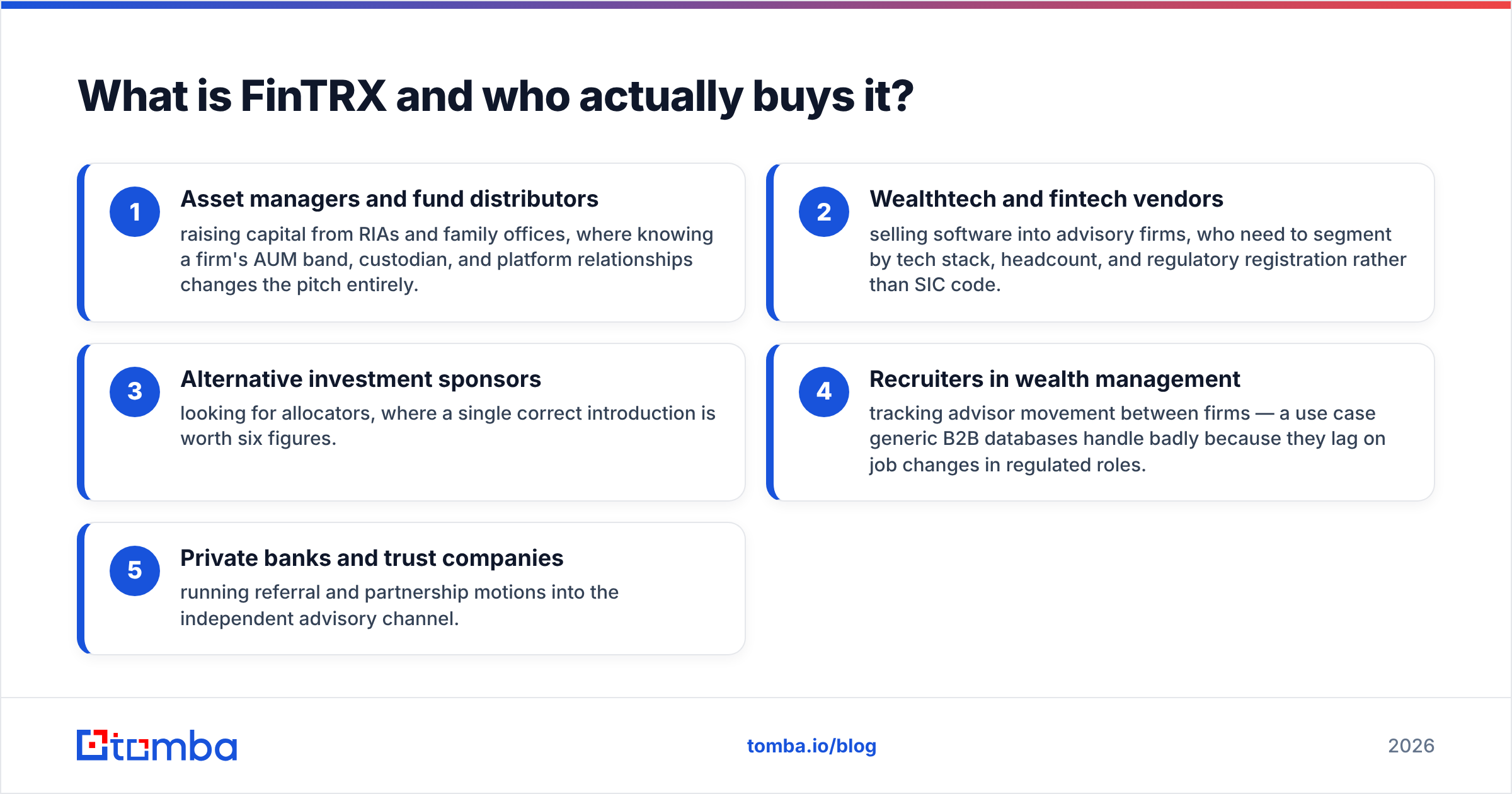
- Asset managers and fund distributors raising capital from RIAs and family offices, where knowing a firm's AUM band, custodian, and platform relationships changes the pitch entirely.
- Wealthtech and fintech vendors selling software into advisory firms, who need to segment by tech stack, headcount, and regulatory registration rather than SIC code.
- Alternative investment sponsors looking for allocators, where a single correct introduction is worth six figures.
- Recruiters in wealth management tracking advisor movement between firms — a use case generic B2B databases handle badly because they lag on job changes in regulated roles.
- Private banks and trust companies running referral and partnership motions into the independent advisory channel.
If you're not in one of those five buckets, FinTRX is almost certainly the wrong tool — not because it's weak, but because you'd be paying a specialty premium for records you can get elsewhere. You can review the vendor's own positioning at fintrx.com and buyer reviews on G2 before committing to a demo cycle.
The underlying value is regulatory-linked data. Firms in this space cross-reference public filings (Form ADV and similar) with proprietary research and manual verification. That's expensive to maintain, which is why the pricing looks nothing like a credit-based email finder.

What is Kipplo and where does it fit?#
Kipplo sits in the general B2B prospecting category — the crowded middle where you build a filtered list of companies and people, pull contact details, and export or sync into your outbound stack. The pitch in this category is always some combination of database size, filter granularity, enrichment accuracy, and how few clicks it takes to get from search to sequence.
Be careful here: this segment moves fast, and feature sets and pricing shift quarter to quarter. Before you sign anything, verify current numbers directly with the vendor rather than trusting any comparison post — including this one. What stays stable is the shape of the product:
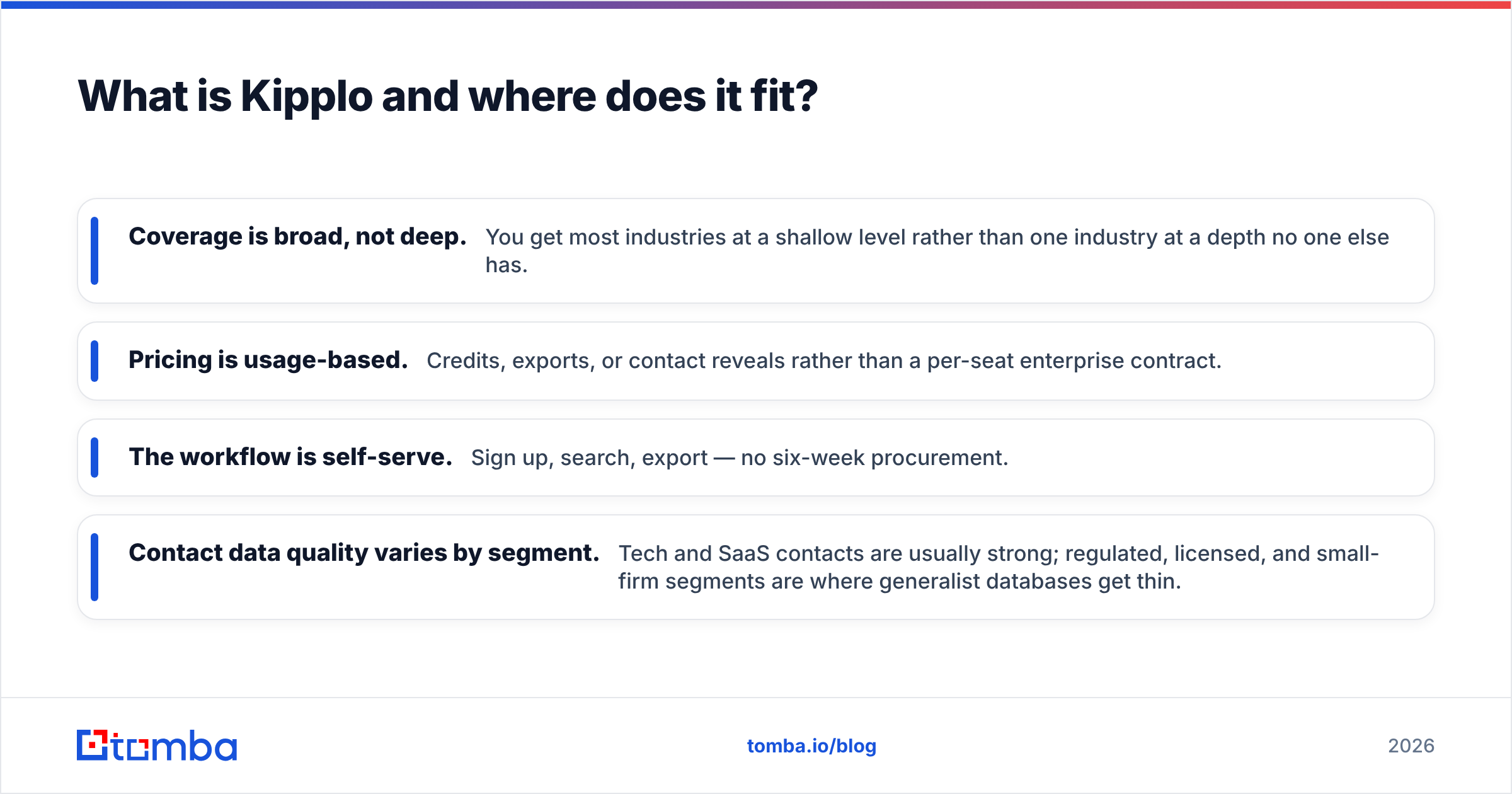
- Coverage is broad, not deep. You get most industries at a shallow level rather than one industry at a depth no one else has.
- Pricing is usage-based. Credits, exports, or contact reveals rather than a per-seat enterprise contract.
- The workflow is self-serve. Sign up, search, export — no six-week procurement.
- Contact data quality varies by segment. Tech and SaaS contacts are usually strong; regulated, licensed, and small-firm segments are where generalist databases get thin.
That last point is exactly where the FinTRX comparison becomes real. A generalist database will have some RIA records. It won't reliably have the advisor's AUM band, custodian relationship, or whether they moved firms nine months ago.
FinTRX vs Kipplo: how do they compare on the things that matter?#
Here's the honest side-by-side. Treat pricing as directional — vertical data vendors quote, they don't publish, and general prospecting tools change plans often.
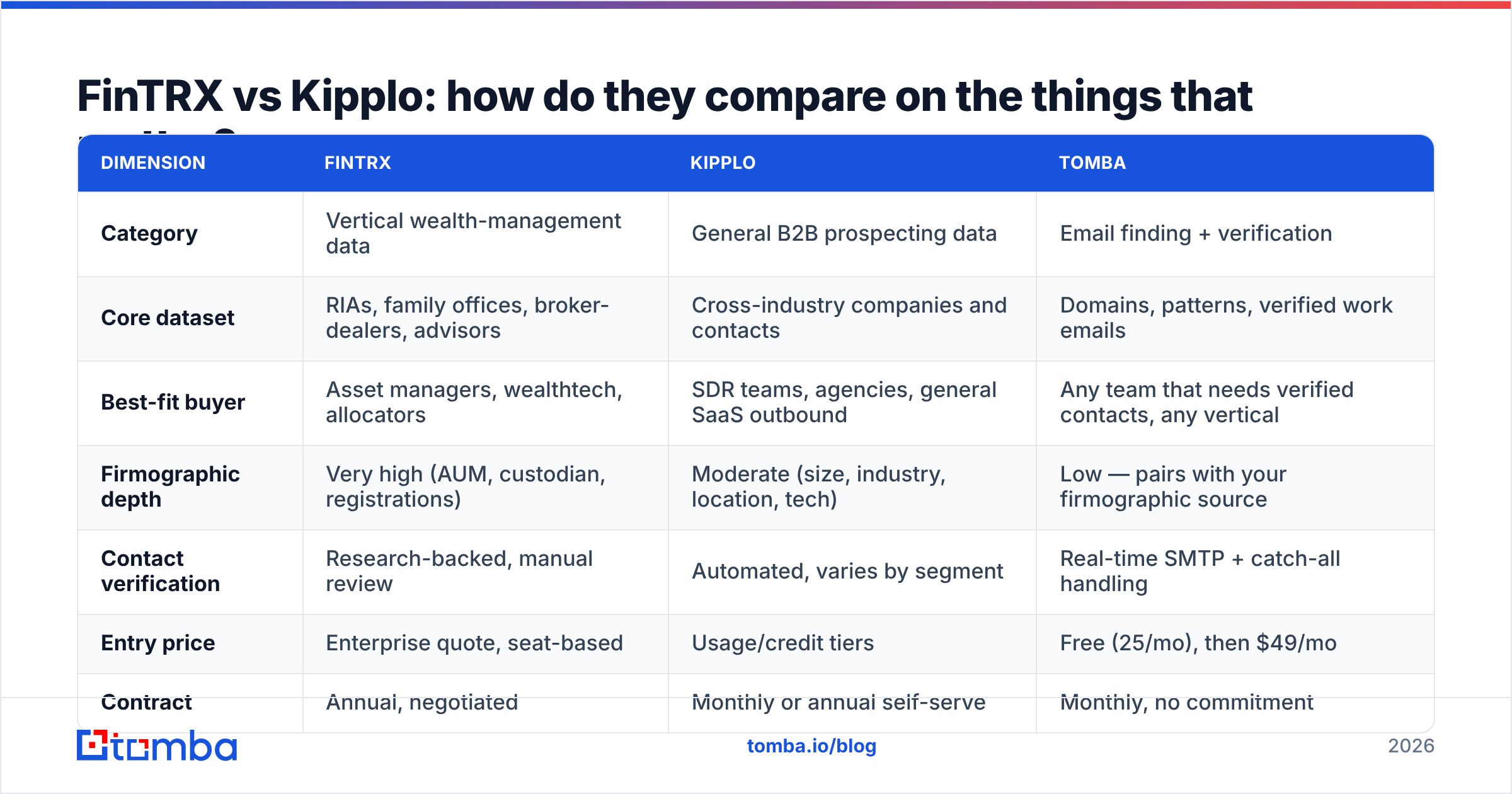
| Dimension | FinTRX | Kipplo | Tomba |
|---|---|---|---|
| Category | Vertical wealth-management data | General B2B prospecting data | Email finding + verification |
| Core dataset | RIAs, family offices, broker-dealers, advisors | Cross-industry companies and contacts | Domains, patterns, verified work emails |
| Best-fit buyer | Asset managers, wealthtech, allocators | SDR teams, agencies, general SaaS outbound | Any team that needs verified contacts, any vertical |
| Firmographic depth | Very high (AUM, custodian, registrations) | Moderate (size, industry, location, tech) | Low — pairs with your firmographic source |
| Contact verification | Research-backed, manual review | Automated, varies by segment | Real-time SMTP + catch-all handling |
| Entry price | Enterprise quote, seat-based | Usage/credit tiers | Free (25/mo), then $49/mo |
| Contract | Annual, negotiated | Monthly or annual self-serve | Monthly, no commitment |
| API access | Available on higher tiers | Typically tier-gated | Included from paid plans |
| Time to first list | Days to weeks (demo + onboarding) | Minutes | Minutes |
| Where it breaks | Useless outside wealth management | Thin in regulated/niche verticals | Not a firmographic database |
The table makes the real decision visible: you are not choosing between two versions of the same thing. You are choosing between paying for a dataset nobody else has and paying for speed and volume across everything.
Is FinTRX worth the premium over a generalist tool?#
Yes — but only if your total addressable market is small and each account is worth a lot.
Run the arithmetic before the demo. If your TAM is 4,000 RIA firms and your average contract value is $60,000, then a dataset that improves your targeting hit rate by even 10 percentage points pays for an enterprise seat several times over in one closed deal. Precision compounds when the universe is small: you can't brute-force 4,000 accounts with volume, so you have to be right about which 400 to work.
Flip the inputs and it collapses. If your TAM is 200,000 companies across a dozen industries and your ACV is $6,000, the vertical premium is dead weight. You need reach, cheap contact data, and a fast feedback loop — which is the generalist play.
Three questions that settle it:
- Can you name your accounts? If a well-built list of target firms fits on one screen, buy depth. If it takes a query to generate, buy breadth.
- Does regulatory or licensing context change your pitch? If AUM band, custodian, or registration type determines what you say, generic firmographics can't get you there.
- How fast does your data decay? Advisor movement in wealth management is frequent and consequential. If your motion depends on catching moves, a specialist maintaining that dataset is worth paying for.
Where do both tools leave gaps in your stack?#
Neither product is a complete outbound system, and both are frequently oversold as one.
Deliverability is not included. A database gives you addresses. It does not protect your domain. Bounce rate is the fastest way to torch sender reputation, and no vendor's internal "verified" flag replaces a fresh check at send time. Run your final list through an email verifier before it touches a sequencer — especially for contacts that have been sitting in a CRM for more than a quarter.
Catch-all domains are a silent killer. Advisory firms, boutique funds, and small professional-services businesses run catch-all mail servers at a much higher rate than tech companies. A generic database will happily mark those addresses "valid" because the server accepts everything. You need a real catch-all verifier to separate a live mailbox from a domain that swallows every message.
Contact rows go stale faster than firmographics. A firm's AUM band changes annually. The person you're emailing changes jobs every 30 months on average. Buying a huge static contact export is buying decay. It is almost always cheaper to hold a good account list and enrich contacts at the moment you work the account — which is the argument for per-credit tooling over per-seat data licenses.
Neither replaces the CRM layer. You still need clean writeback into HubSpot, Salesforce, or whatever holds your pipeline, or you'll rebuild the same list three times.

What's the cheaper setup most teams should actually run?#
Split your spend between account selection and contact acquisition. They are different problems and they should not share a budget line.
Step one: pick the narrowest source of truth for accounts. For wealth management, that may genuinely be FinTRX — the public filings that underpin it are the reason no generalist can match it. For other verticals, it may be an industry association list, a licensing registry, an analyst list, or a scraped set of firms using a specific technology. What matters is that the account list is right, not that it is large. If you're unfamiliar with the regulatory backdrop in this space, the registered investment adviser overview on Wikipedia is a decent primer before you evaluate any vertical vendor.
Step two: attach contacts on demand, per account, at per-credit prices. Once you know the firm and the role you want, finding the person's work email is a commodity problem with a commodity price. Run a domain search to see the firm's email pattern and who's publicly listed, then resolve the specific names you care about. For volume days, bulk email finder processing handles a whole account list in one pass.
Step three: verify immediately before send, not at export time. Verification has a shelf life measured in weeks.
Step four: automate the join. A spreadsheet round-trip between your account source and your contact source is where most teams lose hours. Use the Tomba API or a Google Sheets workflow so enrichment happens where the list already lives.
This structure typically costs a fraction of two overlapping database subscriptions, and it fails gracefully: if one layer disappoints, you swap it without renegotiating an annual contract.
Which should you choose in 2026?#
Choose FinTRX if wealth management is your market, your ACV justifies enterprise data spend, and regulatory context materially changes your outreach. The premium is defensible when the dataset is genuinely proprietary.
Choose Kipplo — or any competent generalist prospecting tool — if you sell across industries, need volume, and want to start today without a procurement cycle. Validate current pricing and coverage in your specific segment with a trial before you commit; that's true of every tool in the category.
Choose neither as your whole stack. The pattern that consistently outperforms is a narrow account source plus cheap, verified, on-demand contact data. Databases sell you rows. Pipeline comes from working the right accounts with contacts that actually deliver.
If your bottleneck is contact data rather than account selection — you know who you want to reach and just need addresses that land — start with the Tomba Email Finder. The free tier gives you 25 searches a month to test accuracy against a list you already know the answers to, and paid plans start at $49/mo with verification, domain search, and API access included. Check Tomba pricing and run your hardest 25 contacts through it before you sign anyone's annual contract.
Related guides#
Ready to find emails that actually work?
Join 150,000+ professionals who stopped guessing and started sending. Free credits on signup — no credit card required.
Get the Tomba newsletter
Practical outbound tactics and product updates — once every two weeks.
About the author