FinTRX vs Salesbot: Which B2B Sales Tool Wins in 2026?
FinTRX sells wealth-management data. Salesbot automates the conversation. They solve opposite halves of the same pipeline problem — here is which one your team actually needs in 2026, and what each really costs.
TL;DR
- FinTRX and Salesbot are not really competitors. FinTRX is a data platform for the wealth-management world (RIAs, family offices, private wealth advisors). Salesbot is an AI conversation layer that qualifies inbound and automates replies.
- If your buyer is a financial advisor or family office principal, FinTRX gives you a curated universe you cannot easily scrape. Nothing Salesbot does replaces that.
- If your problem is "we have leads but nobody follows up in under an hour," Salesbot-style automation moves the needle far faster and far cheaper.
- Both sit behind a demo call. Neither publishes transparent self-serve pricing the way a general-purpose data tool like Tomba does.
- Most teams that evaluate "FinTRX vs Salesbot" actually need a third thing: verified contact data at the person level to feed whichever system they pick.
What are FinTRX and Salesbot, exactly?#
Start here, because the naming is confusing and it burns a lot of evaluation cycles.
FinTRX (fintrx.com) is a private-wealth data and research platform. Its core asset is a structured database of registered investment advisors, family offices, wealth-management firms, and the individual professionals inside them — with AUM figures, mandate details, firm hierarchy, and contact records. Asset managers, fund distributors, alternative-investment sponsors, and fintech vendors selling into wealth management use it to build a target universe that would take a research team months to assemble by hand.
Salesbot is the trickier name. In practice, buyers searching for it mean one of two things:
- Kommo's Salesbot — the no-code chatbot builder inside Kommo CRM, which answers WhatsApp/Instagram/web-chat messages, qualifies leads, books meetings, and pushes stage changes into the pipeline.
- The generic "AI SDR / salesbot" category — a growing crowd of tools that draft replies, run sequences, and handle first-touch conversations autonomously.
For this comparison, treat Salesbot as the second category, with Kommo's implementation as the reference build. The distinction matters: FinTRX answers who should I talk to. Salesbot answers what happens when they respond.
That is why a straight "which is better" verdict is a trap. You are comparing a map to a car.
How do FinTRX and Salesbot compare head-to-head?#
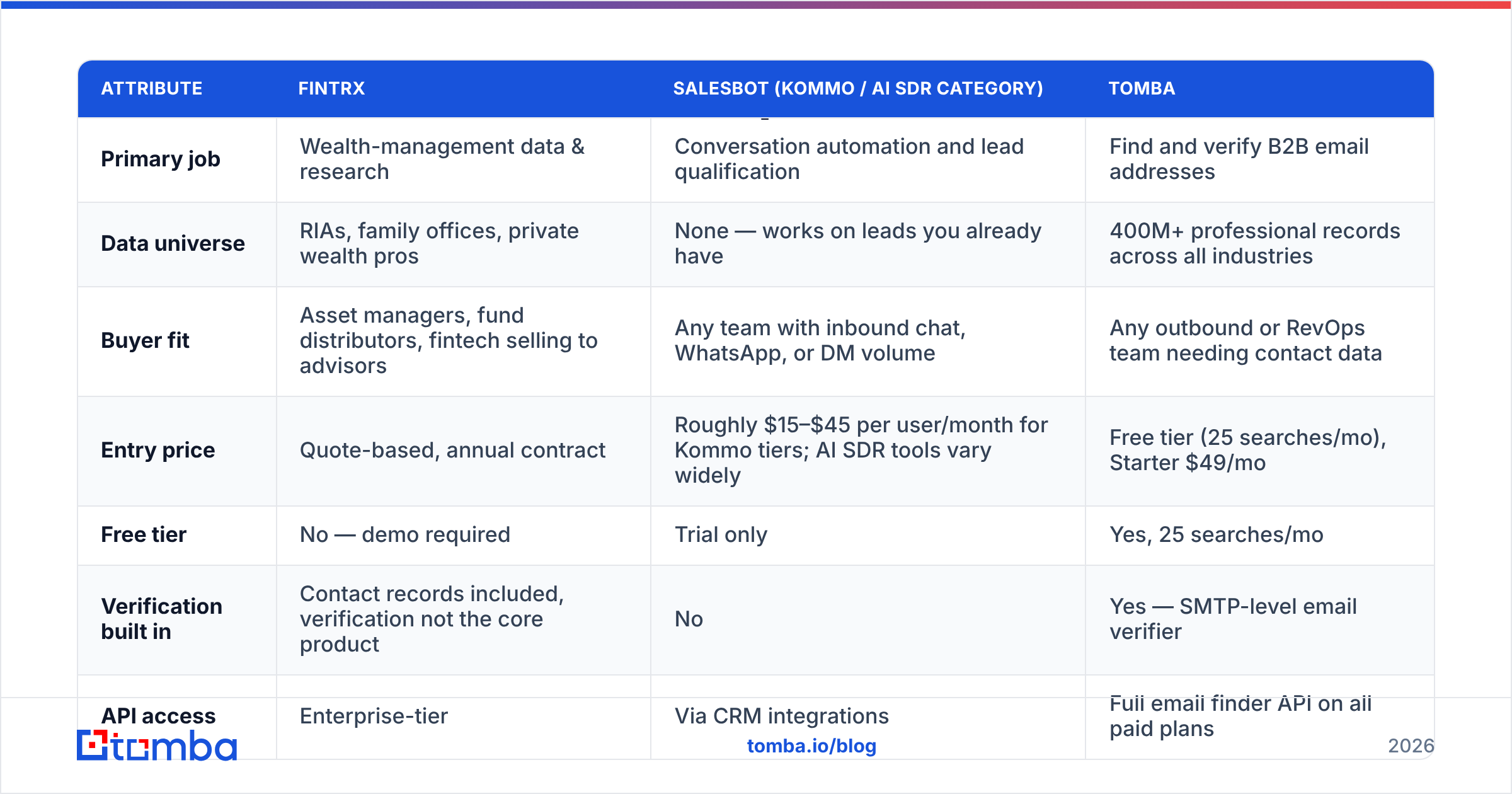
Here is the honest side-by-side. Where a vendor does not publish a number, this table says so rather than inventing one.
| Attribute | FinTRX | Salesbot (Kommo / AI SDR category) | Tomba |
|---|---|---|---|
| Primary job | Wealth-management data & research | Conversation automation and lead qualification | Find and verify B2B email addresses |
| Data universe | RIAs, family offices, private wealth pros | None — works on leads you already have | 400M+ professional records across all industries |
| Buyer fit | Asset managers, fund distributors, fintech selling to advisors | Any team with inbound chat, WhatsApp, or DM volume | Any outbound or RevOps team needing contact data |
| Entry price | Quote-based, annual contract | Roughly $15–$45 per user/month for Kommo tiers; AI SDR tools vary widely | Free tier (25 searches/mo), Starter $49/mo |
| Free tier | No — demo required | Trial only | Yes, 25 searches/mo |
| Verification built in | Contact records included, verification not the core product | No | Yes — SMTP-level email verifier |
| API access | Enterprise-tier | Via CRM integrations | Full email finder API on all paid plans |
| Time to first value | Weeks (onboarding + list build) | Days (bot flow build + testing) | Minutes |
| Biggest weakness | Narrow vertical, opaque pricing | Zero help sourcing net-new prospects | Not a CRM or sequencer |
Read that table twice. The row that decides most evaluations is "data universe." If you sell to wealth management, FinTRX's curation is the entire product and no chatbot substitutes for it. If you sell to literally anyone else, FinTRX is the wrong purchase regardless of how good it is.
What does FinTRX actually do well?#
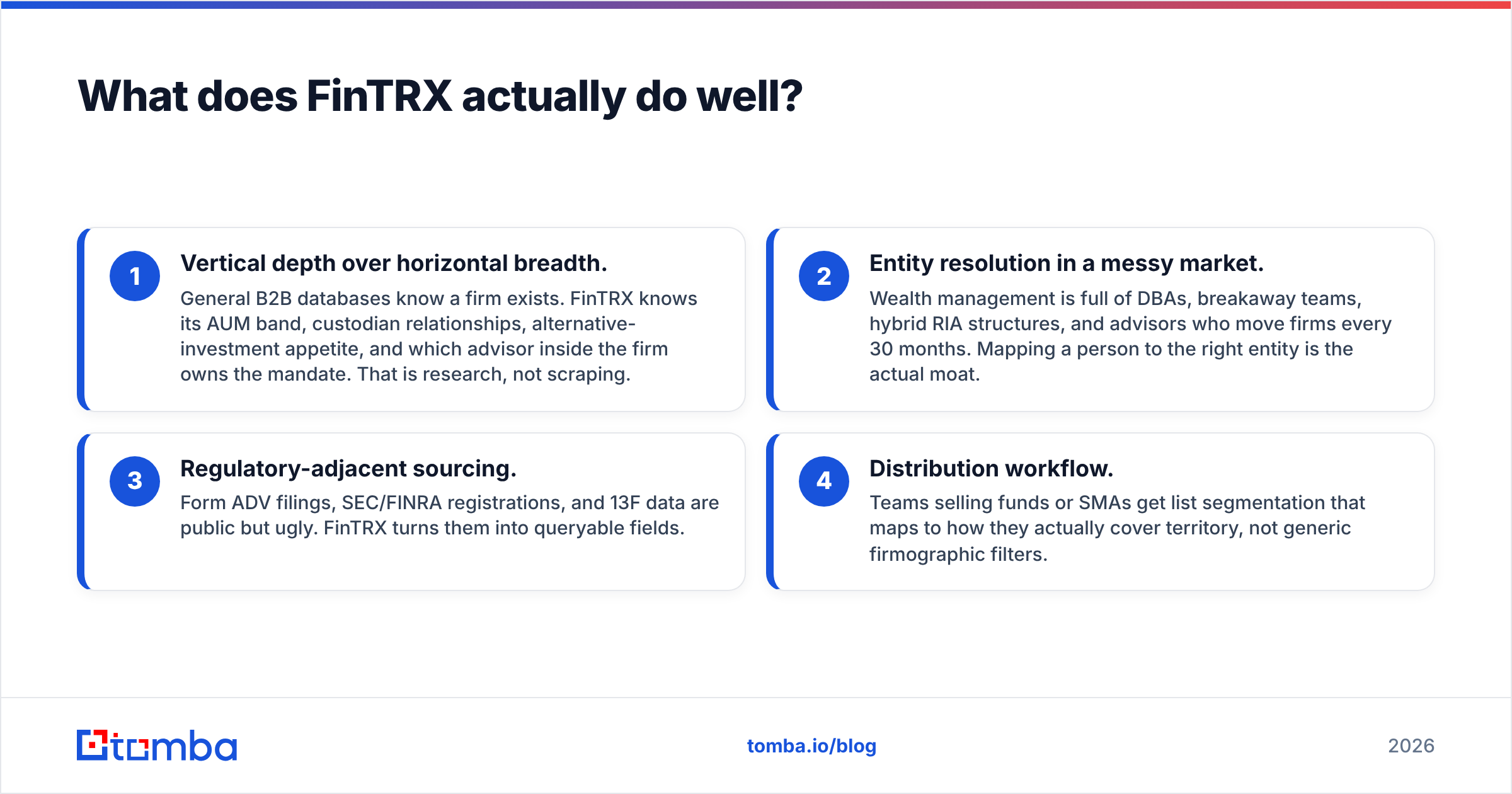
Four things, and they are genuinely hard to replicate:
- Vertical depth over horizontal breadth. General B2B databases know a firm exists. FinTRX knows its AUM band, custodian relationships, alternative-investment appetite, and which advisor inside the firm owns the mandate. That is research, not scraping.
- Entity resolution in a messy market. Wealth management is full of DBAs, breakaway teams, hybrid RIA structures, and advisors who move firms every 30 months. Mapping a person to the right entity is the actual moat.
- Regulatory-adjacent sourcing. Form ADV filings, SEC/FINRA registrations, and 13F data are public but ugly. FinTRX turns them into queryable fields.
- Distribution workflow. Teams selling funds or SMAs get list segmentation that maps to how they actually cover territory, not generic firmographic filters.
Where it falls short: pricing opacity, annual commitments, and — the complaint that shows up most in user reviews on G2 across this vendor category — contact-level email accuracy that decays between refresh cycles. That is not a FinTRX-specific flaw; every static database has it. It is why serious teams re-verify before a send regardless of source.
Where does Salesbot win?#
Salesbot-style automation wins on speed of response, which is the most under-priced variable in B2B sales.
- Sub-minute first touch. Inbound leads contacted within five minutes convert dramatically better than ones contacted the next morning. A bot never sleeps and never takes Friday off.
- Channel coverage. WhatsApp, Instagram DM, Facebook, and web chat are where a growing share of SMB and international B2B conversations start. Most sequencers ignore them entirely.
- Qualification before a human touches it. Budget, timeline, headcount — a five-question flow filters the 60% who were never going to buy.
- Cheap to run. Per-seat CRM pricing plus a bot builder costs a fraction of an enterprise data contract.
- Fast to prove. You can build, test, and measure a qualification flow in a week.
Where it falls short: Salesbot creates nothing. Point it at an empty pipeline and it sits idle. It is a multiplier on existing demand, not a source of it. Teams that buy conversation automation to fix a top-of-funnel problem are treating a symptom.
How much do FinTRX and Salesbot cost in 2026?#
Neither publishes a public price list, which tells you something about how each is sold.
FinTRX is quote-based and annual. Expect a discovery call, a seat-count discussion, and a contract sized to your team and the modules you need. Enterprise data in a regulated vertical is priced like enterprise data in a regulated vertical.
Salesbot depends entirely on which one you mean. Kommo's published CRM tiers run roughly $15–$45 per user/month with Salesbot included in the platform; standalone AI SDR products range from a few hundred dollars a month to five-figure annual deals depending on volume and how much "agent" they claim to be. Verify current pricing directly — this category re-prices constantly.
The practical budgeting rule: FinTRX is a research line item, Salesbot is an ops line item. They come out of different budgets and rarely compete for the same dollar.
Which one fits your team?#
Match your bottleneck to the tool. Not the other way round.
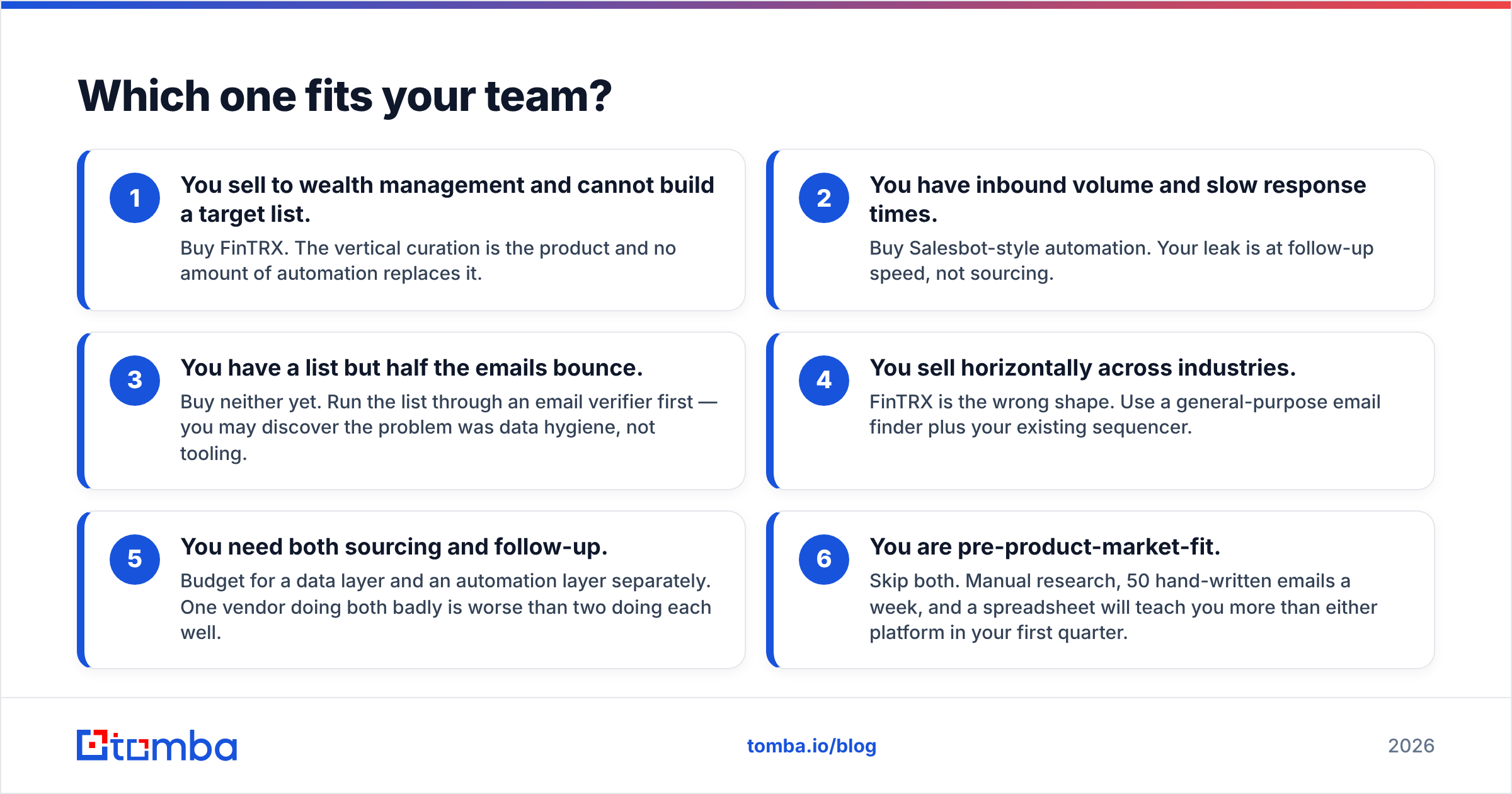
- You sell to wealth management and cannot build a target list. Buy FinTRX. The vertical curation is the product and no amount of automation replaces it.
- You have inbound volume and slow response times. Buy Salesbot-style automation. Your leak is at follow-up speed, not sourcing.
- You have a list but half the emails bounce. Buy neither yet. Run the list through an email verifier first — you may discover the problem was data hygiene, not tooling.
- You sell horizontally across industries. FinTRX is the wrong shape. Use a general-purpose email finder plus your existing sequencer.
- You need both sourcing and follow-up. Budget for a data layer and an automation layer separately. One vendor doing both badly is worse than two doing each well.
- You are pre-product-market-fit. Skip both. Manual research, 50 hand-written emails a week, and a spreadsheet will teach you more than either platform in your first quarter.
Do you still need an email finder alongside either?#
Yes — and this is the part most comparison posts skip.
FinTRX gives you a firm, a person, and a contact record. Salesbot gives you a conversation engine. Neither is designed to answer the narrow, mechanical question that breaks most campaigns: is this specific mailbox live right now?
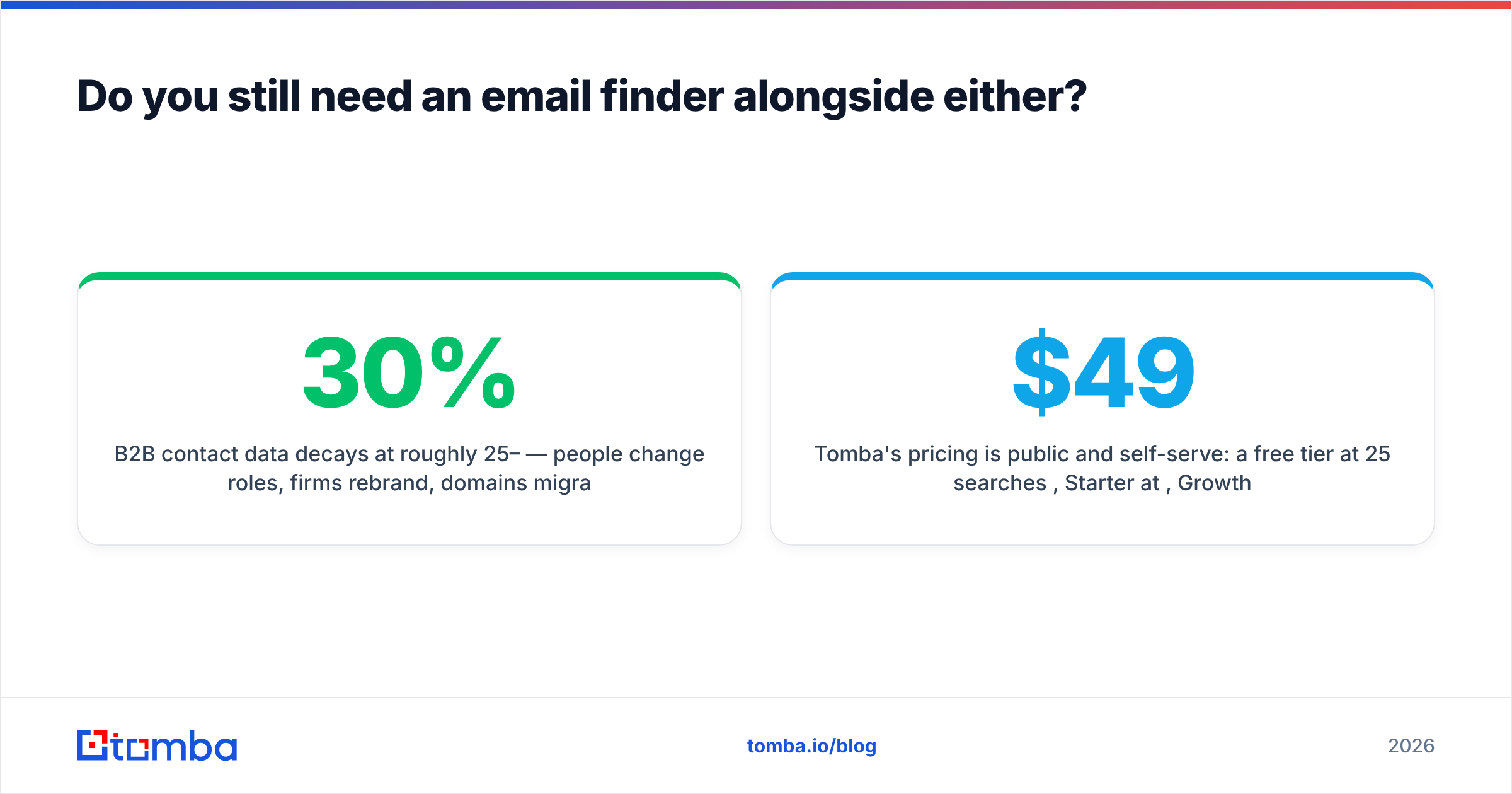
B2B contact data decays at roughly 25–30% per year — people change roles, firms rebrand, domains migrate. A record that was accurate at the last database refresh may be dead by the time it hits your sequence. Bounce rates above 3–5% start damaging sender reputation, and once that slides, even your good addresses stop landing in the inbox.
The fix is a verification step between your data source and your send, plus a way to fill gaps the primary source missed. That is where a general-purpose tool earns its keep:
- Use domain search to pull every discoverable address at a target firm when your database has the company but not the individual.
- Use SMTP-level verification to drop dead mailboxes before they cost you deliverability.
- Use data enrichment to backfill titles, LinkedIn profiles, and company attributes onto records that arrived thin.
- Use the API to run all three automatically on CRM record creation, so nothing enters your sequencer unverified.
Tomba's pricing is public and self-serve: a free tier at 25 searches/month, Starter at $49/mo, Growth at $99/mo, and Pro at $249/mo. You can test accuracy against your own list this afternoon rather than waiting for a demo slot.
What are the alternatives to FinTRX and Salesbot?#
If neither fits cleanly, the adjacent options split along the same data/automation line:
On the data side: general B2B databases cover far more industries but with less wealth-management depth. BookYourData is a well-regarded pay-as-you-go option if you want to buy a targeted list without an annual contract — useful when you need volume for one campaign rather than a standing subscription. Apollo and similar all-in-one platforms bundle data with sequencing, which is convenient until you audit the accuracy on niche verticals.
On the automation side: the AI SDR category is crowded and moving fast. Evaluate on three things only — how well it handles a reply it did not anticipate, how cleanly it writes back to your CRM, and whether it can be switched off mid-conversation and handed to a human without the prospect noticing the seam.
A note on evaluation method: ask every vendor in either category for a sample of 100 records or 100 conversations from your ICP, not their demo account. Then check the sample yourself. Vendors that decline this test are telling you the answer.
FAQ#
Is FinTRX worth it if I only occasionally sell to RIAs? Probably not. The value scales with how much of your revenue comes from wealth management. Occasional deals are better served by a horizontal database plus manual research.
Can Salesbot replace an SDR? It replaces the first 90 seconds of an SDR's job — qualification and routing. It does not replace discovery, objection handling, or the judgment call about whether a deal is real.
Do I need both? Only if you have both problems. Most teams have one, and buying for the other is how software budgets bloat.
How do I test data accuracy before signing an annual contract? Take 200 records from the vendor's sample, run them through an independent verifier, and measure the valid rate. Anything under 90% on a paid database deserves a hard conversation before you sign.
The bottom line#
FinTRX vs Salesbot is a false choice for most buyers. FinTRX is a specialist data purchase that pays off if — and only if — your buyer lives in wealth management. Salesbot is an ops purchase that pays off if you already have conversations you are too slow to answer. They occupy different rows of the budget and different stages of the funnel.
What both assume, and neither guarantees, is that the email address on the record actually works. Start there. Run your existing list through the Tomba Email Finder and its built-in verification — free for your first 25 searches, $49/mo when you scale — and you will know within an hour whether your pipeline problem is a tooling problem or a data problem. Fix the cheaper one first.
Related guides#
Ready to find emails that actually work?
Join 150,000+ professionals who stopped guessing and started sending. Free credits on signup — no credit card required.
Get the Tomba newsletter
Practical outbound tactics and product updates — once every two weeks.
About the author