Five9 vs Talkdesk (2026): Which CCaaS Platform Wins?
Five9 vs Talkdesk: both sell AI-powered cloud contact centers at similar list prices. The real gap shows up in outbound dialing, admin overhead, and what you pay after year one. Here's the honest breakdown.
TL;DR
- Five9 wins outbound. Its predictive dialer, list management, and campaign pacing are built for high-volume calling teams. Talkdesk's outbound works, but it is a second act to its inbound support DNA.
- Talkdesk wins admin speed. Non-technical admins can build and change flows in Talkdesk Studio. Five9's older admin console is slower to learn.
- List pricing is close. Five9 runs about $119-$229 per user per month. Talkdesk runs about $85-$225. Neither number is what you actually pay. Minutes, AI add-ons, and setup fees change the math.
- Both are enterprise contracts. Expect an annual commitment, services fees, and a 6-12 week rollout. Neither one is a self-serve tool you spin up on a Tuesday.
- Your dial list matters more than your dialer. A predictive dialer aimed at stale numbers just burns your caller reputation faster.
Five9 vs Talkdesk is the shortlist almost every contact center buyer lands on. That is the problem. On a feature grid, the two look nearly the same. Both are cloud contact center (CCaaS) platforms. Both bundle voice, digital channels, workforce management, and an AI layer. Both quote in the same price band. Both hold thousands of reviews on G2 that average out to about the same score.
The choice gets clear when you stop comparing feature lists and start comparing shapes. Five9 grew up as an outbound dialing company that added support features. Talkdesk grew up as a modern inbound support platform that later added outbound. Fifteen years on, those origins still show in the product.
This post breaks down where each one actually wins. It shows what the pricing looks like once the add-ons land. And it gives you a way to pick without a three-month bake-off.
Five9 vs Talkdesk: what is the core difference?#
Five9 is a dialer company that became a contact center. Talkdesk is a contact center that added a dialer.
Think of it like a truck versus an SUV. Both have four wheels, seats, and a stereo. But one was built around towing. The other was built around passenger comfort. No trim level changes the chassis underneath.
Here is how that plays out day to day:
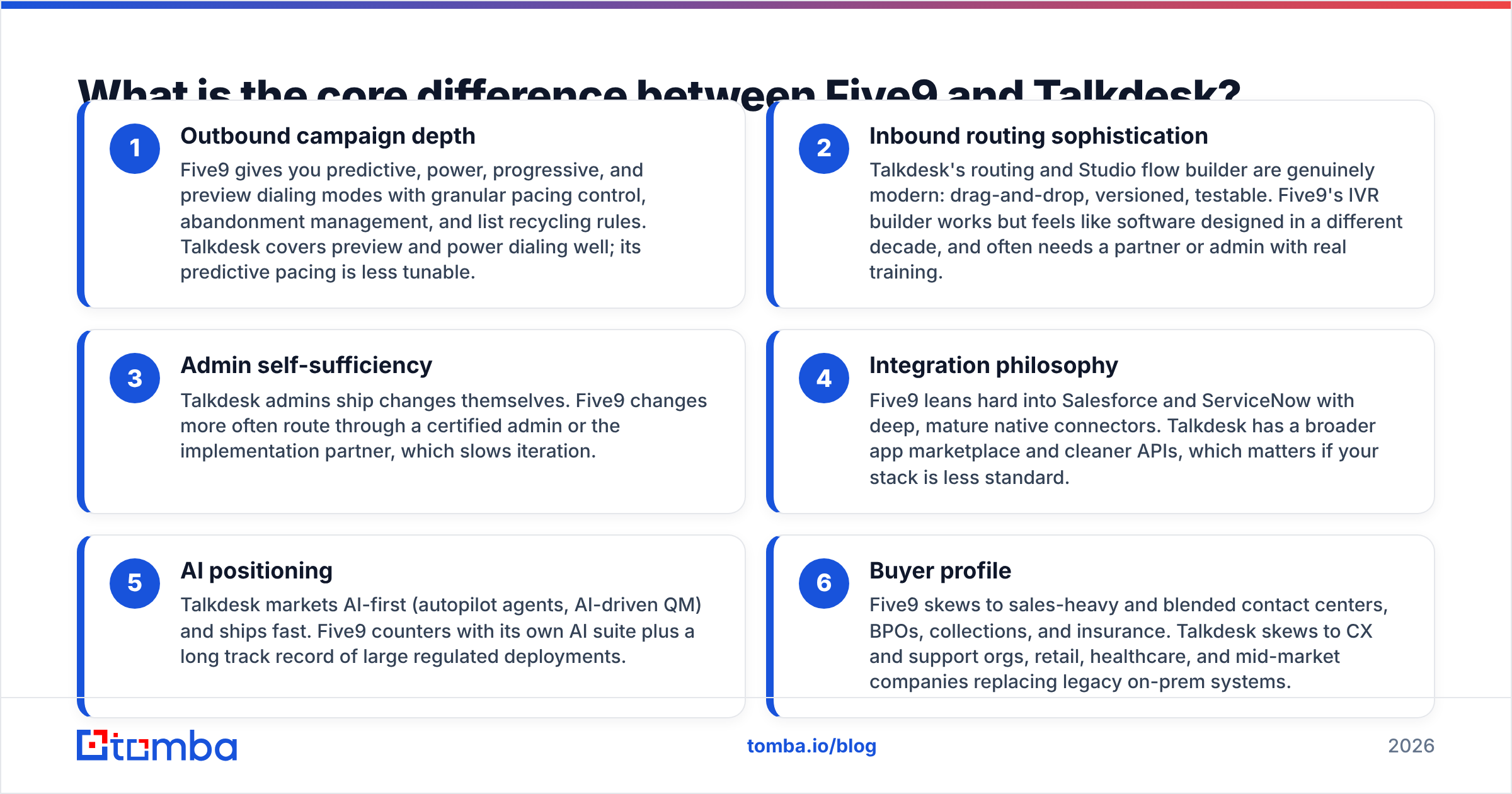
- Outbound campaign depth — Five9 gives you predictive, power, progressive, and preview dialing. You also get fine pacing control, abandonment management, and list recycling rules. Talkdesk handles preview and power dialing well. Its predictive pacing is less tunable.
- Inbound routing — Talkdesk's routing and Studio flow builder are modern: drag-and-drop, versioned, testable. Five9's IVR builder works, but it feels like software from another decade. It often needs a partner or a trained admin.
- Admin self-sufficiency — Talkdesk admins ship changes themselves. Five9 changes tend to route through a certified admin or the implementation partner. That slows iteration.
Three more differences shape the long-term fit:
- Integration philosophy — Five9 leans hard into Salesforce and ServiceNow with deep, mature native connectors. Talkdesk has a broader app marketplace and cleaner APIs. That matters if your stack is less standard.
- AI positioning — Talkdesk markets AI first, with autopilot agents and AI-driven QM, and it ships fast. Five9 counters with its own AI suite and a long record of large regulated deployments.
- Buyer profile — Five9 skews to sales-heavy and blended contact centers, BPOs, collections, and insurance. Talkdesk skews to CX and support orgs, retail, healthcare, and mid-market teams replacing on-prem systems.

How do Five9 and Talkdesk compare on pricing?#
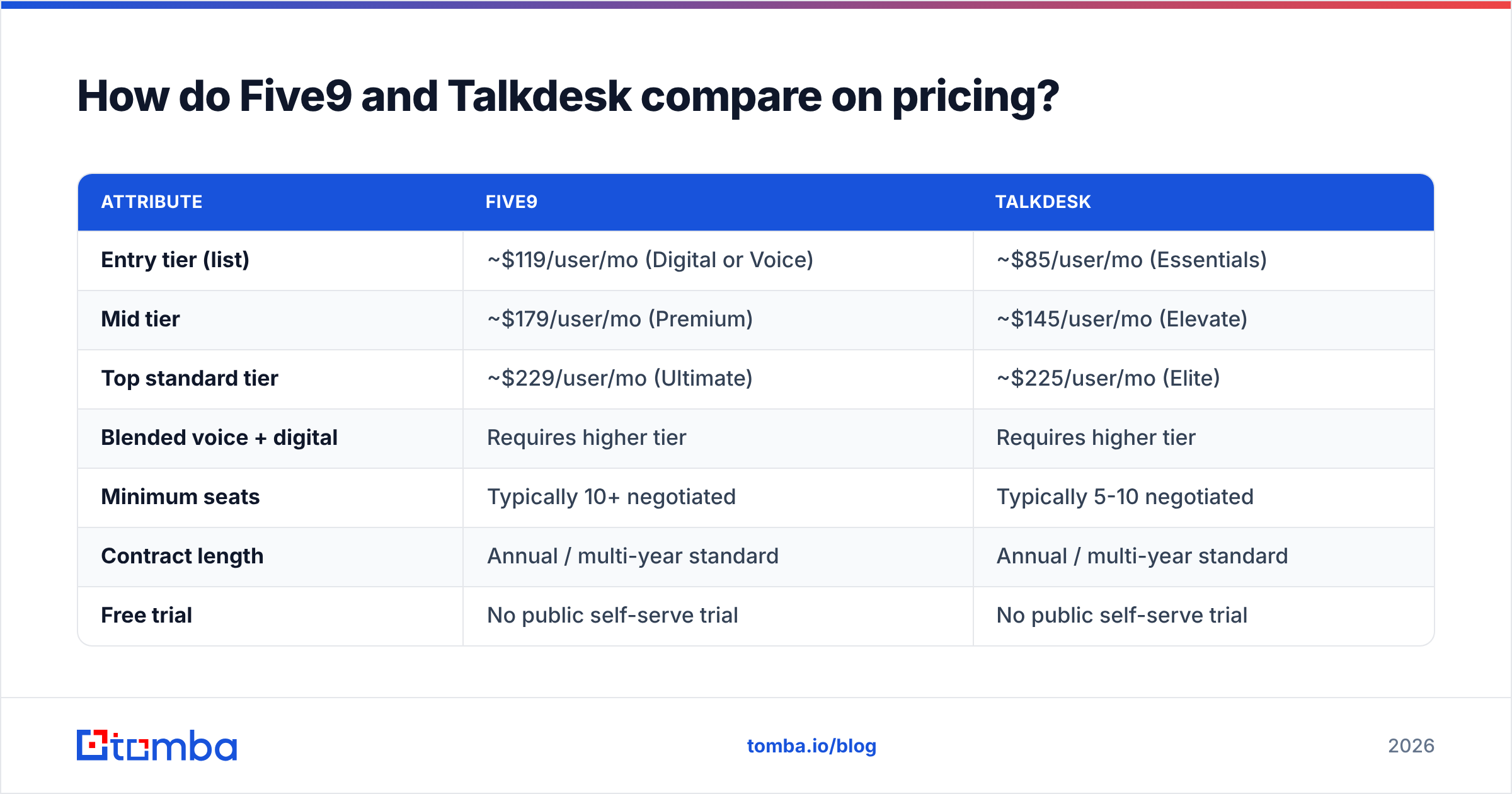
Both vendors publish tiered per-seat pricing. Then they quote you something different. Here is the published shape as of 2026. Treat it as a starting point for negotiation, not a checkout page.
| Attribute | Five9 | Talkdesk |
|---|---|---|
| Entry tier (list) | ~$119/user/mo (Digital or Voice) | ~$85/user/mo (Essentials) |
| Mid tier | ~$179/user/mo (Premium) | ~$145/user/mo (Elevate) |
| Top standard tier | ~$229/user/mo (Ultimate) | ~$225/user/mo (Elite) |
| Blended voice + digital | Requires higher tier | Requires higher tier |
| Minimum seats | Typically 10+ negotiated | Typically 5-10 negotiated |
| Contract length | Annual / multi-year standard | Annual / multi-year standard |
| Free trial | No public self-serve trial | No public self-serve trial |
| Telephony minutes | Usually metered separately | Usually metered separately |
| WFM / WEM | Add-on or top tier | Add-on or top tier |
| AI agents / copilot | Priced separately | Priced separately |
| Implementation fee | Common, four to five figures | Common, four to five figures |
Three things this table hides. They are also the three things that blow up budgets:
Telephony is a separate meter. Per-seat pricing covers the software. Minutes, DIDs, toll-free numbers, and international calls are billed on usage. A 40-seat outbound team dialing eight hours a day can run up a minutes bill as large as the seat bill.
AI is unbundled. Both vendors sell conversational AI, agent assist, and AI quality management as separate SKUs. Pricing is often per interaction or per minute, not per seat. The demo where an AI agent handles a whole call is real. It is also a line item.
Professional services are not optional at scale. Neither platform is a weekend install once you add real routing logic, CRM sync, and compliance rules. Budget for the rollout. Then budget for the person who owns the platform afterward.
Five9 vs Talkdesk for outbound sales teams: which wins?#
Five9, in most cases. If your team's main job is making calls — SDRs, collections, insurance sales, appointment setting — Five9's dialer is the more complete tool.
Four things matter most for outbound:
- Pacing control. You can tune the predictive algorithm against your live connect and abandon rates. It is not a black box.
- List management. Recycling rules, do-not-call scrubbing, time-zone calling windows, and attempt caps are core features, not workarounds.
- Blended agents. Agents who take inbound calls between outbound bursts are a native concept, which helps teams that do both.
- Compliance tooling. For regulated outbound in the US, the consent flags, manual-approve modes, and abandon-rate reports are more mature.
Talkdesk can run an outbound motion. Plenty of teams do it. But if outbound volume is the whole business, you will fight the tool less with Five9.
One counterpoint is worth taking seriously: your dialer is not your bottleneck. Your list is. A predictive dialer at 3:1 pacing does not help if 30% of the numbers are wrong. It just makes more dead air. It also gets your outbound numbers spam-flagged faster and wears out your reps. So validate the data before you spend $200 a seat on dialer sophistication. A phone validator pass before a campaign is the cheapest win a calling team can get. Verified numbers plus verified email for follow-up beat raw dial volume almost every time.
Which one is better for inbound support and CX?#
Talkdesk, in most cases. If most of your volume arrives rather than departs, Talkdesk is the friendlier system to own.
- Studio flow builder. Building, versioning, and testing routing flows is self-service. Support ops leads can make Tuesday's change on Tuesday.
- Digital channels feel native. Chat, email, SMS, and social route through the same engine rather than feeling bolted on.
- Modern agent workspace. Agents complain less. That sounds soft until you price agent training time and turnover.
- Vertical packages. Talkdesk ships bundles for healthcare, retail, and financial services. They shorten time to value if you fit the mold.
- AI shipping cadence. Talkdesk releases AI features fast. The QM automation saves real supervisor hours.
Five9 handles inbound well. It serves large enterprise support orgs every day. The difference is how much admin friction sits between "we should change the routing" and "the routing is changed."
What do real users complain about?#
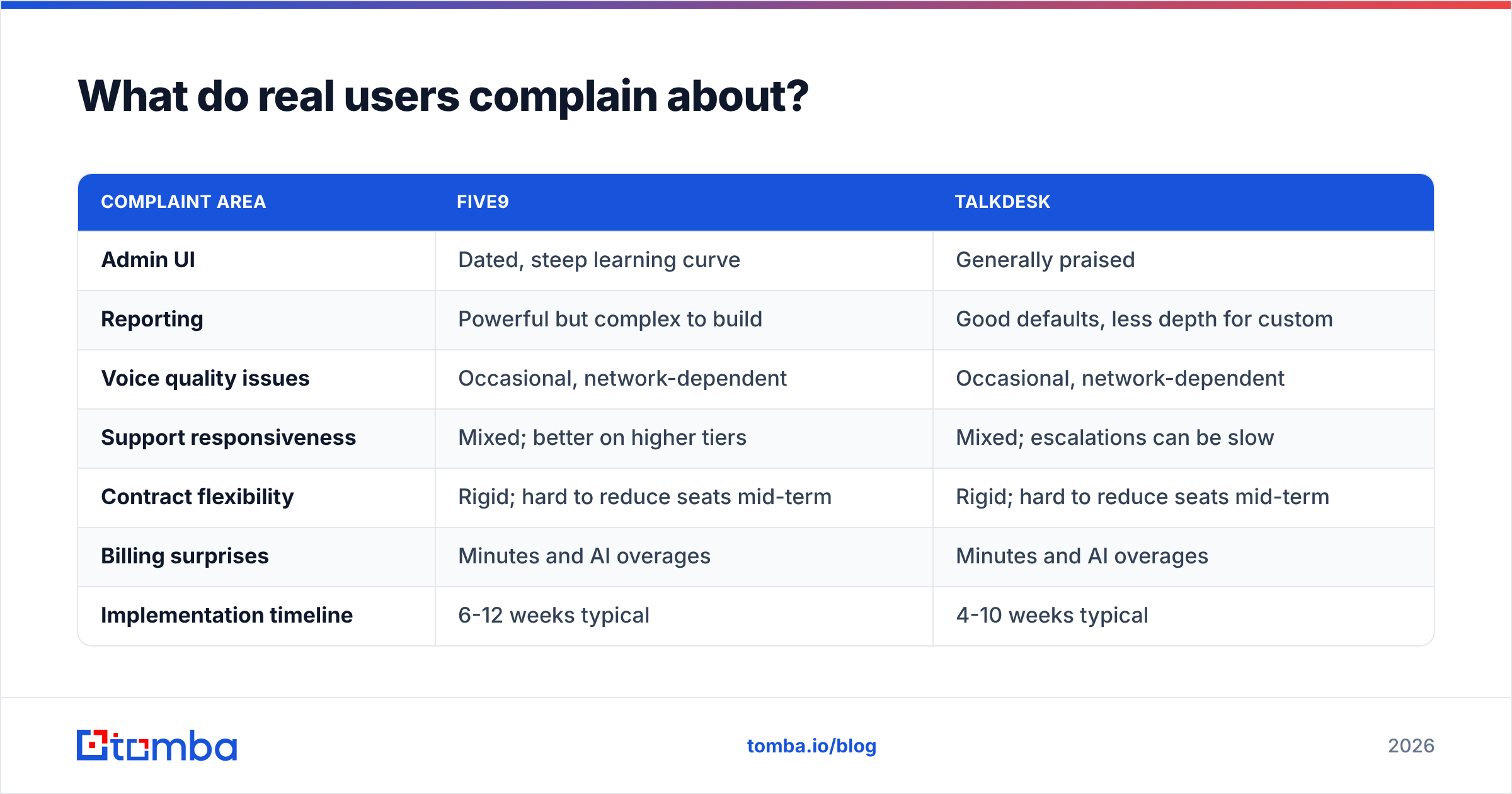
Read this before you sign anything. Both platforms draw the same gripes across Capterra and G2 reviews:
| Complaint area | Five9 | Talkdesk |
|---|---|---|
| Admin UI | Dated, steep learning curve | Generally praised |
| Reporting | Powerful but complex to build | Good defaults, less depth for custom |
| Voice quality issues | Occasional, network-dependent | Occasional, network-dependent |
| Support responsiveness | Mixed; better on higher tiers | Mixed; escalations can be slow |
| Contract flexibility | Rigid; hard to reduce seats mid-term | Rigid; hard to reduce seats mid-term |
| Billing surprises | Minutes and AI overages | Minutes and AI overages |
| Implementation timeline | 6-12 weeks typical | 4-10 weeks typical |
Notice that the bottom three rows are the same. That is the CCaaS category, not a vendor flaw. Negotiate seat flexibility up front. The most expensive buyer mistake is committing to headcount you never hit. Then you pay for empty seats for 24 months.
How do they compare on AI features in 2026?#
Both vendors sell three layers of AI. The naming differs more than the substance.
- Virtual agents / autopilot — AI handles a full interaction for set intents, such as order status, booking, or balance checks. Talkdesk pushes harder here in public. Five9 has strong deployments in regulated verticals.
- Agent assist / copilot — Real-time suggestions, knowledge surfacing, and next-best-action during a live call. The two are comparable.
- Post-interaction AI — Auto-summaries, sentiment scoring, and QM scoring on every interaction instead of a 2% sample. This layer has the clearest ROI on both platforms.
Practical advice: evaluate layer 3 first. Automated QM pays back fast. It also does not ask you to trust an AI with your customers. Layers 1 and 2 are where the demos shine and where rollouts stall on data quality, integration depth, and change management. Check each vendor's own docs (five9.com and talkdesk.com) before you build a business case. AI packaging in this category changes every couple of quarters.
What should you check before signing either contract?#
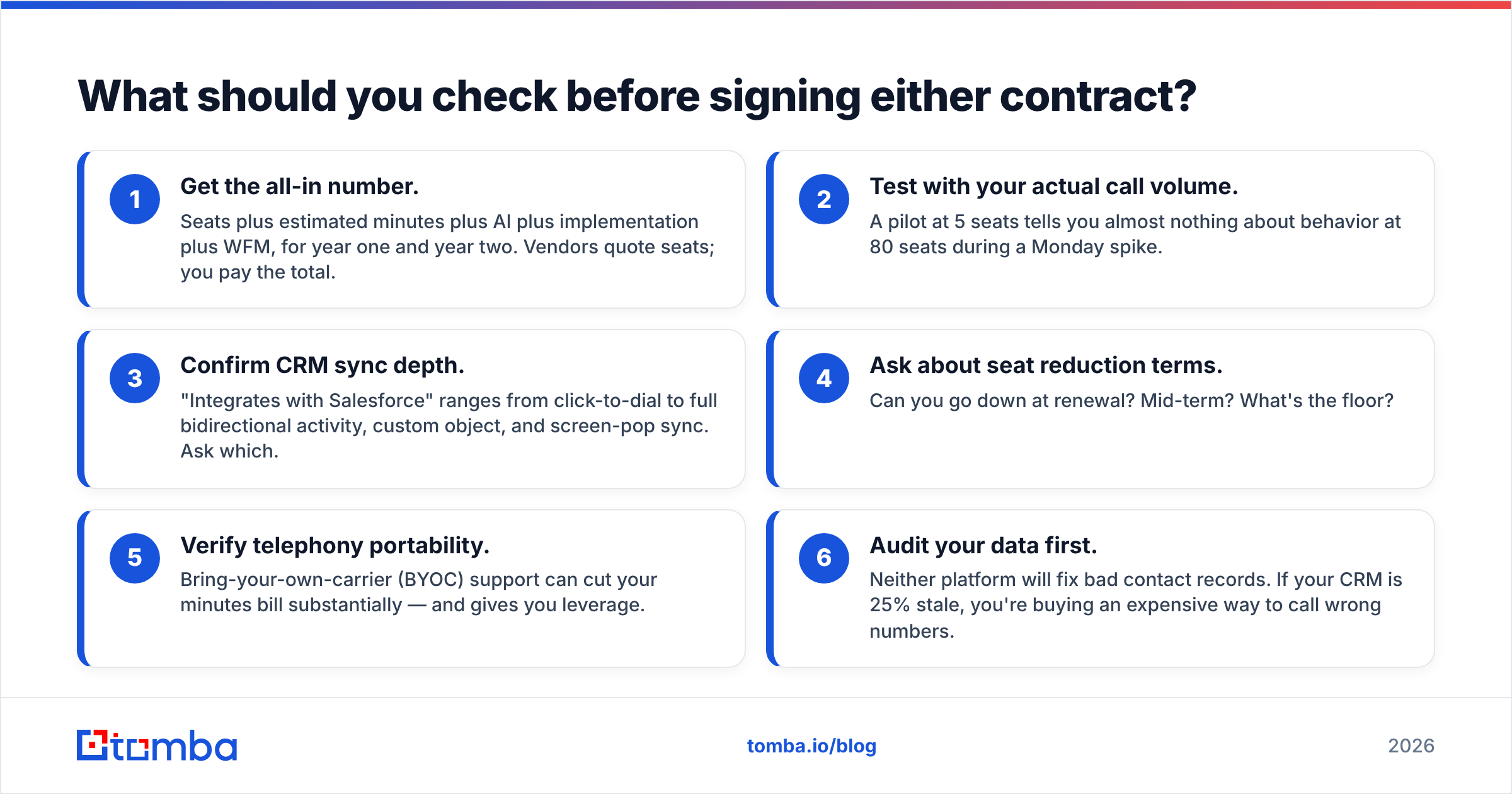
Run this list in your evaluation. It catches most of the regret:
- Get the all-in number. Seats, minutes, AI, implementation, and WFM, for year one and year two. Vendors quote seats. You pay the total.
- Test with your real call volume. A 5-seat pilot tells you little about 80 seats during a Monday spike.
- Confirm CRM sync depth. "Integrates with Salesforce" can mean click-to-dial, or it can mean full two-way activity and screen-pop sync. Ask which one.
- Ask about seat reduction. Can you go down at renewal? Mid-term? What is the floor?
- Verify telephony portability. Bring-your-own-carrier support can cut your minutes bill. It also gives you leverage.
- Audit your data first. Neither platform fixes bad contact records. If your CRM is 25% stale, you are buying a costly way to call wrong numbers.
That last point is where most calling programs lose their return. The platform matters, but list quality decides whether reps have conversations at all. Clean the data before the migration, not after. Run your target accounts through a domain search to map who works there now. Then push verified contacts into your CRM with data enrichment, so the dialer and the sequencer share one accurate record. Teams that do this before a CCaaS rollout see better connect rates in month one.
Which platform should you pick?#
Short version:
| Your situation | Pick |
|---|---|
| High-volume outbound sales or collections | Five9 |
| Support-led CX with mixed digital channels | Talkdesk |
| Deep Salesforce or ServiceNow dependency | Five9 |
| Non-technical ops team owning the platform | Talkdesk |
| Regulated outbound (insurance, lending, healthcare collections) | Five9 |
| Fast rollout, minimal professional services | Talkdesk |
| Blended inbound + outbound at scale | Five9 (slight edge) |
| Budget under $10K/month, under 30 seats | Talkdesk (usually cheaper entry) |
And here is the answer few comparison posts print: if you have fewer than 15 agents and you mostly do outbound prospecting, neither tool is right for you. A sales engagement platform with a built-in dialer costs a fraction of a CCaaS seat. It also gets you calling this week. Five9 and Talkdesk earn their price when you have queues, SLAs, workforce scheduling, and compliance reporting — not when you have eight SDRs and a call list.
The bottom line#
Five9 vs Talkdesk is not a quality contest. Both are credible. The differentiator is fit. Outbound-heavy and Salesforce-centric points at Five9. Support-led with a small ops team points at Talkdesk. Everything else — pricing, contract rigidity, rollout pain, minutes billing — feels about the same with a different logo on the invoice.
Whichever you pick, the platform only performs as well as the contact data you feed it. Before you migrate a single list, make sure the names, emails, and companies in it are real and current. Tomba's Email Finder finds verified professional email addresses by name and domain. Every account your reps dial then has a working email path for follow-up. Start on the free tier with 25 searches a month, or check Tomba pricing — plans run from $49/mo Starter to $249/mo Pro. Clean your list before the dialer ever touches it.
Related guides#
// get started
Find, verify and enrich your first contacts today
Start on the free plan with 25 searches a month, then scale when your team is ready.
Free plan · No credit card required · GDPR & CCPA
Get the Tomba newsletter
Product and data updates
// about the author