Flashlabs Pros and Cons: An Honest 2026 Buyer's Review
Flashlabs promises AI-driven pipeline on autopilot. Here is an honest breakdown of the pros, the cons, the data-quality trade-offs, and the cheaper stack that beats it for most B2B teams.
TL;DR — Flashlabs pros and cons in one screen
- Flashlabs sells speed. AI agents research accounts, build lists, and draft outbound copy. That part mostly works.
- The cons are structural, not cosmetic. You cannot see where the data came from. Credit pricing punishes testing. The AI copy reads like AI copy at scale.
- It suits founder-led teams and 1–3 rep teams who want one console. It suits you badly if you already run a CRM and a sequencer.
- The biggest hidden cost of any all-in-one AI tool is unverified email data. Bounces above 3% hurt your domain long after the trial ends.
- A cheaper, sturdier stack: a dedicated data source (Tomba from $49/mo), your current sequencer, and AI used for research instead of writing every line.
This review walks the Flashlabs pros and cons in the order they show up. What you get in week one. What you notice in month two. What the whole workflow costs.
What is Flashlabs, and who is it for?#
Flashlabs is an "AI GTM agent." That is the wave of tools that arrived after 2024. They fold prospecting, research, list building, enrichment, and first-touch copy into one flow. You type an ideal customer profile in plain English. The tool builds a list, enriches it, drafts messages, and hands you something to send.
The category is real, and it is crowded. G2's sales intelligence category lists hundreds of products with near-identical claims. Most buyer confusion starts there. So before you weigh the Flashlabs pros and cons, be clear on what you are buying. It is a layer on top of data, not a data provider.
That one distinction drives almost every trade-off below. Layers like this are great at cutting steps. They are weak at promising what comes out the far end. The records underneath are licensed, pooled, or scraped from sources the vendor does not own.
One more note. Pricing, credit rules, and packaging change fast here, often each quarter. Treat any number in a third-party review, this one included, as a rough guide. Check current tiers on the vendor's own site before you sign for a year.
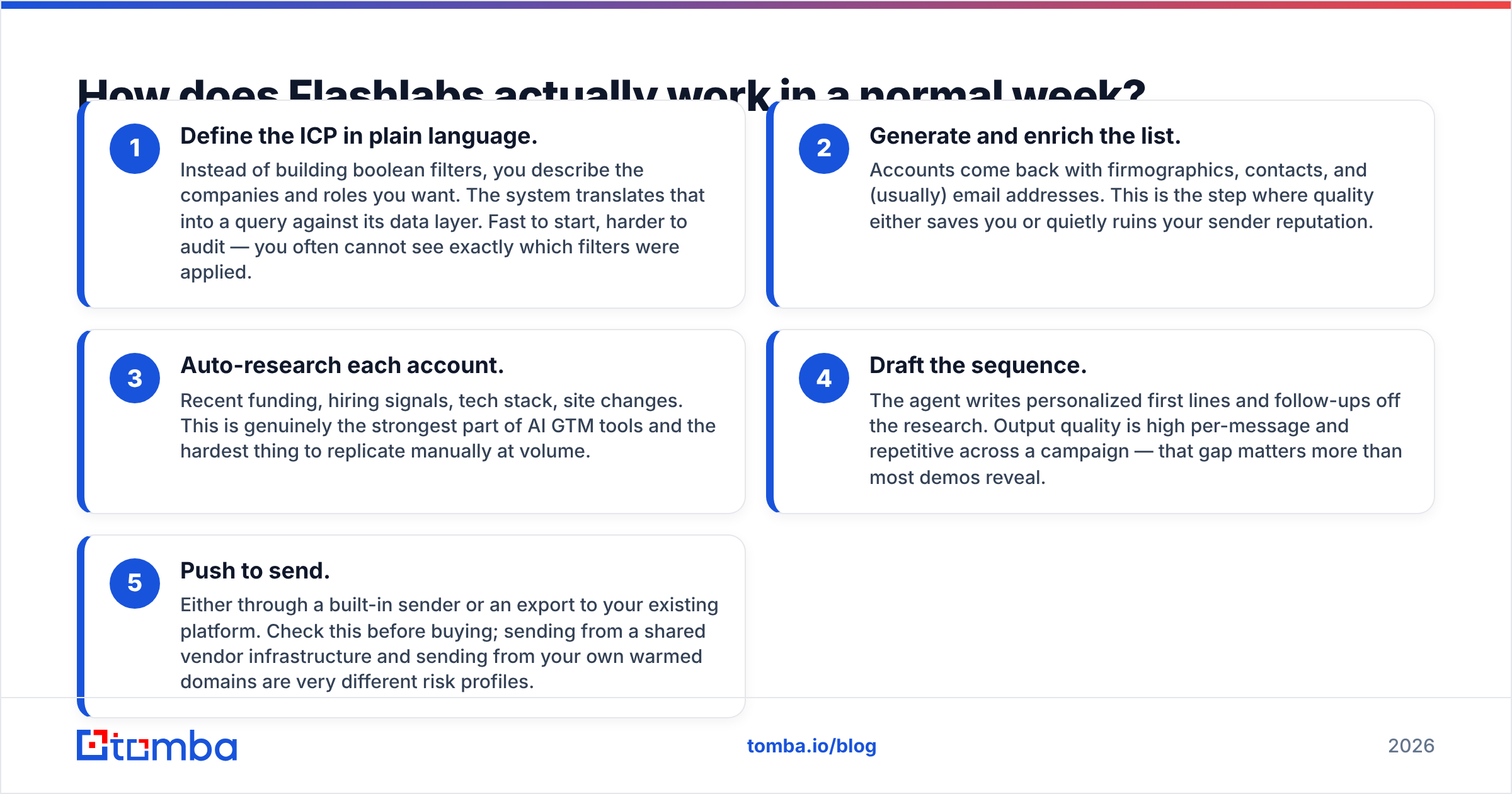
Flashlabs pros and cons: how the tool works in a normal week#
Strip out the marketing and the week looks like this.
- Describe the ICP in plain words. No boolean filters. The tool turns your words into a query. Fast to start, hard to audit — you rarely see which filters ran.
- Build and enrich the list. You get companies, contacts, and usually emails. This step either saves you or burns your sender reputation.
- Research each account. Funding, hiring, tech stack, site changes. This is the best part of AI GTM tools, and the hardest to match by hand.
- Draft the sequence. The agent writes first lines from that research. Each message reads well. The whole set reads the same.
- Send. From a built-in sender, or an export to your own platform. Check this first. Shared vendor servers carry more risk than your own warmed domain.

What are the real pros of Flashlabs?#
Start with the upside. The pros in any Flashlabs pros and cons list cluster at the top of the funnel.
You can launch fast. A non-technical founder can go from "we sell to Series A fintech ops leads" to a live campaign in an afternoon. Building the same thing from a data provider, an enrichment step, a sequencer, and a copy pass takes days the first time.
Account research is the killer feature. The AI reads 40 company pages, press releases, and job boards. It pulls one useful hook per account. That is the best use of LLMs in outbound right now. The work is dull, high volume, and low judgment. Machines should do it.
One console instead of five. Each tool you drop is one less bill, one less integration to babysit, one less place for data to rot. For a two-person team, that is worth real money. It holds even when each part is weaker than a specialist tool.
Less to learn for non-specialists. Filter-driven platforms assume you know how to segment. Prompt-driven tools do not. If nobody on your team has run outbound before, that head start counts.
Fast ICP tests. Trying five segments in a week is realistic here. Early-stage teams find their best segment that way. Older stacks make it slow, so most teams never try.
What are the cons you only find in month two?#
The other half of the Flashlabs pros and cons ledger shows up late, usually around month two.
You cannot see where the data came from. You rarely learn whether an email was checked live, guessed from a pattern, or pulled from a licensed file that is 18 months old. When a campaign bounces at 9%, you cannot tell which layer failed. Compare that with a provider that publishes its data sources and scores each record.
Credit pricing punishes the thing the product sells. The pitch says explore freely. The meter says every test costs credits. Teams learn to test less. That cancels the main benefit.
The AI copy all sounds alike. One message is fine. Four hundred are not. Every rival team runs the same class of tool on the same buyers. "I noticed you recently raised your Series B" now reads as a robot, not research.
Deliverability risk moves to you. If the tool sends from your domain with unchecked addresses, your sender reputation takes the hit. Hard bounces above 3% start to push mail out of the inbox. Recovery takes weeks. Run every list through an email verifier first, whatever the vendor claims.
Lock-in comes from the workflow, not the contract. Lists, research, sequences, and reports all live in one place. Leaving means rebuilding, not moving. Ask what the CSV and API export actually return before you commit.
Coverage thins outside US tech. Almost every AI GTM tool is best on US mid-market SaaS. Selling to European SMBs, manufacturing, or healthcare? Test coverage on 200 real target accounts before you sign.
How does Flashlabs compare to the alternatives?#
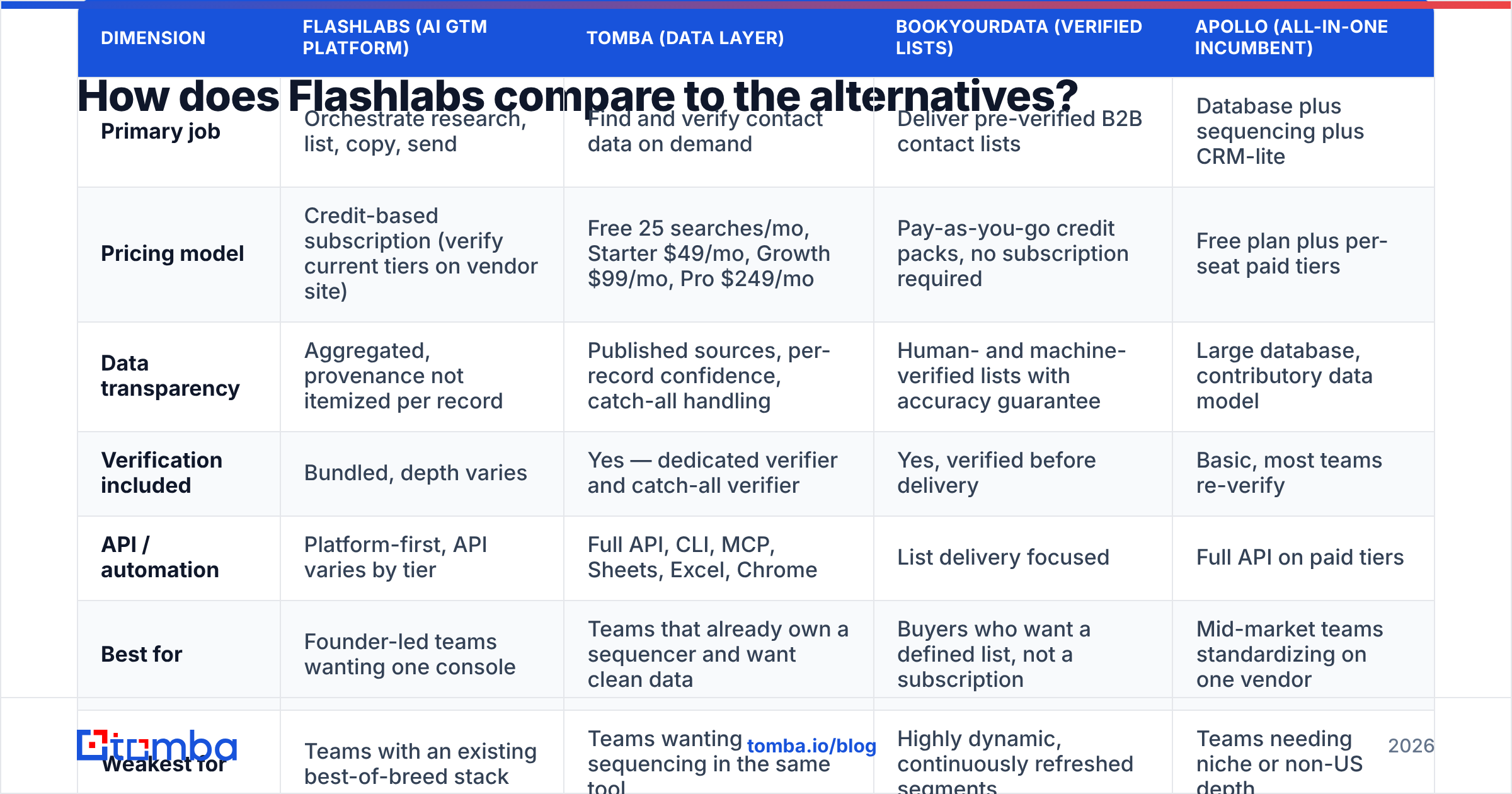
There are three sane ways to build this. An all-in-one AI platform. A data layer plus your own sequencer. Or a one-off buy of verified lists. Each fits a different team.
| Dimension | Flashlabs (AI GTM platform) | Tomba (data layer) | BookYourData (verified lists) | Apollo (all-in-one incumbent) |
|---|---|---|---|---|
| Primary job | Orchestrate research, list, copy, send | Find and verify contact data on demand | Deliver pre-verified B2B contact lists | Database plus sequencing plus CRM-lite |
| Pricing model | Credit-based subscription (verify current tiers on vendor site) | Free 25 searches/mo, Starter $49/mo, Growth $99/mo, Pro $249/mo | Pay-as-you-go credit packs, no subscription required | Free plan plus per-seat paid tiers |
| Data transparency | Aggregated, provenance not itemized per record | Published sources, per-record confidence, catch-all handling | Human- and machine-verified lists with accuracy guarantee | Large database, contributory data model |
| Verification included | Bundled, depth varies | Yes — dedicated verifier and catch-all verifier | Yes, verified before delivery | Basic, most teams re-verify |
| API / automation | Platform-first, API varies by tier | Full API, CLI, MCP, Sheets, Excel, Chrome | List delivery focused | Full API on paid tiers |
| Best for | Founder-led teams wanting one console | Teams that already own a sequencer and want clean data | Buyers who want a defined list, not a subscription | Mid-market teams standardizing on one vendor |
| Weakest for | Teams with an existing best-of-breed stack | Teams wanting sequencing in the same tool | Highly dynamic, continuously refreshed segments | Teams needing niche or non-US depth |
The honest read: Flashlabs and its rivals win on speed for teams starting from zero. BookYourData wins when you know the exact segment you want. You buy one clean list instead of running a subscription. A data layer wins on cost per usable contact, and on portability. You keep the workflow you trust and swap only the source.
Is the data accurate enough for cold outreach?#
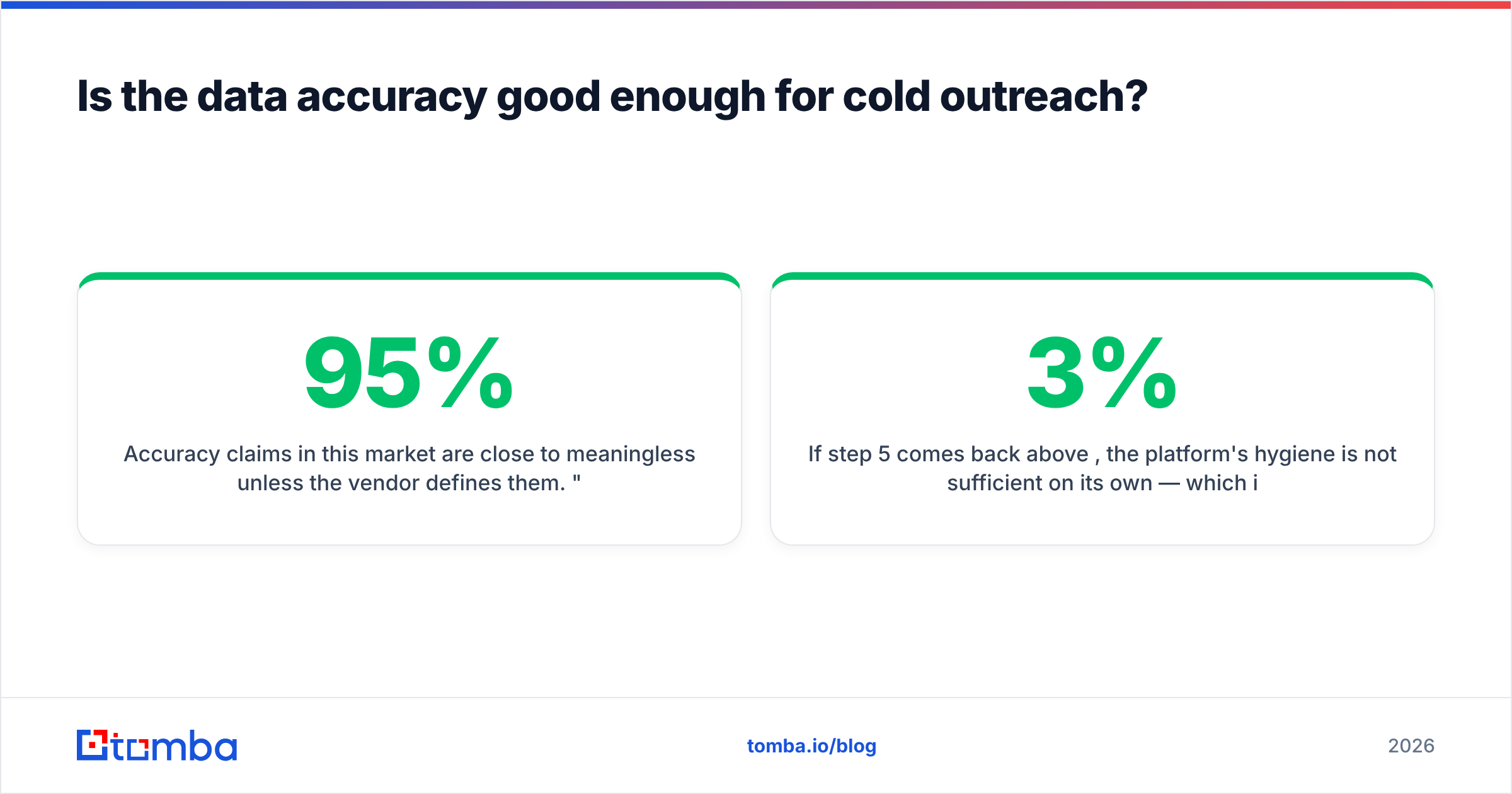
Accuracy claims here mean little unless the vendor defines them. "95% accurate" can mean 95% valid syntax. It can mean 95% deliverable on the day it was collected. It can mean 95% deliverable today. Only the last one protects your domain.
Run this test on any tool in the class, Flashlabs included, during the trial.
- Pull 200 contacts from your real ICP, not a demo segment the vendor picked.
- Re-check all 200 elsewhere with a third-party verifier. Count valid, invalid, catch-all, and unknown on their own.
- Treat catch-all as its own bucket. A catch-all domain accepts everything and proves nothing. Use a catch-all verifier instead of guessing.
- Work out cost per verified contact, not cost per credit. A cheap credit that returns a guess costs more than a pricey one that returns a real mailbox.
- Send a 50-contact pilot from a warmed second domain. Measure the hard-bounce rate.
If step 5 comes back above 3%, the tool's own hygiene is not enough. That is not a scandal. It is the normal state of pooled data. Budget for a verify pass either way. Deliverability outlives every tool you pick this year.
What should Flashlabs cost you per month?#
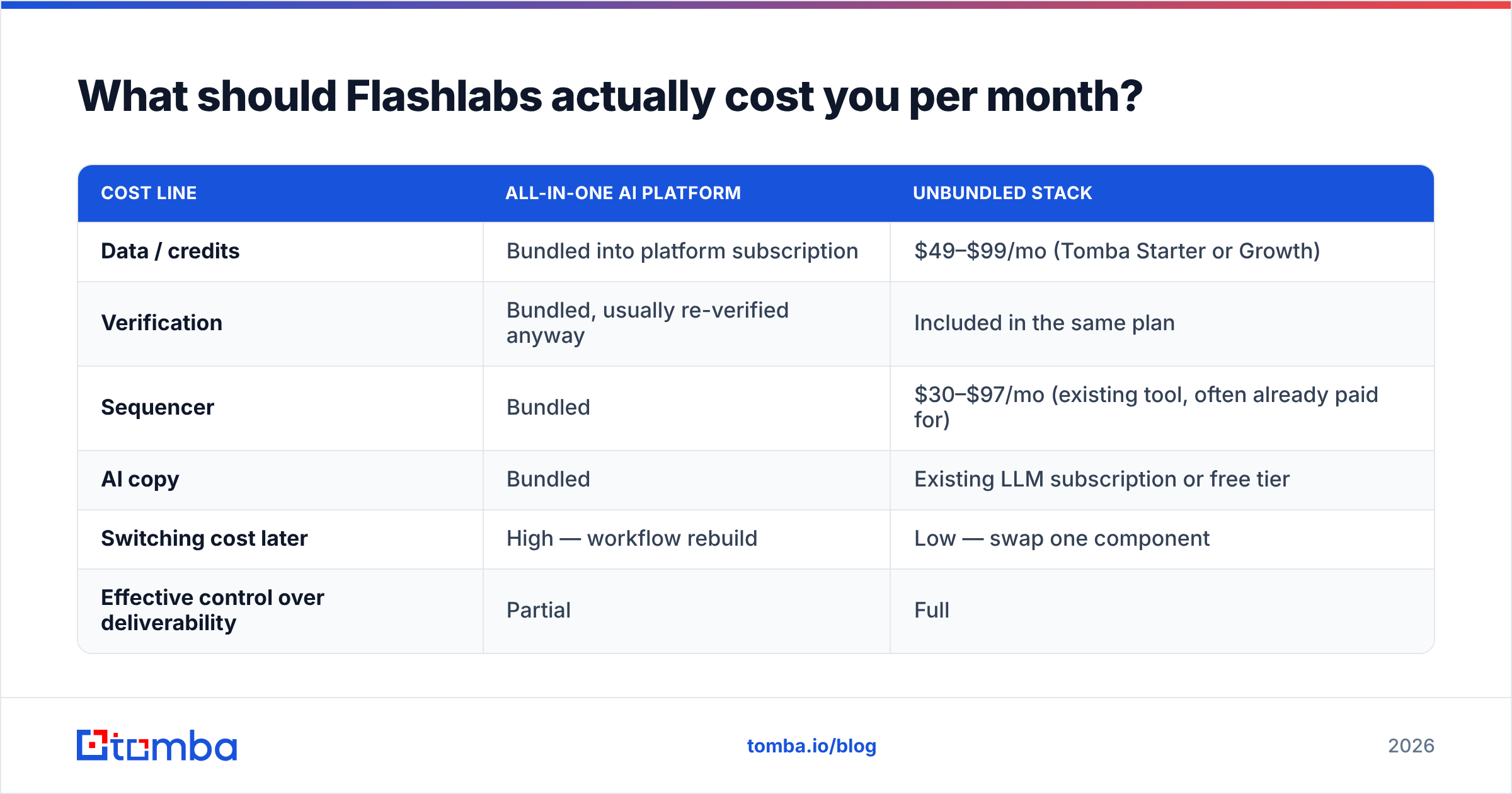
Compare the cost of the whole workflow, not the sticker. Here is a realistic month for a two-rep team sending 2,000 cold emails.
| Cost line | All-in-one AI platform | Unbundled stack |
|---|---|---|
| Data / credits | Bundled into platform subscription | $49–$99/mo (Tomba Starter or Growth) |
| Verification | Bundled, usually re-verified anyway | Included in the same plan |
| Sequencer | Bundled | $30–$97/mo (existing tool, often already paid for) |
| AI copy | Bundled | Existing LLM subscription or free tier |
| Switching cost later | High — workflow rebuild | Low — swap one component |
| Effective control over deliverability | Partial | Full |
The unbundled stack usually costs less after the first quarter. It is also far cheaper to walk away from. That is the real case for it: not price, but the freedom to change your mind. In money terms, the Flashlabs pros and cons come down to cost per usable contact. See Tomba pricing for the data layer on its own.
For wider context, HubSpot's CRM and sales tooling resources and this primer on lead generation are useful neutral reading before you shortlist.
Who should buy Flashlabs, and who should skip it?#
Buy it if: you are founder-led or pre-first-sales-hire. You have no outbound stack. Your ICP is US tech mid-market. Your bottleneck is time, not data quality. The bundle is worth real money to you.
Skip it if: you already like your sequencer. You sell outside the well-indexed US tech market. You need documented data sources for compliance. Or your outbound already gets decent replies and only needs cleaner inputs.
Pilot it if: you sit in between. Run the 200-contact test above against your current stack, side by side. Whichever gives more verified, in-ICP contacts per dollar wins. That answer shifts by segment more than any review can predict.
Flashlabs pros and cons: the bottom line#
The pros are real, and they sit at the top of the funnel. Speed, research, and a soft setup curve. The cons sit where the money is. Unclear data sources, credit math, copy sameness, and risk passed to your domain. Neither list rules it out. Read together, the Flashlabs pros and cons say one thing: strong first tool, weak permanent one.
Whatever you pick as the front end, do not let it be the only thing between your domain and a bad list. Point Tomba's Email Finder at your target domains. Verify before you send. Start free with 25 searches a month, then $49/mo when you outgrow it. Clean data is the one line item you never regret.
Related guides#
Ready to find emails that actually work?
Join 150,000+ professionals who stopped guessing and started sending. Free credits on signup — no credit card required.
Get the Tomba newsletter
Practical outbound tactics and product updates — once every two weeks.
About the author