Follow Up Email After Sending Quotation Examples: 9 That Close
Nine follow up email after sending quotation examples you can copy, plus the timing cadence, subject lines, and objection-handling scripts that get buyers to reply.
TL;DR
- Most quotes die from silence, not from price. The average B2B buyer needs 5–8 touches after a proposal lands before they answer with a decision.
- The follow up email after sending quotation examples below cover all five touches, from the Day 1 scope check to the Day 21 break-up.
- Send follow-up #1 within 24 hours of the quote landing — not to "check in," but to confirm scope and pre-empt the two objections you already know are coming.
- Every follow-up must add something: a case study, a revised line item, a deadline, a risk you spotted. "Just bumping this to the top of your inbox" is why you get ghosted.
- Use a 5-touch cadence over 21 days (Day 1, Day 3, Day 7, Day 14, Day 21), then a clean break-up email. Stop guessing when to send.
- If the buyer stops replying, the contact is often wrong, not cold. Re-verify the address and find the real decision-maker before you write touch #4.
You sent the quote. It was good. The call went well. Now it is day nine, and your CRM still says "Proposal Sent" like a tombstone.
This is the most expensive gap in B2B sales: the stretch between quote delivered and decision made. The work is done. The cost is sunk. The revenue is still a maybe. Below are nine follow up email after sending quotation examples you can copy, the cadence that sequences them, and a quick test for whether a deal is stalled or dead.
Why do quotations go silent in the first place?#
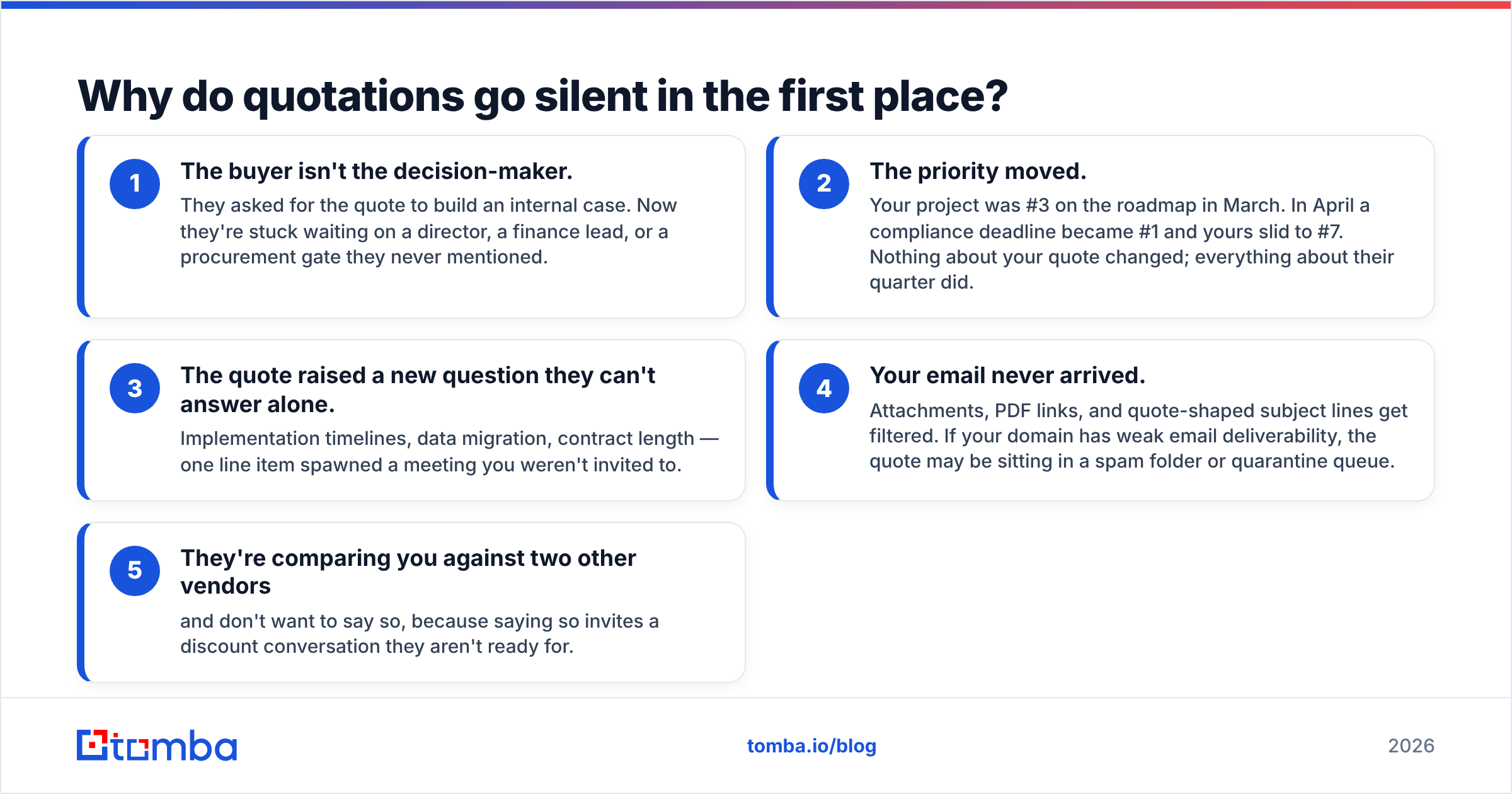
Silence after a quote almost never means "your price is too high." If price were the issue, most buyers would say so — it's the easiest objection to voice. Silence means something structurally different.
Here are the five real causes, ranked by how often they show up:
- The buyer isn't the decision-maker. They asked for the quote to build an internal case. Now they're stuck waiting on a director, a finance lead, or a procurement gate they never mentioned.
- The priority moved. Your project was #3 on the roadmap in March. In April a compliance deadline became #1 and yours slid to #7. Nothing about your quote changed; everything about their quarter did.
- The quote raised a new question they can't answer alone. Implementation timelines, data migration, contract length — one line item spawned a meeting you weren't invited to.
- Your email never arrived. Attachments, PDF links, and quote-shaped subject lines get filtered. If your domain has weak email deliverability, the quote may be sitting in a spam folder or quarantine queue.
- They're comparing you against two other vendors and don't want to say so, because saying so invites a discount conversation they aren't ready for.
Notice that four of those five have nothing to do with your pricing. That matters for what you write next. A follow-up that opens with "I wanted to see if there's flexibility we could discuss on price" solves the least common problem. It also signals that your first number was inflated.

What is the right follow up cadence after sending a quotation?#
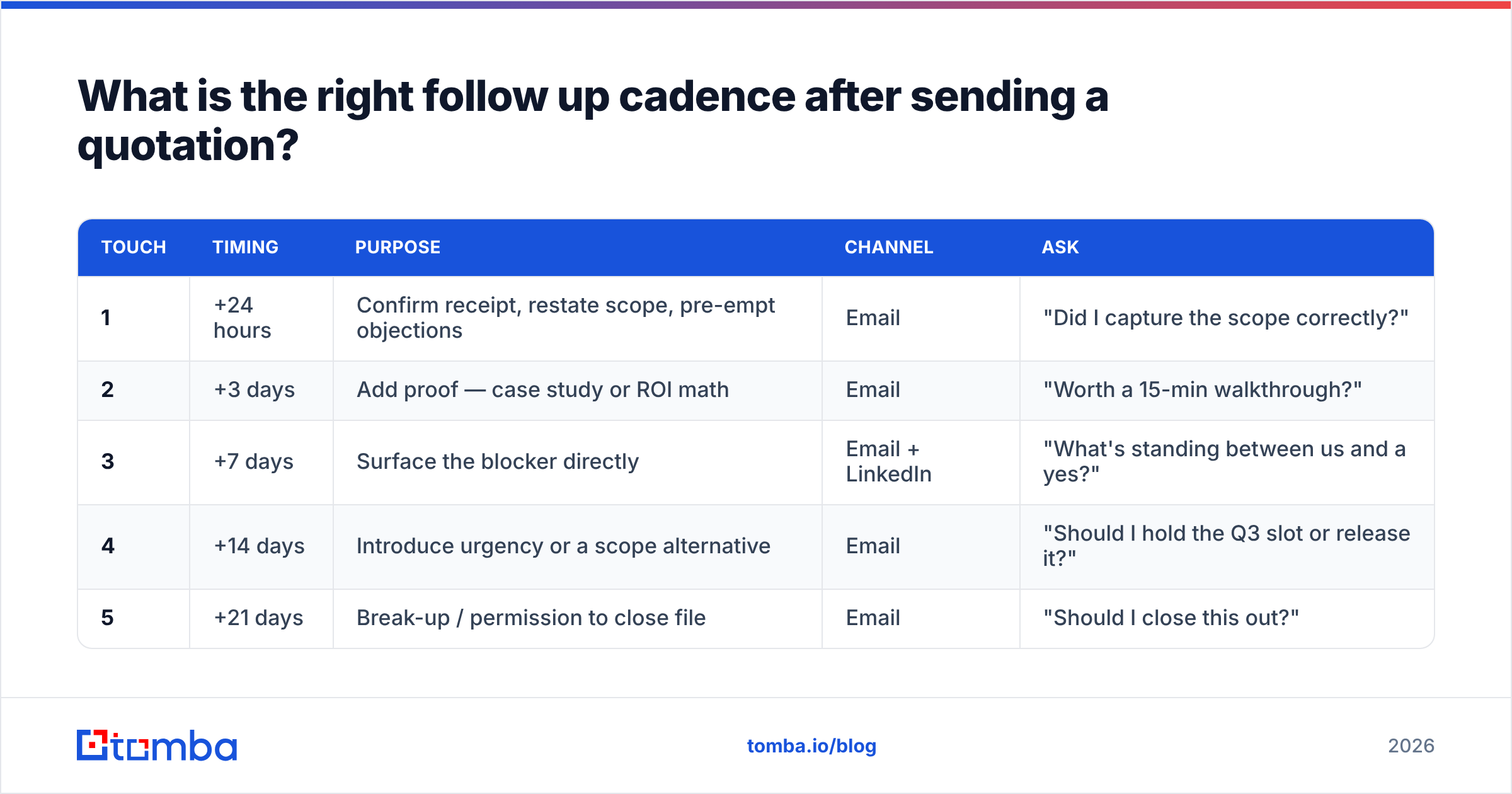
Send five touches over 21 days, then close the loop with a break-up email. Anything shorter under-works the deal; anything longer trains the buyer to ignore you.
Here's the cadence mapped against purpose and channel:
| Touch | Timing | Purpose | Channel | Ask |
|---|---|---|---|---|
| 1 | +24 hours | Confirm receipt, restate scope, pre-empt objections | "Did I capture the scope correctly?" | |
| 2 | +3 days | Add proof — case study or ROI math | "Worth a 15-min walkthrough?" | |
| 3 | +7 days | Surface the blocker directly | Email + LinkedIn | "What's standing between us and a yes?" |
| 4 | +14 days | Introduce urgency or a scope alternative | "Should I hold the Q3 slot or release it?" | |
| 5 | +21 days | Break-up / permission to close file | "Should I close this out?" |
Two rules that make this work:
- Never send two touches with the same ask. If touch 1 asks for a call and touch 2 asks for a call, you've sent the same email twice with different words. Vary the ask so the buyer has multiple low-friction ways to respond.
- Reply in the same thread for touches 1–3, start a fresh thread for 4–5. Threading keeps context; a new thread with a new subject line escapes an inbox where your old thread has already been mentally archived.
Research from HubSpot's sales data consistently shows response rates climbing through the fifth touch before flattening. Most reps quit at two. That gap is the whole opportunity.

What should the first follow up email after a quotation say?#
Send it within 24 hours, and make it about scope confirmation — not about the buyer's decision.
Example 1 — The scope confirmation (Day 1)
Subject: Quick check on the scope in yesterday's quote
Hi Dana,
Sent over the quote yesterday — before you take it internally, I want to make sure I got two things right:
- You're onboarding 40 seats now, with the option to add the EMEA team in Q4 (not day one).
- The migration includes your 2023–2025 historical records, not just active accounts.
If either of those is off, tell me and I'll reissue today — it's easier to fix now than after finance sees it.
One thing I'd flag: the two questions that usually come up internally at this stage are the contract length and who owns implementation on your side. Happy to send a one-pager on both if that's useful for your conversation with Marcus.
— Sam
Why this works: it gives the buyer a reason to reply that isn't "yes or no." Correcting a detail is low-stakes. Any reply reopens the conversation. Naming their internal stakeholder also shows you understand their process.
Example 2 — The short version (Day 1, transactional quotes)
Subject: Quote #4412 — anything unclear?
Hi Priya,
Quote #4412 went over yesterday: 12 units, delivered by March 14, $8,400 all in.
Two things people usually ask: yes, we can split the delivery across two dates, and yes, net-30 is available on orders over $5k.
Anything else I should clarify before you take it to Ravi?
— Sam
Which follow up email after sending quotation examples work for touches 2 and 3?#
Touch 2 adds evidence. Touch 3 names the silence.
Example 3 — The proof drop (Day 3)
Subject: Re: Quick check on the scope in yesterday's quote
Hi Dana,
One thing I should have included with the quote: Ardent Logistics ran almost exactly your setup — 45 seats, same migration scope — and cut their weekly reporting cycle from 6 hours to about 40 minutes.
Their ops lead wrote up how they did it. Two pages, no sales fluff: [link]
If the internal question is "will this actually stick after month one," that document answers it better than I can.
— Sam
Example 4 — The direct blocker question (Day 7)
Subject: Re: Quick check on the scope in yesterday's quote
Hi Dana,
Haven't heard back, which usually means one of three things:
- The timing shifted and this is a Q4 conversation now
- The number is higher than the budget you were working against
- Someone internally has a concern that hasn't reached me
Any of those is fine — I'd just rather know which one so I stop guessing. A one-word reply works.
— Sam
This is the highest-performing template in the set. The reason is simple: replying is easier than ignoring. You have already named the likely objections, so the buyer just picks one. It also gives them permission to say "not now," which removes the social cost of a reply.
Example 5 — The value-add nudge (Day 7 alternative)
Subject: Something I noticed on your careers page
Hi Dana,
Unrelated to the quote — I noticed you're hiring three more analysts. That changes the seat math a little: at 43 seats you'd cross into our next volume tier, which is actually cheaper per seat than what I quoted.
Want me to reissue at 43 so the number reflects where you'll be in six months instead of where you are today?
— Sam
How do you handle price objections in a follow up?#
Never lead with a discount. Lead with restructuring what's inside the price.
Example 6 — The scope alternative (Day 14)
Subject: A smaller version of the same thing
Hi Dana,
If the full scope is more than this quarter can absorb, here's a version that isn't:
- Phase 1 (now): 20 seats, core module only — $2,100/mo
- Phase 2 (Q1): remaining seats + migration, priced at today's rate
Same destination, half the initial commitment, and it locks your pricing before our January adjustment.
Worth 15 minutes to walk through?
— Sam
Example 7 — The genuine deadline (Day 14 alternative)
Subject: Holding your implementation slot until Friday
Hi Dana,
Our implementation team's March calendar closes Friday. I've been holding a slot for your migration on the assumption this was moving.
If it isn't, no problem — I'll release it and we can look at April. Just don't want to hold it if you'd rather I didn't.
Which is it?
— Sam
The rule on urgency: it has to be real. A fake deadline works exactly once, and it costs you the relationship on the next deal. If your implementation calendar genuinely fills, say so. If it doesn't, use a different lever — a pricing change, a contract-year rollover, a resource you can only allocate this month.

What does a good break-up email look like?#
It closes the file without burning the bridge, and it converts more often than any touch except the Day 7 blocker email.
Example 8 — The clean break-up (Day 21)
Subject: Closing your file
Hi Dana,
I'm going to assume this isn't a priority right now and stop filling your inbox.
I'll close the quote out on my end. If it comes back around — this quarter, next year, at a different company — just reply to this email and I'll pick it straight back up. Pricing won't be the same, but the conversation can be.
Good luck with the Q3 rollout.
— Sam
Example 9 — The multi-threading pivot (Day 21 alternative)
Subject: Wrong person on my end?
Hi Dana,
Last note from me. If this stalled because it needs to sit with someone in finance or ops rather than you, I'd rather send it to them directly than keep nudging you about it.
Who should I be talking to? Happy to take it off your plate entirely.
— Sam
Example 9 is underrated. Roughly a third of "cold" quotes are sitting with someone who never had the authority to approve them. Asking for the handoff is not a demotion of the relationship — it's a favor to a contact who's stuck.
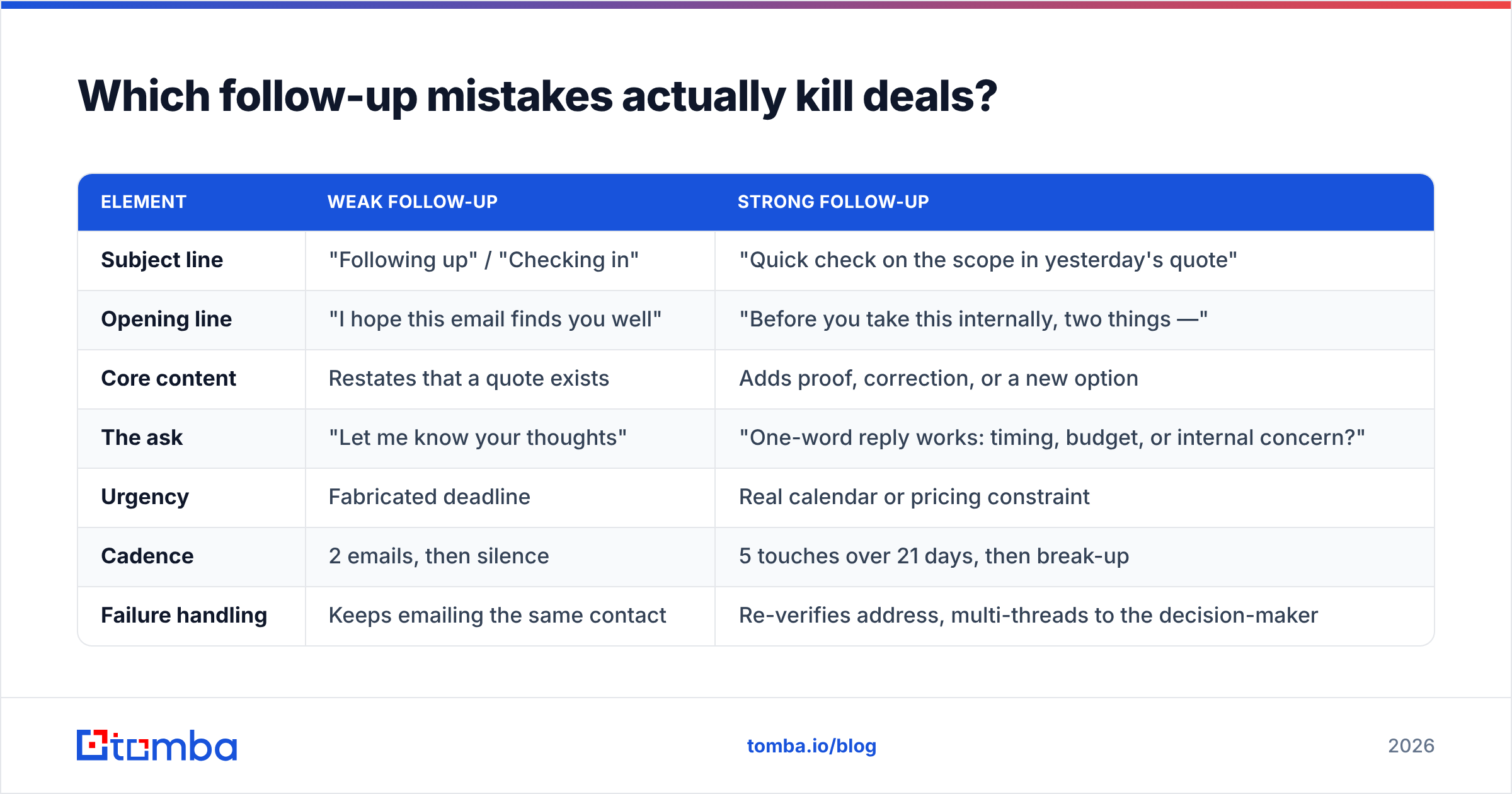
Which follow-up mistakes actually kill deals?#
Here's the honest comparison between the follow-ups that get replies and the ones that get archived:
| Element | Weak follow-up | Strong follow-up |
|---|---|---|
| Subject line | "Following up" / "Checking in" | "Quick check on the scope in yesterday's quote" |
| Opening line | "I hope this email finds you well" | "Before you take this internally, two things —" |
| Core content | Restates that a quote exists | Adds proof, correction, or a new option |
| The ask | "Let me know your thoughts" | "One-word reply works: timing, budget, or internal concern?" |
| Urgency | Fabricated deadline | Real calendar or pricing constraint |
| Cadence | 2 emails, then silence | 5 touches over 21 days, then break-up |
| Failure handling | Keeps emailing the same contact | Re-verifies address, multi-threads to the decision-maker |
Three specific things worth calling out:
- "Just checking in" has no information content. It tells the buyer you have nothing new, which is a reason to deprioritize you. If you genuinely have nothing to add, wait until you do.
- Attachments suppress delivery. A PDF quote attached to a cold-ish follow-up raises spam signals. Link to a hosted quote instead, and run your domain through an SPF checker if you're seeing unusually low open rates on quote threads.
- Sending five emails to a bounced address is a rounding error away from sending zero. Before touch 4, run the contact through an email verifier. If the buyer changed roles or the company migrated domains, you've been talking to a wall.
How do you know when a quote is dead versus just slow?#
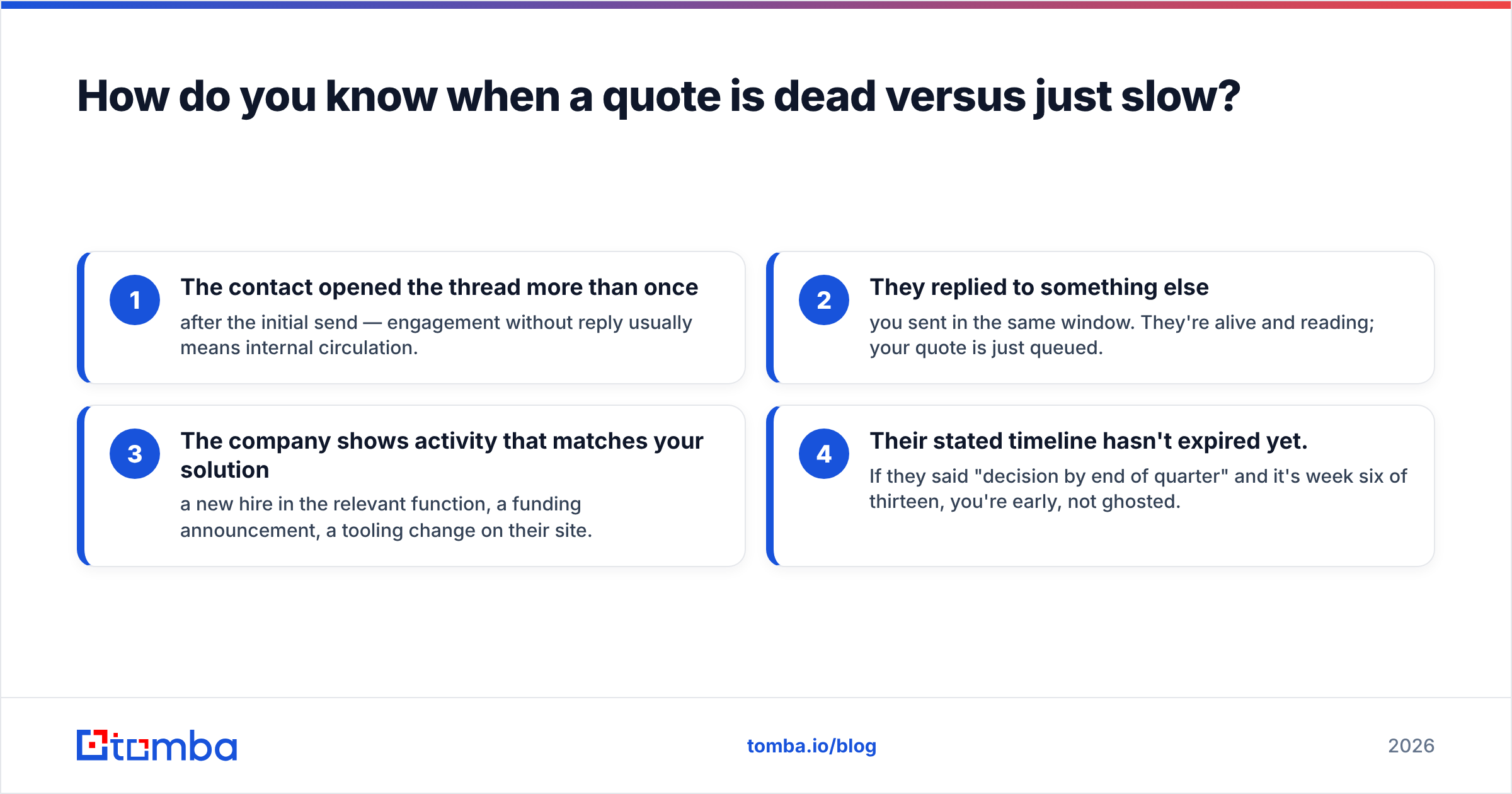
Use behavioral signals, not gut feeling. A quote is slow if any of these are true:
- The contact opened the thread more than once after the initial send — engagement without reply usually means internal circulation.
- They replied to something else you sent in the same window. They're alive and reading; your quote is just queued.
- The company shows activity that matches your solution — a new hire in the relevant function, a funding announcement, a tooling change on their site.
- Their stated timeline hasn't expired yet. If they said "decision by end of quarter" and it's week six of thirteen, you're early, not ghosted.
A quote is dead when: the contact has left the company, a competitor's tooling appears in their stack, the budget line was publicly reallocated, or you've completed the full cadence including the break-up with zero response. Dead quotes belong in a nurture list with a 90-day recheck, not in your active pipeline inflating your forecast.
For the "contact has left the company" case specifically — which is far more common than most reps assume — the fix isn't a better email. It's better data. A reverse email lookup tells you whether the person still sits where you think they do, and a domain search surfaces who replaced them. Rewriting your subject line for the fourth time won't help if the mailbox is deactivated.
What subject lines get quotation follow-ups opened?#
Short, specific, and never announcing that this is a follow-up. Tested patterns worth stealing:
- Reference a detail: "Quick check on the 40-seat number"
- Ask a question: "Wrong person on my end?"
- State a constraint: "Holding your March slot until Friday"
- Name the outcome: "The 6-hours-to-40-minutes thing"
- Be blunt: "Closing your file"
Avoid: "Following up," "Touching base," "Checking in," "Any update?", and anything with "Re:" faked onto a thread that never existed. If you want to pressure-test variants before sending, run them through a subject line tester — but trust reply rate over any score.
What should you do before the next quote goes out?#
Fix the front end so the follow-up has less work to do. Three things:
- Confirm the decision process on the call, before you quote. "Once you have this, what happens next on your side, and who else sees it?" One question, and it eliminates most of the ghosting scenarios above.
- Verify every contact on the buying committee. Deals stall when you're single-threaded. Map two to three stakeholders and confirm their addresses upfront rather than scrambling on Day 14.
- Set the follow-up expectation in the quote email itself. "I'll check in Thursday if I haven't heard back" makes touch 2 an agreement rather than a nag.
Independent reviews on G2 consistently show that teams who define the post-quote cadence as a documented process — rather than leaving it to individual rep discretion — close a materially higher share of quoted deals. The templates matter less than the fact that somebody sends them on schedule.
Close the loop with better contact data#
The follow up email after sending quotation examples above are only half the equation. The best-written Day 7 email does nothing if it lands in a dead mailbox. It does nothing if the person reading it was never allowed to sign anything.
Use the Tomba Email Finder to identify and verify every stakeholder on the buying committee before your quote goes out — the finance approver, the ops owner, the exec sponsor — so touch 4 has somewhere real to go. The free tier covers 25 searches a month, and paid plans start at $49/mo on Tomba pricing if you're running volume. Multi-thread from the start, and you'll spend a lot less time writing break-up emails.
Related guides#
Ready to find emails that actually work?
Join 150,000+ professionals who stopped guessing and started sending. Free credits on signup — no credit card required.
Get the Tomba newsletter
Practical outbound tactics and product updates — once every two weeks.
About the author