Should You CC on Follow-Up Emails? Rules That Actually Work
CC'ing a boss on your third follow-up feels powerful. Usually it just burns the thread. Here's when a followup CC actually lifts replies, and the exact rules for using it without looking desperate.
TL;DR
- A followup CC is a tactic, not a default. Adding a second name to the header changes who the email is for — and most reps use it to apply pressure rather than to add value.
- CC works when the extra person has a real reason to be there: they own the budget, they asked to be looped in, or your contact already named them.
- CC fails when it reads as escalation over someone's head. Expect silence, a forwarded complaint, or a hard "we're not interested."
- BCC is for internal logging (CRM drop addresses), never for stakeholders. Getting caught BCC'ing a human costs you the deal.
- Every CC address is a deliverability risk. One bounced executive address on a threaded reply can drag down the whole send. Verify before you add.
What does "followup cc" actually mean in B2B email?#
A followup CC is the moment you add a second recipient to the carbon-copy field of a follow-up message in an existing thread. You sent email one to a single contact. They went quiet. On email three, you add their VP — or a colleague, or a champion — into CC and hit send.
The mechanic is old. Carbon copy fields exist so people who need visibility get it without being asked to act. In practice, B2B sellers repurposed CC into a social pressure lever: your prospect now knows their boss can see they've ignored you three times.
That reframing is exactly why the tactic is so hit-or-miss. The header field is doing two jobs at once — informing and implying — and the recipient decides which one you meant. Get it wrong and you have not just lost a reply, you have lost the relationship with the person who was going to sponsor you internally.
Three distinct plays hide under the same word:
- Informational CC — you loop in someone your contact already told you about ("Sarah owns procurement"). Low risk, often welcomed.
- Lateral CC — you add a peer in an adjacent team who has the same problem. Medium risk, works well when the use case genuinely spans both.
- Escalation CC — you add the person's manager or skip-level after silence. High risk, occasionally high reward, and the one most reps abuse.
Before you touch the CC field, name which of the three you are running. If you cannot, you are running the third one and telling yourself it is the first.
Does CC'ing someone on a follow-up increase replies?#
Sometimes — and rarely for the reason reps think.
The honest read across outbound teams is that CC lifts reply rate on specific motions and depresses it everywhere else. When the CC'd person is a genuine stakeholder in a buying group, you are simply doing what B2B buying now requires: Gartner's research on B2B buying has documented for years that a typical purchase involves six to ten decision-makers. Reaching one of them and stopping is the actual mistake. In that context, CC is not pressure — it is coverage.
When the CC'd person is a manager who has no idea who you are, the math flips. You are asking a stranger to referee a conversation they were never part of, about a product they have not evaluated, at the expense of a direct report's dignity. The most common outcomes are: no reply from anyone, a curt "please work with Alex on this," or an internal Slack that ends your access to the account.
A rough heuristic that holds up:
- CC a named stakeholder — reply rate typically improves, because you removed a forwarding step.
- CC a lateral peer — neutral to slightly positive, if the relevance is obvious in line one.
- CC a manager after two ignored emails — usually negative on reply, sharply negative on relationship.
- CC three or more people at once — near-uniformly negative. Diffusion of responsibility does the rest.
If you want to raise your email response rate without touching the CC field, fix your first line before you fix your header. Most silence is a relevance problem wearing a timing costume.
When should you CC on a follow-up email?#
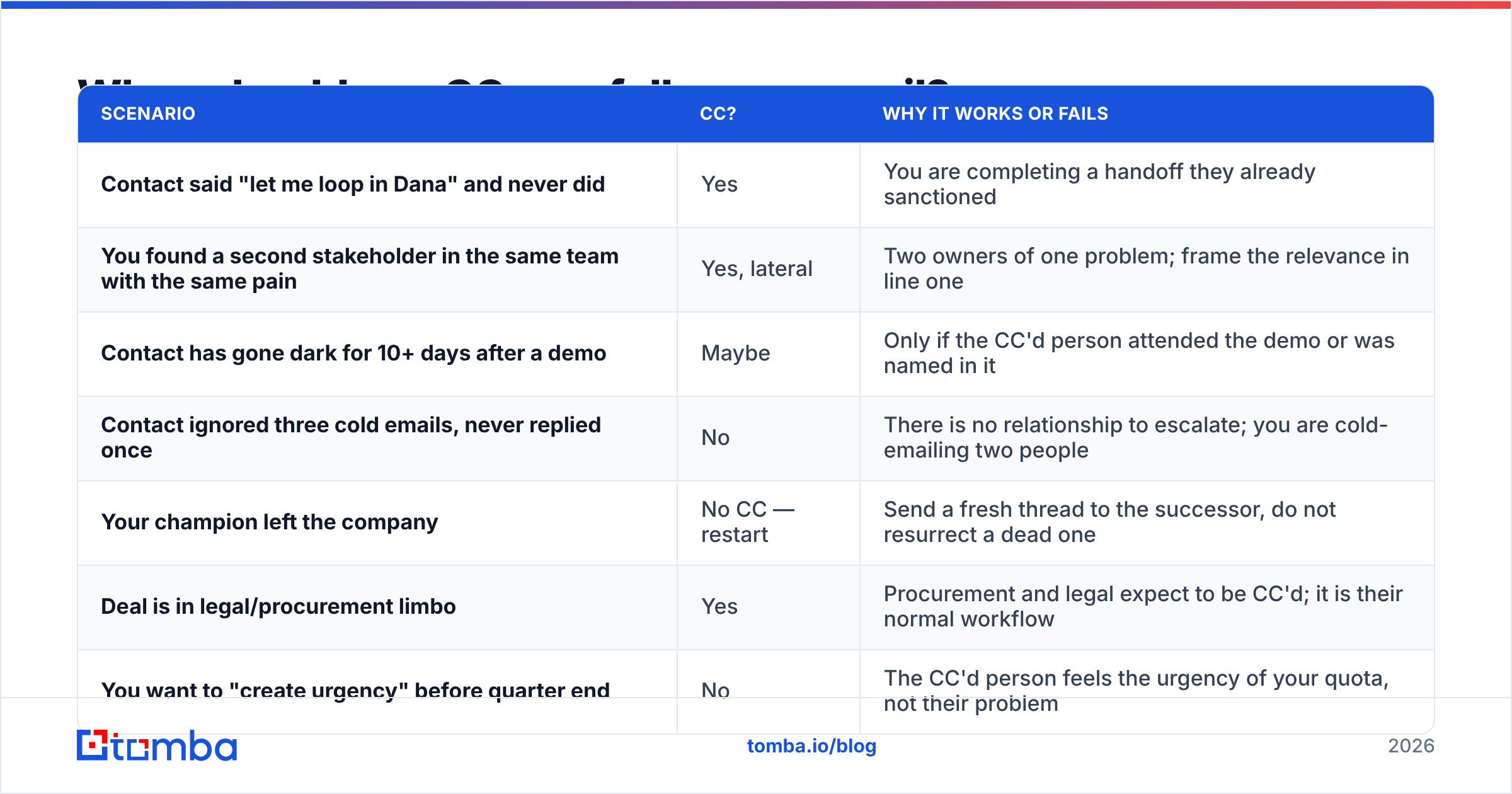
Use this as a decision table before every send. If the row does not match your situation, do not CC.
| Scenario | CC? | Why it works or fails |
|---|---|---|
| Contact said "let me loop in Dana" and never did | Yes | You are completing a handoff they already sanctioned |
| You found a second stakeholder in the same team with the same pain | Yes, lateral | Two owners of one problem; frame the relevance in line one |
| Contact has gone dark for 10+ days after a demo | Maybe | Only if the CC'd person attended the demo or was named in it |
| Contact ignored three cold emails, never replied once | No | There is no relationship to escalate; you are cold-emailing two people |
| Your champion left the company | No CC — restart | Send a fresh thread to the successor, do not resurrect a dead one |
| Deal is in legal/procurement limbo | Yes | Procurement and legal expect to be CC'd; it is their normal workflow |
| You want to "create urgency" before quarter end | No | The CC'd person feels the urgency of your quota, not their problem |
The pattern in the "yes" rows: the CC'd person has an existing, verifiable reason to be on the thread. The pattern in the "no" rows: the only reason is your pipeline.
Is CC better than BCC, a forward, or a separate email?#
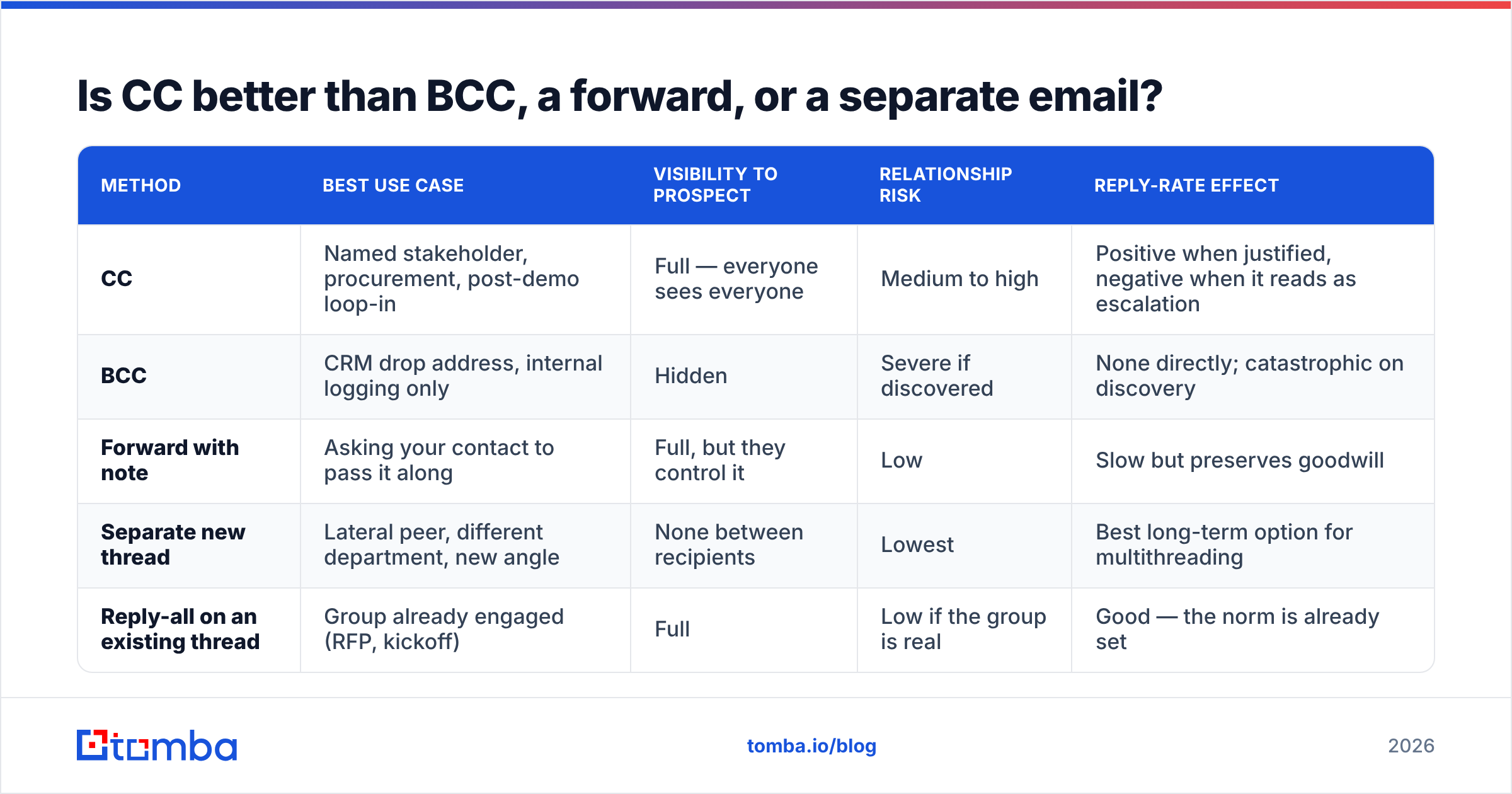
CC is one of four ways to bring a second person into an outbound conversation, and it is not usually the best one. Here is the honest comparison.
| Method | Best use case | Visibility to prospect | Relationship risk | Reply-rate effect |
|---|---|---|---|---|
| CC | Named stakeholder, procurement, post-demo loop-in | Full — everyone sees everyone | Medium to high | Positive when justified, negative when it reads as escalation |
| BCC | CRM drop address, internal logging only | Hidden | Severe if discovered | None directly; catastrophic on discovery |
| Forward with note | Asking your contact to pass it along | Full, but they control it | Low | Slow but preserves goodwill |
| Separate new thread | Lateral peer, different department, new angle | None between recipients | Lowest | Best long-term option for multithreading |
| Reply-all on an existing thread | Group already engaged (RFP, kickoff) | Full | Low if the group is real | Good — the norm is already set |
The underrated winner is the separate new thread. You get multithreaded coverage of the account without publicly signalling that someone ignored you. Two clean conversations beat one awkward one almost every time. The cost is that you need accurate addresses for both people, which is where most teams quietly give up and fall back to CC.
That is a solvable problem. A domain search returns the verified addresses and role patterns for an entire company, so you can open a second thread instead of dragging someone into the first.
How do you write a follow-up that CCs a second stakeholder?#
The rule: the CC must be explained in the first two lines, or it reads as an ambush.
Never let the CC'd person open an email where the only clue about why they are there is their own name in a header. Name them, justify them, and give them something to do.
Here is a structure that survives contact with an executive inbox:
Subject: Re: [original subject] — looping in [Name]
Hi [Contact],
Adding [Name] since you mentioned they own [specific area] — happy to be corrected if that's changed.
[Name] — quick context: [Contact] and I have been discussing [specific problem in their words]. The short version is [one-sentence value, tied to a number].
The only open question is [one specific decision]. If that's a no for this quarter, say the word and I'll close the loop.
[Your name]
Four things that email does correctly:
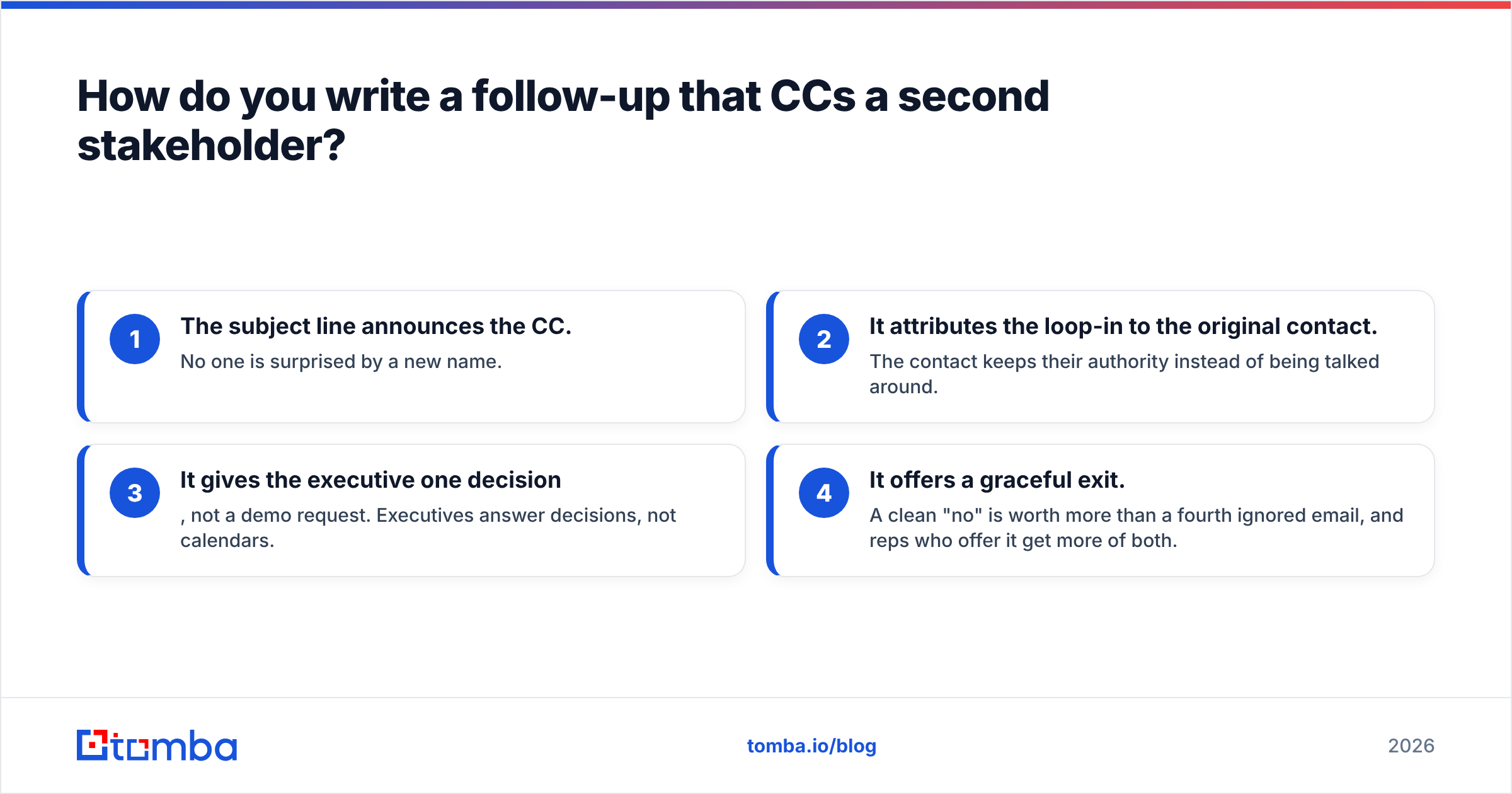
- The subject line announces the CC. No one is surprised by a new name.
- It attributes the loop-in to the original contact. The contact keeps their authority instead of being talked around.
- It gives the executive one decision, not a demo request. Executives answer decisions, not calendars.
- It offers a graceful exit. A clean "no" is worth more than a fourth ignored email, and reps who offer it get more of both.
Compare that to what most CC follow-ups look like: "Hi [Contact], just bumping this to the top of your inbox. CC'ing [Boss] for visibility." That second sentence is the whole tactic, and everyone reading it can see the mechanism.
If you need a starting library, the cold email templates collection covers loop-in and breakup variants you can adapt rather than write from scratch.
What are the rules for CC'ing a manager or executive?#
Escalation CC is the highest-variance move in outbound. Five rules keep it from backfiring:
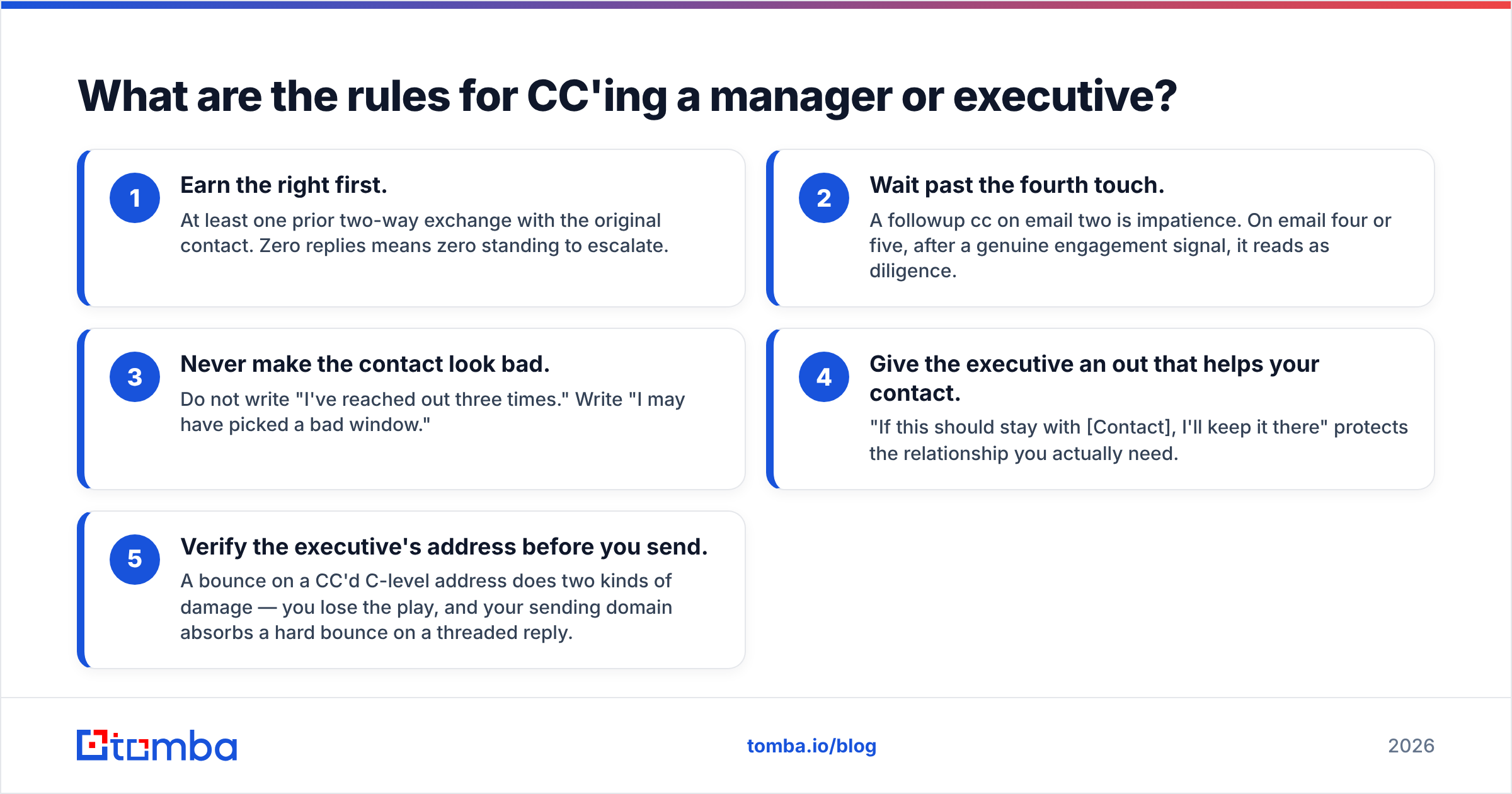
- Earn the right first. At least one prior two-way exchange with the original contact. Zero replies means zero standing to escalate.
- Wait past the fourth touch. A followup cc on email two is impatience. On email four or five, after a genuine engagement signal, it reads as diligence.
- Never make the contact look bad. Do not write "I've reached out three times." Write "I may have picked a bad window."
- Give the executive an out that helps your contact. "If this should stay with [Contact], I'll keep it there" protects the relationship you actually need.
- Verify the executive's address before you send. A bounce on a CC'd C-level address does two kinds of damage — you lose the play, and your sending domain absorbs a hard bounce on a threaded reply.
Rule five is the one that gets skipped. Executive addresses are the most likely to be guessed, scraped from stale directories, or built from an outdated pattern after a rebrand. Running the address through an email verifier takes seconds and prevents the version of this play where you escalate to an address that does not exist and never learn why nobody answered.
What are the most common followup CC mistakes?#
- CC'ing the whole leadership page. Adding four names does not multiply pressure, it divides responsibility. Somebody else will handle it, thinks everybody.
- Using BCC on a human stakeholder. BCC exists for logging, not for secretly watching a conversation. The one time it surfaces — a reply-all, a mail client quirk, a forwarded thread — you are done at that account.
- CC'ing on the first email. There is no follow-up context yet. You are just cold-emailing two people in a way that makes both feel like a list.
- Escalating to the wrong person. Org charts on LinkedIn go stale fast. The "VP" you CC'd may have moved teams in March.
- Reviving a dead thread. If the last message is 40 days old, start fresh. Nobody scrolls.
- Guessed addresses in CC. Pattern-generated executive emails bounce more often than any other category, and bounces on an active thread hurt sender reputation more than a cold first-touch bounce does.
How do you multithread without relying on CC at all?#
The best answer to "should I CC on this follow-up?" is usually "you should have already had a second thread open."
Multithreading before you need it removes the escalation problem entirely. Instead of dragging someone in after silence, you already have a parallel conversation with them, opened on its own merits, weeks earlier.
A practical sequence:
- Map the buying group early. Two to four names per account, identified in week one, not week six.
- Open each thread separately with a different angle relevant to that person's function.
- Reference nothing across threads. No "I also spoke to your colleague" until someone volunteers it.
- Verify every address before the first send, so bounces never cluster on one domain.
- Only then use CC — when two of your threads converge into one decision and everybody already knows everybody.
Running that at scale needs contact data you can trust rather than patterns you invented. Pulling verified addresses for every role at a target account with a bulk email finder is faster than guessing, and it means the day you do hit CC, the header is full of addresses that actually resolve.
Should you ever CC on a breakup email?#
Rarely, and only in one shape: a genuine close-the-loop message to a stakeholder who was already active on the thread.
"[Name] — closing this out on my side since timing doesn't look right. If that changes, you know where to find me" is a fine thing for a procurement contact or a demo attendee to see. It is not a fine thing for a CEO who has never heard your company name.
If a breakup email is your first CC of the sequence, the CC is not communication. It is a parting shot, and it costs you the option to come back in two quarters when the timing genuinely does change.
The bottom line#
CC is a coverage tool that reps keep using as a pressure tool. Ask one question before every send: does this person have a reason to be here that has nothing to do with my quota? If yes, CC them and explain why in line one. If no, open a separate thread, or accept the no and move on.
And whichever you choose, the header only works if the addresses in it are real. Bad CC addresses turn a careful escalation into a silent bounce and quietly erode the domain you send everything else from.
Start with data you can trust. Use the Tomba Email Finder to pull verified addresses for every stakeholder in an account before you build the sequence — so your loop-ins land, your multithreading is real, and CC becomes a deliberate choice instead of a last resort. The free tier covers 25 searches a month; paid plans start at $49/mo on the Starter tier, with full Tomba pricing available if you need bulk or API access.
Related guides#
Ready to find emails that actually work?
Join 150,000+ professionals who stopped guessing and started sending. Free credits on signup — no credit card required.
Get the Tomba newsletter
Practical outbound tactics and product updates — once every two weeks.
About the author