Forager vs SalesIntel 2026: Which B2B Data Provider Wins?
Forager bets on machine-speed data refresh. SalesIntel bets on humans re-verifying records. We compare coverage, accuracy, pricing models and the workflows each one actually fits in 2026.
Forager vs SalesIntel is a choice between two bets. Forager bets on speed: re-crawl the web often, so records stay fresh. SalesIntel bets on people: pay researchers to check records by hand. This guide compares both on data quality, coverage, pricing and fit.
TL;DR
Forager is an API-first B2B dataset company. It sells refresh speed. Profiles, job changes and company records get re-crawled on a fast cycle. You get bulk data or API calls, not a seat-based UI.
SalesIntel is a contact database with a human research layer. It sells verification. Researchers re-check records on a rolling cycle, and direct dials are a core product, not an afterthought.
Pick Forager if you are a data or RevOps team. You pipe records into your own systems, and you care about freshness and volume economics.
Pick SalesIntel if you run an SDR or AE team. You need phone numbers, intent signals and a UI reps will actually open.
Both sell quote-based annual contracts. Neither publishes a real self-serve price, so budget for a sales cycle and a minimum commitment.
If all you need is verified work emails on demand, a per-lookup email finder from $49/mo does that job without a platform contract.
What are Forager and SalesIntel?#
They solve the same problem in opposite ways. One trusts machines to re-scan the world. The other trusts people to double-check what the machines found.
Forager — a B2B data provider built on continuously refreshed person and company profiles. It ships mainly through APIs and dataset feeds. The core claim on forager.ai is refresh cadence: records get re-processed on a short cycle, so job changes, title updates and company moves surface fast. Delivery is developer-shaped — endpoints, bulk files, warehouse drops.
SalesIntel — a sales intelligence platform that pairs machine-collected data with a human research team. salesintel.io leans on human-verified direct dials, firmographics, technographics and Bombora-powered intent. It all sits in a web app, a Chrome extension and CRM sync.
Delivery model — Forager sells data. SalesIntel sells a workflow. That one difference explains most of the pricing, onboarding and support gaps between them.
Primary buyer — Forager lands with data engineering, RevOps and product teams building enrichment into their own stack. SalesIntel lands with sales leaders buying seats for a team that lives in a CRM.
Geographic weight — SalesIntel is strongest in North America, above all in US mid-market and enterprise accounts with phone coverage. Forager skews broader worldwide, because it is built on wide-scale crawling rather than a US-centric research team.
Forager vs SalesIntel: how do they compare head-to-head?#
Here is the practical breakdown. Treat every figure as "verify at signing". Both vendors change packaging often, and neither publishes a public rate card.
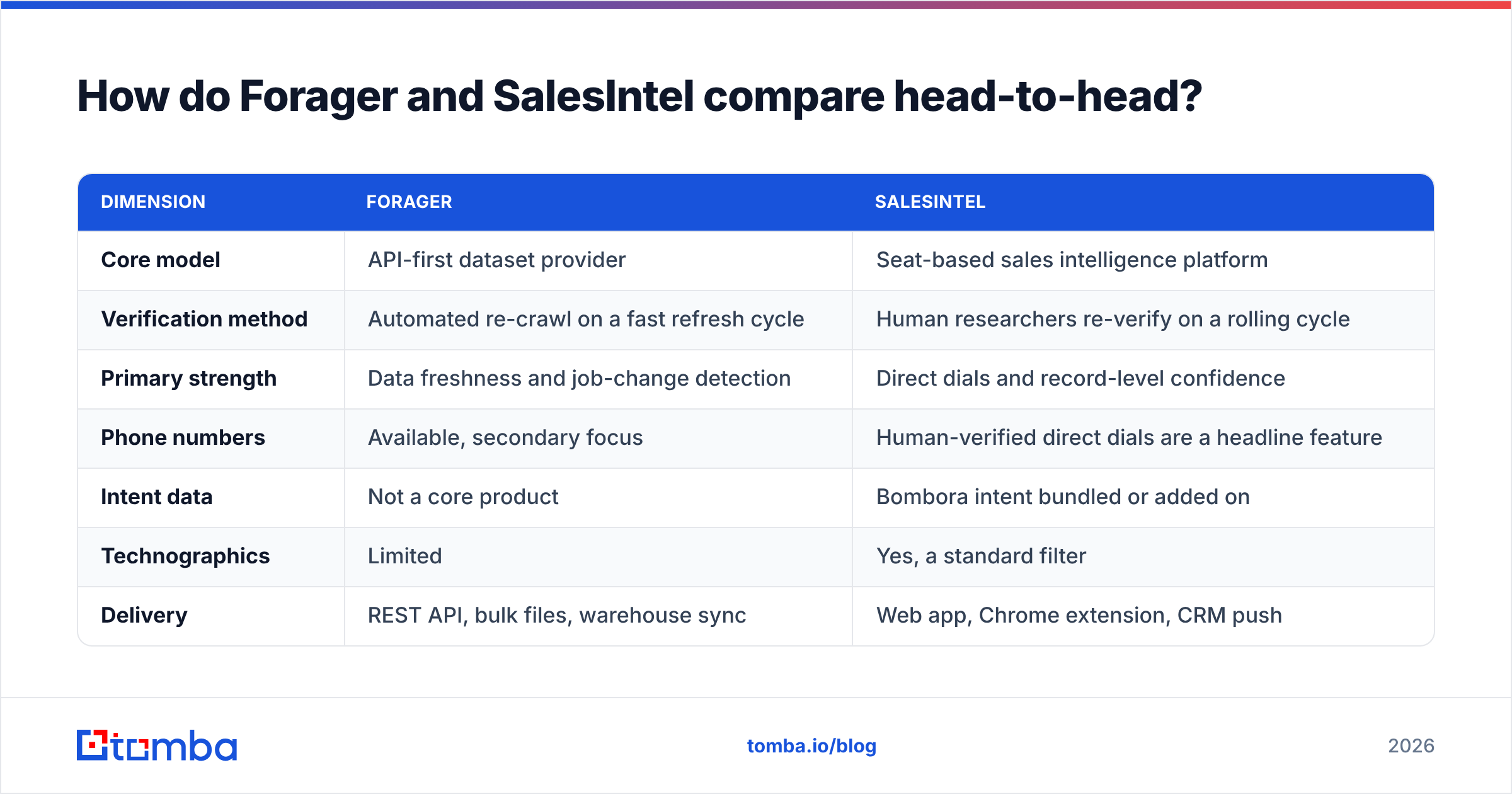
| Dimension | Forager | SalesIntel |
|---|---|---|
| Core model | API-first dataset provider | Seat-based sales intelligence platform |
| Verification method | Automated re-crawl on a fast refresh cycle | Human researchers re-verify on a rolling cycle |
| Primary strength | Data freshness and job-change detection | Direct dials and record-level confidence |
| Phone numbers | Available, secondary focus | Human-verified direct dials are a headline feature |
| Intent data | Not a core product | Bombora intent bundled or added on |
| Technographics | Limited | Yes, a standard filter |
| Delivery | REST API, bulk files, warehouse sync | Web app, Chrome extension, CRM push |
| CRM integrations | Via API and middleware | Native Salesforce, HubSpot, Outreach, Salesloft |
| Typical buyer | RevOps, data eng, product | Sales leadership, SDR teams |
| Pricing model | Custom, usage/volume oriented | Custom, seat + credit oriented |
| Free tier | No public free tier | No public free tier; demo and trial via sales |
| Contract | Annual, quote-based | Annual, quote-based |
The table makes the split clear. If your enrichment logic lives in code, Forager fits. If it lives in a rep's browser tab, SalesIntel fits.
Whose data is actually more accurate?#
Neither vendor's headline accuracy number means what you think it means. That is the most important thing to know before you sign anything.
"95% accurate" almost always describes syntax and deliverability at the last check. It does not tell you whether the person still works there, still owns that title, or still reads that inbox. The two companies attack the decay problem from different ends:
- Forager attacks staleness. Frequent re-processing shrinks the window in which a stale email can sit in your dataset. That helps job-change plays and territory data that ages fast.
- SalesIntel attacks uncertainty. A human confirming a direct dial is a stronger guarantee than a crawler inferring one. For phone data, that step is hard to automate.
Both approaches leave gaps. Fast re-crawling still inherits whatever the source profile says, and profiles lag reality by weeks. Human checks are accurate but costly. So coverage narrows to the segments worth paying a researcher for. That is why SalesIntel's US mid-market coverage beats its long-tail international coverage.

The honest rule: verify at send time, whatever you buy. Run the list through an email verifier before it enters a sequence. A record that was right 40 days ago at the vendor can be wrong today in your sending tool. Your domain reputation pays that difference. Push hard bounces past a few percent and you no longer have a data problem. You have an inbox placement problem.
Run your own bake-off before you commit. Pull 250 ICP contacts from each vendor and verify them yourself. Score four numbers: match rate on the accounts you asked for, hard-bounce rate, catch-all rate, and title accuracy on a manual sample of 25. Vendor accuracy claims are marketing. Your bounce log is evidence.
Which platform gives better coverage for your ICP?#
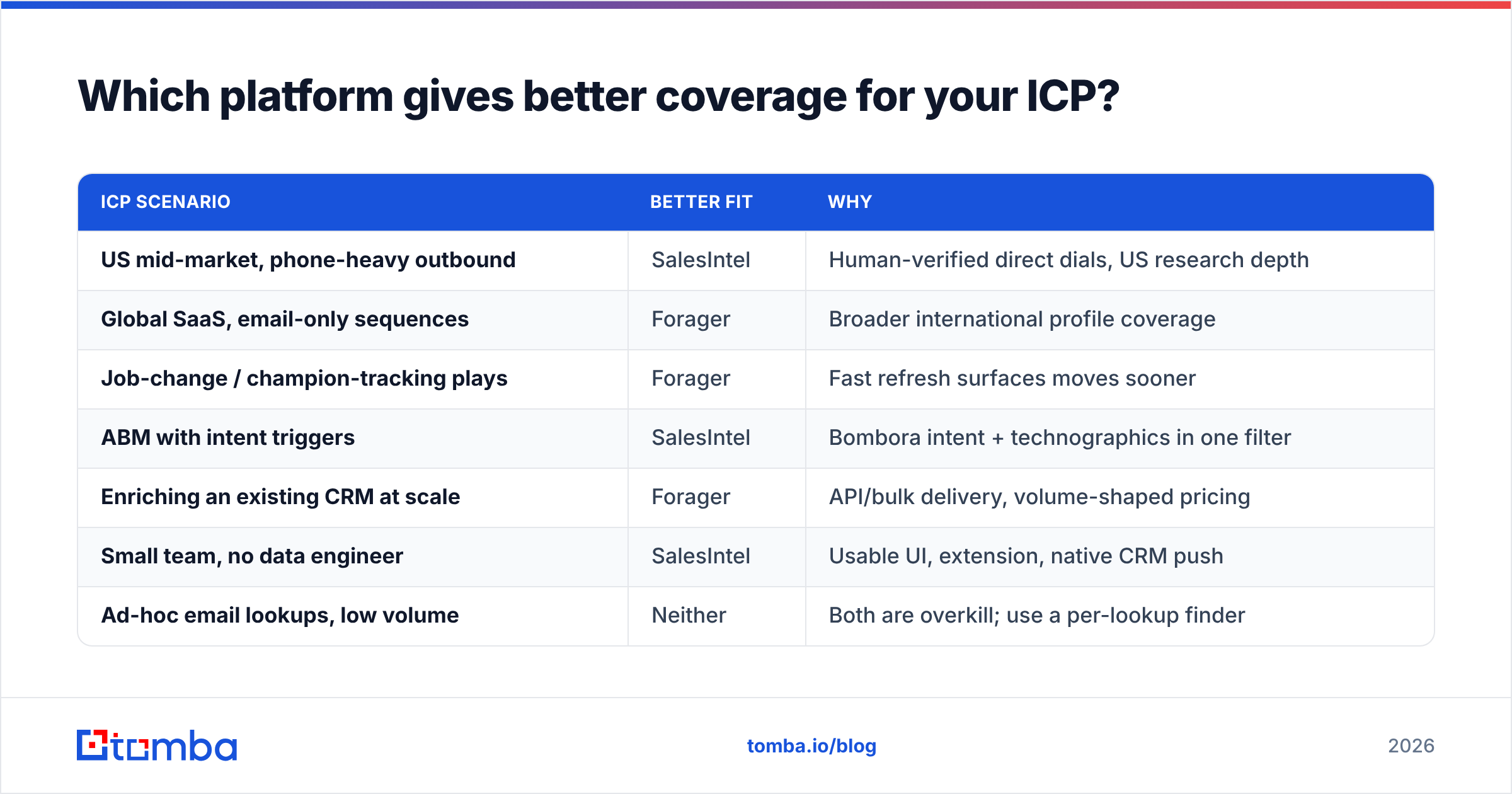
Coverage is where generic comparisons fall apart. "How many contacts" is the wrong question. The right one is "how many contacts in my segment, with the field I need."
| ICP scenario | Better fit | Why |
|---|---|---|
| US mid-market, phone-heavy outbound | SalesIntel | Human-verified direct dials, US research depth |
| Global SaaS, email-only sequences | Forager | Broader international profile coverage |
| Job-change / champion-tracking plays | Forager | Fast refresh surfaces moves sooner |
| ABM with intent triggers | SalesIntel | Bombora intent + technographics in one filter |
| Enriching an existing CRM at scale | Forager | API/bulk delivery, volume-shaped pricing |
| Small team, no data engineer | SalesIntel | Usable UI, extension, native CRM push |
| Ad-hoc email lookups, low volume | Neither | Both are overkill; use a per-lookup finder |
That last row is not a throwaway. Many teams shopping for enterprise data platforms need a fraction of what they get quoted. If the real job is "find the email for a named person at a named company, a few thousand times a month", a domain search plus verification covers it. No seat minimums, far less cost.
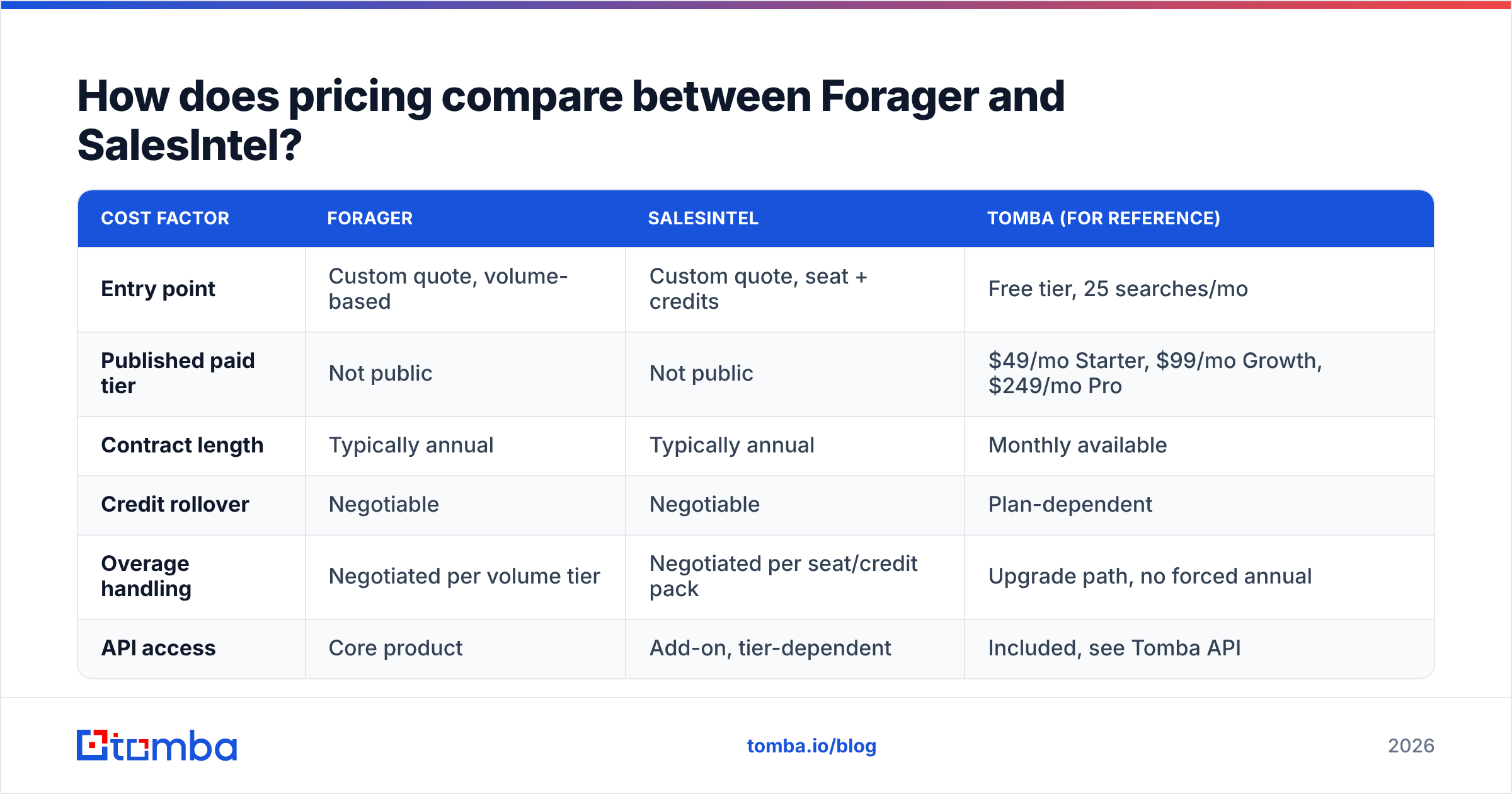
Forager vs SalesIntel pricing: what will you actually pay?#
Both are quote-based, which is itself a data point. Quote-based pricing means the vendor prices to your perceived budget, not to a rate card. Come prepared.
| Cost factor | Forager | SalesIntel | Tomba (for reference) |
|---|---|---|---|
| Entry point | Custom quote, volume-based | Custom quote, seat + credits | Free tier, 25 searches/mo |
| Published paid tier | Not public | Not public | $49/mo Starter, $99/mo Growth, $249/mo Pro |
| Contract length | Typically annual | Typically annual | Monthly available |
| Credit rollover | Negotiable | Negotiable | Plan-dependent |
| Overage handling | Negotiated per volume tier | Negotiated per seat/credit pack | Upgrade path, no forced annual |
| API access | Core product | Add-on, tier-dependent | Included, see Tomba API |
Three negotiation notes that apply to both:
- Credits are not contacts. Ask what consumes a credit: a search, a reveal, a phone number, an export, or a re-enrichment of a record you already own. Re-enrichment billing is where annual budgets quietly double.
- Seat minimums drive the real price. Seat-based pricing scales with headcount. If half your team logs in twice a month, you are funding shelfware. Audit login data at renewal.
- Ask for the bounce SLA in writing. A vendor confident in its data will credit you for invalid records. A vendor that will not put a number on it is telling you something.
For a public reference point at the lookup layer, Tomba pricing is published in full: free at 25 searches/mo, then $49/mo Starter, $99/mo Growth, $249/mo Pro, and custom Enterprise. Tomba does not replace an intent platform. It is a benchmark for the email-finding layer alone. Use it to see how much of a six-figure quote is data, and how much is platform.
What do users say on review sites?#
Read reviews for pattern, not verdict. On G2's sales intelligence category, the themes for this space are consistent enough to plan around:
- SalesIntel is praised for phone accuracy and fast research requests. You can ask the team to verify a specific contact. Criticism clusters on coverage outside North America, and on credits burning faster than expected.
- Forager is praised for API ergonomics and freshness. Criticism clusters on the lack of a polished end-user UI. You also need engineering time to get value, which is a real cost that never shows up on the invoice.
Neither pattern is disqualifying. They just tell you who has to own the tool internally. Buy Forager without an engineer and it sits idle. Buy SalesIntel for a five-country territory and reps will complain about blanks.
What are the alternatives to both?#
The Forager vs SalesIntel frame assumes you need a full data platform. Often you need one or two layers of it.
Email-only workflows — if your outbound is email-first, you need find and verify, not intent scoring. A dedicated finder plus bulk verification covers this at a fraction of platform cost.
Phone-first workflows — if dials are the channel, SalesIntel's human-verified direct dials are a real differentiator. A standalone phone finder handles simpler needs.
CRM hygiene — if the goal is fixing 40,000 stale records, this is an enrichment problem. Point a data enrichment job at the list, measure the fill rate, then decide whether you need a subscription.
Broad database access — if you want to browse and filter rather than look up known targets, a searchable B2B database may fit better. So may a peer like BookYourData, a solid option for downloadable verified lists.
Developer pipelines — if enrichment runs inside your product, compare API design, rate limits and latency, not UI screenshots. This is Forager's home turf, and lightweight API-first providers compete well here too.

How should you run the evaluation?#
Do not run a feature-checklist bake-off. Run a workflow bake-off, on your own accounts, with a fixed scoring rubric.
- Week 1 — define the target list. Pick 250 real target accounts in your core ICP. Not the vendor's sample. Yours.
- Week 2 — request matched trials. Ask both vendors to enrich the same list with the same fields: work email, direct dial, title, company size. Refuse curated sample data.
- Week 3 — verify independently. Run every returned email through a third-party verifier. Record match rate, valid rate, catch-all rate and bounce rate.
- Week 4 — spot-check by hand. Manually confirm 25 titles and 25 phone numbers per vendor. It is tedious, and it is the most informative hour of the process.
- Week 5 — price the real usage. Take your measured match rate and project actual monthly credit burn. Then get the quote. Vendors quote against ambition. Budget against measured burn.
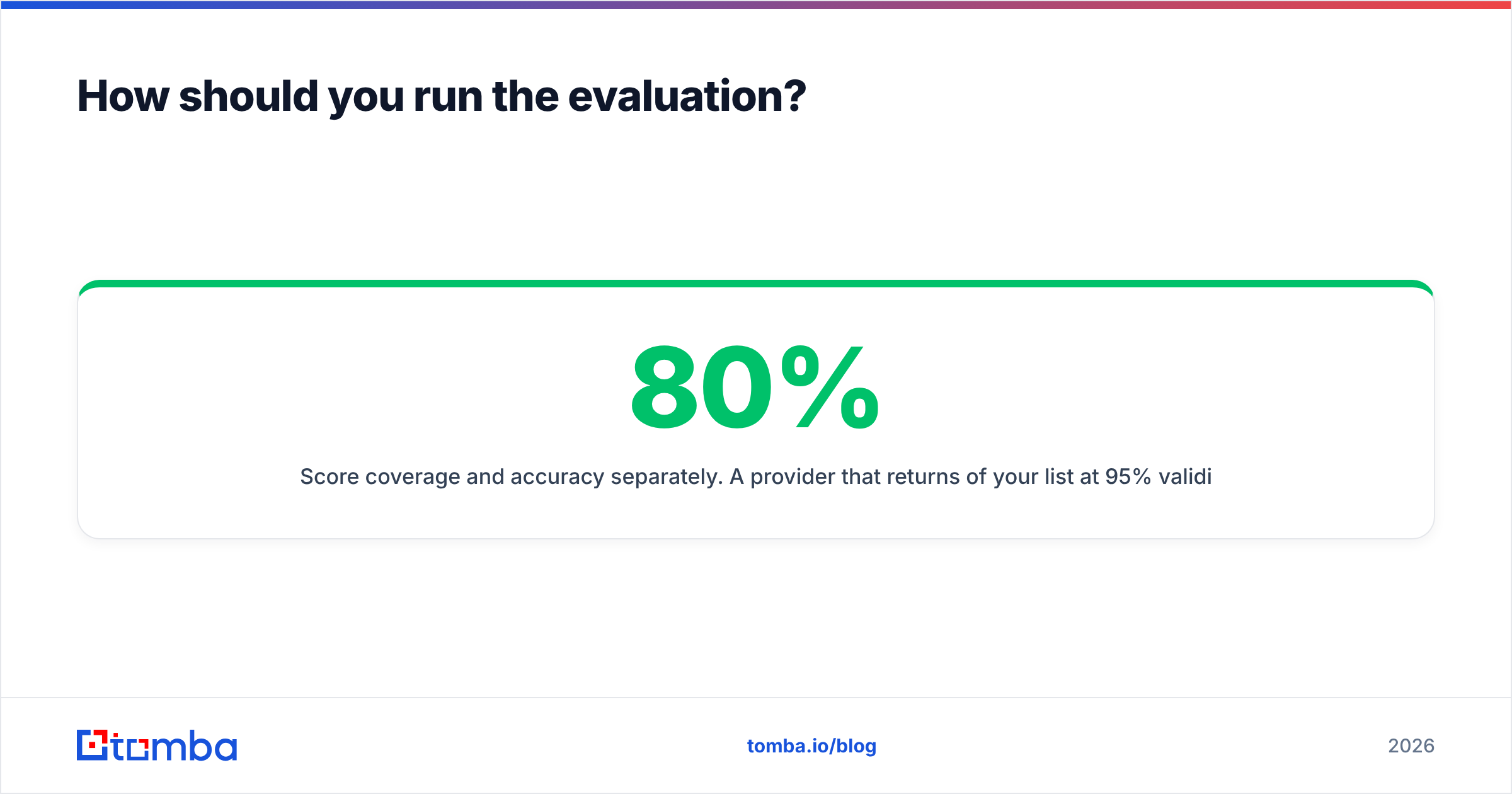
Score coverage and accuracy separately. A provider that returns 80% of your list at 95% validity beats one that returns 95% at 70% validity. The second option costs you sender reputation on every send. If email deliverability is not in your rubric, your rubric is incomplete.
Forager vs SalesIntel: which one should you buy?#
Buy SalesIntel if you run a North-America-heavy sales team, dials matter, and reps should self-serve inside a UI with intent signals attached. You are paying for verification labor and workflow. That is a defensible thing to pay for.
Buy Forager if you have engineering capacity and your enrichment runs on a schedule rather than in a browser. Freshness and volume economics matter more to you than a polished interface. You are paying for a pipe, and pipes are judged on throughput and cleanliness.
Buy neither if what you need is verified work emails for known targets. That is the most common case we see. It is also the one where a platform contract burns the most budget for the least return. Prove the volume first, then upgrade.
Start with the layer that produces pipeline fastest: find the addresses, verify them, and send. Tomba's Email Finder gives you 25 free searches a month, so you can test match rates against your own account list before any contract talk. Paid plans start at $49/mo, with the same data in the API, Chrome extension and Google Sheets. Run your 250-account test against it alongside your Forager and SalesIntel trials.
Related guides#
Ready to find emails that actually work?
Join 150,000+ professionals who stopped guessing and started sending. Free credits on signup — no credit card required.
Get the Tomba newsletter
Practical outbound tactics and product updates — once every two weeks.
About the author