Forager vs Seamless.AI: Which B2B Email Finder Wins in 2026?
Forager.ai and Seamless.AI both promise fresh B2B contact data, but they charge for it in completely different ways. Here's how they compare on accuracy, credits, export limits and real cost per verified email.
TL;DR
- Forager.ai is an API-and-data-feed company. It sells refreshed B2B contact records — often at high volume, usually on an annual contract with custom pricing. Great if you are building a product or a data warehouse, awkward if you just want 500 emails this week.
- Seamless.AI is a seat-based sales platform with a large self-reported database, a Chrome extension, and a free tier of roughly 50 credits. Strong for SDR teams who live inside one UI, weaker on transparent pricing and cancellation terms according to public reviews.
- Neither publishes a straightforward per-verified-email price. Both push you toward a sales call before you see a number.
- On raw email discovery for a known domain, a dedicated email finder with a published price and a real free tier usually beats both on cost per usable contact.
- Pick Forager if you need data as infrastructure. Pick Seamless.AI if you need data inside a rep workflow. Pick a pay-for-what-you-use finder if you need data this afternoon.
What are Forager.ai and Seamless.AI, actually?#
They get lumped together because both sell B2B contact records. That's where the similarity stops.
Forager.ai positions itself as a data provider rather than a sales tool. The pitch is freshness: continuously refreshed professional profiles, company records, and contact points delivered through an API, a bulk export, or a scheduled data feed into your warehouse. The buyer is usually a data engineer, a RevOps lead, or a founder building a product that needs people data underneath it. There is no meaningful "log in and prospect" experience — it isn't trying to be one.
Seamless.AI is the opposite shape. It's a seat-licensed platform with a web app, a Chrome extension, list building, buyer intent add-ons, and a writer tool. The buyer is a sales manager equipping a team of reps. Its core claim is a very large real-time search engine for B2B contacts, and it leans hard on the free-credits-to-book-a-demo motion.
So the honest framing of Forager vs Seamless.AI is not "which database is bigger." It's "do you want a pipe or a cockpit?"

How do the two platforms compare on structure?#
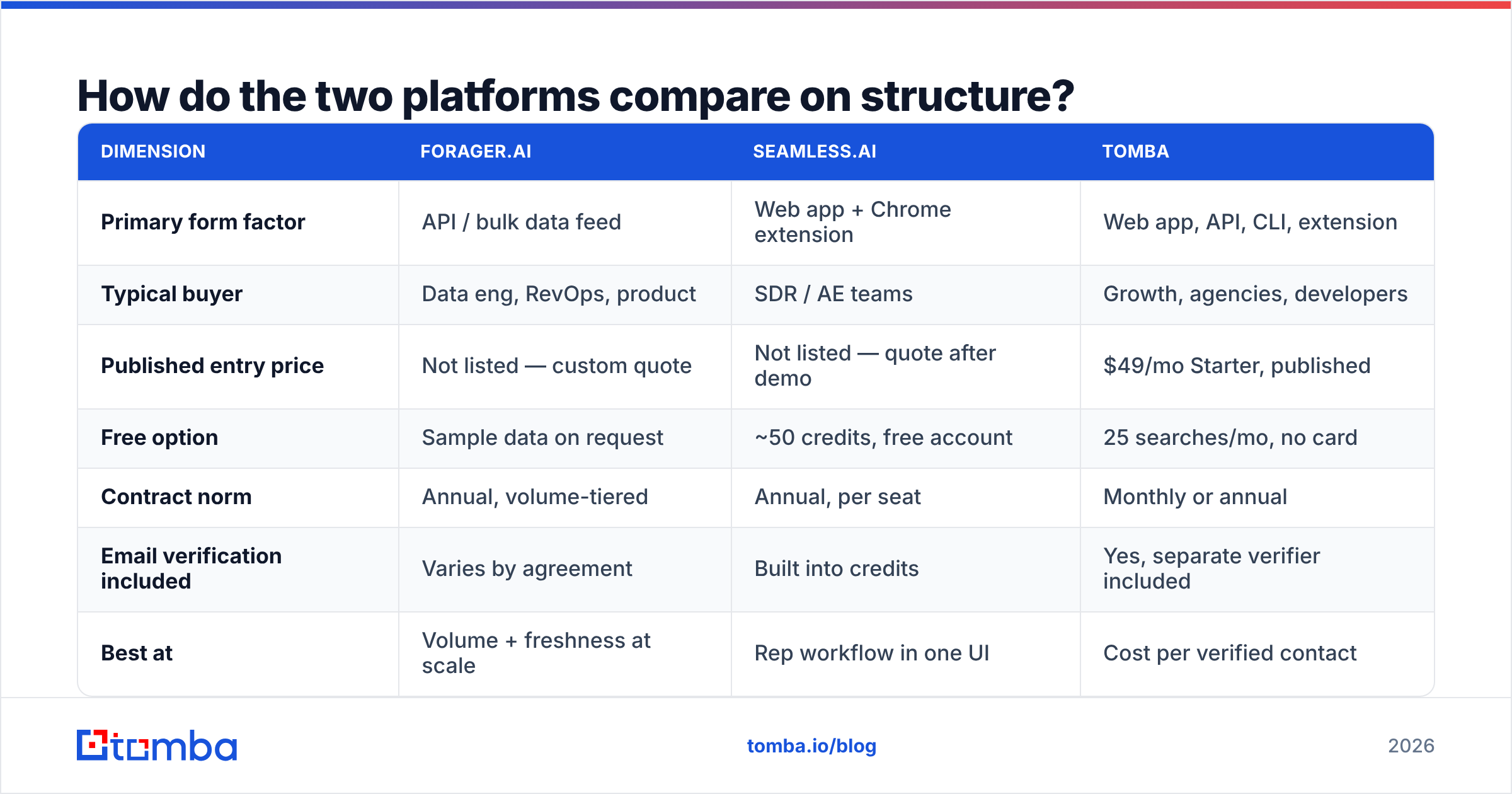
Here is the practical shape of each product, side by side with a transparent-pricing alternative so you have a reference point rather than two black boxes.
| Dimension | Forager.ai | Seamless.AI | Tomba |
|---|---|---|---|
| Primary form factor | API / bulk data feed | Web app + Chrome extension | Web app, API, CLI, extension |
| Typical buyer | Data eng, RevOps, product | SDR / AE teams | Growth, agencies, developers |
| Published entry price | Not listed — custom quote | Not listed — quote after demo | $49/mo Starter, published |
| Free option | Sample data on request | ~50 credits, free account | 25 searches/mo, no card |
| Contract norm | Annual, volume-tiered | Annual, per seat | Monthly or annual |
| Email verification included | Varies by agreement | Built into credits | Yes, separate verifier included |
| Best at | Volume + freshness at scale | Rep workflow in one UI | Cost per verified contact |
Two things jump out. First, both Forager and Seamless.AI hide the number. That isn't a scandal — enterprise data is genuinely priced by volume — but it means you cannot compare them on a spreadsheet without booking two calls. Second, only one of the three lets you test the actual output before a commercial conversation.
How accurate is the data on each side?#
This is where every vendor comparison gets slippery, because every vendor grades its own homework.
Forager's accuracy argument is recency. Their model is continuous refresh: records get re-checked on a cycle rather than sitting in a static dump for eighteen months. In practice, that helps most on job-change-sensitive fields — title, company, seniority — which decay fastest. If your use case is "keep 400,000 records current," recency beats raw count every time.
Seamless.AI's accuracy argument is scale plus real-time lookup. The engine attempts to build and validate a contact at query time rather than only reading from a stored row. When it lands, that's genuinely useful. When it doesn't, you get pattern guesses that look plausible and bounce. Public review threads on G2 reflect exactly this split: reviewers praise coverage and the extension, and repeatedly flag bad emails and billing friction. Read the 2- and 3-star reviews, not the summary score.

The rule that matters more than any vendor benchmark: never send to an unverified record from any provider. Run every list through an independent email verifier before it touches a sequence. A 4% bounce rate is the difference between a warm domain and a dead one, and no data vendor's internal validation is a substitute for your own gate. If a provider's "verified" tier and your verifier disagree by more than a few points, that's your real accuracy number.
[Suggested visual: side-by-side screenshot of a Seamless.AI contact card and the same contact's verification result, showing status mismatch]
What does each one actually cost?#
Neither company publishes a price list, so here's what buyers consistently report and what you should ask for in writing.
- Forager.ai — volume-tiered annual. Pricing scales with record count and refresh frequency. Expect a floor that makes sense for teams pulling six figures of records, not for a two-person agency. Ask for cost per record delivered, cost per record refreshed, and whether re-delivered records bill again.
- Seamless.AI — per seat, credit-capped. The list price is per user per year, with a credit allocation attached. Ask what happens at credit exhaustion, whether unused credits roll over, and — critically — what the cancellation and auto-renewal notice window is. This is the single most common complaint in public reviews.
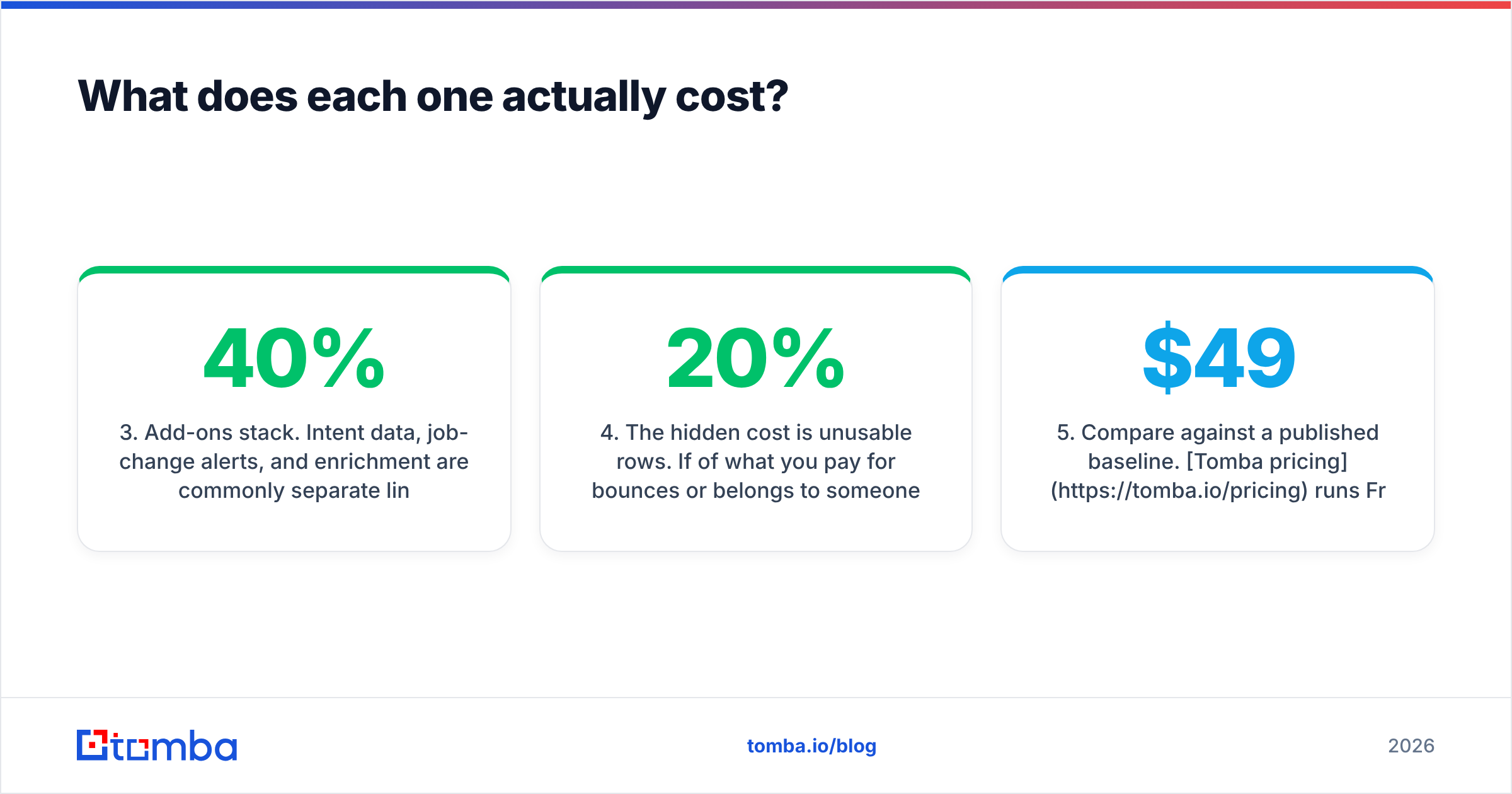
- Add-ons stack. Intent data, job-change alerts, and enrichment are commonly separate line items on both sides. A quote that looks reasonable at signature can be 40% higher with the modules you assumed were included.
- The hidden cost is unusable rows. If 20% of what you pay for bounces or belongs to someone who left in 2024, your effective price per usable contact is 25% above the quoted rate. Model that before you sign.
- Compare against a published baseline. Tomba pricing runs Free (25 searches/mo), Starter $49/mo, Growth $99/mo, Pro $249/mo, Enterprise custom — no seat minimum, no demo required. Whatever quote you get, divide it by expected usable contacts and compare that number against the published tier that covers the same volume.

Which one fits which use case?#
Use the job, not the brand, to decide.
Choose Forager.ai if: you're piping contact data into your own application, warehouse, or scoring model; you need records refreshed on a schedule rather than pulled ad hoc; you have engineering time to build against an API; and your annual volume is large enough that a custom contract is cheaper than metered credits. Forager is a good answer to "we need a data layer." It's a bad answer to "our two SDRs need leads by Thursday."
Choose Seamless.AI if: you're equipping a rep team that will not leave the browser; you value one login for search, list building, and export over best-in-class per-field accuracy; you already run a CRM sync that tolerates some noise; and you're comfortable negotiating an annual per-seat agreement. Go in with your renewal terms in writing. If you're mid-evaluation and having second thoughts, the Seamless.AI alternative breakdown covers the swap in detail.
Choose a metered email finder if: your volume is spiky, you want to pay per lookup rather than per seat, or you need to prove ROI before committing to a year. This is the majority of teams under 20 people, and it's the segment both Forager and Seamless.AI are least designed for.

[Suggested visual: Forager API response payload next to a Seamless.AI list-export CSV, highlighting which fields each returns]
What should you test before you sign anything?#
Run the same evaluation on both. Vendors hate this, which is how you know it works.
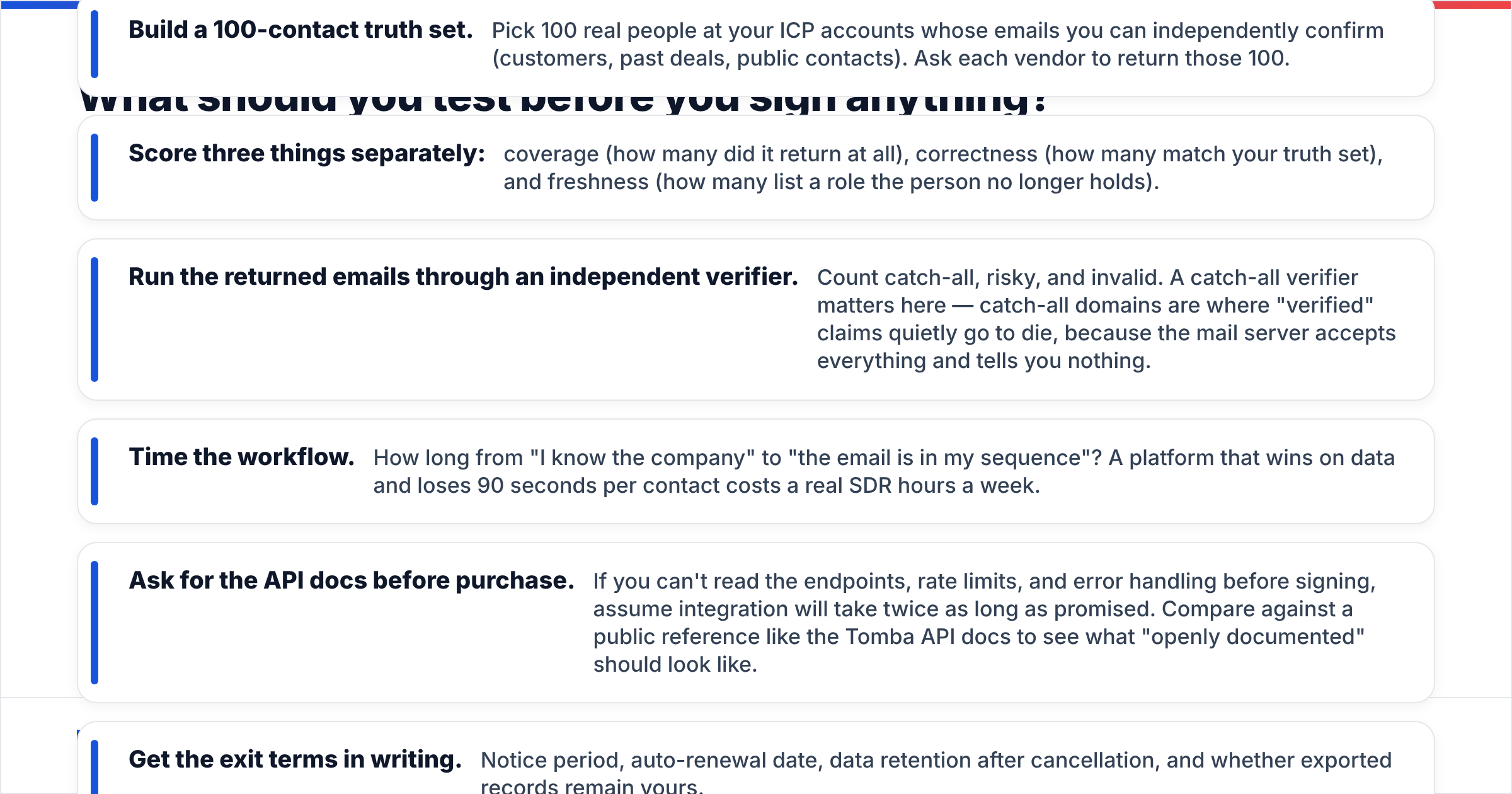
- Build a 100-contact truth set. Pick 100 real people at your ICP accounts whose emails you can independently confirm (customers, past deals, public contacts). Ask each vendor to return those 100.
- Score three things separately: coverage (how many did it return at all), correctness (how many match your truth set), and freshness (how many list a role the person no longer holds).
- Run the returned emails through an independent verifier. Count catch-all, risky, and invalid. A catch-all verifier matters here — catch-all domains are where "verified" claims quietly go to die, because the mail server accepts everything and tells you nothing.
- Time the workflow. How long from "I know the company" to "the email is in my sequence"? A platform that wins on data and loses 90 seconds per contact costs a real SDR hours a week.
- Ask for the API docs before purchase. If you can't read the endpoints, rate limits, and error handling before signing, assume integration will take twice as long as promised. Compare against a public reference like the Tomba API docs to see what "openly documented" should look like.
- Get the exit terms in writing. Notice period, auto-renewal date, data retention after cancellation, and whether exported records remain yours.
Is there a middle path between the two?#
Yes, and most teams land there.
The real split in this market isn't Forager vs Seamless.AI — it's infrastructure data versus workflow data versus on-demand lookup. Forager owns the first. Seamless.AI competes in the second. The third — "I have a domain and a name, get me a deliverable email, bill me for what I use" — is a different product category, and it's where most outbound teams actually spend their day.
That category has a simple test: can you see the price, try it without a sales call, and check the result yourself? If the answer to any of those is no, you're buying a relationship, not a tool. Sometimes that's the right call. At six figures of records with a refresh SLA, it usually is. At 2,000 contacts a month, it almost never is.
A practical stack many teams settle on: a metered finder for day-to-day prospecting, an independent verifier as the gate before every send, and a warehouse-grade provider like Forager only once volume justifies a contract. Peers like BookYourData serve the "buy a clean list once" job well too — the point is matching the purchase shape to the job rather than defaulting to whichever vendor called you first.
The bottom line#
Forager.ai wins on freshness at scale and loses on accessibility. Seamless.AI wins on rep workflow and loses on pricing transparency and, per public reviews, contract flexibility. Both are legitimate for the buyer they're built for — and both are oversized for a team that just needs correct email addresses without a procurement cycle.
If that's you, start with the Tomba Email Finder. Find emails by name and domain, verify them in the same workflow, and see exactly what you're paying: free for 25 searches a month, $49/mo on Starter, no seat minimum and no demo gate. Run it against the same 100-contact truth set you send to Forager and Seamless.AI, compare cost per verified contact, and let the numbers pick the winner instead of the sales deck.
Related guides#
Ready to find emails that actually work?
Join 150,000+ professionals who stopped guessing and started sending. Free credits on signup — no credit card required.
Get the Tomba newsletter
Practical outbound tactics and product updates — once every two weeks.
About the author