Free Lead Generation Tools: 14 That Actually Work in 2026
Most "free" lead gen tools are 7-day trials in disguise. Here are 14 that stay free, what their real limits are, and how to chain them into a working pipeline without paying a cent.
TL;DR
- Most tools marketed as "free" are 14-day trials with a credit card wall. Only about a third of the market offers a genuine forever-free tier.
- The useful free stack splits into four jobs: find contacts, verify them, capture inbound, and automate the handoff. You need one tool per job, not one tool for everything.
- Free tiers cluster around 25–100 credits/month for contact data, 100–250 verifications, and 1,000 contacts for CRM storage.
- The hidden cost of free tools is data decay — an unverified list from a free scraper burns your domain reputation faster than it fills your pipeline.
- Best realistic free combo in 2026: Tomba (25 searches/mo) + HubSpot Free CRM + Google Forms/Tally + a manual verification pass before every send.
What counts as a "free lead generation tool" in 2026?#
Three very different things get shelved under the same label, and conflating them is why most "free tools" lists are useless.
- Forever-free tiers. A permanently available plan with a hard monthly cap. No card, no expiry. Tomba's 25 searches/month and HubSpot's free CRM are the archetypes.
- Free trials. Full product, 7–14 days, usually card-gated. Apollo, Instantly, and most sequencers live here. Useful for a sprint, not a system.
- Free-forever utilities. Single-purpose web tools with no account at all — an email permutator, an SPF checker, a spam checker. Unlimited, but they solve one narrow step.
The mistake teams make is trying to run an entire outbound motion on category 2. You get 14 days of momentum, then a $99 bill you didn't budget for and a half-built list. Category 1 plus category 3 is what actually compounds.

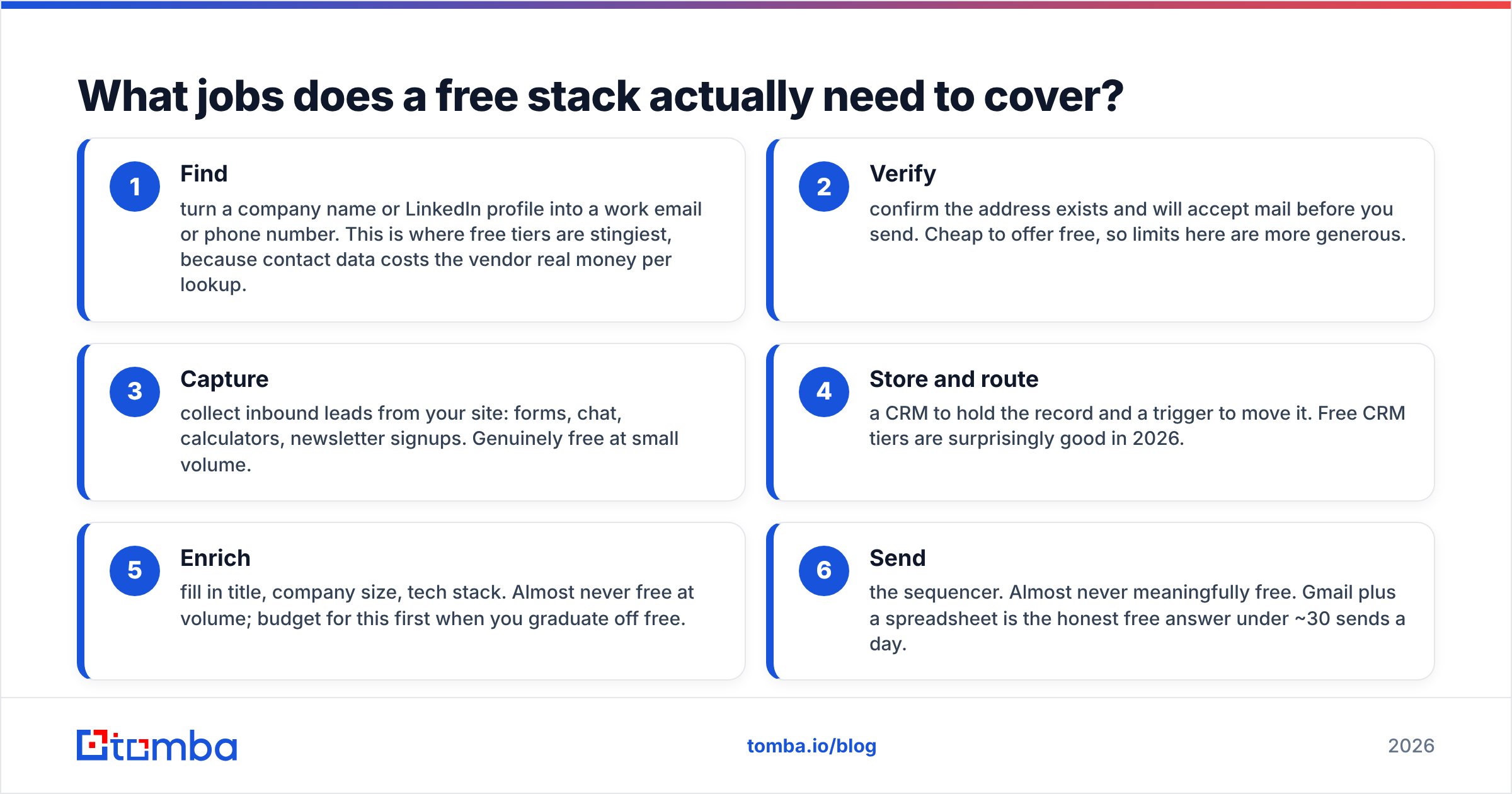
What jobs does a free stack actually need to cover?#
Lead generation is not one task. Before comparing tools, map the four jobs — then pick the best free option for each rather than hunting for a single free everything-platform (which does not exist).
- Find — turn a company name or LinkedIn profile into a work email or phone number. This is where free tiers are stingiest, because contact data costs the vendor real money per lookup.
- Verify — confirm the address exists and will accept mail before you send. Cheap to offer free, so limits here are more generous.
- Capture — collect inbound leads from your site: forms, chat, calculators, newsletter signups. Genuinely free at small volume.
- Store and route — a CRM to hold the record and a trigger to move it. Free CRM tiers are surprisingly good in 2026.
- Enrich — fill in title, company size, tech stack. Almost never free at volume; budget for this first when you graduate off free.
- Send — the sequencer. Almost never meaningfully free. Gmail plus a spreadsheet is the honest free answer under ~30 sends a day.
If a "free lead generation tools" list gives you eight options for job 3 and none for job 1, it's optimising for affiliate payouts, not for your pipeline.
Which free lead generation tools are worth using?#
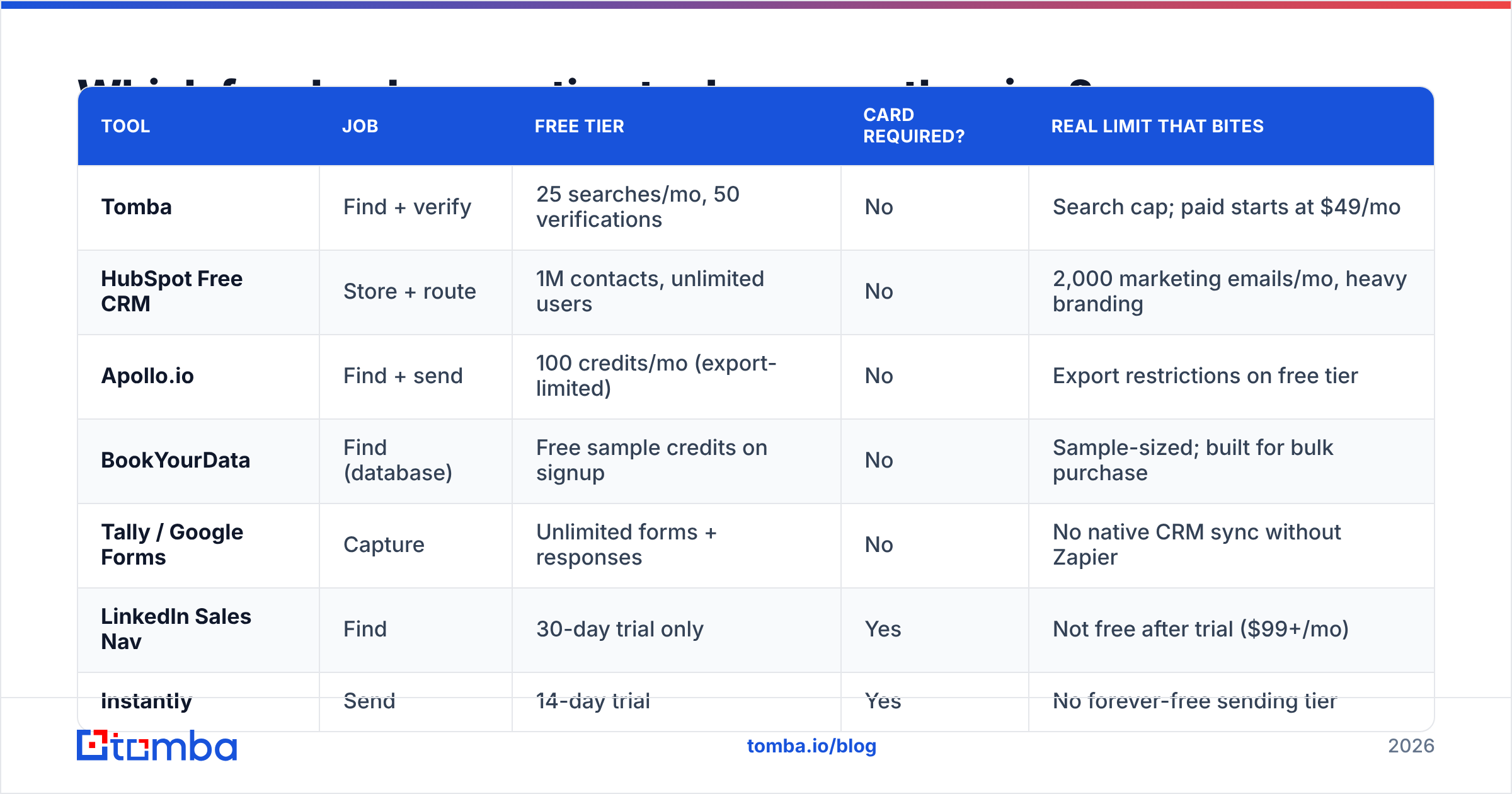
Here's the head-to-head on what each free tier actually gives you. Numbers reflect publicly listed plans as of early 2026 — always re-check on the vendor's pricing page, since free tiers get trimmed quietly.
| Tool | Job | Free tier | Card required? | Real limit that bites |
|---|---|---|---|---|
| Tomba | Find + verify | 25 searches/mo, 50 verifications | No | Search cap; paid starts at $49/mo |
| HubSpot Free CRM | Store + route | 1M contacts, unlimited users | No | 2,000 marketing emails/mo, heavy branding |
| Apollo.io | Find + send | 100 credits/mo (export-limited) | No | Export restrictions on free tier |
| BookYourData | Find (database) | Free sample credits on signup | No | Sample-sized; built for bulk purchase |
| Tally / Google Forms | Capture | Unlimited forms + responses | No | No native CRM sync without Zapier |
| LinkedIn Sales Nav | Find | 30-day trial only | Yes | Not free after trial ($99+/mo) |
| Instantly | Send | 14-day trial | Yes | No forever-free sending tier |
| Mailchimp | Send | 500 contacts, 1,000 sends/mo | No | Daily send cap of 500 |
| Google Sheets + Tomba add-on | Find at scale | Uses your Tomba credits | No | Credits, not the add-on, are the ceiling |
| Hunter | Find | 25 searches/mo, 50 verifications | No | Same shape as Tomba, smaller DB coverage |
| Clearbit (HubSpot Breeze) | Enrich | Bundled free tier via HubSpot | No | Requires HubSpot account |
| Warmy / warmup tools | Deliverability | 7-day trials | Usually | Warmup is rarely free |
| Tomba Chrome extension | Find in-browser | Included on free plan | No | Draws from the same 25 searches |
| Wappalyzer / tech checkers | Qualify | ~50 lookups/mo | No | Enough for manual research only |
Two things jump out. First, the find row is where every free plan converges on roughly 25–100 lookups a month — that's the industry's honest cost floor for contact data. Second, sending is the job nobody gives away, because free senders get abused by spammers within a week of launch.
BookYourData deserves a note here: it's a purchase-per-record database rather than a subscription, so its free allocation is a sample rather than a recurring tier. If your motion is "buy 5,000 verified records once and work them for a quarter," that model can beat a monthly subscription outright. Different shape, not a worse one.
How accurate is free contact data, really?#
Accuracy is where free tiers diverge most, and it's the number vendors are least eager to publish.
Two structural facts drive it. One: B2B contact data decays at roughly 22–30% per year — people change jobs, companies get acquired, domains migrate. A database refreshed quarterly is meaningfully worse than one refreshed weekly, regardless of size. Two: most free-tier lookups return a pattern-guessed address (firstname.lastname@domain) unless the provider verifies it in real time via SMTP. A guess that looks right and bounces is worse than no result, because it costs you sender reputation.
So the question to ask a free tool isn't "how many contacts do you have" — it's "do you SMTP-verify at the moment of lookup, and do you tell me the confidence score?" Tomba returns a confidence score plus source URLs on every result, including on the free plan, which is the single most useful signal for deciding whether to send.
Practical rule: never send to anything under 90% confidence without a separate verification pass. Run the address through a free email checker or a catch-all verifier first. Catch-all domains are the trap — they accept everything at SMTP, so a naive verifier marks them "valid" and you find out the truth from your bounce report.
Can you build a full pipeline for $0?#
Yes, at low volume. Here's a stack that works and costs nothing, assuming you're targeting 25–50 net-new prospects a month — which is a realistic target for a founder-led motion or a solo SDR testing a new segment.
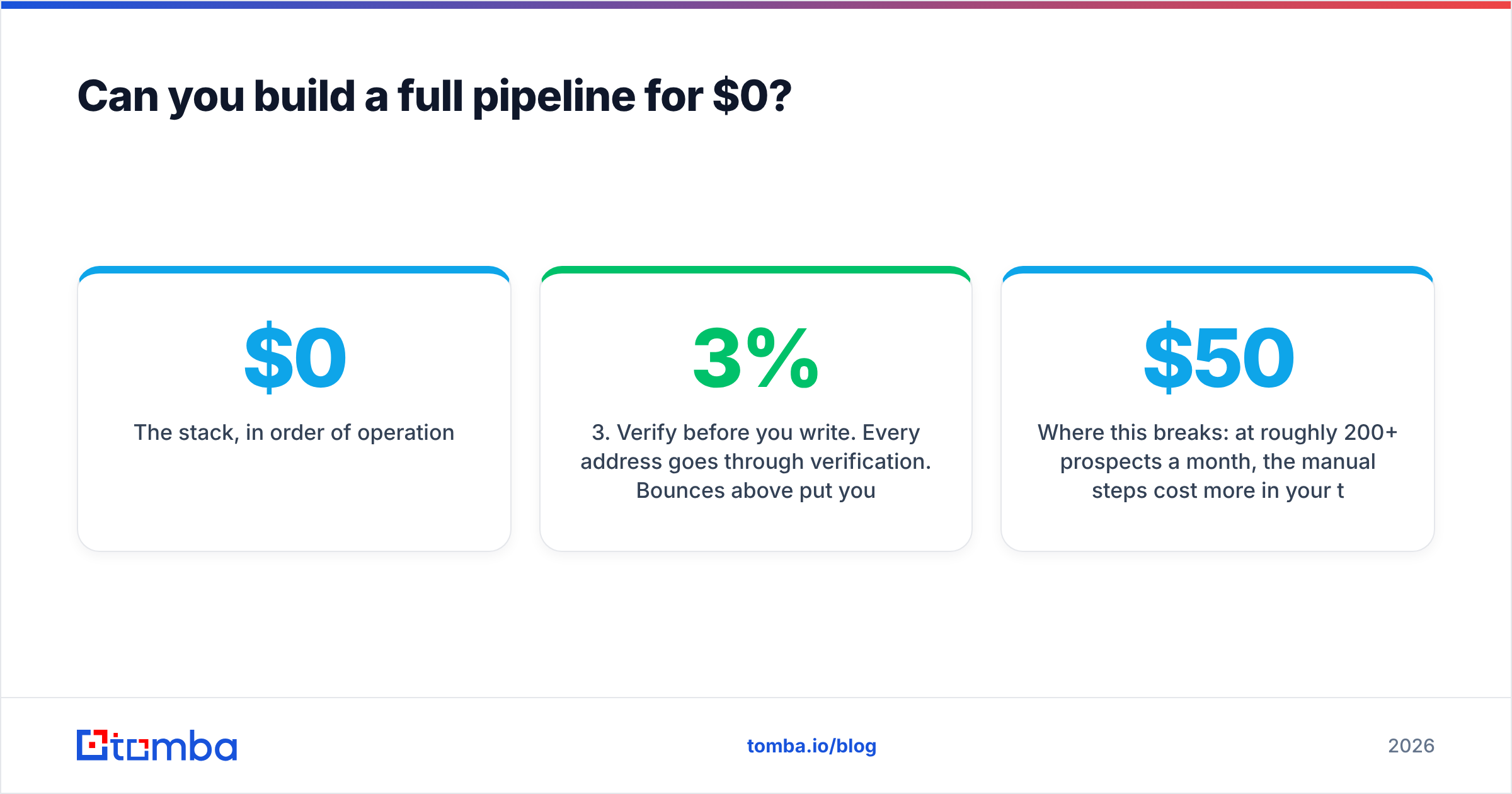
The $0 stack, in order of operation:
- Source the account list manually. LinkedIn search, a G2 category page, a conference attendee list, a funding announcement. This is labour, not software, and it's free.
- Find the contact. Use a domain search to pull the pattern and named contacts for each target company. On 25 free searches you can cover ~25 companies a month — spend them on accounts you've already qualified, not on spray-and-pray.
- Verify before you write. Every address goes through verification. Bounces above 3% put your domain at risk, and free tools give you no protection from that.
- Store in HubSpot Free. Contact record, company record, deal stage. Free tier handles a million contacts, which you will never approach on a free finding tier.
- Send from Gmail or Outlook directly. Under ~30 personalised emails a day, a sequencer adds risk (shared IP pools, template detection) rather than removing it. Write them yourself.
- Track replies in the CRM. Manual, but at this volume, manual is fine and the data quality is better.
Where this breaks: at roughly 200+ prospects a month, the manual steps cost more in your time than a paid plan costs in cash. If an hour of your time is worth $50 and manual sourcing eats four hours a week, you're spending $800/month to avoid a $49 bill. That's the moment to upgrade — not before.

What are the hidden costs of free tools?#
Four, and they're all real.
Sender reputation. Free scrapers and unverified exports produce lists with 15–25% invalid addresses. Google and Microsoft's 2024 bulk-sender requirements set a hard spam-complaint ceiling of 0.3%, and high bounce rates correlate directly with filtering. You can torch a domain in two weeks and spend three months rebuilding sender reputation. Read Google's own bulk sender guidelines before your first campaign, not after.
Export handcuffs. Several free tiers let you see data but not export it — you can view 100 contacts and copy them one at a time. That's a time tax dressed as a feature. Check the export policy before you invest hours in a tool.
Data ownership on shutdown. If a free tool sunsets its free tier (this happens constantly), can you get your data out in a usable format? CSV export should be table stakes.
Compliance. Scraped personal data without a lawful basis is a GDPR problem, and "the free tool gave it to me" is not a defence. Business contact data used for relevant B2B outreach under legitimate interest is generally defensible in the EU; consumer data and personal Gmail addresses are not. Vendors that publish where their data comes from are the ones you want on record.
When should you stop using free tools?#
Three signals, any one of which means it's time.
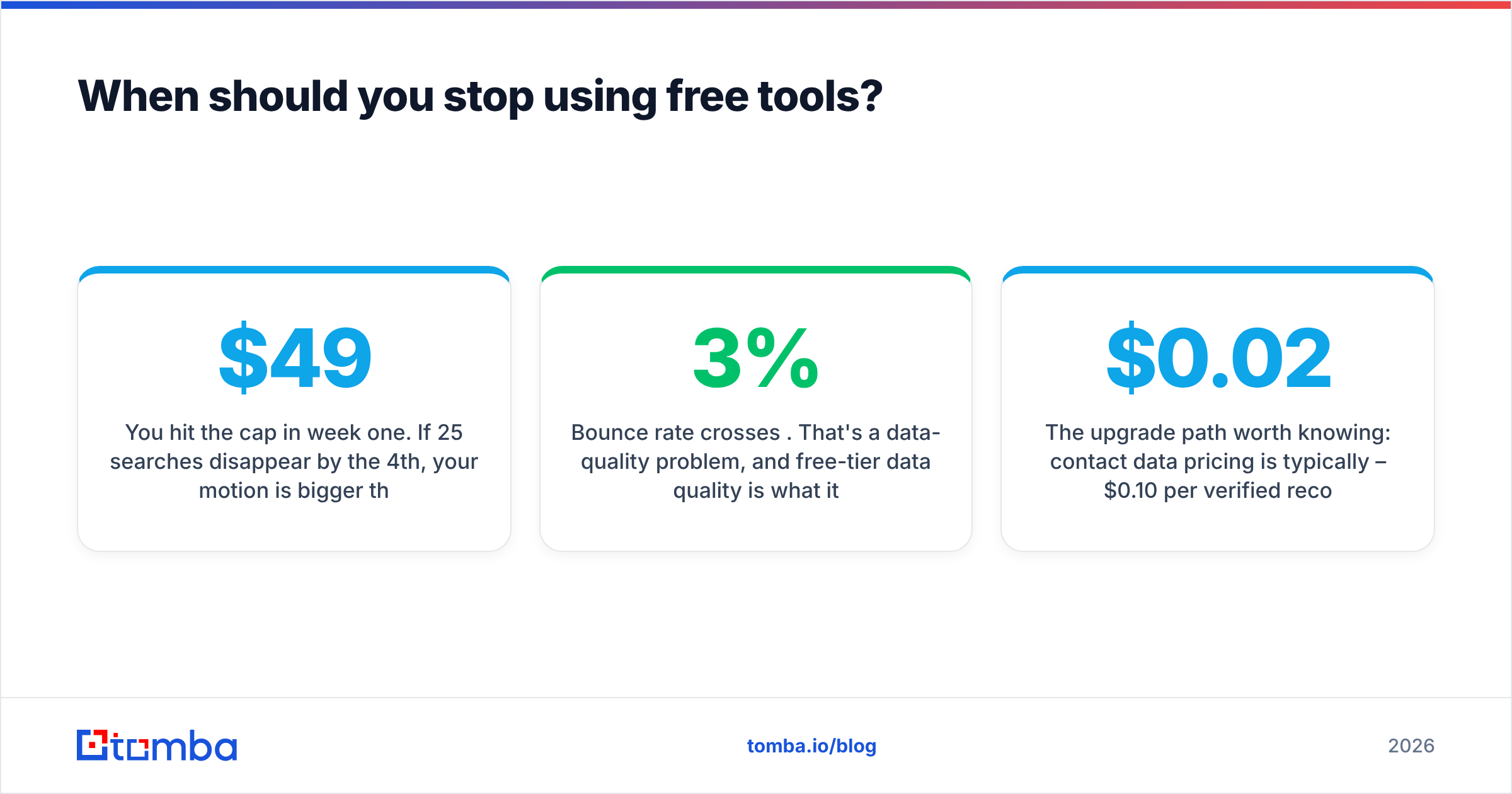
- You hit the cap in week one. If 25 searches disappear by the 4th, your motion is bigger than the free tier and you're just throttling revenue to save $49.
- You're maintaining a spreadsheet as middleware. Copy-pasting between four free tools is a job. Once that job takes more than two hours a week, a paid plan with native integrations pays for itself immediately.
- Bounce rate crosses 3%. That's a data-quality problem, and free-tier data quality is what it is. Paid verification tiers with catch-all handling exist precisely for this.
The upgrade path worth knowing: contact data pricing is typically $0.02–$0.10 per verified record on entry plans. Tomba's Starter at $49/mo and Growth at $99/mo sit in that band; Pro at $249/mo is where bulk and API access unlock. Compare against your close rate — if one closed deal is worth more than a year of tooling, the free-tier optimisation is a distraction.
For a broader view of how the vendors price against each other, G2's lead intelligence category has the most current per-seat comparisons, and it surfaces which free tiers users complain about being throttled.
How do you get the most out of a 25-search free tier?#
Treat credits as the scarce resource they are.
- Qualify before you search. Never burn a lookup on a company you haven't confirmed fits ICP. Check headcount, funding stage, and tech stack first — those are free.
- Search by domain, not by person. One domain search returns the email pattern plus multiple contacts. One person search returns one contact. Same credit cost, very different yield.
- Use the pattern to derive the rest. Once you know a company uses
f.lastname@, a free email permutator generates the variants for other contacts at zero credit cost — then verify only the top candidate. - Batch at month start. Credits usually don't roll over. Plan the month's target accounts, spend the credits in one session, work the list for four weeks.
- Log everything in the CRM immediately. Losing a found address to a closed browser tab is the most expensive free-tier mistake there is.
That fourth point is the one people miss. A 25-search tier stretched intelligently — domain-first, pattern-derived, verified selectively — realistically yields 60–100 usable contacts a month. Used carelessly, it yields 25 unverified guesses.
Which free tool should you start with?#
If you only add one thing this week, make it the find step — because capture and CRM are already well served by free tools you probably have, and sending is something you can do from your existing inbox.
Start with the Tomba Email Finder. The free plan gives you 25 searches and 50 verifications a month with no card, returns a confidence score and source URLs on every result so you can judge quality yourself, and includes the Chrome extension and Google Sheets add-on so the workflow fits where you already work. When 25 stops being enough, Starter is $49/mo — and by then you'll know exactly what you're buying instead of guessing.
Related guides#
Ready to find emails that actually work?
Join 150,000+ professionals who stopped guessing and started sending. Free credits on signup — no credit card required.
Get the Tomba newsletter
Practical outbound tactics and product updates — once every two weeks.
About the author