Free Leads in 2026: Where to Find Them (Without Junk Data)
Free leads are everywhere — most of them are worthless. Here's where the genuinely useful free lead sources live in 2026, what each one costs you in time, and when paying beats scraping.
TL;DR
- "Free leads" almost always means you pay in time, deliverability, or data decay instead of dollars. The question is never free vs paid — it's which currency you can afford to spend.
- The three free sources that still work in 2026: your own website traffic, public communities where your buyers self-identify, and manual research on 20–50 named accounts.
- The three that mostly waste your quarter: scraped mega-lists, "1M B2B contacts" torrents, and unverified directory dumps. Bounce rates north of 30% will torch your sending domain.
- A free-tier tool (25 verified searches/month) beats a 100,000-row scraped CSV on nearly every metric that matters — reply rate, bounce rate, and hours spent.
- Rule of thumb: free lead generation scales to roughly 50 contacts a week per rep. Past that, tooling is cheaper than your own payroll.
What Are Free Leads, Really?#
A free lead is a contact record you obtained without paying a data vendor. That's the whole definition — and it hides an enormous quality range.
Think of it like foraging versus buying groceries. Foraging is genuinely free and the food can be excellent, but you spend a Saturday doing it, you need to know which mushrooms kill you, and you cannot feed a restaurant that way. Free lead generation works the same. It's viable at small volume with expert judgment, and it collapses the moment you need predictable throughput.
The practical breakdown of what people mean when they say "free leads":
- Self-generated leads — inbound form fills, newsletter subscribers, webinar registrants, content downloads. Genuinely free at the margin, highest intent, lowest volume.
- Manually researched leads — you found a company, identified the right person on LinkedIn, and figured out their email pattern. Free in cash, expensive in hours (roughly 4–7 minutes per contact done properly).
- Free-tier tool leads — a real data provider's free plan. Verified, structured, capped in volume. Usually 25–100 records a month.
- Community-sourced leads — people who raised their hand in a Slack group, subreddit, Reddit thread, or LinkedIn comment section. Free, high-context, unpredictable.
- Scraped or list-dump leads — a CSV someone posted, a directory scrape, a "free B2B database" download. Free in the way that a stray dog is free.
- Referral and partner leads — introductions from existing customers or complementary vendors. Free, highest close rate, hardest to systematize.
Categories 1, 2, 4, and 6 are legitimate. Category 3 is legitimate and underused. Category 5 is where most people burn their sending domain and then conclude that cold email is dead.

Why Do Most Free Lead Lists Fail?#
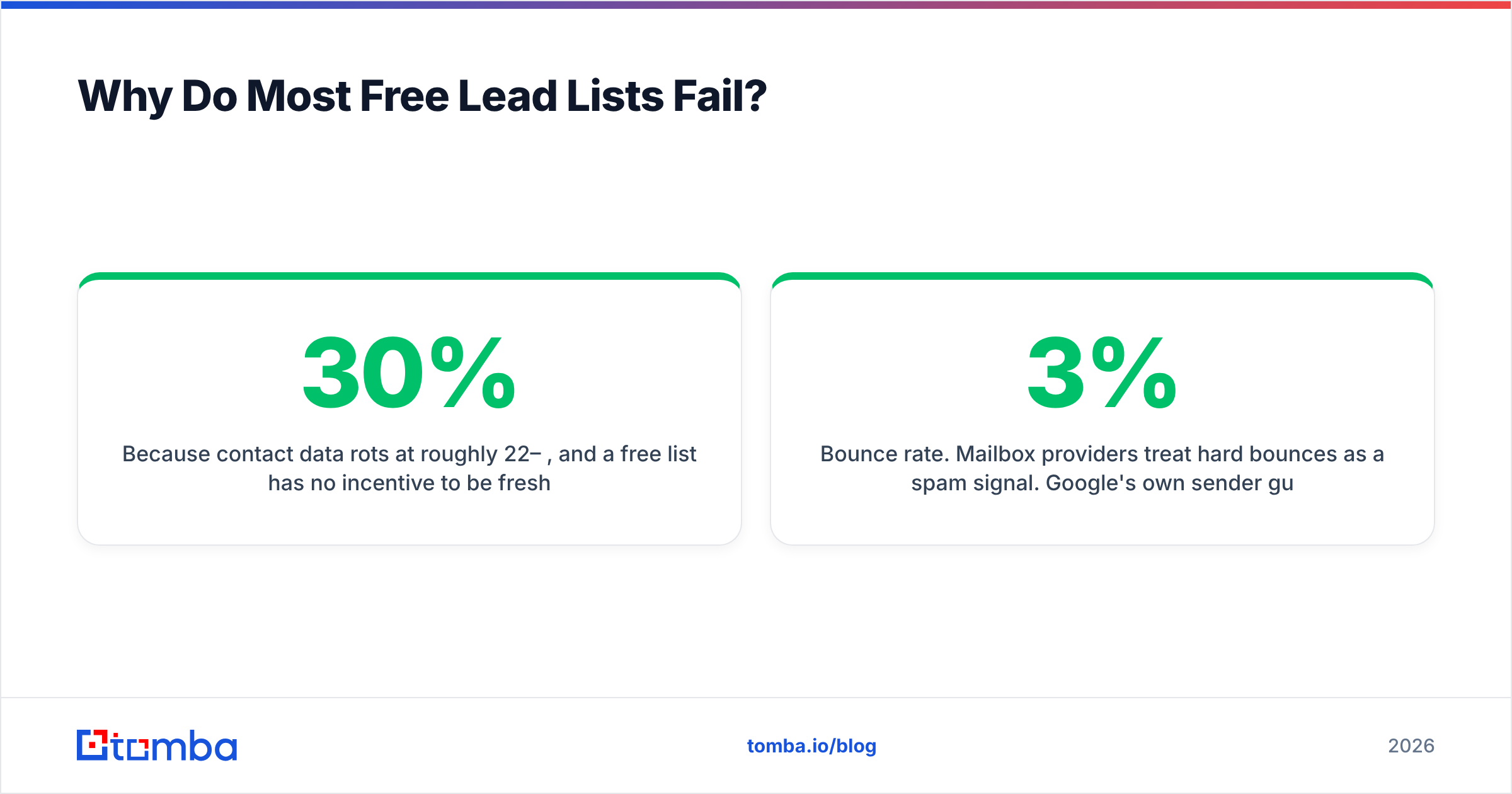
Because contact data rots at roughly 22–30% per year, and a free list has no incentive to be fresh.
Every free mega-list you find has the same lifecycle. Someone scrapes a source in year one. It circulates. By the time it reaches you in year three, a third of those people have changed jobs, the companies have rebranded their domains, and half the addresses were pattern-guesses that were never validated in the first place.
Here's what that does downstream:
- Bounce rate. Mailbox providers treat hard bounces as a spam signal. Google's own sender guidelines put the practical ceiling around 2–3%. A scraped list routinely bounces at 25–40%. You will land in spam by day three.
- Spam traps. Recycled traps are old real addresses that providers reactivate specifically to catch stale-list senders. Free lists are dense with them.
- Wrong-person waste. Even the addresses that deliver often reach someone who left the role. Your reply rate looks like a rounding error and you can't tell whether the message or the data failed.
- Compliance exposure. GDPR and CAN-SPAM don't care that the list was free. Under GDPR you need a defensible legitimate-interest basis, which a mystery CSV of unknown provenance does not give you.
If you take nothing else from this post: a list you cannot trace to a source is not an asset, it's a liability with a filename.
Where Can You Actually Get Free Leads in 2026?#
Ranked by realistic return per hour spent.
1. Your own website traffic. Most B2B sites convert 1–3% of visitors. The other 97% are companies that visited, evaluated, and left silently. Visitor-identification tools resolve a portion of that anonymous traffic to company level, and the good ones have free or trial tiers. This is the highest-intent free source you have and almost nobody works it.
2. LinkedIn, worked manually. Not scraped — worked. Search for the job title and industry, filter by recent activity, and build a list of 30 names. Then find the email pattern for each domain. It's slow, but the contacts are current by definition because the profile is maintained by the person.
3. Communities where buyers self-identify. Subreddits, Slack workspaces, Discord servers, industry forums. When someone posts "we're evaluating X, what are people using," that's a lead with stated intent and a timeline. No database sells that.
4. Public company sources. Job postings tell you what a company is building and which tools they use (a posting requiring Salesforce admin experience is a qualification signal). Funding announcements, press releases, conference speaker lists, podcast guest rosters, G2 review authors — all public, all free, all under-mined.
5. Free tiers of real data tools. A capped free plan from a legitimate provider gives you verified, sourced, compliant records. Tomba's free tier is 25 searches a month; other vendors sit in a similar range. Twenty-five verified contacts will outperform 2,500 scraped ones. That is not marketing copy, it's arithmetic on bounce and reply rates.
6. Referrals and partner swaps. Ask three happy customers for one introduction each. Trade prospect lists with a non-competing vendor selling to the same buyer. Slowest to set up, best conversion of anything on this list.
How Do Free Sources Compare to Paid Data?#
Here's the honest scorecard. "Cost" below means your true cost, including time at a loaded rate of about $40/hour for an SDR.
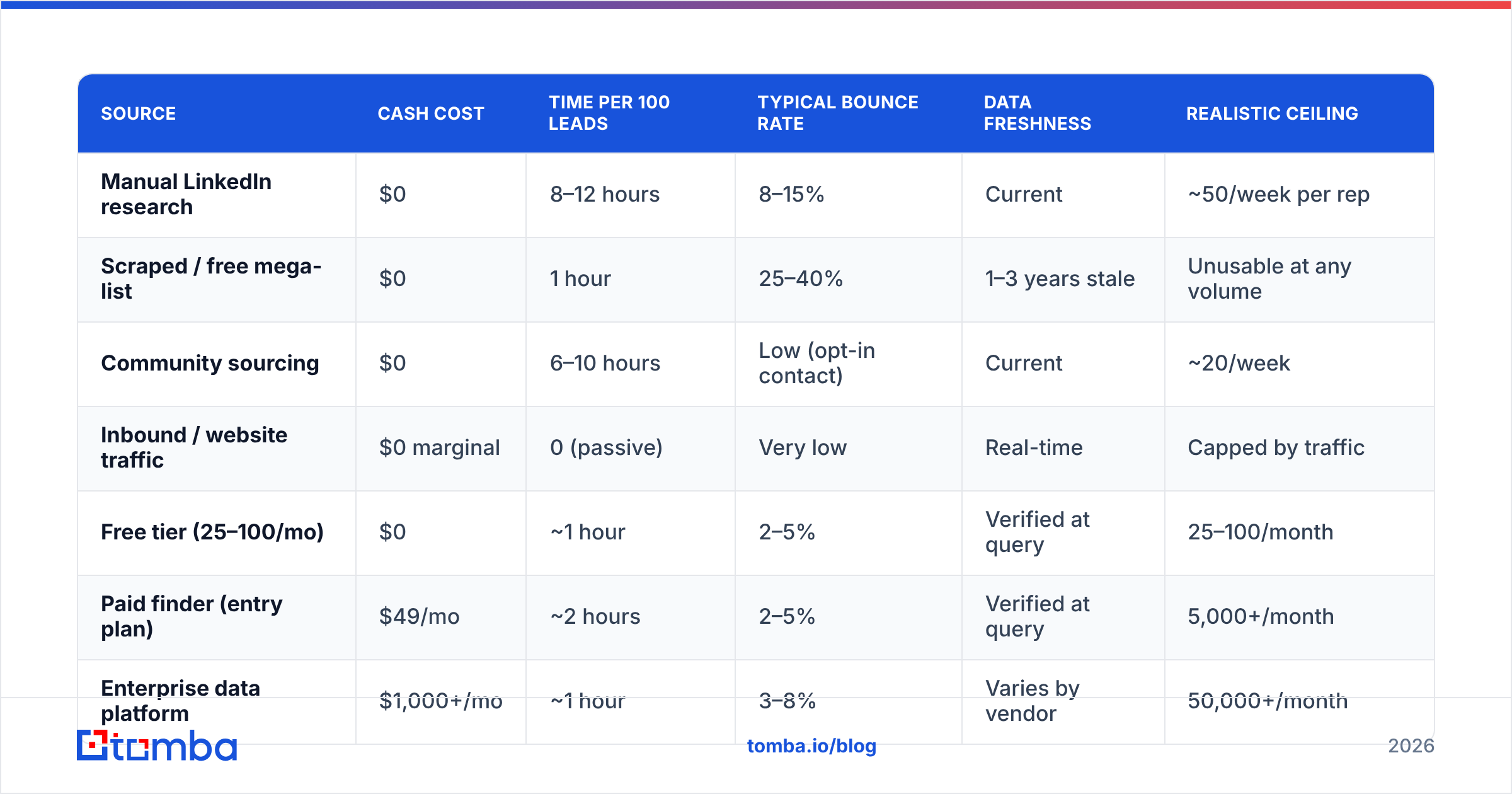
| Source | Cash cost | Time per 100 leads | Typical bounce rate | Data freshness | Realistic ceiling |
|---|---|---|---|---|---|
| Manual LinkedIn research | $0 | 8–12 hours | 8–15% | Current | ~50/week per rep |
| Scraped / free mega-list | $0 | 1 hour | 25–40% | 1–3 years stale | Unusable at any volume |
| Community sourcing | $0 | 6–10 hours | Low (opt-in contact) | Current | ~20/week |
| Inbound / website traffic | $0 marginal | 0 (passive) | Very low | Real-time | Capped by traffic |
| Free tier (25–100/mo) | $0 | ~1 hour | 2–5% | Verified at query | 25–100/month |
| Paid finder (entry plan) | $49/mo | ~2 hours | 2–5% | Verified at query | 5,000+/month |
| Enterprise data platform | $1,000+/mo | ~1 hour | 3–8% | Varies by vendor | 50,000+/month |
Read the time column carefully. A hundred manually researched leads costs you roughly ten hours — call it $400 of loaded SDR time. That is eight times the price of an entry paid plan that would produce the same hundred contacts, verified, in under two hours. "Free" stopped being free somewhere around lead number thirty.
The break-even is unusually clean: free lead generation makes sense below roughly 50 contacts per week per rep. Above that, you're paying more in salary than the tool costs, and you're getting worse data for it.
What Does a Free Lead Actually Cost You?#
Three currencies, and you spend all three whether you notice or not.
Time. Finding one verified contact manually breaks down as: identify the company (1 min), find the right person (2 min), determine the email pattern (2 min), verify it doesn't bounce (1–2 min). Call it 6 minutes on a good day. At 100 contacts, that's your entire week gone.
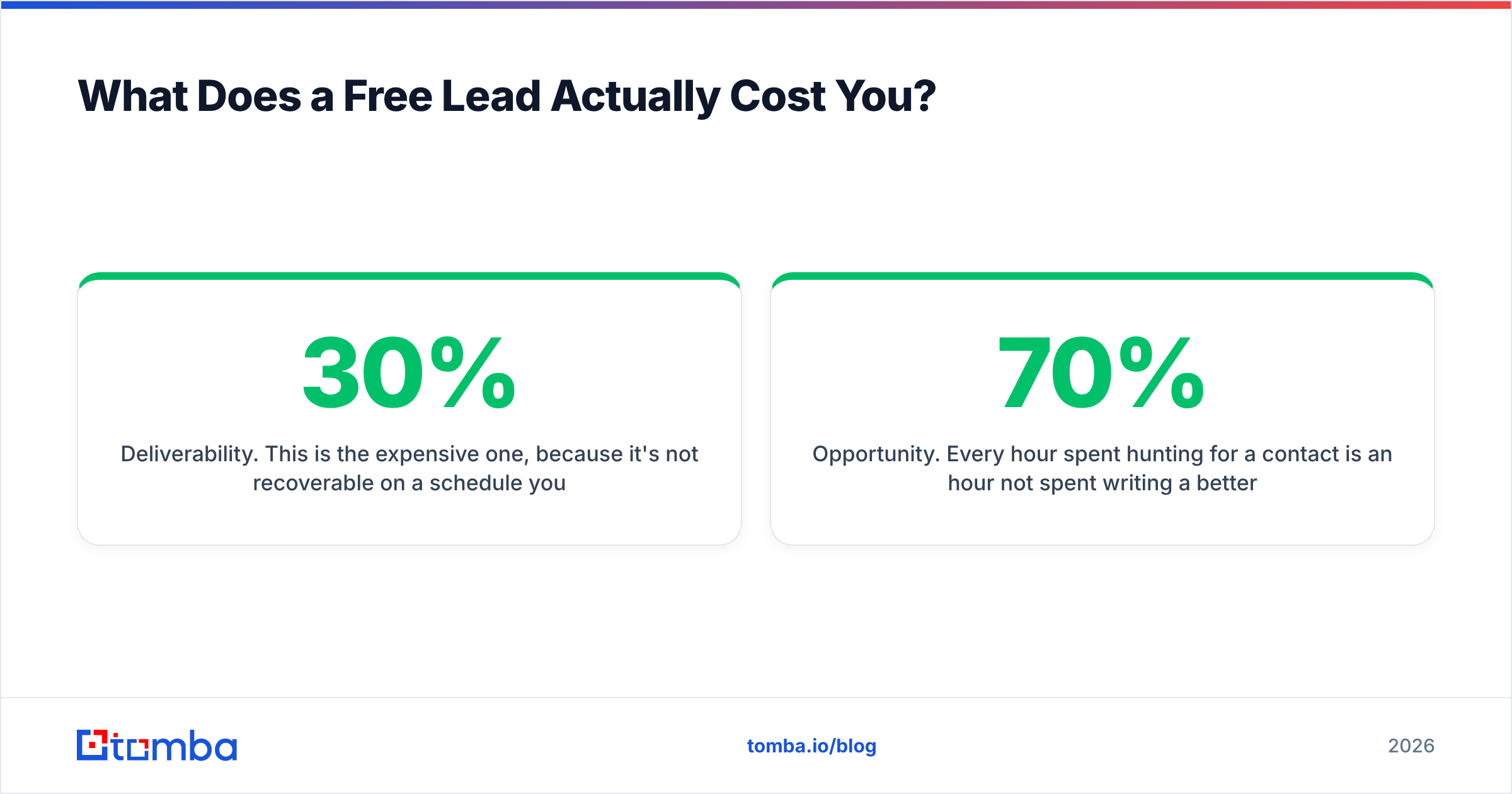
Deliverability. This is the expensive one, because it's not recoverable on a schedule you control. Send to a 30%-bounce list and your sender reputation drops. Recovery means weeks of warmup, reduced volume, and possibly a new domain. Your good campaigns suffer for a bad list. Run anything you didn't verify through an email verifier before it touches your sequencer — that step is non-negotiable regardless of where the list came from.
Opportunity. Every hour spent hunting for a contact is an hour not spent writing a better message or having a conversation. Most teams have the ratio inverted: 70% of rep time on list-building, 30% on selling. Reversing that is usually worth more than any tool.
Which Free Tools Are Worth Setting Up?#
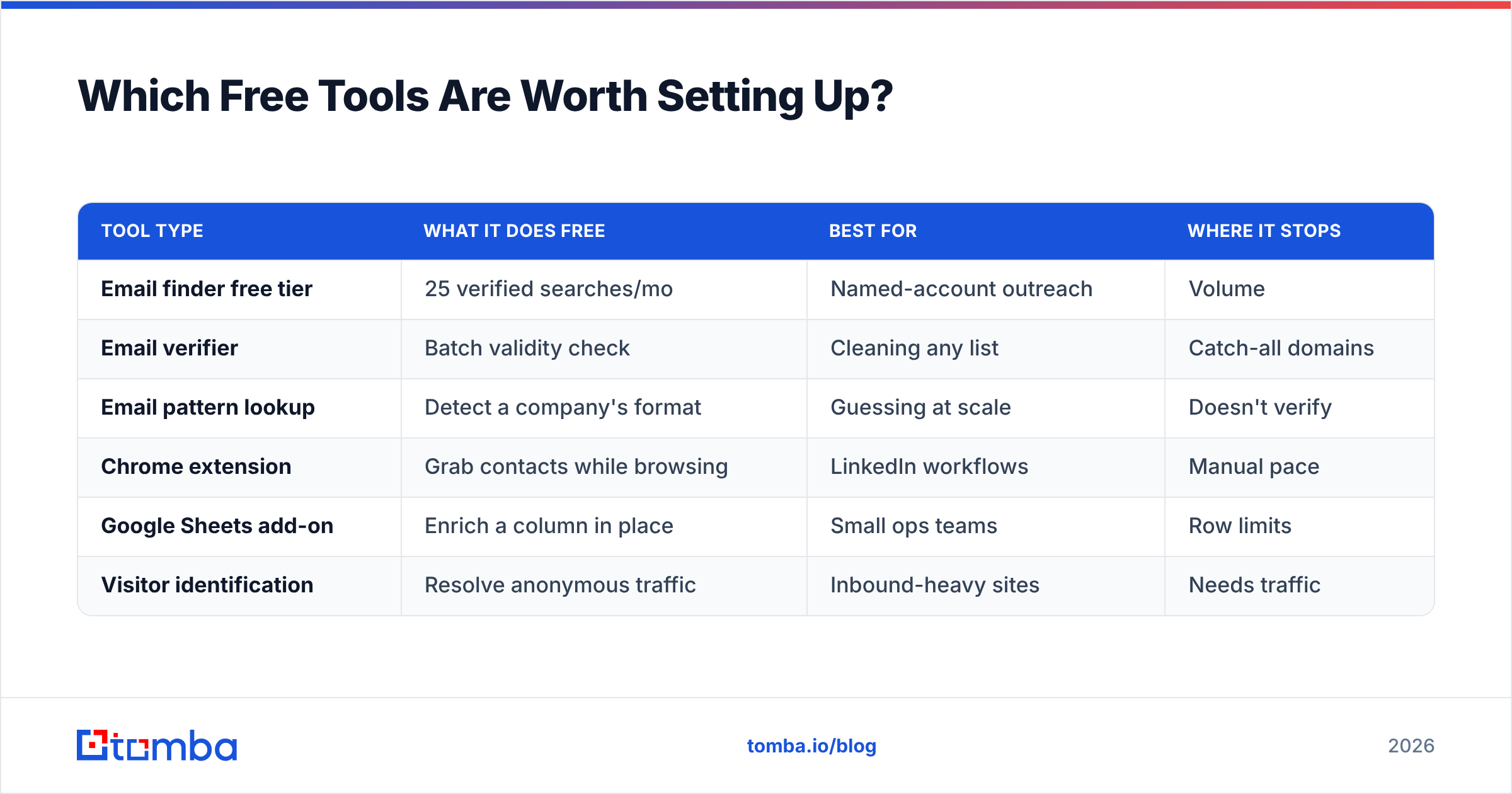
The free tiers worth having in your stack, and what each is actually for:
| Tool type | What it does free | Best for | Where it stops |
|---|---|---|---|
| Email finder free tier | 25 verified searches/mo | Named-account outreach | Volume |
| Email verifier | Batch validity check | Cleaning any list | Catch-all domains |
| Email pattern lookup | Detect a company's format | Guessing at scale | Doesn't verify |
| Chrome extension | Grab contacts while browsing | LinkedIn workflows | Manual pace |
| Google Sheets add-on | Enrich a column in place | Small ops teams | Row limits |
| Visitor identification | Resolve anonymous traffic | Inbound-heavy sites | Needs traffic |
A few of these are genuinely no-cost forever. Tomba's free email checker and email permutator don't require a plan. The permutator generates the likely formats for a name and domain; the checker tells you which one resolves. That pair covers a surprising amount of manual prospecting for zero dollars.
For paid-but-cheap, note the actual entry points. Tomba starts at $49/mo for Starter, $99/mo for Growth, and $249/mo for Pro, with the free tier at 25 searches — see Tomba pricing for current credit allocations. Competitors like BookYourData take a different approach with pay-as-you-go credits and no subscription, which suits teams doing occasional bursts rather than continuous outbound. Neither model is wrong; they solve different cash-flow problems.

How Do You Build a Free Lead System That Doesn't Collapse?#
A workflow you can run this week with no budget:
Step 1 — Define 50 accounts, not 5,000. Pick companies by a signal, not a filter. Recently funded, recently posted a relevant job, recently switched a tool you integrate with. Signal beats volume every time at this scale.
Step 2 — Find the human, not the department. One decision-maker per account. Check that their LinkedIn shows activity in the last 90 days, which confirms they're still in the role.
Step 3 — Derive the email, then verify it. Determine the company's pattern (first.last@, flast@, first@), generate the candidate, and verify it. Do not skip verification because the pattern "looked obvious." Catch-all domains in particular need a catch-all verifier — a standard SMTP check returns "accepted" for every address on those domains, which is not the same as valid.
Step 4 — Log the source. One column in your sheet: where this contact came from and on what date. When you later need to justify legitimate interest under GDPR, or figure out which source is producing replies, this column is the whole answer.
Step 5 — Cap the list, then send. Fifty contacts, one sharply written sequence, three touches. Measure reply rate, not open rate. If your reply rate is under 3% with verified data, the problem is the message — go fix that before you scale the list.
Step 6 — Review the math at week four. Count the hours. If list-building consumed more than 20% of selling time, you've hit the ceiling where paid tooling is cheaper than doing it yourself.
That last step is the one people skip, and it's the one that decides whether "free" was a smart constraint or an expensive habit.
Is Free Lead Generation Legal?#
Mostly yes, with real caveats — and "it was free" is not a defense.
Under GDPR, B2B cold outreach in most EU jurisdictions relies on legitimate interest, which requires that the contact is relevant to their professional role, that you can document your source, and that you provide an easy opt-out. A purchased or scraped list of unknown provenance fails the documentation test immediately.
Under CAN-SPAM (US), cold B2B email is permitted, but you need accurate headers, a real physical address, and a functioning unsubscribe. Consent isn't required; honesty is.
Scraping occupies contested ground. Public profile data has generally survived legal challenge in the US (the hiQ v. LinkedIn line of cases), but platform terms of service still prohibit it, and enforcement is via account bans rather than courts. Reputable data vendors publish where their data comes from precisely because provenance is the compliance question that matters.
The practical standard: if you can't say in one sentence where a contact came from and why they're professionally relevant to your offer, don't email them.
When Should You Stop Chasing Free Leads?#
Four signals, any one of which means you've outgrown it:
- You're spending over 8 hours a week on list-building. At a loaded rate, that's more than $1,500 a month of time to avoid a $49 subscription.
- Your bounce rate crossed 5%. Free-sourced data has degraded past the point where your deliverability survives it. Verify everything or stop.
- You need more than 200 contacts a month. Manual research genuinely doesn't scale there. No amount of discipline fixes the arithmetic.
- You can't attribute replies to sources. If your pipeline is a pile of untracked contacts, you can't improve it — you're guessing, expensively.
Free leads are a great constraint for validating a message and a market. They're a terrible foundation for a revenue target. Use them to learn what works with 50 accounts, then buy the throughput to run that same play on 5,000.
The Bottom Line#
Free leads work when they're few, fresh, and self-sourced. They fail when they're many, stale, and inherited. Almost every horror story about cold email — spam folders, dead domains, 0.2% reply rates — traces back to someone treating a free CSV as if it were a verified database.
Start free: build 50 signal-based accounts by hand, verify every address before you send, and log where each one came from. When the hours stop justifying themselves — and they will, right around the 50-per-week mark — the Tomba Email Finder picks up where manual research runs out, with a free tier of 25 searches a month so you can test the data quality against your hand-built list before spending anything. Compare the bounce rates side by side. That comparison, not a pricing page, is what should decide it.
Related guides#
Ready to find emails that actually work?
Join 150,000+ professionals who stopped guessing and started sending. Free credits on signup — no credit card required.
Get the Tomba newsletter
Practical outbound tactics and product updates — once every two weeks.
About the author