7 Best FreedomVoice Alternatives in 2026 for Small Teams
FreedomVoice was the cheap, dependable virtual phone line for a generation of small businesses. Here are seven alternatives compared on price, porting, mobile apps, and what they actually cost once you add users.
TL;DR
- FreedomVoice was a 1990s-era virtual phone system that GoDaddy acquired in 2017 and folded toward its own SmartLine product. If you are still on a legacy plan, you are on a product nobody is investing in.
- The best drop-in replacement for solo operators and micro-teams is OpenPhone or Grasshopper; growing sales teams should look at Dialpad, RingCentral, or Nextiva.
- Expect to pay $10–$30 per user per month. The cheap end (Google Voice, Phone.com) buys you a number and voicemail; the expensive end buys you routing, analytics, and CRM sync.
- Number porting is the only irreversible part of the migration. Do it last, after the new system is fully configured and tested.
- A new dialer does not fix a bad list. If your outbound is underperforming, the bottleneck is usually contact data quality, not the phone system.
What happened to FreedomVoice?#
FreedomVoice launched in 1996 as one of the first virtual phone systems for small businesses: a toll-free or local number, an auto-attendant, voicemail-to-email, and call forwarding to whatever handset you already owned. No PBX hardware, no per-seat licenses, no IT contractor. For a two-person insurance agency or a solo contractor, that was genuinely revolutionary in 2003.
GoDaddy acquired FreedomVoice in 2017. The technology and team were absorbed into GoDaddy's own communications products — most visibly SmartLine, a second-number app for sole proprietors. Since then, the legacy FreedomVoice product line has received essentially no meaningful feature development, and existing customers have been steered toward GoDaddy's newer offerings. If you are reading this, you have probably received a migration notice, seen your plan quietly change, or just noticed the mobile app feels like it was built for a different decade.
Check your own account notices for the exact status and deadline on your plan — do not take a blog post's word for your billing timeline.
The practical question is not "is FreedomVoice dead?" It is: what do you actually need from a business phone system in 2026, and what is the cheapest way to get it?
What should you look for in a FreedomVoice alternative?#
Most people over-index on price and under-index on the two things that actually cause pain six months later. Score every candidate against these six criteria before you look at a pricing page:
- Number porting support — Can you bring your existing business number, including toll-free? Is porting free, and how long does it take? Some vendors port free in 5–10 business days; others charge $15–$30 per number or refuse toll-free ports entirely.
- Per-user vs per-number pricing — FreedomVoice charged per line with generous minute bundles. Most modern VoIP charges per user. If you have four people sharing one main number, per-user pricing can quadruple your bill overnight.
- Mobile and desktop app quality — This is where legacy providers lose. Read recent app-store reviews, not vendor marketing. A dropped-call-prone app is worse than a landline.
- Routing and auto-attendant depth — Ring groups, business-hours rules, IVR menus, voicemail transcription, shared inboxes. Solo operators need almost none of this; a five-person sales team needs all of it.
- CRM and workflow integrations — Does it log calls into HubSpot, Pipedrive, or Salesforce automatically? Manual call logging is the single biggest silent time-sink in small sales teams.
- Total cost at your real headcount — Take the advertised price, multiply by seats, add number fees, add international minutes, add the annual-vs-monthly delta. That number is what you compare, not the marketing headline.
Sorry — that image should read as a plain embed:
Which FreedomVoice alternatives are worth considering in 2026?#
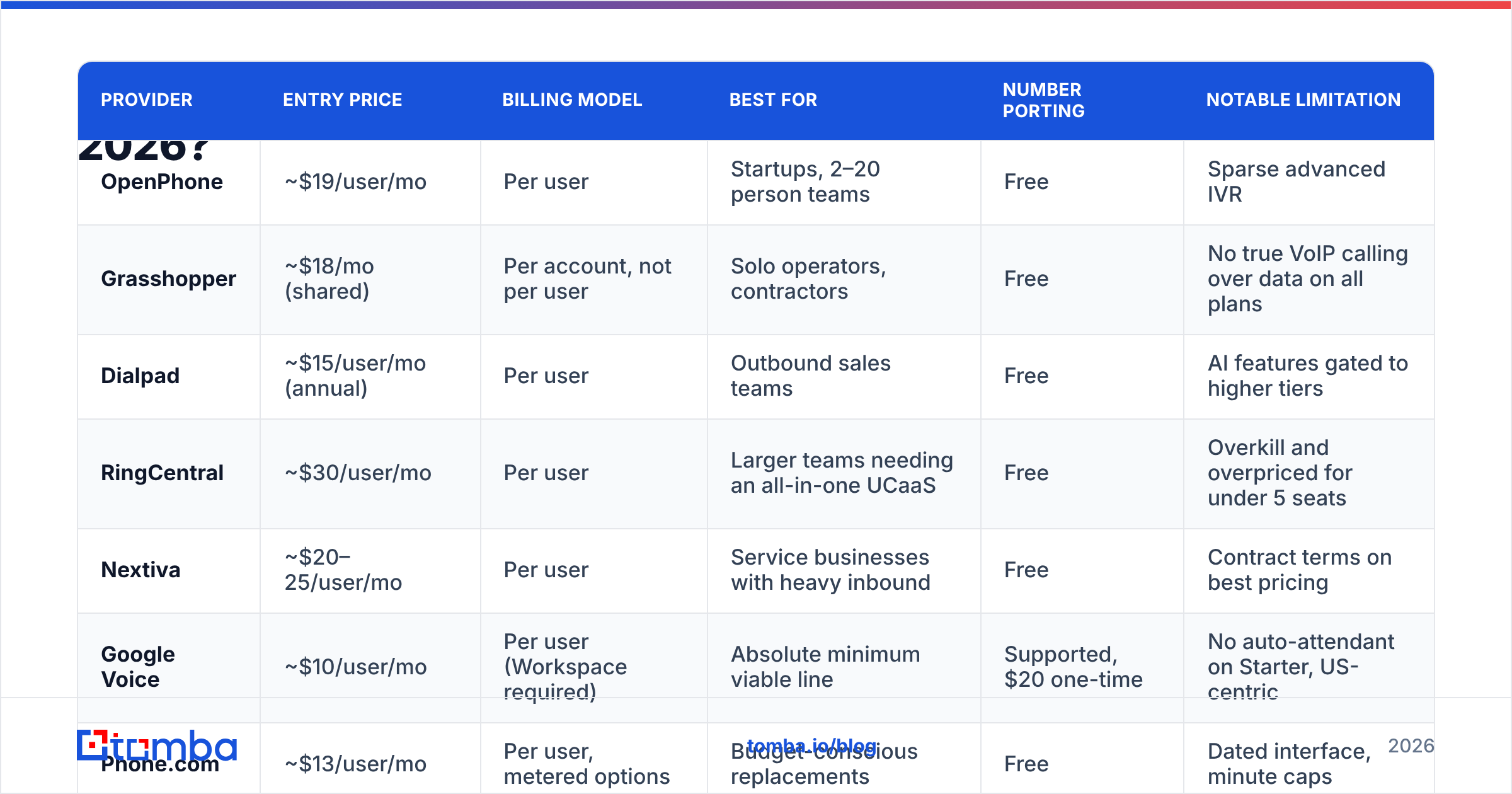
Here is the head-to-head. Prices are entry-tier list prices at the time of writing and change often — always confirm on the vendor's own pricing page before you commit.
| Provider | Entry price | Billing model | Best for | Number porting | Notable limitation |
|---|---|---|---|---|---|
| OpenPhone | ~$19/user/mo | Per user | Startups, 2–20 person teams | Free | Sparse advanced IVR |
| Grasshopper | ~$18/mo (shared) | Per account, not per user | Solo operators, contractors | Free | No true VoIP calling over data on all plans |
| Dialpad | ~$15/user/mo (annual) | Per user | Outbound sales teams | Free | AI features gated to higher tiers |
| RingCentral | ~$30/user/mo | Per user | Larger teams needing an all-in-one UCaaS | Free | Overkill and overpriced for under 5 seats |
| Nextiva | ~$20–25/user/mo | Per user | Service businesses with heavy inbound | Free | Contract terms on best pricing |
| Google Voice | ~$10/user/mo | Per user (Workspace required) | Absolute minimum viable line | Supported, $20 one-time | No auto-attendant on Starter, US-centric |
| Phone.com | ~$13/user/mo | Per user, metered options | Budget-conscious replacements | Free | Dated interface, minute caps |
OpenPhone — the closest thing to a modern FreedomVoice#
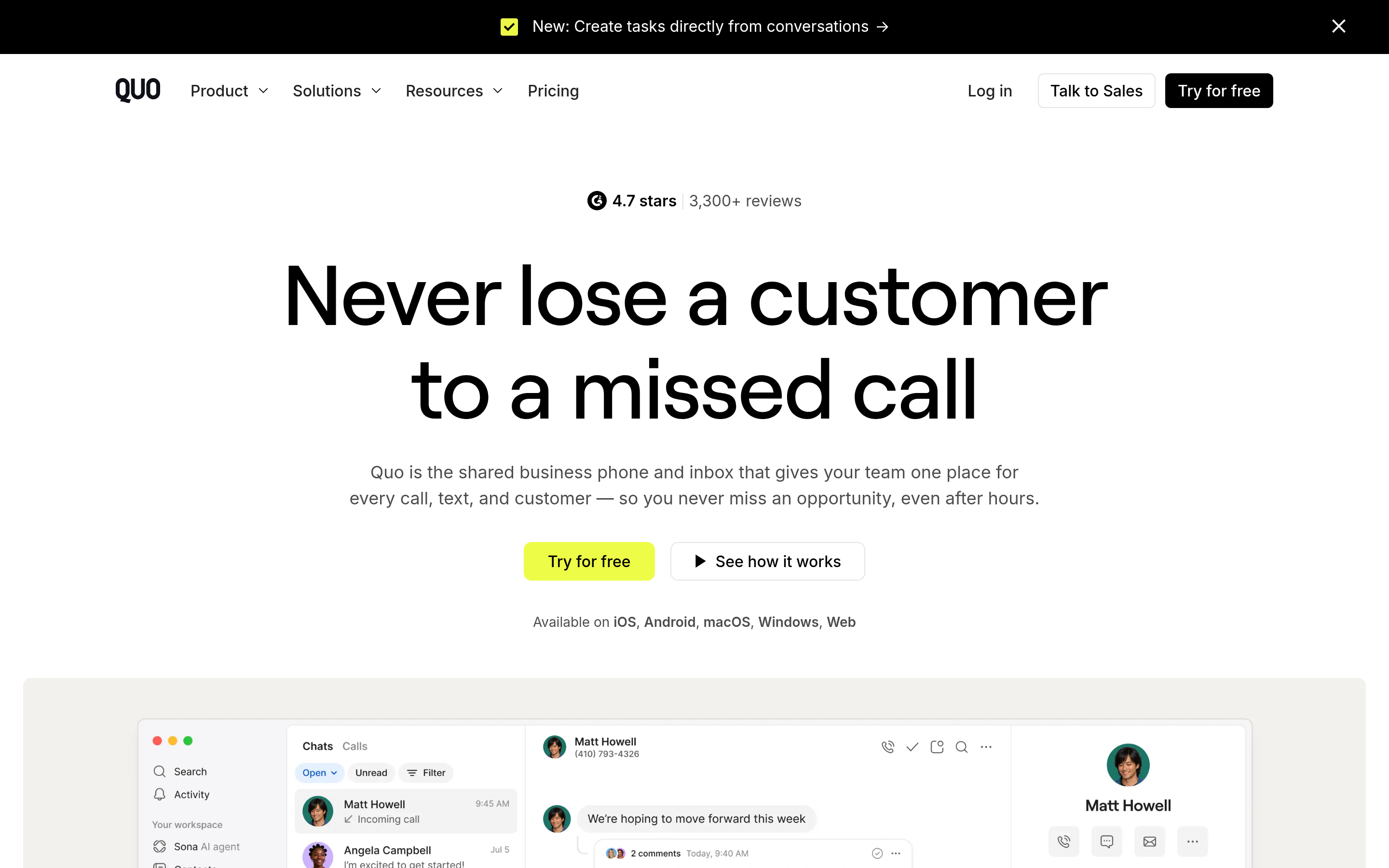
OpenPhone is what most former FreedomVoice users end up on. You get a business number, shared inboxes so a team can collaborate on the same line, SMS, voicemail transcription, and a genuinely good mobile app. The pricing is per user, which stings if you have five people on one shared number, but the shared-number model means you often need fewer seats than you think.
Pick it if: you are 1–20 people, you care about texting customers, and you want something that feels built this decade.
Grasshopper — closest on the billing model#
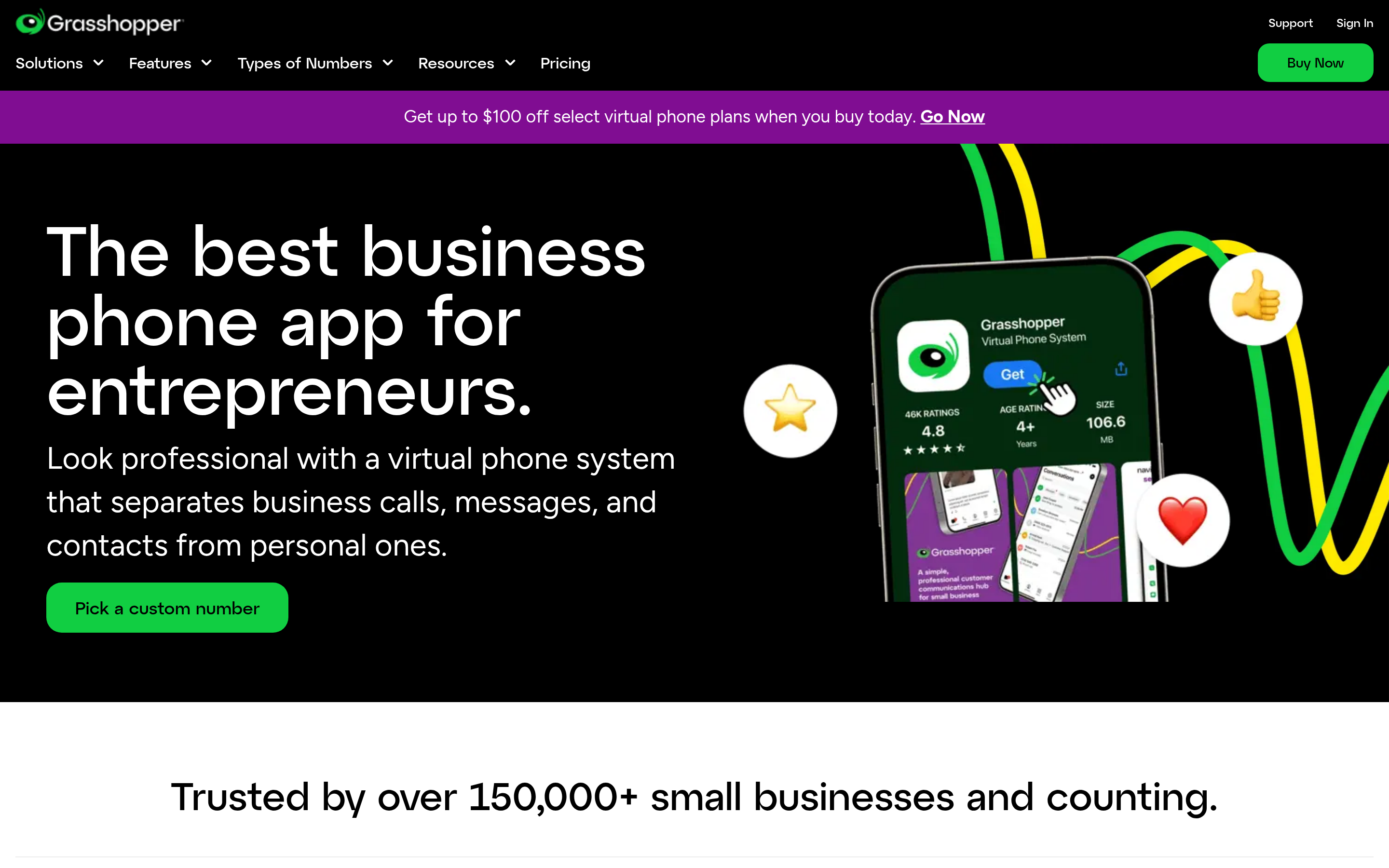
Grasshopper is the only mainstream option that still bills like FreedomVoice did: per account, with a bundle of numbers and extensions, not per user. For a three-person shop sharing one main line, that can be dramatically cheaper than per-seat VoIP. The trade-off is that Grasshopper is essentially a sophisticated forwarding service — calls land on your existing cell plan rather than routing over data on every plan.
Pick it if: headcount would blow up per-seat pricing and you mostly need a professional front door, not a call center.
Dialpad — the outbound sales pick#
Dialpad bundles real-time transcription, call coaching, and AI-generated call summaries into a price point that undercuts RingCentral. For a team making 40+ outbound calls a day, the automatic logging alone justifies the switch. It is the most "sales-native" option on this list.
Pick it if: your phone system is a revenue tool, not just a reception desk.
RingCentral and Nextiva — the enterprise-shaped options#
RingCentral and Nextiva both sell unified communications: phone, video, messaging, contact center, analytics, SLA-backed uptime. They are excellent products and the wrong purchase for a three-person business. At $30/user/month with annual commitments, you are paying for governance and scale you do not have yet.
Pick them if: you have 15+ seats, compliance requirements, or a call volume that justifies a real contact-center layer.
Google Voice and GoDaddy SmartLine — the "is this enough?" tier#
Both are cheap, both are fine, both are deliberately limited. Google Voice's Starter tier gives you a number, voicemail, and forwarding inside Google Workspace, but no auto-attendant or ring groups. SmartLine is a second number on your existing phone — great for a solo consultant, useless for a team.
Pick them if: you were using FreedomVoice as a glorified voicemail box and honestly nothing more.
How do you migrate off FreedomVoice without losing your number?#
Porting is the one step you cannot undo casually. Run it in this order:
- Sign up for the new provider first and get a temporary number. Do not cancel anything yet.
- Rebuild your routing on the new system — greetings, business hours, extensions, voicemail boxes — and test it end to end from an outside phone.
- Pull your port-out details from FreedomVoice/GoDaddy: account number, PIN, and the service address exactly as it appears on the bill. Mismatched addresses are the number one cause of port rejections.
- Submit the port request through the new provider. Expect 5–10 business days for local numbers, sometimes longer for toll-free.
- Keep the old account active until the port completes. Cancelling first releases the number and you may lose it permanently.
- Update everything downstream — Google Business Profile, email signatures, website, invoices, CRM records, and any contact enrichment fields where your outbound number is stored.
One underrated detail: after you port, spot-check that your new outbound caller ID is registered correctly. Unregistered or mismatched caller ID is a fast route to being flagged as spam-likely by carriers, and it will quietly tank your connect rate before you notice anything is wrong.
Does switching phone systems actually improve your outbound results?#
Almost never on its own — and this is where most "we upgraded our stack" projects disappoint.
A phone system controls how a call is placed, routed, recorded, and logged. It has zero influence over whether the number you dialed belongs to the right person at the right company. If your team is burning an hour a day on disconnected lines, wrong departments, and gatekeepers who have never heard of the contact, the dialer is not your problem. The list is.
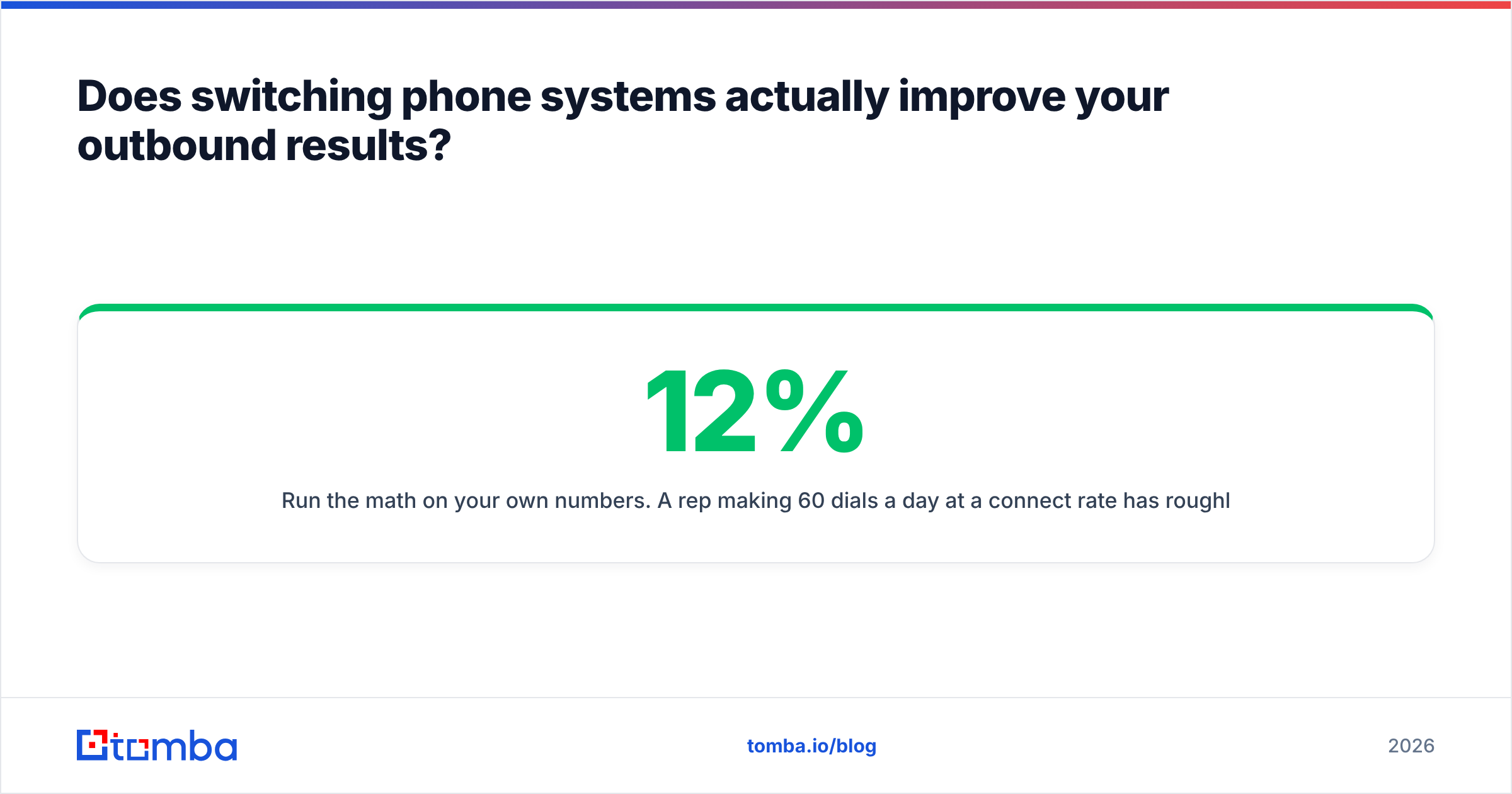
Run the math on your own numbers. A rep making 60 dials a day at a 12% connect rate has roughly seven conversations. Push the connect rate to 20% by cleaning the data — removing dead lines, correcting direct dials, dropping records where the contact has changed jobs — and the same 60 dials produce twelve conversations. That is a 70% increase in pipeline conversations with no change in effort, no new software seats, and no migration project.
Practical order of operations:
- Validate before you dial. Run your list through a phone validator to strip out disconnected, invalid, and mistyped numbers. Dialing dead numbers costs time and degrades your caller reputation.
- Fill the gaps. Where you have a company and a name but no number, a phone finder closes the loop far faster than a rep manually hunting through a website's contact page.
- Pair phone with email. Multi-channel sequences consistently outperform phone-only ones. A verified email beside every direct dial gives your reps a second touch that costs seconds instead of minutes.
Independent review platforms like G2 are useful for comparing VoIP vendors on support responsiveness and uptime — the two things vendor marketing pages never disclose honestly. Read the two- and three-star reviews specifically; five-star reviews tell you what the product does, mid-tier reviews tell you what it does badly.
Which alternative should you actually choose?#
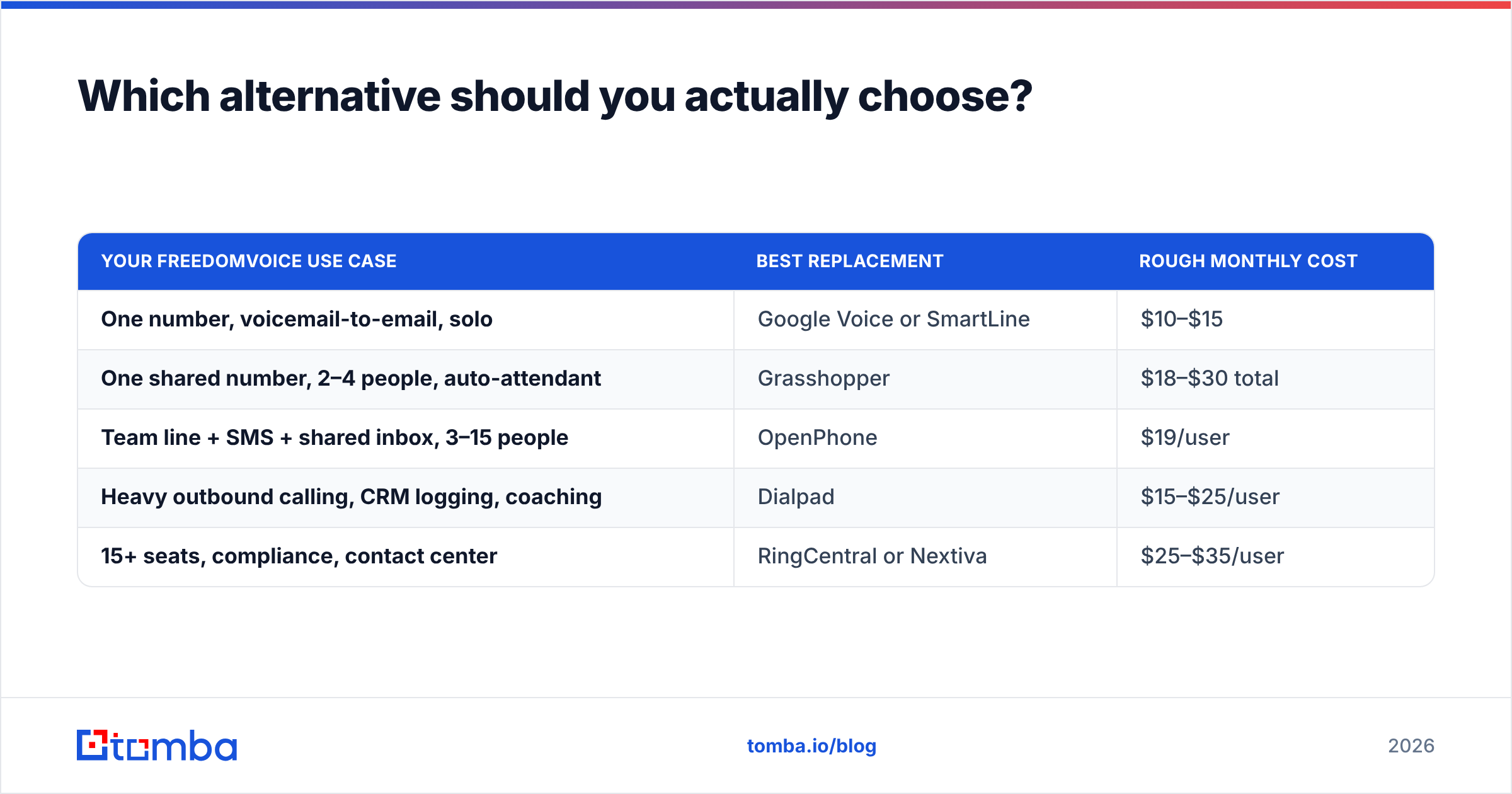
Short version, mapped to how you were using FreedomVoice:
| Your FreedomVoice use case | Best replacement | Rough monthly cost |
|---|---|---|
| One number, voicemail-to-email, solo | Google Voice or SmartLine | $10–$15 |
| One shared number, 2–4 people, auto-attendant | Grasshopper | $18–$30 total |
| Team line + SMS + shared inbox, 3–15 people | OpenPhone | $19/user |
| Heavy outbound calling, CRM logging, coaching | Dialpad | $15–$25/user |
| 15+ seats, compliance, contact center | RingCentral or Nextiva | $25–$35/user |
If you cannot decide between two, choose the one with the better mobile app. Feature checklists converge over time; app quality rarely does.
Ready to make those new lines produce conversations?#
Swapping FreedomVoice for OpenPhone, Dialpad, or Grasshopper fixes your infrastructure. It does not fill your call list. Before your reps dial the first number on the new system, make sure the contacts behind those numbers are real, current, and reachable on more than one channel.
Start with the Tomba Email Finder to attach a verified email address to every prospect record you plan to call, so a missed dial turns into a follow-up instead of a dead end. The free tier includes 25 searches a month, and paid plans start at $49/mo on Starter, $99/mo on Growth, and $249/mo on Pro — full Tomba pricing is public, with no seat minimums or annual lock-in. Clean data first, then let the new phone system do its job.
Related guides#
Ready to find emails that actually work?
Join 150,000+ professionals who stopped guessing and started sending. Free credits on signup — no credit card required.
Get the Tomba newsletter
Practical outbound tactics and product updates — once every two weeks.
About the author