FullCircl vs Warpleads: Which B2B Data Tool Wins in 2026?
One is a regulated-market company intelligence platform with annual contracts. The other is a self-serve bulk lead exporter. Here is how FullCircl and Warpleads actually compare on data, pricing, and fit — plus when neither is the right buy.
FullCircl vs Warpleads is a shortlist that comes up a lot. The two tools do different jobs, and that is most of the answer. Here is the short version.
TL;DR
- FullCircl and Warpleads are not really competitors. FullCircl sells company intelligence and onboarding/KYB workflow to regulated industries. Warpleads sells bulk B2B lead exports to outbound teams.
- Pick FullCircl if your buying committee includes compliance or credit risk. It also fits a UK/Ireland-heavy account strategy that needs filings-grade firmographics inside Salesforce or Dynamics.
- Pick Warpleads if you run cold email at volume and your bottleneck is "we need 20,000 contacts in a CSV by Friday."
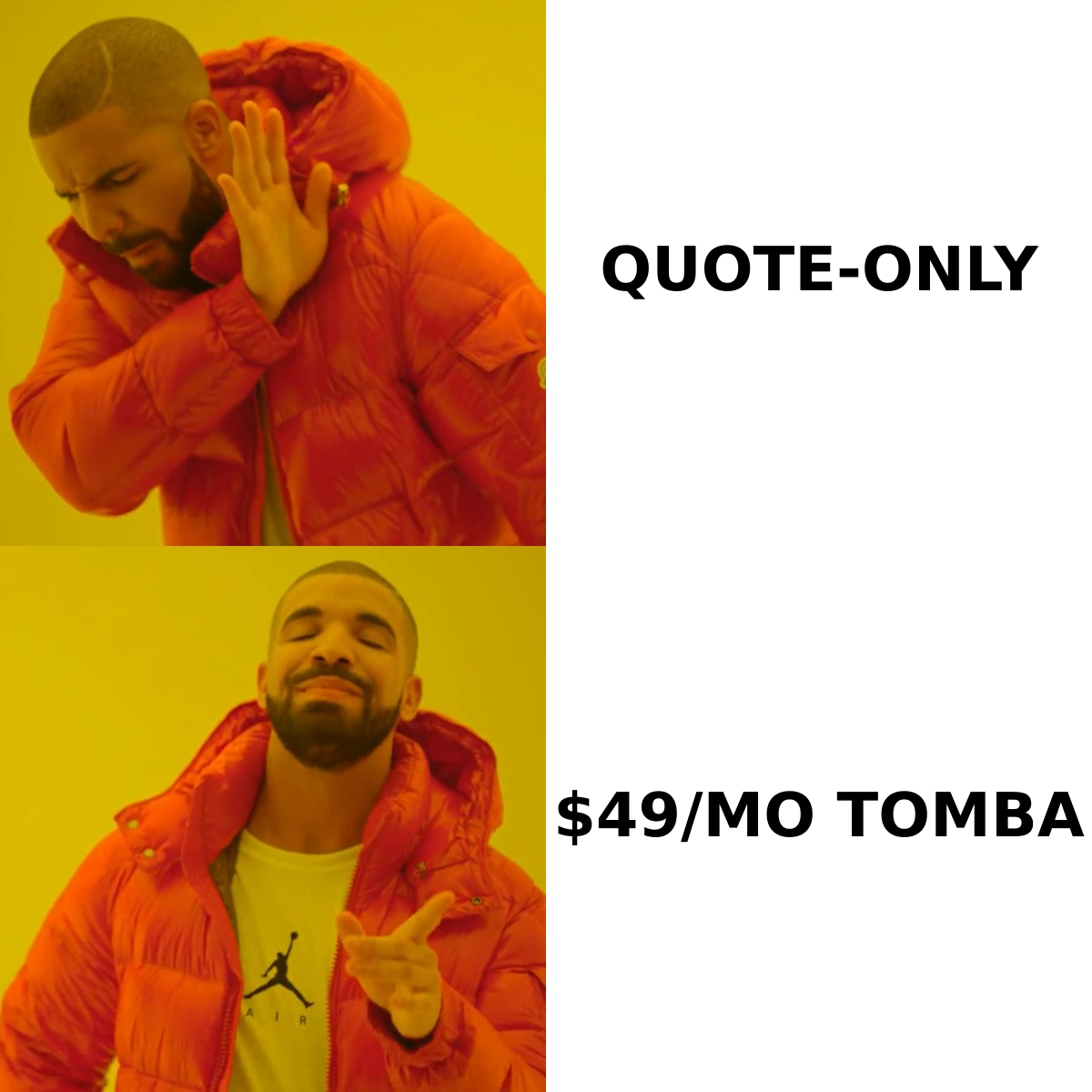
- FullCircl is quote-only and annual. Warpleads is self-serve and monthly. That one difference decides the deal for most teams before any feature comparison starts.
- Neither is a precision contact-finder. If you already know the accounts and just need verified work emails, a dedicated email finder at $49/mo does that job cheaper than either platform.
What are FullCircl and Warpleads, exactly?#
They solve different problems. Both get filed under "B2B data," which is why buyers keep putting them on the same shortlist.
FullCircl is a UK-based customer lifecycle intelligence platform. It came out of the merger of Artesian Solutions and DueDil, and was later bought by banking-software vendor nCino. Its center of gravity is regulated business: banking, insurance, commercial finance, and B2B services that have to know who they are onboarding.
The platform combines company registry data, financials, credit signals, corporate structures, and news-based triggers. That data lands in the CRM, so relationship managers see risk and opportunity in one view. You can read the vendor's own positioning at fullcircl.com.
Warpleads is a much younger, much narrower product. It is a B2B lead database built around export volume. The pitch is high-volume exports of contact records (name, title, company, email) for cold outreach, plus on-demand list building when the database does not cover a niche.
It is self-serve, monthly, and aimed at agencies and outbound teams who burn through lists. See warpleads.com for the current tier structure.
One is a system of intelligence. The other is a list vendor. Both are real categories. They just answer different questions.
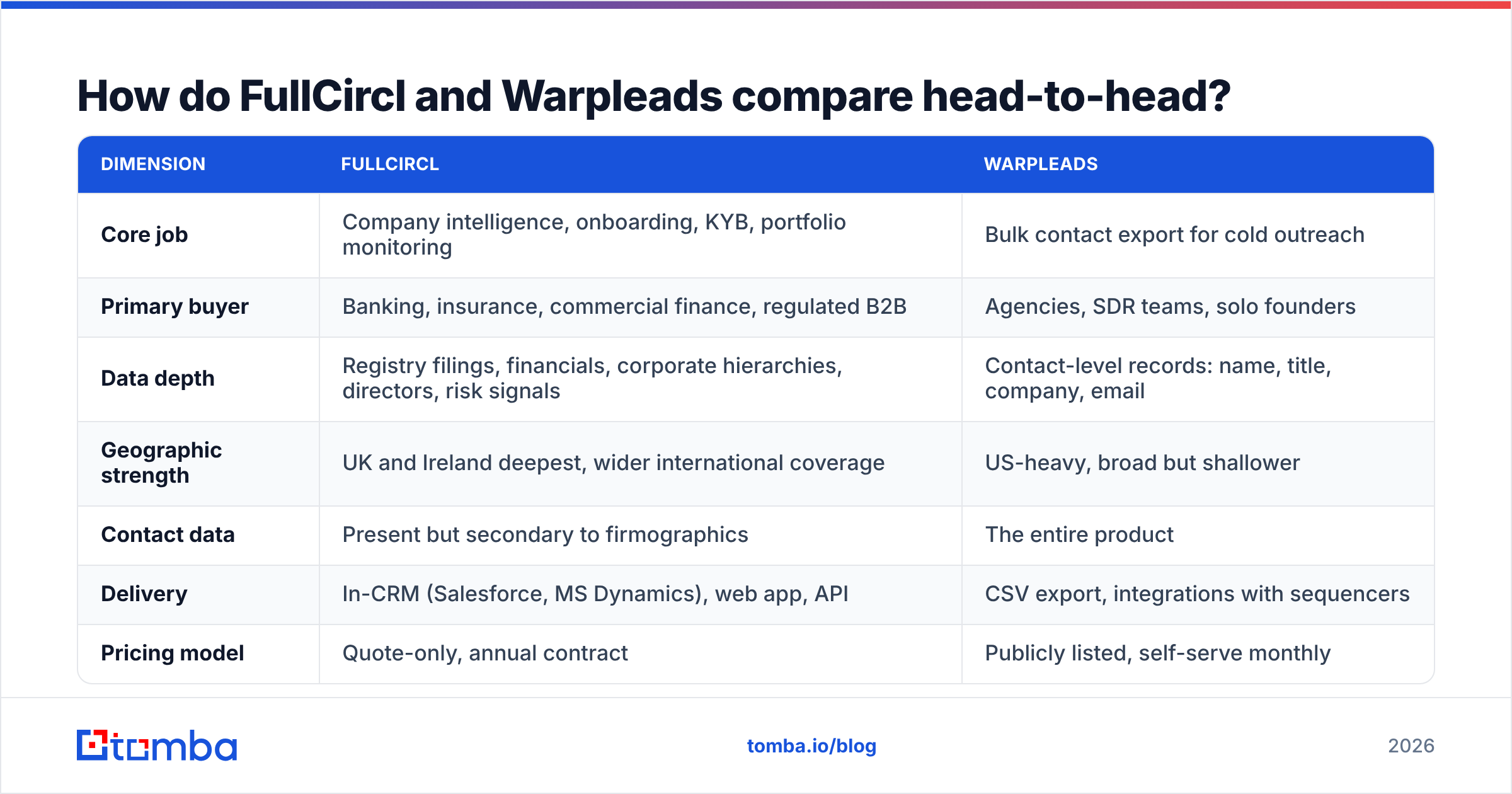
FullCircl vs Warpleads: how do they compare head-to-head?#
| Dimension | FullCircl | Warpleads |
|---|---|---|
| Core job | Company intelligence, onboarding, KYB, portfolio monitoring | Bulk contact export for cold outreach |
| Primary buyer | Banking, insurance, commercial finance, regulated B2B | Agencies, SDR teams, solo founders |
| Data depth | Registry filings, financials, corporate hierarchies, directors, risk signals | Contact-level records: name, title, company, email |
| Geographic strength | UK and Ireland deepest, wider international coverage | US-heavy, broad but shallower |
| Contact data | Present but secondary to firmographics | The entire product |
| Delivery | In-CRM (Salesforce, MS Dynamics), web app, API | CSV export, integrations with sequencers |
| Pricing model | Quote-only, annual contract | Publicly listed, self-serve monthly |
| Time to first value | Weeks (procurement, implementation) | Same day |
| Trigger/intent data | Yes — news, filings, and event-based alerts | No |
| Compliance posture | Built for KYB and regulated onboarding | Standard list-vendor posture |
The pattern is clear once it sits on one grid. FullCircl is a platform purchase with an implementation. Warpleads is a utility purchase with a credit card.
If your evaluation committee is stuck between the two, one of two things is true. Either the problem is not defined yet, or two teams with different problems are sharing a shortlist.
What does FullCircl actually do well?#
- Filings-grade UK and Ireland data. The DueDil lineage shows. If you underwrite, onboard, or prospect UK limited companies, the depth of registry data, group structures, and director histories is hard to match with a general prospecting database.
- Risk and revenue in one record. Most sales-intelligence tools ignore credit and compliance. FullCircl was built for teams where "should we sell to them" and "are we allowed to onboard them" are the same conversation.
- CRM-native delivery. The value shows up where reps already work, not in a separate tab. Relationship managers get alerts on their book of business without learning a new tool. That single factor predicts whether a data tool survives its first renewal.
- Event triggers that are actually events. Filing changes, director appointments, funding, adverse news. These are structural signals, not the "visited your pricing page" guesswork that most platforms resell.
- Portfolio monitoring, not just acquisition. Existing customers get re-screened as their filings change. That is where regulated firms get most of the ROI.
The catch is simple. Every one of those strengths costs money and time. This is a platform you implement, not a tool you try.
What does Warpleads actually do well?#
- Export volume without credit anxiety. The core promise is that you stop rationing exports. For an agency running ten client campaigns, per-credit pricing taxes every experiment. Flat-rate export removes that tax.
- Speed to first list. Sign up, filter, export, load into your sequencer. No onboarding call stands between you and a campaign.
- On-demand list building for gaps. When the database misses a niche vertical or geography, sourcing a custom list is part of the offer rather than an upsell to another product line.
- Price transparency. Tiers are published. You can model your cost per campaign before you talk to anyone, which is more than most of the category allows.
The catch is just as clear. Volume products optimize for volume. Bulk B2B databases decay like every static dataset: roughly 2 to 2.5 percent of B2B contact records go stale each month as people change jobs.
So a list that was 92 percent accurate at export is meaningfully worse ninety days later. No vendor's marketing page accounts for that.
Where does each tool fall short?#
FullCircl's weak points:
- No public pricing, and annual commitments. A five-person startup is not the customer.
- Contact-level email coverage is not the product's strength. You still need a way to turn "right company, right decision-maker" into "here is their verified work email."
- Outside the UK and Ireland, the depth advantage narrows against generalist providers.
- Implementation overhead. CRM-native means CRM configuration, which means an admin, which means time.
Warpleads' weak points:
- Thin firmographics. You get contacts, not corporate structures, financials, or risk signals.
- No trigger or event data, so timing is entirely your problem.
- Verification quality is the whole ballgame with a volume product. Test it on your own ICP instead of trusting a headline accuracy number. Run a sample through an independent email verifier before you commit budget. If bounce risk on a 1,000-row sample tops 3 to 4 percent, your domain reputation pays for it long before your pipeline does.
- Compliance and data-provenance documentation are lighter than what a regulated buyer will require.
How do the pricing models compare?#
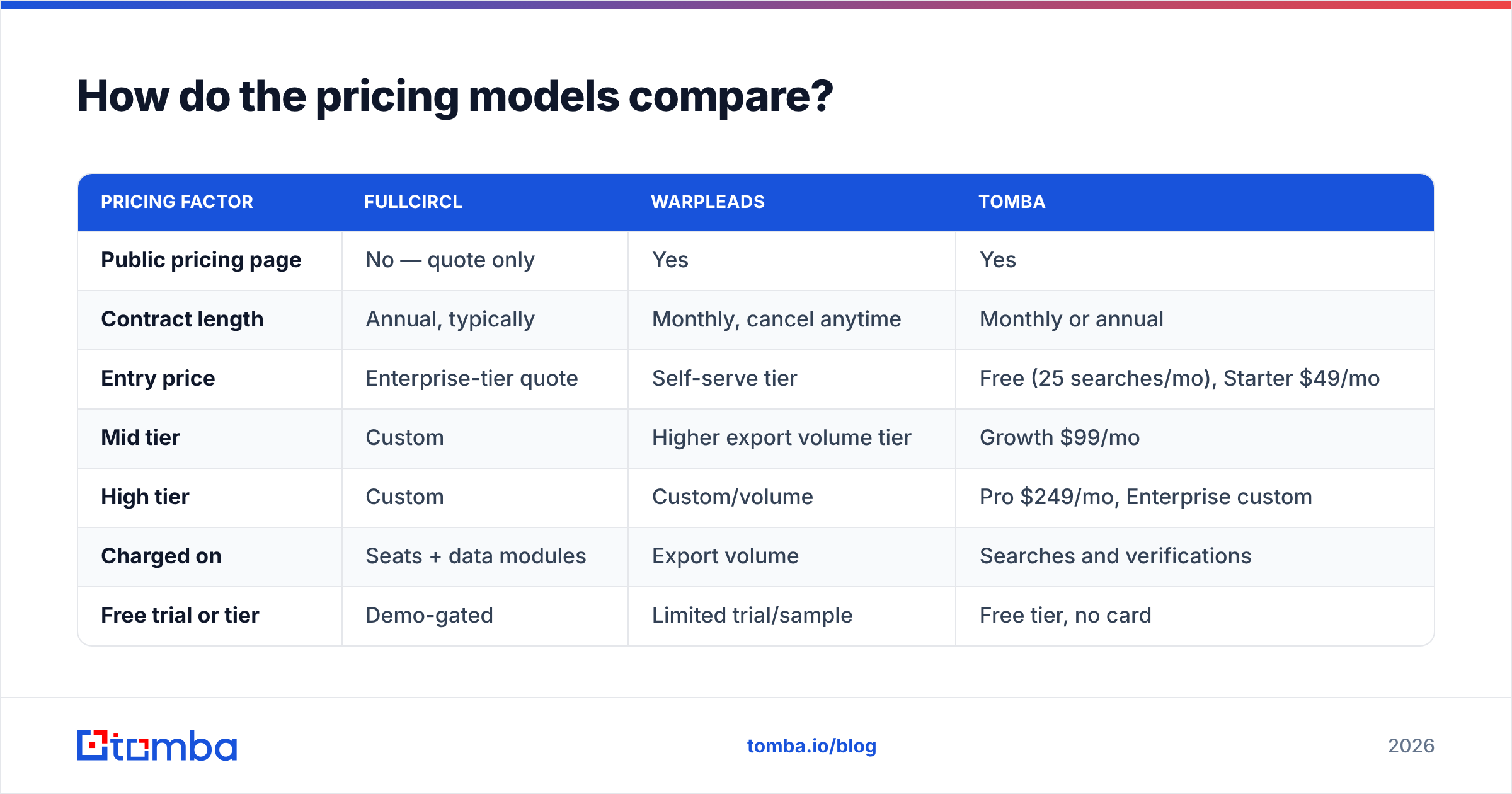
| Pricing factor | FullCircl | Warpleads | Tomba |
|---|---|---|---|
| Public pricing page | No — quote only | Yes | Yes |
| Contract length | Annual, typically | Monthly, cancel anytime | Monthly or annual |
| Entry price | Enterprise-tier quote | Self-serve tier | Free (25 searches/mo), Starter $49/mo |
| Mid tier | Custom | Higher export volume tier | Growth $99/mo |
| High tier | Custom | Custom/volume | Pro $249/mo, Enterprise custom |
| Charged on | Seats + data modules | Export volume | Searches and verifications |
| Free trial or tier | Demo-gated | Limited trial/sample | Free tier, no card |
Two practical notes. First, quote-only pricing is not a red flag by itself. It is normal for platforms sold into compliance functions. It does mean a three-to-eight week evaluation cycle you should budget for.
Second, "unlimited exports" is only unlimited in rows. It is never unlimited in usable rows. Deliverability, not export capacity, is the real limit on outbound volume. Compare against Tomba pricing if you want a per-verified-contact benchmark to hold both vendors against.
Which one should you pick for your use case?#
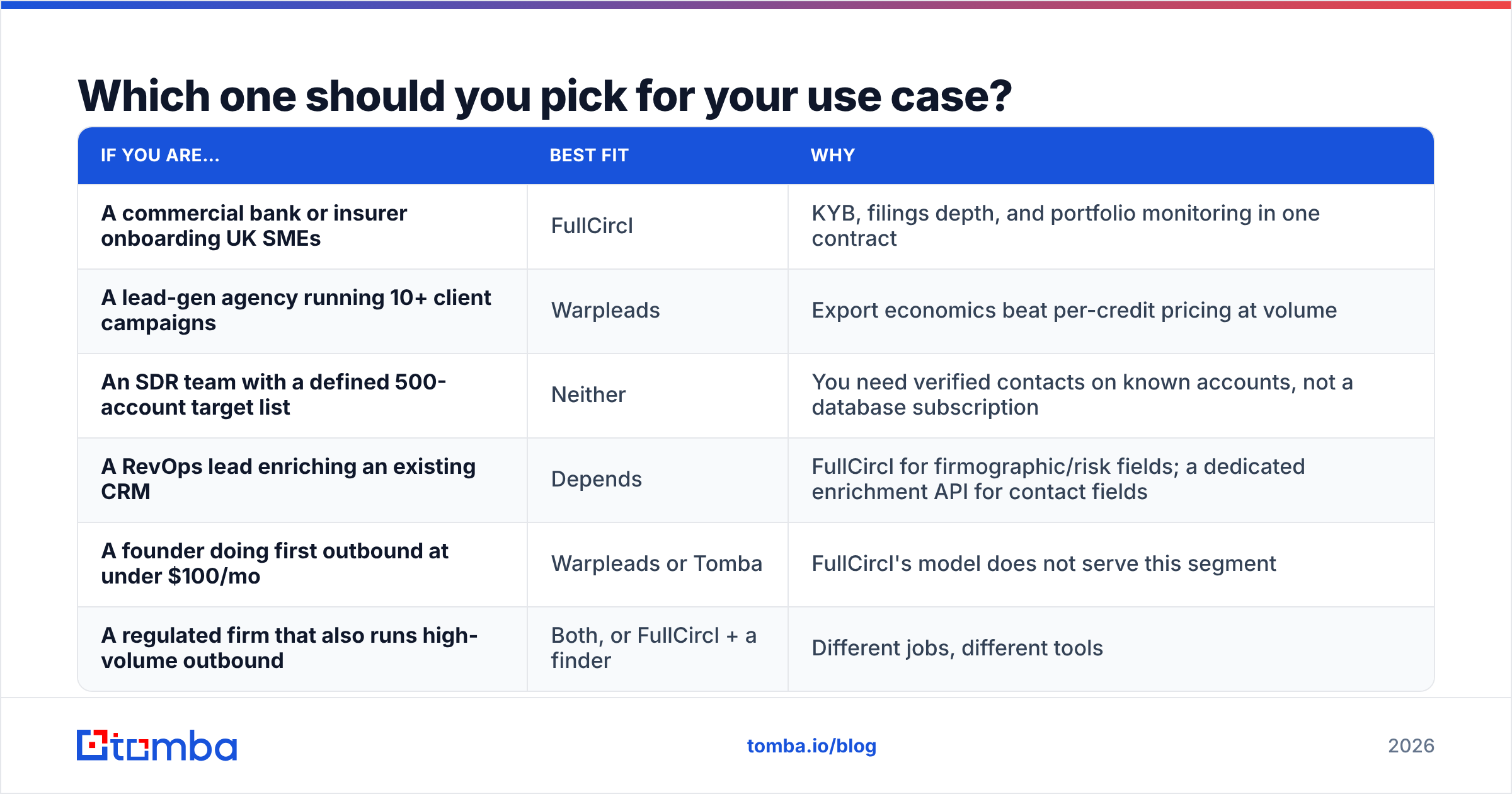
| If you are… | Best fit | Why |
|---|---|---|
| A commercial bank or insurer onboarding UK SMEs | FullCircl | KYB, filings depth, and portfolio monitoring in one contract |
| A lead-gen agency running 10+ client campaigns | Warpleads | Export economics beat per-credit pricing at volume |
| An SDR team with a defined 500-account target list | Neither | You need verified contacts on known accounts, not a database subscription |
| A RevOps lead enriching an existing CRM | Depends | FullCircl for firmographic/risk fields; a dedicated enrichment API for contact fields |
| A founder doing first outbound at under $100/mo | Warpleads or Tomba | FullCircl's model does not serve this segment |
| A regulated firm that also runs high-volume outbound | Both, or FullCircl + a finder | Different jobs, different tools |
That third row is the one most buyers land on and misread. If you already know which companies you want, buying a database means buying a haystack to find needles you have already spotted.
The cheaper path is account-level lookup. Run domain search against your target list to surface the people and email patterns at each company, then verify before you send.
Is there a third option worth evaluating?#
Yes. And it is worth being honest about what it does and does not replace.
Tomba is not a substitute for FullCircl. It does not do KYB, credit risk, corporate structures, or portfolio monitoring. If your compliance team is in the room, Tomba is not the answer to their question.
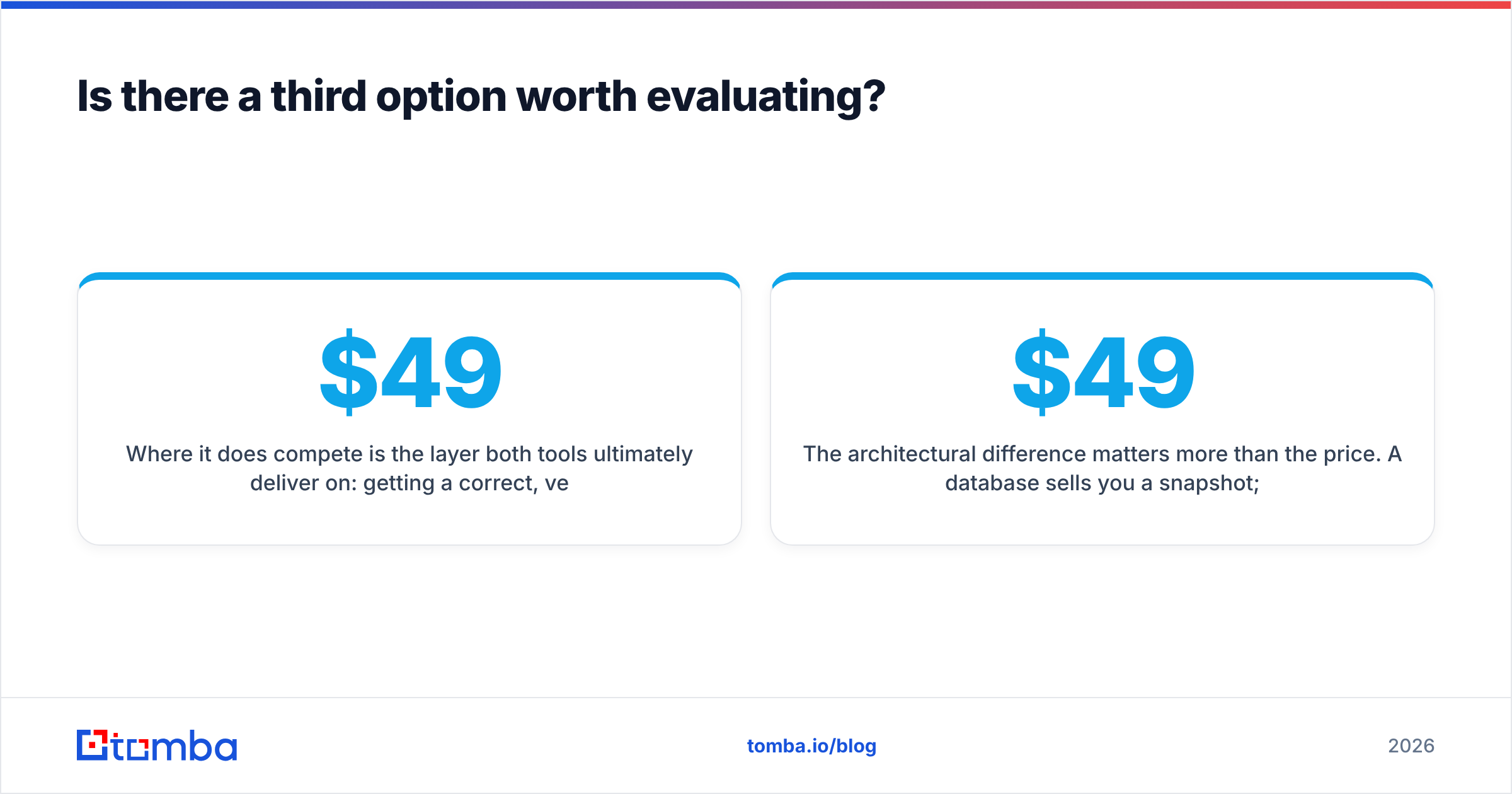
Where it does compete is the layer both tools ultimately deliver on: a correct, verified, deliverable work email for a named person at a named company. Tomba's finder works from a domain, a name, or a company. Verification is built into the same workflow instead of sold as a separate subscription.
The free tier gives you 25 searches a month. Starter is $49/mo, Growth is $99/mo, and Pro is $249/mo. No demo call required to find out.
The design difference matters more than the price. A database sells you a snapshot. An API resolves the answer at request time. If you enrich through the Tomba API the moment a lead enters your CRM, you never inherit the decay that turns a 90-day-old CSV into a deliverability liability.
For teams already committed to FullCircl for intelligence, a finder API is a $49–$99 line item. It closes the contact-data gap without reopening the platform contract.
If you want a sanity check on vendor claims, review aggregators like G2's sales intelligence category are a reasonable place to look. That includes the claims made here.
How should you run the evaluation?#
Do not compare feature lists. Compare outcomes on your own data.
- Build a 200-row control list from your real ICP. Use companies you actually want to sell to, not the vendor's demo segment.
- Ask each vendor to match it. Coverage rate on your list is the only number that matters. Vendors quote database size. You should measure hit rate.
- Verify independently. Take 100 emails from each result set and run them through a neutral verifier. Count hard bounces, catch-alls, and unknowns separately. Catch-all domains are not failures, but they are not wins either.
- Score the fields you actually use. If your sequence personalizes on headcount and funding, missing revenue data does not matter. If underwriting needs filings, contact coverage does not matter.
- Price the total. Add the platform fee to the tools you will still need. Most FullCircl buyers still buy a finder. Most Warpleads buyers still buy verification. Model the real stack, not the line item.
- Time-box it. Two weeks for the self-serve option, six for the enterprise one. If a vendor cannot get you a test dataset in that window, that tells you about the relationship, not just the product.
Teams that run this process rarely end up in a real FullCircl vs Warpleads decision. They realize they need intelligence and contact data. So they buy the intelligence platform their industry requires, plus the cheapest reliable finder they can get.
The bottom line#
FullCircl wins when compliance, credit, and UK/Ireland account depth are non-negotiable, and you have the budget and the runway to match. Warpleads wins when your constraint is list volume and your buying process is a credit card.
If you put them side by side and neither feels right, that is the correct signal. You probably have a contact-data problem, not a platform problem.
Start there before you sign anything. Run your target account list through the Tomba Email Finder on the free tier: 25 searches, no card. See how many verified decision-maker emails you get without a database subscription at all. If the hit rate covers your pipeline needs, you just saved an annual contract. If it does not, you now know exactly which gap you are paying a platform to fill.
Related guides#
Ready to find emails that actually work?
Join 150,000+ professionals who stopped guessing and started sending. Free credits on signup — no credit card required.
Get the Tomba newsletter
Practical outbound tactics and product updates — once every two weeks.
About the author