Gamalogic vs Warpleads: Which B2B Email Tool Wins in 2026?
Gamalogic sells verified email lookups by the credit. Warpleads sells lead exports by the bucket. They solve different problems — here is which one actually fits your outbound motion in 2026.
Gamalogic vs Warpleads is not really a feature fight. It is a category choice. One tool finds and verifies a single address. The other hands you thousands of rows at once. Pick the wrong one and you pay for it — in wasted credits, or in bounces.
TL;DR
- They are not the same category. Gamalogic is a precision email finder and verifier you query one contact or one domain at a time. Warpleads is a bulk B2B lead database built around large exports.
- Pick Gamalogic when you already know who you want to reach and need a deliverable address for that person. It also fits when you need a verification API inside your own stack.
- Pick Warpleads when you need volume fast — thousands of rows filtered by industry, title, and geography — and you accept that you will verify and prune the list yourself.
Two more things worth knowing before you buy:
- Bulk exports hide the real cost. A 10,000-row export at 70% deliverability is worth less than 3,000 rows at 97%, because bounces damage your sender reputation, not just your open rate.
- The practical setup for most teams is a sourcing layer plus a verification layer. Tomba covers both in one account — email finder, email verifier, and bulk email finder — starting at $49/mo with a free tier of 25 searches.
What are Gamalogic and Warpleads?#
Gamalogic positions itself as an email finder and email verification service. You give it a name and a company domain, or just a domain, and it returns candidate addresses with a validity signal. It also exposes an API. That is the part most engineering-adjacent teams care about: you can drop lookups into a CRM enrichment job or a signup-form check without a human touching a spreadsheet.
Warpleads comes at outbound from the opposite direction. It is a lead database with filtering — industry, job title, company size, location — and its headline pitch is export volume. Instead of paying per lookup, you pay for access and pull large lists. The mental model is closer to a data warehouse you shop in than a lookup tool you query.
That distinction matters more than any feature checkbox. One tool answers "what is this person's email?" The other answers "who are 5,000 people who look like my ICP?" Teams that mix up the two pay credit prices for volume work. Or they blast an unverified export and wonder why their domain got throttled.
Gamalogic vs Warpleads: how do they compare at a glance?#
Here is the honest side-by-side. Pricing and limits change often on both platforms. Treat the numbers as a shape rather than a quote, and check each vendor's page before you buy.
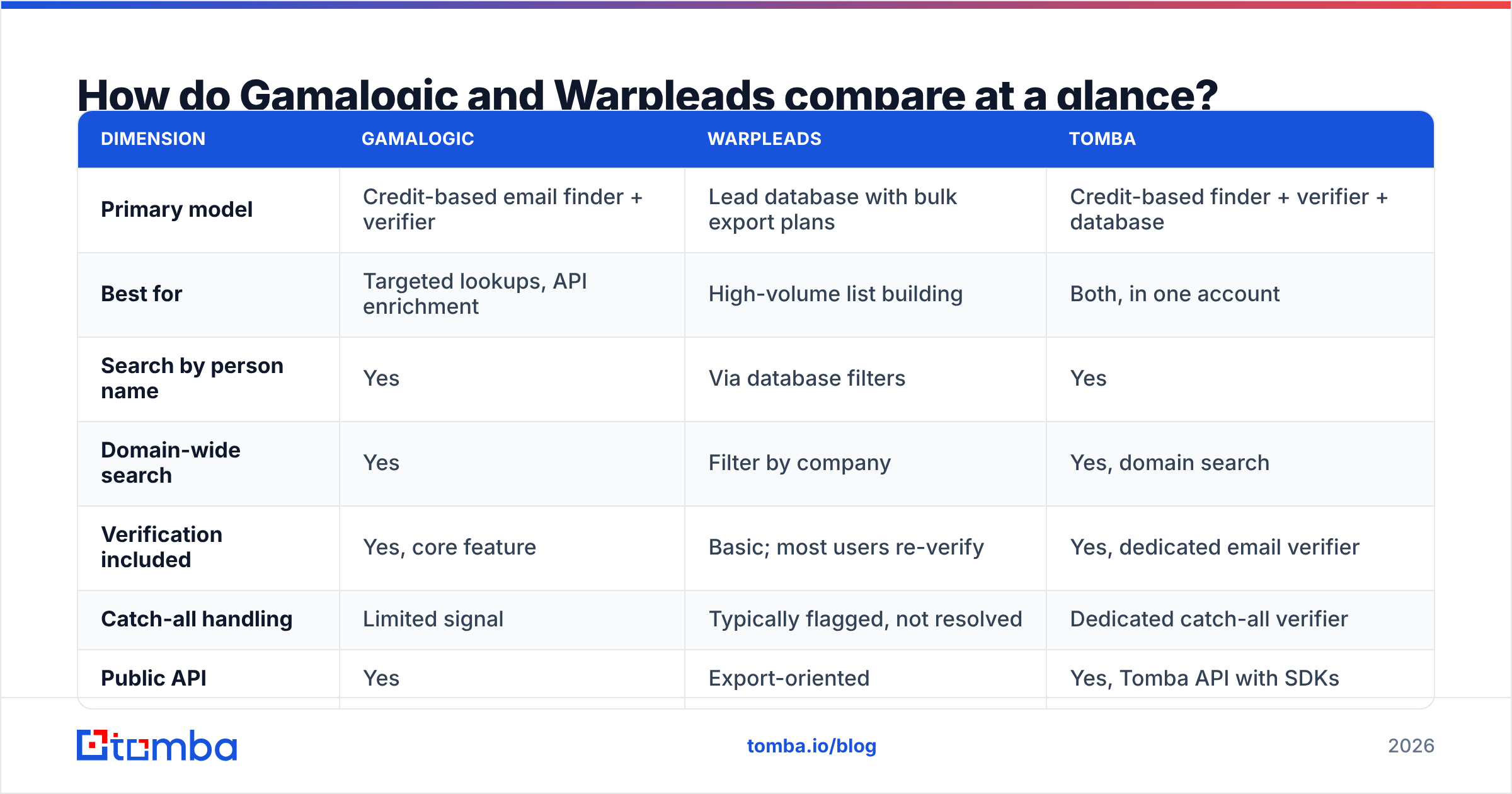
| Dimension | Gamalogic | Warpleads | Tomba |
|---|---|---|---|
| Primary model | Credit-based email finder + verifier | Lead database with bulk export plans | Credit-based finder + verifier + database |
| Best for | Targeted lookups, API enrichment | High-volume list building | Both, in one account |
| Search by person name | Yes | Via database filters | Yes |
| Domain-wide search | Yes | Filter by company | Yes, domain search |
| Verification included | Yes, core feature | Basic; most users re-verify | Yes, dedicated email verifier |
| Catch-all handling | Limited signal | Typically flagged, not resolved | Dedicated catch-all verifier |
| Public API | Yes | Export-oriented | Yes, Tomba API with SDKs |
| Free tier | Trial credits | Trial/limited export | 25 searches/mo, no card |
| Entry paid tier | Low-cost credit packs | Export-tier subscription | $49/mo Starter |
| Spreadsheet workflow | CSV upload | Native CSV export | Google Sheets, Excel, Airtable |

The table exposes the real trade. Gamalogic optimizes for precision per record. Warpleads optimizes for records per dollar. Neither is wrong. They are answers to different questions, and the wrong answer is expensive in a way that never shows up on the invoice.
What is Gamalogic actually good at?#
Single-contact precision. Sometimes your list is already built — from a conference page, a funding announcement, a podcast guest roster. Then you do not need a database. You need one address per name, and you need to know whether it will bounce. That is Gamalogic's native shape.
API-first enrichment. If you are enriching inbound signups or backfilling a CRM, an API beats any UI. It takes {first_name, last_name, domain} and returns a scored address. Gamalogic ships this, and for teams running Node or Python services it slots in without ceremony.
Verification as a first-class feature, not an upsell. Plenty of finders return an address and shrug. Gamalogic treats validity checking as part of the core product, which is the right instinct.
Where it gets tighter: coverage. Credit-based finders live and die on the underlying pattern and source data. For large, well-indexed companies, hit rates are strong across most vendors. For small firms, regional businesses, and odd domain formats, coverage varies a lot. You burn credits finding that out. So test 100 of your accounts before you commit. Do not judge either tool on the vendor's demo list.
What is Warpleads actually good at?#
Volume at a predictable price. If your outbound math requires 20,000 contacts a quarter, per-credit pricing gets ugly fast. An export-tier subscription flattens that curve. Agencies running campaigns for several clients get real value here. So do teams testing a brand-new ICP, where you do not yet know who to target.
Discovery, not just retrieval. Filters let you find companies and people you had not thought of. A finder cannot do that — it only tells you about names you already have.
Speed to first campaign. Filter, export, import into your sequencer. Some teams go from signup to first send in an afternoon.
The catch is the one every bulk database shares: freshness and deliverability decay. B2B contact data goes stale at roughly 2–3% per month as people change jobs. Over a year, a quarter to a third of any list is wrong. HubSpot's research on database decay puts the annual figure around 22.5%. Nobody is immune to this — not Warpleads, not Apollo, not Tomba. The question is whether the vendor re-validates at export time or hands you a snapshot.
Assume the snapshot. Verify before you send. Every time.
Which one is more accurate?#
Neither vendor publishes an independently audited accuracy figure. Be skeptical of anyone who claims a hard number without a methodology. What you can do is run your own bake-off. It takes about an hour.

Here is the protocol that produces a defensible answer:
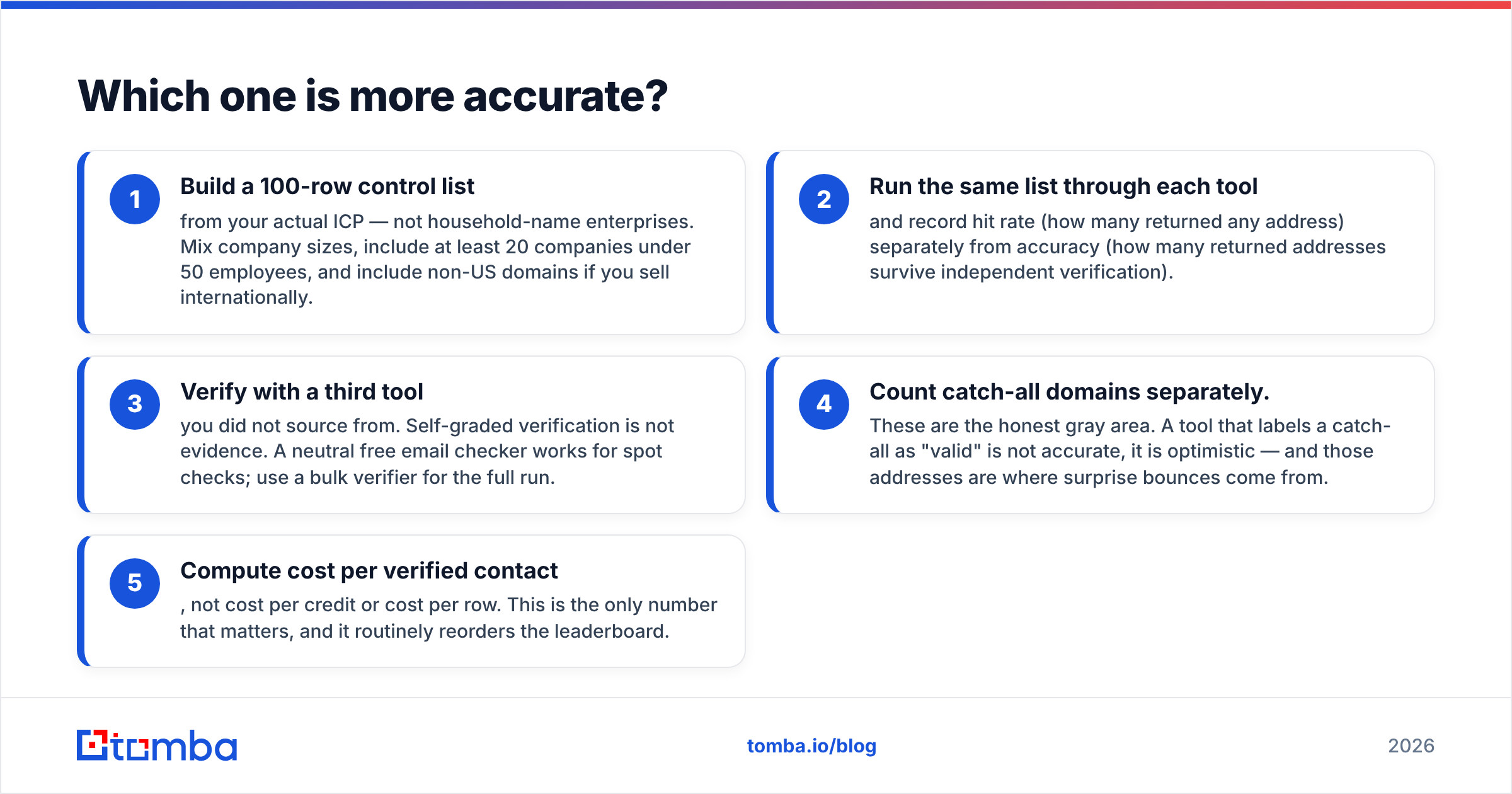
- Build a 100-row control list from your actual ICP — not household-name enterprises. Mix company sizes, include at least 20 companies under 50 employees, and add non-US domains if you sell internationally.
- Run the same list through each tool and record hit rate (how many returned any address) separately from accuracy (how many of those survive independent verification).
- Verify with a third tool you did not source from. Self-graded verification is not evidence. A neutral free email checker works for spot checks; use a bulk verifier for the full run.
- Count catch-all domains separately. These are the honest gray area. A tool that labels a catch-all as "valid" is not accurate, it is optimistic — and those addresses are where surprise bounces come from.
- Compute cost per verified contact, not cost per credit or cost per row. This is the only number that matters, and it routinely reorders the leaderboard.
Run that and the pattern is usually clear. The gap between vendors is small on big-company lookups and much wider on the long tail. Long-tail coverage is where the money is, because that is where your competitors' data is also thin.
How does the pricing math actually work out?#
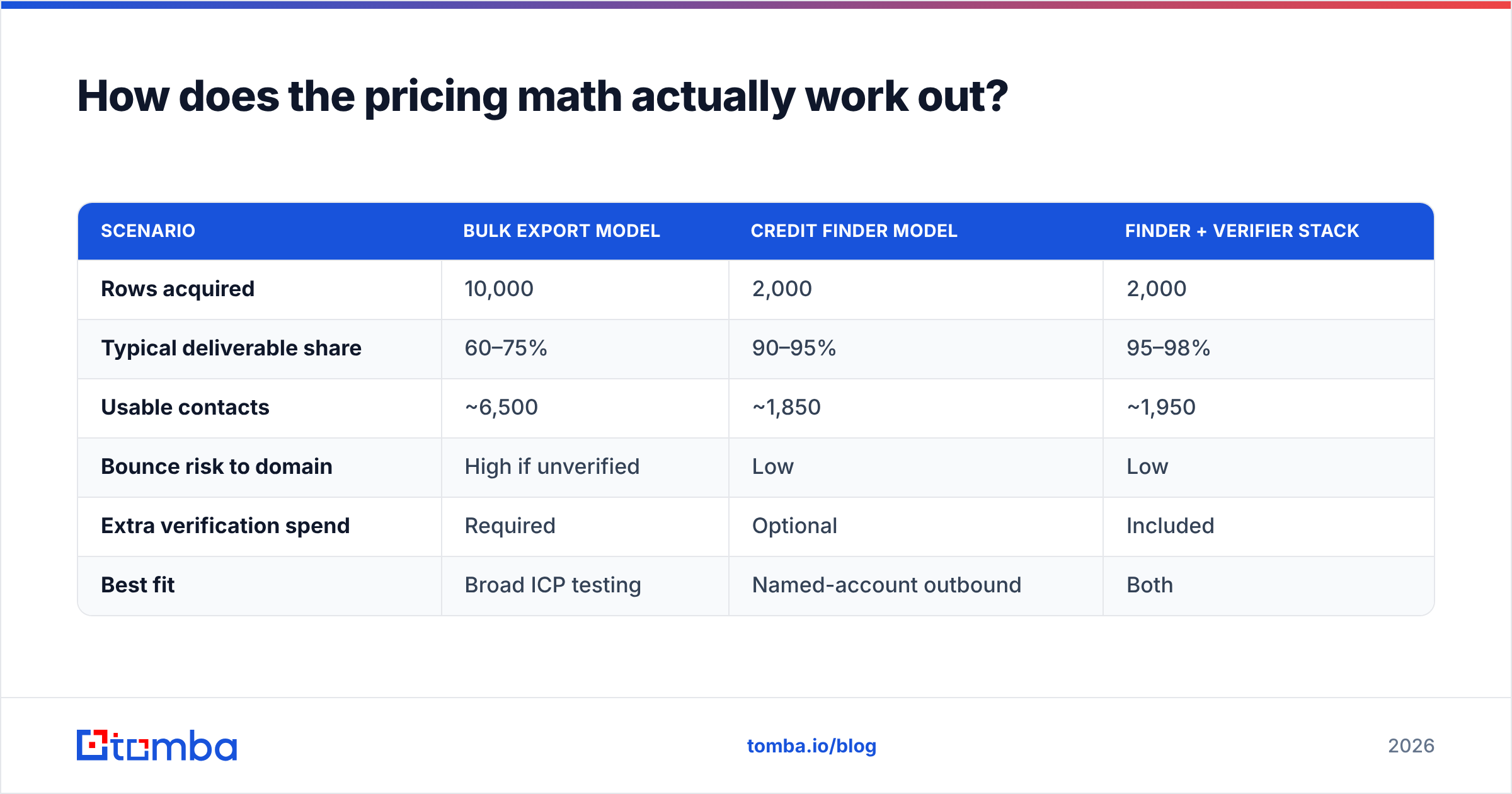
Compare on cost per verified, deliverable contact and the picture changes.
| Scenario | Bulk export model | Credit finder model | Finder + verifier stack |
|---|---|---|---|
| Rows acquired | 10,000 | 2,000 | 2,000 |
| Typical deliverable share | 60–75% | 90–95% | 95–98% |
| Usable contacts | ~6,500 | ~1,850 | ~1,950 |
| Bounce risk to domain | High if unverified | Low | Low |
| Extra verification spend | Required | Optional | Included |
| Best fit | Broad ICP testing | Named-account outbound | Both |
The bulk column still wins on raw usable volume. That is real, and you should not pretend otherwise. What the table does not show is the tail risk. A 25% bounce rate on a 10,000-send campaign is 2,500 hard bounces. Mailbox providers read that as a spam signal. Google and Yahoo's 2024 bulk-sender rules made this official: high bounce and complaint rates get your mail filtered, and recovery takes weeks. Cheap rows that torch your email deliverability are not cheap.
The honest rule: if you buy volume, budget for verification. If you buy precision, budget for coverage gaps. No plan skips both.
Which should you pick for your outbound motion?#
- Named-account ABM (under 500 targets/quarter): Gamalogic, or any credit-based finder. You are not volume-constrained, you are precision-constrained. Warpleads' export ceiling is irrelevant to you.
- Agency running 5+ client campaigns: Warpleads. Flat export pricing across clients beats per-credit billing, and you have the ops capacity to verify in bulk before sending.
- Product-led SaaS enriching signups: Gamalogic or a finder API. This is a real-time, per-record job. A database export cannot answer "who just signed up 200ms ago?"
Three more common setups:
- New market or ICP exploration: Warpleads first for discovery, then a finder for the accounts that survive qualification. Two tools, two jobs, in sequence.
- Recruiting or founder-led sales: A finder plus a LinkedIn finder beats a static database, because your targeting is inherently one-at-a-time.
- High-volume outbound at scale (10k+/month): You need both layers. Buy the cheapest reliable volume source, then run everything through a dedicated verifier before it touches a sequencer.
Where does Tomba fit in this comparison?#
Tomba sits deliberately in the middle, and that is a real position rather than a marketing hedge. You get a finder, a verifier, a domain search, a catch-all resolver, and a bulk workflow in one account. The "source cheap, verify separately" pattern collapses into a single bill and a single API key.
Concretely:
- Email finder for name + domain lookups, the Gamalogic-shaped job.
- Domain search to pull every known address at a company, which covers a chunk of the discovery job.
- Bulk email finder for CSV in, verified CSV out — the Warpleads-shaped job, without the separate verification bill.
- Catch-all verifier for the domains most tools quietly mark "unknown" and let you send to anyway.
- Tomba API with SDKs, a CLI, and an MCP server if your workflow is code rather than clicks.
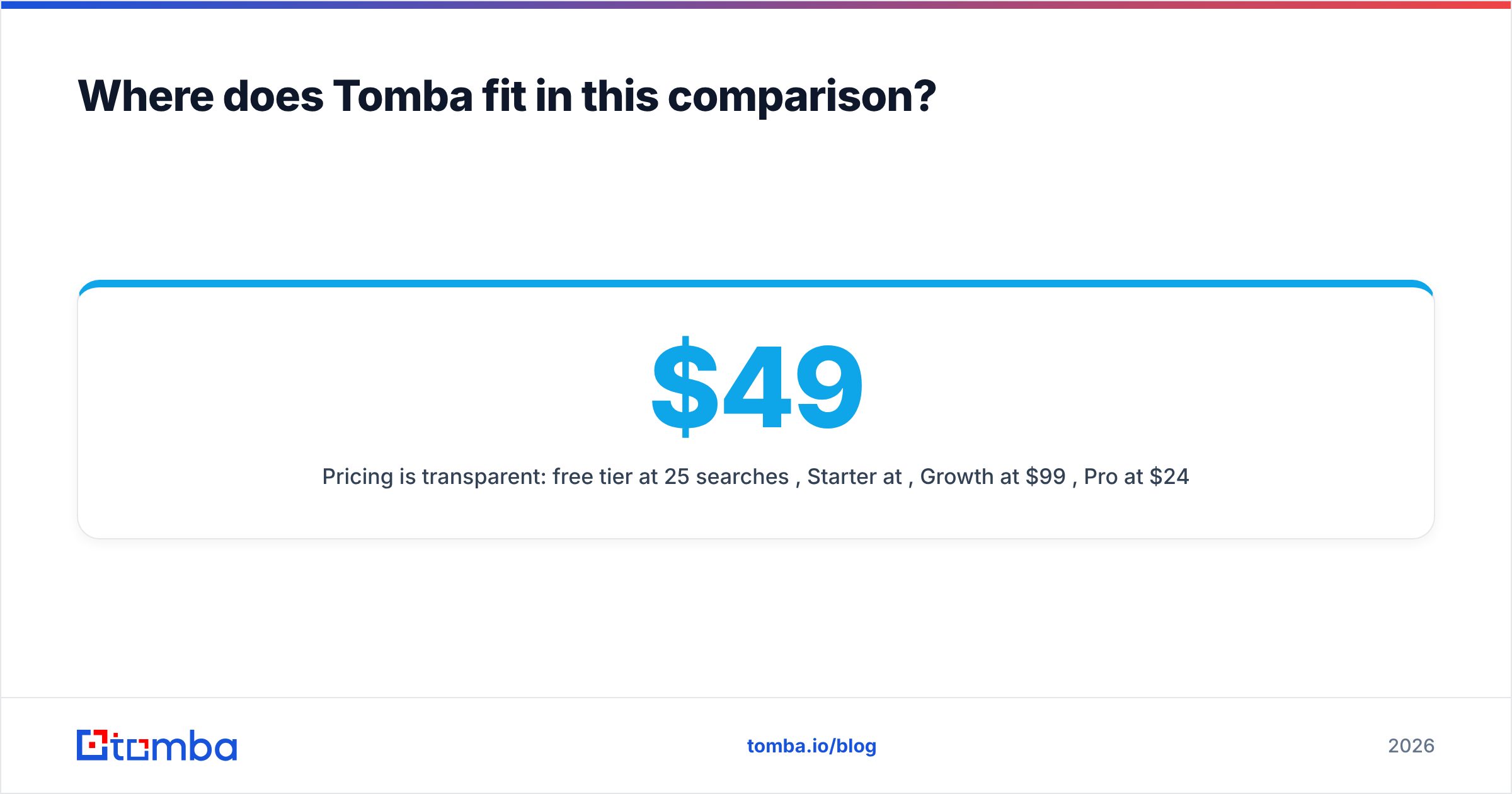
Pricing is transparent: free tier at 25 searches/mo, Starter at $49/mo, Growth at $99/mo, Pro at $249/mo, Enterprise custom. Full Tomba pricing is public — no demo call required to see a number.
The honest limitation: maybe your entire requirement is "give me 50,000 rows for a flat fee and I do not care about per-record quality." Then a dedicated export-tier database will beat any credit-based tool on raw volume economics. That is a legitimate strategy for some plays. It is just not most teams' strategy, and it is not compatible with a warm sending domain.
What should you check before you commit to either?#
Do not sign an annual deal off a demo. Run this checklist against both vendors — and against anyone else on your shortlist, including us.
- Test on your ICP, not theirs. Vendor demo lists are curated. Your long tail is not.
- Read the credit-rollover and refund policy. Do failed lookups burn credits? Some vendors charge for a miss, which quietly doubles your effective rate.
- Check GDPR and CCPA posture if you sell into the EU or California. Ask where the data comes from and whether there is a documented opt-out path. Compare answers against each vendor's data sources disclosure.
- Confirm the export format matches your sequencer's import schema. Column-mapping cleanup is silent, recurring labor.
- Look at recent reviews with dates. G2 and Capterra listings for smaller vendors move fast. A 2023 review describes a different product than the one you are buying in 2026.
- Verify a 200-row sample independently before your first real campaign. This single step has saved more sending domains than any warmup tool.
The verdict#
The Gamalogic vs Warpleads verdict: Gamalogic wins on precision-per-record and API ergonomics. Warpleads wins on volume-per-dollar and discovery. Forced to pick one with no context, take Gamalogic. A small verified list cannot hurt you. A large unverified one can. But the real answer for most outbound teams is that you need both jobs done, and paying two vendors to do them is neither cheaper nor simpler.
That is the gap Tomba was built for. Start with the Tomba Email Finder on the free tier — 25 searches, no card. Then run the 100-row bake-off above against whatever you use today. If our cost per verified contact does not beat your current stack on your own ICP, you will have learned something useful either way. If it does, the $49/mo Starter plan is the cheapest way to stop paying for bounces.
Related guides#
Ready to find emails that actually work?
Join 150,000+ professionals who stopped guessing and started sending. Free credits on signup — no credit card required.
Get the Tomba newsletter
Practical outbound tactics and product updates — once every two weeks.
About the author