Gazelle vs ZoomInfo (2026): Which B2B Data Platform Wins?
Gazelle.ai predicts which companies are about to grow. ZoomInfo tells you who to call there. They solve different halves of the same problem — here is which one your team actually needs, and what each really costs.
TL;DR
- Gazelle.ai and ZoomInfo are not really competitors. Gazelle.ai is a company-intelligence and growth-prediction platform. ZoomInfo is a contact database plus a go-to-market execution suite. One tells you which accounts are heating up; the other tells you who to email there.
- Pick Gazelle.ai if your job is account selection at the company level: investment attraction, economic development, expansion tracking, international account mapping, or ABM target-list building.
- Pick ZoomInfo if your job is filling a rep's calendar: direct dials, verified work emails, intent signals, and native sequencing inside one platform.
- Both are quote-only, annual-contract purchases. Neither publishes transparent self-serve pricing, and buyer-reported ZoomInfo contracts commonly start around $15,000/year before add-ons.
- Most small teams need neither at full price. If the actual gap is "I have a target list but no email addresses," a per-contact email finder at $49/month closes it for roughly 2% of an enterprise data contract.
What is Gazelle.ai, and who actually uses it?#
Gazelle.ai is an AI-driven company intelligence platform built around a single question: which companies are about to grow?
The name is deliberate. In economics, a "gazelle" is a firm growing revenue or headcount at an outsized clip year over year — the small share of companies that produce a disproportionate share of new jobs and new spend. Gazelle.ai's core product scores companies on predicted growth and expansion likelihood, then lets you filter a global company universe by those scores alongside firmographics, location, industry, and parent-subsidiary relationships.
Its most distinctive user base is not a typical SaaS sales team. Economic development organizations, investment-attraction agencies, chambers of commerce, and commercial real estate teams use it to answer questions like "which foreign manufacturers are likely to open a facility in our region in the next 18 months?" B2B sales teams use the same engine differently: as a targeting layer that surfaces accounts before they show up on everyone else's list.
Think of it as a weather forecast for company growth. It won't hand you a phone number for the buyer, but it tells you which building to point at.
What Gazelle.ai is strong at:
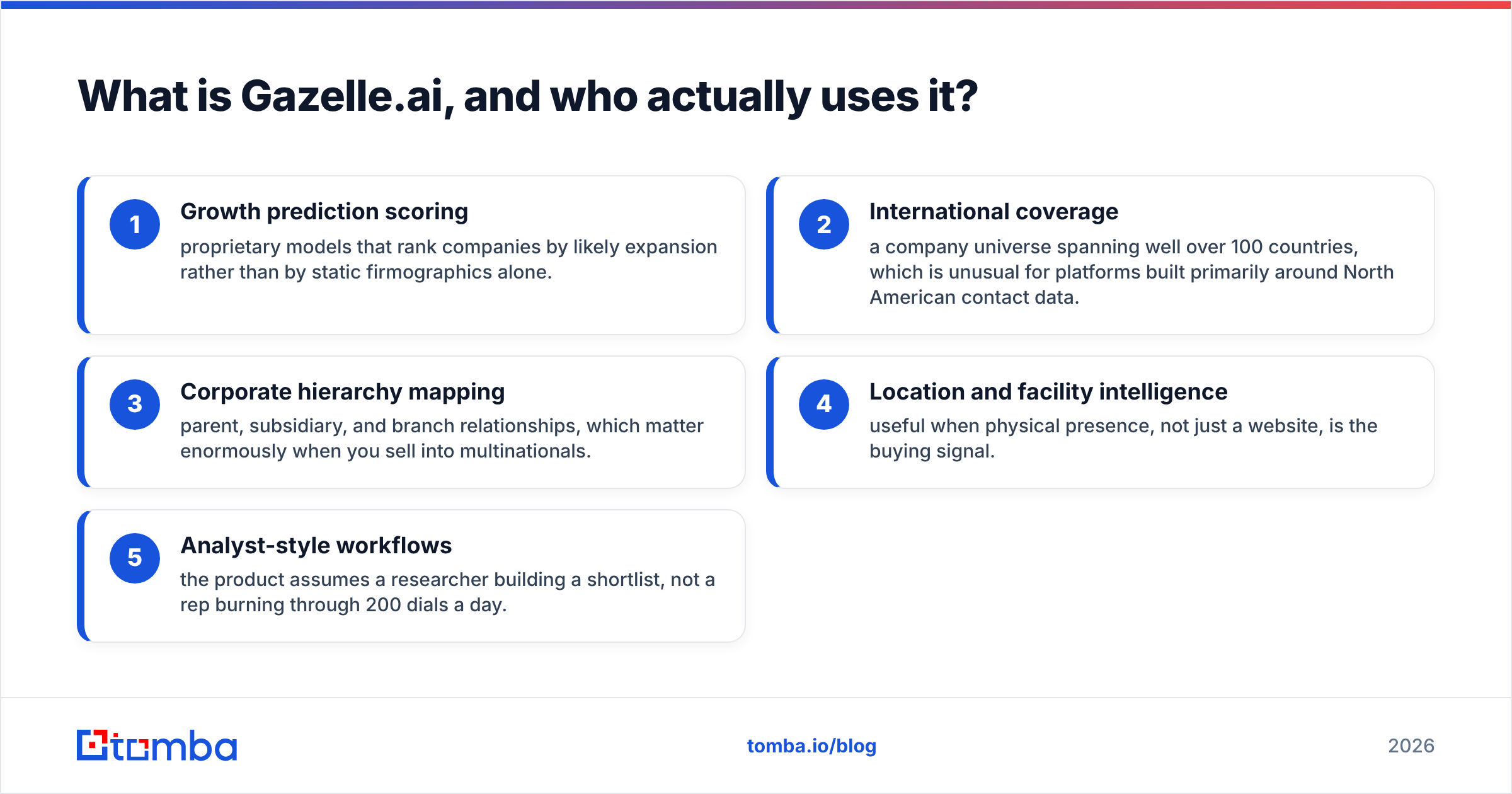
- Growth prediction scoring — proprietary models that rank companies by likely expansion rather than by static firmographics alone.
- International coverage — a company universe spanning well over 100 countries, which is unusual for platforms built primarily around North American contact data.
- Corporate hierarchy mapping — parent, subsidiary, and branch relationships, which matter enormously when you sell into multinationals.
- Location and facility intelligence — useful when physical presence, not just a website, is the buying signal.
- Analyst-style workflows — the product assumes a researcher building a shortlist, not a rep burning through 200 dials a day.
What is ZoomInfo, and what does it actually sell you?#
ZoomInfo is the largest publicly traded B2B contact-data company, and its pitch is coverage plus execution in one place. The core database holds vendor-reported figures in the hundreds of millions of professional profiles and tens of millions of companies, refreshed continuously through a mix of web crawling, contributory data from users' email and calendar integrations, third-party licensing, and human research.
Around that database, ZoomInfo has bolted on a full go-to-market stack: buying-intent signals, website visitor identification, conversation intelligence, data enrichment into your CRM, workflow automation, and email sequencing. The strategic bet is that you stop buying five tools and buy one.
That bundling is both its strength and the source of most buyer complaints. You get a lot in one contract. You also get a lot you may not use, on an annual commitment, with credit limits that reset in ways procurement teams have learned to read carefully.
What ZoomInfo is strong at:
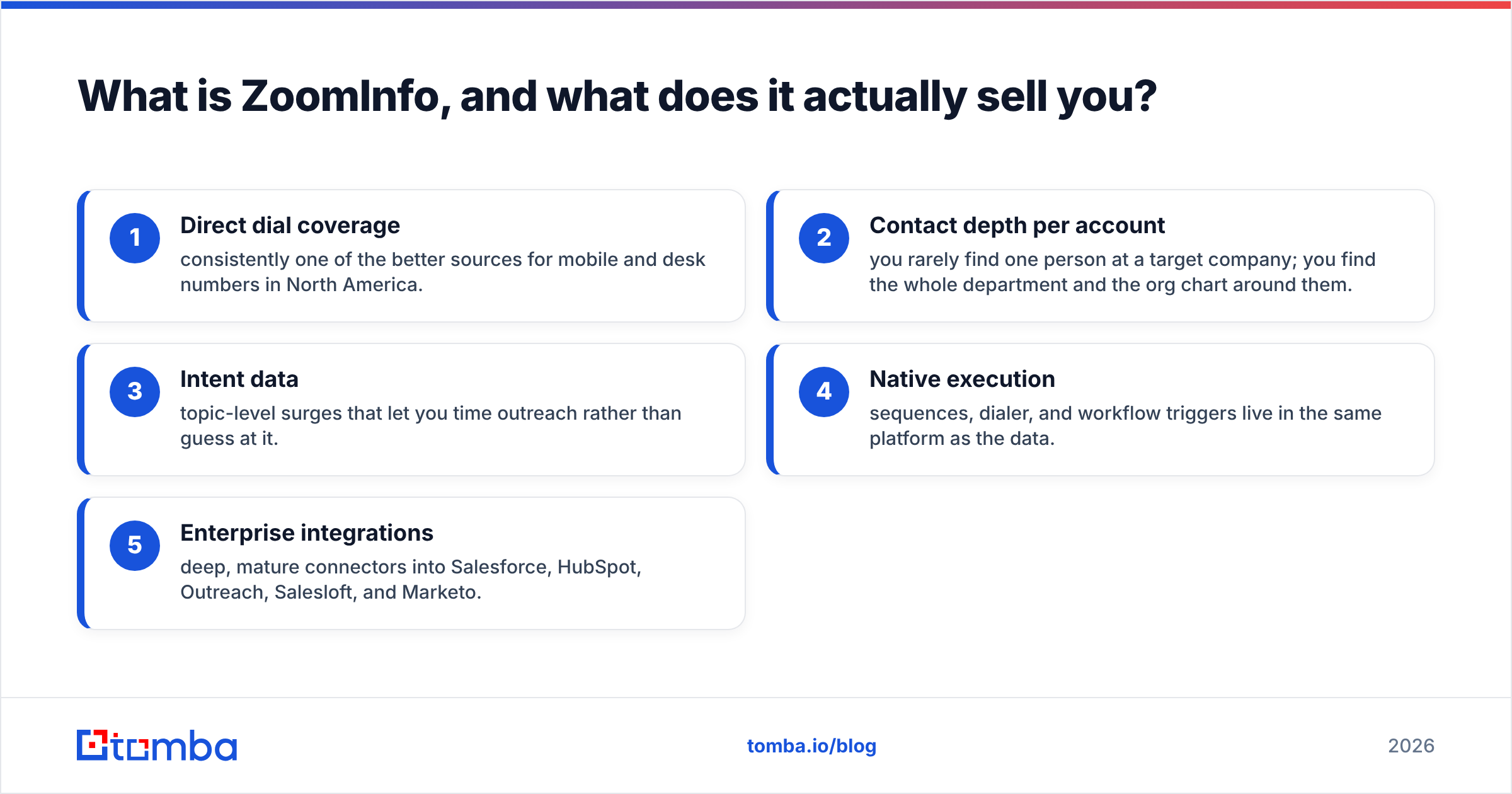
- Direct dial coverage — consistently one of the better sources for mobile and desk numbers in North America.
- Contact depth per account — you rarely find one person at a target company; you find the whole department and the org chart around them.
- Intent data — topic-level surges that let you time outreach rather than guess at it.
- Native execution — sequences, dialer, and workflow triggers live in the same platform as the data.
- Enterprise integrations — deep, mature connectors into Salesforce, HubSpot, Outreach, Salesloft, and Marketo.
Gazelle vs ZoomInfo: how do they compare head to head?#
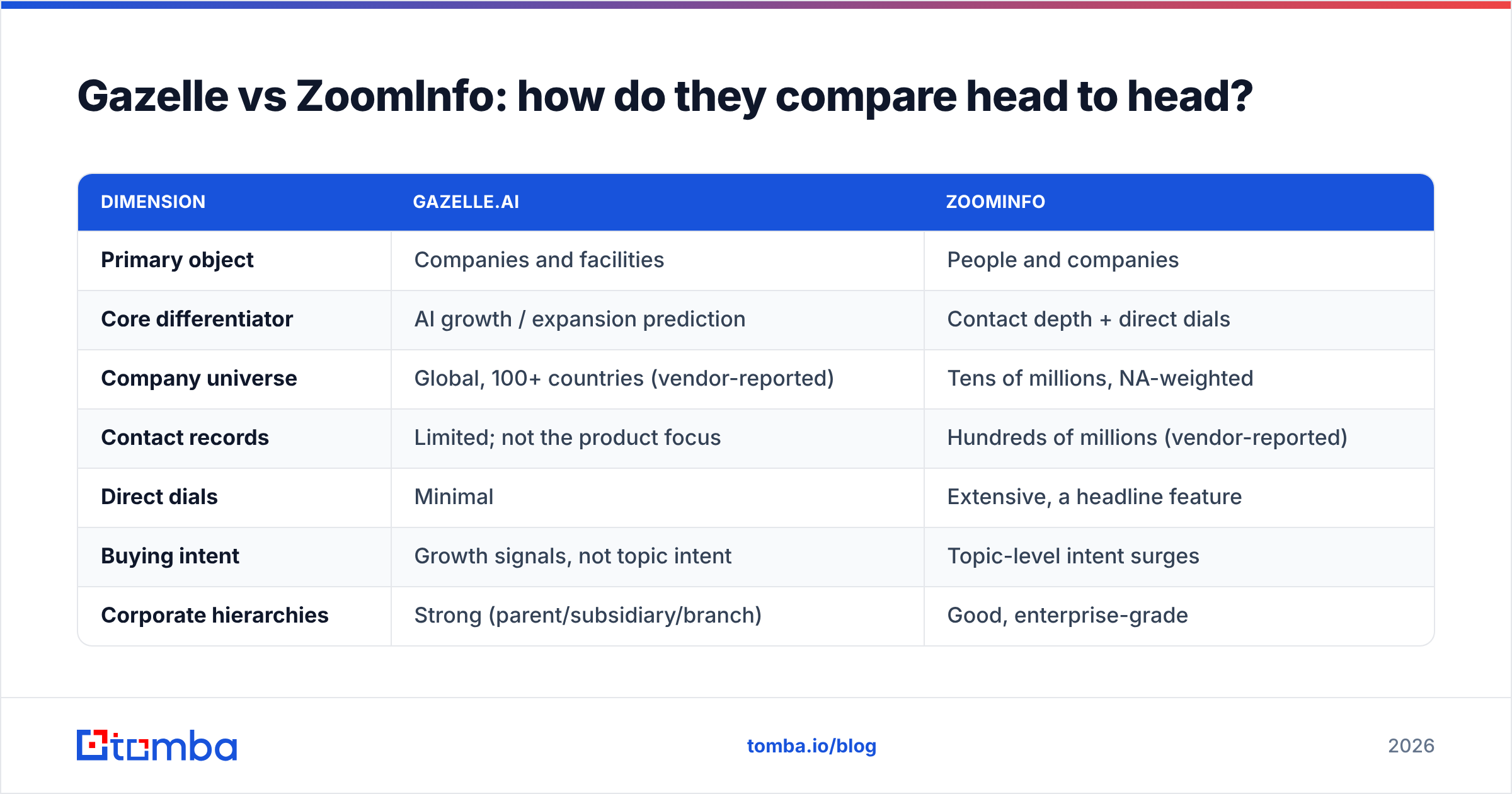
Here is the honest side-by-side. Where a vendor does not publish a figure, it is marked as such rather than invented.
| Dimension | Gazelle.ai | ZoomInfo |
|---|---|---|
| Primary object | Companies and facilities | People and companies |
| Core differentiator | AI growth / expansion prediction | Contact depth + direct dials |
| Company universe | Global, 100+ countries (vendor-reported) | Tens of millions, NA-weighted |
| Contact records | Limited; not the product focus | Hundreds of millions (vendor-reported) |
| Direct dials | Minimal | Extensive, a headline feature |
| Buying intent | Growth signals, not topic intent | Topic-level intent surges |
| Corporate hierarchies | Strong (parent/subsidiary/branch) | Good, enterprise-grade |
| Native sequencing | No | Yes (Engage) |
| Chrome extension | Limited | Yes |
| API access | Yes, on higher tiers | Yes, metered by credits |
| Typical buyer | EDOs, IPAs, CRE, ABM strategists | SDR teams, RevOps, demand gen |
| Pricing model | Quote only, annual | Quote only, annual, credit-based |
| Free tier | No | No (demo only) |
| Contract floor (buyer-reported) | Not published | Commonly ~$15k/yr and up |
Read that table twice and the conclusion writes itself: these two tools overlap on the word "database" and almost nowhere else. Gazelle.ai narrows where to sell. ZoomInfo tells you who to talk to and hands you the phone.
Which one has better data accuracy?#
Wrong question, and it is the question most comparison posts get lazy about. Accuracy is only meaningful against the record type you actually need.
On company-level accuracy, Gazelle.ai holds up well in its niche because it is solving a narrower problem. Firmographics, locations, and hierarchy relationships decay far more slowly than personal contact details. A factory does not change its address every eleven months. A VP of Operations changes jobs constantly.
On contact-level accuracy, ZoomInfo is the stronger of the two by default, because Gazelle.ai barely competes there. But "stronger than a company-data tool" is not the same as "clean." Every large contact database inherits the same structural problem: B2B contact data decays at roughly 25–30% per year as people change roles, companies rebrand, and mail servers get reconfigured. Independent reviews on G2 reliably surface the same two themes for ZoomInfo — excellent coverage, and a non-trivial share of stale or bounced records, especially outside North America and in SMB segments.
The practical takeaway: whichever platform you buy, run exports through an email verifier before they touch a sending domain. A bounce rate above 3% is a deliverability problem, not a data-quality footnote, and no vendor's SLA protects your sending reputation for you.
What do Gazelle.ai and ZoomInfo cost in 2026?#
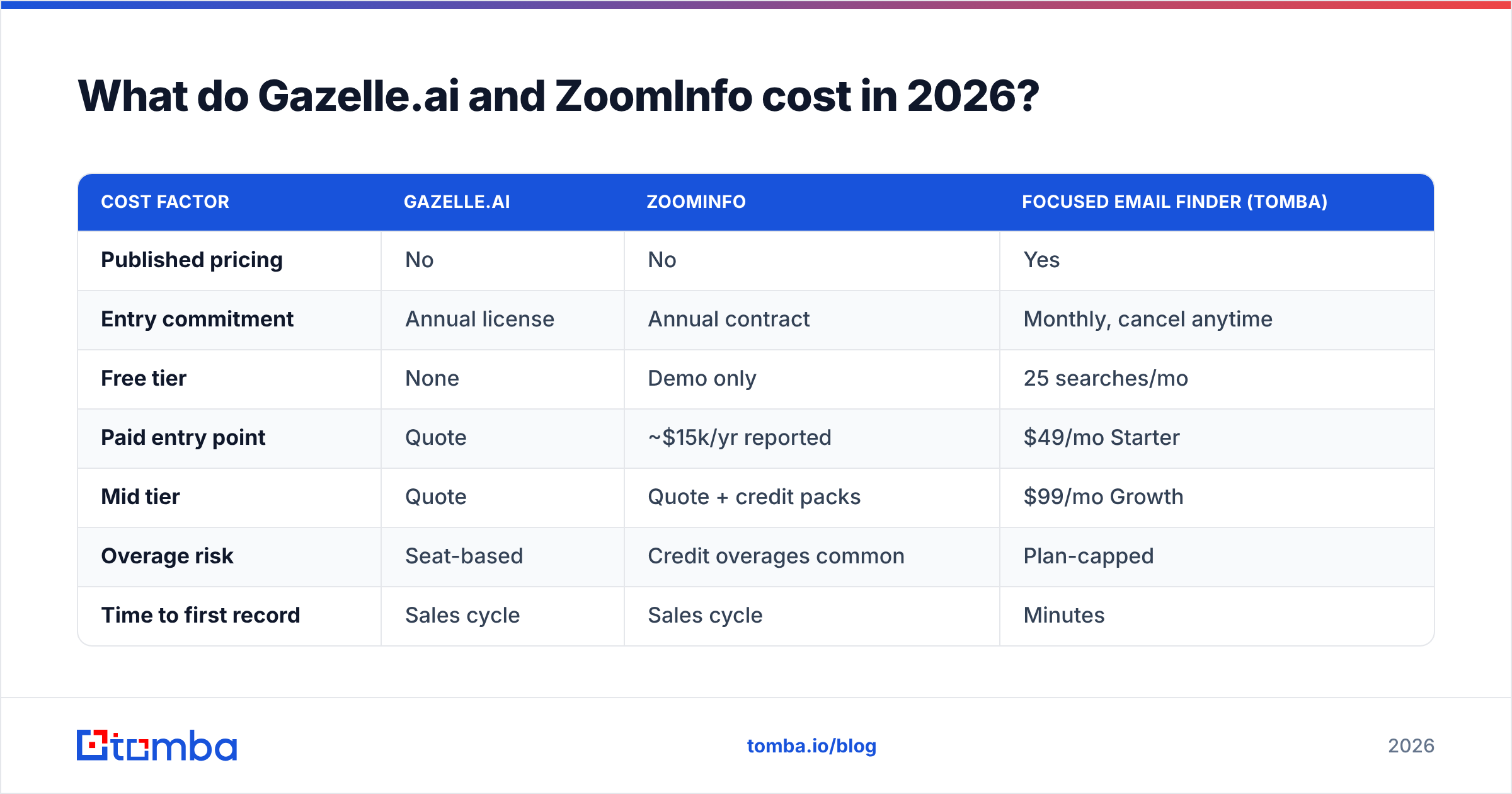
Neither vendor publishes a price list, which tells you what kind of sale each one runs. Both use a demo-first, quote-based motion with annual commitments.
ZoomInfo's structure is publicly discussed enough by buyers to sketch: a tiered platform fee (commonly cited starting near $15,000/year for a small seat count) plus credit packs for exports and enrichment, plus separate line items for intent, Copilot features, conversation intelligence, and website visitor identification. Overages and mid-term seat additions are where budgets actually break.
Gazelle.ai does not publish pricing either, and its buyer profile — agencies, regional development bodies, enterprise ABM teams — suggests a similar annual-license shape sized to seats and data scope. Treat any specific number you see quoted online as unverified.
| Cost factor | Gazelle.ai | ZoomInfo | Focused email finder (Tomba) |
|---|---|---|---|
| Published pricing | No | No | Yes |
| Entry commitment | Annual license | Annual contract | Monthly, cancel anytime |
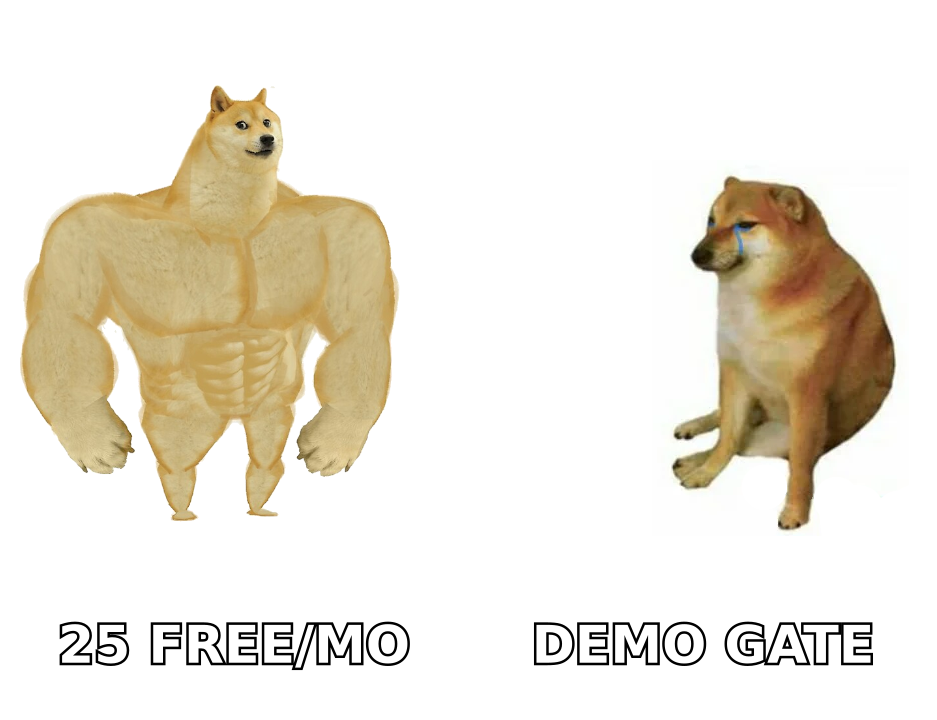
| Free tier | None | Demo only | 25 searches/mo |
| Paid entry point | Quote | ~$15k/yr reported | $49/mo Starter |
| Mid tier | Quote | Quote + credit packs | $99/mo Growth |
| Overage risk | Seat-based | Credit overages common | Plan-capped |
| Time to first record | Sales cycle | Sales cycle | Minutes |
That last row matters more than teams expect. If your Q1 pipeline plan depends on data you cannot access until a procurement cycle closes in six weeks, the cheapest platform on paper is not the cheapest platform in practice. Full Tomba pricing sits at the other end of that spectrum: Free at 25 searches, Starter at $49/month, Growth at $99/month, Pro at $249/month.
Is Gazelle better than ZoomInfo for outbound sales?#
For pure outbound execution, no. Gazelle.ai does not pretend to be a sequencing platform or a direct-dial source, and buying it expecting one is a self-inflicted wound.
For outbound targeting, it can be better, and this is the part worth taking seriously. The bottleneck for most outbound teams in 2026 is not "I cannot find contacts." Contact data has commoditized. The bottleneck is that everyone is emailing the same 4,000 obvious accounts pulled from the same three filters, which is precisely why reply rates have collapsed across the category.
A growth-prediction layer changes the input to that machine. If Gazelle.ai flags 300 mid-market manufacturers with expansion signals that your competitors' static firmographic filters do not surface, you are running outbound into a less-saturated list. That is a real edge, and it is orthogonal to whose contact database you use.
Which points at the architecture most efficient teams have actually converged on:
- Layer 1 — Account selection. Growth signals, hiring data, funding, expansion. Gazelle.ai fits here.
- Layer 2 — Contact resolution. Turn the account list into named people with valid emails. An email finder or contact database fits here.
- Layer 3 — Verification. Validate before send, including catch-all verification for domains that accept everything and confirm nothing.
- Layer 4 — Execution. Sequencing, dialing, and reply handling in your sending tool of choice.
ZoomInfo tries to be all four layers in one contract. Gazelle.ai is a deep layer one. Neither is wrong; they are answers to different budget questions.
What are the alternatives to both?#
If you read the comparison above and concluded that you are paying enterprise prices for one layer you actually use, you are in the majority. A few realistic paths:
If you need account intelligence but not the full ZoomInfo suite: pair a lighter company-data source with an intent or signal provider, and keep the contract length short. Six-month pilots exist if you ask for them.
If you already know your target accounts: the entire account-selection layer is a solved problem for you, and you are shopping for the wrong thing. What you need is contact resolution — take a domain, get the people and their verified emails. Domain search does exactly this, at a price that does not require a business case.
If you are enriching an existing CRM: the value is in fill rate and freshness on records you already own, not in database size. A pay-per-successful-match data enrichment model usually beats a credit bundle you have to spend down before renewal.
If you are building the pipeline into a product or internal tool: skip the UI question entirely and evaluate on API quality, rate limits, and per-call cost. The Tomba API and ZoomInfo's API solve overlapping problems at very different price points and very different integration efforts.
If you sell internationally: test both on your actual target geography before signing. North American coverage numbers tell you almost nothing about hit rates in DACH, LATAM, or Southeast Asia, and this is where large contact databases most often disappoint.
Which should you choose?#
Choose Gazelle.ai if your success metric is account selection quality — you are attracting investment, tracking expansion, mapping multinationals, or building ABM lists where picking the wrong 500 companies costs more than emailing them badly.
Choose ZoomInfo if your success metric is rep activity volume — you have SDRs who need direct dials, a manager who wants intent data, and a budget that can absorb an annual six-figure-adjacent commitment without flinching.
Choose neither at full price if your honest situation is: "we know who we want to reach, we just need their email addresses to be correct." That is not a $15,000 problem. That is a workflow you can stand up this afternoon.
Run your target domains through Tomba Email Finder and see what your actual hit rate looks like before you sit through another demo. The free tier gives you 25 searches a month with no card, Starter is $49/month, and every result comes back with a confidence score and verification status so you know what you are sending to. Test it against a list you already know the answers to — that is the only benchmark that matters.
Related guides#
Ready to find emails that actually work?
Join 150,000+ professionals who stopped guessing and started sending. Free credits on signup — no credit card required.
Get the Tomba newsletter
Practical outbound tactics and product updates — once every two weeks.
About the author