Generect vs NeverBounce: Which B2B Data Tool Wins in 2026?
Generect finds leads. NeverBounce cleans lists. Here's an honest breakdown of pricing, accuracy, and which one actually belongs in your outbound stack in 2026 — plus when you need neither.
Generect vs NeverBounce is the wrong fight for most teams. One tool finds leads. The other cleans lists. Here is what each does, what each costs, and which one your stack actually needs.
TL;DR
- Generect and NeverBounce are not real competitors. Generect is a lead database built on LinkedIn data. NeverBounce is a pure email verification engine owned by ZoomInfo.
- Need contact discovery? NeverBounce cannot help. Need bounce protection on a list you already own? Generect is the wrong buy.
- NeverBounce charges per verification: about $0.008 an email at low volume, closer to $0.003 in bulk. Generect sells seat-plus-credit plans that start in the low three figures a month.
- Most teams who buy one end up buying both. Then they pay twice for overlapping data hygiene.
- A combined find-and-verify platform like Tomba ($49/mo Starter, free tier at 25 searches) folds the two line items into one API. Price it against both before you sign anything annual.
What are Generect and NeverBounce, actually?#
They solve different halves of one problem. That is why the comparison confuses people.
Generect is a B2B lead generation platform built on LinkedIn data. You define an ICP — job titles, headcount, geography, tech stack. It returns matching contacts with work emails, plus phone numbers on higher tiers. It also ships a LinkedIn Sales Navigator scraper and an API for pulling company and people data in bulk. It is a sourcing tool: you start with nothing and end with a list.
NeverBounce is a real-time and bulk email verification service. ZoomInfo bought it in 2021. You upload a list you already have, from a CRM export, a webinar form, or a scraped dataset. It tells you which addresses will bounce. Under the hood it runs SMTP handshakes, syntax checks, and disposable-domain detection. It also flags role accounts and catch-all domains. It is a hygiene tool: you start with a dirty list and end with a clean one.
The overlap is thin but real. Generect promises verified emails at delivery time. NeverBounce promises 99.9%+ deliverability on the addresses it marks valid. Both make a claim about the same thing — whether the message lands. They just make it from opposite ends of the pipeline.
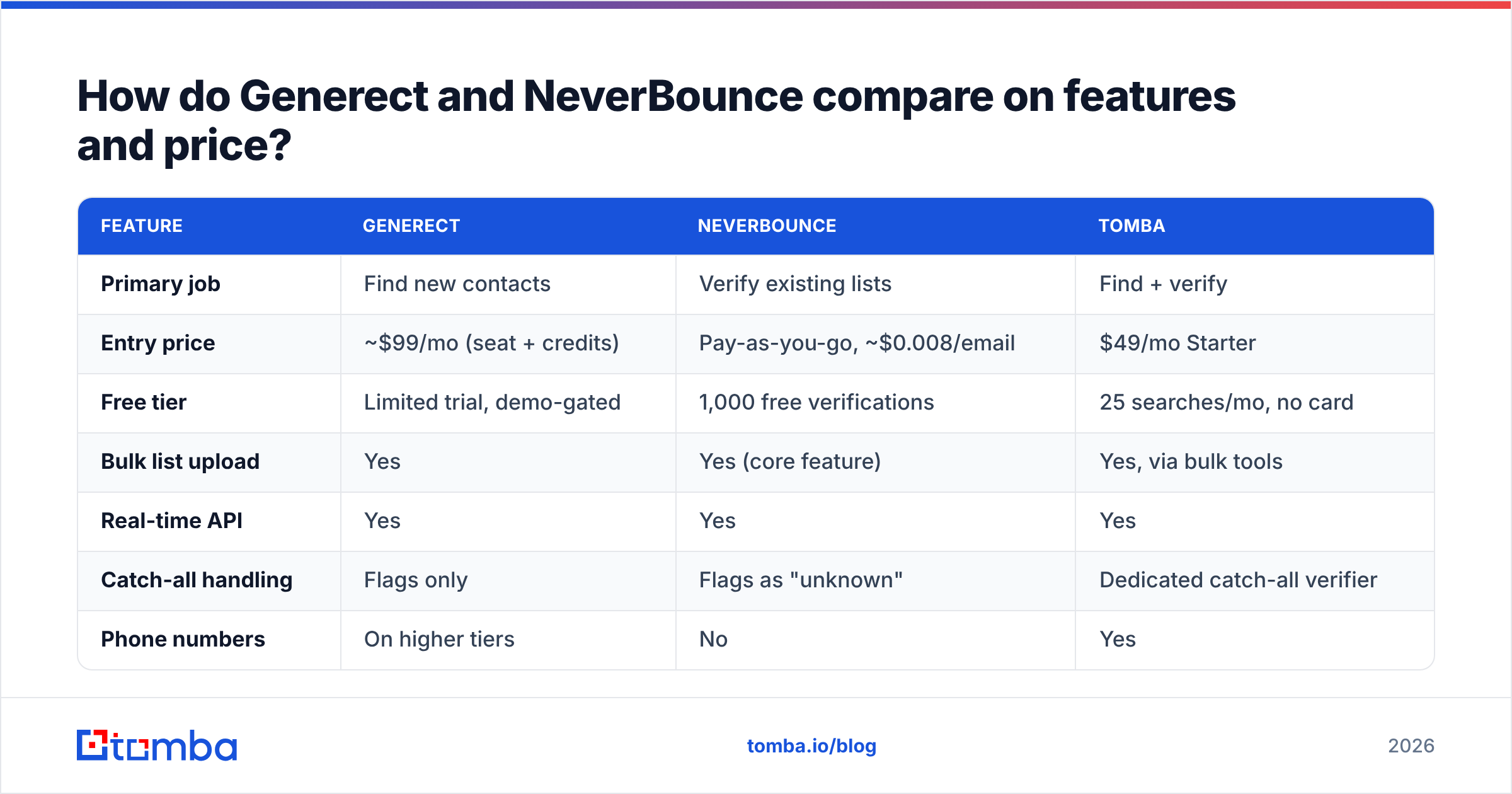
Generect vs NeverBounce: features and pricing compared#
Here is the honest side-by-side. Prices reflect public rates as of early 2026 and change often. Check each vendor before you commit.
| Feature | Generect | NeverBounce | Tomba |
|---|---|---|---|
| Primary job | Find new contacts | Verify existing lists | Find + verify |
| Entry price | ~$99/mo (seat + credits) | Pay-as-you-go, ~$0.008/email | $49/mo Starter |
| Free tier | Limited trial, demo-gated | 1,000 free verifications | 25 searches/mo, no card |
| Bulk list upload | Yes | Yes (core feature) | Yes, via bulk tools |
| Real-time API | Yes | Yes | Yes |
| Catch-all handling | Flags only | Flags as "unknown" | Dedicated catch-all verifier |
| Phone numbers | On higher tiers | No | Yes |
| LinkedIn sourcing | Yes (core feature) | No | Yes, via LinkedIn finder |
| Domain-wide search | Limited | No | Yes |
| CRM integrations | HubSpot, Pipedrive, Salesforce | HubSpot, Mailchimp, Zapier, 80+ | HubSpot, Salesforce, Pipedrive, Zapier, Make |
| Owned by | Independent | ZoomInfo | Independent |
The shape of the price matters more than the feature grid. NeverBounce is pay-per-use with no floor. Verify 500 emails once and pay about $4. Generect sells seats, so you commit up front. A two-person team testing it for a quarter spends several hundred dollars first. Only then do they learn whether the data fits their ICP.
That gap should set the order of your trials. Test NeverBounce with a $10 spend on a real list. Test Generect later, once you have written down the exact segments you need. Then judge it against a known-good sample.
Is Generect accurate enough for cold outbound?#
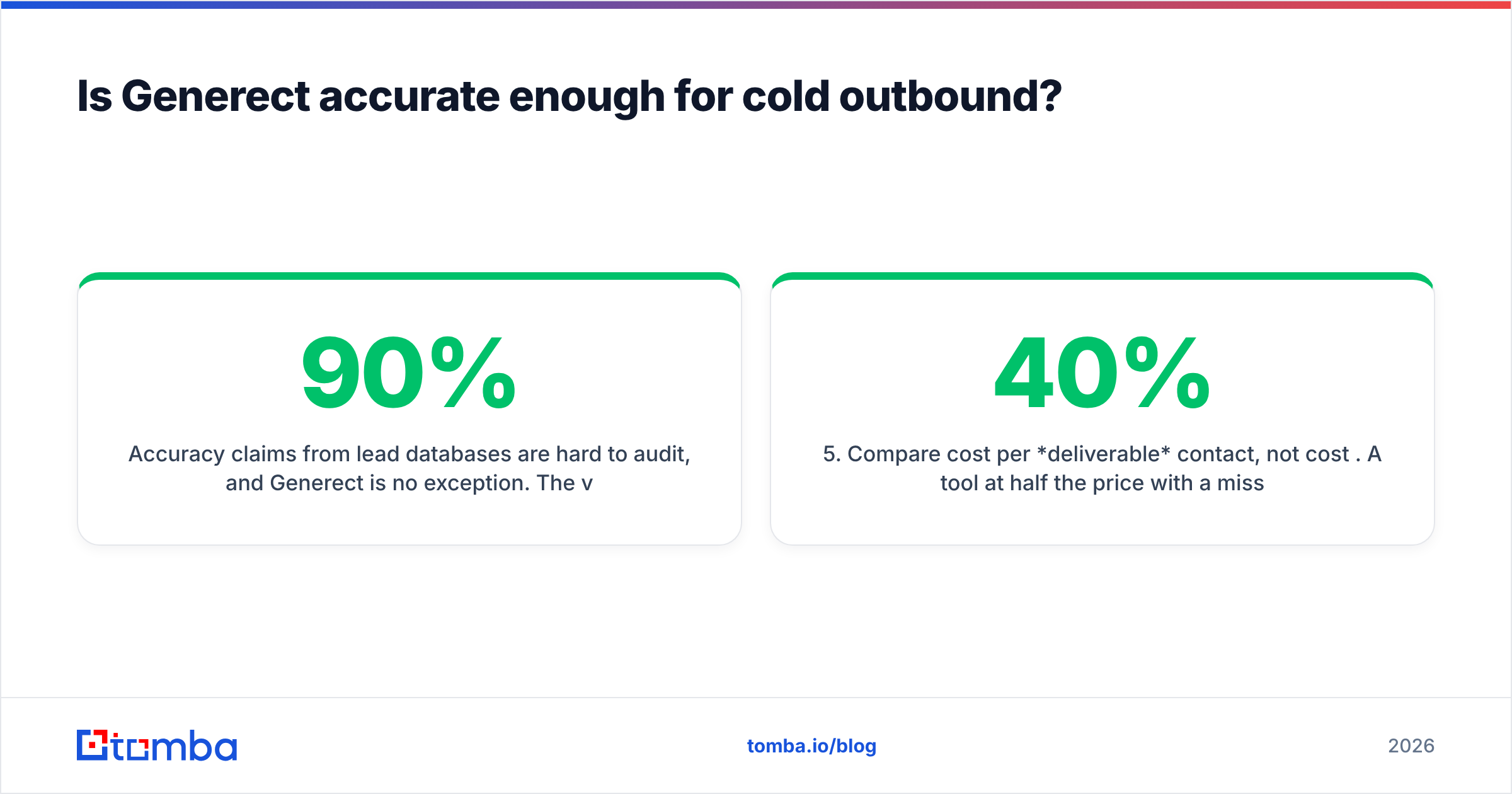
Accuracy claims from lead databases are hard to audit. Generect is no exception. The vendor markets high match rates on LinkedIn contacts. But "match rate" and "deliverability" are different numbers. A tool can return an address for 90% of your list, and one in five of those can still bounce.
Run this test before you trust any provider, Generect included:
- Build a control list of 200 contacts whose emails you know are good — past customers, prospects who replied, colleagues at partner companies.
- Strip the emails, keeping only name and company domain.
- Run the stripped list through the tool. Measure two things: how many addresses came back at all (coverage), and how many match your known-good value (precision).
- Send a small warm-up campaign to the addresses the tool found but you had no record of. Log the hard-bounce rate.
- Compare cost per deliverable contact, not cost per credit. A tool at half the price with a 40% miss rate costs you more.
Most teams skip step 5 and buy on sticker price. That is the most common reason outbound budgets look fine in a spreadsheet and awful in the pipeline report.
Coverage also swings by region and company size. Tomba publishes its data sources openly, and that is a fair bar to hold any vendor to before you sign.
Does NeverBounce actually reduce bounce rates?#
Yes, within limits. Knowing the limits is what separates a useful buy from a wasted one.
NeverBounce is strong at the mechanical checks: syntax rules, MX record lookups, disposable domains, and known-bad addresses from its own history. On a list of hand-typed signup emails, it catches typos, dead mailboxes, and spam traps it has seen before.
Every verifier hits the same wall: catch-all domains. Some mail servers accept every address at a domain, whether or not the mailbox exists. An SMTP handshake then tells you nothing. NeverBounce returns these as "unknown" or "accept-all." In some industries that bucket is 20-30% of a B2B list. You are left with a choice: mail an unknown segment, or bin contacts you paid to acquire.
This is where a dedicated catch-all verifier earns its place. It resolves a real share of that unknown bucket instead of writing it off. If catch-all domains rule your target market — common in enterprise SaaS, finance, and healthcare — test how each vendor handles that one segment. Overall accuracy claims will not tell you.
The other limit is timing. Verification is a snapshot. B2B email data decays 22-30% a year, by widely cited industry estimates. People change jobs and teams get reshuffled. A list verified in January and mailed in June is not a verified list. Verify at send time, not at import time.

Which should you choose for your use case?#
The answer depends almost entirely on what you already have.
| Your situation | Best fit | Why |
|---|---|---|
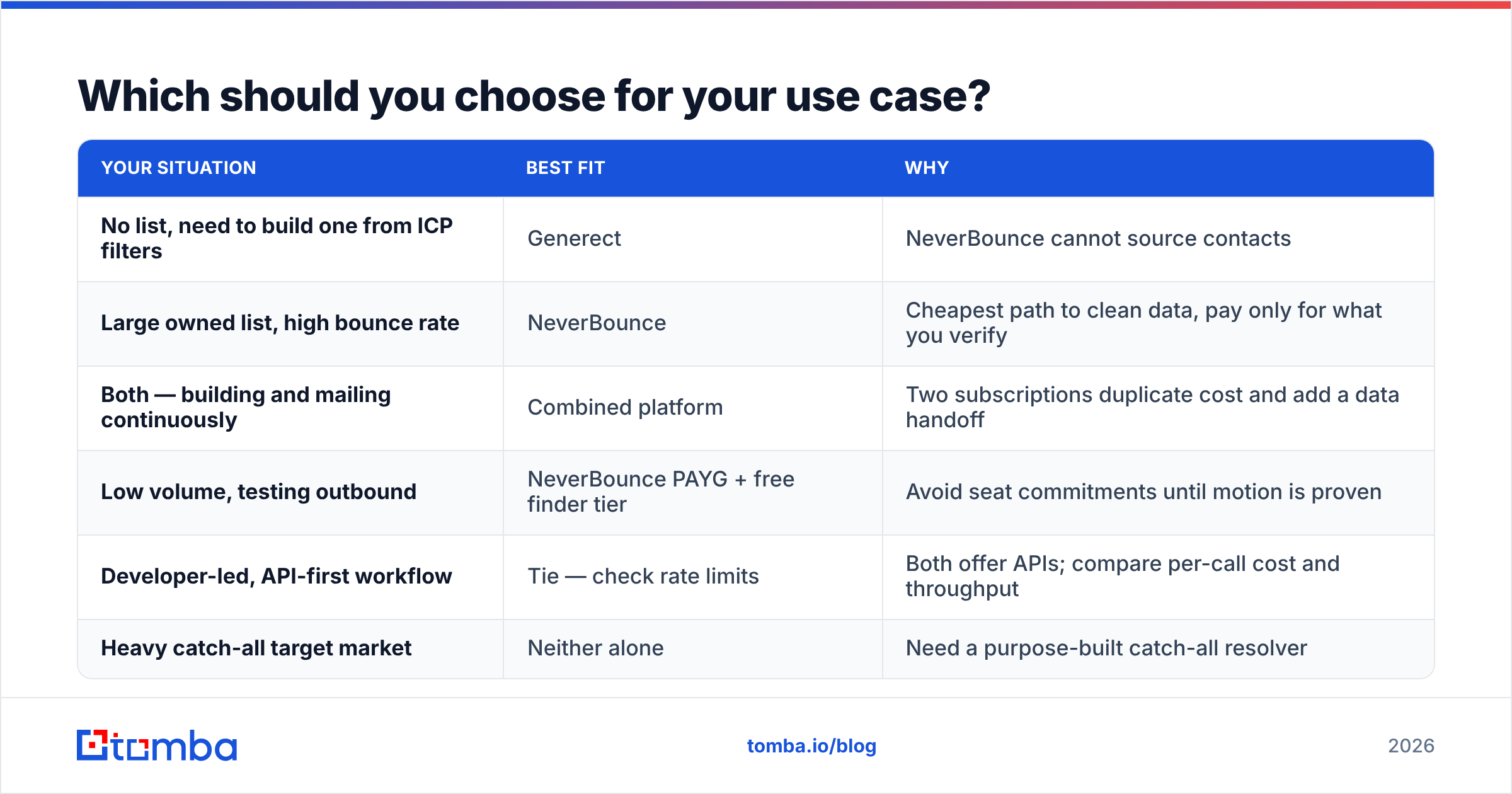
| No list, need to build one from ICP filters | Generect | NeverBounce cannot source contacts |
| Large owned list, high bounce rate | NeverBounce | Cheapest path to clean data, pay only for what you verify |
| Both — building and mailing continuously | Combined platform | Two subscriptions duplicate cost and add a data handoff |
| Low volume, testing outbound | NeverBounce PAYG + free finder tier | Avoid seat commitments until motion is proven |
| Developer-led, API-first workflow | Tie — check rate limits | Both offer APIs; compare per-call cost and throughput |
| Heavy catch-all target market | Neither alone | Need a purpose-built catch-all resolver |
A few notes worth flagging:
- Already a ZoomInfo customer? NeverBounce may be bundled or discounted in your existing contract. Ask your rep before you buy it standalone.
- Is your outbound LinkedIn-first? Generect's Sales Navigator link is genuinely handy. But LinkedIn's terms of service restrict automated scraping, and enforcement has tightened. Know the risk you are accepting.
- Need phone numbers as well as emails? NeverBounce is out. Look at Generect's higher tiers, or a phone finder that covers both channels.
- Is compliance review part of your buying process? Ask both vendors for a GDPR data-processing addendum and sourcing docs in writing. Verbal assurances do not survive a legal review.
What are the alternatives worth pricing against these two?#
Neither tool is uncontested. The market has also thinned out since 2024.
On the verification side, compare ZeroBounce, Bouncer, Debounce, and Clearout. At volume they all price within a fraction of a cent per email. So judge them on catch-all handling, API speed, and integrations rather than the headline rate. Recent user reviews on G2 help more here than any vendor comparison page, this one included.
On the sourcing side, Generect competes with Apollo, RocketReach, Wiza, Findymail, and BookYourData. Apollo bundles sequencing and a CRM. That is a feature if you need it and bloat if you already own those tools. BookYourData sells verified lists per record with no subscription. That model suits teams who buy a list now and then rather than prospect every day. Wiza and Findymail sit closer to Generect's LinkedIn-first approach.
The real question: do you want the find step and the verify step in one system? Splitting them means two contracts, two credit balances, two support queues, and a handoff you have to build. Combining them means one vendor's coverage limits become your coverage limits.
There is no universal answer. For teams under about 20 reps, one platform usually saves more in daily work than best-of-breed adds in accuracy. Above that size, separate tools start to pay for themselves.
Want to sanity-check email formats at a company before you pay for anything? The free company email pattern checker shows whether a domain uses first.last, flast, or something custom. That is often enough to hand-build a small target list with no subscription at all.
How do you build a stack that doesn't waste credits?#
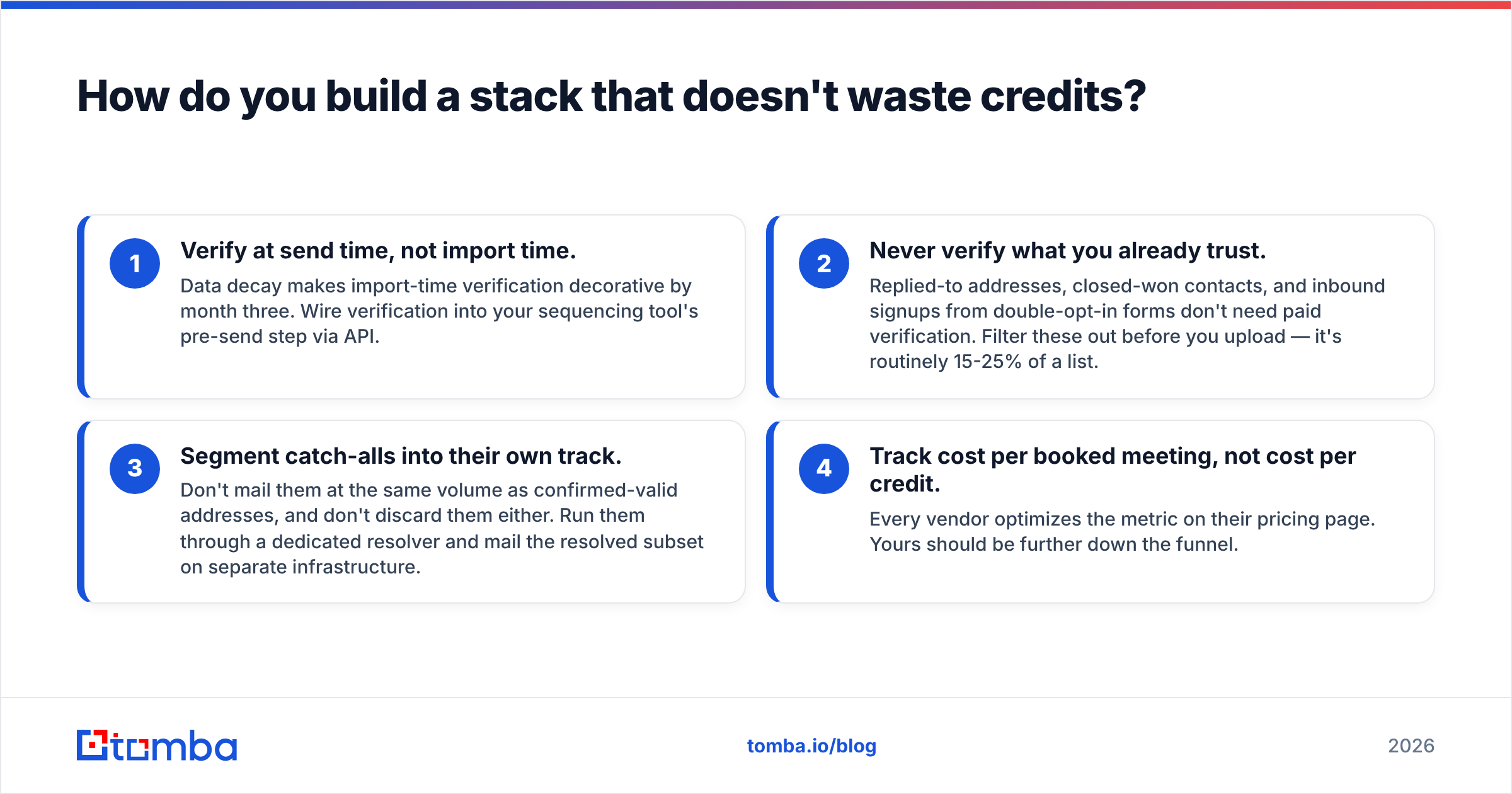
Four rules that hold whichever vendor you pick:
- Verify at send time, not import time. Data decay makes import-time verification useless by month three. Wire verification into the pre-send step of your sequencing tool.
- Never verify what you already trust. Addresses that replied, closed-won contacts, and double-opt-in signups do not need paid checks. Filter them out before you upload. It is routinely 15-25% of a list.
- Segment catch-alls into their own track. Do not mail them at full volume, and do not throw them away either. Run them through a dedicated resolver, then mail the resolved subset on separate infrastructure.
- Track cost per booked meeting, not cost per credit. Every vendor optimizes the metric on its own pricing page. Yours should sit further down the funnel.
Deliverability sits downstream of all of this. Clean data prevents bounces. It does not repair sender reputation you have already damaged. It is also no substitute for correct SPF, DKIM, and DMARC records. Google and Yahoo's bulk sender rules — documented by Google here — made authentication non-negotiable in 2024. Enforcement has only tightened since.
Generect vs NeverBounce: the verdict#
For most B2B teams, this comparison is a category error. Generect wins if your question is "how do I find contacts I don't have." NeverBounce wins if your question is "how do I stop bouncing on contacts I do have." Neither wins if the real question is "how do I do both without paying two vendors and gluing them together."
Buy NeverBounce if you have a list problem and a pay-as-you-go budget. A bad call there costs you $20, not a year's contract.
Buy Generect if LinkedIn prospecting is your main motion, you have checked match rate on a control list, and pipeline justifies the seat cost.
Buy neither, for now, if you have not proven the outbound motion yet. Start on a free tier. Hand-verify 100 contacts. Run a real campaign. Let the reply rate tell you what to buy.
Where Tomba fits: you may prefer to run discovery and verification through one API and one credit balance. The Tomba Email Finder covers domain search, name lookup, LinkedIn extraction, and verification in one platform. The free tier gives 25 searches a month, and paid plans start at $49/mo. Compare it against both tools on your own control list before you renew anything. Full Tomba pricing is public, with no demo call required.
Related guides#
Ready to find emails that actually work?
Join 150,000+ professionals who stopped guessing and started sending. Free credits on signup — no credit card required.
Get the Tomba newsletter
Practical outbound tactics and product updates — once every two weeks.
About the author