Generect vs RemoveBounce: Which B2B Data Tool Wins in 2026?
Generect finds B2B leads. RemoveBounce cleans the list you already have. They solve opposite halves of the same problem — here's how they compare on accuracy, pricing, and workflow fit in 2026.
TL;DR
- Generect and RemoveBounce are not really competitors. Generect is a B2B lead-data and LinkedIn-sourcing platform; RemoveBounce is a bulk email verification service. One fills the list, the other cleans it.
- If you already have contact data and just need bounce rates under 2%, RemoveBounce is the cheaper, simpler buy — verification is priced per email and you never touch a subscription if you don't want to.
- If you have no list at all, RemoveBounce cannot help you. You need a sourcing tool like Generect, an email finder, or a database.
- Buying both means two vendors, two credit systems, and two invoices. Consolidated platforms — Tomba included — bundle finding and verification in one plan starting at $49/mo.
- The real decision is not "Generect vs RemoveBounce" but "how many tools do I want in my prospecting stack?" This post breaks down all three paths.
What are Generect and RemoveBounce, exactly?#
Generect is a B2B lead generation platform built primarily around LinkedIn data. You define an ideal customer profile — job title, seniority, headcount, industry, geography — and it returns matching contacts with work emails, and in some cases phone numbers. It is API-first: a lot of its users are agencies and product teams pulling leads programmatically rather than clicking through a UI. The pitch is "search LinkedIn at scale without running scrapers yourself."
RemoveBounce does one job: it takes a list of email addresses you already own and tells you which ones are safe to send to. Upload a CSV, get back a scored file — valid, invalid, catch-all, disposable, role-based. It handles syntax checks, MX record lookups, SMTP handshakes, and spam-trap screening. There is no discovery layer. It never tells you who to email.
That distinction matters more than any feature table, so hold onto it: Generect is an input problem solver. RemoveBounce is an output quality solver. Comparing them directly is like comparing a supplier to a quality-control inspector. You can argue about which one you need first, but you cannot argue that one replaces the other.
Most teams land on this comparison because they searched something like "best tool to stop my cold emails bouncing" and got both results on the same page. If that's you, the honest answer is: you probably need verification and a source, and the interesting question is whether you buy them separately.
How do Generect and RemoveBounce compare head-to-head?#
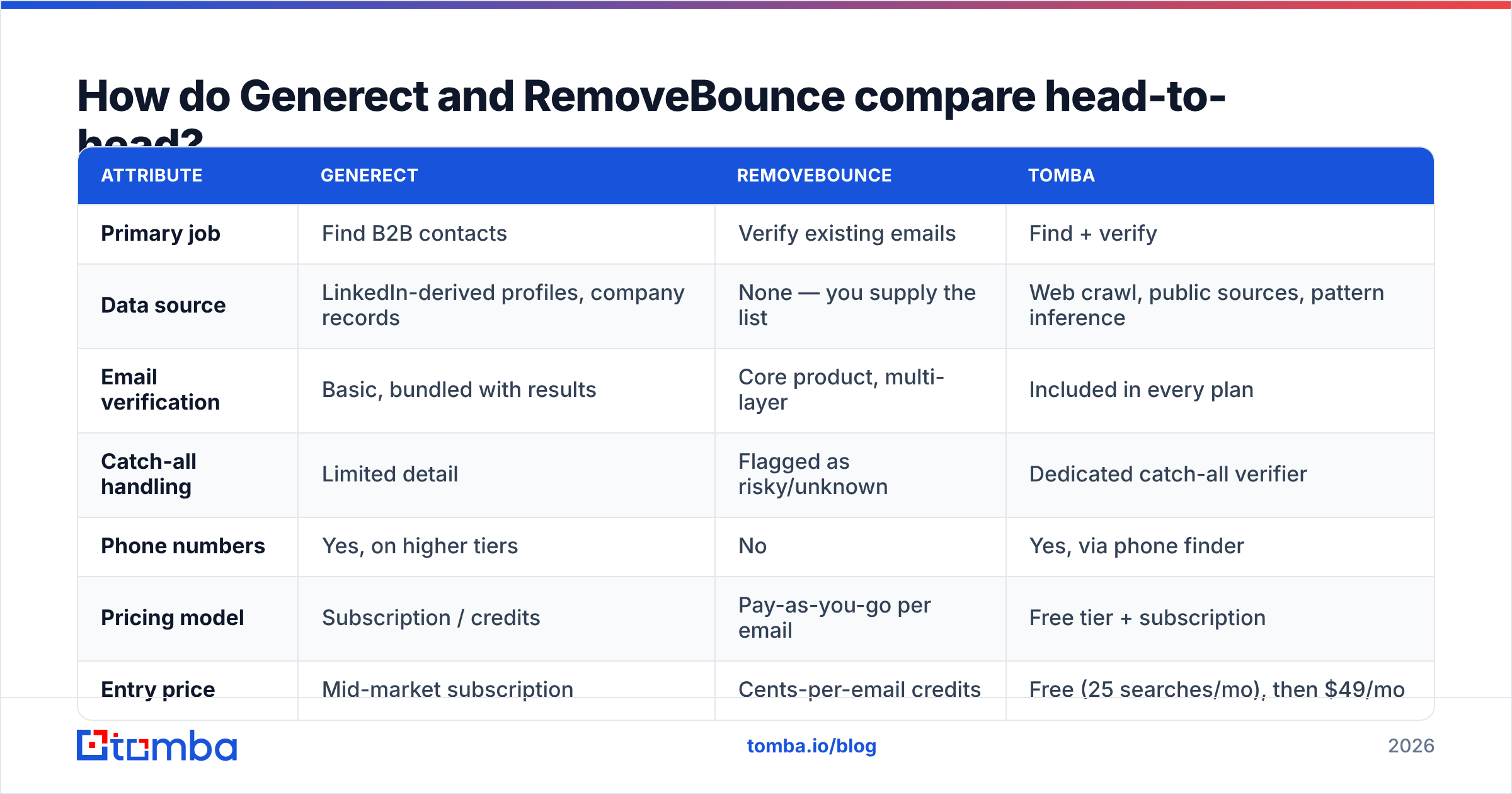
Here is the practical breakdown. Pricing on both platforms changes, and both use credit-based models that vary by volume, so treat the figures as directional and confirm on the vendor's own page before you commit budget.
| Attribute | Generect | RemoveBounce | Tomba |
|---|---|---|---|
| Primary job | Find B2B contacts | Verify existing emails | Find + verify |
| Data source | LinkedIn-derived profiles, company records | None — you supply the list | Web crawl, public sources, pattern inference |
| Email verification | Basic, bundled with results | Core product, multi-layer | Included in every plan |
| Catch-all handling | Limited detail | Flagged as risky/unknown | Dedicated catch-all verifier |
| Phone numbers | Yes, on higher tiers | No | Yes, via phone finder |
| Pricing model | Subscription / credits | Pay-as-you-go per email | Free tier + subscription |
| Entry price | Mid-market subscription | Cents-per-email credits | Free (25 searches/mo), then $49/mo |
| API access | Yes, core to product | Yes | Yes, all paid plans |
| Best for | Building lists from scratch | Cleaning lists you inherited | Teams that need both in one bill |

The pattern is consistent across every serious evaluation: sourcing tools and verification tools optimize for different failure modes. A sourcing tool is judged on coverage — how many of your target accounts it can actually return a contact for. A verifier is judged on precision — how rarely it labels a dead address "valid." Those are different engineering problems, and vendors that claim to be world-class at both deserve scrutiny.

How accurate is each tool in practice?#
Accuracy claims in this category are close to meaningless without a definition, so here is the one that matters: accuracy = the percentage of addresses you send to that do not bounce. Everything else is marketing.

For Generect, accuracy depends on how fresh the underlying profile data is. LinkedIn-derived datasets decay fast — roughly 2–2.5% of B2B contacts change jobs every month, which compounds to about a quarter of your list going stale in a year. A vendor that re-crawls weekly will beat one that re-crawls quarterly, regardless of who has the bigger database. Ask any sourcing vendor, Generect included, how often records are refreshed, not how many records they hold.
For RemoveBounce, accuracy is about SMTP interrogation quality and how it treats ambiguity. The hard cases are:
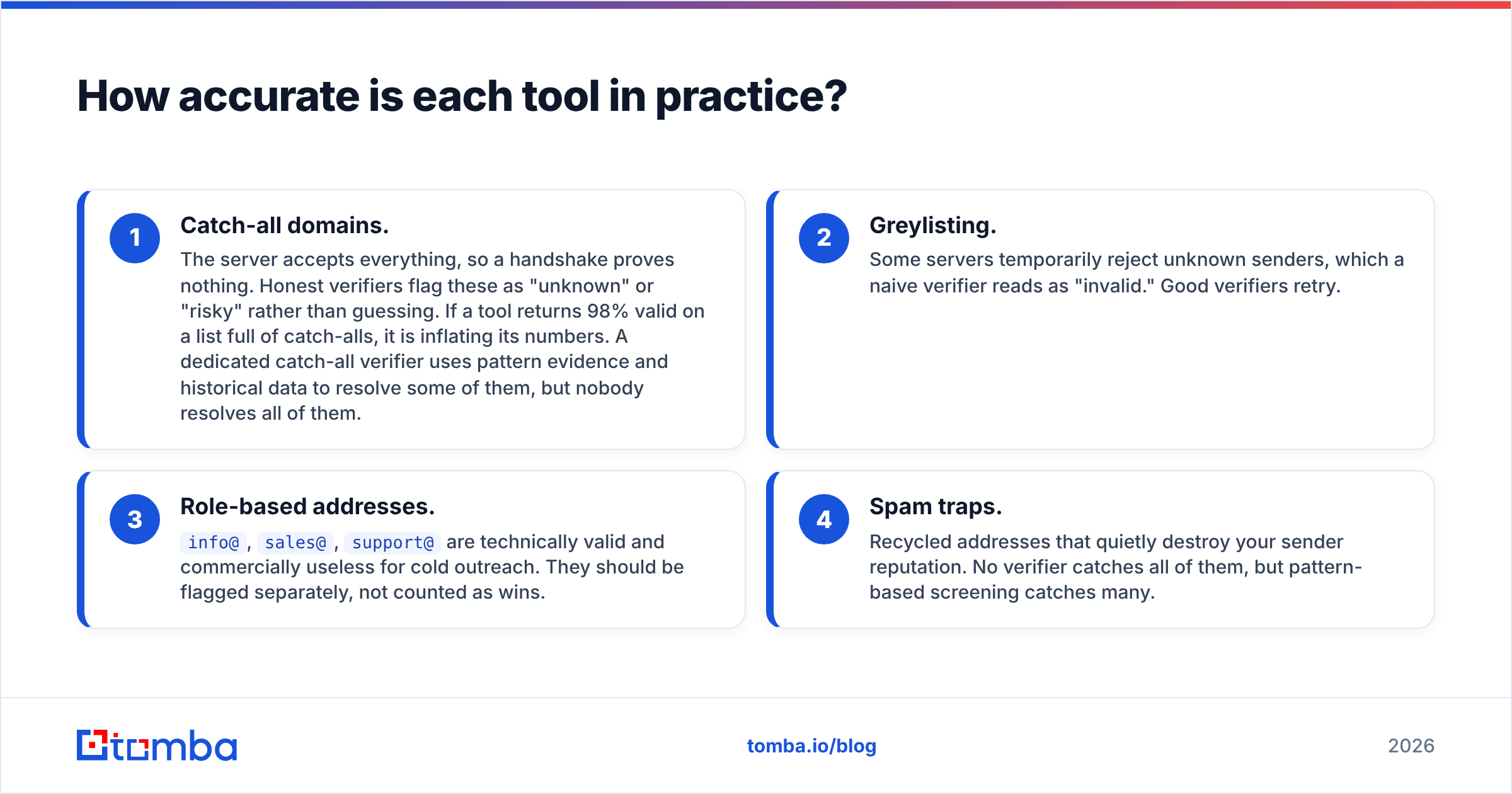
- Catch-all domains. The server accepts everything, so a handshake proves nothing. Honest verifiers flag these as "unknown" or "risky" rather than guessing. If a tool returns 98% valid on a list full of catch-alls, it is inflating its numbers. A dedicated catch-all verifier uses pattern evidence and historical data to resolve some of them, but nobody resolves all of them.
- Greylisting. Some servers temporarily reject unknown senders, which a naive verifier reads as "invalid." Good verifiers retry.
- Role-based addresses.
info@,sales@,support@are technically valid and commercially useless for cold outreach. They should be flagged separately, not counted as wins. - Spam traps. Recycled addresses that quietly destroy your sender reputation. No verifier catches all of them, but pattern-based screening catches many.
Benchmark both tools yourself before you scale. Take 200 addresses you already know the outcome of — from a real send with real bounce data — and run them through. That single test tells you more than any G2 grid. Speaking of which, G2's category pages are useful for spotting support complaints and billing friction, which vendor sites never surface.
What does each one actually cost in 2026?#
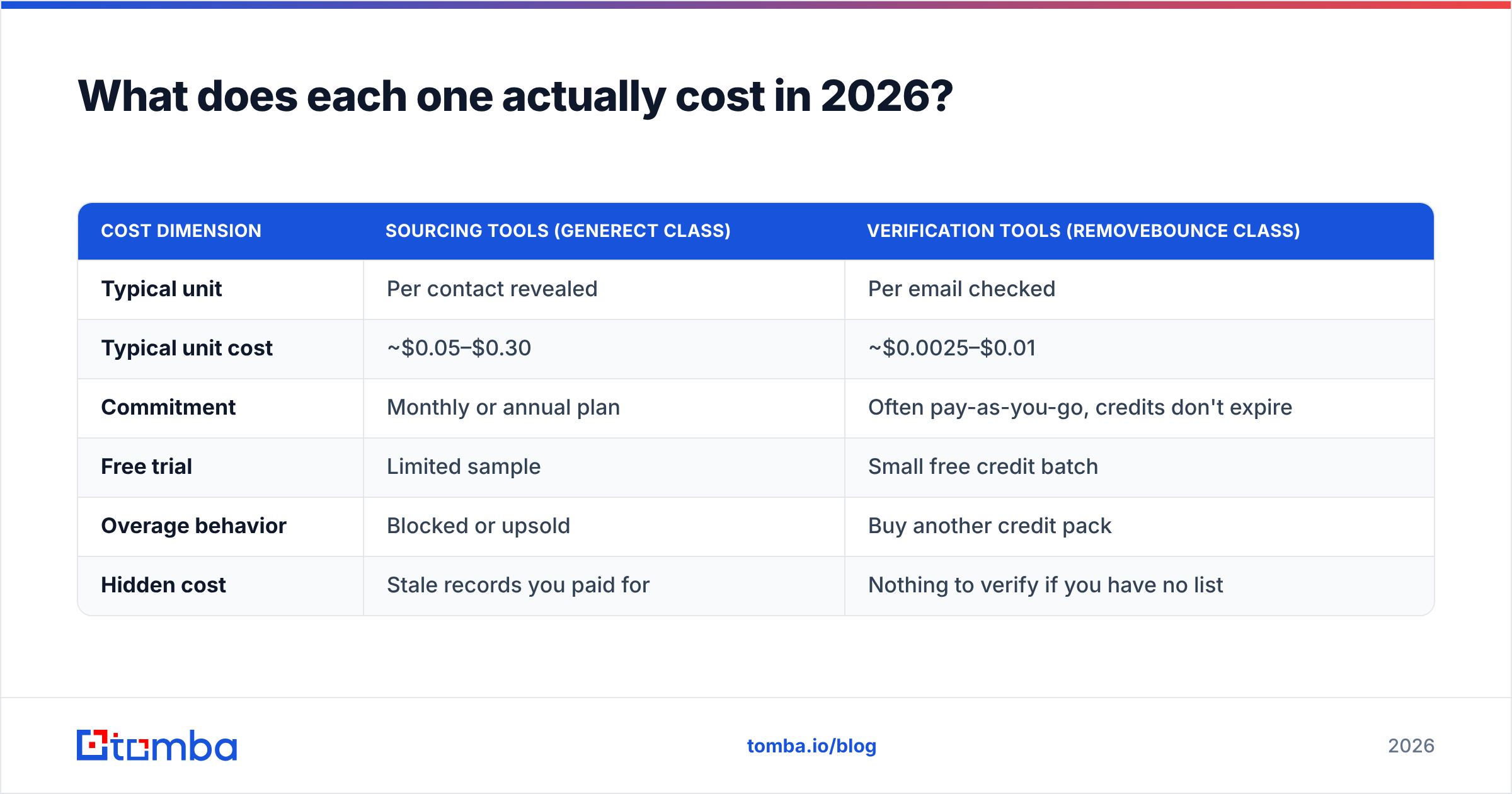
Cost comparison is awkward here because the units are different. Generect sells contacts. RemoveBounce sells verifications. A "credit" means something different on each platform.
Rough shape of the market, so you can sanity-check quotes:
| Cost dimension | Sourcing tools (Generect class) | Verification tools (RemoveBounce class) |
|---|---|---|
| Typical unit | Per contact revealed | Per email checked |
| Typical unit cost | ~$0.05–$0.30 | ~$0.0025–$0.01 |
| Commitment | Monthly or annual plan | Often pay-as-you-go, credits don't expire |
| Free trial | Limited sample | Small free credit batch |
| Overage behavior | Blocked or upsold | Buy another credit pack |
| Hidden cost | Stale records you paid for | Nothing to verify if you have no list |
The takeaway: verification is cheap and sourcing is not. Verifying 50,000 addresses might cost less than sourcing 500 new ones. That asymmetry is why "just add a verifier" feels like an easy yes and why teams end up with three or four data vendors before anyone audits the stack.
If you want a fixed reference point, Tomba pricing runs a free tier at 25 searches per month, Starter at $49/mo, Growth at $99/mo, Pro at $249/mo, and custom Enterprise — with finding and verification drawing from the same pool rather than two separate meters.
Who should choose Generect?#
Pick a sourcing platform like Generect when these describe you:
- You are starting from zero. No CRM history, no exported list, no inbound. You need names before you need hygiene.
- Your ICP is defined by LinkedIn-shaped attributes. Job title, seniority, department, headcount, funding stage. If your targeting is based on technographics or web behavior instead, a LinkedIn-derived dataset is a weaker fit.
- You want programmatic access. Generect's API-first design suits teams building lead flow into their own product or ops pipeline, not just downloading CSVs.
- You are running an agency. Multiple client ICPs, high monthly volume, and a need to refill lists constantly.
Where it gets expensive: if you only need a few hundred contacts a month, a full sourcing subscription is heavy. And if your list problem is quality rather than quantity, you're paying to solve the wrong bottleneck.
Who should choose RemoveBounce?#
Pick a verification-only tool when:
- You inherited a list. Trade-show scans, an old marketing database, a merged CRM, or a partner's file. All of it needs washing before it touches your sending domain.
- Your bounce rate is above 3%. That is the threshold where mailbox providers start treating you as a risk. Verification is the fastest fix available.
- You already have a source you like. If your sourcing tool works and only its verification layer is weak, bolting on a specialist is rational.
- Volume is spiky. Pay-as-you-go credits beat a subscription when you clean 100k addresses in March and nothing in April.
Where it falls short: it is a single-purpose product. The moment your problem becomes "I need 2,000 new contacts at Series B fintechs," RemoveBounce has nothing to offer, and you are back to shopping.
Do you actually need both tools?#
Sometimes yes. Often no. Work through this in order:
- Do you have a list right now? If no, verification is premature. Buy sourcing first. If yes, continue.
- Where did the list come from? Data sourced in the last 30 days from a vendor with built-in verification usually does not need a second pass. Anything older than 90 days does.
- What is your actual bounce rate? Send a 200-address test batch and measure. Under 2% and you have no verification problem to solve. Over 5% and you have an urgent one.
- How many vendors can your ops team maintain? Every extra tool is another API key, another billing cycle, another support queue, and another schema to map into your CRM.
- Is your spend concentrated or scattered? Two mid-tier subscriptions frequently cost more than one consolidated plan that covers both jobs at your volume.
If you land on "I need both functions but I don't want both vendors," that is exactly the gap consolidated platforms fill.
Where does Tomba fit into this comparison?#
Tomba sits deliberately in the middle: it is an email finder first, with verification, enrichment, and phone lookup running on the same credits and the same account.
That means the workflow that requires two vendors elsewhere collapses into one call. You run a domain search against a target company, get back named contacts with role and department, and each result arrives already scored by the email verifier. Catch-all domains route to a dedicated resolver instead of being dumped into an "unknown" bucket you have to deal with later.
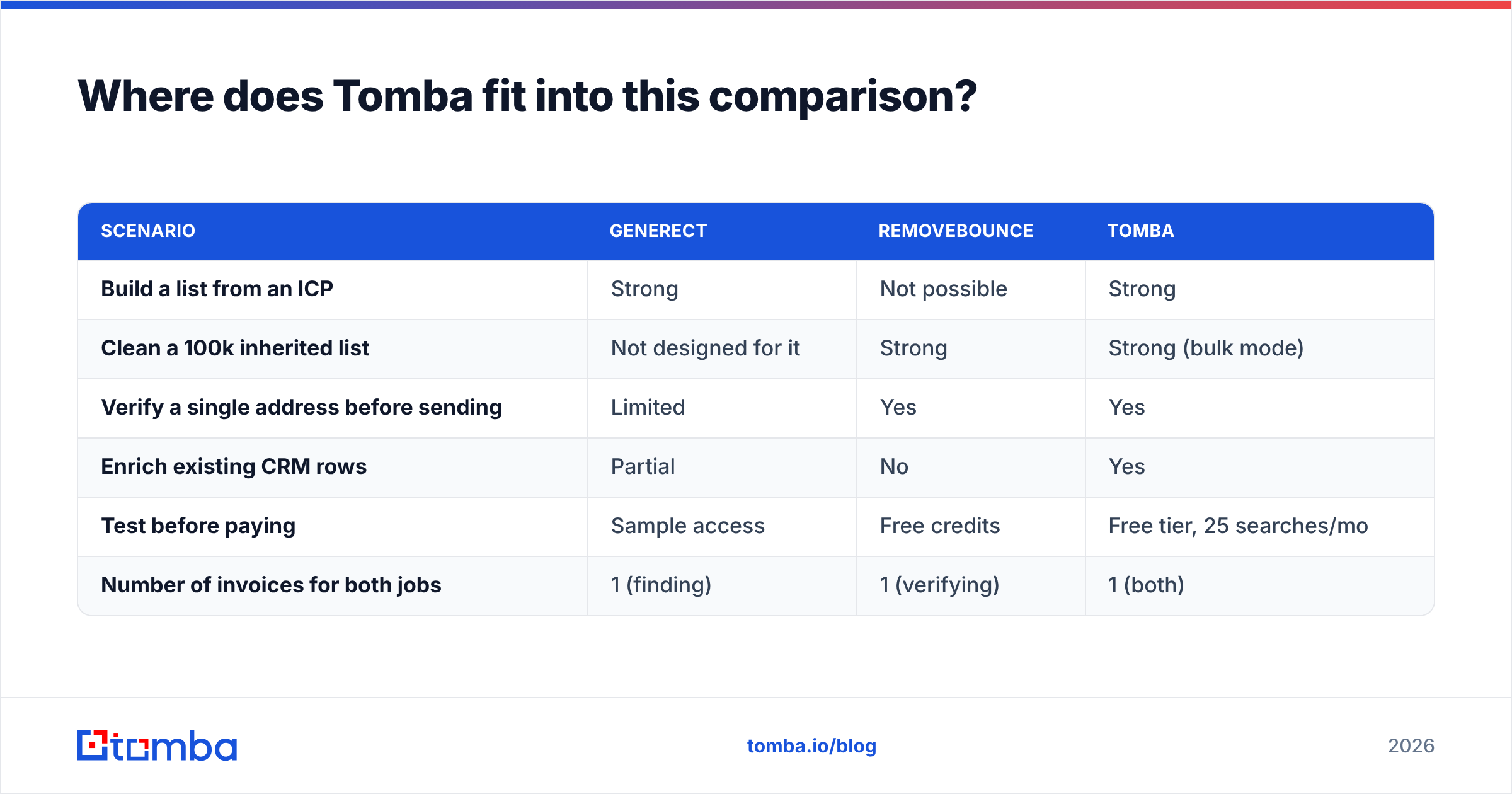
Practical differences against the two tools in this post:
| Scenario | Generect | RemoveBounce | Tomba |
|---|---|---|---|
| Build a list from an ICP | Strong | Not possible | Strong |
| Clean a 100k inherited list | Not designed for it | Strong | Strong (bulk mode) |
| Verify a single address before sending | Limited | Yes | Yes |
| Enrich existing CRM rows | Partial | No | Yes |
| Test before paying | Sample access | Free credits | Free tier, 25 searches/mo |
| Number of invoices for both jobs | 1 (finding) | 1 (verifying) | 1 (both) |
Tomba is not the right answer for everyone. If your entire targeting model depends on LinkedIn-specific filters that only a LinkedIn-derived dataset exposes, a specialist sourcing tool will serve you better. And if you genuinely only ever verify — you never source — a pure pay-as-you-go verifier will be cheaper per unit. Consolidation wins when you do both regularly, which describes most outbound teams.
Worth noting: you don't have to guess about coverage. Run the same 50 target domains through all three, count how many return a deliverable, role-relevant contact, and divide by cost. That's a two-hour test that beats a two-week trial.
What is the verdict on Generect vs RemoveBounce?#
They are not substitutes, so there is no single winner — but there is a right sequence.
- No list? Start with sourcing. Generect if your ICP is LinkedIn-shaped and you want API-first access. A general email finder if you're working from domains and company names.
- Dirty list? Start with verification. RemoveBounce is a clean, single-purpose choice with pay-as-you-go pricing and no subscription lock-in.
- Both problems, one budget? Consolidate. Two specialist subscriptions usually cost more than one platform covering both, and the ops overhead of two vendors is real even when the invoices look small.
The failure mode to avoid is buying a verifier to fix a sourcing problem. A perfectly clean list of the wrong 5,000 people converts at zero. Deliverability is a floor, not a strategy — get it right, then spend your attention on targeting and messaging, where the actual response rate is won.
Try it before you commit. The Tomba Email Finder gives you 25 searches a month free, with verification included on every result — enough to run a real head-to-head against whatever you're using now. Pull 25 contacts from your top target accounts, send to them, and measure the bounce rate yourself. If it holds under 2%, you've replaced two line items with one.
Related guides#
Ready to find emails that actually work?
Join 150,000+ professionals who stopped guessing and started sending. Free credits on signup — no credit card required.
Get the Tomba newsletter
Practical outbound tactics and product updates — once every two weeks.
About the author