Generect vs Voila Norbert: Which Email Finder Wins in 2026?
Generect sells LinkedIn-native lead lists. Voila Norbert sells simple name-plus-domain lookups. We compare accuracy, pricing, API depth, and workflow fit — plus where a third option beats both.
Generect vs Voila Norbert is a choice between two jobs. One tool builds lists for you. The other looks up people you have already named. Pick the wrong one and you pay for a machine you never open.
TL;DR
- Generect is a LinkedIn-first lead database. You set filters, and it hands back rows of people with emails attached. Best when you want lists, not lookups.
- Voila Norbert is a veteran single-purpose email finder. Give it a first name, last name, and domain. It returns one address. Best when you already know who you want.
- Accuracy is close on large B2B domains. Both slip on small companies, catch-all domains, and non-US TLDs. Norbert slips harder, because it has no database to fall back on.
- Pricing works in different units. Norbert bills per lead found, and meters verification on its own line. Generect bills per seat or volume, with LinkedIn scraping included.
- Neither ships a serious developer platform. Need an API, a bulk pipeline, catch-all handling, and enrichment on one bill? Look at Tomba pricing first.
What are Generect and Voila Norbert, exactly?#
They solve the same problem — "get me a working email for this person" — from opposite ends.
Voila Norbert launched in 2014, and it is one of the older names here. The loop is narrow on purpose. You type a person's name and a company domain. It guesses the pattern, checks it at the mail server, and returns one address with a confidence label. Around that core sit a bulk CSV upload, a Chrome extension, a verification product, and a Zapier link. That is the whole surface. The plain design is the point. There is nothing to learn.
Generect is newer and built around LinkedIn. You do not start with a name. You start with a filter: industry, headcount, geography, job title, tech stack. Generect then returns a list of matching people with company data and contact details. It sells itself as a lead database with a scraping layer over LinkedIn and Sales Navigator. Teams can also use the API to pipe lists into their own systems.
The practical split: Norbert answers a question you bring it. Generect writes the question for you.
That one difference drives the rest — pricing shape, data freshness, failure modes, and who on your team logs in.

Generect vs Voila Norbert: how do they compare head-to-head?#
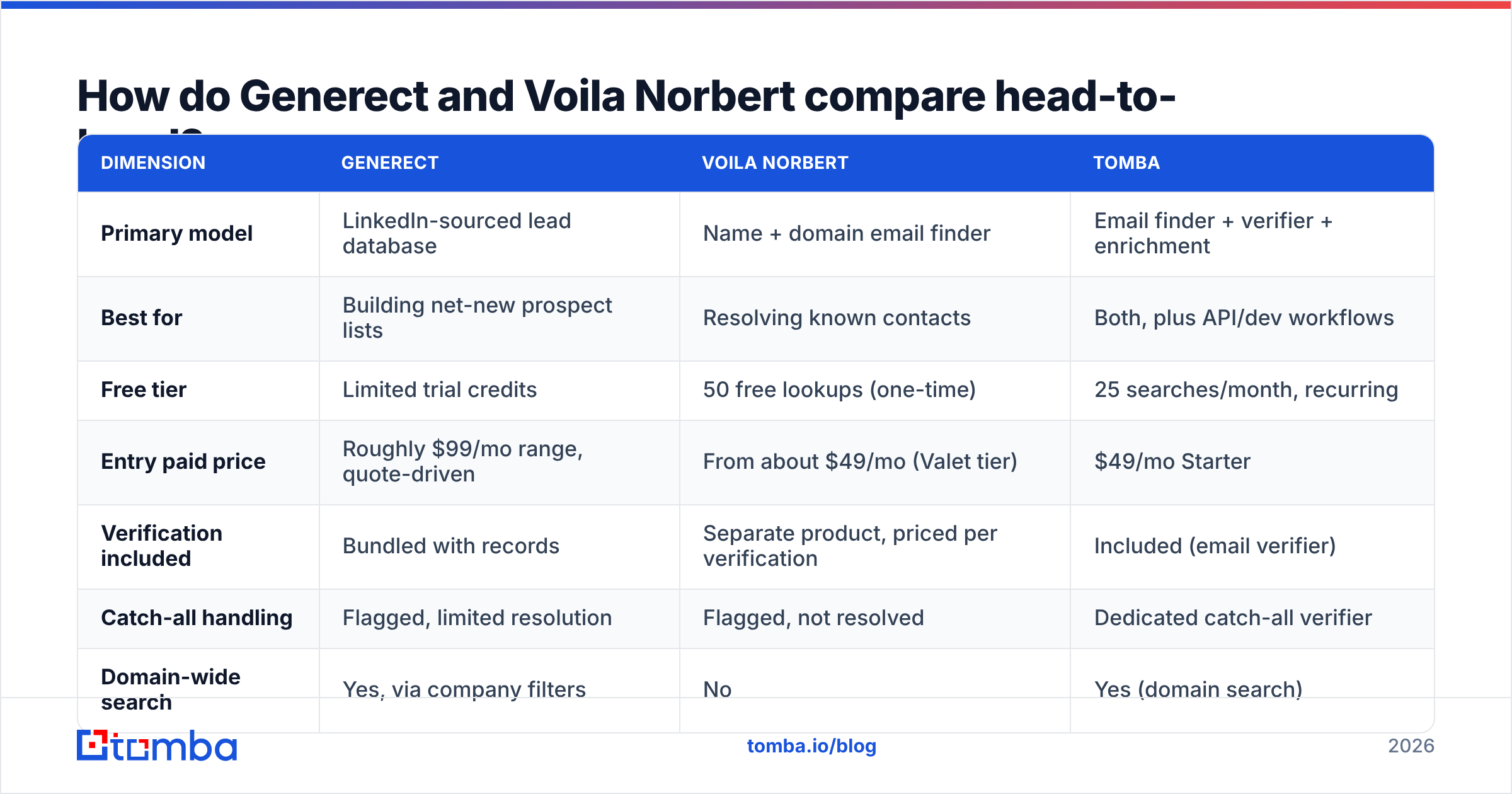
| Dimension | Generect | Voila Norbert | Tomba |
|---|---|---|---|
| Primary model | LinkedIn-sourced lead database | Name + domain email finder | Email finder + verifier + enrichment |
| Best for | Building net-new prospect lists | Resolving known contacts | Both, plus API/dev workflows |
| Free tier | Limited trial credits | 50 free lookups (one-time) | 25 searches/month, recurring |
| Entry paid price | Roughly $99/mo range, quote-driven | From about $49/mo (Valet tier) | $49/mo Starter |
| Verification included | Bundled with records | Separate product, priced per verification | Included (email verifier) |
| Catch-all handling | Flagged, limited resolution | Flagged, not resolved | Dedicated catch-all verifier |
| Domain-wide search | Yes, via company filters | No | Yes (domain search) |
| Phone numbers | Yes, on higher tiers | No | Yes, via phone finder |
| Public API | Yes | Yes, basic | Yes, documented (Tomba API) |
| Bulk CSV | Yes | Yes | Yes, plus Sheets/Excel add-ins |
| Chrome extension | Yes (LinkedIn overlay) | Yes | Yes |
The table hides one point worth saying out loud. These two tools rarely chase the same buyer. An SDR manager who needs a 5,000-row ICP list will find Norbert close to useless, since you need the names first. A content marketer emailing 40 podcast hosts they already picked will find Generect's list machinery to be pure overhead.
Which one is more accurate?#
Accuracy claims here mean little without context. Treat every vendor's "98%" with care. What really differs is where each tool fails.
Voila Norbert fails quietly. Its engine leans on pattern guesses (first.last@, flast@, first@) checked against the mail server. Many domains now block SMTP probes, run a catch-all, or sit behind Microsoft 365 filtering. That covers most of the mid-market today. In those cases Norbert returns nothing, or a low-confidence guess. On well-known domains with public email patterns, it does well. On a 60-person parts maker in Bavaria, it often comes back empty.
Generect fails on stale data. Its records come from a scraped profile layer. So the email on a person reflects the last refresh, not today. LinkedIn profiles often lag job changes by months. About a third of B2B contacts change roles each year. A database-first tool inherits all of that decay. Generect's coverage is broad, but freshness varies by country and company size.

The fix for both is the same, and it is not optional: verify before you send. A found email is only a guess until you check it. Run every list through verification. That means a live SMTP and syntax check, plus a clear catch-all label, before the list reaches your sequencer. Bounce rates above 3% start to hurt your sender reputation. No finder is accurate enough to save a domain you have already burned.
Norbert bills verification as a separate line. Generect adds a validity flag, but hides the check behind it. Neither one shows you why an address passed.
How does pricing actually work on each?#
Here the comparison gets messy, because the two vendors price different units.
Voila Norbert bills on leads found. A search that returns nothing costs you nothing, which is fair. Plans start near $49 a month for a few hundred leads, then climb through several tiers. Verification runs on its own meter. It is sold in blocks, at fractions of a cent per address. Credits do not roll over forever, so a seasonal push wastes budget.
Generect prices like a database subscription. You commit monthly and pick a volume tier. Prices are often quoted rather than published, and higher bands push annual contracts. Scraping and enrichment come bundled. That makes the sticker look bigger, but the cost per enriched record drops at volume — if you use the volume.
Check three traps before you sign either one:
- Credit expiry. Ask if unused credits roll over month to month. Most do not. A 10,000-credit plan used at 3,000 a month is a 70% overpay.
- Charged on null. Norbert does not charge for a miss. Confirm the same with any database vendor. Some take a credit for every row returned, even when the email field is empty.
- Double billing on verification. You pay to find an address, then pay again to confirm it. Your true cost per usable contact is often two to three times the headline rate.
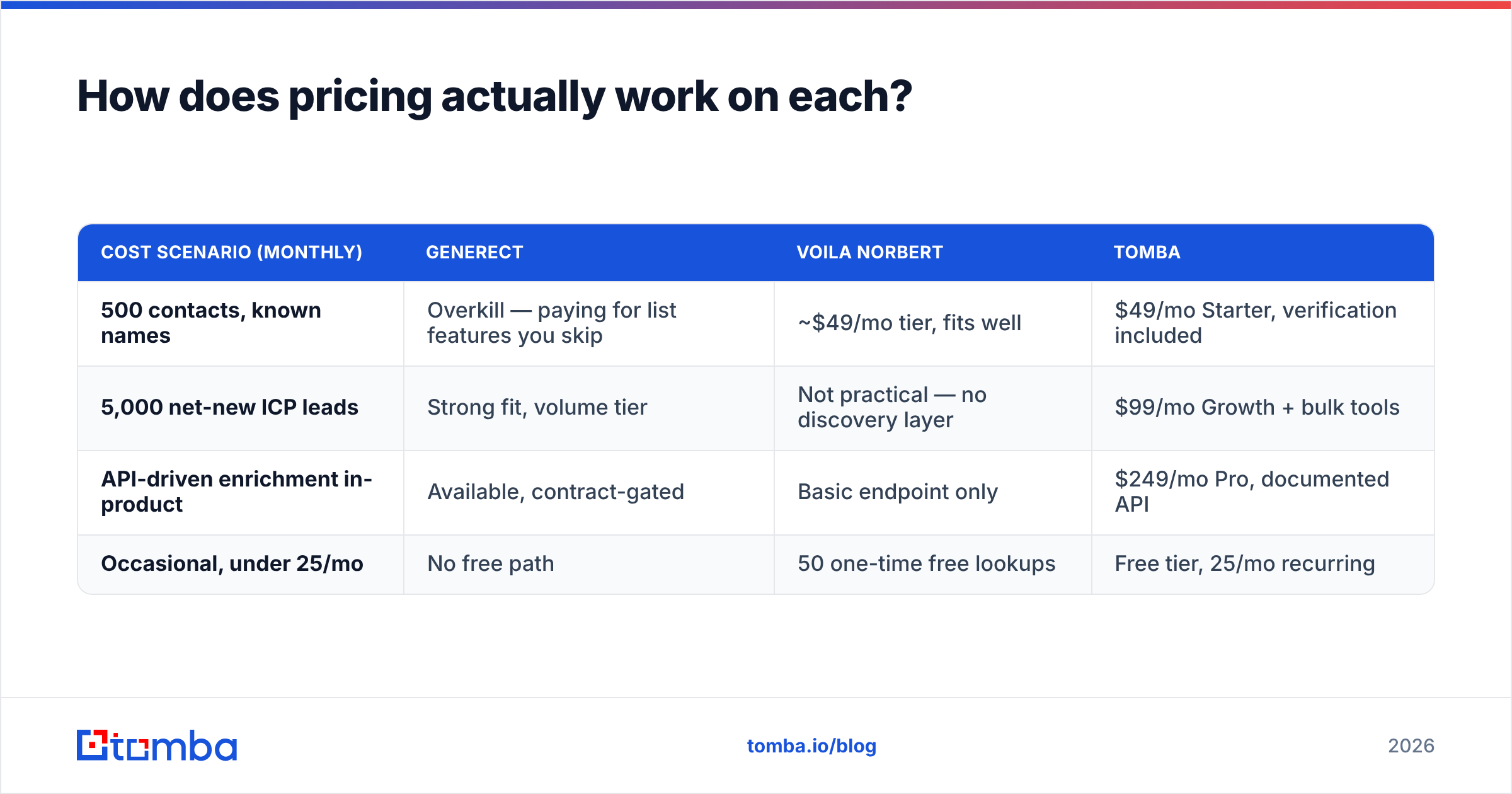
| Cost scenario (monthly) | Generect | Voila Norbert | Tomba |
|---|---|---|---|
| 500 contacts, known names | Overkill — paying for list features you skip | ~$49/mo tier, fits well | $49/mo Starter, verification included |
| 5,000 net-new ICP leads | Strong fit, volume tier | Not practical — no discovery layer | $99/mo Growth + bulk tools |
| API-driven enrichment in-product | Available, contract-gated | Basic endpoint only | $249/mo Pro, documented API |
| Occasional, under 25/mo | No free path | 50 one-time free lookups | Free tier, 25/mo recurring |
Under a hundred lookups a month, both paid tools are hard to justify. A recurring free tier plus a free email checker covers that volume with no subscription.
Is Generect better than Voila Norbert for outbound teams?#
For real outbound at volume: yes, Generect fits the workflow better. Two caveats come with that.
The outbound loop runs in five steps: define ICP, build list, enrich, verify, sequence. Norbert touches step three only, and only after someone produces names. So you export from LinkedIn Sales Navigator by hand, clean the CSV, then upload it. Generect folds steps two and three into one query. That saves real time when you rebuild lists every week.
Caveat one: LinkedIn data carries a compliance question. Scraped profile data meets GDPR legitimate-interest rules in ways your legal team may want to review, above all for EU contacts. This is not unique to Generect. It applies to most of the LinkedIn-native category. Still, ask the question before you standardize on it. The G2 category listings show how peers describe their own compliance stance.
Caveat two: filter-built lists tempt you to send more than you should. Bounce rates and spam complaints spike after teams adopt a database tool. The tool is not the cause. Building 10,000 rows in ten minutes makes 10,000 sends feel normal. The bill lands on your email deliverability, and recovery takes months.

For targeted outbound — 50 to 200 researched accounts a quarter — Norbert's simplicity wins. You skip paying for a discovery engine you never open, and per-found-lead billing matches how you work.
What are the best Generect and Voila Norbert alternatives?#
Both tools leave the same gap. Neither is a full contact-data layer you can build on.
If you need an API and a pipeline, not a dashboard, the limits that matter are docs and steady rate limits. Tomba's email finder API exposes finder, verifier, domain search, and enrichment as separate endpoints on one key. A CLI and an MCP server cover agent-driven workflows. Norbert's API works, but it is thin. Generect's sits behind a contract.
If catch-all domains are your bottleneck, this is the least-served problem in the category. Most tools flag a catch-all and stop there. A dedicated catch-all finder tries to resolve it instead. That matters, because catch-all setups now cover a large slice of mid-market domains.
If you're buying prebuilt B2B lists, providers like BookYourData take another route. You pay as you go for prebuilt, verified records, with no subscription. That fits one-off campaigns where you do not want a monthly line item, and it dodges the credit-expiry trap.
If your workflow lives in a spreadsheet, skip both dashboards. A Google Sheets or Excel add-in enriches in place. That removes the export-import cycle, which quietly eats an hour a week.

How should you choose between them?#
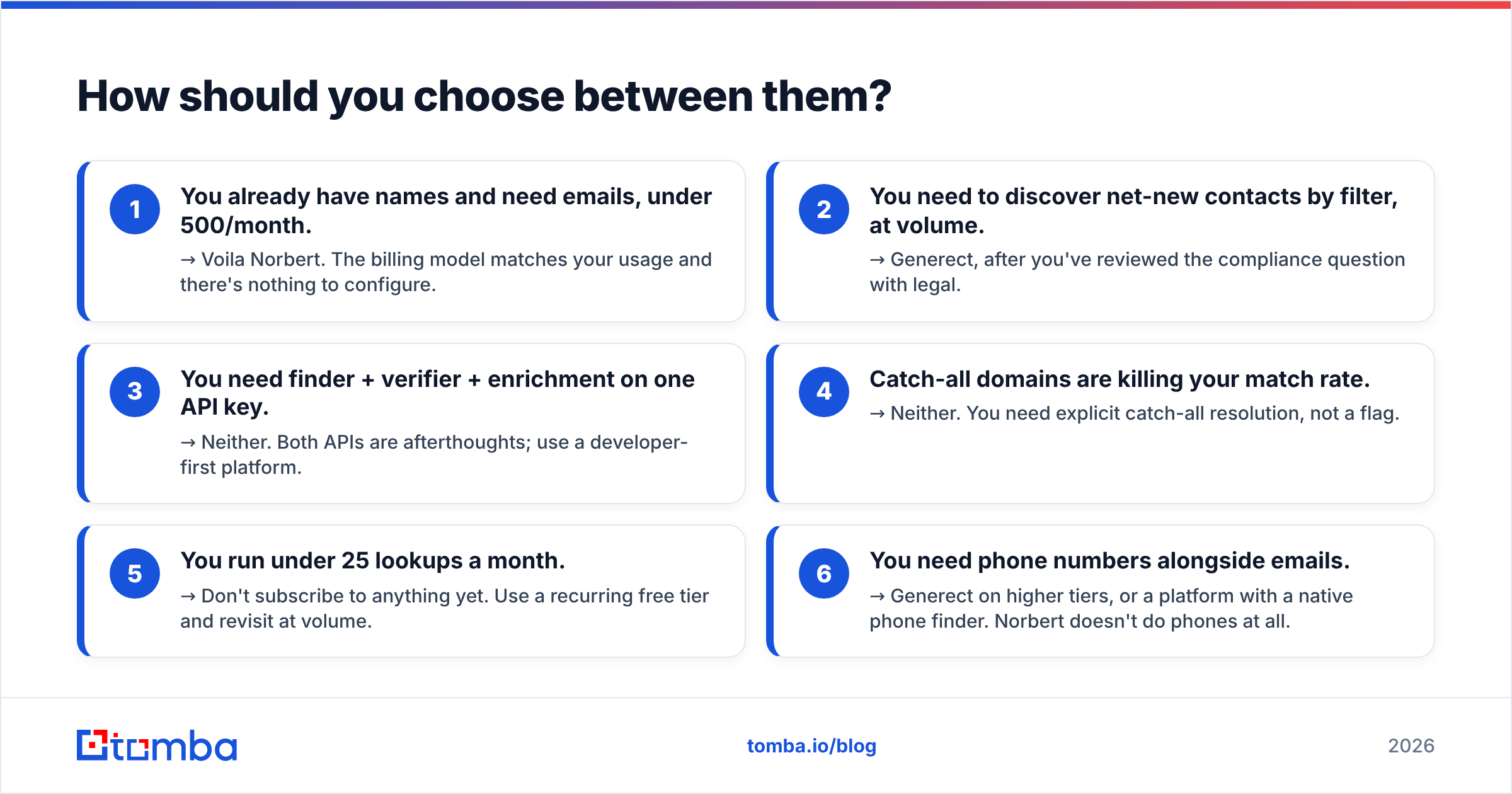
Run this list in order. Stop at the first line that matches you.
- You have names and need emails, under 500 a month. → Voila Norbert. The billing matches your usage, and there is nothing to set up.
- You need to find net-new contacts by filter, at volume. → Generect, once legal has reviewed the compliance question.
- You need finder, verifier, and enrichment on one API key. → Neither. Both APIs are afterthoughts. Use a developer-first platform.
- Catch-all domains are killing your match rate. → Neither. You need real catch-all resolution, not a flag.
- You run under 25 lookups a month. → Do not subscribe yet. Use a recurring free tier and revisit at volume.
- You need phone numbers too. → Generect on higher tiers, or a platform with a native phone finder. Norbert does not do phones at all.
One habit beats tool choice: check the company's email pattern before you run anything at scale. A quick company email pattern lookup tells you whether a domain uses first.last@ or flast@. Then you can sanity-check whatever your finder returns. When a tool hands back an address that breaks the known pattern, verify harder — or drop it.
What does this mean for your stack in 2026?#
The email-finder market has split in two. On one side sit list-building databases that scrape a social graph and sell you volume. On the other sit lookup tools that resolve one contact at a time. Generect vs Voila Norbert is a clean example of that split.
The best teams in 2026 do not pick a side. They build a thin stack: one discovery source, one finder, one verifier, and a verification step that is never skipped. More of them now buy that from one vendor, because three credit meters means three places to overpay. Analysts like Forrester keep pointing at data fragmentation, not data volume, as the drag on B2B pipeline. Every extra contact-data vendor is one more fragment.
Whichever way you go, budget for verification up front, not later. The cheapest email you will ever find is the one that does not bounce.
Ready to skip the finder-versus-finder trade-off? The Tomba Email Finder covers name-and-domain lookups, full domain search, catch-all resolution, and built-in verification on one plan. It is free at 25 searches a month, $49/mo on Starter, $99/mo on Growth, with a documented API on Pro. Test it against your hardest 50 contacts — the ones both tools missed — and compare the match rate yourself.
Related guides#
Ready to find emails that actually work?
Join 150,000+ professionals who stopped guessing and started sending. Free credits on signup — no credit card required.
Get the Tomba newsletter
Practical outbound tactics and product updates — once every two weeks.
About the author