Generect vs Warpleads (2026): Which B2B Lead Data Tool Wins?
Generect sells LinkedIn-native, real-time lead extraction. Warpleads sells unlimited export volume. We break down accuracy, pricing, data freshness, and which one actually fits your outbound motion in 2026.
Generect vs Warpleads is a choice between fresh data and cheap volume. Generect pulls leads live from LinkedIn. Warpleads sells huge exports from a stored database. This guide compares both on accuracy, price, and export limits — and shows where each one falls short.
TL;DR
Generect is a LinkedIn-native lead extractor. It pulls contacts in real time from LinkedIn and Sales Navigator searches. There is no pre-built static database behind it. Best when your ICP lives on LinkedIn and freshness beats raw volume.
Warpleads is an export-volume play. It sells unlimited exports from a large B2B database, plus an on-demand scraping layer. Best when you need tens of thousands of rows a month and you already verify them.
Neither is a verification tool. Both hand you emails. Neither proves the address will accept mail. Budget for a separate verifier either way.
The pricing shape differs more than the price. Generect meters credits against live lookups. Warpleads sells plans with high or uncapped export ceilings. That changes your cost per usable contact, not your cost per row.
Our pick: Generect for precision ABM and LinkedIn prospecting. Warpleads for high-volume teams that verify hard. If you mainly need accurate work emails by domain, plus an API to get them at scale, a dedicated finder like Tomba is the cheaper spine under either one.
What are Generect and Warpleads, exactly?#
Both answer the same question — who should I contact — from opposite directions.
Generect is a real-time LinkedIn data engine. You give it a LinkedIn or Sales Navigator search URL. It returns structured lead records: name, title, company, work email, sometimes phone. The data is pulled at query time, not from a cache built months ago. An API lets teams wire lead pulls into their own systems. The core promise is recency. The job title you see is the title on the profile today.
Warpleads is a data warehouse with a very generous tap. The headline is unlimited, or near-unlimited, exports from a database of hundreds of millions of records. An on-demand scraping mode covers lists the stored database handles poorly. The core promise is volume economics. Stop rationing credits, and stop paying per row.
That gap explains almost every trade-off below. Live extraction costs more per record and runs slower, so vendors meter it. Warehouse data is cheap and instant, so vendors uncap it. The catch is decay. Those records age between refreshes.
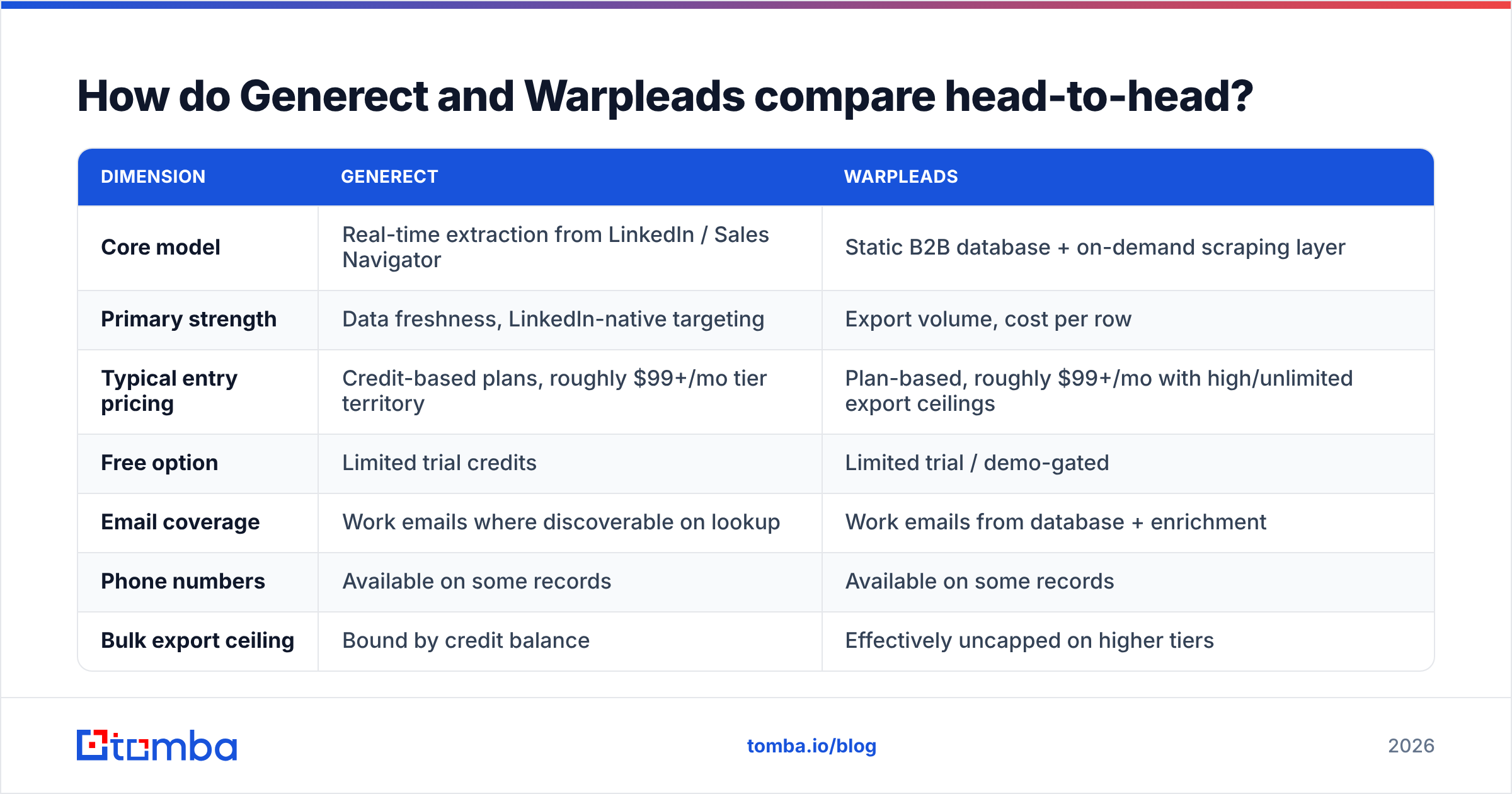
Generect vs Warpleads: how do they compare head-to-head?#
Here is the practical breakdown. Treat pricing as directional. Both vendors move their tiers, and neither posts a full rate card for every plan.
| Dimension | Generect | Warpleads |
|---|---|---|
| Core model | Real-time extraction from LinkedIn / Sales Navigator | Static B2B database + on-demand scraping layer |
| Primary strength | Data freshness, LinkedIn-native targeting | Export volume, cost per row |
| Typical entry pricing | Credit-based plans, roughly $99+/mo tier territory | Plan-based, roughly $99+/mo with high/unlimited export ceilings |
| Free option | Limited trial credits | Limited trial / demo-gated |
| Email coverage | Work emails where discoverable on lookup | Work emails from database + enrichment |
| Phone numbers | Available on some records | Available on some records |
| Bulk export ceiling | Bound by credit balance | Effectively uncapped on higher tiers |
| API access | Yes, positioned as a core feature | Available, less central to the pitch |
| Built-in verification | Basic / limited | Basic / limited |
| Best-fit team | ABM, recruiting, precision outbound | High-volume SDR teams, agencies |
| Weakest point | Cost per record at scale | Record staleness between refreshes |
The last two rows matter most. You are picking between two costs. Pay more per record and get today's data. Or pay less per record and filter out the stale ones yourself.
Which one has better data accuracy?#
Short answer: Generect wins on profile accuracy. Warpleads wins on coverage. Neither wins on email deliverability without help.
Most comparison posts blur these three:
- Profile accuracy — is this person still in this role at this company? Live LinkedIn extraction is better here. A database that refreshed six months ago will hand you a VP who left in March.
- Coverage — how much of your target list has a record at all? Large databases usually win. They pull from many sources, not from one platform.
- Email validity — will the mail server accept this address? That is a different question. Neither tool is built to answer it.
Teams get burned on the third point. A record can be current — right person, right company, right title — and still carry a guessed email that bounces. B2B contact data decays fast. Common estimates put the decay near 2–3% a month. Over a year, that is a quarter of your list or more. Gartner and other analyst firms have flagged bad data as an expensive drag on sales and marketing for years.
The fix is boring. Run every export through an email verifier before it reaches a sending tool. Skip that step and your bounce rate does the QA for you. It does that by wrecking your sender reputation.
Some domains accept every address. That is the catch-all problem. Standard checks return unknown, so most teams either drop the record or send blind. A catch-all verifier recovers many of those without gambling your domain on them.
How does pricing really compare?#
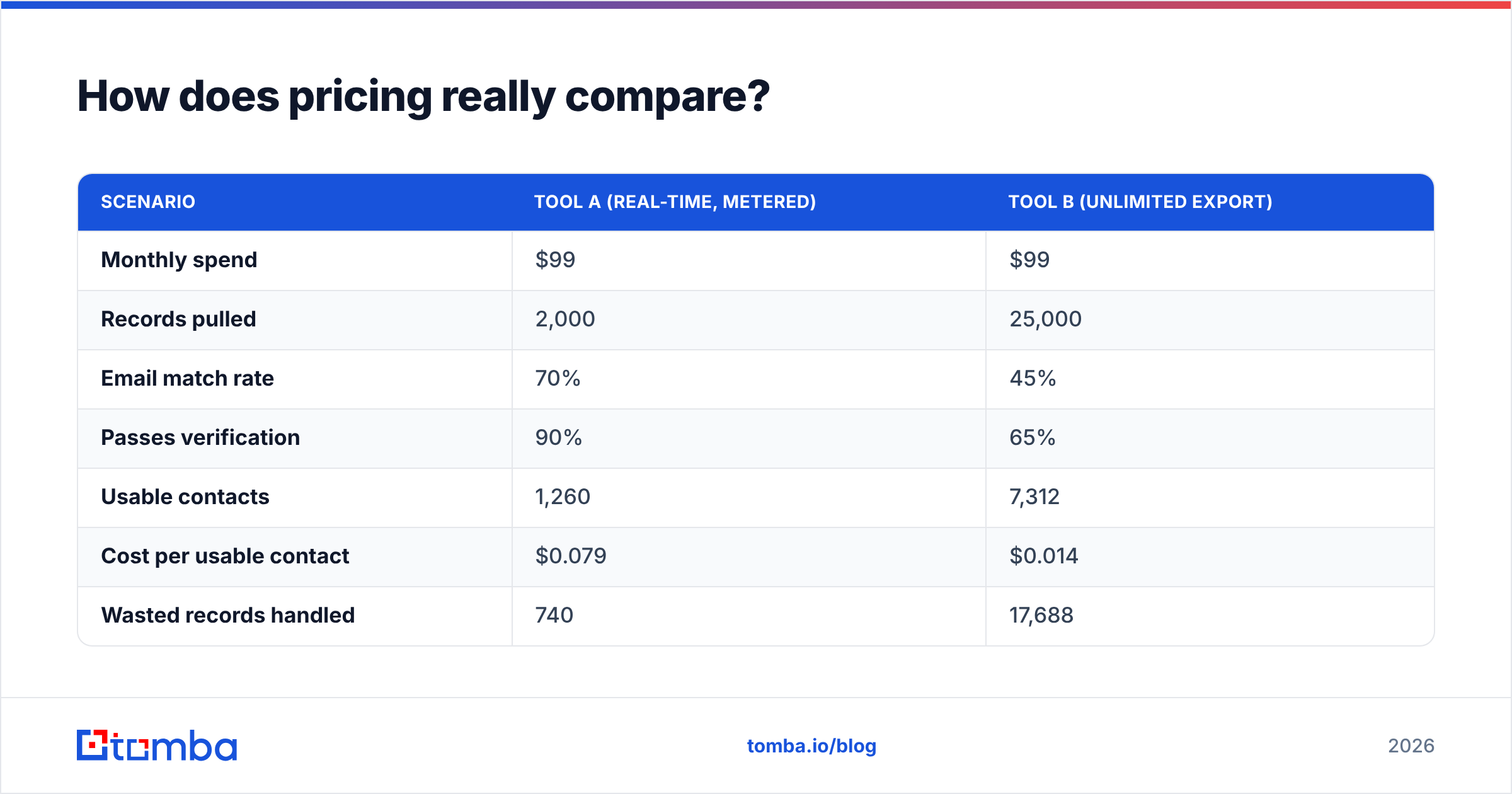
Both tools sit in the same price range. They split on cost per usable contact. That is the only number that should drive the decision.
Run the math this way:
Cost per usable contact = (monthly price) ÷ (records exported × match rate × verified-valid rate)
Two teams can pay the same $99 a month and still land 4x apart.
| Scenario | Tool A (real-time, metered) | Tool B (unlimited export) |
|---|---|---|
| Monthly spend | $99 | $99 |
| Records pulled | 2,000 | 25,000 |
| Email match rate | 70% | 45% |
| Passes verification | 90% | 65% |
| Usable contacts | 1,260 | 7,312 |
| Cost per usable contact | $0.079 | $0.014 |
| Wasted records handled | 740 | 17,688 |
Volume wins on unit cost. Now look at the last row. Those 17,688 dead records still cost you money. You pay for verification credits, storage, dedupe time, and CRM cleanup. That hidden tax is why unlimited plans are not always cheaper in practice.
People also forget the verifier bill. Standalone verifiers charge about $0.001–$0.007 per email, depending on volume. Checking 25,000 records a month is a real invoice, not a rounding error.
Want a clear reference point on tiering? Tomba pricing runs Free (25 searches/mo), Starter at $49/mo, Growth at $99/mo, Pro at $249/mo, and custom Enterprise. Finding and verification sit in one account, not across two vendors.
Is Generect better than Warpleads for LinkedIn prospecting?#
Yes, if LinkedIn is genuinely your main sourcing channel.
Generect treats the LinkedIn search URL as its input. You build a Sales Navigator search with filters you trust — headcount, seniority, geography, recent job change. Then you hand over the URL. You keep LinkedIn's filtering power, which still beats most database filter panels for people-level targeting.
Warpleads can scrape LinkedIn-adjacent sources too. But its center of gravity is the database. You filter inside its own UI, so you inherit its labels for industry and seniority. Those labels are always looser than the source platform's.
Where Generect's model gets uncomfortable:
- Cost scales with curiosity. Every test search burns credits, so you stop exploring new segments.
- Platform dependency. Anything built on LinkedIn lives with LinkedIn's rate limits, layout changes, and terms of service. Read the LinkedIn User Agreement and judge your own risk. Automated extraction sits in contested ground.
- Offline coverage gaps. Much of your ICP — trades, regional manufacturers, government-adjacent buyers — barely uses LinkedIn.
For that last gap, start with the domain instead of the profile. If you already know the companies you want, a domain search returns email patterns and known contacts for that company. Nobody needs a LinkedIn presence for it to work. It is a different search axis, and it often fills the holes LinkedIn tools leave.

Is Warpleads worth it for high-volume outbound?#
It can be, on one condition. You need a verification and dedupe pipeline already running.
The unlimited-export model fits a specific kind of team:
- Agencies with many client ICPs. You build 15 lists a month, and per-record pricing kills the margin.
- Broad-TAM SMB outbound. Your ICP is any US HVAC company with 10–50 staff. Reach matters more than precision.
- List-building for enrichment. You want a wide skeleton of companies and names, then enrich the good ones through a more accurate provider.
- Cheap segment tests. Uncapped exports let you probe five markets without a procurement call.
The failure mode is just as specific. Some teams read unlimited as permission to skip quality control. Sending 25,000 unverified emails is the fastest way to burn a domain. Google and Yahoo have enforced bulk sender rules since 2024. They cap spam complaints at 0.3% and require proper authentication. Check Google's bulk sender guidelines for the current rules. Volume without hygiene is not a strategy. It is a countdown.
If you pick Warpleads, wrap it in a stack. Verify everything. Remove duplicates across lists. Suppress anyone already in your CRM. Warm the sending domain properly. A bulk email finder and a verification pass cost far less than rebuilding a burned domain.
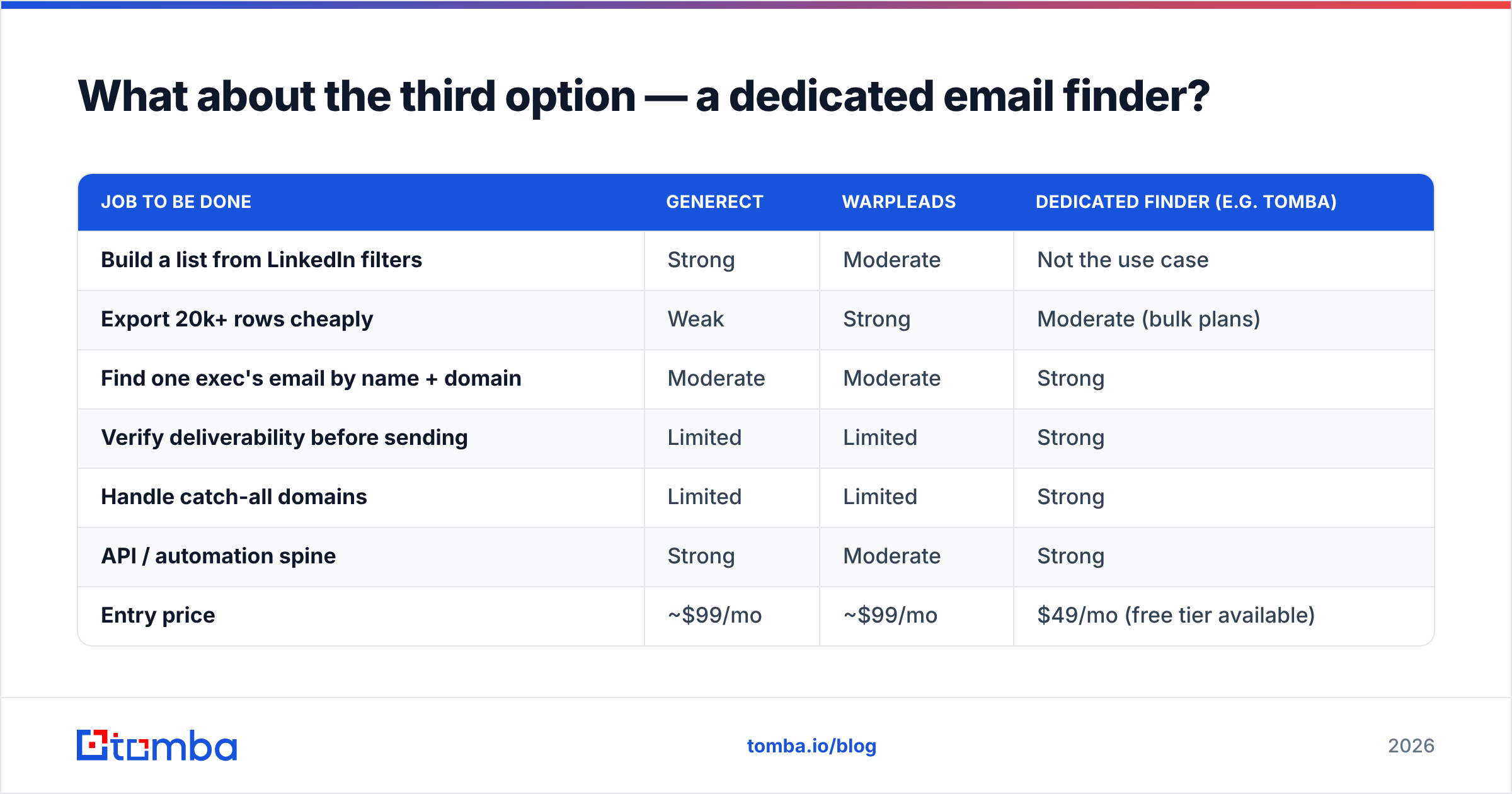
What about the third option — a dedicated email finder?#
Most head-to-head posts skip this, and it is often the right answer.
Generect and Warpleads are both list-building tools. They answer one question: who should I contact. A dedicated email finder answers another: what is the correct, verified address for this person at this company. Those jobs are separate. Splitting them usually lowers total cost.
The setup that works:
- Source the account list from the cheapest place — LinkedIn search, a database export, a conference list, a G2 category page, your own site traffic.
- Resolve contacts by domain with an email finder or domain search. That sidesteps platform risk.
- Verify before you send, catch-all domains included.
- Enrich only what converts. Do not buy firmographics on 25,000 records when 800 will reply.
| Job to be done | Generect | Warpleads | Dedicated finder (e.g. Tomba) |
|---|---|---|---|
| Build a list from LinkedIn filters | Strong | Moderate | Not the use case |
| Export 20k+ rows cheaply | Weak | Strong | Moderate (bulk plans) |
| Find one exec's email by name + domain | Moderate | Moderate | Strong |
| Verify deliverability before sending | Limited | Limited | Strong |
| Handle catch-all domains | Limited | Limited | Strong |
| API / automation spine | Strong | Moderate | Strong |
| Entry price | ~$99/mo | ~$99/mo | $49/mo (free tier available) |
The market is wider than these two. BookYourData sells pay-as-you-go credits with an accuracy guarantee. That suits teams who buy lists now and then instead of subscribing, and it is worth pricing out alongside both. Review sites like G2 help you check vendor claims against recent users, especially on support and refunds for bad data.
Want the resolution layer to be programmable? The Tomba API handles finder and verifier calls in one integration. You avoid stitching two vendors' rate limits together in your enrichment job.
Which should you choose in 2026?#
Match the tool to your motion, not to the feature list. Here is the Generect vs Warpleads decision in short form.
Choose Generect if:
- LinkedIn and Sales Navigator are where your ICP actually is
- You run precision ABM or recruiting, where a wrong title wastes a real conversation
- Your list volume runs in the hundreds to low thousands per month
- You are comfortable with platform-dependency risk
Choose Warpleads if:
- Your outbound math depends on volume, not precision
- You run several ICPs or client accounts at once
- You already have verification, dedupe, and suppression running
- Flat, predictable cost matters more than per-record quality
Choose a dedicated finder + verifier stack if:
- You already know your target accounts and just need correct contacts
- Deliverability is the constraint, which it usually is
- You want an API-first spine that outlives any single data vendor
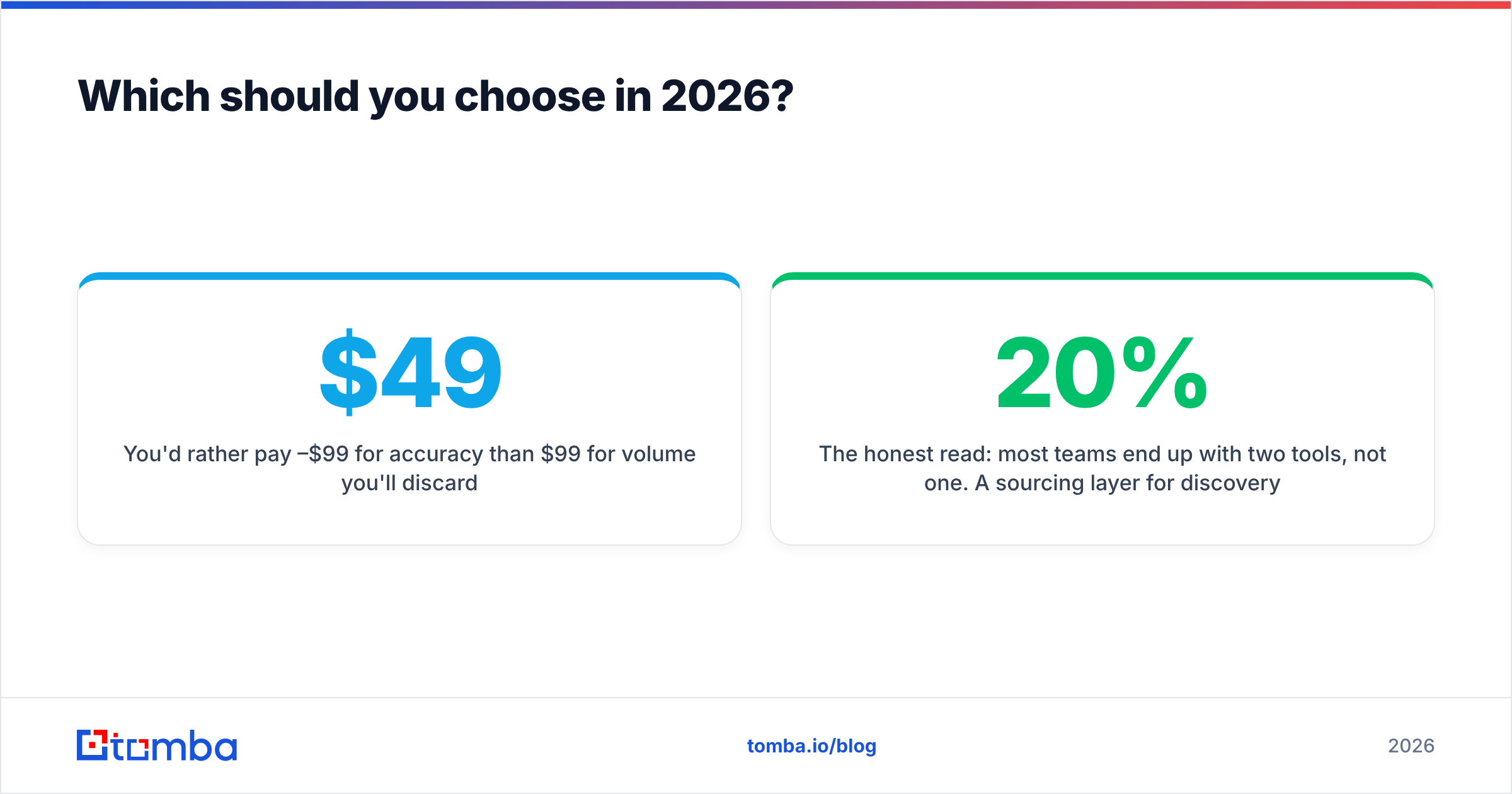
- You would rather pay $49–$99/mo for accuracy than $99/mo for volume you discard
The honest read: most teams end up with two tools, not one. One layer finds accounts. The other resolves and verifies contacts. Force one tool to do both and you get a 20% bounce rate and a subscription you resent.
What's the fastest way to test all three?#
Run a controlled 200-record bake-off before you sign an annual plan.
- Pick one segment you know well — 200 companies, one title band.
- Pull the same segment from each tool on a trial.
- Verify all three outputs through the same verifier, so the comparison is fair.
- Measure four numbers: match rate, verified-valid rate, title accuracy on a manual 25-record check, and total cost.
- Send to a 50-record subset from each source, then compare bounce and reply rates.
That takes about a day. It will teach you more than any comparison article, this one included. Vendor accuracy claims come from their own favorable samples. Your numbers are the ones that pay your bills.
Start with the accuracy layer#
Whichever sourcing tool you pick, the contact data still has to be right on the day you press send. Generect and Warpleads both leave that part to you.
Tomba Email Finder resolves work emails by name and domain. It verifies them in the same workflow. It also handles the catch-all cases most tools return as unknown. Start free with 25 searches a month, then $49/mo on Starter. Pair it with whichever list-builder fits your motion, and you stop paying for rows you cannot mail.
Related guides#
Ready to find emails that actually work?
Join 150,000+ professionals who stopped guessing and started sending. Free credits on signup — no credit card required.
Get the Tomba newsletter
Practical outbound tactics and product updates — once every two weeks.
About the author