GetEmail.io vs Seamless.AI: Which Email Finder Wins in 2026?
GetEmail.io is a lightweight credit-based finder; Seamless.AI is a full contract-based sales platform. We compare credits, accuracy, verification, and the real cost per usable contact.
GetEmail.io vs Seamless.AI is not a fair fight on features. One is a cheap lookup tool. The other is a full sales platform sold on an annual contract. Here is the short version.
TL;DR
- GetEmail.io is a narrow, cheap, self-serve email finder built around an AI-prediction engine. You buy credits, you look up emails, you leave. No CRM, no sequencer, no phone data on the low tiers.
- Seamless.AI is a full B2B prospecting platform — search engine, contact database, phone numbers, buyer intent, Chrome extension. A sales rep sells it, usually on an annual contract.
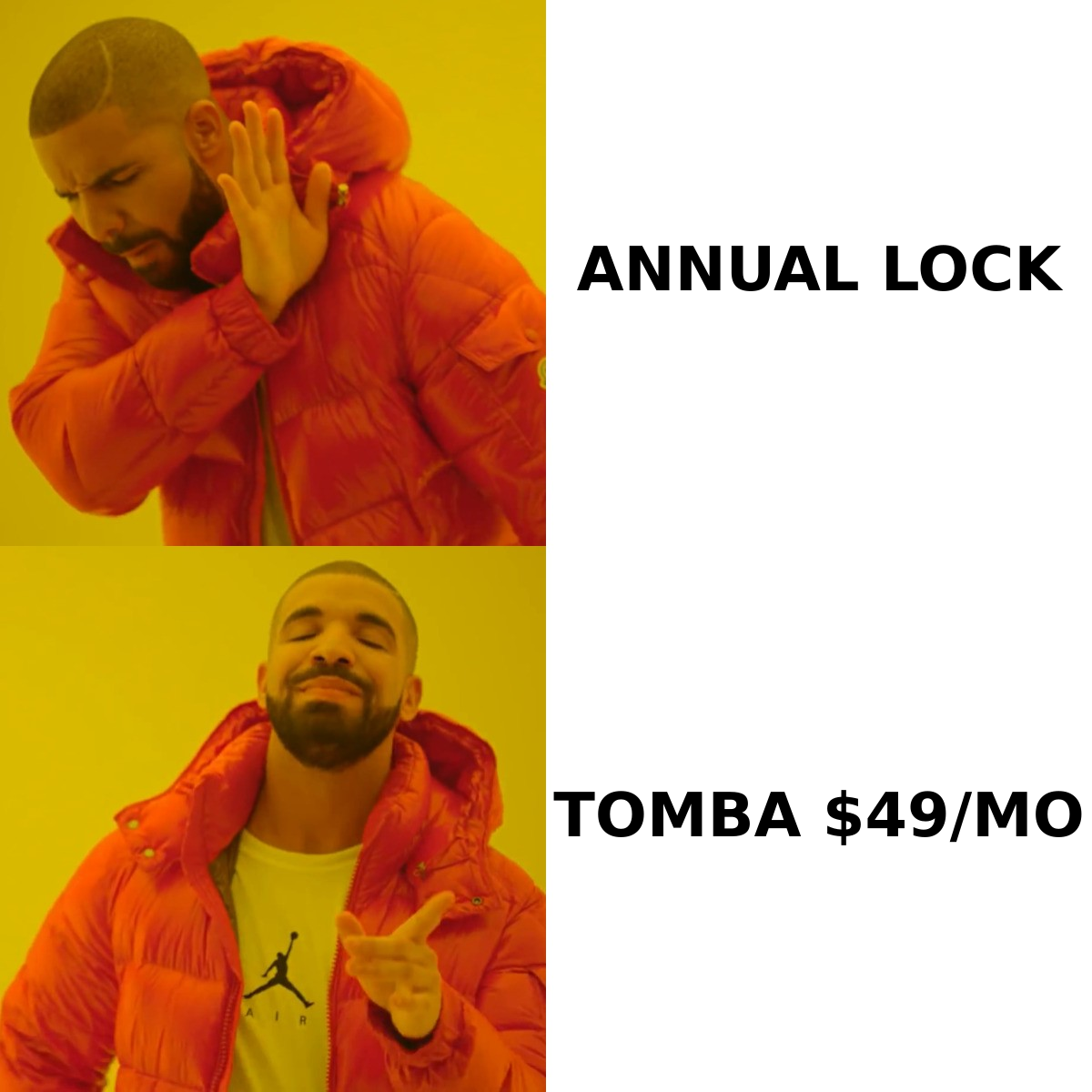
- The real difference is not features. It is commitment: GetEmail.io asks for a card, Seamless.AI asks for a call and a signature.
- Neither tool publishes an independent verification score. Whichever you pick, budget for a separate verification pass. Skip it and you will burn your sending domain.
- Want database breadth and transparent monthly pricing? A dedicated finder-plus-verifier stack (Tomba, Hunter, Findymail) usually beats both on cost per usable contact.
What is GetEmail.io and who is it actually for?#
GetEmail.io is an email lookup tool. It predicts a person's work email from a first name, a last name, and a company domain. You type "Jane Doe" plus "acme.com", and it returns a best-guess address with a confidence label. It also ships a Chrome extension for LinkedIn, a Gmail sidebar, and a small API.
The positioning is deliberately narrow. GetEmail.io does not try to be your CRM or your sequencer. It is a lookup utility, closer to a calculator than a platform. The pricing reflects that: a free tier of roughly 10 credits per month, then paid tiers that scale credit volume rather than unlocking new modules.
That narrowness is the selling point for one profile: a founder, recruiter, or solo consultant. They need 50–300 emails a month, they already know who they want to reach, and they do not want to sit through a demo. It is also the limitation. If you don't already have a name and a company, GetEmail.io has nothing to give you. It finds emails; it does not build lists.
What is Seamless.AI and how is it different?#
Seamless.AI sits at the opposite end. It markets itself as a real-time search engine for B2B leads. You define a filter set — title, industry, headcount, location, tech stack — and it returns contact records with emails, direct dials, and mobile numbers. Add-ons cover buyer intent, job-change alerts, data enrichment, and a writing assistant.
Two structural things matter more than the feature list.
First, Seamless.AI is a list-building tool, not a lookup tool. You start with a persona, not a name. That is a genuinely different job. It is also the main reason people compare these two products badly — they are answering different questions.
Second, Seamless.AI is sold, not self-served. Pricing is not published on the site; you book a demo and get a quote. Public reviews on G2 describe annual agreements, seat-based pricing, and credit caps that reset in ways buyers didn't expect. Some users love the volume. The recurring complaint across review sites is friction at renewal and cancellation. Go in with the contract read, not skimmed.
GetEmail.io vs Seamless.AI: the head-to-head comparison#
Here is the honest side-by-side. Prices reflect publicly available information at the time of writing. Seamless.AI's tiers are quote-based, so treat any number you see quoted online as directional, not gospel.
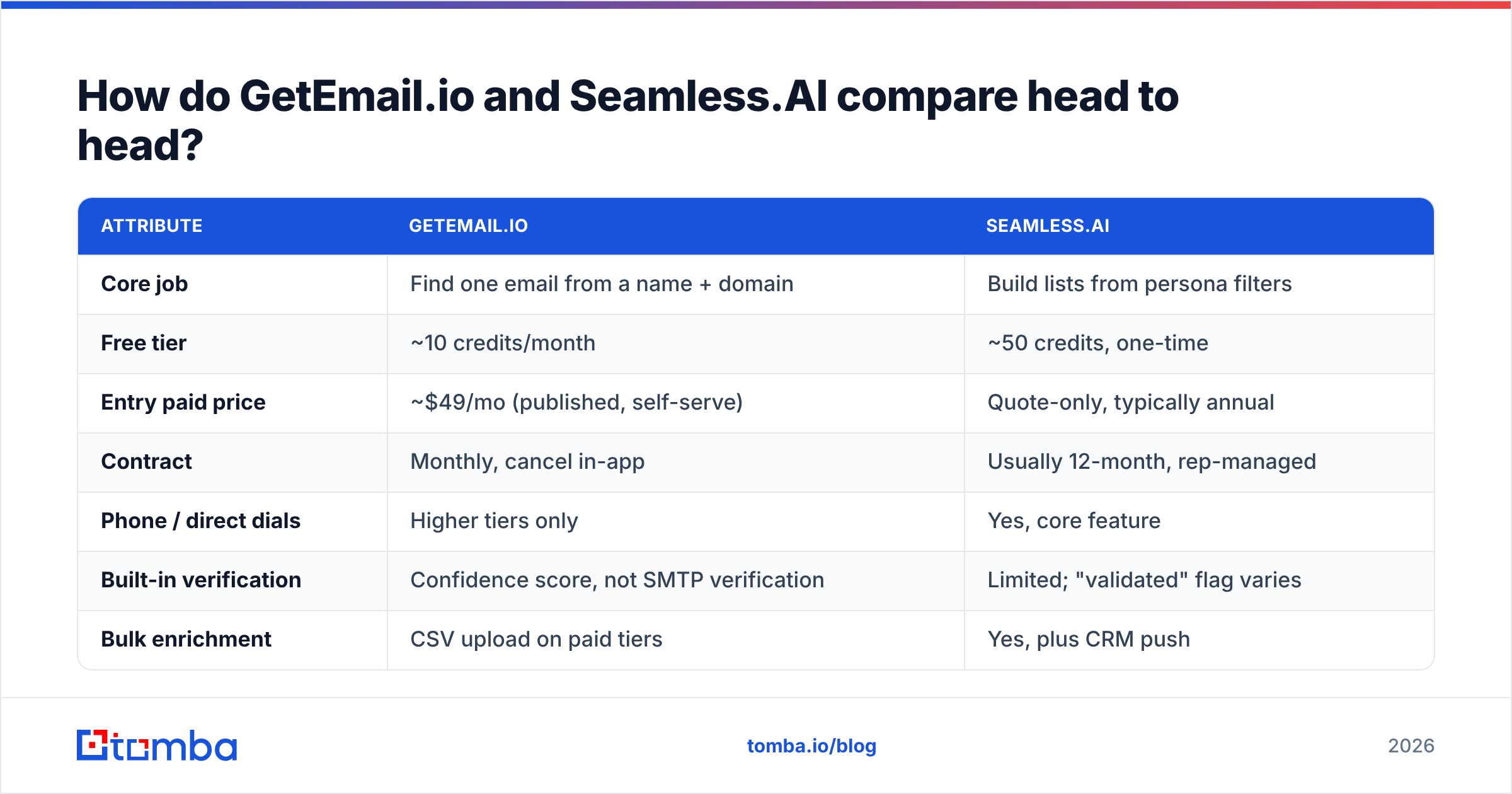
| Attribute | GetEmail.io | Seamless.AI |
|---|---|---|
| Core job | Find one email from a name + domain | Build lists from persona filters |
| Free tier | ~10 credits/month | ~50 credits, one-time |
| Entry paid price | ~$49/mo (published, self-serve) | Quote-only, typically annual |
| Contract | Monthly, cancel in-app | Usually 12-month, rep-managed |
| Phone / direct dials | Higher tiers only | Yes, core feature |
| Built-in verification | Confidence score, not SMTP verification | Limited; "validated" flag varies |
| Bulk enrichment | CSV upload on paid tiers | Yes, plus CRM push |
| CRM integrations | Light (Zapier, API) | Deep (Salesforce, HubSpot, Outreach) |
| Buyer intent data | No | Yes, paid add-on |
| API access | Yes, credit-metered | Yes, tiered |
| Best for | Solo founders, recruiters, low volume | Mid-market SDR teams with budget |
| Worst for | Anyone who needs to build a list | Anyone testing a channel on $50/mo |
The pattern is clean. GetEmail.io wins on friction and price. Seamless.AI wins on breadth and phone coverage. Both leave the verification problem for you to solve.
How accurate are they in practice?#
This is where most comparison posts hand-wave, so let's be specific. "Accuracy" hides three separate numbers, and vendors love to blur them:
- Hit rate (coverage) — of 1,000 prospects you submit, how many come back with any email? Database tools like Seamless.AI usually win here, because they return whatever record exists.
- Validity rate — of the emails returned, how many actually accept mail? Prediction-first tools like GetEmail.io can return a plausible-looking address that no mailbox answers to.
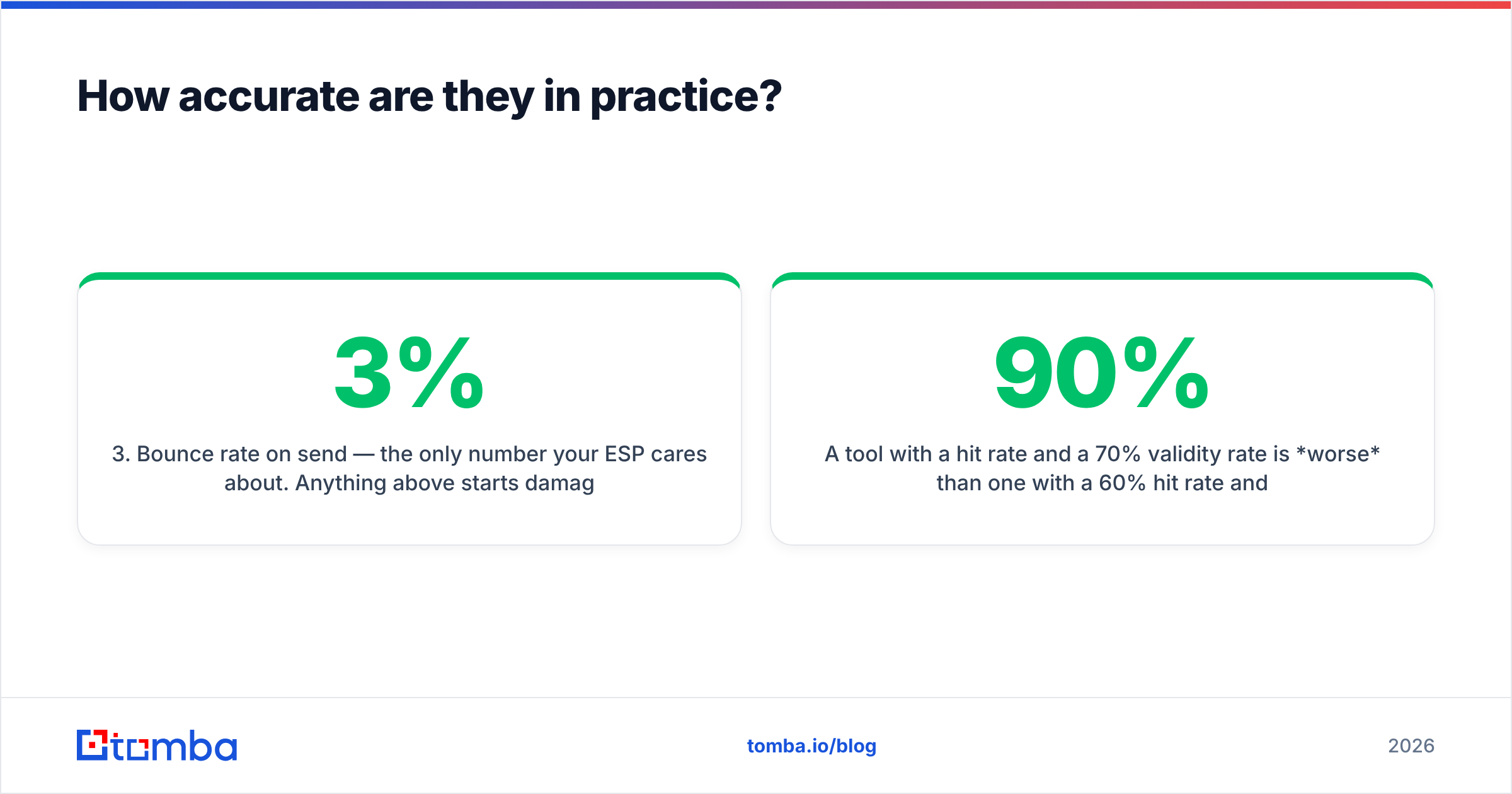
- Bounce rate on send — the only number your ESP cares about. Anything above 3% starts damaging sender reputation, and above 5% you are in deliverability trouble.
A tool with a 90% hit rate and a 70% validity rate is worse than one with a 60% hit rate and a 97% validity rate. The first one quietly poisons your domain. Marketing pages almost always quote number one.

Neither GetEmail.io nor Seamless.AI publishes a third-party-audited validity figure. Both have review threads complaining about stale records. GetEmail.io gets blamed for pattern guesses at companies with mixed formats. Seamless.AI gets blamed for records scraped years ago and never re-checked. So whichever you buy, run the export through a separate email verifier before it touches your sequencer. A verification pass costs fractions of a cent per record. It is the cheapest insurance in outbound.
Also test catch-all domains explicitly. A large share of enterprise domains accept everything at the SMTP layer. That makes "valid" meaningless without a dedicated catch-all verifier. Both tools tend to mark catch-all hits as deliverable. They are not — they are unknown.
What does each one really cost per usable email?#
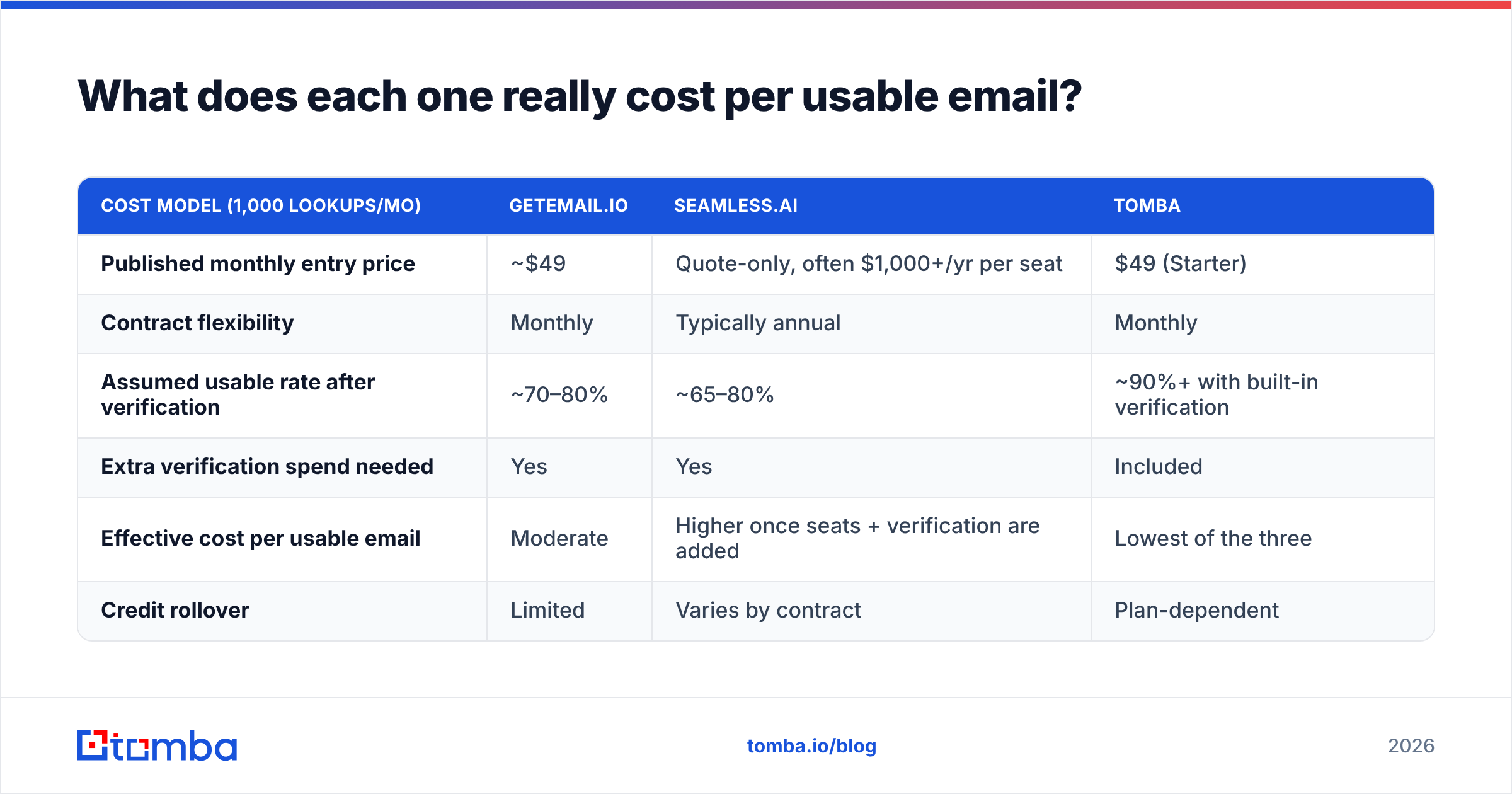
Sticker price is the wrong unit. Compute cost per usable contact: plan price ÷ (credits × validity rate). Here is a worked model at 1,000 lookups per month, using conservative validity assumptions.
| Cost model (1,000 lookups/mo) | GetEmail.io | Seamless.AI | Tomba |
|---|---|---|---|
| Published monthly entry price | ~$49 | Quote-only, often $1,000+/yr per seat | $49 (Starter) |
| Contract flexibility | Monthly | Typically annual | Monthly |
| Assumed usable rate after verification | ~70–80% | ~65–80% | ~90%+ with built-in verification |
| Extra verification spend needed | Yes | Yes | Included |
| Effective cost per usable email | Moderate | Higher once seats + verification are added | Lowest of the three |
| Credit rollover | Limited | Varies by contract | Plan-dependent |
Two cost traps worth naming. First, seat multiplication — platform tools price per user, so a three-rep team triples the bill while the database stays identical. Second, wasted credits on failures: check whether a lookup that returns nothing still burns a credit. Charging for misses is the single biggest hidden markup in this category. Policies differ between vendors, and even between plans.
Transparent, published tiers make this math possible. Tomba lists its plans openly — Free (25 searches/month), Starter $49/mo, Growth $99/mo, Pro $249/mo — so you can model cost per contact before you talk to anyone. See the full Tomba pricing breakdown if you want to run the same calculation against your own volume.

GetEmail.io vs Seamless.AI: which one fits your workflow?#
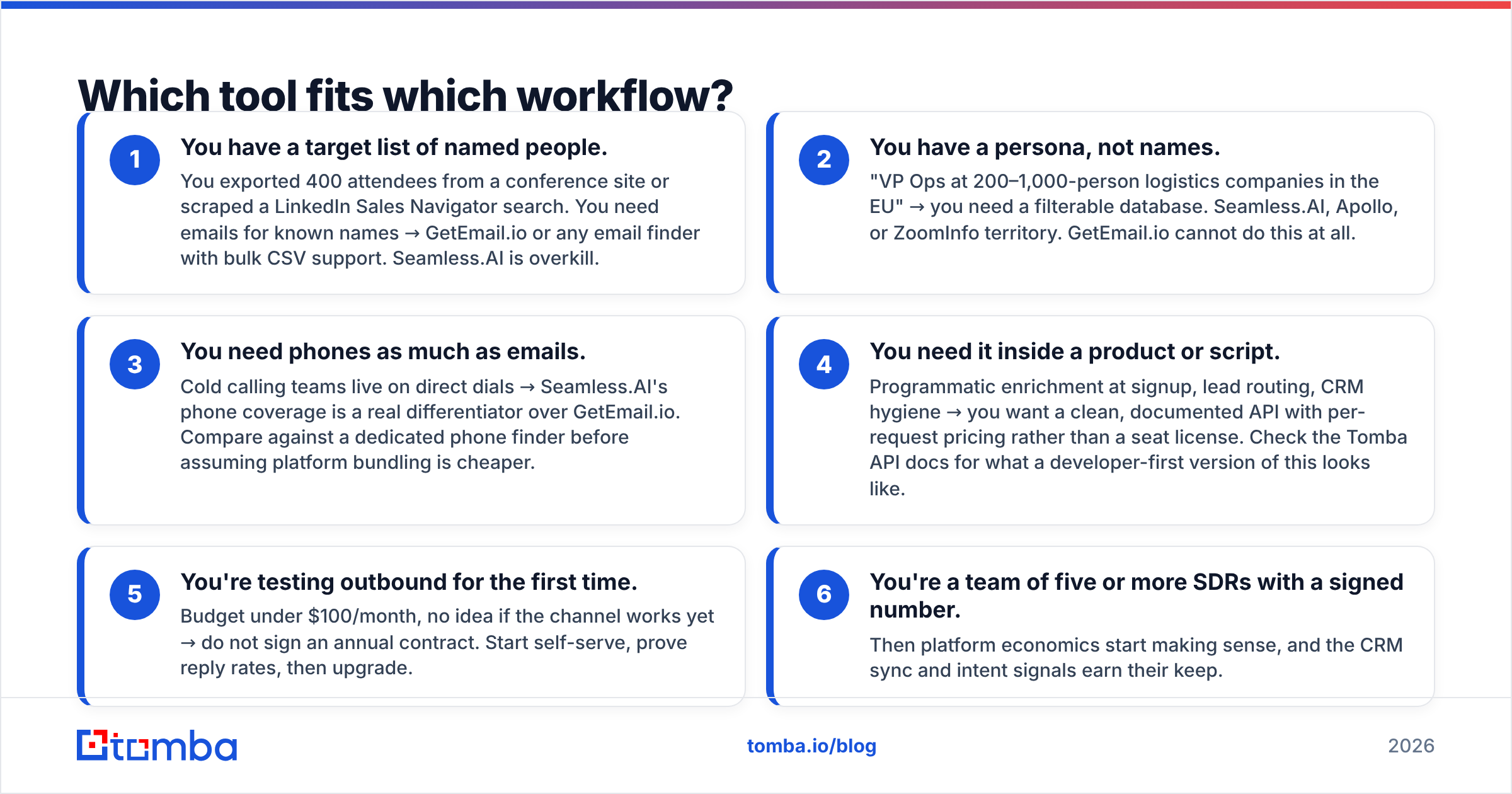
Pick by the job you're actually doing, not by feature count. Start with the three cases where the answer is clear:
- You have a target list of named people. You exported 400 attendees from a conference site, or scraped a LinkedIn Sales Navigator search. You need emails for known names → GetEmail.io or any email finder with bulk CSV support. Seamless.AI is overkill.
- You have a persona, not names. "VP Ops at 200–1,000-person logistics companies in the EU" → you need a filterable database. That is Seamless.AI, Apollo, or ZoomInfo territory. GetEmail.io cannot do this at all.
- You need phones as much as emails. Cold calling teams live on direct dials → Seamless.AI's phone coverage is a real differentiator over GetEmail.io. Compare it against a dedicated phone finder before you assume bundling is cheaper.
The next three come down to budget, stage, and team size:
- You need it inside a product or script. Programmatic enrichment at signup, lead routing, CRM hygiene → you want a clean, documented API with per-request pricing rather than a seat license. Check the Tomba API docs for what a developer-first version looks like.
- You're testing outbound for the first time. Budget under $100/month, no idea if the channel works yet → do not sign an annual contract. Start self-serve, prove reply rates, then upgrade.
- You're a team of five or more SDRs with a signed number. Then platform economics start making sense, and the CRM sync and intent signals earn their keep.
Where does each tool fall short?#
GetEmail.io's weak spots. No list building, which is disqualifying for demand-gen teams. Confidence scores are not verification — an "A" grade is a probability, not an SMTP handshake. Integrations are thin compared to platform competitors. The engine also leans on pattern prediction, so accuracy degrades sharply at companies with inconsistent formats, recent rebrands, or acquired subsidiaries on legacy domains.
Seamless.AI's weak spots. Opaque pricing makes procurement slow and comparison shopping nearly impossible. The annual-contract model means a bad data-quality experience in month two still costs you ten more months. Reviewers regularly report duplicate records and outdated titles. That is the standard failure mode of any large scraped database — people change jobs faster than crawlers re-index. And the credit system rewards volume over precision, which nudges reps toward spraying rather than targeting.
What they share. Both push the verification burden downstream to you, and both make it easy to send to a technically-valid-but-abandoned mailbox. That is a deliverability problem, not a data problem, and it shows up as spam-folder placement three weeks later.

Is there a better alternative in 2026?#
For most teams, GetEmail.io vs Seamless.AI is a false binary. GetEmail.io is too narrow for a growing team. Seamless.AI is too heavy — and too contractual — for a team still proving the channel.
The middle path is a finder that includes verification natively, publishes its pricing, and exposes an API you can automate against. That is where tools like Tomba, Hunter, and Findymail sit. Concretely, look for:
- Verification bundled with finding, so you never send to an unchecked address
- Domain search to pull every public address at a company in one query
- Bulk processing for CSV enrichment without a sales call
- Published, monthly pricing you can cancel without an email chain
- A real free tier — Tomba's is 25 searches a month, enough to test accuracy against your own known-good contacts before paying anything
That last point is the practical test. Take 50 contacts you already have verified emails for, run them through each tool, and measure how many it gets right. Ten minutes of that beats any comparison article, including this one.
Ready to test it against your own list?#
Start with the Tomba Email Finder. Run your 50-contact control list through the free tier, then check the hit rate and the verification status side by side. Compare that to whatever quote Seamless.AI puts in front of you, or whatever GetEmail.io charges for the same volume. If the numbers don't beat what you're using, you've lost nothing but ten minutes. If they do, you'll be paying $49/month with no contract instead of signing for a year on trust.
Related guides#
Ready to find emails that actually work?
Join 150,000+ professionals who stopped guessing and started sending. Free credits on signup — no credit card required.
Get the Tomba newsletter
Practical outbound tactics and product updates — once every two weeks.
About the author