GetEmail.io vs Smarte: Which Email Finder Wins in 2026?
GetEmail.io guesses patterns fast. Smarte sells verified B2B contact data with mobile numbers. We break down accuracy, credits, coverage and real cost so you pick the right one.
GetEmail.io vs Smarte comes down to one choice: a guessed email pattern, or a sourced contact record. Here is the short version.
TL;DR
- GetEmail.io is a light, self-serve email finder built on AI pattern prediction. It is fast and cheap to start. It works best when you already know the person's name and company domain.
- Smarte is a full B2B contact-data platform. It sells verified emails and mobile numbers, with strong EMEA/APAC coverage and GDPR-aligned sourcing. Pricing is quote-based, not self-serve.
The rest of the trade-off:
- The real question is not which tool finds more emails. It is guessed pattern vs sourced record, and what you pay per usable contact after bounces.
- Want transparent credits, a verifier, bulk jobs, and an API on one bill? A third option like Tomba lands between the two on cost.
- Rule of thumb: run a 200-contact paid pilot before you commit. Vendor accuracy numbers are marketing. Your own bounce rate is data.
What are GetEmail.io and Smarte?#
They solve overlapping problems from opposite ends of the market.
GetEmail.io is a search-first email finder. You give it a first name, last name, and company domain. It returns a predicted work email with a confidence score. It ships a Chrome extension, a LinkedIn workflow, a Gmail sidebar, and a simple API. The pitch is speed: no onboarding call, no data platform, no seat minimums.
Smarte sits in the B2B contact-data category. It keeps a contact database, adds company firmographics on top, and pushes two differentiators: direct mobile numbers and non-US coverage (Europe, India, APAC), framed for GDPR and CCPA. It behaves like a data subscription, not a lookup tool.
That gap shapes everything else: accuracy, price, contract length, and who on your team actually uses the tool.
GetEmail.io vs Smarte: where does the data come from?#
This is the core idea, and it is where most buyers get burned. Here is what splits a predicted address from a sourced one.
- Pattern inference — The tool learns that
acme.comusesfirst.last@, then applies that template to any name you submit. Cheap and instant. It breaks whenever a company runs mixed formats, legacy addresses, or acquired-domain aliases. - SMTP validation — After the guess, the tool pings the mail server to see if the mailbox accepts mail. That catches most bad guesses. It fails on catch-all domains, which quietly accept everything.
- Sourced records — Someone observed the contact somewhere (public web, partner data, opt-in panels, contributed address books) and stored it with provenance. Slower to build, much harder to fake, and the reason data platforms cost more.
Two more factors decide how long a record stays useful.
- Enrichment joins — A record is stitched to a company profile, job title, seniority, and sometimes a phone number. You can then filter by ICP instead of looking up one person at a time.
- Recency decay — Each year, roughly 25–30% of B2B contacts change jobs or titles. A record's age matters as much as how it was collected. A two-year-old "verified" email is not verified today.
GetEmail.io leans on 1 and 2. Smarte leans on 3 and 4. Neither escapes 5. That is why an email verifier belongs in your stack, whichever finder you buy.

Which one is more accurate?#
Neither vendor's headline number will match your list.
GetEmail.io publishes high confidence claims for its predictions. On clean, well-indexed domains — US SaaS, mid-market tech, any company with a public team page — it performs well. Pattern prediction breaks down exactly where outbound teams live: small firms with mixed formats, agencies that use aliases, enterprises running f.lastname@ and flastname@ side by side, and catch-all domains that call anything valid.
Smarte's profile is different. Records are sourced, not generated, so the hit rate on a given name is often lower. The contact is in the database or it is not. But the addresses it does return bounce less. You trade coverage for confidence. Smarte also performs better outside North America, which is genuinely rare. Most finders collapse on German, French, and Indian mid-market domains.

The honest way to measure this yourself:
- Take 200 contacts from your real ICP, not a sample list.
- Run them through both tools.
- Track three numbers: hit rate (returned an address), deliverability (survived a send), and cost per delivered contact.
- Ignore any address flagged "catch-all" until you run it through a dedicated catch-all verifier. Those are the ones that quietly wreck a sending domain.
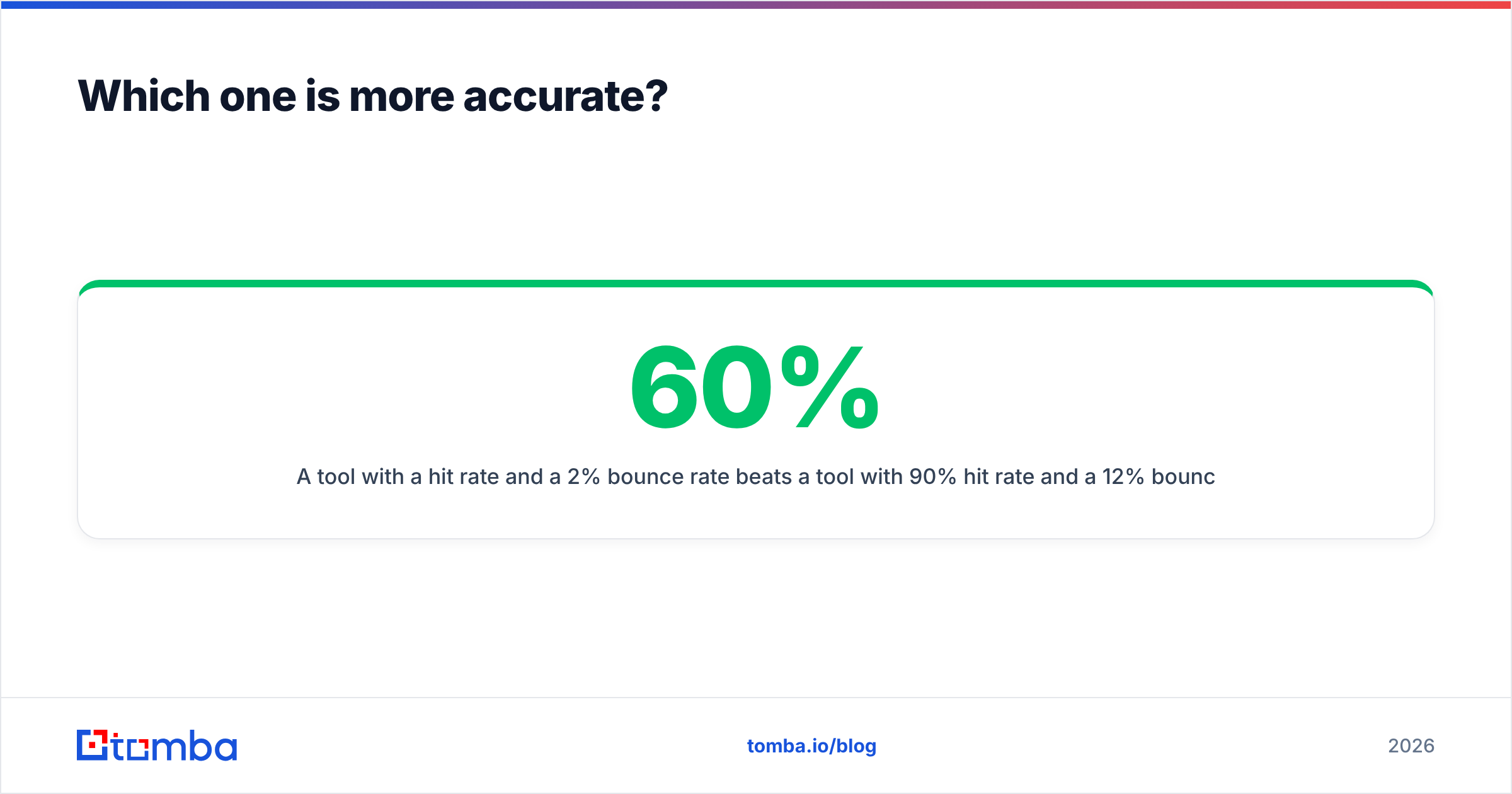
A tool with a 60% hit rate and a 2% bounce rate beats a tool with a 90% hit rate and a 12% bounce rate. The second one costs you the mailbox.
How do GetEmail.io and Smarte compare on features and price?#
Pricing below reflects publicly listed plans at the time of writing. Both vendors change tiers, so check their sites before you buy.

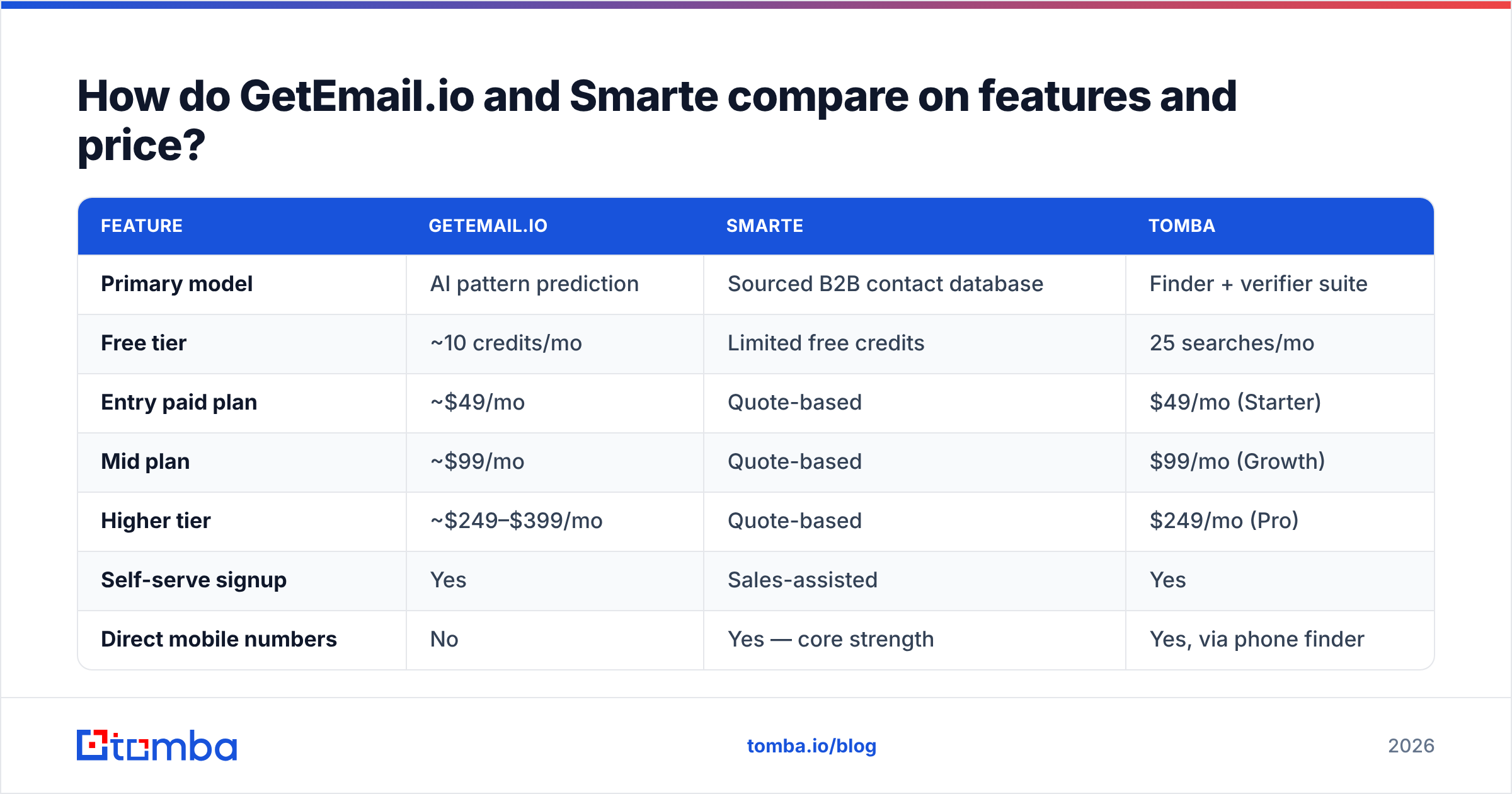
| Feature | GetEmail.io | Smarte | Tomba |
|---|---|---|---|
| Primary model | AI pattern prediction | Sourced B2B contact database | Finder + verifier suite |
| Free tier | ~10 credits/mo | Limited free credits | 25 searches/mo |
| Entry paid plan | ~$49/mo | Quote-based | $49/mo (Starter) |
| Mid plan | ~$99/mo | Quote-based | $99/mo (Growth) |
| Higher tier | ~$249–$399/mo | Quote-based | $249/mo (Pro) |
| Self-serve signup | Yes | Sales-assisted | Yes |
| Direct mobile numbers | No | Yes — core strength | Yes, via phone finder |
| Email verification included | Basic validation | Included in records | Dedicated verifier + catch-all |
| Bulk upload | Limited | Yes | Yes |
| Public API | Yes | Yes | Yes, documented |
| Chrome extension | Yes | Yes | Yes |
| Non-US coverage | Moderate | Strong (EMEA/APAC) | Broad, domain-driven |
| Best fit | Solo AEs, founders, low volume | Enterprise data teams, global ABM | SDR teams, agencies, developers |
Two things stand out.
First, GetEmail.io's credit ladder gets expensive per contact at volume. Entry plans include a few hundred credits. If your SDR team burns 3,000 lookups a month, you hit the upper tiers fast. You are still paying for guesses that may not survive a send.
Second, Smarte's quote-based pricing is a filter, not a flaw. It signals a product sold to teams with a data budget and a procurement process. If you are a two-person startup that wants to buy a plan on a Tuesday afternoon, that friction is real. If you run global ABM and need mobile numbers with compliance docs, the same friction comes with a support motion GetEmail.io does not offer.

Is GetEmail.io better than Smarte for cold outreach?#
For pure cold email at small scale, GetEmail.io is the lower-friction pick. Sign up, install the extension, work a LinkedIn list, export. There is no onboarding, no minimum commitment, no negotiation. A founder doing their first 500 sends will be productive within an hour.
For multichannel outbound — email plus phone, across regions, feeding a CRM — Smarte fits better. Mobile numbers change the economics of a sequence. A connected call after two emails converts at rates a pure-email cadence rarely reaches. And if half your TAM sits in Germany or India, GetEmail.io's pattern engine will produce a lot of confident guesses that never land.
Scale matters too. Pattern prediction degrades as your list gets stranger, and cold lists always get stranger as you move past the obvious accounts. If your first 500 prospects are known brands and your next 5,000 are 40-person companies with custom domains, expect the hit rate to drop and the bounce rate to climb on any prediction-first tool.
Whatever you pick, protect email deliverability by verifying before you send. Both tools return addresses that will bounce. The only question is what percentage.
Which use case fits which tool?#
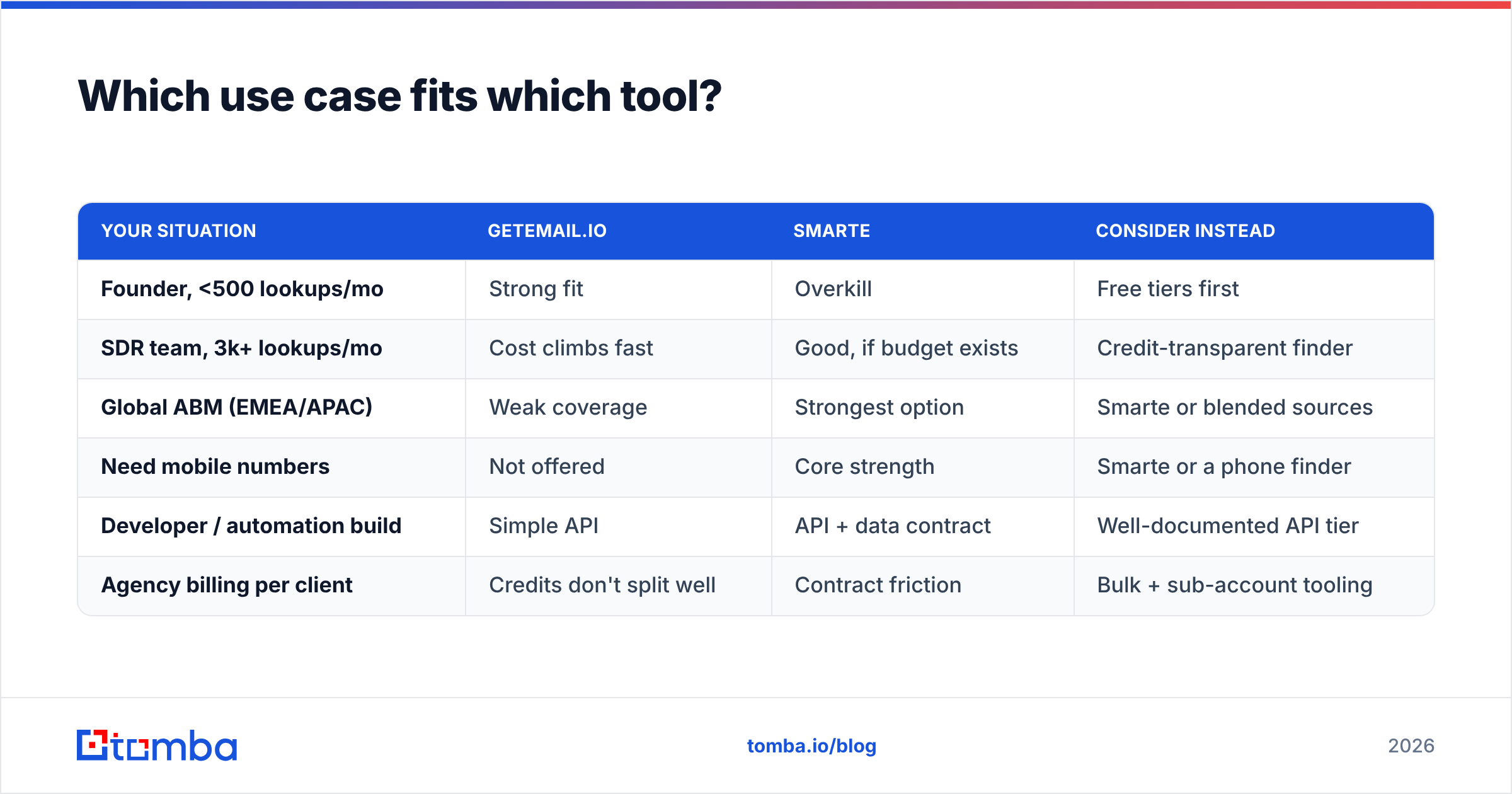
| Your situation | GetEmail.io | Smarte | Consider instead |
|---|---|---|---|
| Founder, <500 lookups/mo | Strong fit | Overkill | Free tiers first |
| SDR team, 3k+ lookups/mo | Cost climbs fast | Good, if budget exists | Credit-transparent finder |
| Global ABM (EMEA/APAC) | Weak coverage | Strongest option | Smarte or blended sources |
| Need mobile numbers | Not offered | Core strength | Smarte or a phone finder |
| Developer / automation build | Simple API | API + data contract | Well-documented API tier |
| Agency billing per client | Credits don't split well | Contract friction | Bulk + sub-account tooling |
Where does Tomba fit between them?#
Tomba sits in the middle: self-serve like GetEmail.io, but with the verification depth and bulk tooling that prediction-only tools skip.
The practical differences:
- Verification is first-class. The email verifier and catch-all verifier are separate products. If a domain is catch-all, you get told, instead of a false green light.
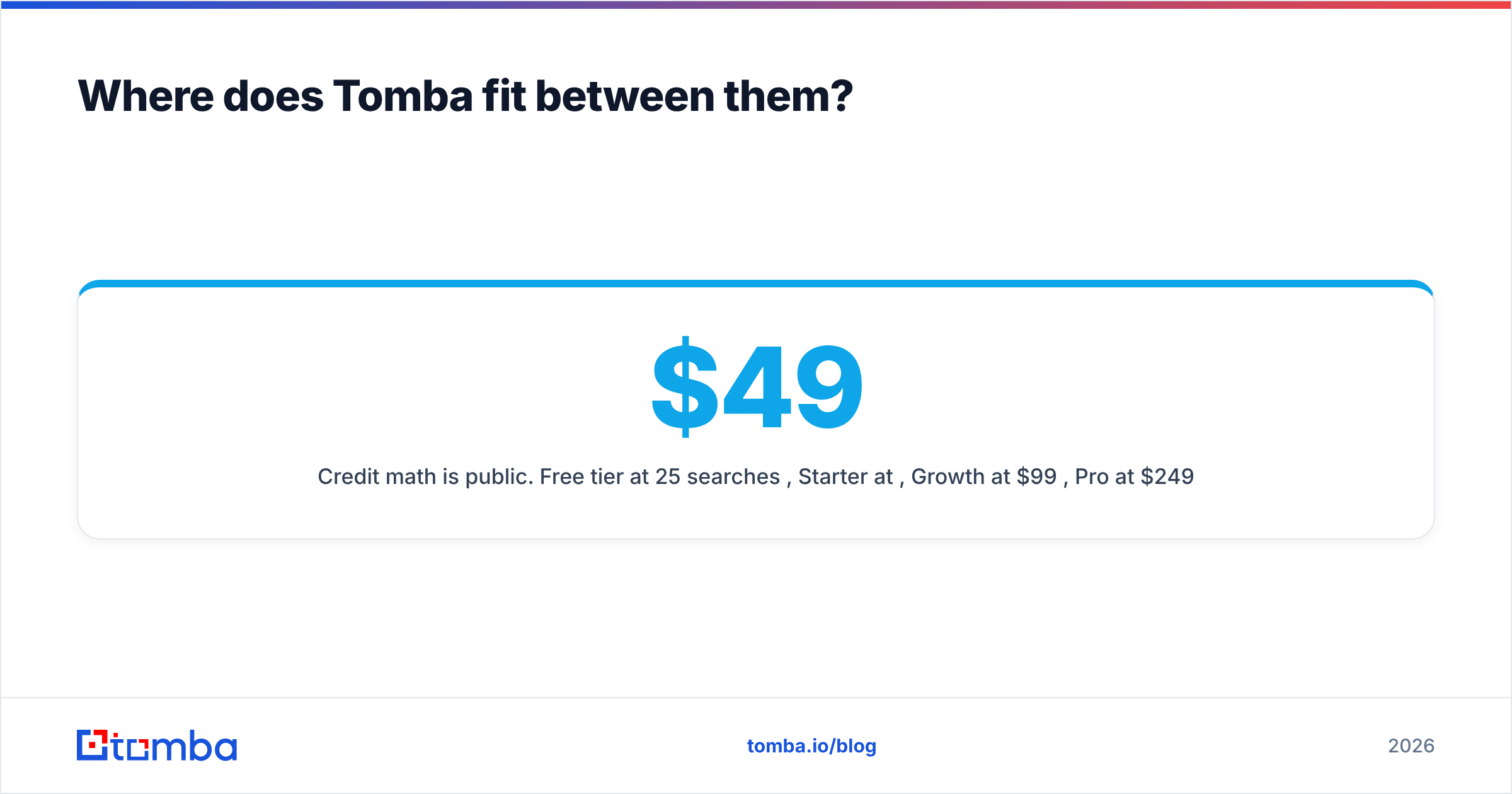
- Credit math is public. Free tier at 25 searches/mo, Starter at $49/mo, Growth at $99/mo, Pro at $249/mo. Full Tomba pricing is on the page, with no quote cycle.
- Bulk and API on one account. Bulk email finder jobs, a documented REST Tomba API, Sheets and Excel add-ins, and a Chrome extension all draw from one credit pool.
- Domain-first discovery. When you have no names yet, domain search returns the contacts a company publishes.
Tomba is not the right answer for everything. If direct mobile numbers across APAC decide the deal, Smarte's database is built for that, and Tomba's phone coverage is broader but shallower. Buy the tool that matches the job.
How should you run the evaluation?#
Do this in a week, not a quarter:
- Define the list. 200 contacts from real target accounts — same segment, same geography, same seniority as your live pipeline.
- Run all candidates on the same list. Same inputs, same day. Anything else is not a comparison.
- Verify independently. Send every returned address through a third-party verifier, so no vendor grades its own homework. A free email checker is enough for spot checks.
- Send a real, small campaign. 50 addresses per tool, warmed domain, plain text. Bounce rate is the only accuracy metric that pays rent.
- Compute cost per delivered contact. Plan price ÷ contacts that actually landed. This number reorders vendor rankings more often than any feature grid.
- Check the exit. Can you export your data? What happens to unused credits? Is there an auto-renew clause? Read this before you sign, not after.
Peer reviews on G2 help on support quality and billing complaints, the things vendors never disclose. Treat star ratings on "data accuracy" as noise. Accuracy is segment-specific, and yours will differ.
The verdict#
Here is how GetEmail.io vs Smarte resolves in practice.
Pick GetEmail.io if you are a founder or solo seller doing low-volume, US-centric prospecting and you want a tool running in ten minutes with no sales call.
Pick Smarte if you need verified mobile numbers, real EMEA/APAC coverage, and compliance docs your legal team will accept — and you have the budget and the patience that quote-based pricing implies.
Pick something in the middle if you are an SDR team, agency, or developer who needs transparent credits, real verification, bulk processing, and an API without an enterprise contract.
Whichever way you go, verify before you send. The cheapest email finder in the world is expensive if it costs you a sending domain.
Ready to test the middle path? Start with the Tomba Email Finder free tier — 25 searches a month, no card. Run your own 200-contact benchmark against whatever you use today, and let the bounce rate settle the argument. Paid plans start at $49/mo when you are ready to scale.
Related guides#
Ready to find emails that actually work?
Join 150,000+ professionals who stopped guessing and started sending. Free credits on signup — no credit card required.
Get the Tomba newsletter
Practical outbound tactics and product updates — once every two weeks.
About the author