GetEmail.io vs Warpleads (2026): Which Email Finder Wins?
GetEmail.io guesses emails from a name and domain. Warpleads sells you bulk exported lead lists. They solve different problems badly if you pick wrong — here is the honest breakdown.
TL;DR
- GetEmail.io is a single-contact email finder: you give it a first name, last name and company domain, and its AI predicts the most likely address. Best for one-off lookups and LinkedIn browsing.
- Warpleads is a bulk lead-export platform: you filter a database by industry, title and geography and pull thousands of contacts at once. Best for volume list-building.
- They are not really competitors — one answers "what is this person's email?", the other answers "give me 5,000 people who look like my ICP."
- Neither ships a deep verification stack. If you buy from either, budget separately for email verification before you send.
- If you need both patterns — targeted lookups and bulk export and built-in verification — a combined platform like Tomba covers all three from one credit pool starting at $49/mo.
What are GetEmail.io and Warpleads, exactly?#
Start with the shape of each product, because the "vs" framing hides how different they are.
GetEmail.io launched as a prediction engine. You type a name and a company domain into the web app or its Chrome extension, and it returns a best-guess address with a confidence label. There is no database you can browse and no filter panel. The core motion is: you already know who you want, you just don't know their address.
Warpleads works from the opposite direction. It is a lead-database and export tool built for outbound teams who want raw volume — you define filters (industry, headcount, job title, region), preview the count, and export a CSV. The pitch is unlimited or high-volume exports for a flat monthly fee rather than per-credit pricing.
That difference explains almost every complaint you will read about either tool. People who wanted a list get frustrated with GetEmail.io's one-at-a-time flow. People who wanted precision on 40 named executives get frustrated with a bulk export where half the rows are irrelevant.
Here is how the two models differ in practice:
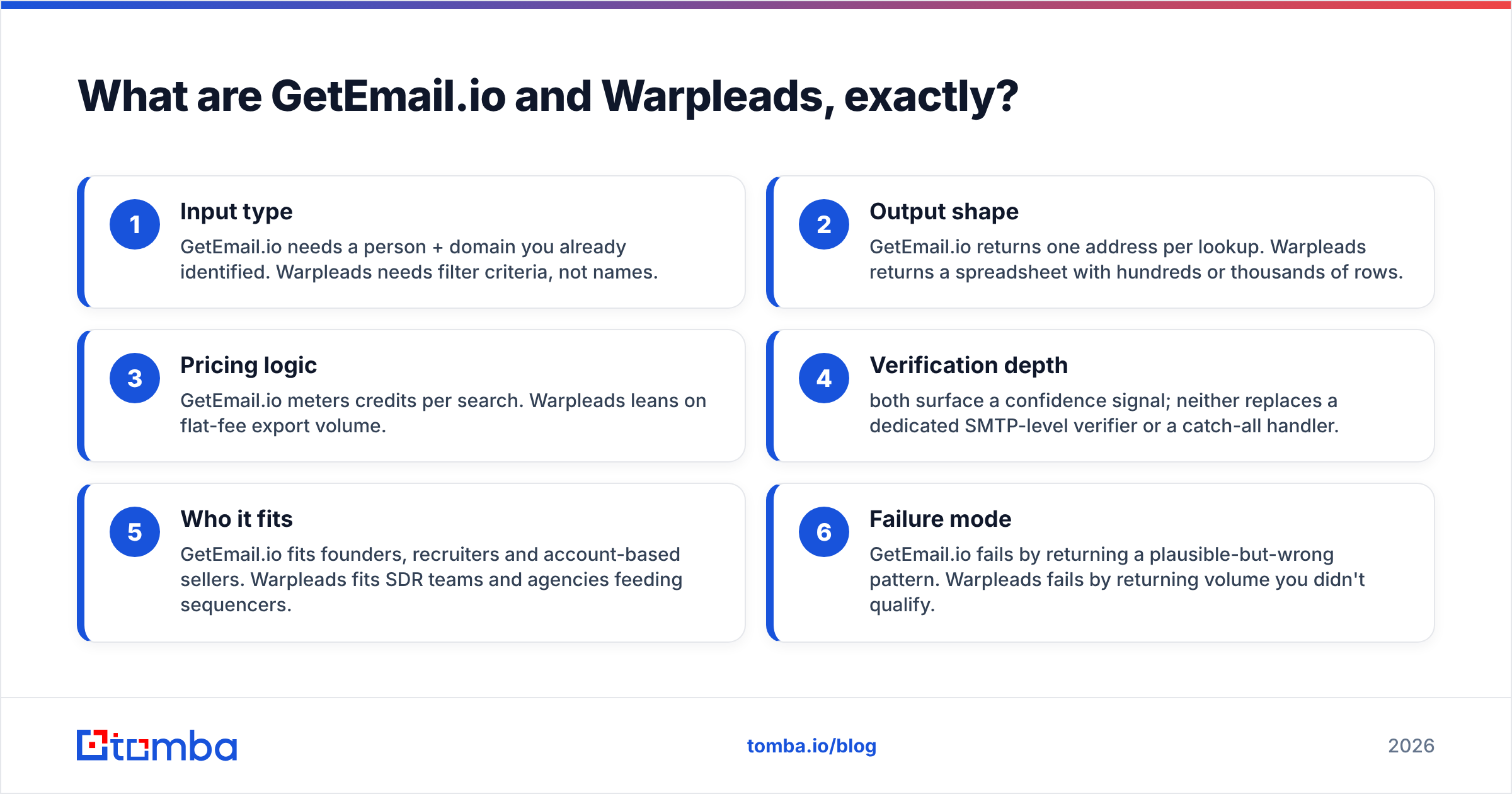
- Input type — GetEmail.io needs a person + domain you already identified. Warpleads needs filter criteria, not names.
- Output shape — GetEmail.io returns one address per lookup. Warpleads returns a spreadsheet with hundreds or thousands of rows.
- Pricing logic — GetEmail.io meters credits per search. Warpleads leans on flat-fee export volume.
- Verification depth — both surface a confidence signal; neither replaces a dedicated SMTP-level verifier or a catch-all handler.
- Who it fits — GetEmail.io fits founders, recruiters and account-based sellers. Warpleads fits SDR teams and agencies feeding sequencers.
- Failure mode — GetEmail.io fails by returning a plausible-but-wrong pattern. Warpleads fails by returning volume you didn't qualify.

How accurate is each one?#
This is where most buying decisions actually get made, and where marketing pages get slippery.
Prediction-first tools like GetEmail.io are strong when the target company has a clean, consistent email pattern — first.last@, finitial+last@, and so on. Give them a 2,000-person software company and hit rates are usually respectable. Give them a 12-person agency on a custom domain with no public footprint, and the engine has nothing to pattern-match against. It will still return something, and that something may be a guess dressed as a result.
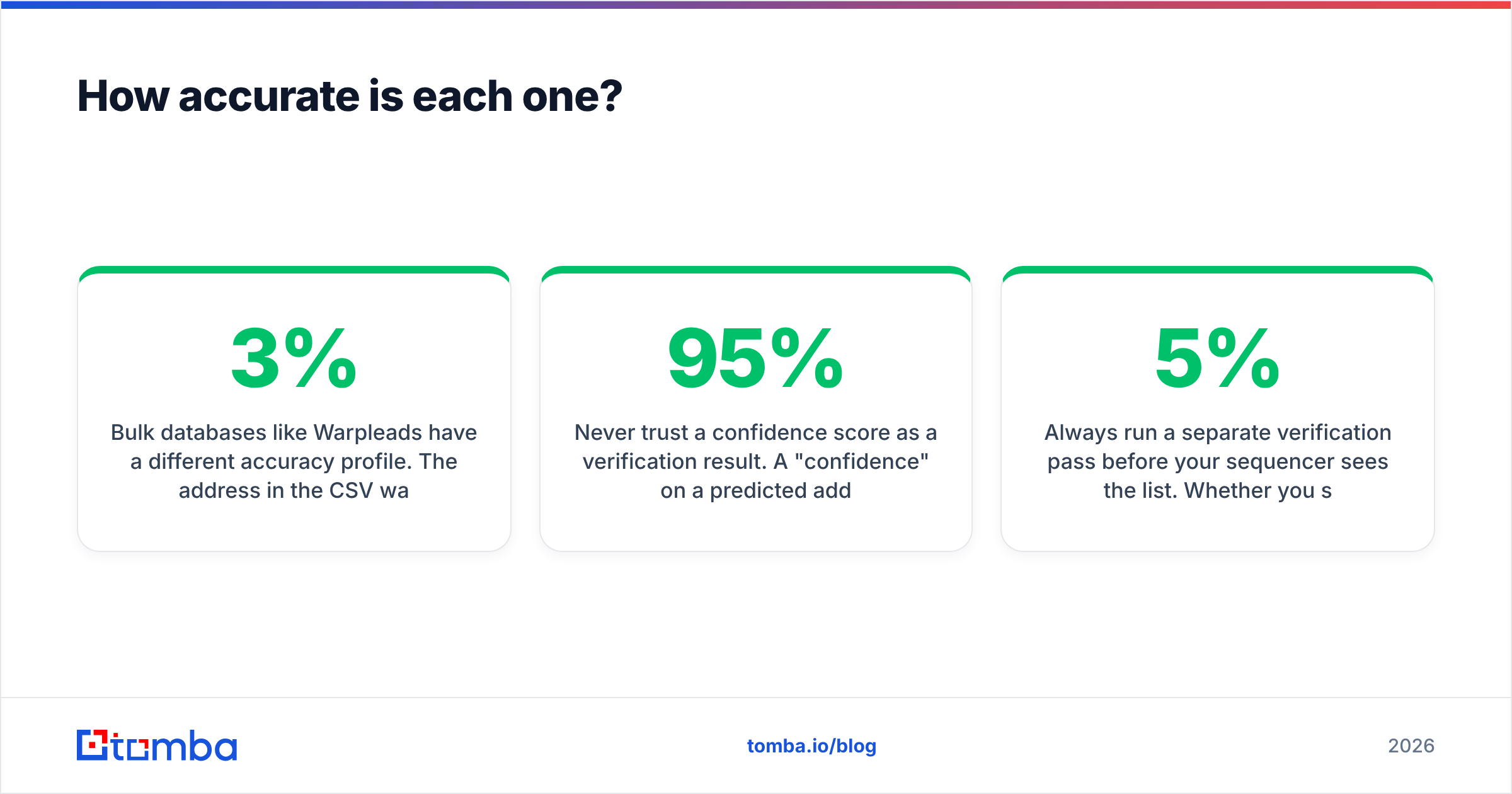
Bulk databases like Warpleads have a different accuracy profile. The address in the CSV was real at some point — the question is when. B2B contact data decays roughly 2–3% per month as people change jobs, which compounds to about a quarter of any list going stale within a year. Export volume does nothing to slow that decay; it just means you export more stale rows per click.

Two rules survive every accuracy debate:
- Never trust a confidence score as a verification result. A 95% "confidence" on a predicted address is a probability estimate about a pattern, not a mailbox-level check.
- Always run a separate verification pass before your sequencer sees the list. Whether you sourced from GetEmail.io, Warpleads, or anywhere else, a real email verifier catching 5% of bad rows is the difference between a healthy domain and a spam-folder spiral.
Catch-all domains complicate both. If a company accepts mail to any address, standard SMTP verification returns "unknown" and the row sits in limbo. Neither GetEmail.io nor Warpleads was built to resolve that state — a dedicated catch-all verifier is the only way to sort those rows into send/don't-send buckets.
GetEmail.io vs Warpleads: how do they compare feature by feature?#
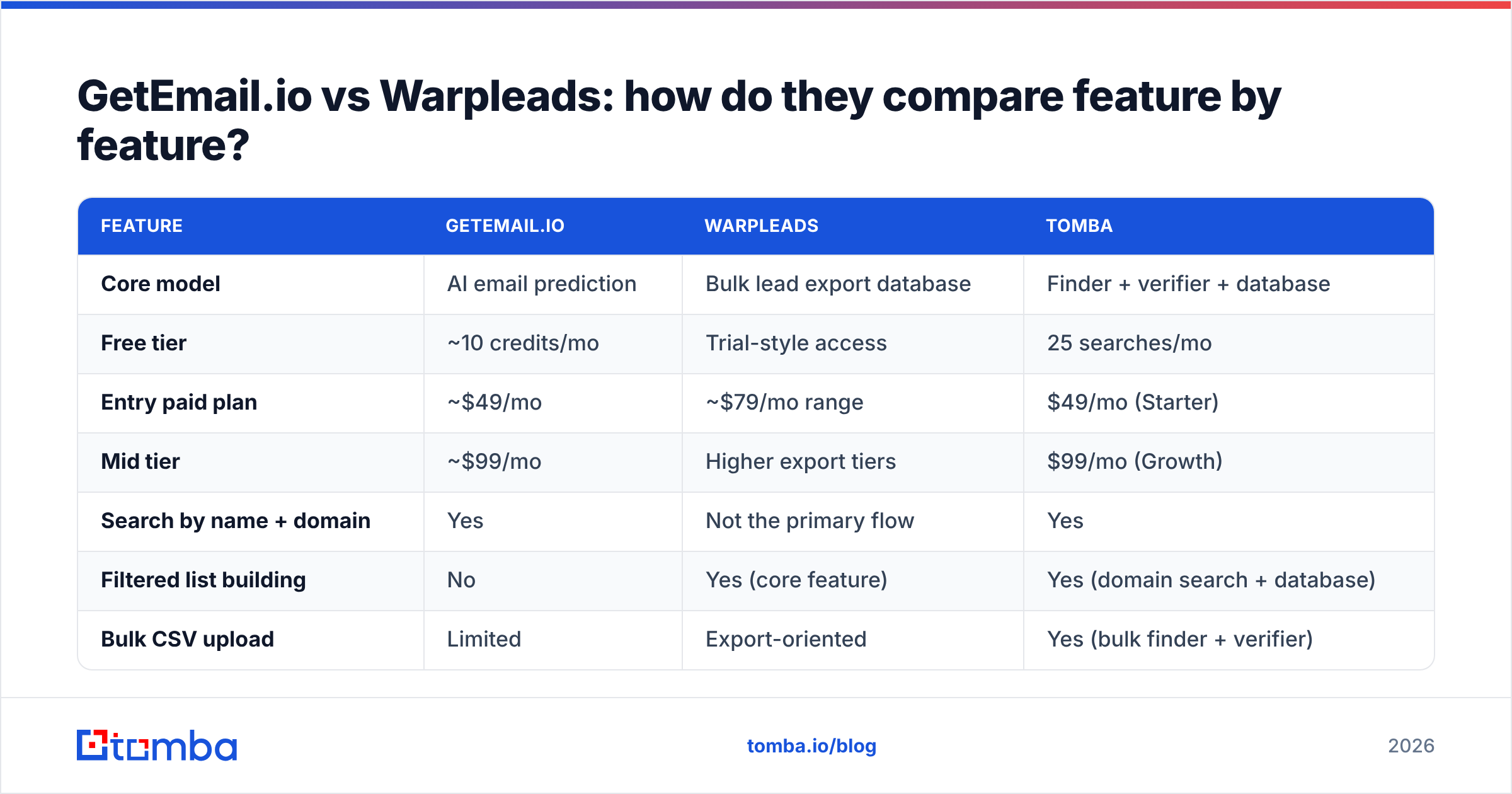
Vendor pricing and packaging shift regularly, so treat the numbers below as a snapshot from public pages at the time of writing and confirm on each vendor's site before you buy.
| Feature | GetEmail.io | Warpleads | Tomba |
|---|---|---|---|
| Core model | AI email prediction | Bulk lead export database | Finder + verifier + database |
| Free tier | ~10 credits/mo | Trial-style access | 25 searches/mo |
| Entry paid plan | ~$49/mo | ~$79/mo range | $49/mo (Starter) |
| Mid tier | ~$99/mo | Higher export tiers | $99/mo (Growth) |
| Search by name + domain | Yes | Not the primary flow | Yes |
| Filtered list building | No | Yes (core feature) | Yes (domain search + database) |
| Bulk CSV upload | Limited | Export-oriented | Yes (bulk finder + verifier) |
| Built-in email verification | Confidence score | Basic validation | Dedicated verifier + catch-all |
| Catch-all handling | No dedicated tool | No dedicated tool | Yes |
| Public API | Yes | Limited | Yes, documented |
| Chrome extension | Yes | Varies | Yes |
| Phone numbers | No | Some plans | Yes (phone finder) |
| CRM integrations | Basic | CSV-first | HubSpot, Salesforce, Pipedrive, Zapier |

The table exposes the real trade-off. GetEmail.io is narrow and cheap to start. Warpleads is broad and volume-priced. Both leave verification and enrichment as your problem, which means the sticker price is rarely the total cost.
Which one is cheaper in real terms?#
Cheaper depends entirely on your motion, so run the math on your own numbers rather than comparing headline prices.
Scenario A — 200 named targets a month (ABM or recruiting). You already have the names from LinkedIn, a conference list or a customer research doc. You need 200 accurate lookups. A per-credit prediction tool is the natural fit; a flat-fee bulk exporter is overkill because you are not filtering, you are resolving. Watch the credit burn on failed lookups — some tools charge for a search that returns nothing, which quietly inflates cost per usable contact.
Scenario B — 5,000 new contacts a month (SDR pipeline). Buying 5,000 individual lookups at prediction-tool rates gets expensive fast. This is where Warpleads' flat-fee export model earns its keep. But price your verification layer in: if 20% of exported rows are dead, your effective cost per sendable contact is 25% higher than the invoice suggests.
Scenario C — mixed. Most teams live here. You want 3,000 filtered prospects for the top of funnel and precise lookups for 150 named accounts your AEs actually care about. Running two subscriptions to cover both patterns is how tool sprawl starts. This is the specific case where a consolidated platform wins on cost, not just convenience — one credit pool covers bulk lead generation and single lookups.
A quick sanity formula: cost per sendable contact = (monthly fee + verification cost) ÷ (contacts returned × verified-valid rate). Plug in honest numbers and the ranking often flips versus the pricing page.

Who should pick GetEmail.io?#
Pick GetEmail.io if your workflow looks like this:
- You browse LinkedIn or company sites and identify targets manually, one at a time.
- Your list is small and high-value — 20 to 300 people, not 5,000.
- You need a lightweight browser extension more than a data warehouse.
- You are a solo founder, recruiter or consultant with no ops team to run list hygiene.
- Budget matters more than breadth, and a modest monthly plan covers your volume.
Where it will frustrate you: no filter-driven discovery, no meaningful bulk workflow, and confidence scores that do not substitute for verification. If you catch yourself pasting 400 rows into a one-at-a-time interface, you have outgrown the category.
Who should pick Warpleads?#
Pick Warpleads if this is closer to your reality:
- You run or manage SDRs who need thousands of fresh contacts every month.
- Your ICP is defined by firmographics — "SaaS, 50–200 employees, US, VP Sales" — not by named individuals.
- You feed a sequencer (Instantly, Smartlead, Lemlist) and need CSVs, not one-off answers.
- Predictable flat pricing beats per-credit metering for your finance team.
- You already have a verification vendor in the stack, or you're willing to add one.
Where it will frustrate you: precision. Filtered exports always include rows that technically match your criteria and obviously don't match your buyer. Budget review time, and budget verification. If you skip both, your bounce rate does the budgeting for you — and email deliverability damage takes weeks to undo.
Are there better options than either?#
Worth saying plainly: the market has more than two doors, and the honest answer for a lot of teams is "neither, alone."
Peer-reviewed comparisons on G2 show the category splitting into three groups. Prediction-first finders (GetEmail.io sits here) optimise for a single accurate lookup. Database exporters (Warpleads, and providers like BookYourData, which has built a solid reputation for verified B2B list data with straightforward pay-as-you-go pricing) optimise for volume and filtering. Consolidated platforms try to cover both plus verification and enrichment in one subscription.
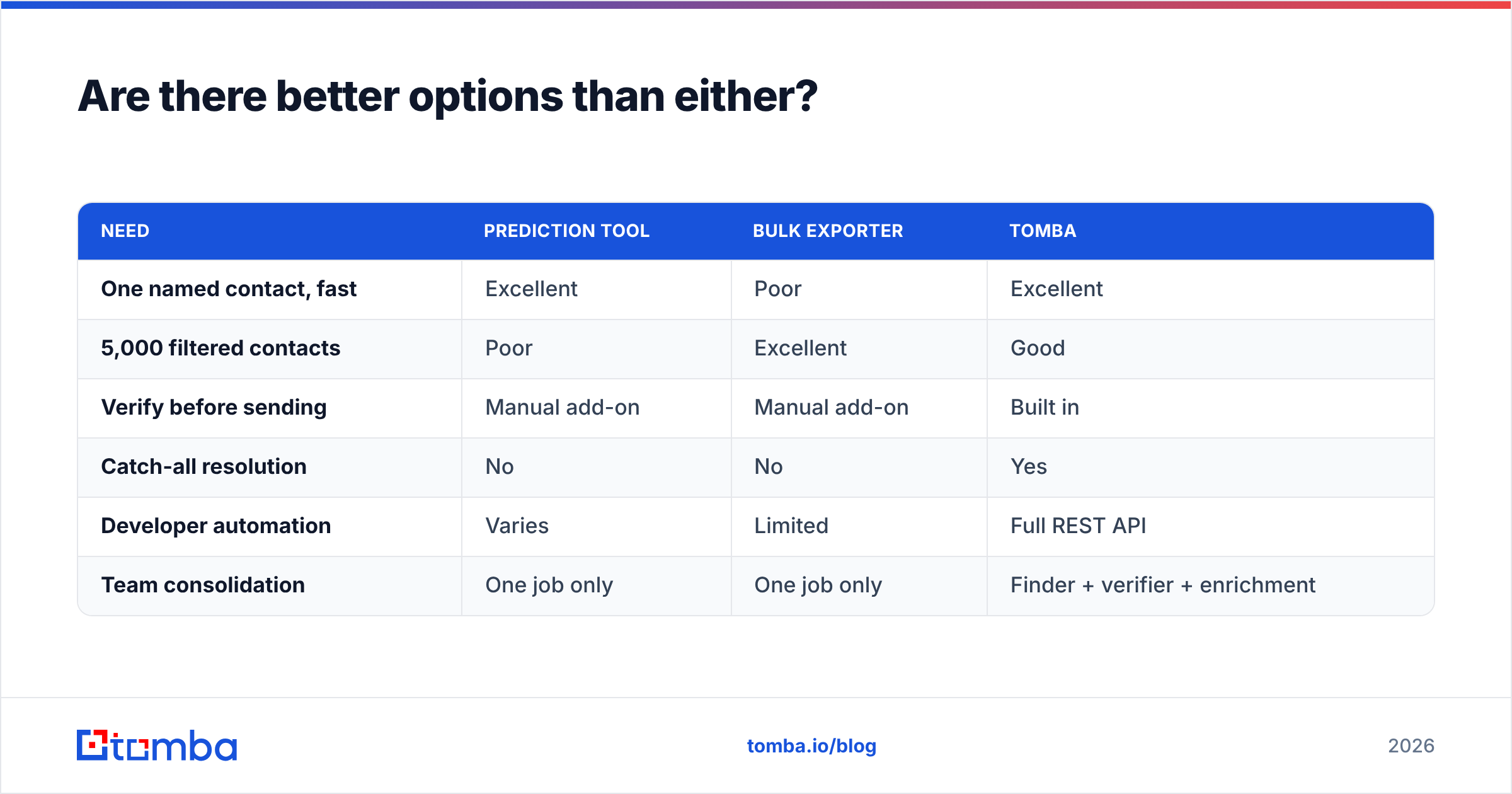
Tomba belongs in that third group, and it's fair to be specific about the trade-off rather than just claiming a win:
| Need | Prediction tool | Bulk exporter | Tomba |
|---|---|---|---|
| One named contact, fast | Excellent | Poor | Excellent |
| 5,000 filtered contacts | Poor | Excellent | Good |
| Verify before sending | Manual add-on | Manual add-on | Built in |
| Catch-all resolution | No | No | Yes |
| Developer automation | Varies | Limited | Full REST API |
| Team consolidation | One job only | One job only | Finder + verifier + enrichment |
Where a dedicated bulk exporter still wins is raw list volume at a flat rate — if your only job is pulling maximum rows per dollar, a specialist will beat a generalist. Where the consolidated approach wins is total cost of ownership when your workflow has more than one shape.
For context on how source data quality drives all of this, Tomba publishes its data sources rather than treating provenance as a black box. That matters more than any single accuracy percentage on a landing page — a vendor that won't say where data comes from can't explain why a record is wrong.
How should you test both before committing?#
Do not buy on a demo. Run the same 50-contact benchmark through every tool you're considering.
- Build a control list. Pick 50 real prospects across company sizes — a few enterprises, several mid-market, and at least 10 small companies with custom domains. Small companies are where prediction engines break.
- Run identical inputs. Same names, same domains, same day. Record hit rate (how many returned an address) and coverage gaps.
- Verify independently. Push every returned address through a neutral verifier. Do not use the finding tool's own confidence score as the grader.
- Score cost per verified contact. Divide plan price by verified-valid results, not by raw results. This number is the only one that matters.
- Test the boring stuff. Export formats, API rate limits, CRM sync, GDPR/CCPA documentation, and how support responds when a record is wrong.
Most teams find the ranking they expected from marketing pages inverts by step 4. A tool with a lower hit rate but higher verified-valid rate often wins outright, because bounced sends cost more than missed lookups.
If you want to automate that benchmark, both a Tomba API key and a spreadsheet are enough — pull results programmatically, verify in the same call chain, and compare vendors on identical inputs instead of anecdotes.
The verdict#
GetEmail.io wins if your outbound is precision work on a short list and you want the cheapest possible entry into single-contact lookups.
Warpleads wins if your outbound is a volume game, your ICP is defined by filters, and flat-fee exports beat per-credit metering for your finance team.
Neither wins if you need both motions, because you'll end up paying for two subscriptions plus a third verification vendor — and reconciling three different data qualities inside one CRM.
That last case is the common one, and it's why consolidation keeps winning renewals. If your week includes both "find this VP's email" and "give me 2,000 companies matching this profile," running one platform for both is cheaper and cleaner than stitching specialists together.
Start with the Tomba Email Finder free tier — 25 searches a month, no card, enough to run the 50-contact benchmark above against whatever you're using now. If the numbers hold up, Tomba pricing starts at $49/mo for Starter and $99/mo for Growth, with the verifier, domain search, catch-all handling and enrichment drawing from the same credit pool rather than a separate invoice. Run the test, score cost per verified contact, and let the data pick your vendor.
Related guides#
Ready to find emails that actually work?
Join 150,000+ professionals who stopped guessing and started sending. Free credits on signup — no credit card required.
Get the Tomba newsletter
Practical outbound tactics and product updates — once every two weeks.
About the author