GetProspect vs Goava (2026): Which Tool Fits Your Pipeline?
GetProspect finds emails at scale. Goava tells Nordic sales teams which accounts to call. They barely overlap — here's which one your pipeline actually needs, plus pricing, data coverage, and a third option.
TL;DR
- GetProspect is a prospecting database and email finder: ~200M contacts, LinkedIn extension, list building, bulk enrichment. It answers "how do I reach this person?"
- Goava is a Nordic sales-intelligence platform: company data on Swedish, Norwegian, Danish, and Finnish businesses plus AI account recommendations. It answers "which company should I call next?"
- They are not real competitors. If you are running outbound into US/UK/EU-wide markets, GetProspect is the relevant tool. If you sell into the Nordics and need registry-grade firmographics, Goava is.
- Pricing diverges hard: GetProspect starts around $49/mo self-serve; Goava is quote-based annual contracts typically landing in the several-thousand-euro range.
- Most teams end up needing both a targeting layer and a contact layer. A verified email finder is the cheaper half of that stack.
If you landed here, you probably searched both names in the same session and assumed they compete. They don't — and that mismatch is exactly why so many teams buy one, get disappointed, and churn. Let's fix the framing first, then get concrete.
What is GetProspect and who actually uses it?#
GetProspect is a B2B contact database with an email-finding layer on top. You filter a database of roughly 200 million contacts by job title, industry, headcount, location, and technology, then export verified work emails. There's a Chrome extension that pulls contacts off LinkedIn search results and profiles, plus bulk enrichment from a CSV of names and domains.
The typical GetProspect user is an SDR, founder, or agency operator who already knows the ICP and needs volume. The workflow is: build a filter, export 2,000 contacts, push to a sequencer, send.
Where it holds up:
- LinkedIn-native list building. The extension is the main draw. Scroll a Sales Navigator search, capture the list, enrich.
- Self-serve pricing. No demo call required to start. Credit-based plans scale from free trial credits upward.
- Built-in verification. Emails are checked before export, though "verified" quality varies by region and company size.
Where it strains:
- Accuracy on smaller and non-English-market companies drops noticeably. Enterprise domains with predictable patterns do fine; 15-person Nordic engineering firms do not.
- Catch-all domains get flagged as "risky" and dumped into a bucket you have to decide about yourself. That's a real cost — catch-alls are roughly a fifth of B2B domains, and treating them as undeliverable throws away pipeline. A dedicated catch-all verifier recovers most of them.
- No account intelligence. GetProspect tells you who works somewhere. It does not tell you whether that company is worth contacting this quarter.

What is Goava and why is it a different category?#
Goava is a Swedish sales-intelligence platform built on Nordic company registry data. Its core value is not contact discovery — it's account prioritization. Goava ingests official registry filings (financials, employee counts, ownership structures, board members, credit ratings), layers on signals like website technology, hiring activity, and news mentions, then produces AI-driven recommendations of which accounts a rep should work.
It plugs into CRMs — Salesforce, HubSpot, Pipedrive, Upsales, Lime — and enriches existing account records rather than replacing them. Reps see a scored list inside the CRM instead of a separate export tool.
Who buys Goava: Nordic sales organizations, usually 10+ reps, selling to Nordic companies, where the buying committee is knowable but the account universe is huge and undifferentiated. A Swedish SaaS company trying to figure out which of 40,000 registered manufacturers are worth a call is Goava's exact use case.
What it does not do well:
- Coverage outside the Nordics is thin to nonexistent. This is a deliberate regional product, not a global one.
- Contact-level email discovery is secondary. You get company intelligence and some contact records, but it is not an email-finder in the way GetProspect or Tomba are.
- Procurement friction. Annual contracts, demo-gated pricing, onboarding. Not a tool you test on a Tuesday afternoon.
GetProspect vs Goava: how do they compare head to head?#
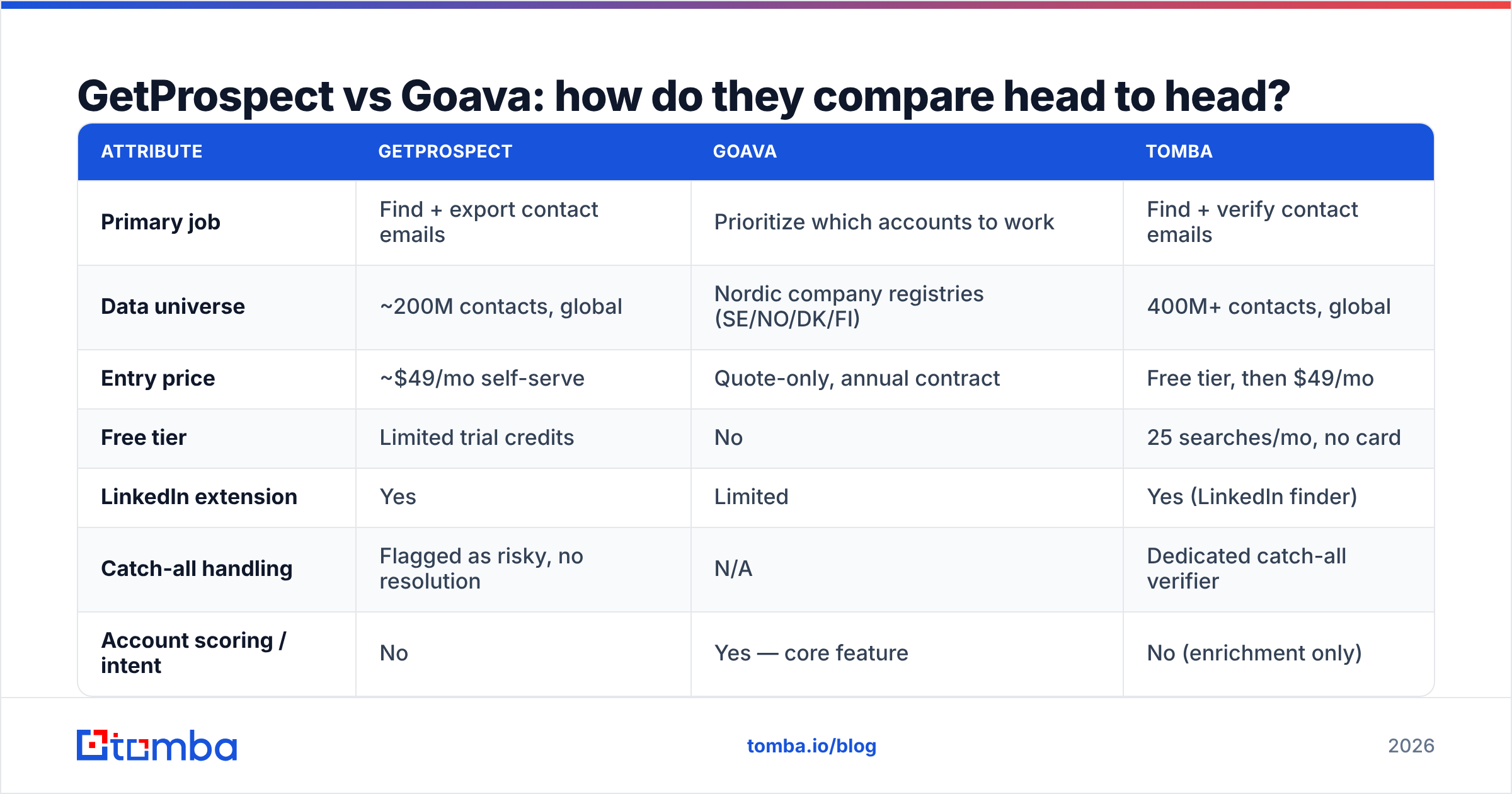
Here is the honest side-by-side. Note how few rows are genuine apples-to-apples — that's the point.
| Attribute | GetProspect | Goava | Tomba |
|---|---|---|---|
| Primary job | Find + export contact emails | Prioritize which accounts to work | Find + verify contact emails |
| Data universe | ~200M contacts, global | Nordic company registries (SE/NO/DK/FI) | 400M+ contacts, global |
| Entry price | ~$49/mo self-serve | Quote-only, annual contract | Free tier, then $49/mo |
| Free tier | Limited trial credits | No | 25 searches/mo, no card |
| LinkedIn extension | Yes | Limited | Yes (LinkedIn finder) |
| Catch-all handling | Flagged as risky, no resolution | N/A | Dedicated catch-all verifier |
| Account scoring / intent | No | Yes — core feature | No (enrichment only) |
| CRM enrichment | Basic export/integrations | Deep, native CRM sync | HubSpot, Salesforce, Pipedrive, Zapier |
| API access | Yes, on paid plans | Yes, enterprise | Yes, all paid plans |
| Phone numbers | Limited | Company switchboards | Dedicated phone finder |
| Best for | SDR teams doing global outbound | Nordic field sales, 10+ reps | Teams that need accuracy per credit |
| Contract | Monthly, cancel anytime | Annual | Monthly or annual |
The row that matters most is the first one. Everything else is downstream of it.
Which one should you pick for your motion?#
Skip the feature checklist and answer three questions instead.
Where do your customers live? If more than half your ICP is registered in Sweden, Norway, Denmark, or Finland, Goava's registry depth is genuinely hard to replicate — you cannot get audited financials and ownership graphs for a 30-person Danish wholesaler out of a global contact database. If your ICP is spread across the US, UK, DACH, or anywhere else, Goava's advantage evaporates and you should not be evaluating it.
Is your bottleneck targeting or reach? Teams with a clear ICP and no contact data have a reach problem — buy a contact tool. Teams sitting on 8,000 stale CRM accounts with no idea which to touch have a targeting problem — buy intelligence. Most teams misdiagnose this. Look at your last 90 days: if reps are burning hours hunting emails, it's reach. If they're burning hours arguing about which accounts to work, it's targeting.
What's your tolerance for bounce rate? This is where the GetProspect conversation gets uncomfortable. A 5% bounce rate on a 3,000-send month is 150 hard bounces — enough to visibly dent sender reputation on a young domain. Cheap credits that produce unverified emails are not cheap.
How do the pricing models really compare?#
GetProspect and Goava price on opposite philosophies, and the sticker number hides most of the real cost.
GetProspect is credit-metered and self-serve. Entry paid plans start in the ~$49/mo range with a few thousand credits, scaling up through mid-tier plans. The hidden cost is wasted credits: every unverifiable email, every catch-all you can't resolve, every duplicate you didn't dedupe before upload burns credit you paid for. Effective cost-per-usable-email is often 1.5–2x the headline rate.
Goava is seat-and-contract based, quoted per organization, almost always annual. Expect a demo, a scoping call, and a multi-thousand-euro annual commitment. The hidden cost there is adoption: account-intelligence tools only pay back if reps actually change behavior based on the scores. Bought and ignored, it's the most expensive line item on the stack.
Tomba sits in the self-serve lane with published numbers: a free tier at 25 searches/month, Starter at $49/mo, Growth at $99/mo, Pro at $249/mo, and custom enterprise. Full Tomba pricing is public — no demo gate.
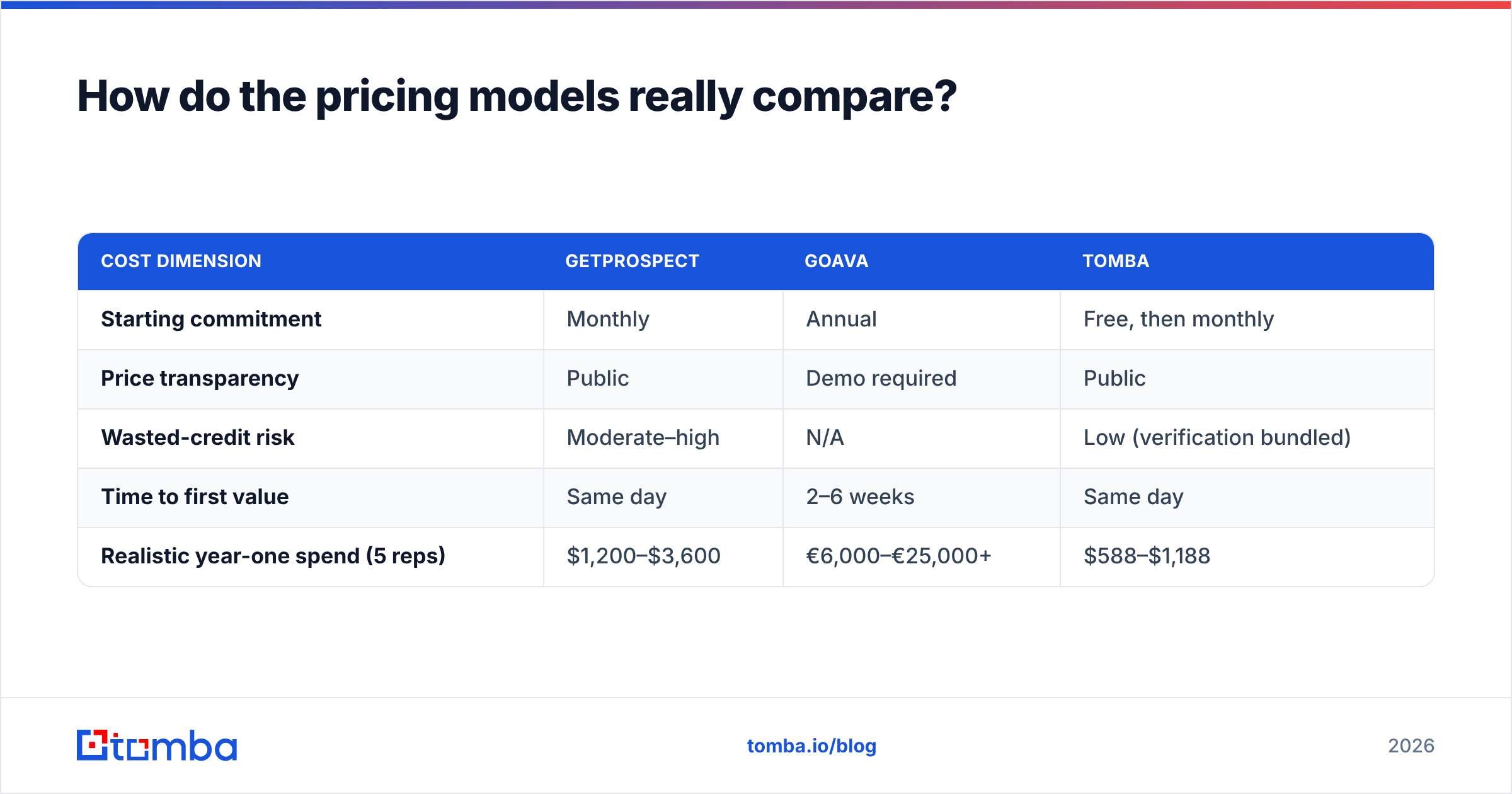
Here's the practical framing:
| Cost dimension | GetProspect | Goava | Tomba |
|---|---|---|---|
| Starting commitment | Monthly | Annual | Free, then monthly |
| Price transparency | Public | Demo required | Public |
| Wasted-credit risk | Moderate–high | N/A | Low (verification bundled) |
| Time to first value | Same day | 2–6 weeks | Same day |
| Realistic year-one spend (5 reps) | $1,200–$3,600 | €6,000–€25,000+ | $588–$1,188 |
Numbers for GetProspect and Goava are estimates based on publicly listed tiers and typical Nordic mid-market contract sizes; confirm directly with each vendor. Tomba's are list prices.
Does data accuracy actually differ between these tools?#
Yes, and it differs in ways the marketing pages won't tell you.
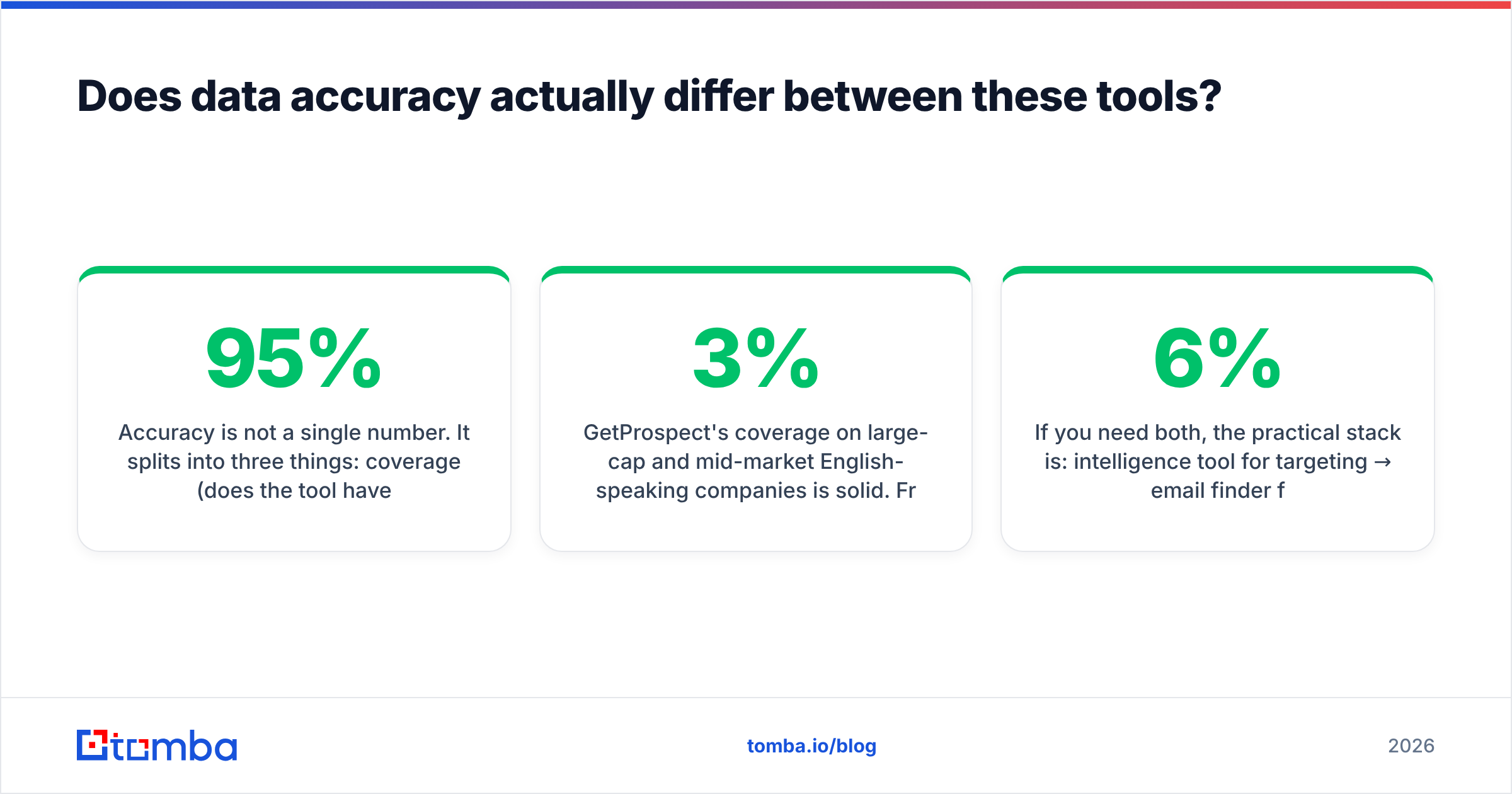
Accuracy is not a single number. It splits into three things: coverage (does the tool have anyone at this company), freshness (is the record still true), and deliverability (will the email land). A tool can score 95% on one and 60% on another.

GetProspect's coverage on large-cap and mid-market English-speaking companies is solid. Freshness is where credit-based databases universally struggle — records built from scrapes decay at roughly 2–3% per month as people change jobs, which compounds to a third of a list going stale inside a year. Deliverability depends on whether the tool actually SMTP-verifies at export time or just pattern-matches against a known company format.
Goava's accuracy question is different: its registry data is essentially authoritative, because it comes from government filings rather than inference. A Swedish company's revenue figure in Goava is the filed figure. That's a real moat — but it's firmographic accuracy, not contact accuracy.
If you need both, the practical stack is: intelligence tool for targeting → email finder for reach → verifier before send. Running exports through an email verifier before they hit your sequencer is a 20-minute step that routinely cuts bounce rates from 6% to under 2%. Independent review sites like G2 and Capterra are useful for sanity-checking vendor claims, but read the 3-star reviews, not the 5-star ones — that's where the coverage gaps show up.
What are the real alternatives to both?#
Because GetProspect and Goava sit in different categories, "alternative" means two different lists.
If you're evaluating GetProspect (contact discovery), the realistic comparison set is Tomba, Hunter, Apollo, Findymail, and BookYourData. BookYourData is worth a look if you want pre-built, pay-as-you-go lists with a bounce guarantee rather than a subscription — a genuinely different purchasing model that suits campaign-based teams. Apollo bundles sequencing but at a much higher seat cost. Tomba competes on cost-per-verified-email and includes catch-all resolution most competitors charge extra for or simply don't offer. See the full Apollo alternative and Findymail alternative breakdowns if those are on your shortlist.
If you're evaluating Goava (account intelligence), the comparison set is Vainu (also Nordic, strong Finnish coverage), Bisnode/Dun & Bradstreet, Cognism for broader EU, and 6sense or Demandbase if you want intent signals over registry depth. Vainu alternative is the closest head-to-head.
A pattern worth noting: teams that buy account intelligence first almost always need a contact layer within a quarter. Goava will tell you that Kalmar Industri AB scores 92 and is hiring three ops roles. It will not reliably hand you the operations director's direct email. That last mile is where a domain search or bulk finder earns its keep.
How do you actually stack these tools without overpaying?#
Four moves, in order:
- Define the account universe with the cheapest possible source first. Registry data, LinkedIn filters, or your own closed-won analysis. Don't pay for intelligence until you've exhausted free segmentation.
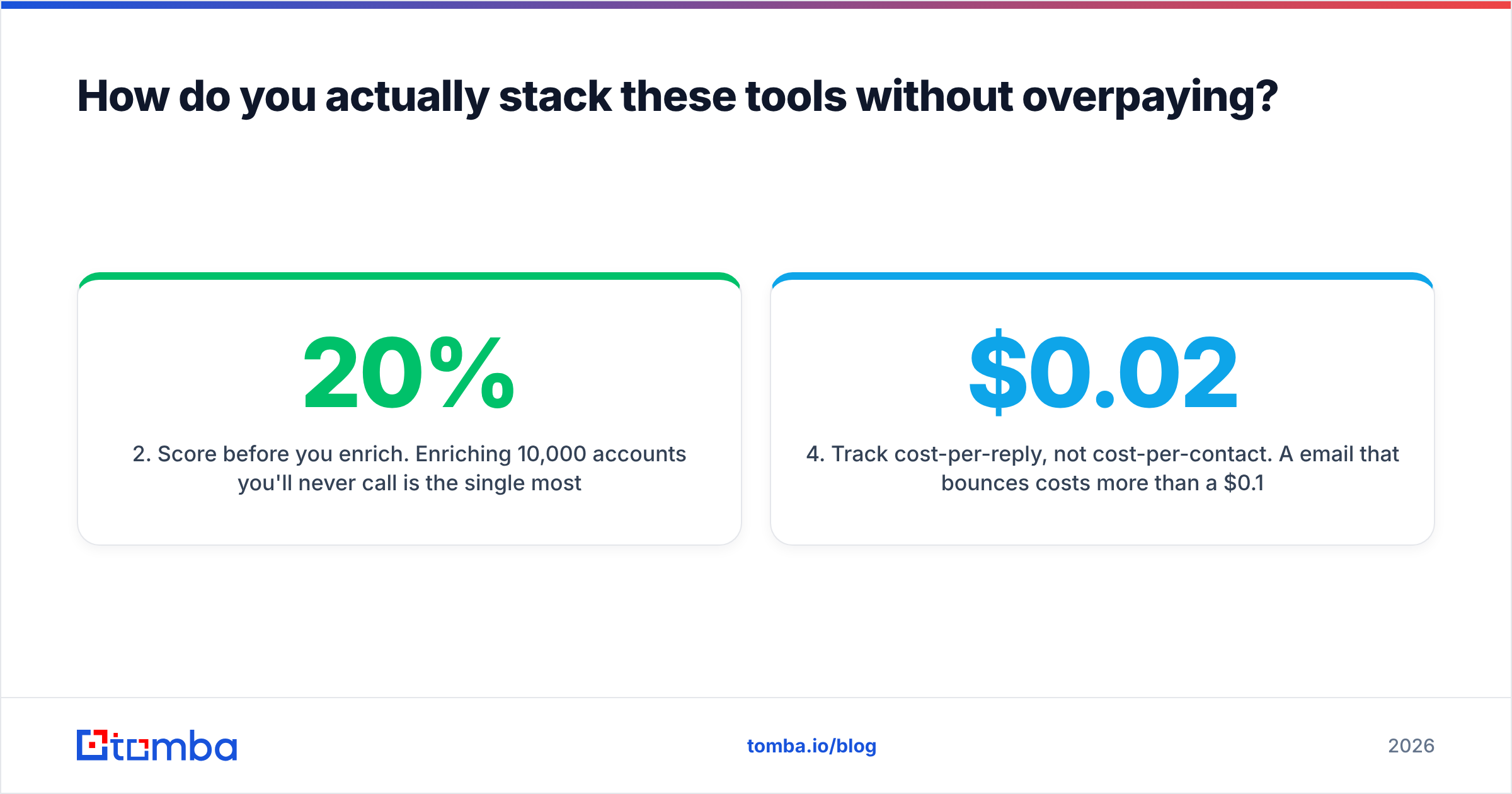
- Score before you enrich. Enriching 10,000 accounts you'll never call is the single most common way teams waste credits. Cut to the top 20% by fit, then enrich.
- Verify at the last possible moment. Contact data decays, so verifying a list two months before you send it defeats the purpose. Verify the week you launch.
- Track cost-per-reply, not cost-per-contact. A $0.02 email that bounces costs more than a $0.10 email that lands, once you price in domain damage and rep time. Run the math on your last campaign — most teams have never done it.
That fourth point reframes the whole GetProspect vs Goava question. Neither tool's list price tells you what it costs you. Goava is expensive per seat and can still be the highest-ROI tool in a Nordic org because it changes what reps do all day. GetProspect is cheap per credit and can quietly cost you a domain if verification is sloppy.
The verdict#
Pick Goava if you sell into the Nordics, have 10+ reps, and your problem is that nobody knows which accounts to work. Nothing global replicates its registry depth in that region.
Pick GetProspect if you're doing global outbound, know your ICP, and need LinkedIn-sourced contact volume at a self-serve price point.
Pick neither if what you actually need is accurate, verified contact data at a predictable cost — which, for most outbound teams, is the real bottleneck. That's the gap Tomba was built for: find email addresses by domain, name, or company, with verification, catch-all resolution, and a public price list. Start on the free tier at 25 searches a month, run 50 of your hardest-to-find prospects through it, and compare the hit rate against whatever you're paying for now. If it doesn't beat your current tool on verified-emails-per-dollar, you've lost 20 minutes. If it does, you've just cut your data spend in half.
Sources: G2 Lead Intelligence category, Capterra Sales Intelligence software, HubSpot sales data research
Related guides#
Ready to find emails that actually work?
Join 150,000+ professionals who stopped guessing and started sending. Free credits on signup — no credit card required.
Get the Tomba newsletter
Practical outbound tactics and product updates — once every two weeks.
About the author