GetProspect vs Interseller: Which B2B Prospecting Tool Wins in 2026?
GetProspect sells contact data volume. Interseller (now Nexxt Intelligence) sells recruiter-grade sourcing plus sequences. We break down accuracy, pricing, and which one actually fits your outbound motion.
TL;DR
- GetProspect vs Interseller in one line: one sells data, the other sells a hiring workflow.
- GetProspect is a contact database with a LinkedIn add-on. Filter by title or industry, export 1,000 rows, push them to your sequencer.
- Interseller (now part of Greenhouse) is built for recruiters. It finds people, sends email, and logs each touch in your ATS.
- GetProspect wins on cost per contact. Interseller wins when your pipeline is candidates, not buyers.
- Both share one weak spot: the data layer. Rows that look valid still bounce.
- Own a sequencer already? A dedicated email finder with a checking step costs less than both. Tomba starts at $49/mo with 25 free searches.
What is GetProspect and who actually uses it?#
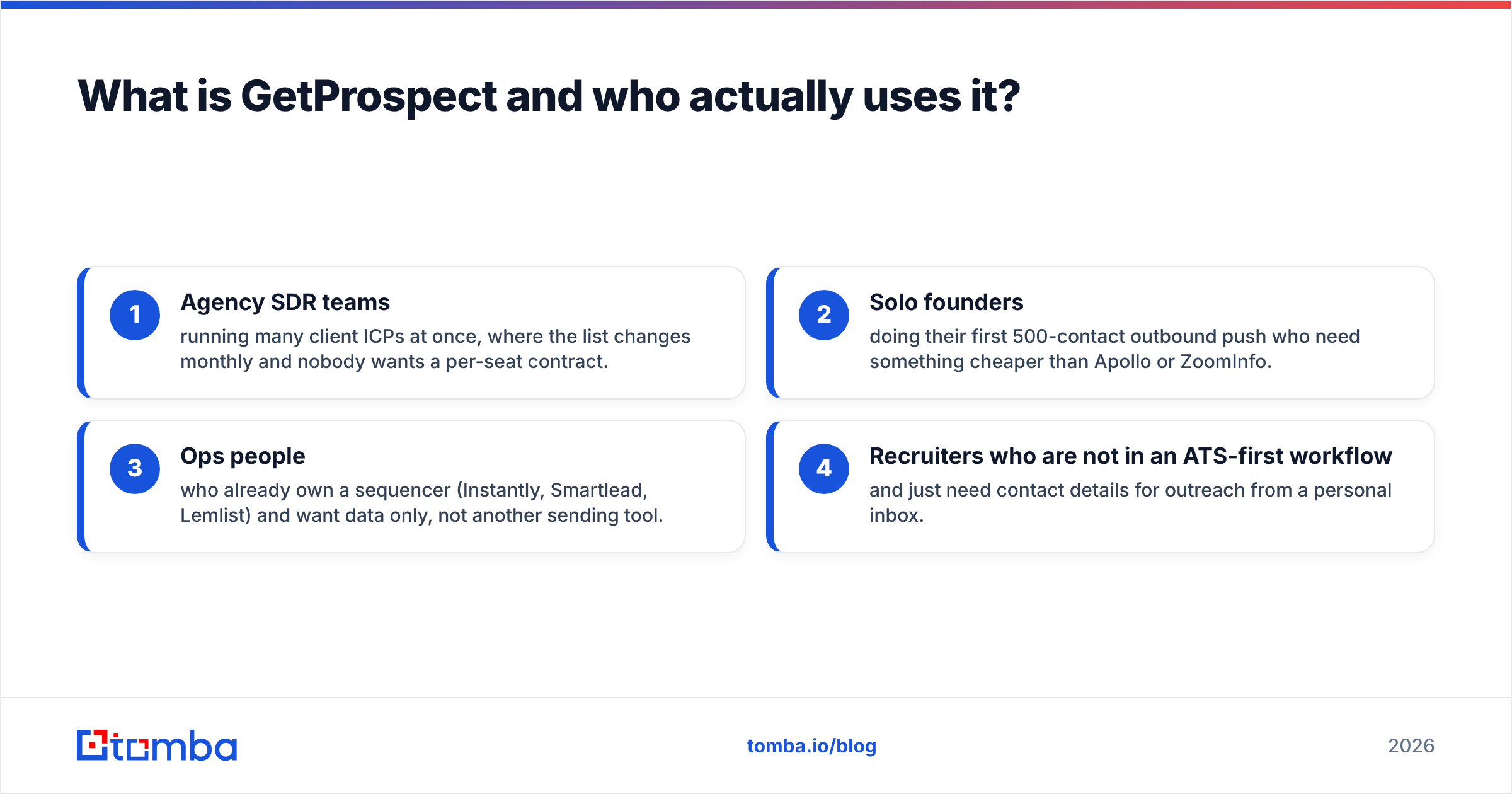
GetProspect is a B2B contact database with a LinkedIn add-on. You can search it by job title, seniority, industry, location, company size, or tech stack. Or you can browse LinkedIn and let the add-on pull emails for the profiles on screen. Output goes to CSV, Google Sheets, HubSpot, Pipedrive, or Zapier.
The promise is volume. GetProspect claims tens of millions of contacts, and it prices in credits. That suits agencies and SDR teams who build big lists, not short ones.
Who it fits:
- Agency SDR teams. They run many client profiles at once. The list changes each month, and nobody wants a per-seat deal.
- Solo founders. Your first 500-contact push has to cost less than Apollo or ZoomInfo.
- Ops people. You already own a sequencer, so you want data only.
- Recruiters outside an ATS. You just need contact details for a personal inbox.
Where it lets you down: catch-all domains. A catch-all server accepts every address, so the row comes back marked "valid." Then it bounces. Every vendor has this problem. Still, you need a catch-all verifier in the chain before those rows touch your sending domain.
In a GetProspect vs Interseller split, this is the data-only side of the fence.
What is Interseller and why is it different?#
Interseller began as an outreach tool for recruiters. Find a candidate. Get a personal email. Drop them into a short sequence. Sync every touch back to the ATS. Greenhouse then bought it and folded it into hiring tools.
That history explains the design. The sequences are short and chatty. The data leans toward personal email, such as Gmail or Outlook. Candidates do not want a recruiter pitch at work. The integration list is ATS-first: Greenhouse, Bullhorn, Lever, JobAdder. Salesforce is not the centre of it.
For a B2B SaaS rep, that is friction. You do not want a Gmail address for a buying pitch. Your system of record is a CRM, not an ATS. For a staffing agency, it fits well. One tool sources, writes, sends, and logs, with no CSV round trip.
That gap is the whole story in GetProspect vs Interseller.

GetProspect vs Interseller: how do they compare feature by feature?#
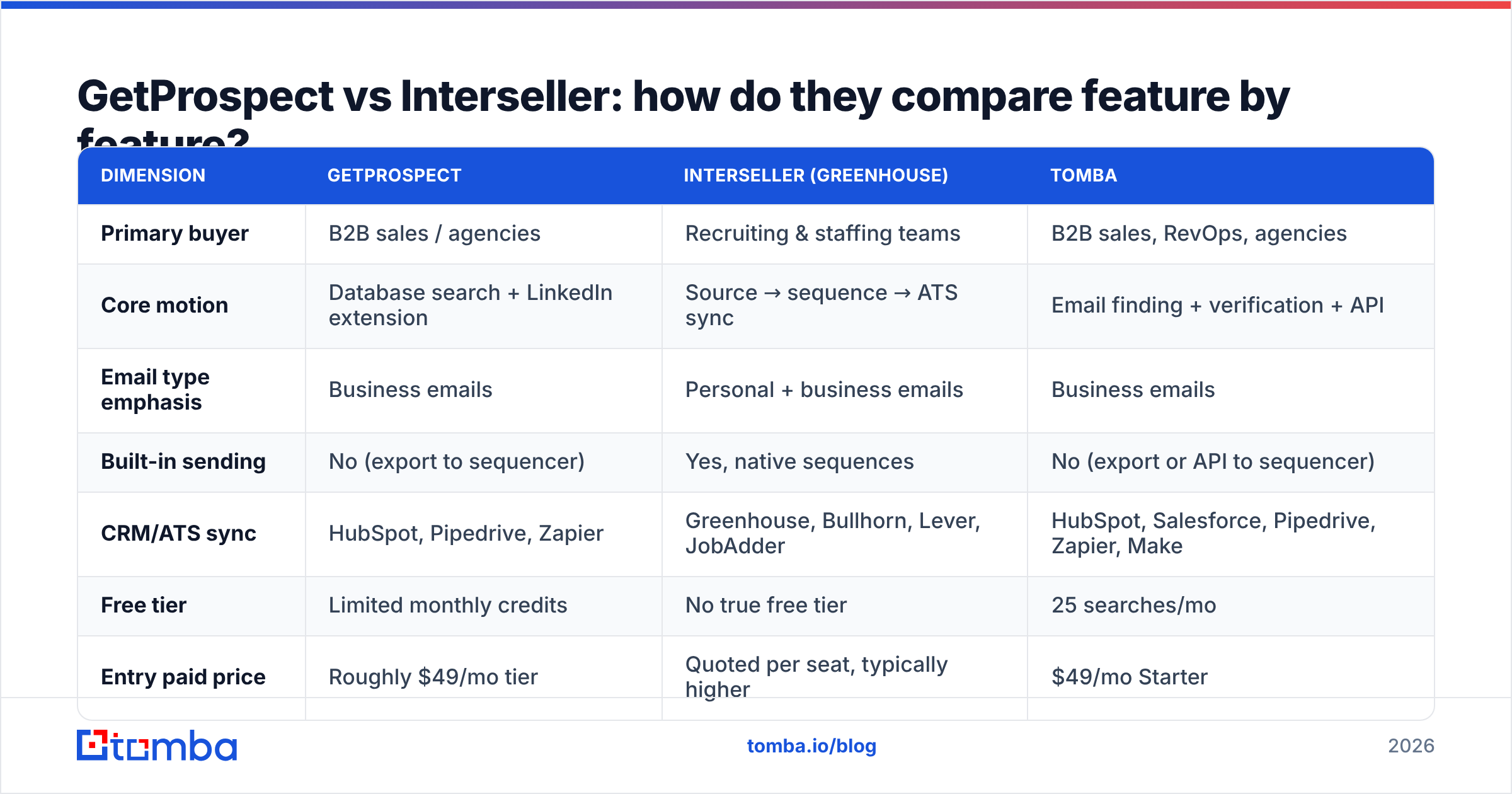
Here is the side by side. Prices move, so check both vendors before you sign.
| Dimension | GetProspect | Interseller (Greenhouse) | Tomba |
|---|---|---|---|
| Primary buyer | B2B sales / agencies | Recruiting & staffing teams | B2B sales, RevOps, agencies |
| Core motion | Database search + LinkedIn extension | Source → sequence → ATS sync | Email finding + verification + API |
| Email type emphasis | Business emails | Personal + business emails | Business emails |
| Built-in sending | No (export to sequencer) | Yes, native sequences | No (export or API to sequencer) |
| CRM/ATS sync | HubSpot, Pipedrive, Zapier | Greenhouse, Bullhorn, Lever, JobAdder | HubSpot, Salesforce, Pipedrive, Zapier, Make |
| Free tier | Limited monthly credits | No true free tier | 25 searches/mo |
| Entry paid price | Roughly $49/mo tier | Quoted per seat, typically higher | $49/mo Starter |
| Verification included | Basic | Basic | Dedicated verifier + catch-all checks |
| Bulk workflow | CSV upload | Limited | Bulk email finder with CSV in/out |
| Developer API | Yes | Limited | Full email finder API, CLI, MCP |
Read the GetProspect vs Interseller table with one question in mind. What is your system of record? If it is an ATS, Interseller earns its price, and no pile of GetProspect credits will replace that sync. If it is a CRM or a sheet, the best part of Interseller sits idle. You end up paying a hiring premium for a sales job.
Which one has better data accuracy?#
Neither vendor publishes an audited number. Be wary of any claim of 98% or more without a named test set.
Here is what repeat testing tends to show.
- GetProspect does fine on mid-market and large firms with simple email patterns, like first.last@. It slips on small firms, agencies, and non-US domains.
- Interseller is better at personal email, which is a harder job. It is weaker on work addresses, because that is not its focus.
- Both return catch-all rows marked valid. On a 1,000-row export, expect a chunk to bounce.
The fix is the same either way. Check the list again before it hits a sending domain. A dedicated email verifier runs syntax, MX, SMTP, and catch-all tests. It catches what a finder's own check misses. This matters more than the GetProspect vs Interseller pick. A 12% bounce rate can hurt email deliverability for weeks, and it can cost you the domain.
Run one test first. Take 100 contacts you know are right: customers, past buyers, people in your CRM. Push them through each trial. Count exact hits, wrong hits, and blanks. That takes an hour, and it beats any review site. G2's category listings help you find tools to test. They do not settle the choice.
How does pricing really compare?#
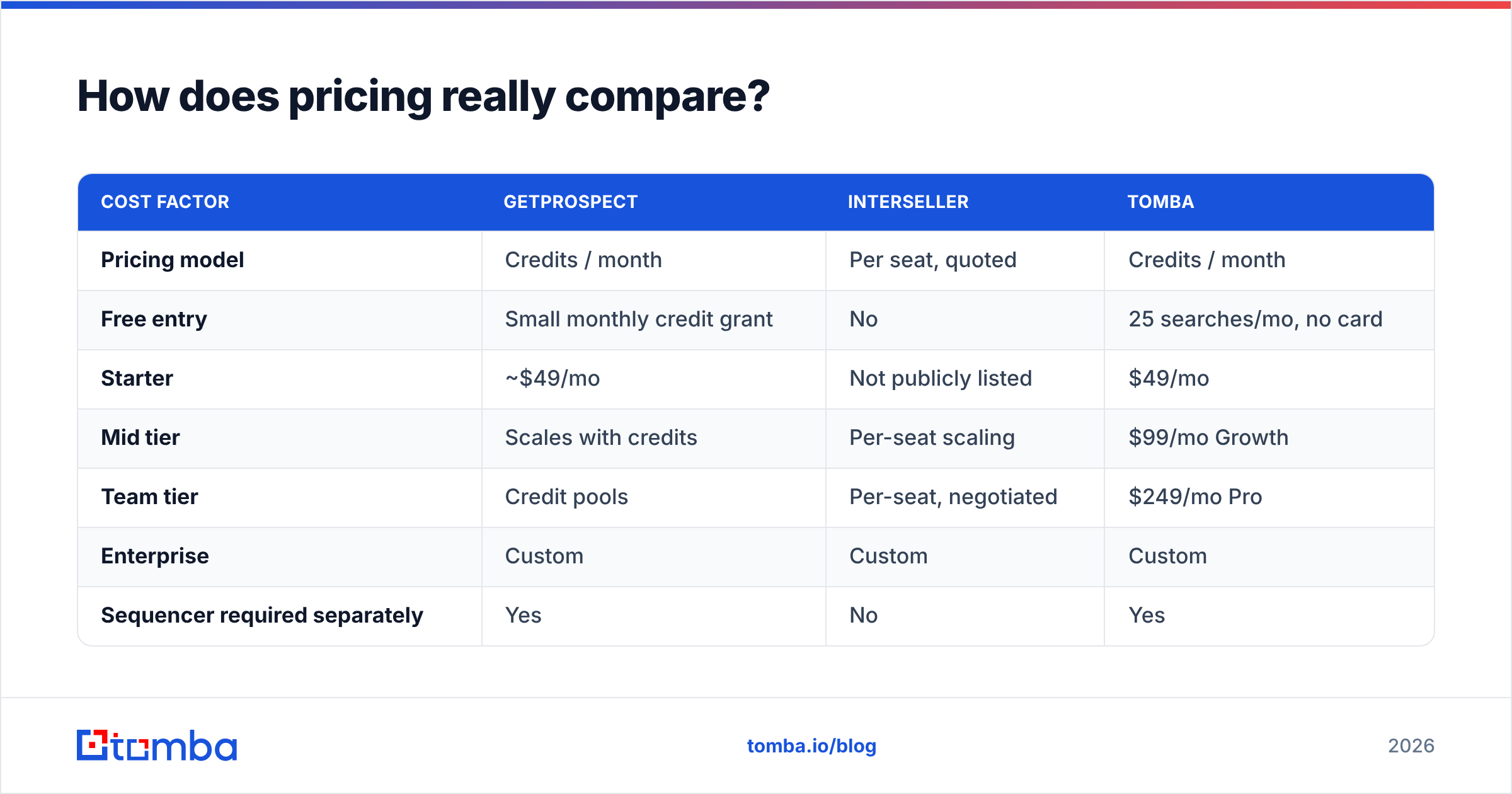
Pricing is where GetProspect vs Interseller stops being comparable. The two price on different logic, so the sticker numbers mislead.
GetProspect sells credits. You buy a set number of lookups each month. Unused credits rarely roll over. The math is simple. Divide total spend by usable contacts, not by credits. If one row in five bounces or comes back blank, your $49 tier really costs 25% more.
Interseller sells seats, by quote. Hiring tools price per user, and the sending engine is baked in. Replacing a sourcing tool and an outreach tool at once? Then the blended price can make sense. Already paying for a sequencer? Then you pay twice.
| Cost factor | GetProspect | Interseller | Tomba |
|---|---|---|---|
| Pricing model | Credits / month | Per seat, quoted | Credits / month |
| Free entry | Small monthly credit grant | No | 25 searches/mo, no card |
| Starter | ~$49/mo | Not publicly listed | $49/mo |
| Mid tier | Scales with credits | Per-seat scaling | $99/mo Growth |
| Team tier | Credit pools | Per-seat, negotiated | $249/mo Pro |
| Enterprise | Custom | Custom | Custom |
| Sequencer required separately | Yes | No | Yes |
| Wasted spend risk | Unused credits expire | Idle seats | Unused credits expire |
The pattern holds for all three. Your real cost is per usable contact. Run the trial, count the good rows, divide. Tomba pricing is public for that reason. Quote-only pricing tends to move with how much the vendor thinks you will pay.
Is Interseller worth it if you are not a recruiter?#
Short answer: no.
Interseller's value is the loop between sourcing, sending, and the ATS. Take out the ATS and little is left. You get a mid-tier sequencer and a finder that favours personal email. In most places you cannot use those addresses for cold B2B sales, in law or in taste. GDPR treats a personal address differently from a shared work one. "A tool gave it to me" is not a lawful basis. Read the ICO's guidance on direct marketing before you build a list of anyone's Gmail.
Now flip it. If you hire for a living, GetProspect vs Interseller has a clear winner, and it is Interseller. The ATS sync kills the manual logging that eats an hour a day. GetProspect hands you a sheet. Interseller hands you a workflow.
What are the best alternatives to both?#
Neither tool is the only answer. Often "GetProspect vs Interseller" is the wrong bracket. Sort by the job to be done.
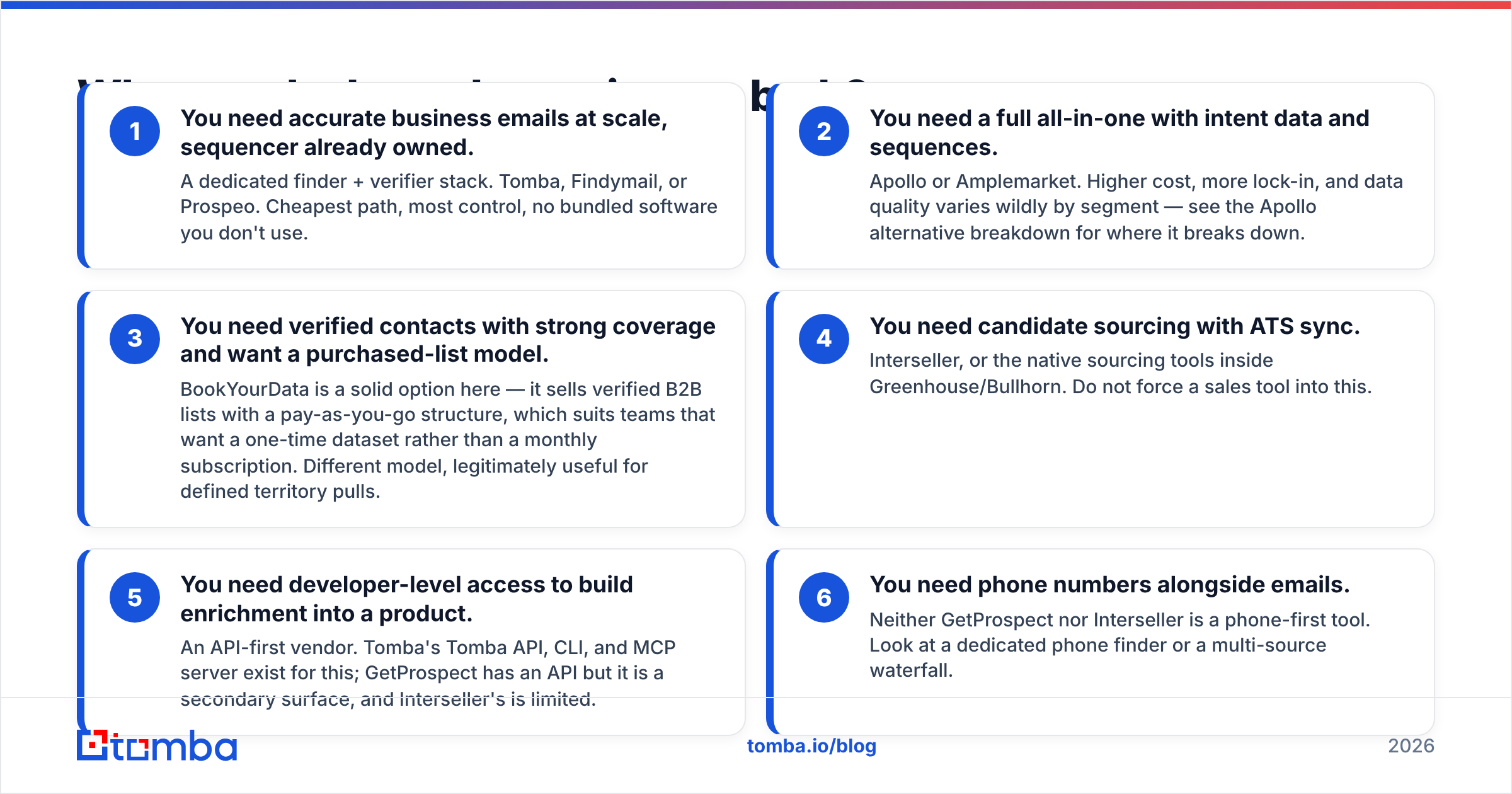
You need business emails at scale and own a sequencer. Use a finder plus a verifier. Tomba, Findymail, or Prospeo. Cheapest path, most control, no bundled software you never open.
You want one platform with intent data and sequences. Apollo or Amplemarket. More cost, more lock-in. Data quality swings by segment. See the Apollo alternative breakdown for where it breaks down.
You want to buy a list outright. BookYourData sells checked B2B lists on a pay-as-you-go basis. Different model, and it suits a one-off pull for a set territory.
You need candidate sourcing with ATS sync. Interseller, or the sourcing tools inside Greenhouse or Bullhorn. Do not force a sales tool into this.
You need an API to build enrichment into a product. Tomba's Tomba API, CLI, and MCP server exist for this. GetProspect has an API, but it is a side door. Interseller's is limited.
You need phone numbers too. Neither tool leads with phones. Use a phone finder or a multi-source waterfall instead.
That waterfall deserves a mention. Strong teams query two or three vendors in order. They take the first solid hit, then check it. Each row costs more, but coverage beats any single vendor. Above 5,000 contacts a month, run the numbers.
How do you decide in under an hour?#
This checklist settles GetProspect vs Interseller fast. It is boring, and it works.
- Name the record type. Candidates point to Interseller. Buyers point to GetProspect or a plain finder. That one answer settles most of it.
- Match the integration list to your stack. If your system of record is missing, budget for Zapier forever.
- Run the 100-known-contact test on both trials. Count exact hits, wrong hits, and blanks. A wrong hit is worse than a blank.
- Check the winner's output yourself. If 15% or more come back risky, the built-in check is for show.
- Work out cost per usable contact, not cost per credit or seat.
- Check the exit. Can you export it all as CSV without a support ticket?
Teams that skip the third step tend to regret it by month two. The bounce rate on a young domain climbs, and nobody knows which tool brought the bad rows.
Where does Tomba fit in this comparison?#
On the GetProspect vs Interseller map, Tomba sits next to GetProspect. It does not source candidates. It does not sync to an ATS. It does not send email. It finds and checks business emails. You get that through a UI, a bulk uploader, sheet add-ins, a Chrome add-on, and an API.
That narrow scope is the point. If you own a sequencer and a CRM, a bundled platform makes you pay for overlap. If you need candidate work inside an ATS, Tomba is wrong and Interseller is right. That is a boundary, not a hedge.
Tomba beats GetProspect on checking depth: catch-all handling, a standalone verifier, data enrichment on rows you already hold, and open data sources. GetProspect may still win on one thing. It gives you a big, browsable database with a lot of filters.
The bottom line#
GetProspect vs Interseller is a category mismatch dressed up as a duel. GetProspect is data for sales teams. Interseller is a workflow for recruiters. So the GetProspect vs Interseller answer starts with your system of record. Then judge the data layer on its own. Both tools will hand you rows that bounce if you send without a check.
Is your answer "CRM, work emails, sequencer already bought"? Then start narrow, not with a bundle. Run Tomba Email Finder against your next 25 accounts on the free tier. Check the output. Compare the count of usable contacts with what you pay today. That number should decide the renewal, not a feature grid.
Related guides#
Ready to find emails that actually work?
Join 150,000+ professionals who stopped guessing and started sending. Free credits on signup — no credit card required.
Get the Tomba newsletter
Practical outbound tactics and product updates — once every two weeks.
About the author