GetProspect vs Postaga (2026): Which One Fits Your Outreach?
GetProspect builds lead lists. Postaga runs AI outreach campaigns. They overlap just enough to confuse buyers — here is where each one actually wins, what they cost, and when neither is the right pick.
TL;DR
- GetProspect is a lead database and email finder. Its job ends when a verified contact lands in your CSV or CRM. It does not send campaigns.
- Postaga is an outreach engine with a finder bolted on. Its job starts when you have a target list, and it leans hard on AI-generated sequences and link-building/podcast/blog-post campaign types.
- They are not real substitutes. Comparing them head-to-head is really a question of which half of the outbound stack you're missing.
- Cost split matters: GetProspect's entry paid tier lands near $49/mo; Postaga's starts materially higher because you're paying for sending infrastructure and AI copy, not just data.
- The common failure: teams buy Postaga for the campaigns, discover its contact discovery is thin for their ICP, then bolt on a dedicated finder anyway — paying twice.
What are GetProspect and Postaga, actually?#
Start here, because most "GetProspect vs Postaga" comparisons treat them as the same category. They aren't.
GetProspect is a B2B contact database plus an email finder. You search by company domain, job title, industry, headcount, or location, pull matching contacts, and export them. It has a Chrome extension for LinkedIn, a bulk finder, and built-in verification. Think of it as a warehouse with a good search bar: you walk in, describe who you want, and walk out with a list.
Postaga is an outreach platform. It generates campaign ideas, drafts sequences with AI, finds contact info for the sites and people you're targeting, and sends multi-step emails from your own mailbox. Its DNA is link building and content promotion — the campaign templates are built around "you wrote a post, now go pitch it" workflows rather than "we sell HR software to 200-person manufacturers."
The analogy: GetProspect is the grocery store. Postaga is the meal-kit service that also throws a few ingredients in the box. If you already have a full pantry, the meal kit is overpriced. If you have no recipes, the grocery store leaves you staring at raw chicken.
That distinction drives every other trade-off below.

How do GetProspect and Postaga compare on features and pricing?#
Prices below reflect publicly listed plans as of early 2026. Both vendors reprice and reshuffle credit allowances regularly, so treat these as directional and confirm on the vendor pages before you buy.
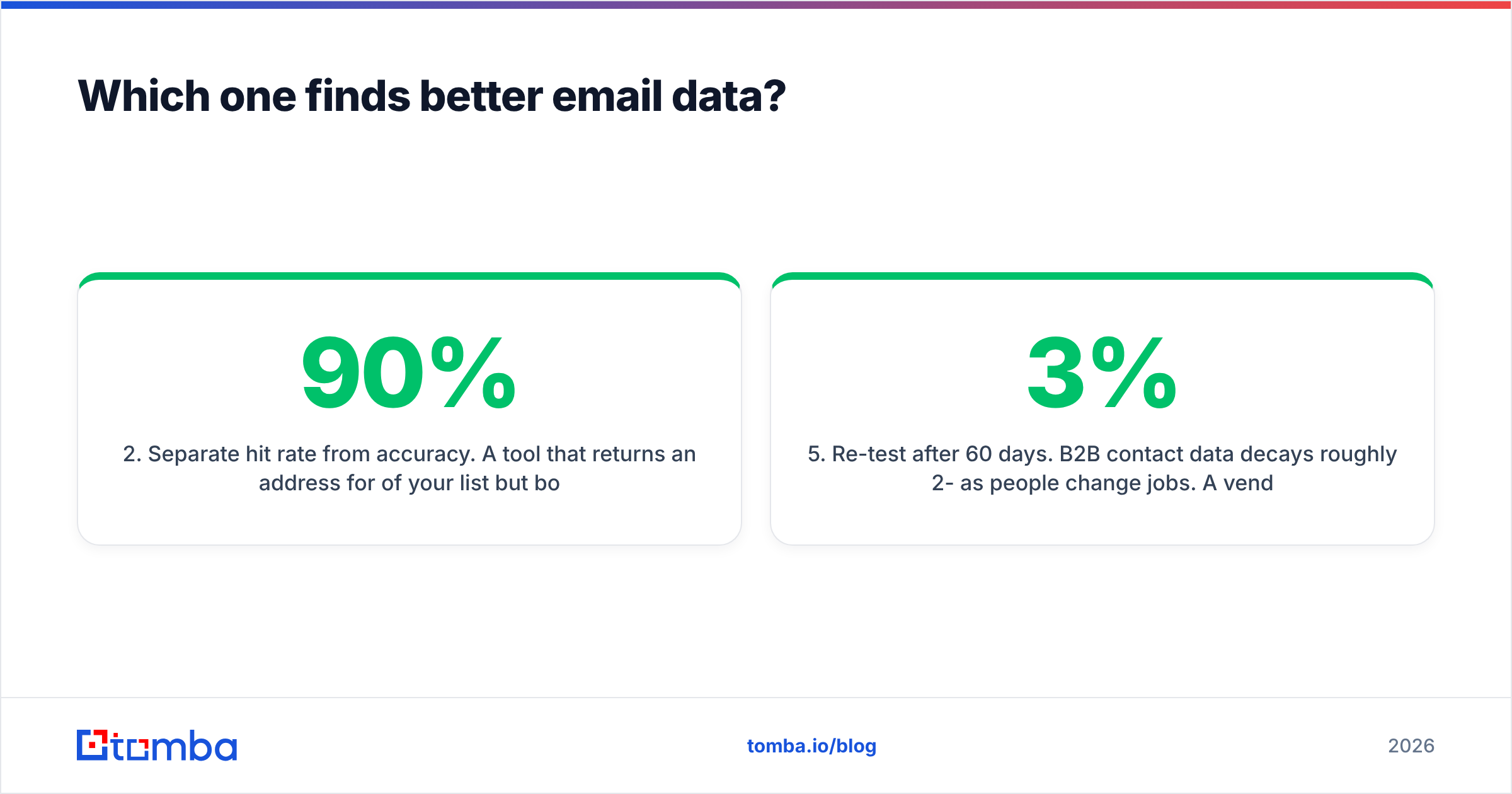
| Dimension | GetProspect | Postaga |
|---|---|---|
| Primary job | Find + verify B2B contacts | Build and send outreach campaigns |
| Free tier | Yes — small monthly valid-email allowance | Trial only, no permanent free plan |
| Entry paid price | ≈ $49/mo | ≈ $84/mo (annual billing) |
| Contact database | Yes — searchable, filterable | No standing database; discovers per-campaign |
| Email verification | Built in | Basic validation only |
| Email sending | No | Yes — connects your mailbox, multi-step sequences |
| AI copywriting | No | Yes — core feature |
| LinkedIn extension | Yes | Limited |
| API access | Yes, on higher tiers | Limited |
| Best-fit buyer | SDR teams, agencies building lists | Content/SEO teams running link-building outreach |
The pattern is clean: GetProspect is deeper on data, Postaga is deeper on delivery. Neither is bad at its own job. Both are noticeably weaker outside it.
One pricing nuance people miss: Postaga's cost is per-user and includes sending capacity, so a three-person team scales differently than a three-seat data tool. Run the math on your actual headcount, not the headline number. If you only need one seat and a big list, a data-first tool plus a cheap sender is usually cheaper. If you need five people running campaigns and each of them needs copy help, the calculus flips.
Which one finds better email data?#
GetProspect, and it isn't especially close — but the reason matters more than the verdict.
Postaga finds contacts reactively. You give it a URL or a topic, it crawls for associated people and guesses addresses. That's genuinely useful for link building, where your target is "whoever runs content at these 200 blogs" and you don't know their names in advance. It's much weaker when your target is "VPs of Finance at Series B fintechs in DACH," because there's no structured database underneath to filter.
GetProspect works proactively from a stored index. You filter, you get names, you get emails, you verify.
Here's how to evaluate either one — or any email finder — on data quality rather than marketing claims:
- Test on your actual ICP, not a famous domain. Every tool nails
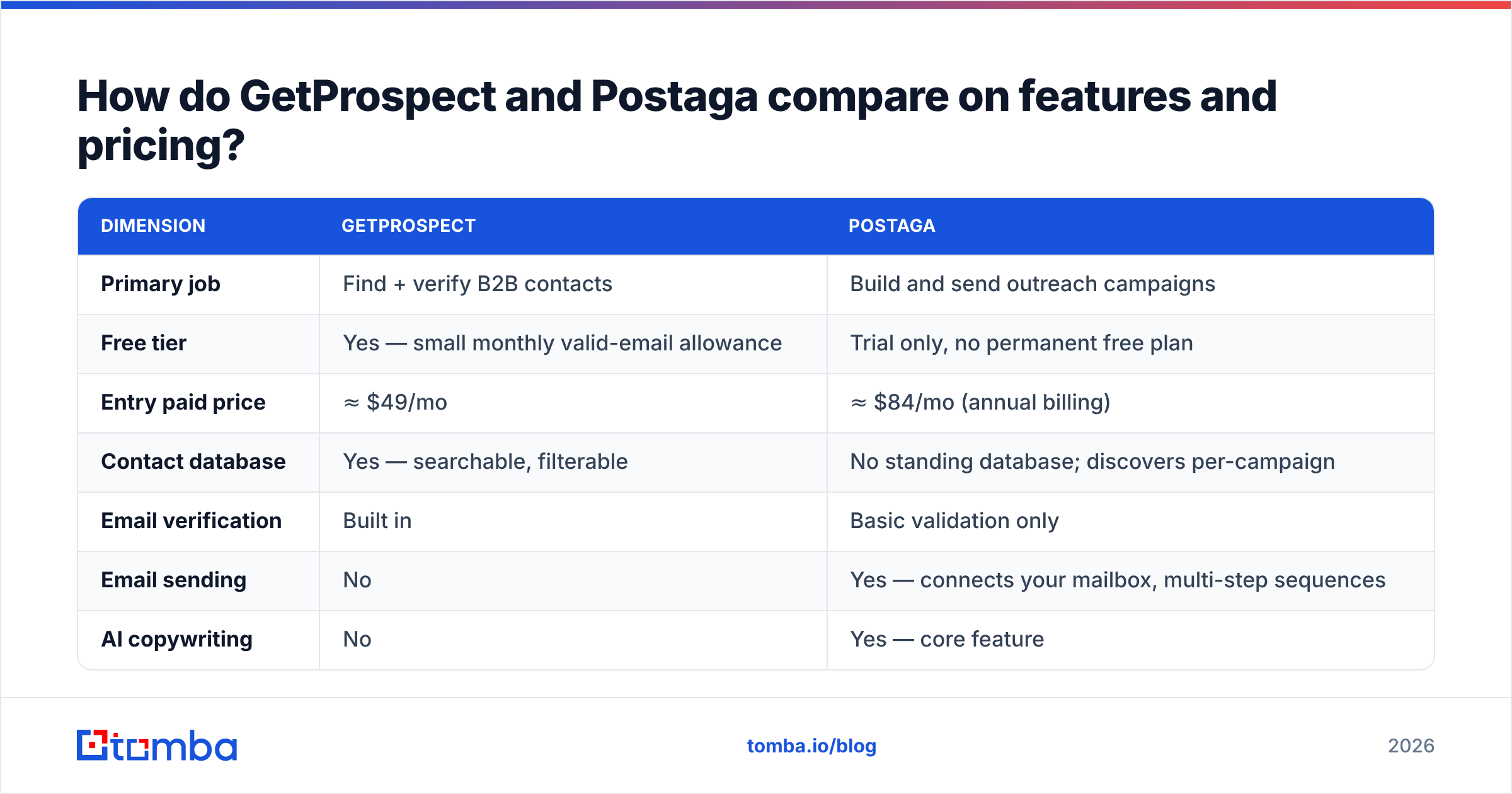
stripe.com. Run 100 domains from your real target list — mid-market, non-US, weird TLDs — and measure hit rate there. - Separate hit rate from accuracy. A tool that returns an address for 90% of your list but bounces on a third of them is worse than one that returns 60% clean. Measure both numbers independently.
- Check catch-all handling. Catch-all domains accept everything at the SMTP layer, so naive verifiers mark guesses as "valid." Ask how the vendor scores them, or run your list through a dedicated catch-all verifier before sending.
- Look at the confidence score, not just the address. A tool that hands you a pattern-guessed address with no confidence signal is offloading its risk onto your sender reputation.
- Re-test after 60 days. B2B contact data decays roughly 2-3% per month as people change jobs. A vendor's freshness policy matters more than its raw record count.
Run that on both tools and you'll see the split immediately. Postaga's discovery is opportunistic; GetProspect's is systematic. If your motion is account-based and list-driven, opportunistic discovery leaves gaps you'll have to fill manually.
Is Postaga's AI outreach worth the price?#
It depends entirely on whether you'd otherwise write the sequences yourself.
Postaga's strongest feature is its campaign generator. Pick a campaign type — skyscraper outreach, podcast guesting, expert roundups, product review pitches — and it scaffolds the whole thing: target discovery, personalisation tokens pulled from the target's own content, a multi-step sequence, and follow-up logic. For a content marketer who has never built an outreach sequence, that's a real accelerator. It removes the blank-page problem, which is the actual reason most link-building programs never launch.
For an experienced SDR team, it's less compelling. You already have sequences that convert. You already know your angles. What you need is volume, deliverability control, and CRM sync — and Postaga's sending layer is competent but not in the same tier as dedicated sequencers on reporting depth or inbox rotation.
The honest read from user reviews on G2 and similar sites: people love Postaga's speed to first campaign and get frustrated with its ceiling once campaigns get complex. That's a normal profile for an all-in-one, and it's not a knock — it's a fit question.
Also worth saying plainly: AI-generated cold email is not automatically good cold email. Personalisation tokens scraped from a blog post produce openers like "Loved your piece on remote onboarding!" — which every recipient has now seen four hundred times. The tool speeds up production. It does not make the message land. If your reply rate is the problem, better cold email templates and a sharper offer will move the number more than any generator will.
What does GetProspect miss that outreach teams need?#
Three things, and you should budget for all of them.
Sending. GetProspect exports. That's the end of its job. You need a sequencer, a mailbox provider, and a warmup process on top. That's not a criticism — data tools that also send tend to be mediocre at both — but it's a line item.
Deliverability tooling. Finding a valid address is necessary, not sufficient. Your SPF, DKIM, and DMARC records, your domain age, and your sending ramp determine whether verified emails reach the inbox or the spam folder. Google and Microsoft both tightened bulk-sender requirements through 2024-2025, and Google's official sender guidelines are still the reference document worth reading before you scale volume. A clean list improves email deliverability; it doesn't guarantee it.
Campaign intelligence. GetProspect won't tell you which segment replied, which subject line won, or which sequence step is dead weight. That reporting lives in whatever sending tool you pair with it.
So the fair comparison isn't "GetProspect vs Postaga." It's "GetProspect + a sequencer vs Postaga alone." Once you price it that way, Postaga's number looks more reasonable — and its data limitations look more expensive.

Which should you pick for your use case?#
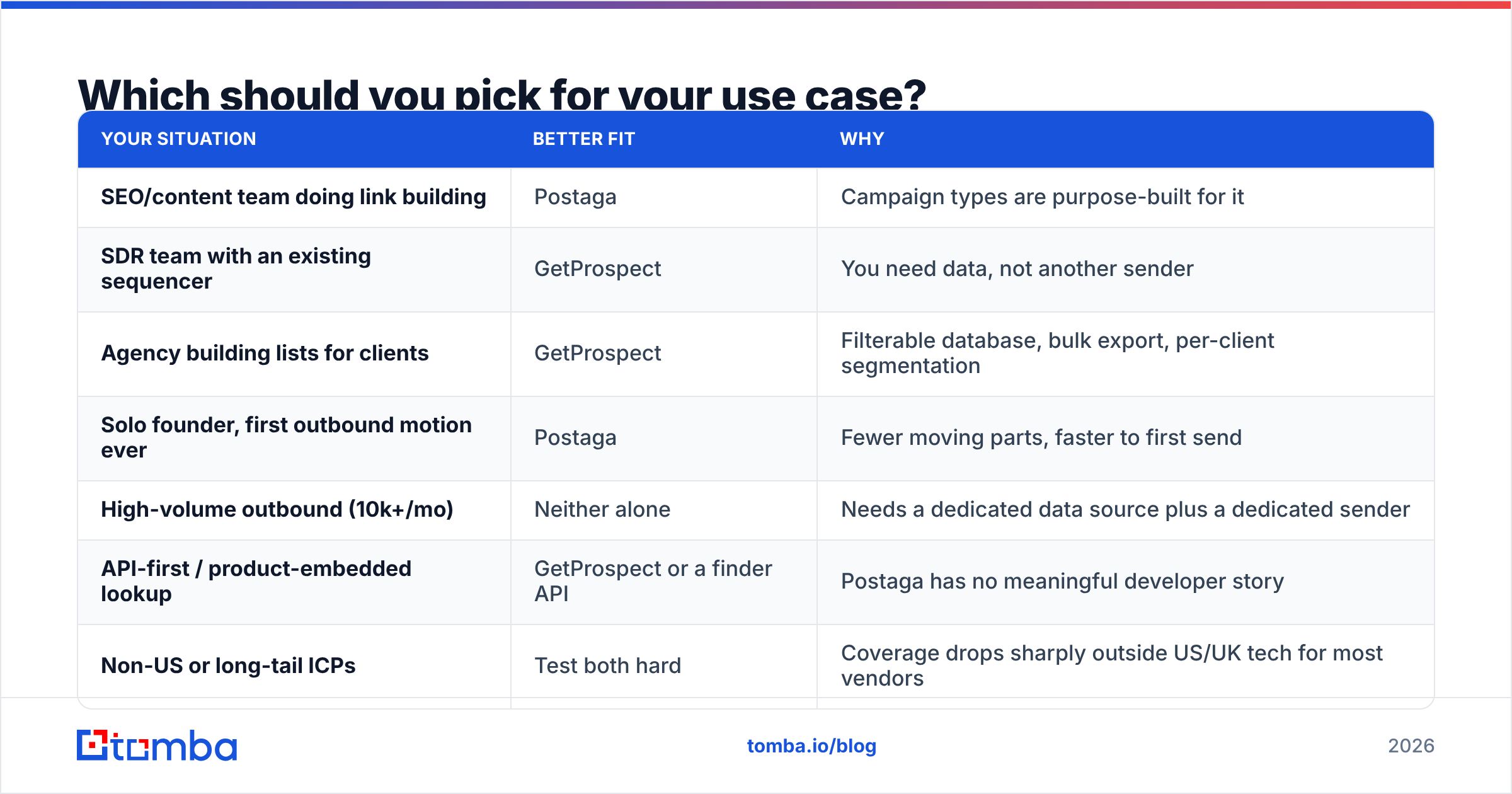
| Your situation | Better fit | Why |
|---|---|---|
| SEO/content team doing link building | Postaga | Campaign types are purpose-built for it |
| SDR team with an existing sequencer | GetProspect | You need data, not another sender |
| Agency building lists for clients | GetProspect | Filterable database, bulk export, per-client segmentation |
| Solo founder, first outbound motion ever | Postaga | Fewer moving parts, faster to first send |
| High-volume outbound (10k+/mo) | Neither alone | Needs a dedicated data source plus a dedicated sender |
| API-first / product-embedded lookup | GetProspect or a finder API | Postaga has no meaningful developer story |
| Non-US or long-tail ICPs | Test both hard | Coverage drops sharply outside US/UK tech for most vendors |
The last row is the one that trips people up. Both tools index the same broad universe of publicly available and contributed data, and both thin out in the same places — smaller European firms, non-English domains, industries that don't live on LinkedIn. Don't take a coverage claim on faith. Pull 200 rows from your real target list and count.
Can you combine both — or replace them entirely?#
You can combine them, and some teams do: GetProspect for list building, Postaga for the campaign layer. It works. It also means two subscriptions, two credit systems, and a CSV shuttling between them.
The cheaper architecture for most teams is: one strong data layer + one strong sending layer + a verification step between them. The data layer should be API-accessible so it can feed your CRM directly instead of via manual export. The sending layer should be whatever your team already knows.
That's where a purpose-built finder earns its keep. Tomba's bulk email finder handles list building at volume, the email verifier catches the bounces before they hit your sender reputation, and everything is reachable through the Tomba API so the data lands in your CRM without a human touching a spreadsheet. Pricing runs Free (25 searches/mo), Starter $49/mo, Growth $99/mo, and Pro $249/mo — see Tomba pricing for the credit breakdowns.
The point isn't that one vendor beats the other. It's that paying an outreach platform for mediocre data — or paying a data platform and then rebuilding a sequencer around it — is how outbound budgets quietly double.
What should you check before you commit?#
Run this before any annual contract:
- Export a real list on the free tier or trial. 100+ rows from your actual ICP. Not a demo domain.
- Bounce-test independently. Send the list through a third-party verifier and compare its verdict against the vendor's own confidence scores. Gaps here are the single best predictor of future pain.
- Confirm credit rollover and refund policy. Some vendors charge a credit for a failed lookup. Some don't. Over a year that's a meaningful difference.
- Check CRM sync depth. "HubSpot integration" can mean a native two-way sync or a Zapier webhook. Ask which.
- Ask about GDPR posture. If you're prospecting into the EU, the legal basis for processing matters and "the vendor said it's fine" is not a defence.
- Test support response time during the trial. It only gets slower after you pay.
Verdict: GetProspect or Postaga?#
Pick GetProspect if you need contact data and you already have — or can cheaply get — a way to send. It's the better data product, it's cheaper at entry, and its free tier lets you validate coverage before spending anything.
Pick Postaga if you're a content or SEO team running link-building and content-promotion outreach, you don't have a sequencer, and the campaign templates match the motions you actually run. The AI scaffolding earns its price when it's replacing work you weren't going to do.
Pick neither if you're running high-volume, ICP-defined outbound with a real CRM behind it. At that point you want a dedicated data source with API access, a dedicated sender, and a verification gate between them — because that stack scales and the all-in-ones don't.
Whichever way you lean, the list quality determines the outcome. A great sequence sent to a stale list underperforms a mediocre sequence sent to a clean one, every time.
Start with the data. Run your target domains through the Tomba Email Finder on the free plan, verify what comes back, and compare the hit rate against whatever GetProspect or Postaga returns for the same list. Twenty-five searches is enough to see which tool actually covers your market — and that's a decision worth making with evidence instead of a pricing page.
Related guides#
Ready to find emails that actually work?
Join 150,000+ professionals who stopped guessing and started sending. Free credits on signup — no credit card required.
Get the Tomba newsletter
Practical outbound tactics and product updates — once every two weeks.
About the author