GetProspect vs PrivCo 2026: Emails, Financials, Pricing
GetProspect finds verified work emails. PrivCo sells private-company financials. They get compared constantly and they solve almost opposite problems. Here's which one your team actually needs in 2026.
TL;DR
- GetProspect is a contact-data tool: it finds and verifies work email addresses from LinkedIn, domains, and a B2B people database. PrivCo is a financial research platform: revenue estimates, funding history, and ownership data on private companies.
- They land in the same shortlists because both get filed under "B2B data," but they answer different questions. GetProspect answers who do I email? PrivCo answers is this company worth emailing?
- Price gap is enormous. GetProspect starts in the double-digit dollars per month; PrivCo is a research subscription priced in the four figures per year.
- If you run outbound, you need contact data first and firmographics second. If you run corp dev, PE sourcing, or competitive intel, that order flips.
- Most teams that buy PrivCo still need an email finder bolted on. Very few teams that buy GetProspect end up needing PrivCo.
What are GetProspect and PrivCo, exactly?#
Think of it like buying a house. PrivCo is the surveyor's report — how much the property is actually worth, who owns it, what the mortgage looks like. GetProspect is the phone number of the person selling it. Both are useful. Neither substitutes for the other.
GetProspect (getprospect.com) launched as a LinkedIn email extractor and grew into a full prospecting suite: a searchable database of professional contacts, a Chrome extension that pulls emails while you browse LinkedIn, bulk enrichment via CSV, an API, and built-in verification. Its filters are the ones outbound reps recognize — job title, seniority, headcount, industry, location, tech stack.
PrivCo (privco.com) is a private-company intelligence database. Its value proposition is data you cannot get from a Crunchbase-style funding tracker: modeled revenue, employee-count trajectories, EBITDA estimates, ownership structures, and deal history for companies that never file with the SEC. Its users are investment bankers, private equity associates, corp dev teams, and market researchers — not SDRs.
That difference explains almost every other difference between them.
How do GetProspect and PrivCo compare head-to-head?#
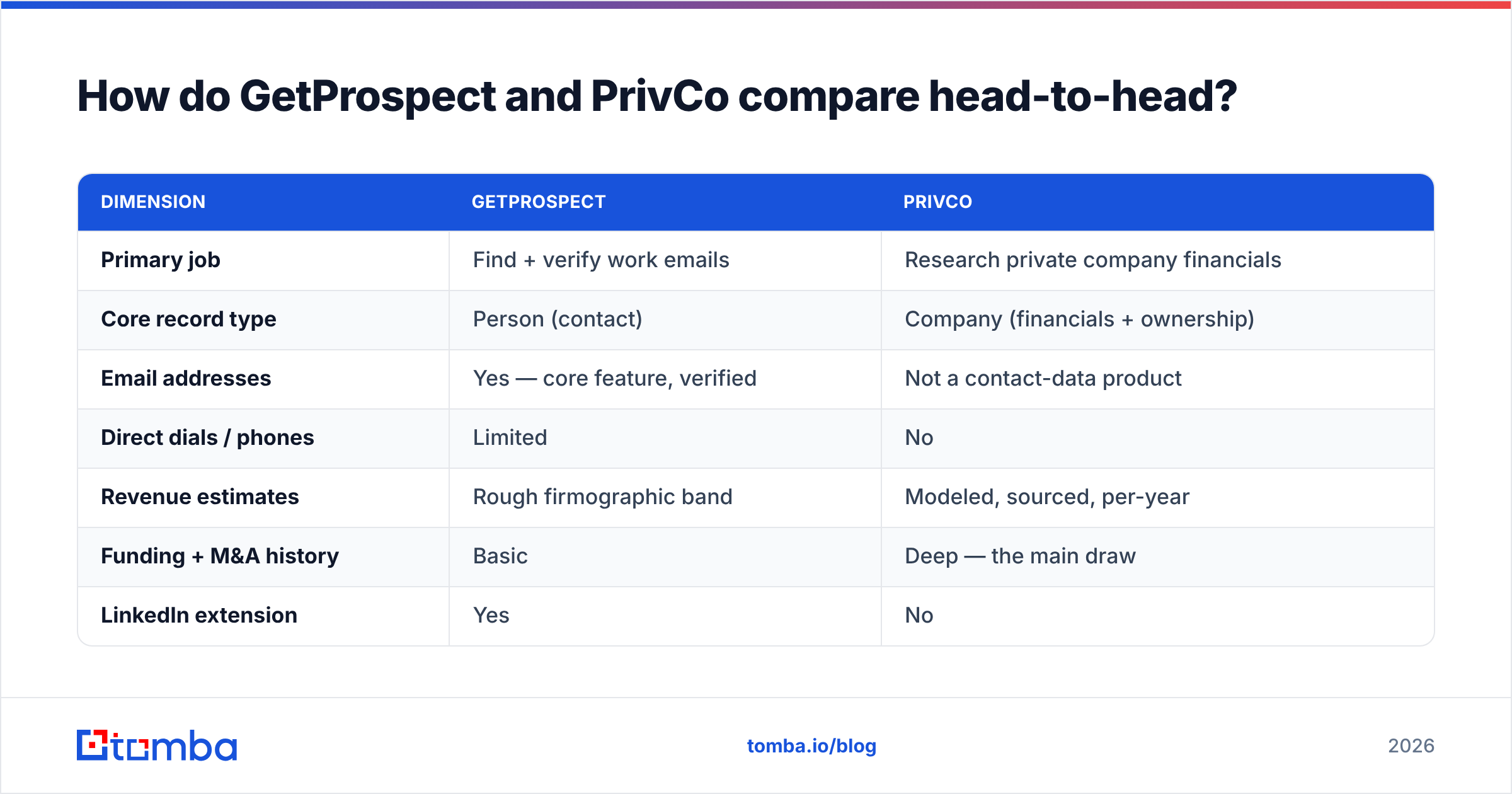
| Dimension | GetProspect | PrivCo |
|---|---|---|
| Primary job | Find + verify work emails | Research private company financials |
| Core record type | Person (contact) | Company (financials + ownership) |
| Email addresses | Yes — core feature, verified | Not a contact-data product |
| Direct dials / phones | Limited | No |
| Revenue estimates | Rough firmographic band | Modeled, sourced, per-year |
| Funding + M&A history | Basic | Deep — the main draw |
| LinkedIn extension | Yes | No |
| CSV bulk enrichment | Yes | Export-limited |
| API access | Yes, on paid tiers | Enterprise-oriented |
| Typical buyer | SDR, growth, agency | PE/VC analyst, corp dev, researcher |
| Entry price | Tens of dollars/month | Four figures/year |
| Free option | Limited free tier | Trial/demo only |
The table makes the split obvious: there is exactly one row where they genuinely overlap — company firmographics — and even there they're solving it at different resolutions. GetProspect tells you a company has 200–500 employees in SaaS. PrivCo tells you it did an estimated $47M in revenue last year, raised a Series C in 2023, and is majority-owned by a growth fund.

Which one is better for outbound prospecting?#
GetProspect, without much debate. PrivCo is not built for it and does not pretend to be.
If your workflow is "build a list of 500 heads of marketing at Series B fintechs, get their emails, load them into a sequencer," GetProspect covers the whole path. Its LinkedIn extension is the piece most reps actually use daily — you browse a Sales Navigator search, click, and contacts land in a list with verification status attached.
Where GetProspect gets criticised, based on public reviews on G2 and Capterra, is consistency of coverage:
- Regional gaps. Coverage is strongest in North America and Western Europe. APAC and LATAM hit rates drop noticeably.
- Credit burn on misses. How a vendor charges for "not found" and catch-all results is the single biggest driver of real cost per usable contact — check this before you commit.
- Catch-all handling. Domains that accept all mail return ambiguous verification. If a big share of your ICP runs catch-all, you need a dedicated catch-all verifier to avoid mailing into the dark.
- Enrichment depth. You get title, company, location. You do not get the financial context PrivCo sells.
- Bounce liability. Any single-source finder should be re-verified before send. Your sender reputation is the thing paying for a bad list, not your credit balance.
That last point matters more than most buyers assume. A 6% bounce rate does not just waste 6% of your list — it degrades inbox placement for the other 94%.
Which one is better for company research?#
PrivCo, and it isn't close. This is the half of the comparison where GetProspect has almost nothing to offer.
PrivCo's defensible asset is modeled financials on companies with no public filings. If you're building a target list for an acquisition thesis, screening for companies in a revenue band, or trying to figure out whether a private competitor is growing or quietly shrinking, that data is genuinely hard to replicate. Free sources give you headcount and funding rounds. PrivCo gives you revenue trajectory, ownership, and deal context.
Three honest caveats:
- They're estimates. Modeled revenue for private companies is inference, not disclosure. Treat it as a directional screen you validate in diligence, not a number you underwrite to.
- Coverage skews US. Strongest on US private companies; thinner internationally.
- It's a research seat, not a data pipe. Export limits and seat-based pricing make it awkward if what you actually wanted was bulk enrichment across 50,000 accounts.
If your real requirement is "append firmographics to my whole CRM," PrivCo is the wrong shape of product — you want a data enrichment API instead.
How does pricing compare in 2026?#
Pricing changes; verify on each vendor's site before you buy. But the order of magnitude has been stable, and it's the part that decides most evaluations.
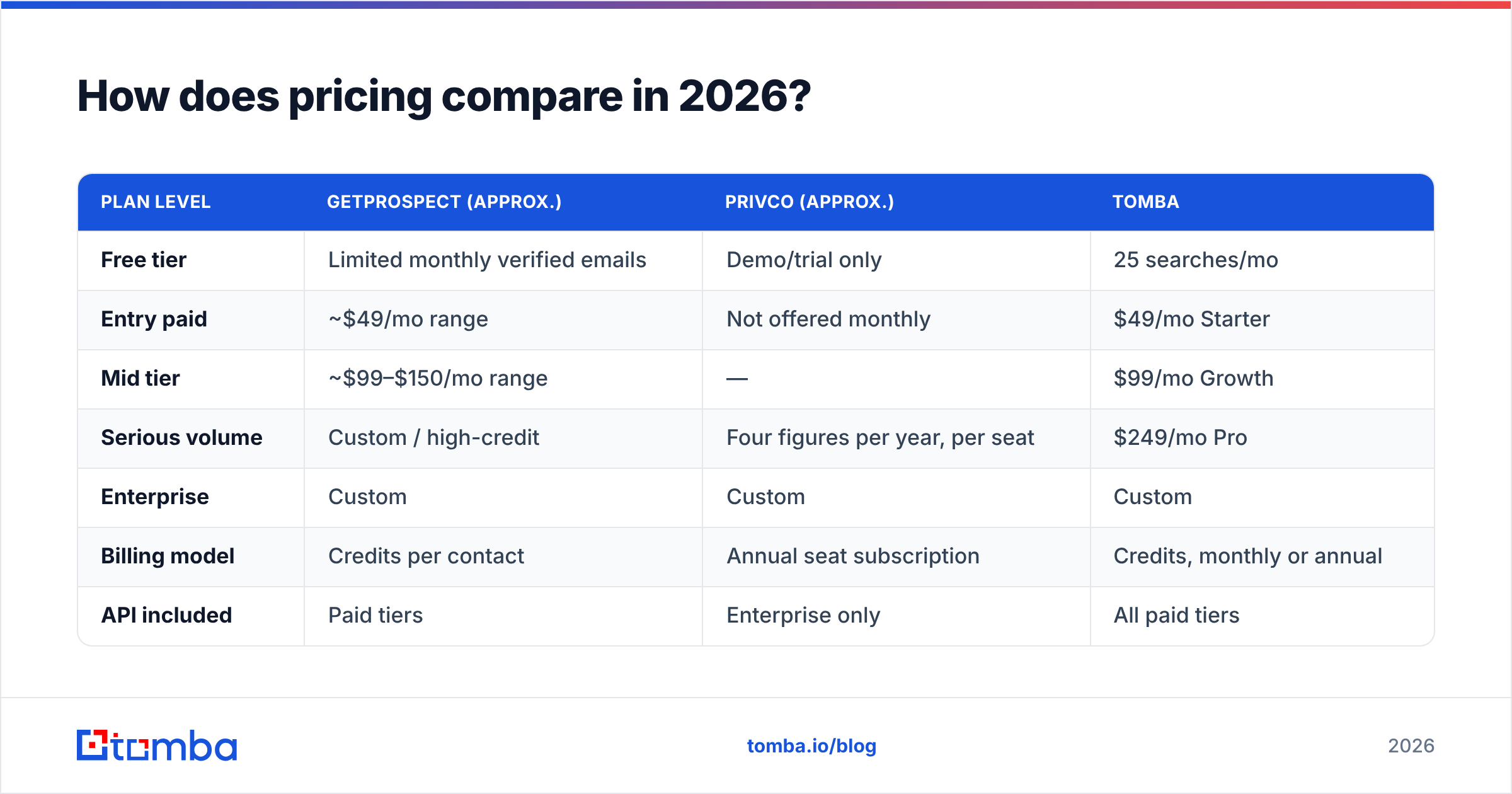
| Plan level | GetProspect (approx.) | PrivCo (approx.) | Tomba |
|---|---|---|---|
| Free tier | Limited monthly verified emails | Demo/trial only | 25 searches/mo |
| Entry paid | ~$49/mo range | Not offered monthly | $49/mo Starter |
| Mid tier | ~$99–$150/mo range | — | $99/mo Growth |
| Serious volume | Custom / high-credit | Four figures per year, per seat | $249/mo Pro |
| Enterprise | Custom | Custom | Custom |
| Billing model | Credits per contact | Annual seat subscription | Credits, monthly or annual |
| API included | Paid tiers | Enterprise only | All paid tiers |
The structural difference is credits versus seats. GetProspect and Tomba pricing both scale with how much data you pull. PrivCo scales with how many analysts need a login. A three-person SDR team pulling 20,000 contacts a year is cheap on credits and expensive on seats. A single analyst reading 400 company profiles a year is the reverse.
That's the actual decision rule. Ask: is my cost driven by volume of records or number of humans?
Can you use both — and should you?#
Yes, and for a specific kind of team it's the right answer.
The pattern that works: PrivCo defines the account list, a contact-data tool finds the people. A corp dev team screens for US software companies between $20M and $80M revenue with no PE ownership, exports 180 targets, then runs those domains through a domain search to pull the CEO, CFO, and head of corp dev at each one. PrivCo answers which 180. The email finder answers which humans, at what addresses.
The pattern that doesn't work: buying PrivCo hoping it will double as a prospecting database. It won't. You'll pay a research-grade subscription and still be guessing email formats.
There's a cheaper version of the same workflow if your qualification criteria are firmographic rather than financial. Headcount, tech stack, hiring signals, and funding stage are available from standard B2B data sources at a fraction of the cost. You only need PrivCo-grade financials when the number itself — revenue, EBITDA, ownership percentage — is what gates the decision. If "company looks like it's growing" is enough, you're overpaying.
Where does a dedicated email finder fit in?#
Both of these tools have a weak flank, and it's the same one: verification depth.
GetProspect verifies, but it's one source with one set of coverage gaps. PrivCo doesn't do contact data at all. If email deliverability is what your revenue depends on, running a second, independent verification layer is not redundancy — it's insurance.
This is where a purpose-built finder earns its slot:
- Independent sourcing. A different data source fills different gaps. Running a domain through two finders routinely surfaces contacts neither would find alone.
- Verification as a first-class product. An email verifier that handles catch-all, role accounts, and disposable domains separately gives you a real risk score, not a binary guess.
- Bulk economics. A bulk email finder that processes a 10,000-row CSV without seat limits changes what list sizes are viable.
- Developer access. A documented email finder API means enrichment runs inside your CRM workflow instead of in someone's spreadsheet.
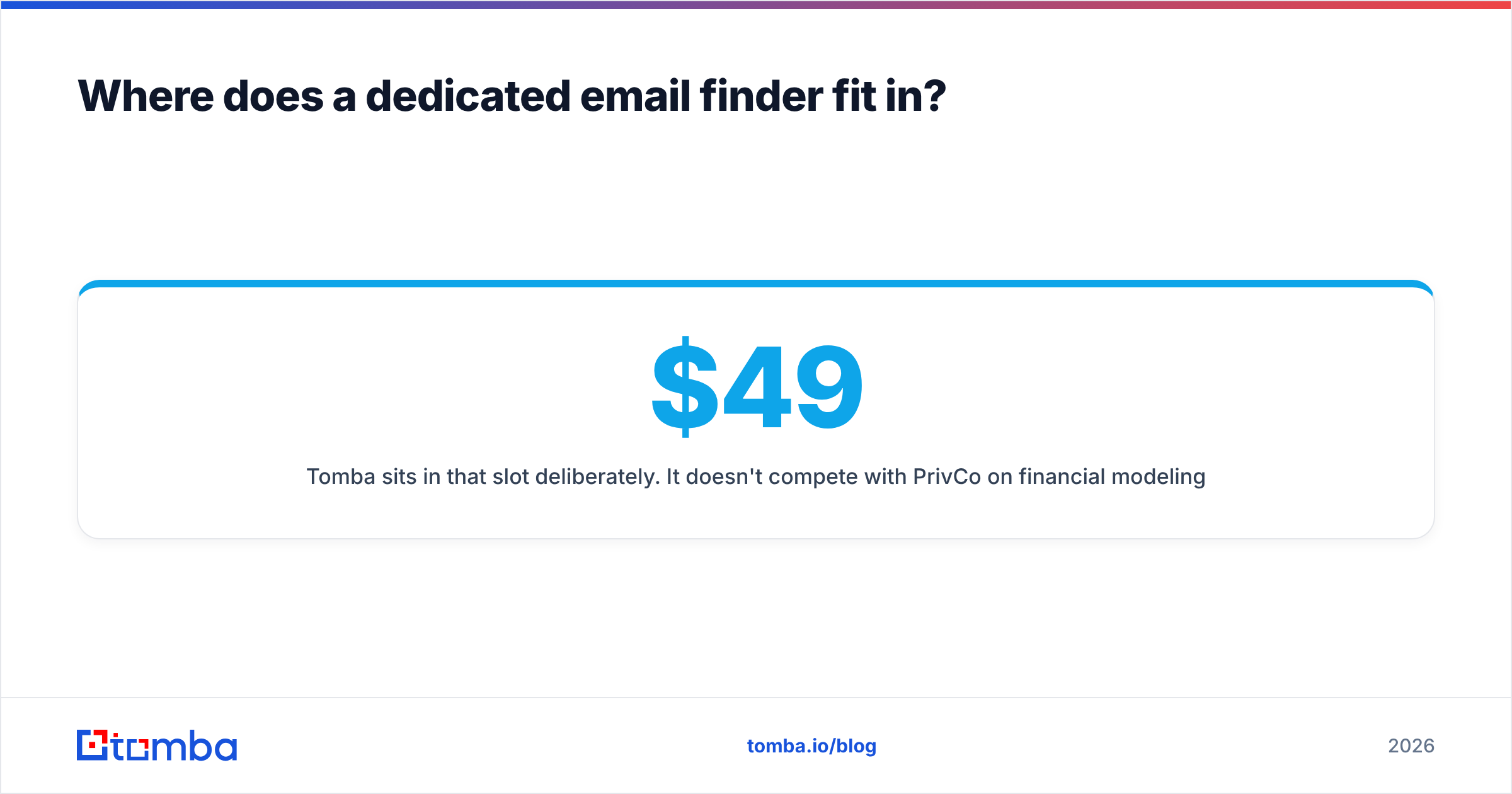
Tomba sits in that slot deliberately. It doesn't compete with PrivCo on financial modeling — it has no ambition there. It competes with GetProspect on the contact-data job, with the free tier at 25 searches a month, Starter at $49/mo, Growth at $99/mo, and Pro at $249/mo, plus API access on every paid plan rather than gated behind enterprise. If your evaluation is really "which tool gets me verified addresses at the lowest cost per usable contact," that's the axis to test on.
Worth noting for completeness: if you want static, pre-built lists rather than on-demand lookup, database vendors like BookYourData serve a genuinely different buying preference — pay per record, download, done. That's a reasonable model; it's just a different one from credit-based live lookup.
What's the verdict on GetProspect vs PrivCo?#
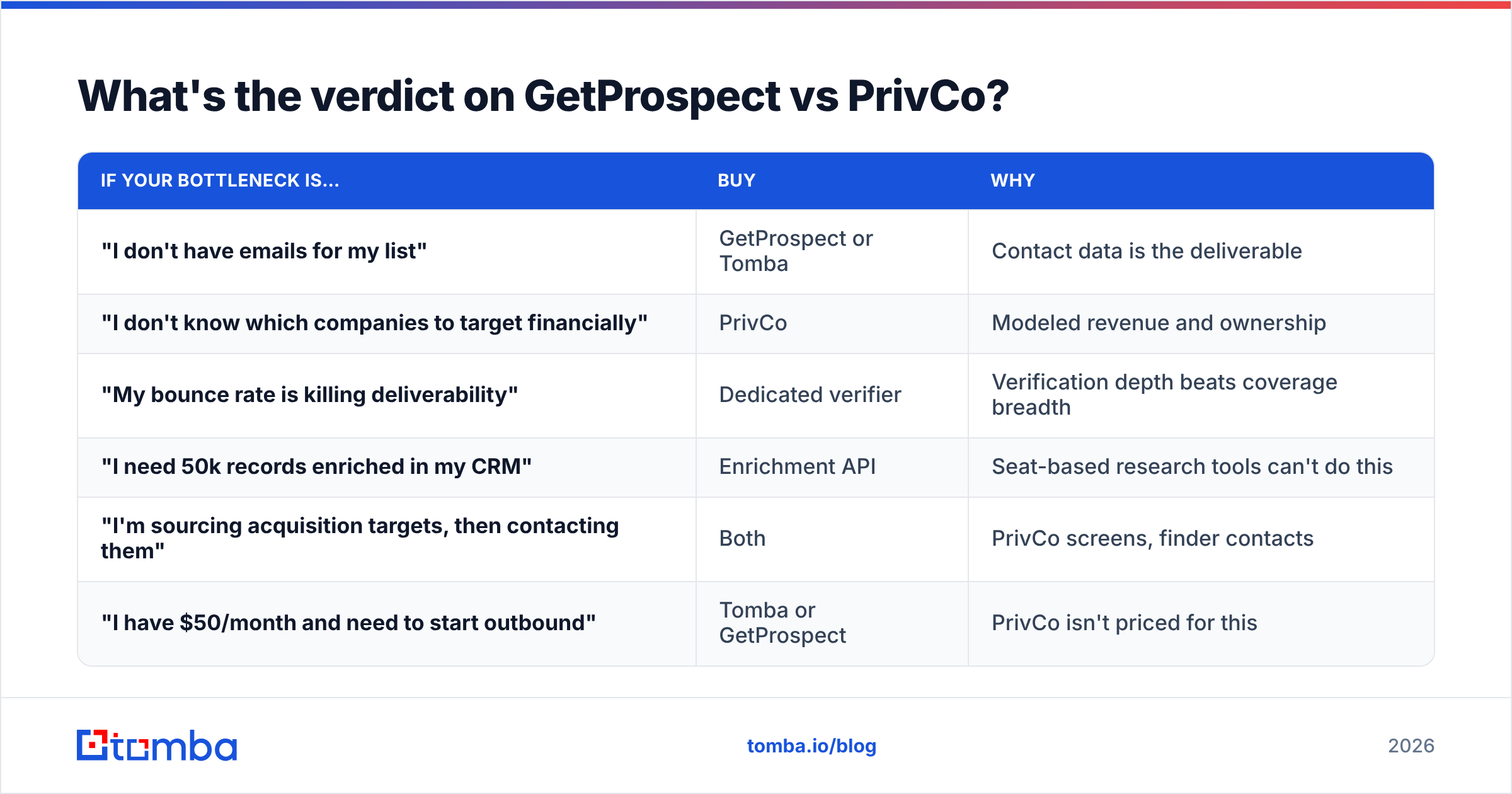
Pick based on which question is blocking you.
| If your bottleneck is… | Buy | Why |
|---|---|---|
| "I don't have emails for my list" | GetProspect or Tomba | Contact data is the deliverable |
| "I don't know which companies to target financially" | PrivCo | Modeled revenue and ownership |
| "My bounce rate is killing deliverability" | Dedicated verifier | Verification depth beats coverage breadth |
| "I need 50k records enriched in my CRM" | Enrichment API | Seat-based research tools can't do this |
| "I'm sourcing acquisition targets, then contacting them" | Both | PrivCo screens, finder contacts |
| "I have $50/month and need to start outbound" | Tomba or GetProspect | PrivCo isn't priced for this |
The framing that trips people up is treating this as a like-for-like bake-off. It isn't. GetProspect and PrivCo appear on the same comparison pages because search engines group them under "B2B data platforms," but a rep who buys PrivCo will be furious by week two, and an analyst who buys GetProspect will find nothing they can put in a model.
Diagnose the bottleneck first. If it's reach — you know who you want, you can't contact them — buy contact data. If it's selection — you can contact anyone, you don't know who's worth it — buy research. If it's both, budget for both, and don't expect either vendor to cover the other's half.
For the reach problem specifically, start with the Tomba Email Finder. Run 25 free searches against the accounts you're already working, compare hit rate and bounce rate against whatever you're using now, and let the numbers decide. It's a cheaper experiment than a four-figure annual research subscription, and it tests the thing that actually gates your pipeline.
Related guides#
Ready to find emails that actually work?
Join 150,000+ professionals who stopped guessing and started sending. Free credits on signup — no credit card required.
Get the Tomba newsletter
Practical outbound tactics and product updates — once every two weeks.
About the author