GetProspect vs Salutary Data: Which B2B Data Wins in 2026
One is a self-serve LinkedIn-era email finder. The other is a quote-based US contact data file. We compare GetProspect and Salutary Data on accuracy, coverage, pricing model, and who should actually buy which.
TL;DR
- GetProspect is a self-serve email finder and B2B database with a Chrome extension built around LinkedIn workflows. You sign up, search, export, and pay by credit.
- Salutary Data is a curated, quote-based US B2B contact file — you talk to a human, define an audience, and buy records (email plus direct dial) in bulk or via API.
- They compete for the same budget line but solve different problems: GetProspect is discovery on demand, Salutary Data is bulk audience acquisition.
- Pricing models are not comparable apples-to-apples. GetProspect publishes tiers and a free plan; Salutary Data quotes per record and typically expects a meaningful minimum.
- If you want per-lookup control, verification, and an API you can wire into your own stack without a sales call, a self-serve provider like Tomba sits closer to GetProspect's model with stricter verification defaults.
What are GetProspect and Salutary Data?#
Think of it like buying coffee. GetProspect is the espresso machine on your counter — you pull a shot whenever you want one, you control the grind, and you pay per bag. Salutary Data is the wholesale supplier that delivers pallets to your warehouse — cheaper per unit at volume, but you commit up front and you need somewhere to put it.
GetProspect launched as a LinkedIn email extractor and grew into a full prospecting suite: a searchable B2B database, a Chrome extension that pulls contacts off LinkedIn search results and Sales Navigator lists, built-in verification, CRM-style list management, and a light email-sending layer. The product is designed so a single SDR can go from zero to an exported CSV in about ten minutes, no procurement involved.
Salutary Data comes at it from the data-broker side. It's a US-focused B2B contact and company database assembled from compiled, licensed, and verified sources, sold as data — files, feeds, or API access — rather than as a UI you live inside. The pitch is accuracy and compliance posture on direct dials and business emails, aimed at teams building outbound at scale, enriching a CRM, or feeding an ABM platform.
That difference in shape drives almost everything else in this comparison.

How do GetProspect and Salutary Data actually differ?#
Here are the five dimensions that matter when you're choosing between them:
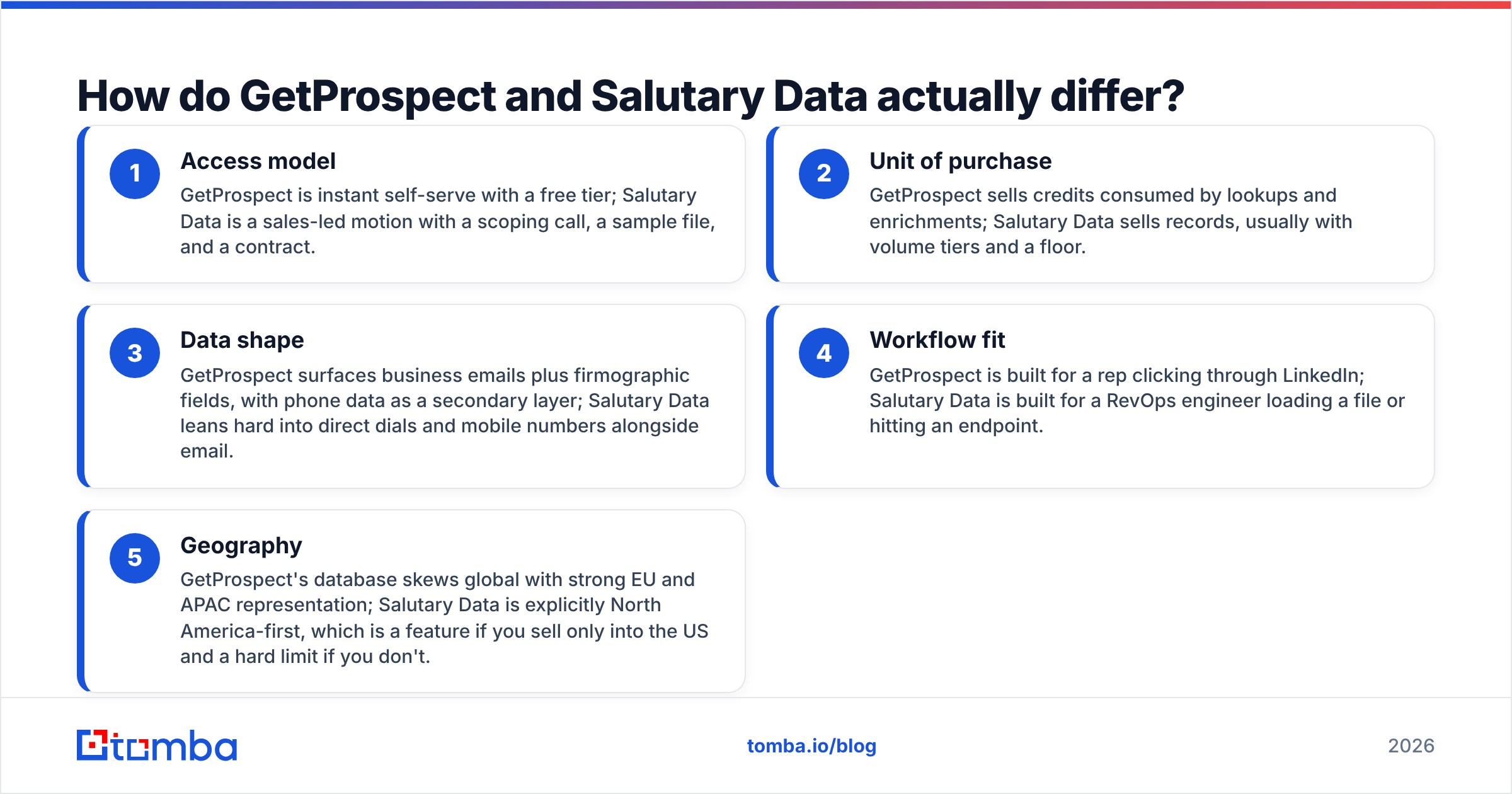
- Access model — GetProspect is instant self-serve with a free tier; Salutary Data is a sales-led motion with a scoping call, a sample file, and a contract.
- Unit of purchase — GetProspect sells credits consumed by lookups and enrichments; Salutary Data sells records, usually with volume tiers and a floor.
- Data shape — GetProspect surfaces business emails plus firmographic fields, with phone data as a secondary layer; Salutary Data leans hard into direct dials and mobile numbers alongside email.
- Workflow fit — GetProspect is built for a rep clicking through LinkedIn; Salutary Data is built for a RevOps engineer loading a file or hitting an endpoint.
- Geography — GetProspect's database skews global with strong EU and APAC representation; Salutary Data is explicitly North America-first, which is a feature if you sell only into the US and a hard limit if you don't.
Neither of those profiles is wrong. But buying the wrong shape is how teams end up with 40,000 records they never load and a renewal they resent.
Which one has better data accuracy?#
This is where you should be skeptical of everyone, including both vendors and this post.
Accuracy claims in this category are almost always measured on the vendor's own sample, against the vendor's own definition of "valid." A 95% claim on a hand-picked set of Fortune 500 marketing directors tells you nothing about your ICP of 30-person logistics firms in Ohio. Salutary Data's positioning centers on human-in-the-loop verification and refresh cadence, which historically produces strong direct-dial hit rates on US mid-market. GetProspect's accuracy is a function of pattern inference plus SMTP verification, which is very good on domains with a clean, guessable format and weaker on catch-all domains where SMTP can't give a definitive answer.

The practical test that actually settles it:
- Pull 200 contacts from your real ICP, not a demo list.
- Run them through a third-party email verifier you don't buy the data from.
- Send a 200-contact warm-up batch and measure the hard bounce rate, not the "deliverable" label.
- Separate catch-all domains into their own bucket before you calculate anything — otherwise one vendor's "accept-all = valid" policy will silently inflate its score by 10 to 20 points.
That last point is the single biggest source of misleading comparisons. If a provider counts every catch-all address as valid, its stated accuracy is structurally higher than a provider that marks them unknown. Run a proper catch-all verifier pass before you compare anything, or you're grading on two different curves.
GetProspect vs Salutary Data: full comparison table#
Pricing and packaging change often. Treat the figures below as directional and confirm on each vendor's own page before you sign anything.
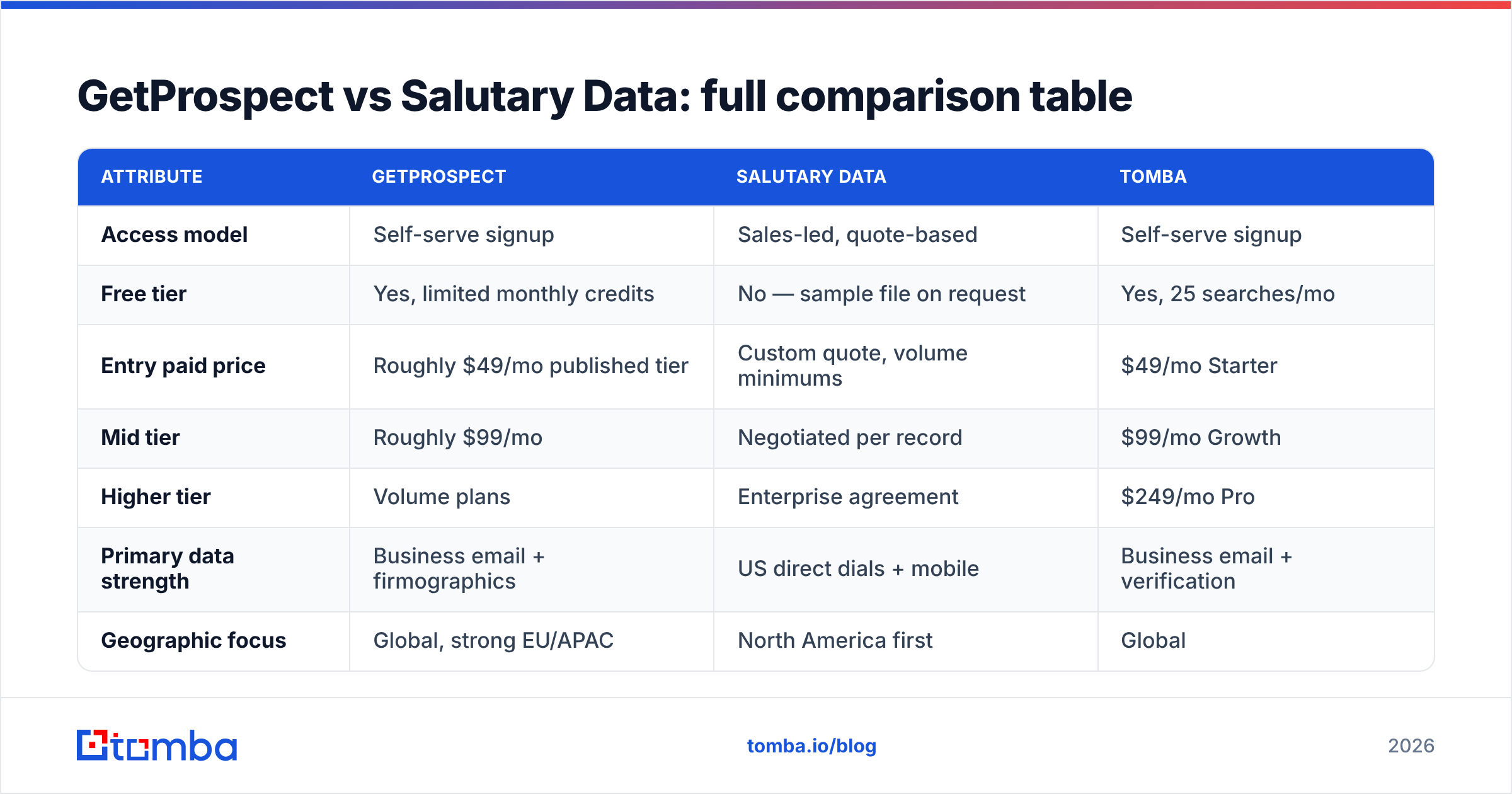
| Attribute | GetProspect | Salutary Data | Tomba |
|---|---|---|---|
| Access model | Self-serve signup | Sales-led, quote-based | Self-serve signup |
| Free tier | Yes, limited monthly credits | No — sample file on request | Yes, 25 searches/mo |
| Entry paid price | Roughly $49/mo published tier | Custom quote, volume minimums | $49/mo Starter |
| Mid tier | Roughly $99/mo | Negotiated per record | $99/mo Growth |
| Higher tier | Volume plans | Enterprise agreement | $249/mo Pro |
| Primary data strength | Business email + firmographics | US direct dials + mobile | Business email + verification |
| Geographic focus | Global, strong EU/APAC | North America first | Global |
| LinkedIn extension | Yes, core to the product | No | Yes |
| API | Yes | Yes | Yes, documented and public |
| Bulk enrichment | Yes, CSV upload | Yes, file delivery | Yes, bulk jobs |
| Catch-all handling | SMTP-based, limited | Varies by record source | Dedicated catch-all verifier |
| Contract required | No | Typically yes | No |
| Time to first record | Minutes | Days to weeks | Minutes |

Read the "time to first record" row carefully. For a founder testing a channel, weeks is disqualifying. For a company running a 500,000-contact ABM program, minutes are irrelevant and cost per record is everything.
What does each one actually cost?#
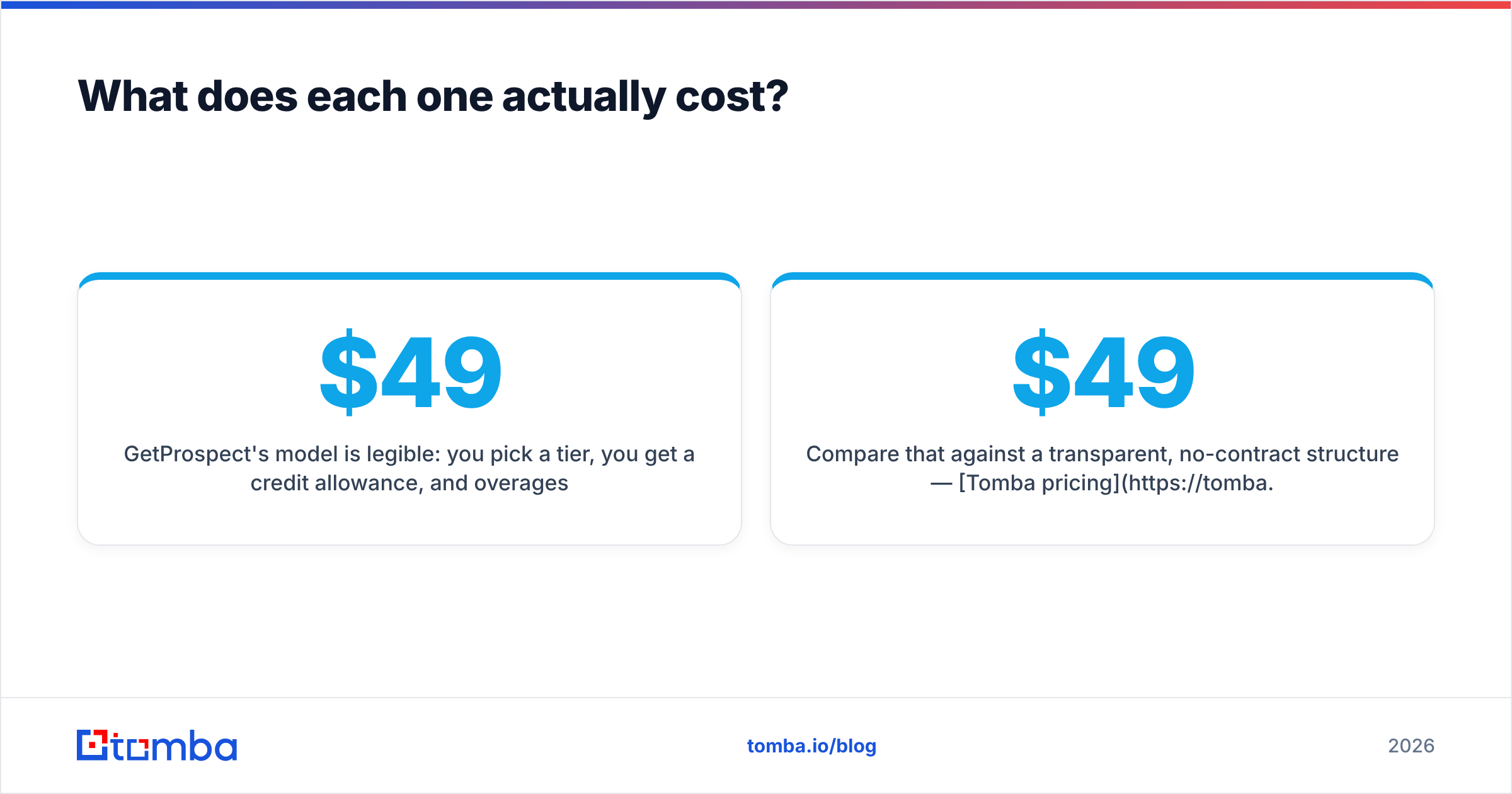
GetProspect's model is legible: you pick a tier, you get a credit allowance, and overages or upgrades are self-service. A single rep can expense it. Published tiers land in the same neighborhood as most self-serve finders — a starter plan around $49/mo, a mid plan near $99/mo, with volume plans above that. You'll burn credits faster than you expect because verification, enrichment, and re-lookups all draw from the same pool.
Salutary Data doesn't publish a price card, which is standard for data brokers and not a red flag by itself. What it means in practice: your effective cost per record depends on volume, field selection (adding mobile numbers costs more than email alone), refresh rights, and whether you're licensing for a term or buying a one-time file. Teams report per-record pricing that becomes genuinely competitive at high volume and genuinely expensive at low volume — which is exactly what a wholesale model should look like.
The trap is the minimum. If you need 3,000 targeted contacts and the floor is 25,000 records, you're paying for 22,000 rows of audience you don't want, and your "cheap" per-record price is a fiction.

Compare that against a transparent, no-contract structure — Tomba pricing starts free at 25 searches/mo, moves to $49/mo Starter, $99/mo Growth, and $249/mo Pro — where you can size up or down monthly without renegotiating. That's not a knock on the wholesale model; it's a reminder that the right answer depends entirely on your volume curve.
Which should you choose for your use case?#
Choose GetProspect if: your motion is rep-led and LinkedIn-centric. You have SDRs building lists off Sales Navigator searches, you want them self-sufficient, and you'd rather pay a predictable monthly seat-style fee than manage a data contract. It's also the better fit if you sell outside North America, since a US-first file will leave large holes in an EU or APAC territory.
Choose Salutary Data if: you're buying an audience, not doing lookups. You know your ICP precisely, you need direct dials as much as emails, you sell into the US, and you have a RevOps function that can ingest, dedupe, and route a large file into your CRM without it turning into a swamp. At real volume, the per-record economics beat credit-based tools by a wide margin.
Choose a self-serve API provider if: your bottleneck is engineering, not sourcing. If you're enriching signups in real time, building an internal tool, or resolving contacts inside a product, you want documented endpoints and per-call pricing — not a quarterly file drop. That's the case for something like the Tomba API, which exposes finder, verifier, and enrichment as separate calls so you only pay for the step you actually need.
A pattern worth stealing: use one provider for discovery and a different one for verification. Buying data and validating it from the same vendor is a mild conflict of interest — the vendor grading its own homework. Running a bulk file through an independent bulk verify pass before it touches your sequencing tool routinely strips 8 to 20% of records and saves your sending domain.
What are the honest weaknesses of each?#
GetProspect's weak spots. Credit consumption is opaque until you've used it for a month — enrichment and verification draw from the same bucket, so a heavy list-building week can wipe an allowance. Coverage on very small companies and non-tech verticals thins out, as it does for nearly every tool built on public-web signals. Phone data exists but isn't the product's center of gravity; if direct dials are your primary channel, you'll be disappointed relative to a dial-first provider.
Salutary Data's weak spots. The sales cycle is the cost. Scoping, sampling, legal review, and delivery mean you're weeks from your first send, and iterating on ICP definition means going back to a human. Non-US coverage is limited by design. And because you're buying a snapshot, decay starts the day the file lands — B2B contact data degrades roughly 2 to 2.5% per month as people change jobs, so a file you bought in January is materially worse by June unless refresh rights are in your contract. Negotiate refresh explicitly; it's the single highest-leverage clause in a data agreement.
The shared weakness. Neither tool fixes your email deliverability. Perfect data sent from an unwarmed domain with no SPF alignment still lands in spam. Data quality is necessary and nowhere near sufficient.
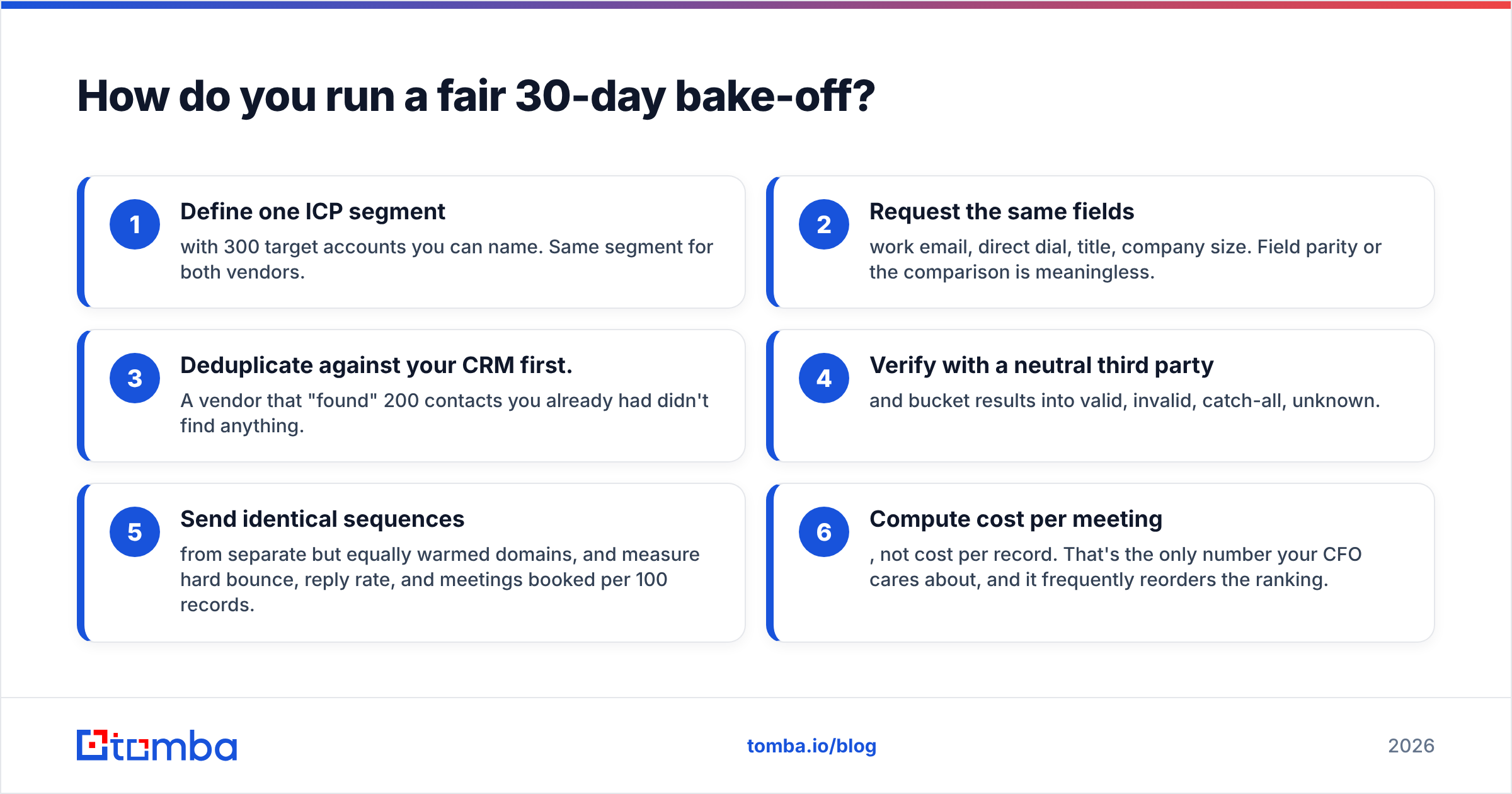
How do you run a fair 30-day bake-off?#
Don't pick on the website. Pick on a controlled test.
- Define one ICP segment with 300 target accounts you can name. Same segment for both vendors.
- Request the same fields — work email, direct dial, title, company size. Field parity or the comparison is meaningless.
- Deduplicate against your CRM first. A vendor that "found" 200 contacts you already had didn't find anything.
- Verify with a neutral third party and bucket results into valid, invalid, catch-all, unknown.
- Send identical sequences from separate but equally warmed domains, and measure hard bounce, reply rate, and meetings booked per 100 records.
- Compute cost per meeting, not cost per record. That's the only number your CFO cares about, and it frequently reorders the ranking.
Teams that run this properly are often surprised: the cheaper-per-record file loses on cost per meeting because half the records were out of ICP, while the pricier per-lookup tool wins because every credit was spent on a contact a rep actually wanted. You can sanity-check third-party review patterns on G2 before you start, but treat reviews as a hypothesis generator, not evidence.
The verdict#
GetProspect wins for rep-led, global, self-serve prospecting. Salutary Data wins for high-volume US audience buys where direct dials matter. They aren't really substitutes — they're different purchasing models wearing similar marketing language, and the mistake most teams make is comparing their price tags instead of their shapes.
If your real requirement is "find and verify business emails on demand, at a price I can predict, without a sales call," start with a self-serve finder and only graduate to a bulk data contract when your volume makes per-record economics dominate.
That's the gap the Tomba Email Finder is built for: search by domain, name, or company, get a confidence score and verification status on every result, and stay on a plan you can change any month — free at 25 searches, $49/mo Starter, scaling to $249/mo Pro with no contract to negotiate. Run it against the same 300-account list you'd send to any other vendor, and let the bounce rate decide.
Related guides#
Ready to find emails that actually work?
Join 150,000+ professionals who stopped guessing and started sending. Free credits on signup — no credit card required.
Get the Tomba newsletter
Practical outbound tactics and product updates — once every two weeks.
About the author