GetProspect vs Stirista 2026: Which B2B Data Tool Wins?
One tool costs $49 a month and finds emails on demand. The other sells identity graphs on annual contracts and won't quote you a price until a discovery call. Here's how GetProspect and Stirista actually compare in 2026.
TL;DR
- GetProspect vs Stirista is not a fair fight — the two tools do different jobs. GetProspect is a self-serve B2B email finder built for LinkedIn prospecting. Stirista is an enterprise identity-data and ad-targeting company. They overlap only because both hand you contact records.
- Price is the fastest tiebreaker. GetProspect posts its plans. You can buy one with a credit card in three minutes. Stirista quotes each deal after a call, and most deals run a year.
- Pick GetProspect if a small sales team needs verified work emails from LinkedIn lists this week.
- Pick Stirista if you run paid ads, CTV, or direct mail at scale. You need matching across offline and digital channels, not just an email column.
- Pick a third option if your real problem is email accuracy and API speed. Tools like Tomba cost about the same as GetProspect. They add a full verification stack and a developer API on the same credits.
GetProspect vs Stirista: what does each one do?#
They solve different problems. That mix-up costs teams real money.
GetProspect is a classic email finder. You search a built-in B2B database by job title, company size, industry, and location. You can also push LinkedIn profiles into it with a Chrome extension. It returns work emails, checks them, and exports to CSV or your CRM.
The buyer is an SDR, a founder doing outbound, or a two-person growth team.
Stirista is a data and identity company. Its main product is an identity graph. That graph maps one person across email hashes, device IDs, postal addresses, and IP data. Stirista then builds audiences and sends them to ad platforms, CTV, and direct mail.
The buyer here is a demand-gen lead, a media buyer, or a marketing ops director with a media budget. Stirista sells B2B and consumer data. A big share of its work is ad targeting, not one-by-one prospecting.
So the honest framing of GetProspect vs Stirista is not "which is better." It is "which layer am I buying?"
Here is the practical split:
- Contact discovery — find one person's work email so a rep can write to them. That is GetProspect's home turf.
- Audience activation — build a segment of 400,000 profiles. Push it to LinkedIn Ads, a DSP, or a CTV buy. That is Stirista's home turf.
- Identity resolution — link an unknown visitor or an offline record to a real person. Stirista does this. GetProspect does not.
- Verification — confirm the mailbox exists before you send. GetProspect does a light pass. An email verifier goes deeper, with catch-all handling and SMTP checks.
- Programmatic access — pull records into your own system on a schedule. Both offer it. The price floors are miles apart.
Point to the line that blocks you today. That answers the question.

GetProspect vs Stirista: feature by feature#
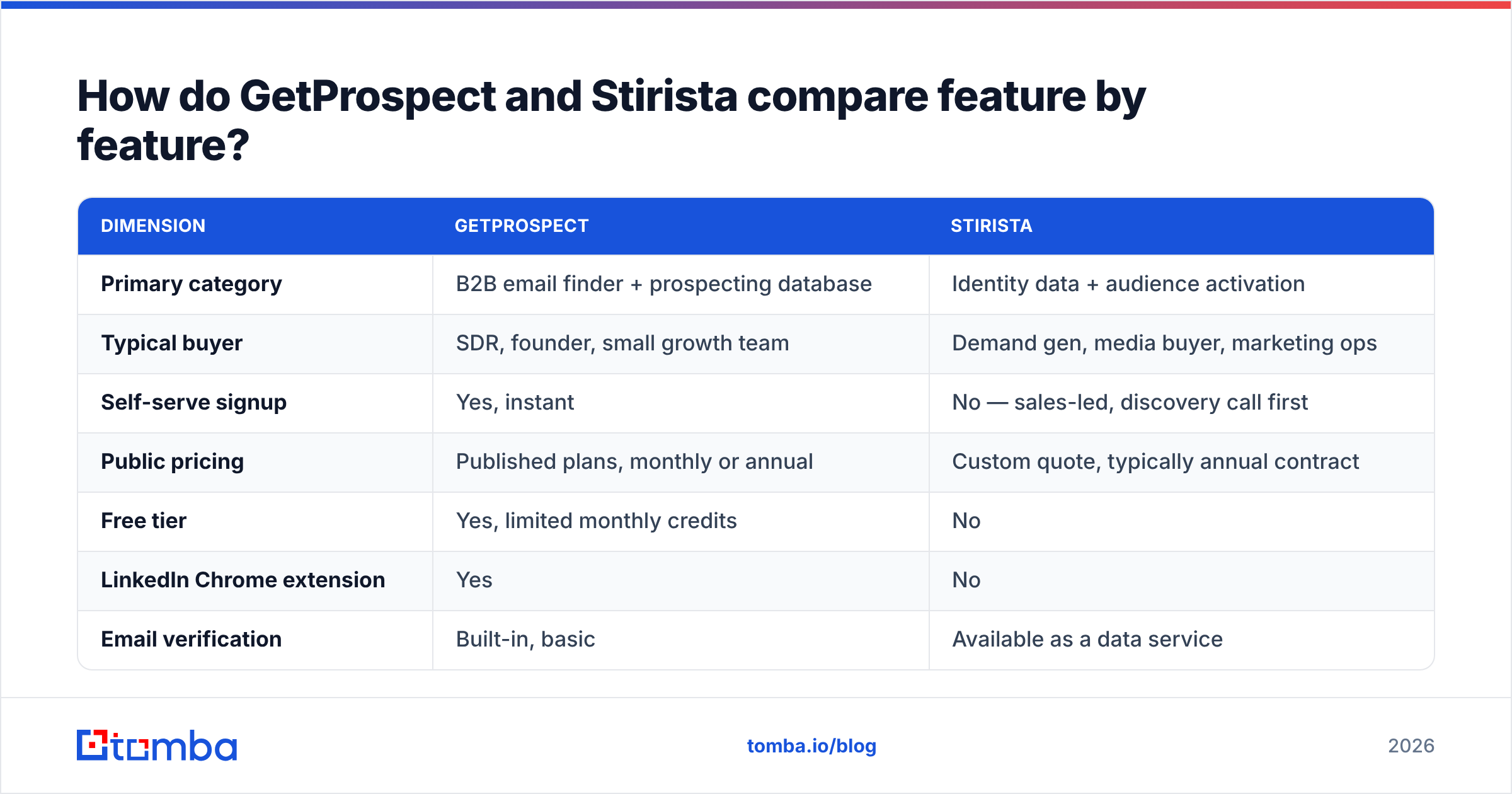
The table below shows why these two rarely land in the same review.
| Dimension | GetProspect | Stirista |
|---|---|---|
| Primary category | B2B email finder + prospecting database | Identity data + audience activation |
| Typical buyer | SDR, founder, small growth team | Demand gen, media buyer, marketing ops |
| Self-serve signup | Yes, instant | No — sales-led, discovery call first |
| Public pricing | Published plans, monthly or annual | Custom quote, typically annual contract |
| Free tier | Yes, limited monthly credits | No |
| LinkedIn Chrome extension | Yes | No |
| Email verification | Built-in, basic | Available as a data service |
| Phone / mobile numbers | Limited | Yes, as part of enrichment |
| Postal + offline data | No | Yes |
| CTV / display / DSP activation | No | Yes |
| Identity graph / device matching | No | Yes, core product |
| API access | Yes, on higher plans | Yes, enterprise |
| Contract length | Month-to-month possible | Usually 12 months |
| Time to first record | Minutes | Weeks |
Two rows matter most: time to first record and contract length. A team that needs 500 verified emails by Friday cannot buy Stirista. A team running a $200k multichannel campaign cannot run it from a Chrome extension.

Where each tool sits on price, coverage, and self-serve access.
Which one has better data accuracy?#
Wrong question. The two vendors measure accuracy in different units. One number would mislead you.
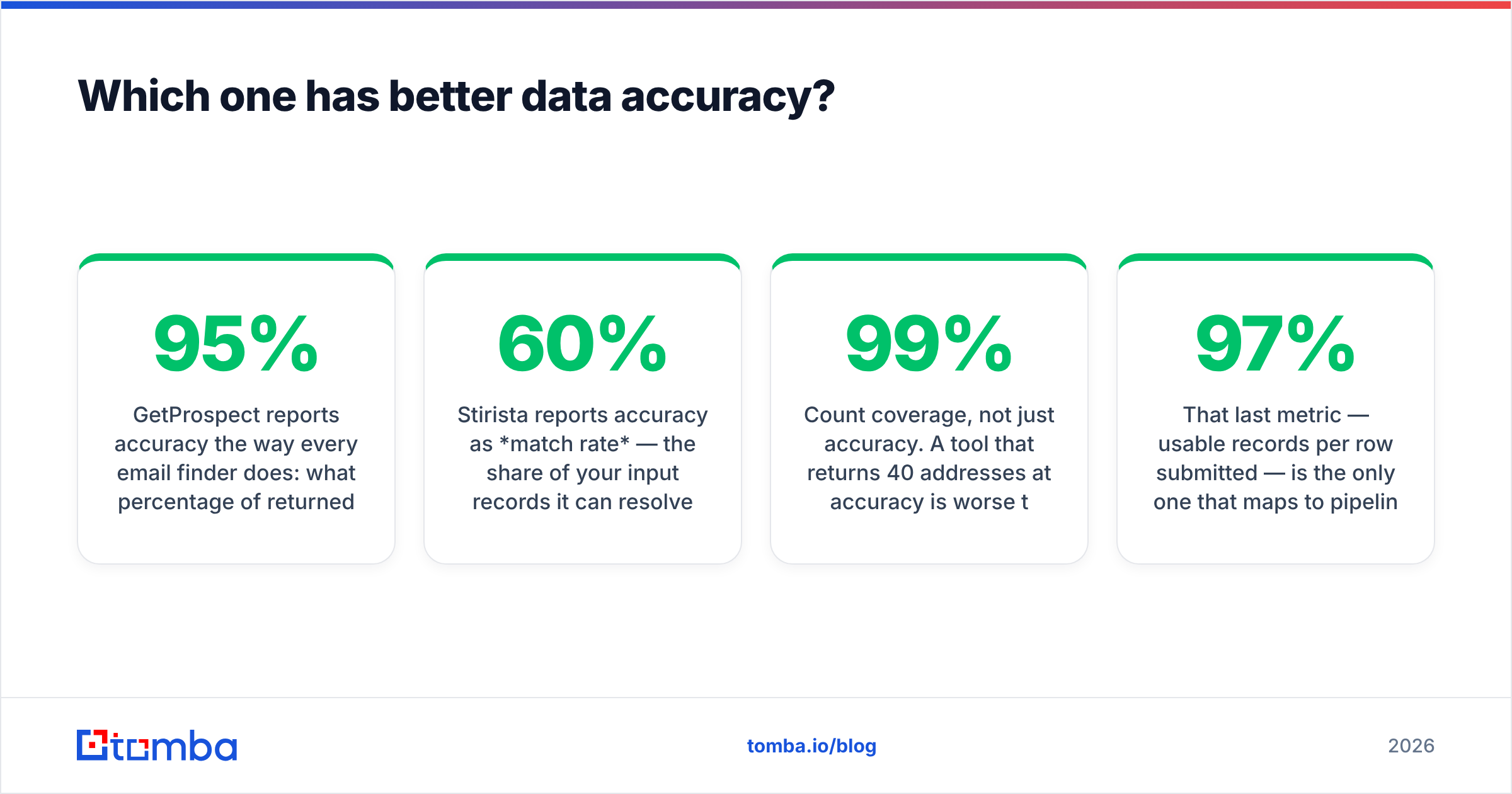
GetProspect reports accuracy the way every email finder does. It tells you what share of returned addresses can be delivered. You can check that yourself. Export 200 addresses, run them through an outside verifier, and count hard bounces. Above 95% on a normal B2B list is good. Under 90% will hurt your sender reputation within two weeks.
Stirista reports accuracy as match rate. That is the share of your input records it can tie to a known person. It also reports how many of those carry the field you asked for. A 60% match rate can be a great result in identity work and a bad one in email finding. The units do not line up.

Three rules for testing either vendor honestly:
- Bring your own list. Never test on the vendor's sample. Pull 300 real accounts from your ICP. Include at least 50 companies under 50 people. That is where every database thins out.
- Verify with a neutral third party. Do not let the vendor grade its own homework. Run the export through a separate email verification pass. Count catch-all domains apart from valid ones.
- Count coverage, not just accuracy. A tool that returns 40 addresses at 99% accuracy is worse than one that returns 180 at 95%. Score
(valid emails returned) ÷ (rows submitted), not the headline percentage.
That last number is the one that maps to pipeline. Most teams skip it. Then they wonder why two "97% accurate" tools gave them very different volumes.
GetProspect vs Stirista pricing: what do they cost?#
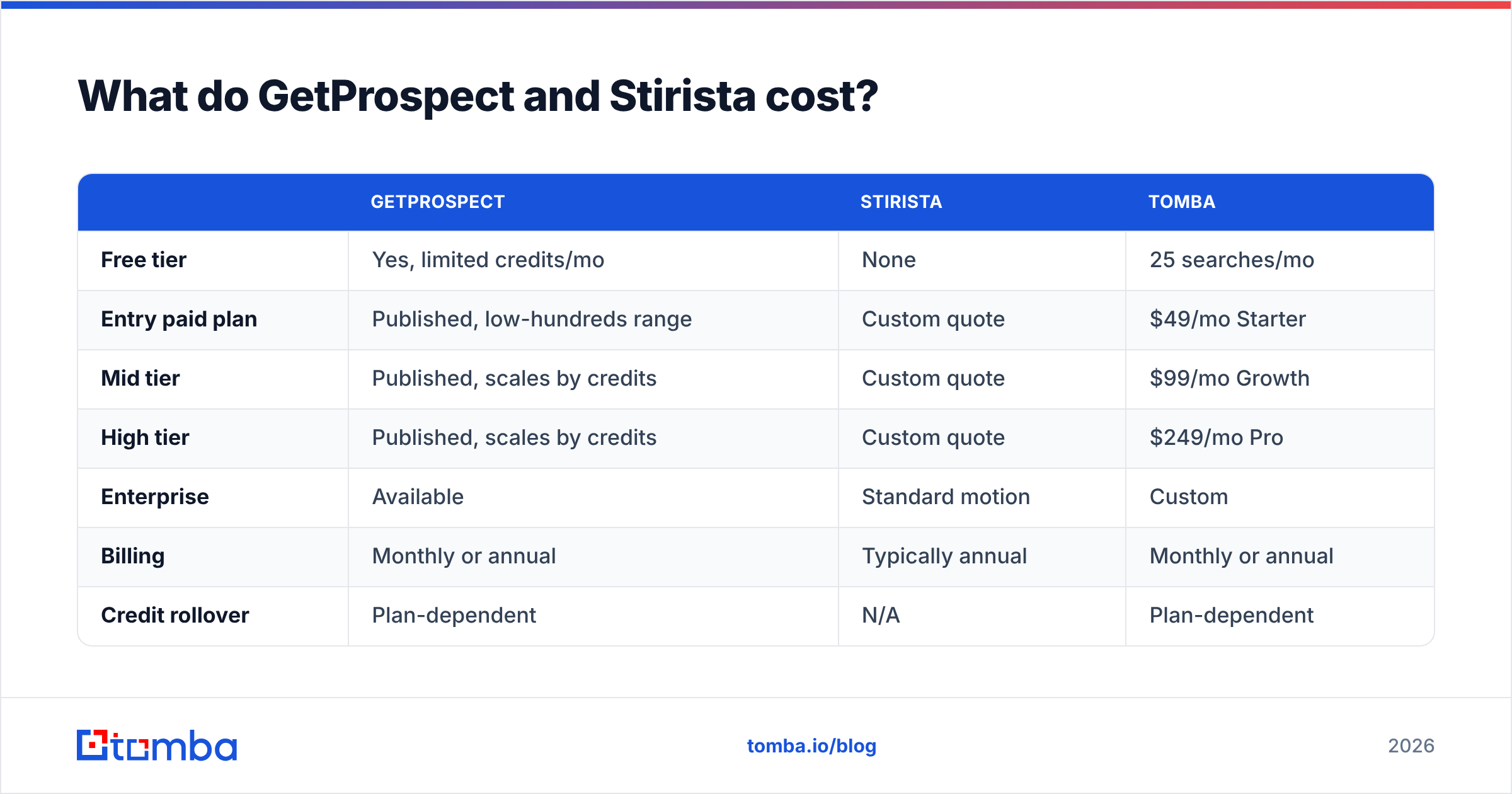
GetProspect posts its plans. Stirista does not. That gap tells you who each product is built for.
| GetProspect | Stirista | Tomba | |
|---|---|---|---|
| Free tier | Yes, limited credits/mo | None | 25 searches/mo |
| Entry paid plan | Published, low-hundreds range | Custom quote | $49/mo Starter |
| Mid tier | Published, scales by credits | Custom quote | $99/mo Growth |
| High tier | Published, scales by credits | Custom quote | $249/mo Pro |
| Enterprise | Available | Standard motion | Custom |
| Billing | Monthly or annual | Typically annual | Monthly or annual |
| Credit rollover | Plan-dependent | N/A | Plan-dependent |
| Buy without a call | Yes | No | Yes |
Check the current numbers on each vendor's own pricing page before you budget. Email-finder pricing changes more often than any other line in the martech stack. You can see the Tomba pricing tiers directly, and GetProspect lists its plans in public.
The hidden cost with GetProspect-class tools is credit burn. A search that finds no email often still costs you a credit. Bulk jobs eat a monthly allowance fast.
The hidden cost with Stirista-class vendors runs the other way. You commit to a year of data before you know if your campaigns will use it. Both risks are survivable. Neither one shows up on the price page.
Who should choose GetProspect?#
Choose GetProspect when all of these are true:
- Your motion is 1:1 outbound. Reps write to named people, not audiences.
- LinkedIn is your source. You build lists in Sales Navigator and need the email attached.
- Your volume is human-scale. A few thousand contacts a month, not a few million.
- You want to buy today. No procurement, no security review, no annual commit.
- You don't need offline data. Postal, CTV, and device graphs do not matter to you.
GetProspect is a solid, well-scoped product for that profile. Its reviews on G2 say what you would expect. The LinkedIn workflow is good. Accuracy on mid-market and enterprise targets is decent. Coverage thins out on very small firms and outside the US. Credit accounting annoys some users.
Who should choose Stirista?#
Choose Stirista when your problem is reach, not discovery:
- You buy media. Display, CTV, audio, or programmatic. You need addressable audiences, not a contact list.
- You need offline-to-online matching. Direct mail, in-store, or event data must tie back to digital IDs.
- You run ABM at real scale. You target 5,000 accounts across many channels at once.
- Legal cares about data lineage. Enterprise data vendors document sources and consent. Self-serve tools rarely do.
- You have an annual budget line for data. Not a corporate card.
If none of those fit you, Stirista is an expensive way to get what a $49 tool already does.

Where does Tomba fit between them?#
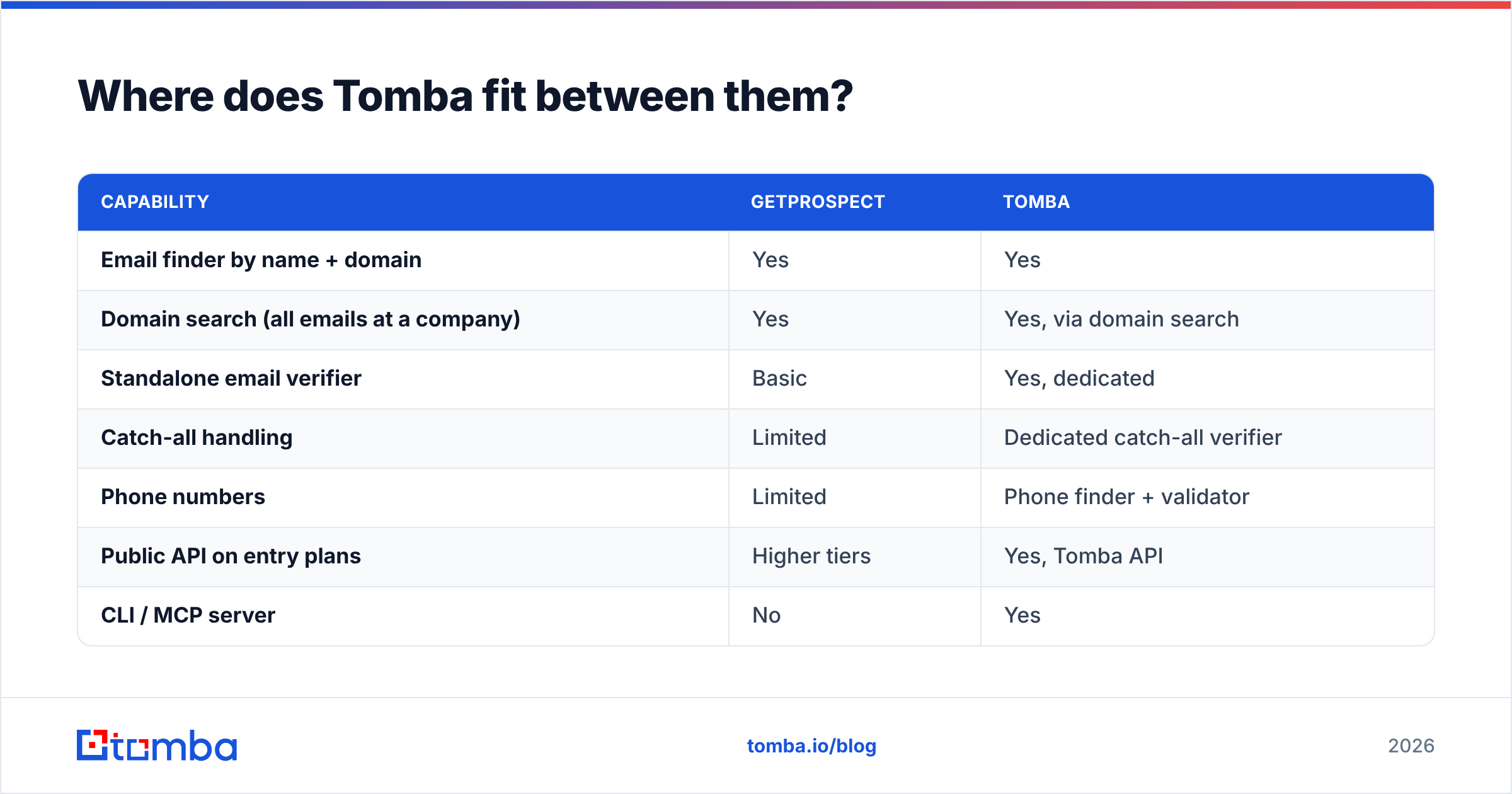
Tomba sits in the same self-serve band as GetProspect. It adds a deeper verification stack and an open API.
For most small and mid-sized teams, the real answer to GetProspect vs Stirista is neither one. It is a different self-serve email finder. It closes the two gaps GetProspect users hit most: verification depth and API access.
| Capability | GetProspect | Tomba |
|---|---|---|
| Email finder by name + domain | Yes | Yes |
| Domain search (all emails at a company) | Yes | Yes, via domain search |
| Standalone email verifier | Basic | Yes, dedicated |
| Catch-all handling | Limited | Dedicated catch-all verifier |
| Phone numbers | Limited | Phone finder + validator |
| Public API on entry plans | Higher tiers | Yes, Tomba API |
| CLI / MCP server | No | Yes |
| Chrome extension | Yes | Yes |
| Sheets / Excel / Airtable add-ons | Partial | Yes |
| Starter price | Published | $49/mo |
| Free tier | Yes | 25 searches/mo |
The catch-all point is worth a moment. About a third of B2B domains accept mail to any address. A basic verifier marks those "valid." Your bounce rate looks fine until the campaign hits a spam trap.
A dedicated catch-all check tells you the difference. It separates "the server takes everything" from "this mailbox is real." If your ICP skews to large firms on Microsoft 365, that check beats a few points of headline coverage.
The second point is throughput. Maybe you enrich a CRM on a schedule instead of pulling lists by hand. Then bulk email finding and API access on an entry plan change the math. You stop paying for a high tier just to unlock the endpoint.
How should you run the evaluation?#
Give yourself one week and one fixed test file. That is the shortest path to a choice you can defend.
- Define the unit of value. Verified work emails for reps? Or audience reach? Write it down before any demo.
- Build a 300-row test file from your real ICP. Weight it the way your pipeline is weighted. Include the small firms and non-US domains that break databases.
- Run the same file through every candidate. Free tiers count. GetProspect and Tomba both have one. Stirista will need a match-rate test through their team.
- Verify outside the vendor. Push every output through a neutral verifier. Score
valid ÷ submittedand keep catch-alls in their own bucket. - Price the winner per usable record. Divide the monthly cost by the number of verified, usable contacts. That single number ends most arguments.
- Test the integration path last. A tool that wins on data but needs a Zapier chain to reach your CRM will lose by month two.
Teams that skip step 4 buy on demo impressions. Teams that run it find the gap is small on accuracy. The gap is large on coverage, price per usable record, and export pain.
GetProspect vs Stirista: which one wins in 2026?#
For a sales team that needs contacts, GetProspect wins on speed, price, and fit. Stirista is not built for that job. For a marketing org buying media across channels, Stirista wins, and no email finder comes close.
Here is the more useful answer. Most teams weighing GetProspect vs Stirista want one thing: reliable work emails, verified, at a price that skips procurement. If that is you, run the 300-row test across three self-serve tools. That beats arguing over two products in different categories.
Start with the Tomba Email Finder free tier. You get 25 searches a month, no card, and the same verification and API stack as the paid plans. Run your own list. Count the usable records. Let the numbers pick the vendor.
Related guides#
Ready to find emails that actually work?
Join 150,000+ professionals who stopped guessing and started sending. Free credits on signup — no credit card required.
Get the Tomba newsletter
Practical outbound tactics and product updates — once every two weeks.
About the author