GetProspect vs Tami AI: Which B2B Lead Tool Wins in 2026?
GetProspect sells a verified B2B contact database. Tami AI sells an AI research agent that builds lists from a prompt. They solve different halves of the same problem — here's which one your pipeline actually needs.
TL;DR
- GetProspect is a database-first email finder: a large B2B contact index, LinkedIn Chrome extension, filters, and built-in verification. You search by attributes, it returns rows.
- Tami AI is an AI-agent-first prospecting tool: you describe the customer you want in plain language, it researches the web and assembles a list. You search by intent, it returns a shortlist.
- They are not really substitutes. GetProspect wins on volume, per-contact cost, and repeatability. Tami AI wins on niche, hard-to-filter segments where firmographic checkboxes fail.
- Both leave the same gap: contact-level accuracy at send time. Neither replaces a dedicated verification step before you load a list into a sequencer.
- If your bottleneck is "I know who I want, I just need clean emails at scale," a focused email finder with an API is cheaper than either.
What is GetProspect and what is Tami AI?#
Different problems wearing similar marketing.
GetProspect launched as a LinkedIn email extractor and grew into a full B2B contact database. The workflow is familiar to anyone who has used Apollo or Hunter: filter by job title, company size, industry, technology, and location; get a list of names with work emails; export to CSV or push to your CRM. The Chrome extension pulls contacts off LinkedIn search results and profile pages. Verification is bundled — GetProspect marks emails as valid, risky, or unknown before you export.
Tami AI belongs to the newer category of AI research agents for go-to-market. Instead of a filter panel, you type something like "Series B fintech companies in the Nordics that just hired a Head of Compliance and use Stripe." The agent decomposes that into searches, reads company sites, news, and job boards, and returns companies and contacts that match the description — including criteria that no database has as a structured field.
The distinction matters more than any feature checklist:
- GetProspect answers "who fits these filters?" — bounded by whatever fields exist in the index. Fast, cheap per row, reproducible.
- Tami AI answers "who looks like this?" — bounded by what's publicly readable on the web. Slower, costlier per row, better at nuance.
- GetProspect's failure mode is a stale row — the person left 14 months ago and nobody updated the record.
- Tami AI's failure mode is a confident wrong match — the agent inferred a fit from a blog post that turned out to be a customer story, not a hire.
- Both fail on the last mile — an email that parses correctly and still bounces because the mailbox was deactivated last quarter.
How do GetProspect and Tami AI compare head-to-head?#
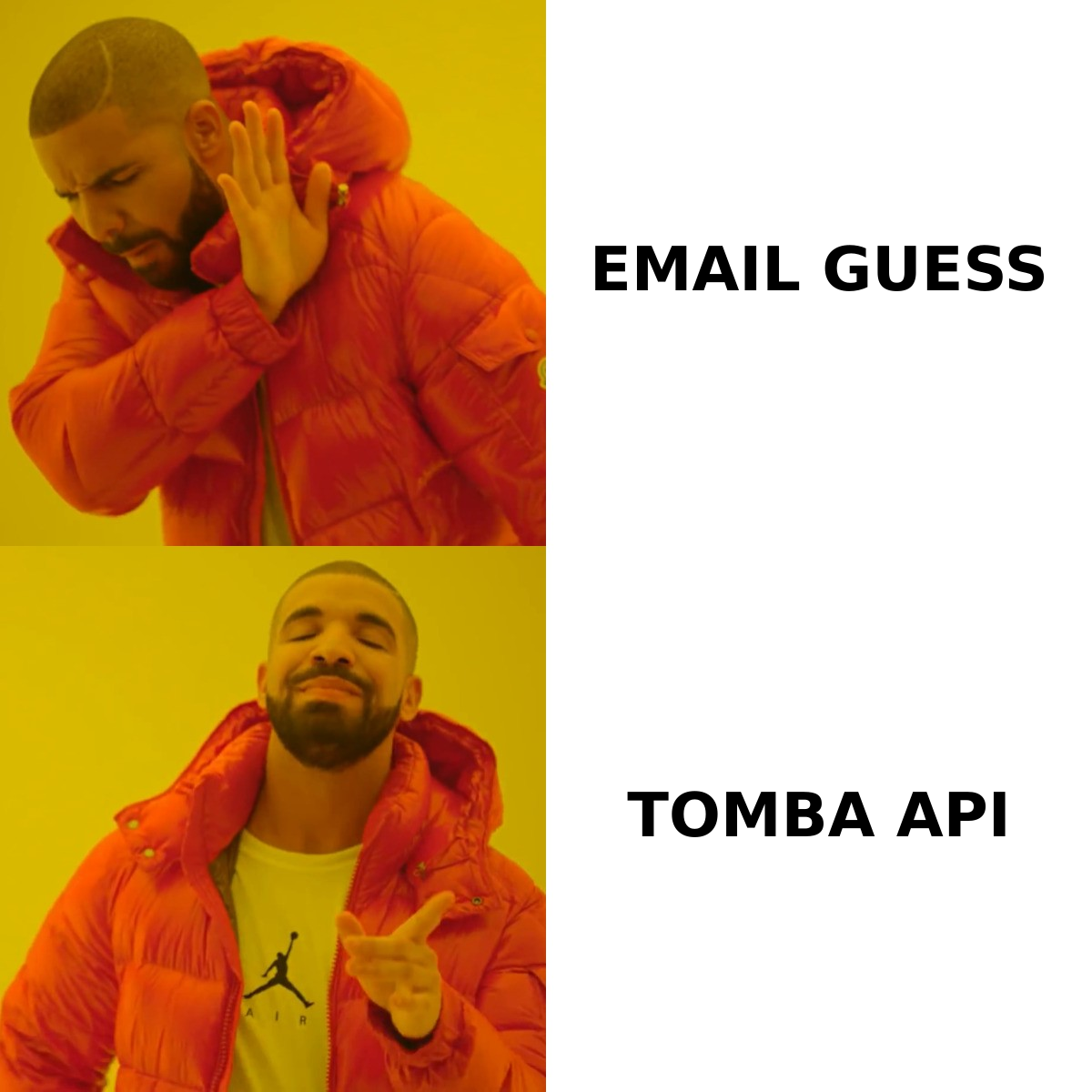
Pricing below reflects publicly listed plans at the time of writing. Both vendors change tiers frequently — check their pricing pages before you commit to an annual contract.
| Dimension | GetProspect | Tami AI |
|---|---|---|
| Core model | Static B2B contact database + LinkedIn extension | AI research agent that builds lists from a prompt |
| How you search | Structured filters (title, industry, size, tech, geo) | Natural-language description of your ICP |
| Best at | High-volume, well-defined segments | Narrow, signal-based, "unfilterable" segments |
| Email verification | Built in, results labeled valid/risky/unknown | Enrichment via third-party providers |
| Phone numbers | Available on higher tiers | Depends on enrichment source |
| Entry price | Free tier, then roughly $49/mo for the first paid plan | Credit-based; typically higher effective cost per contact |
| Speed to 1,000 contacts | Minutes | Materially slower — the agent researches per account |
| API | Yes | Yes, agent-oriented |
| Repeatability | High — same filters, same result set | Lower — prompts drift, results vary between runs |
| CRM push | HubSpot, Pipedrive, Salesforce, Zapier | Growing integration set, newer ecosystem |
| Learning curve | Low | Low to use, high to prompt well |
The line that decides most evaluations is "repeatability." If you run the same GetProspect filter next month, you get a comparable list plus new records. If you run the same Tami AI prompt next month, you may get a different set — sometimes better, sometimes shifted. For a RevOps team building a territory model, that variance is a real cost. For a founder hunting 40 perfect accounts, it's irrelevant.
Which one gives you better email accuracy?#
Neither vendor should be trusted on this without your own test.
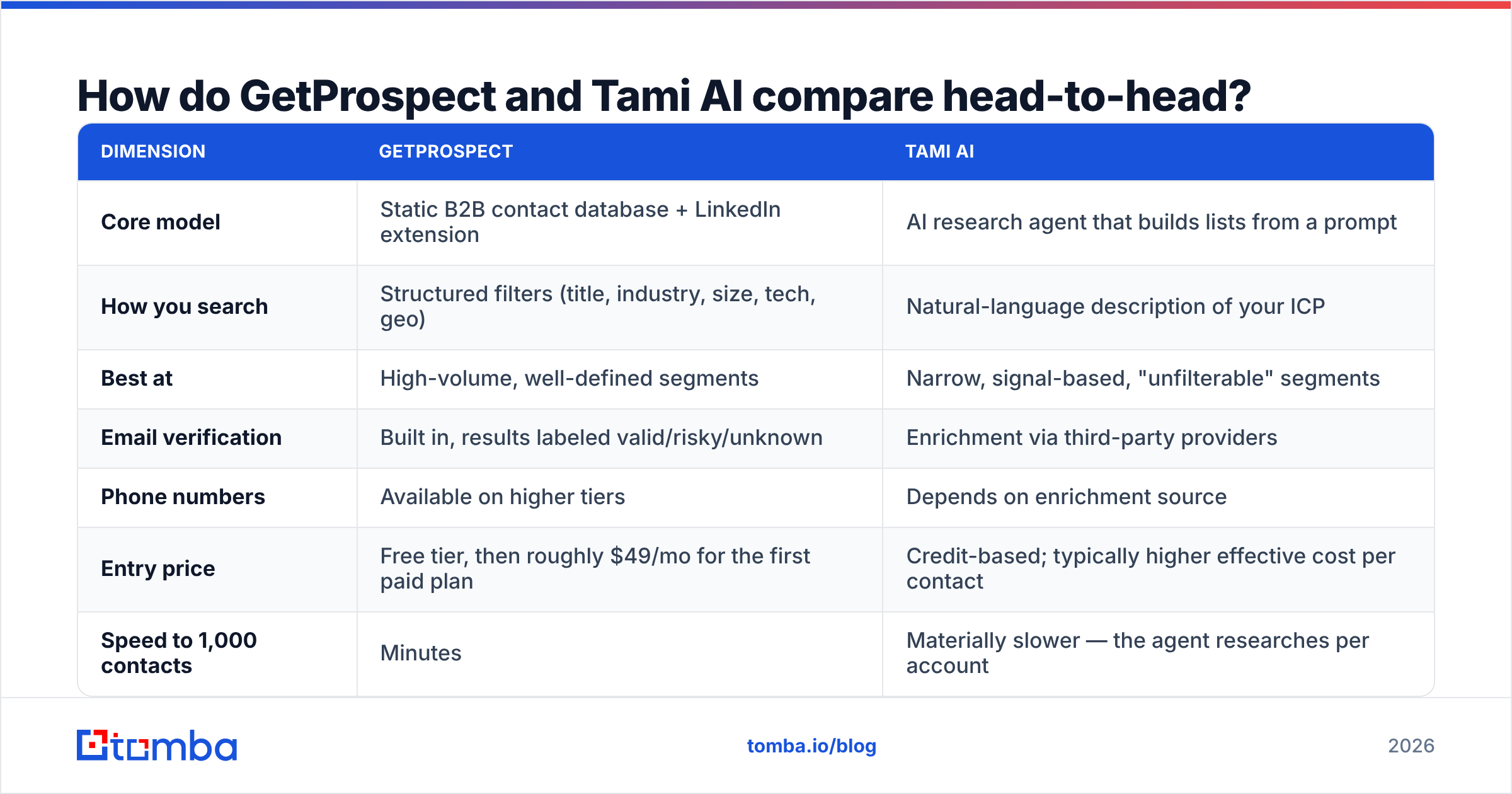
Every provider in this market publishes an accuracy number, and every number is measured on a self-selected sample. A database that only returns contacts it is confident about will report 97% accuracy and 30% coverage. A tool that returns everything it finds will report 85% accuracy and 80% coverage. Both statements can be true and neither tells you what happens to your list.

Run this test before you buy either tool — it takes about an hour:
- Build a 100-contact control set from accounts you already know: current customers, closed-lost deals, people who have replied to you. You already know the real email for each.
- Run the same 100 names through both tools. Record found/not-found, not just accuracy on found rows.
- Compute coverage separately from accuracy. Coverage = rows returned ÷ rows requested. Accuracy = correct emails ÷ rows returned. A tool with 40% coverage and 98% accuracy delivers 39 usable contacts. A tool with 85% coverage and 90% accuracy delivers 76. The second one is better even though its headline number is worse.
- Re-verify everything through a neutral third party. Use an independent email verifier so the same vendor isn't both finding and grading its own work.
- Check the catch-all rate. Domains that accept all mail inflate "valid" counts everywhere. If 25% of your list is catch-all, you need a real catch-all verifier, not a green checkmark.
In practice, both GetProspect and Tami AI perform well on large US and Western European tech companies and degrade on SMBs, non-English markets, and companies with fewer than 20 employees. That degradation is a property of the underlying web, not of either vendor's engineering.
How do the pricing models actually differ?#
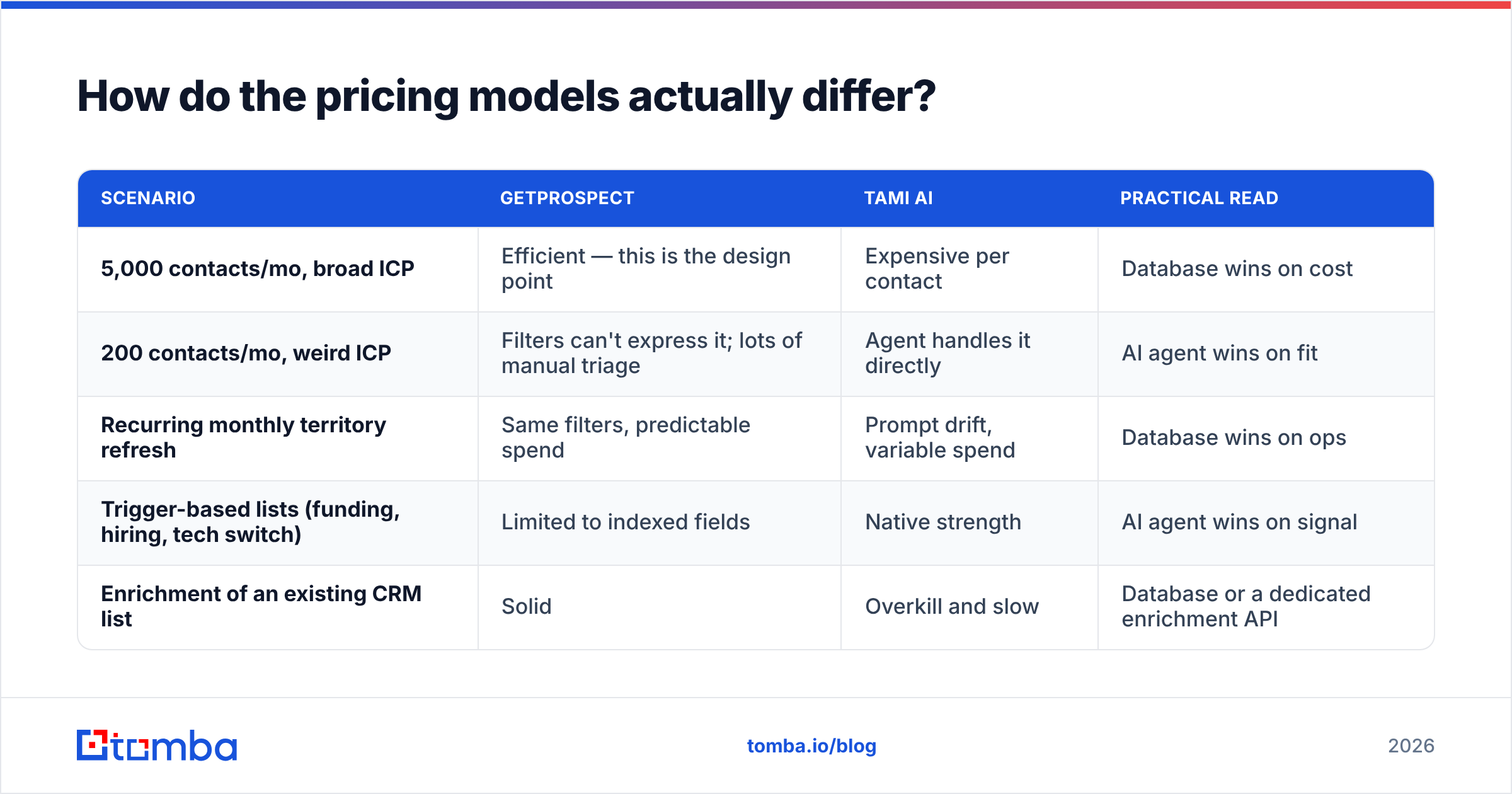
GetProspect prices like a database. Tami AI prices like compute.
That difference compounds. A database charges you per row returned, and rows are cheap because the index already exists. An AI agent charges for research work — reading pages, reasoning, cross-checking — so each contact costs more, and a wide prompt burns credits fast even when the results are thin.

| Scenario | GetProspect | Tami AI | Practical read |
|---|---|---|---|
| 5,000 contacts/mo, broad ICP | Efficient — this is the design point | Expensive per contact | Database wins on cost |
| 200 contacts/mo, weird ICP | Filters can't express it; lots of manual triage | Agent handles it directly | AI agent wins on fit |
| Recurring monthly territory refresh | Same filters, predictable spend | Prompt drift, variable spend | Database wins on ops |
| Trigger-based lists (funding, hiring, tech switch) | Limited to indexed fields | Native strength | AI agent wins on signal |
| Enrichment of an existing CRM list | Solid | Overkill and slow | Database or a dedicated enrichment API |
For reference, Tomba pricing sits in the same neighborhood as GetProspect's entry tier: a free tier with 25 searches per month, Starter at $49/mo, Growth at $99/mo, Pro at $249/mo, Enterprise custom. The reason to bring it up here isn't a pitch — it's that the $49–$99 band is the market clearing price for database-style email finding in 2026, and any AI-agent tool has to justify a premium over that band with results you genuinely can't filter for.

Which workflows suit GetProspect?#
Pick GetProspect when the list is the easy part and the volume is the hard part.
- SDR team with a defined territory. Titles, headcount bands, and geography are already agreed. You need 800 fresh contacts a month, consistently, in the same shape. Filters do this better than prompts.
- LinkedIn-led prospecting. The Chrome extension over Sales Navigator search results is GetProspect's strongest single feature. If your reps live in LinkedIn, this removes a copy-paste step. A dedicated LinkedIn finder covers the same ground if you'd rather not adopt a full platform.
- CRM hygiene projects. Bulk-enriching 10,000 stale HubSpot records with current emails and titles is a database job. An agent would take days and cost a fortune.
- Budget-constrained teams. The free tier is genuinely usable for testing, and the first paid tier is affordable for a two-person outbound motion.
Where it struggles: anything defined by an event rather than an attribute. "Companies that just opened a second office" or "teams that mention SOC 2 in a job post" aren't filters. You'd have to build the trigger list elsewhere and then use GetProspect only for contact lookup — which, honestly, is a perfectly good architecture.
Which workflows suit Tami AI?#
Pick Tami AI when your ICP is a paragraph, not a set of checkboxes.
- Founder-led sales into a novel category. You're selling something with no SIC code. Describing the buyer works; filtering for them doesn't.
- Signal-based outbound. Hiring patterns, product launches, regulatory changes, tech-stack migrations. The agent reads the same public sources a good researcher would, at 50x the pace.
- Account research before a call. Even when you sourced contacts elsewhere, an agent that summarizes an account in one pass saves a rep 15 minutes.
- Small, high-value target lists. If a closed deal is worth $80k, spending $4 of research credits per account is trivially correct.
Where it struggles: volume economics, reproducibility, and audit trails. When your VP asks "why is this account in the list?", the answer "the model thought it fit" is not a great one. Some AI prospecting tools now expose their reasoning per row — check whether Tami AI does for your use case, because that transparency is the difference between a usable list and an unauditable one.
Also worth noting: AI-sourced contacts still need the same downstream hygiene as database-sourced contacts. An agent that reads a company site and infers firstname.lastname@domain.com has produced a hypothesis, not a verified mailbox. Run it through verification before it touches your sequencer, or your email deliverability pays the bill.
What do both tools miss?#
Three gaps show up in almost every evaluation.
- Verification independence. When the tool that finds the email also grades it, you have a conflict of interest baked into your data pipeline. Separate the two vendors. It costs a few dollars per thousand and protects your domain.
- Catch-all handling. Roughly a fifth to a quarter of B2B domains accept all mail. Most tools mark these "risky" and move on, which pushes the decision onto you at the worst possible moment — right before send.
- Cost per usable contact. Everybody quotes cost per credit. Nobody quotes cost per contact that (a) exists, (b) is current, and (c) doesn't bounce. Compute that yourself from your control-set test; it often reorders the whole shortlist.
There's also an integration question. Both tools want to own the top of your funnel. If you already run a sequencer, a CRM, and an enrichment layer, adding a fourth platform with its own UI, its own credits, and its own export limits is real overhead. An API-first approach — where contact lookup is a function call inside a workflow you already control — avoids that. Tools like Clay built an entire category on that premise, and it's why buyers increasingly compare an email finder API against a full platform rather than platform against platform. Third-party review sites like G2's lead intelligence category are useful for spotting which vendors people actually keep past month three.
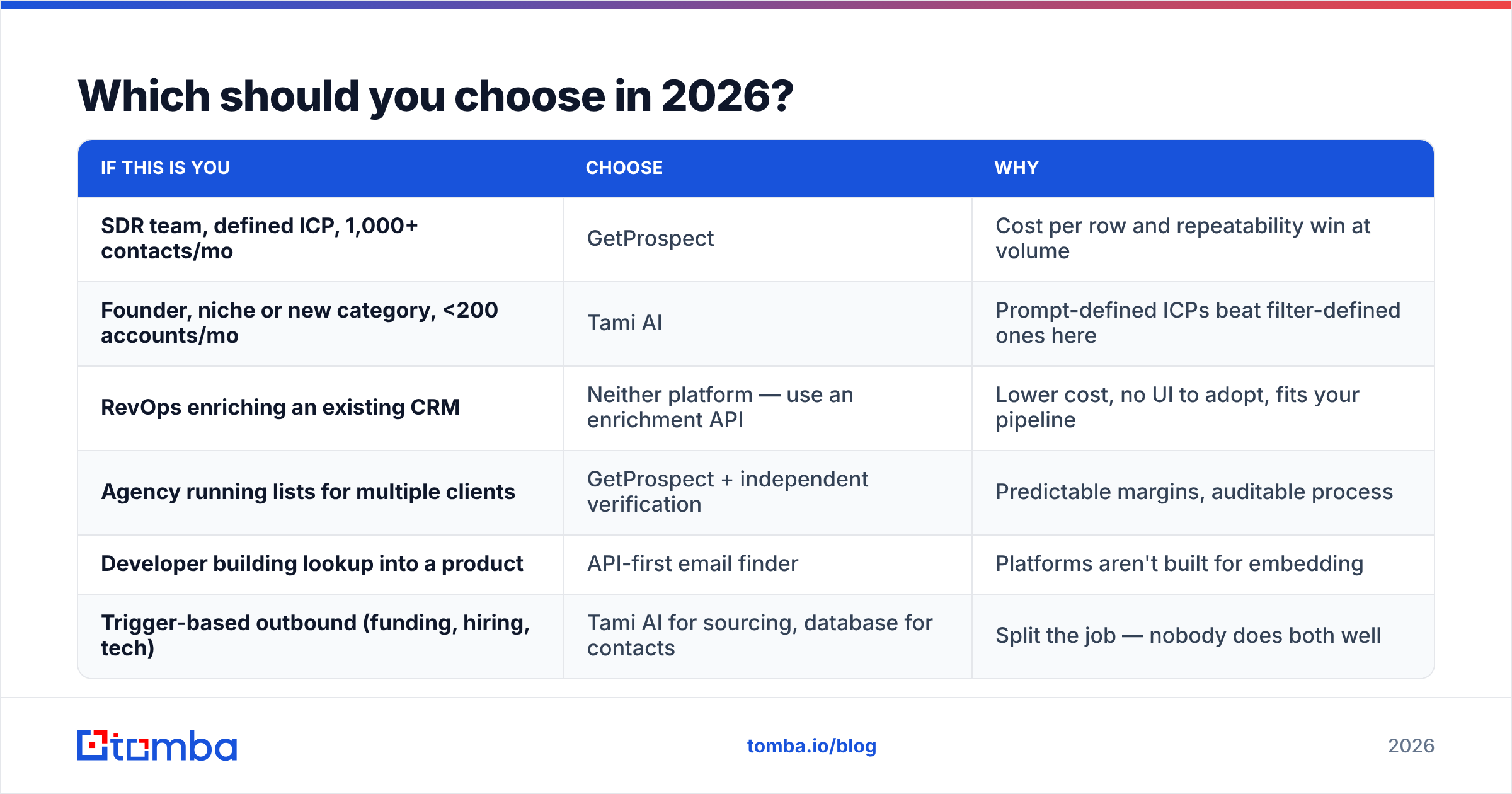
Which should you choose in 2026?#
Here's the decision compressed.
| If this is you | Choose | Why |
|---|---|---|
| SDR team, defined ICP, 1,000+ contacts/mo | GetProspect | Cost per row and repeatability win at volume |
| Founder, niche or new category, <200 accounts/mo | Tami AI | Prompt-defined ICPs beat filter-defined ones here |
| RevOps enriching an existing CRM | Neither platform — use an enrichment API | Lower cost, no UI to adopt, fits your pipeline |
| Agency running lists for multiple clients | GetProspect + independent verification | Predictable margins, auditable process |
| Developer building lookup into a product | API-first email finder | Platforms aren't built for embedding |
| Trigger-based outbound (funding, hiring, tech) | Tami AI for sourcing, database for contacts | Split the job — nobody does both well |
The honest verdict: GetProspect vs Tami AI is a false binary for most teams. The AI agent is good at deciding which accounts. The database is good at delivering which people, at what address. Teams that get the best results from either usually run a two-step stack — signal sourcing on one side, high-volume contact lookup and verification on the other — rather than forcing one tool to do both jobs badly.
If you're mid-evaluation, resist the urge to buy annual on either. Run both monthly for 60 days with the same control set, measure cost per usable contact, and let the number decide. The difference between the winner and the loser is usually 2–3x, and it's rarely the tool with the better demo.
Getting clean contacts is the part neither category has solved for you. If your real bottleneck is turning a list of names and domains into deliverable work emails — at API speed, with verification and catch-all handling built into the same call — start with the Tomba Email Finder. The free tier gives you 25 searches a month to run your own control-set test, and paid plans start at $49/mo with the same accuracy checks on every row. Bring your worst 100 contacts and see what comes back.
Related guides#
Ready to find emails that actually work?
Join 150,000+ professionals who stopped guessing and started sending. Free credits on signup — no credit card required.
Get the Tomba newsletter
Practical outbound tactics and product updates — once every two weeks.
About the author