GetProspect vs Xverum: Which B2B Data Tool Wins in 2026?
One is a self-serve email finder built for SDRs. The other is a bulk data feed built for engineers. Here is the honest breakdown of where each one earns its money — and where it quietly wastes yours.
TL;DR
- GetProspect is a self-serve prospecting tool: LinkedIn extension, list building, email finding and verification, priced per contact credit with a free tier.
- Xverum is a bulk B2B data provider: company and people datasets delivered as feeds, S3 drops, or API — quote-based, annual, and aimed at data teams rather than SDRs.
- They barely compete. If you have a rep who needs 500 emails this week, Xverum is the wrong shape. If you need 40M company records refreshed monthly into a warehouse, GetProspect is the wrong shape.
- Cost per usable contact is where the comparison actually gets decided — not headline pricing. Run the same 100-domain test list through both before you sign anything.
- If you want the middle ground — API-first email finding without an annual data contract — a Tomba Email Finder style tool covers most of what teams buy Xverum for at a fraction of the commitment.
What are GetProspect and Xverum, exactly?#
They get compared because both sell B2B contact data. That's where the similarity stops.
GetProspect is a prospecting workspace. You install a Chrome extension, run a LinkedIn Sales Navigator search, and pull profiles into lists. It finds work emails, verifies them, enriches with job title and company data, and pushes to your CRM or a CSV. The whole product is designed around a human building a list they will personally email this quarter.
Xverum is a data supply company. You don't "use" Xverum day to day — you receive it. Company profiles, people profiles, job postings, and firmographic datasets arrive as scheduled deliveries in JSON, CSV, or Parquet, or you query them through an API. The buyer is usually a data engineer, an ML team training a model, or a platform embedding third-party data into its own product.
The mental model: GetProspect is a fishing rod. Xverum is a shipment of fish. Both get you dinner. Only one makes sense when you're feeding a hundred restaurants.
That distinction matters more than any feature table, because most bad purchases in this category come from buying the wrong shape of product, not the wrong vendor.

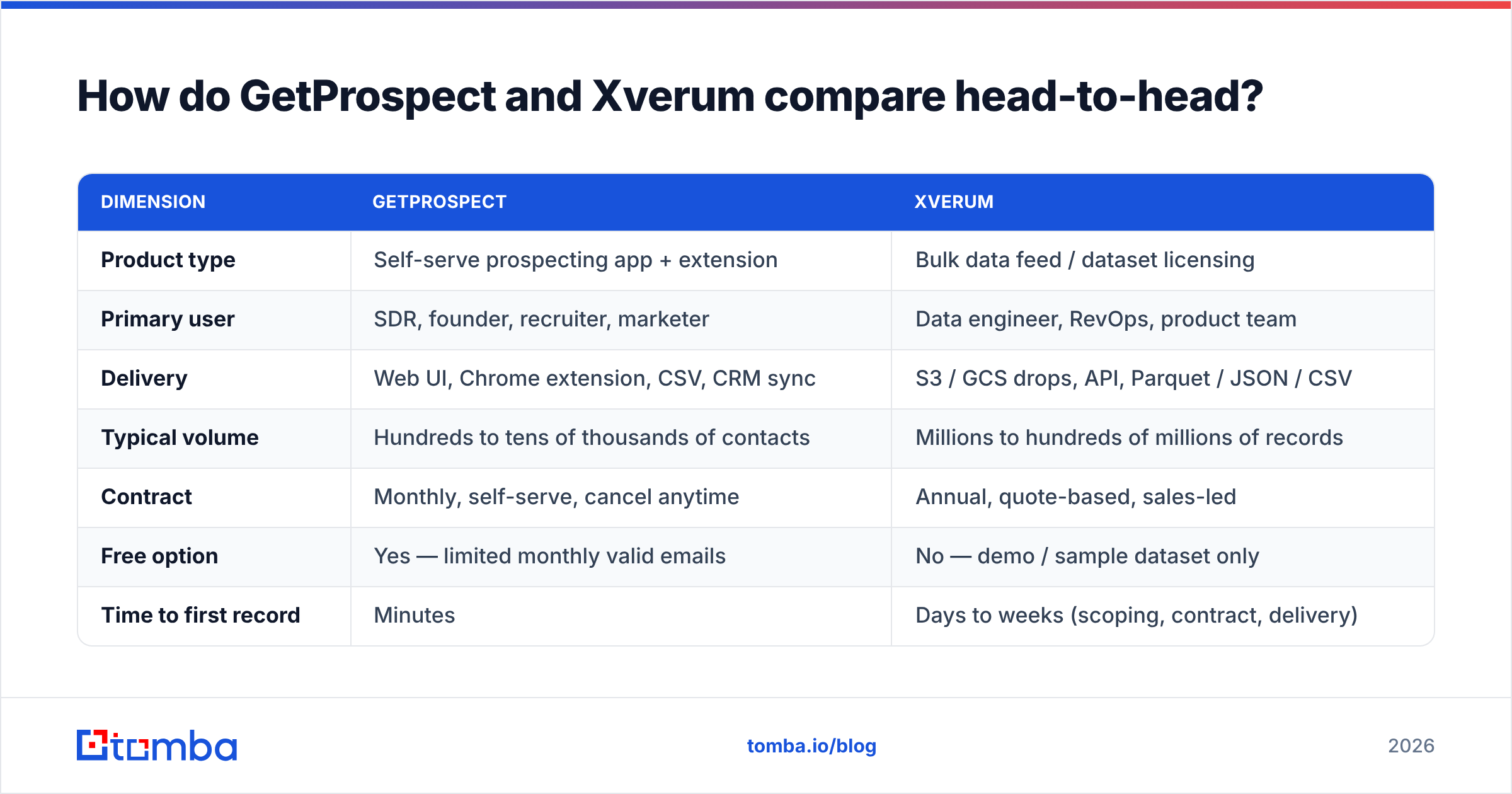
How do GetProspect and Xverum compare head-to-head?#
Here is the practical comparison. Verify current numbers on each vendor's pricing page before you commit — this category changes plans often.
| Dimension | GetProspect | Xverum |
|---|---|---|
| Product type | Self-serve prospecting app + extension | Bulk data feed / dataset licensing |
| Primary user | SDR, founder, recruiter, marketer | Data engineer, RevOps, product team |
| Delivery | Web UI, Chrome extension, CSV, CRM sync | S3 / GCS drops, API, Parquet / JSON / CSV |
| Typical volume | Hundreds to tens of thousands of contacts | Millions to hundreds of millions of records |
| Contract | Monthly, self-serve, cancel anytime | Annual, quote-based, sales-led |
| Free option | Yes — limited monthly valid emails | No — demo / sample dataset only |
| Time to first record | Minutes | Days to weeks (scoping, contract, delivery) |
| Email verification | Built in | Varies by dataset; often your job |
| Best for | Building this quarter's outbound list | Powering a product, model, or warehouse |
Two takeaways from that table.
First, the buying cycle alone disqualifies one of them for most teams. If you're a five-person sales team, a sales-led annual data contract is not a purchase you want to make in Q3 to hit Q3 numbers.
Second, Xverum's advantage only shows up at scale. Below roughly 50,000 records, per-contact pricing from a self-serve tool almost always beats a dataset license. Above a few million, the math flips hard and per-credit tools become absurd.
Which one fits your workflow?#
Match yourself to one of these five profiles. It's faster than a feature audit.
- Solo founder or 1–3 person sales team. You need 200–2,000 contacts a month, you want to see them before you email them, and you want to cancel if it doesn't work. GetProspect fits. Xverum does not.
- SDR team of 5–20. You need seat-based access, shared lists, CRM push, and verification that keeps your bounce rate under 3%. GetProspect fits; so does any credit-based email finder with a real API for the ops layer underneath.
- RevOps building a TAM model. You want firmographics on every company in a market, not just the ones a rep clicked. This is Xverum territory — or a bulk export from a database vendor.
- Product team embedding data. You're shipping a feature that enriches your own users' records. You need licensed, redistributable, scheduled data. Xverum is built for exactly this; a per-seat prospecting tool usually forbids it in its terms.
- ML / data science team. You're training on job postings, headcount trends, or tech-stack signals. GetProspect has no product for you. Xverum does.
If you read those and thought "I'm two of them" — that's normal, and it's the case where you buy a cheap self-serve tool with a strong API rather than one enormous contract.
What does each one actually cost?#
Pricing is where the comparison gets uncomfortable, because the two vendors don't publish on the same terms.
GetProspect publishes tiers. There's a free plan with a small monthly allowance of valid emails, then paid tiers that scale by contact credits, with additional charges for extra seats and higher verification volumes. Reviewers on G2 consistently flag the same thing: the sticker price is fine, the credit burn is what surprises people. Credits get consumed on searches that return nothing usable, and you don't get them back.
Xverum doesn't publish list pricing at all. Dataset licensing is scoped — how many records, which fields, how often refreshed, whether you can redistribute. Expect an annual commitment and a sales process with a scoping call, a sample file, and legal review. That's not a criticism; it's how licensed data works everywhere from Dun & Bradstreet down.
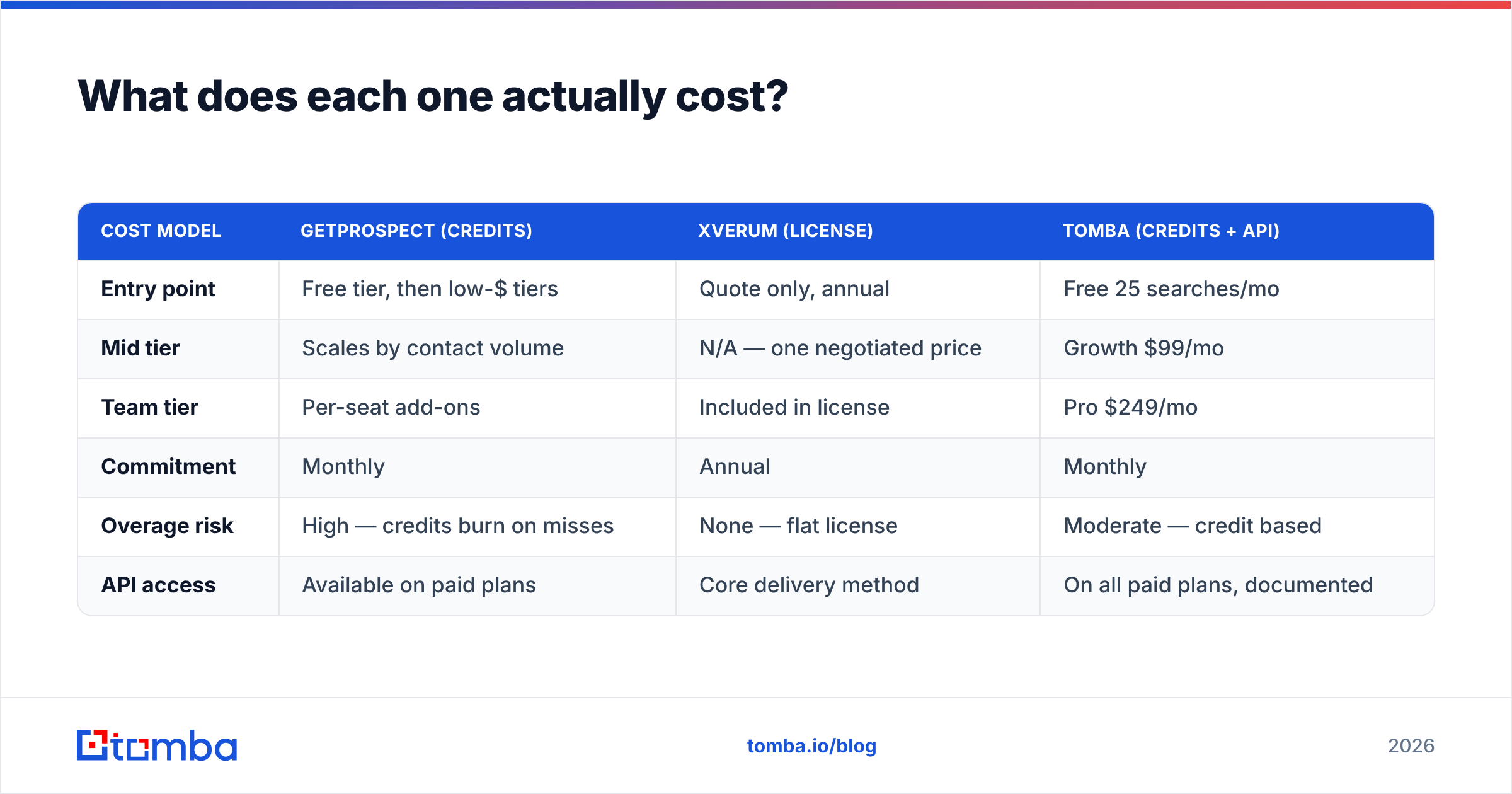
For a like-for-like reference point, here's how three cost models stack up on a team that needs roughly 10,000 verified contacts a month:
| Cost model | GetProspect (credits) | Xverum (license) | Tomba (credits + API) |
|---|---|---|---|
| Entry point | Free tier, then low-$ tiers | Quote only, annual | Free 25 searches/mo |
| Mid tier | Scales by contact volume | N/A — one negotiated price | Growth $99/mo |
| Team tier | Per-seat add-ons | Included in license | Pro $249/mo |
| Commitment | Monthly | Annual | Monthly |
| Overage risk | High — credits burn on misses | None — flat license | Moderate — credit based |
| API access | Available on paid plans | Core delivery method | On all paid plans, documented |
The honest read: at 10,000 contacts a month, a license is overkill and a per-credit tool wins. At 10 million records a year, the license is the only rational choice. Anyone telling you otherwise is selling one of the two.
Check current Tomba pricing and both vendors' own pages before budgeting — every number in this category moves.
How accurate is the data from each?#
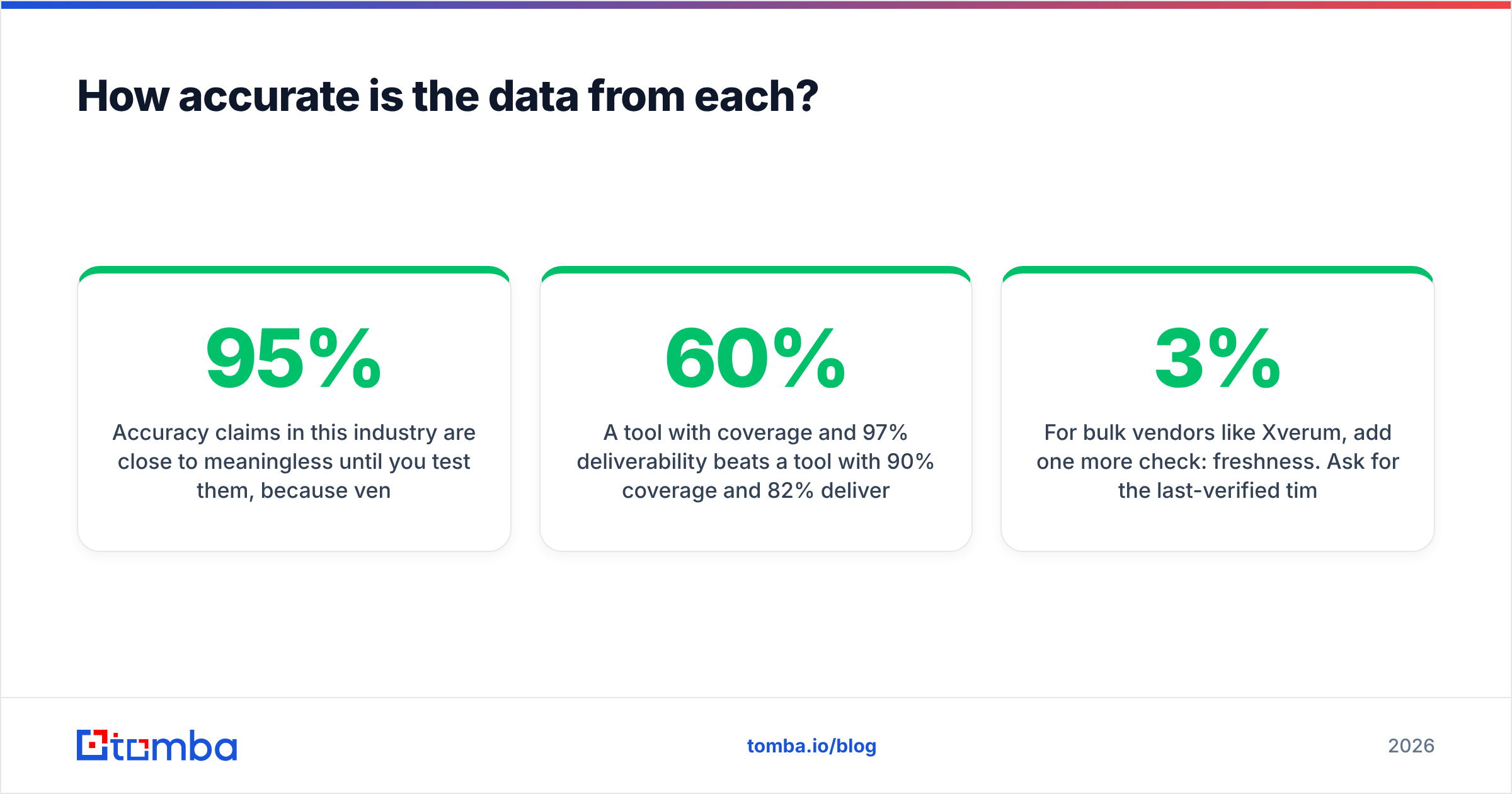
Accuracy claims in this industry are close to meaningless until you test them, because vendors measure different things. "95% accurate" can mean "95% of emails we return pass SMTP" — which excludes every contact the tool failed to find at all. That second number, coverage, is usually the one that decides your campaign volume.
Run this test before you buy, on both tools, with the same input:
- Take 100 real target domains from your ICP — not Fortune 500 names, which every vendor has memorized.
- Ask for a specific role (VP Marketing, Head of Engineering) at each.
- Record the hit rate: how many of the 100 returned any contact at all.
- Record the verified rate: of those hits, how many pass an independent email verifier you control — not the vendor's own.
- Send a small batch and record hard bounces at 48 hours. This is the only number that pays your bills.
A tool with 60% coverage and 97% deliverability beats a tool with 90% coverage and 82% deliverability for cold outbound, every time — because bounces damage sender reputation and coverage gaps only cost you names.
For bulk vendors like Xverum, add one more check: freshness. Ask for the last-verified timestamp on people records. B2B contact data decays roughly 2–3% a month as people change jobs; a dataset refreshed quarterly is 9% wrong before it lands in your warehouse. Any serious provider will tell you their refresh cadence. If they won't, that's your answer.

Where does each one break down?#
Both tools have failure modes their marketing pages skip.
GetProspect's weak points. Credit consumption on failed lookups is the recurring complaint — you pay for the search, not the result. The LinkedIn-centric workflow also means your coverage inherits LinkedIn's coverage: strong for tech, marketing, and North America; thin for regional manufacturing, trades, and markets where decision-makers aren't on the platform. And because list-building is manual and human-driven, it doesn't scale past a certain team size without someone building automation on the API anyway.
Xverum's weak points. Time to value is the big one. Scoping, contracting, sample review, and pipeline setup can burn a full quarter before a rep sees a single lead. Second, raw data isn't a workflow — someone on your side has to clean, dedupe, verify, and route it. Third, annual licenses lock you into a coverage profile before you've stress-tested it in production; if the vertical you actually sell into turns out to be thin, you're paying for it until renewal.
The shared weak point. Neither one solves catch-all domains cleanly. A large share of enterprise domains accept all mail at the SMTP layer, which makes standard verification useless — the server says "yes" to everything. If a meaningful part of your ICP sits behind Microsoft 365 with catch-all enabled, you need a dedicated catch-all verifier regardless of which vendor you pick, or you'll be flying blind on a third of your list.
Is there a middle option between the two?#
Yes, and it's where most teams should actually land: an API-first email finder with self-serve pricing.
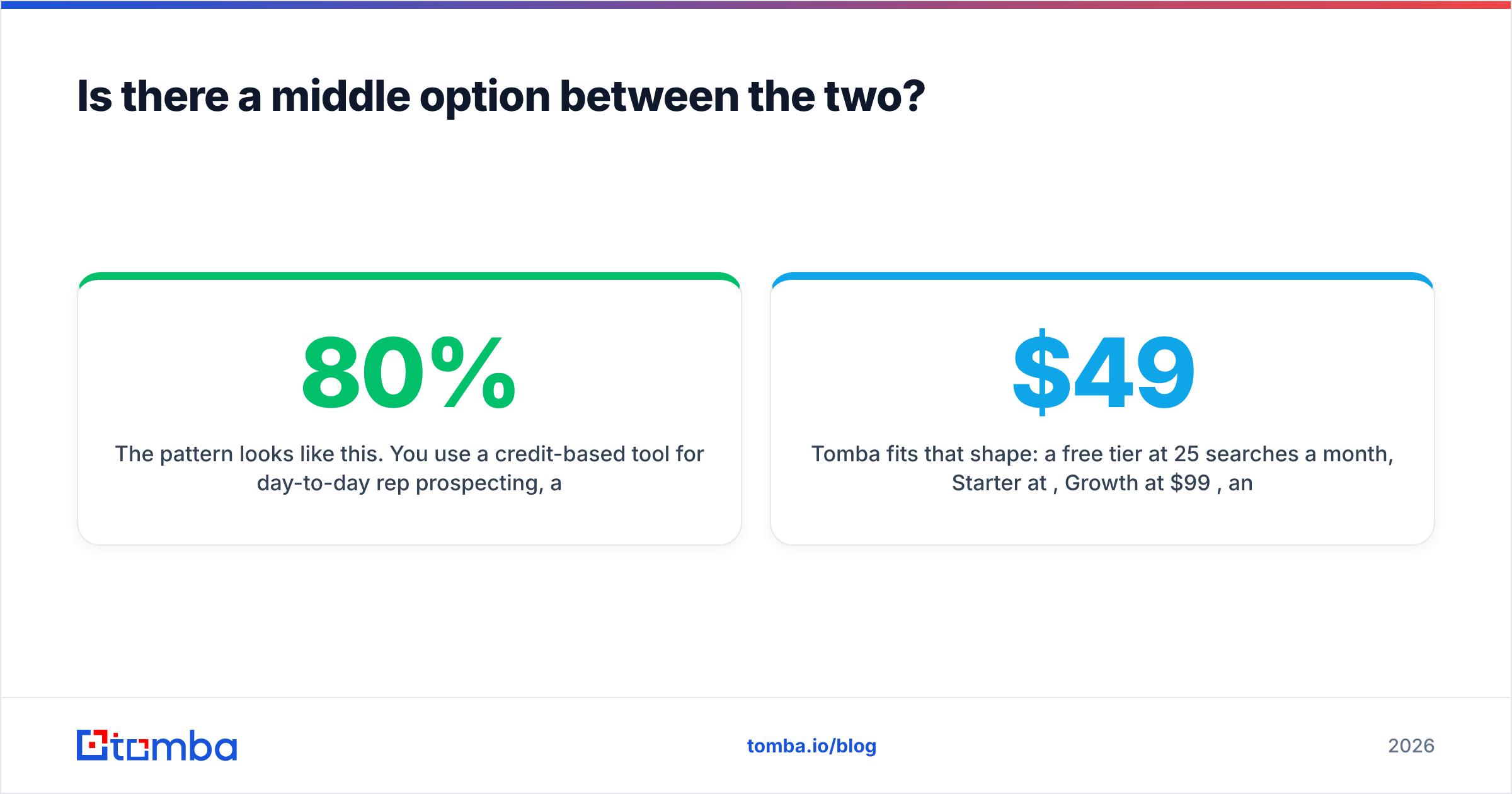
The pattern looks like this. You use a credit-based tool for day-to-day rep prospecting, and you use the same vendor's API to run bulk enrichment jobs on lists you already have — CRM records with missing emails, webinar signups with only a company name, scraped domain lists. That gets you 80% of what a data license delivers without a 12-month commitment or a data engineer.
Tomba fits that shape: a free tier at 25 searches a month, Starter at $49/mo, Growth at $99/mo, and Pro at $249/mo, with the same email finder API available across paid plans and bulk verify for list-level jobs. Domain search covers the "give me everyone at this company" use case that usually pushes people toward bulk vendors in the first place.
The decision rule is simple:
| Your situation | Pick |
|---|---|
| Reps building lists manually, <10k/mo | GetProspect or a credit-based finder |
| Warehouse-scale firmographics, 1M+ records | Xverum or a comparable licensor |
| CRM enrichment + rep prospecting, mixed | API-first finder (Tomba, or similar) |
| Product feature needing redistributable data | Xverum — licensing terms matter here |
| Testing outbound for the first time | Free tier, any vendor. Don't sign anything |
Which should you pick in 2026?#
Pick GetProspect if you're a sales team that lives in LinkedIn, wants to see contacts before emailing them, and needs to start this week. Watch the credit burn and cap your seats.
Pick Xverum if data is an input to a system, not a rep — a model, a warehouse, a product feature. Ask hard questions about refresh cadence and redistribution rights before signing, and negotiate a pilot dataset rather than accepting a 12-month term on faith.
Pick neither if your real problem is that you have 8,000 CRM records with no email addresses on them. That's an enrichment problem, and both a manual list-builder and a bulk license are expensive ways to solve it. A data enrichment endpoint you call from a script solves it in an afternoon.
Whatever you choose, run the 100-domain test first. It costs a free tier and two hours, and it will tell you more than every review site combined.
Ready to test the middle path? Start with the Tomba Email Finder — 25 free searches a month, no card, and the same API you'd use in production. Run your 100-domain list through it, check the verified rate against whatever quote is sitting in your inbox, and let the bounce numbers make the decision for you.
Related guides#
Ready to find emails that actually work?
Join 150,000+ professionals who stopped guessing and started sending. Free credits on signup — no credit card required.
Get the Tomba newsletter
Practical outbound tactics and product updates — once every two weeks.
About the author