Getro vs Leadzenai: Which B2B Tool Fits Your Pipeline?
Getro and LeadZen.ai get compared constantly, but they solve opposite problems. Here's what each actually does, what they cost, and which one belongs in your 2026 outbound stack.
Getro vs Leadzenai is a common comparison search, and it starts from a wrong premise. The two tools solve opposite problems. Getro runs talent networks. LeadZen.ai sells B2B contact data for cold outbound. Here is how each one works, what it costs, and which one you actually need.
TL;DR
- Getro and LeadZen.ai are not really competitors. Getro powers talent networks and job boards for VC firms, accelerators, and communities. LeadZen.ai is a B2B contact database with email and phone lookup on top.
- Is your job to help portfolio companies hire and connect? Getro is the right category. Is your job to book 30 meetings this quarter? Getro will not help, and LeadZen.ai is the closer fit.
- Pricing differs sharply. Getro sells annual, quote-based platform contracts. LeadZen.ai sells self-serve credit plans. The two budgets are an order of magnitude apart.
- Neither tool is a strong standalone answer for cold-email accuracy. Both need a verification step before you send. Skip it and your bounce rate does the damage.
- Best split in practice: keep Getro for community and talent work, then run a dedicated email finder plus verifier for outbound. That is where a tool like Tomba earns its place.
Getro vs Leadzenai: what is each tool built for?#
Start with the honest answer. These two products were built for different buyers. Most people who search for Getro vs Leadzenai inherited a stack and want to know what each line item does.
Getro is community infrastructure. It has two main products. The first is a white-label job board that pulls open roles from a portfolio or member network. The second is a network layer that maps who in your community knows whom. The buyer is usually a venture fund's platform team, an accelerator, an economic-development group, or a large professional community. The value is talent flow and warm intros inside a closed group. It is not cold outreach to strangers.
LeadZen.ai sits in a different aisle. It is a B2B contact database. Search a person or a company and you get back work emails, phone numbers, and company details. Then you export to CSV or push the records into your CRM. It ships a Chrome extension for LinkedIn prospecting and a bulk lookup for list building. The buyer is an SDR, a founder doing their own outbound, or a small growth team.
Put plainly: Getro helps people who already belong to your world find each other. LeadZen.ai helps you reach people who have never heard of you.
How do Getro and LeadZen.ai compare feature by feature?#
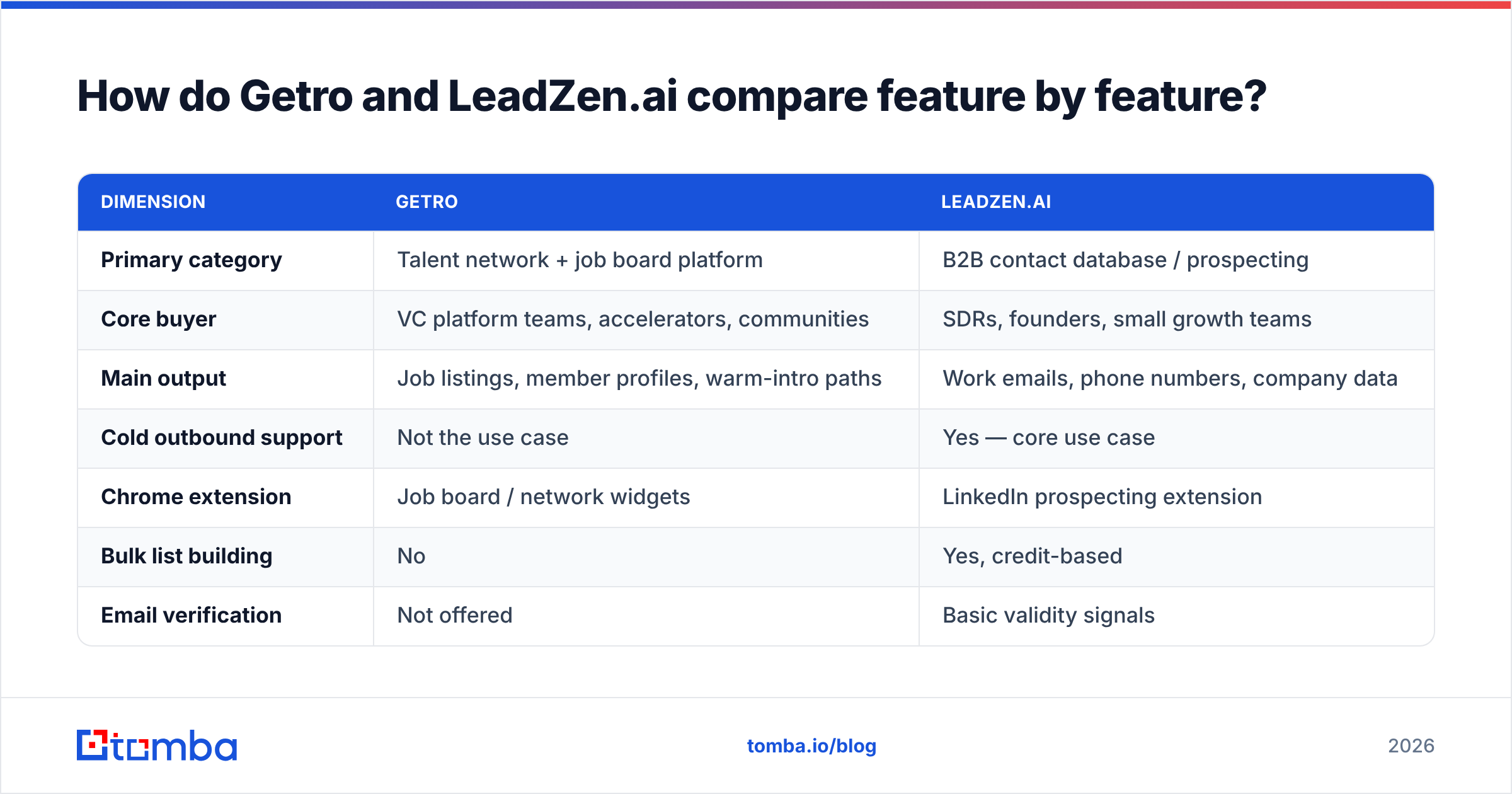
Here is the side-by-side that most comparison pages skip. It makes the mismatch obvious.
| Dimension | Getro | LeadZen.ai |
|---|---|---|
| Primary category | Talent network + job board platform | B2B contact database / prospecting |
| Core buyer | VC platform teams, accelerators, communities | SDRs, founders, small growth teams |
| Main output | Job listings, member profiles, warm-intro paths | Work emails, phone numbers, company data |
| Cold outbound support | Not the use case | Yes — core use case |
| Chrome extension | Job board / network widgets | LinkedIn prospecting extension |
| Bulk list building | No | Yes, credit-based |
| Email verification | Not offered | Basic validity signals |
| CRM push | Limited, community-oriented | CSV export + CRM integrations |
| Pricing model | Annual, quote-based | Self-serve credit tiers |
| Typical contract length | 12 months | Monthly or annual |
If you read only one row, read the cold outbound line. It decides which product belongs in a sales stack and which belongs in a platform-ops stack.

Which one has better data quality?#
They do not measure the same thing. So the fair question is quality for which purpose.
Getro's data is community-scoped. Most of it is self-reported or supplied by employers. Job listings come straight from portfolio company career pages. Member profiles come from the members themselves. Inside that boundary, freshness is good. A role that closes drops off the board, because the source is the company's own site. Outside that boundary, Getro has nothing to say. Ask it for the VP of Engineering at a company that is not in the network and you get nothing.
LeadZen.ai gathers data at scale, so the classic tradeoff applies: broad coverage, uneven accuracy per record. Reviews on G2 and similar sites describe the same pattern across mid-market contact databases. Hit rates are strong on well-documented companies. Results get thin and stale on SMBs, non-US regions, and roles that changed recently. That is not a knock on LeadZen alone. Any database that refreshes on a crawl schedule works this way.
So treat any export as a guess, not a fact. A record that was right in March may be dead in August. Running exports through an email verifier before a send is the cheapest insurance in the stack. A $10 verification pass can protect a domain worth thousands.
Three things drive deliverability more than anything else:
- How fresh the record is. A 90-day-old email at a fast-growing startup is a coin flip. Job changes cause more hard bounces than any other factor.
- Catch-all handling. Some domains accept every address. Those addresses pass naive checks and still bounce. A dedicated catch-all verifier is the only honest way to score them.
- Guessed versus confirmed. A guessed pattern such as first.last@ looks the same as a confirmed address in a CSV. If your tool does not flag the difference, you are sending blind.
What do Getro and LeadZen.ai cost in 2026?#
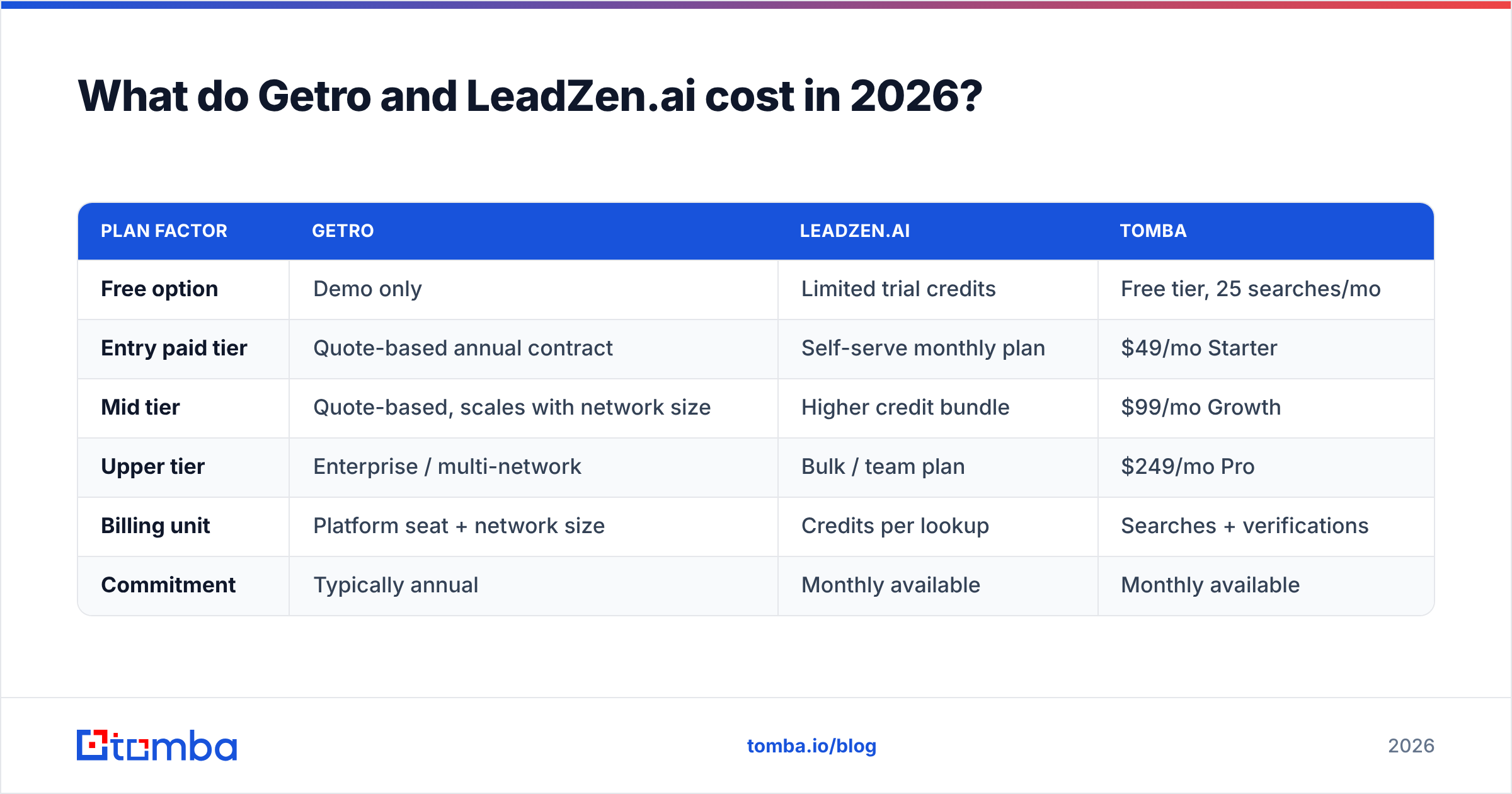
Pricing is where the two products stop being comparable. Check current numbers with each vendor before you budget. Both change tiers now and then.
| Plan factor | Getro | LeadZen.ai | Tomba |
|---|---|---|---|
| Free option | Demo only | Limited trial credits | Free tier, 25 searches/mo |
| Entry paid tier | Quote-based annual contract | Self-serve monthly plan | $49/mo Starter |
| Mid tier | Quote-based, scales with network size | Higher credit bundle | $99/mo Growth |
| Upper tier | Enterprise / multi-network | Bulk / team plan | $249/mo Pro |
| Billing unit | Platform seat + network size | Credits per lookup | Searches + verifications |
| Commitment | Typically annual | Monthly available | Monthly available |
Two takeaways. First, Getro is a platform purchase. You are buying an operating system for a community, so the cost is judged by member count and retention, not by cost per lead. Second, cost per contact is not a fair test for Getro at all. Benchmark LeadZen.ai against real email-finding tools instead. The Tomba pricing page gives you an honest anchor.
Who should choose Getro?#
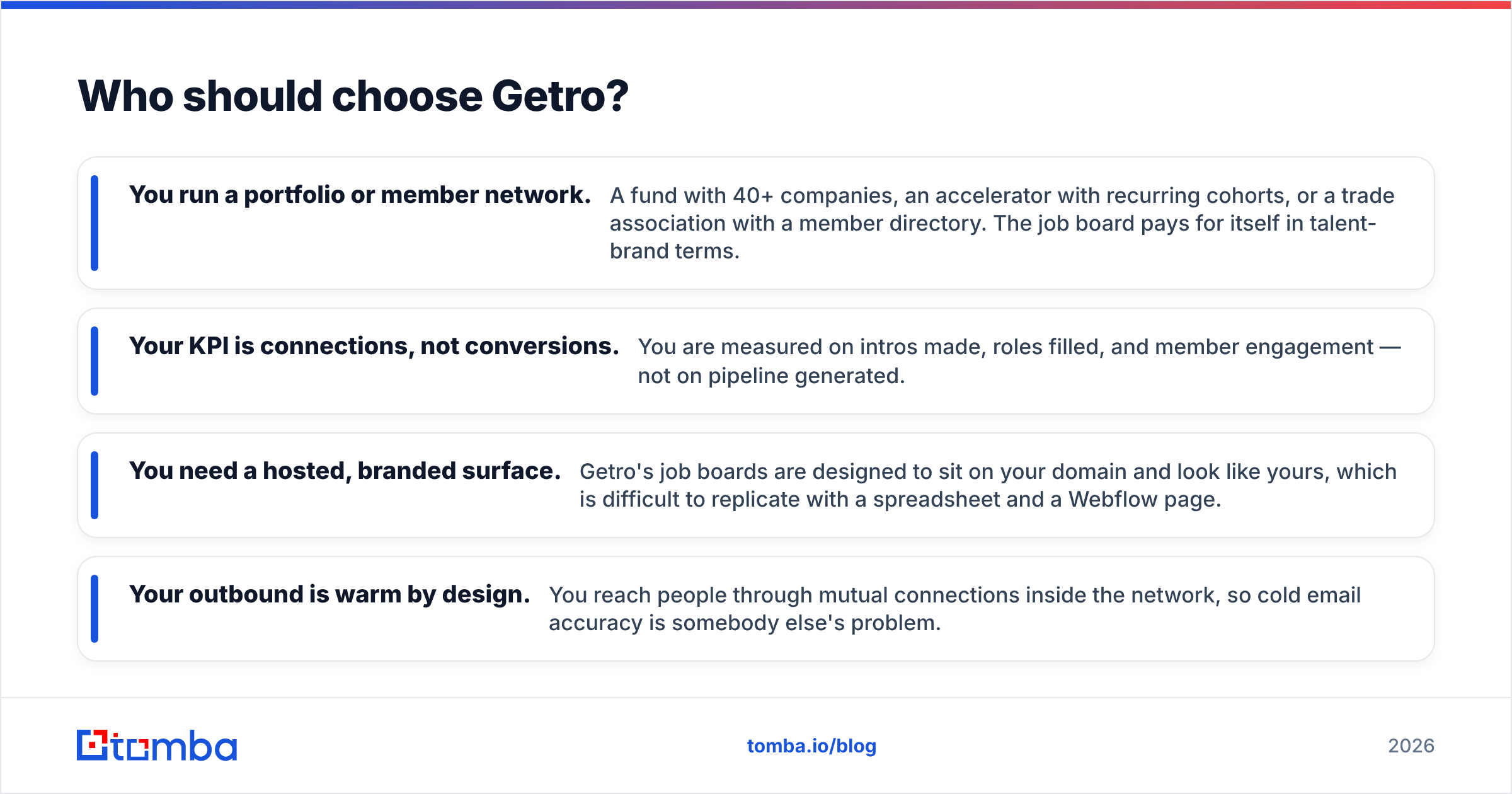
Pick Getro when these describe you:
- You run a portfolio or member network. Think a fund with 40+ companies, an accelerator with recurring cohorts, or a trade association with a member directory. The job board pays for itself in talent-brand terms.
- Your KPI is connections, not conversions. You are measured on intros made, roles filled, and member engagement. You are not measured on pipeline.
- You need a hosted, branded surface. Getro's job boards sit on your domain and look like yours. That is hard to copy with a spreadsheet and a Webflow page.
- Your outreach is warm by design. You reach people through mutual connections inside the network, so cold email accuracy is somebody else's problem.
Where Getro frustrates people: it is not a prospecting tool, and some teams buy it hoping it will double as one. It will not. There is no bulk export of decision-maker emails at random companies, and asking for one misreads the product.
Who should choose LeadZen.ai?#
Pick LeadZen.ai when:
- You need contacts outside any network you own. Cold market, no existing relationship, no warm path in.
- You want self-serve pricing. No procurement cycle and no annual commit. Card on file, start today.
- LinkedIn is your main sourcing surface. The extension workflow of browse, capture, enrich matches how most SDRs work.
- Volume matters more than certainty per record. You build lists in the thousands and you verify them downstream.
Where LeadZen.ai frustrates people: coverage gaps outside its strongest regions, plus the usual guessed-or-confirmed ambiguity that affects most databases in this tier. If your ICP is European SMBs or niche verticals, run a real trial on your own account list before you commit.

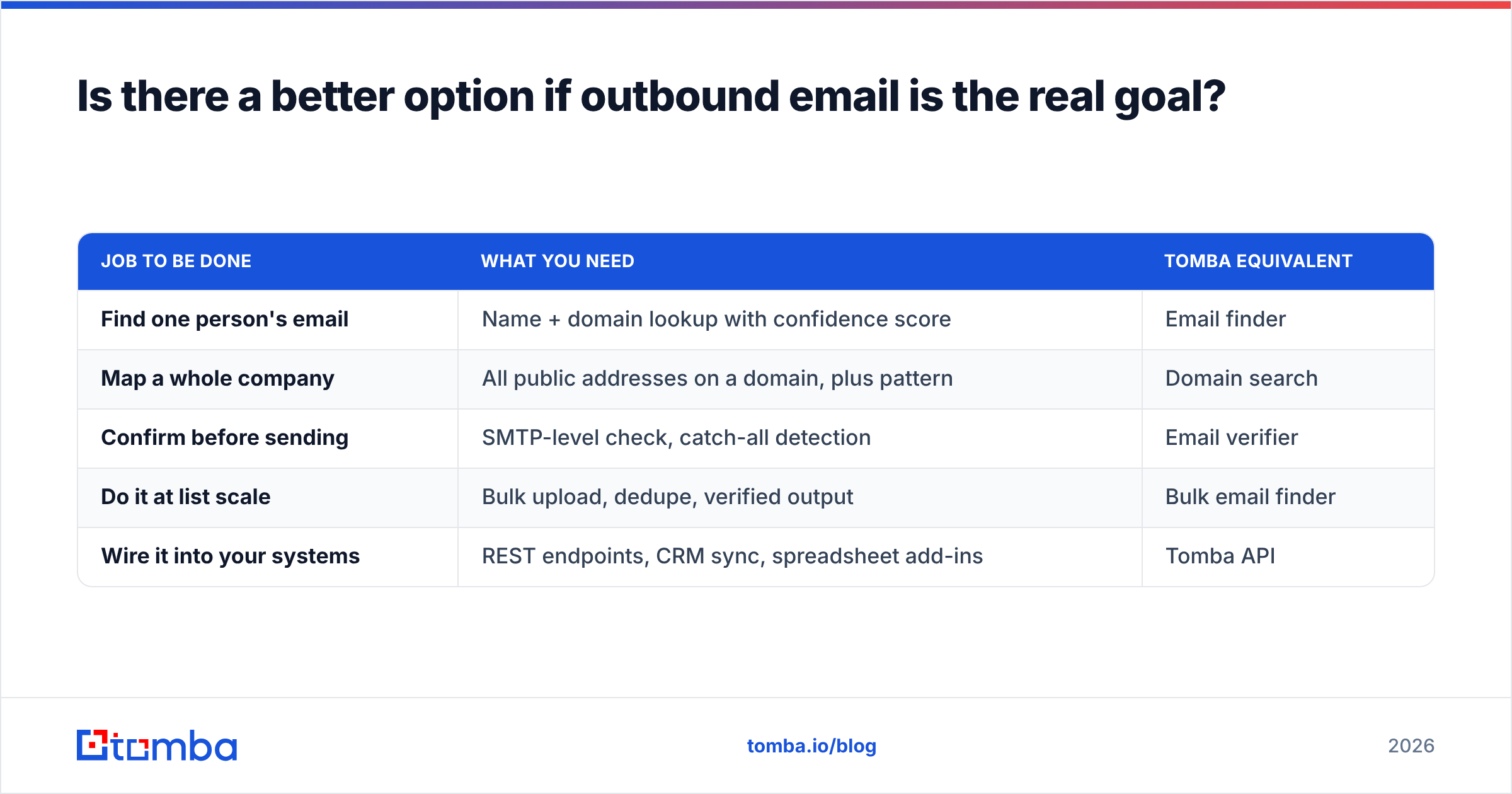
Is there a better option if outbound email is the real goal?#
Yes, and this part deserves a blunt answer. If you came to Getro vs Leadzenai because you need reliable work emails for cold outreach, neither product is built for that job. Getro is out of scope. LeadZen.ai is database-first, so verification is a side feature rather than the core engineering problem.
A purpose-built outbound stack looks like this:
| Job to be done | What you need | Tomba equivalent |
|---|---|---|
| Find one person's email | Name + domain lookup with confidence score | Email finder |
| Map a whole company | All public addresses on a domain, plus pattern | Domain search |
| Confirm before sending | SMTP-level check, catch-all detection | Email verifier |
| Do it at list scale | Bulk upload, dedupe, verified output | Bulk email finder |
| Wire it into your systems | REST endpoints, CRM sync, spreadsheet add-ins | Tomba API |
The difference is in the design. A crawl-and-store database answers one question: what did we last see for this person? A finder plus verifier answers a different one: is this address deliverable right now? For cold email, only the second question matters. Your sender reputation is scored on today's bounces, not on last quarter's data.
That is also why cost comparisons mislead. A cheap plan that returns 5,000 unverified records costs more than a $49/mo plan that returns 800 verified ones. Price in one burned domain and a two-week warmup, and the math flips.
What are the biggest limitations of each tool?#
Getro's limitations
- No cold-prospecting features at all. That is by design, not by oversight.
- Quote-based annual pricing means slow procurement and no cheap way to test.
- Value depends on network size. A 10-company portfolio will struggle to justify it.
- Reporting covers engagement and placements, not pipeline.
LeadZen.ai's limitations
- Coverage is uneven by geography and company size. Test it against your real ICP.
- Verification signals are lighter than a dedicated verification tool provides.
- Credit models make cost forecasting harder when hit rates swing by segment.
- Exports still need a cleanup pass: dedupe, role-change checks, catch-all scoring.
Neither list is disqualifying. These are the honest tradeoffs of two products doing different jobs at different price points.
Which should you pick in 2026?#
Decide with one question. Is the person you want to reach already inside a network you control?
- Yes, and you run that network → Getro. Nothing else here does what it does.
- No, and you need contact data at volume → LeadZen.ai is a reasonable self-serve start, but budget for a separate verification step.
- No, and deliverability is your bottleneck → skip the database-first route. Build on a finder plus verifier. It is cheaper, more accurate, and less cleanup.
- Both → run them side by side and stop treating them as alternatives. Getro handles talent and community. A dedicated email stack handles pipeline. They barely overlap.
The teams that get burned buy one tool and expect it to cover both jobs. A platform team that buys LeadZen.ai to improve the network gets a CSV nobody uses. An SDR team that inherits Getro access wonders why it cannot export anything. Match the tool to the actual job.
Ready to fix the outbound half of the stack?#
Maybe your real problem is that emails bounce, contacts go stale, or list building eats a day a week. Then start with the piece that governs everything downstream. The Tomba Email Finder returns work emails with a confidence score and a source trail. Verification runs in the same workflow instead of as a separate purchase. The free tier gives you 25 searches a month, so you can test it on your own account list before you spend anything. Run 50 known contacts through it, compare the hit rate to your current tool, and let the numbers decide.
Related guides#
Ready to find emails that actually work?
Join 150,000+ professionals who stopped guessing and started sending. Free credits on signup — no credit card required.
Get the Tomba newsletter
Practical outbound tactics and product updates — once every two weeks.
About the author