Getro vs Tomba (2026): Talent Network or Email Finder?
Getro builds talent networks and job boards for VC firms and communities. Tomba finds and verifies B2B email addresses. Here is where they overlap, where they don't, and which one your team should actually buy.
TL;DR
- Getro and Tomba are not competitors in the usual sense. Getro is talent-network and job-board software built mostly for VC firms, accelerators and communities. Tomba is a B2B email finder and verification platform.
- If your job is "help 80 portfolio companies fill roles from our network," Getro is the category fit. If your job is "reach 5,000 named people who have never heard of us," Getro cannot do it.
- The overlap is thin but real: both end up managing contact data about people and companies, and both get asked to "just export the emails."
- Pricing models are opposite. Getro is quote-based annual software sold to platform teams. Tomba is self-serve, from a free 25-search tier up to $249/mo Pro, with an API.
- The realistic answer for most VC platform and community teams in 2026 is both: Getro for the network layer, Tomba for the contact-discovery layer feeding it.
What is Getro, and who actually buys it?#
Getro (see getro.com) sells two things that usually get bought together: a hosted job board that syncs open roles from a portfolio or member companies, and a network/talent product that lets a firm surface candidates and connections inside that community.
The buyer is almost always a platform person — the VC operator whose job is portfolio value-add, or a community manager at an accelerator, chamber, or membership org. The success metric is placements and engagement: how many roles got filled, how many candidates got introduced, how many portfolio founders stopped emailing you asking for a head of growth.
What Getro is optimised for:
- Aggregation. Pulling live job listings from dozens or hundreds of company career pages into one branded board without manual entry.
- Network graph. Knowing who in your community knows whom, and surfacing warm paths.
- Candidate flow. Letting job seekers opt in, then matching them against roles across the portfolio.
- Brand surface. A jobs page that looks like the firm's site, not a generic applicant tracking system.
What Getro is not optimised for: finding the email address of a stranger who is not in your network and has never opted in to anything you run. That is a different data problem entirely.
What is Tomba, and what problem does it solve?#
Tomba is a B2B contact-data platform. The core product is an email finder that takes a name plus a company domain and returns the most likely professional email address, with a confidence score and the public sources behind it. Around it sit an email verifier, domain search, catch-all handling, phone lookup, and data enrichment.
The buyer is a founder, SDR, recruiter, or RevOps engineer. The success metric is deliverable, reachable contacts per dollar and per hour.
Concretely, Tomba answers questions like:
- Who works here? Give it a domain, get back the people and role titles it can see publicly.
- What is this person's work email? Given a name and a company, return the address and how confident the system is.
- Will this bounce? Syntax, MX, SMTP and catch-all checks before you ever load a list into a sequencer.
- Can I do this 10,000 times without clicking? Yes — via the Tomba API, CSV bulk jobs, or the Sheets and Excel add-ins.
Sorry — corrected placement below.

How do Getro and Tomba compare feature by feature?#
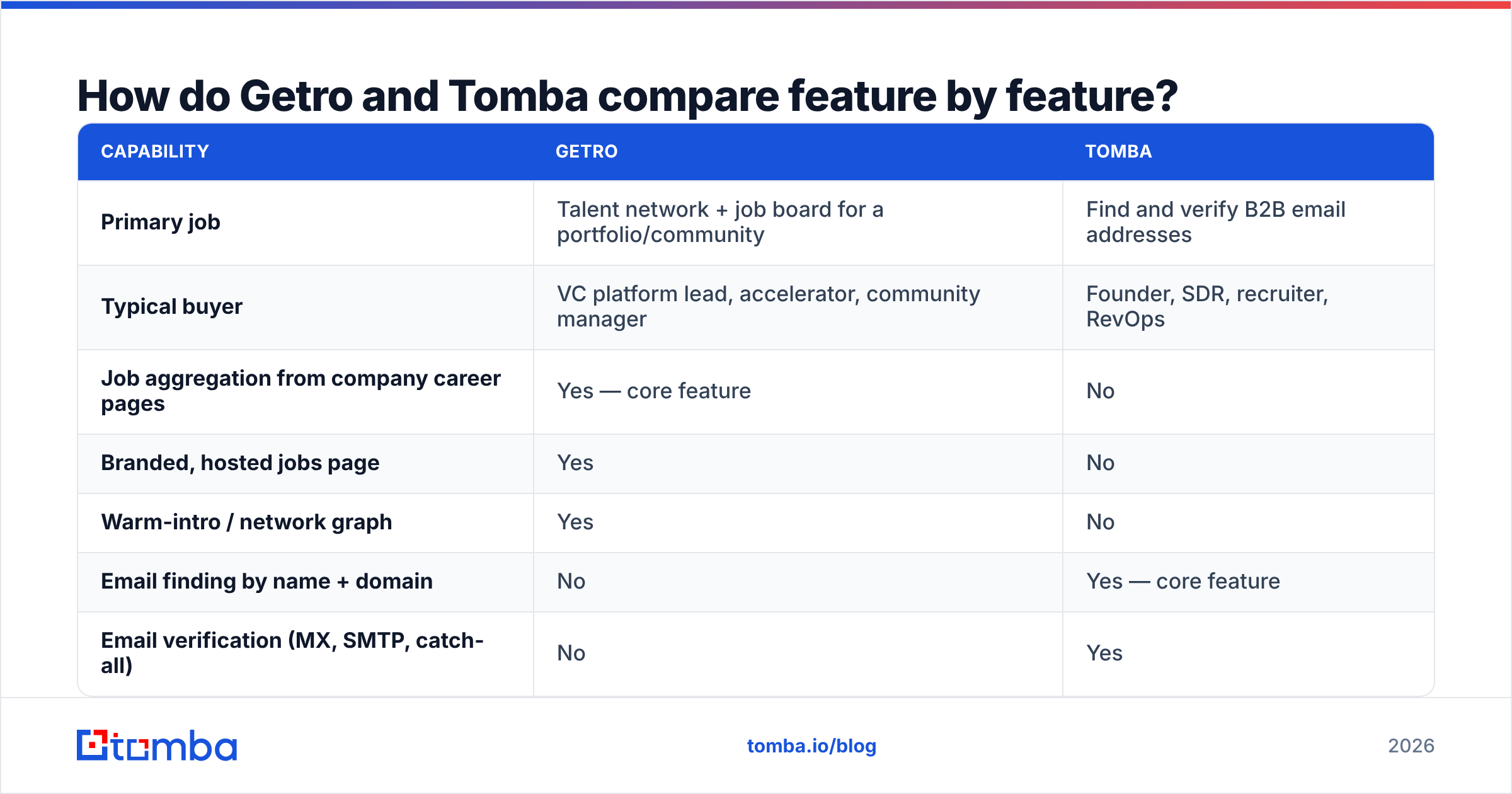
Here is the honest side-by-side. Note how few rows have a genuine head-to-head winner — that itself is the finding.
| Capability | Getro | Tomba |
|---|---|---|
| Primary job | Talent network + job board for a portfolio/community | Find and verify B2B email addresses |
| Typical buyer | VC platform lead, accelerator, community manager | Founder, SDR, recruiter, RevOps |
| Job aggregation from company career pages | Yes — core feature | No |
| Branded, hosted jobs page | Yes | No |
| Warm-intro / network graph | Yes | No |
| Email finding by name + domain | No | Yes — core feature |
| Email verification (MX, SMTP, catch-all) | No | Yes |
| Domain search ("who works at X") | No | Yes |
| Phone number lookup | No | Yes |
| Public API for programmatic lookups | Limited / integration-oriented | Yes, documented and self-serve |
| Bulk CSV enrichment | Not the use case | Yes |
| Chrome extension | Talent-network oriented | Yes, for contact capture |
| Self-serve signup | No — sales-led | Yes |
| Free tier | Demo / trial via sales | 25 searches per month |
If you were expecting a scorecard where one tool wins, this is the wrong frame. The correct question is not "which is better" but "which layer of my stack is missing."
Where do Getro and Tomba actually overlap?#
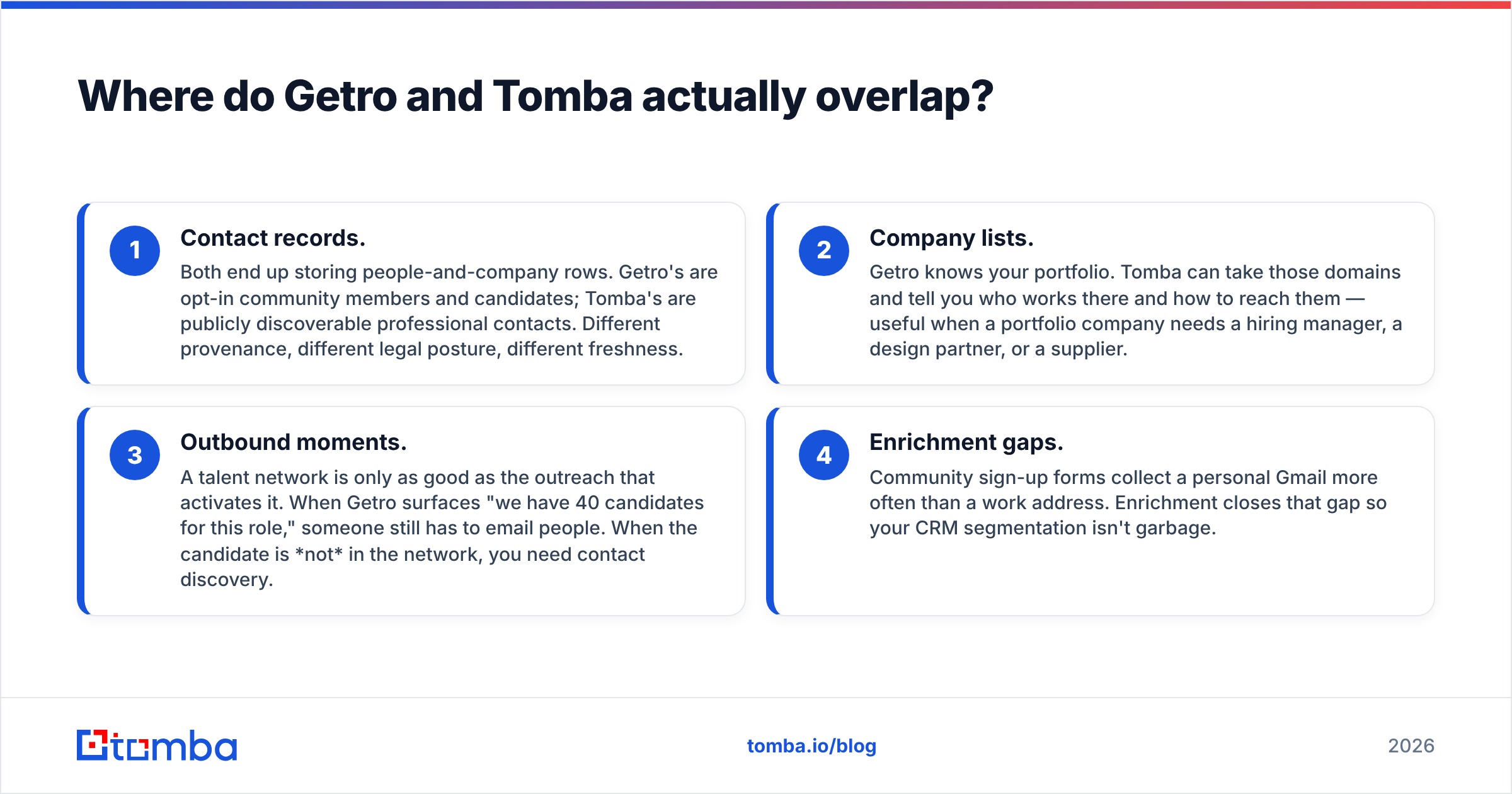
Four places, and only four:
- Contact records. Both end up storing people-and-company rows. Getro's are opt-in community members and candidates; Tomba's are publicly discoverable professional contacts. Different provenance, different legal posture, different freshness.
- Company lists. Getro knows your portfolio. Tomba can take those domains and tell you who works there and how to reach them — useful when a portfolio company needs a hiring manager, a design partner, or a supplier.
- Outbound moments. A talent network is only as good as the outreach that activates it. When Getro surfaces "we have 40 candidates for this role," someone still has to email people. When the candidate is not in the network, you need contact discovery.
- Enrichment gaps. Community sign-up forms collect a personal Gmail more often than a work address. Enrichment closes that gap so your CRM segmentation isn't garbage.
That is the whole overlap. Anyone telling you Getro replaces an email finder, or that an email finder replaces a job board, is selling something.
What does each one cost in 2026?#
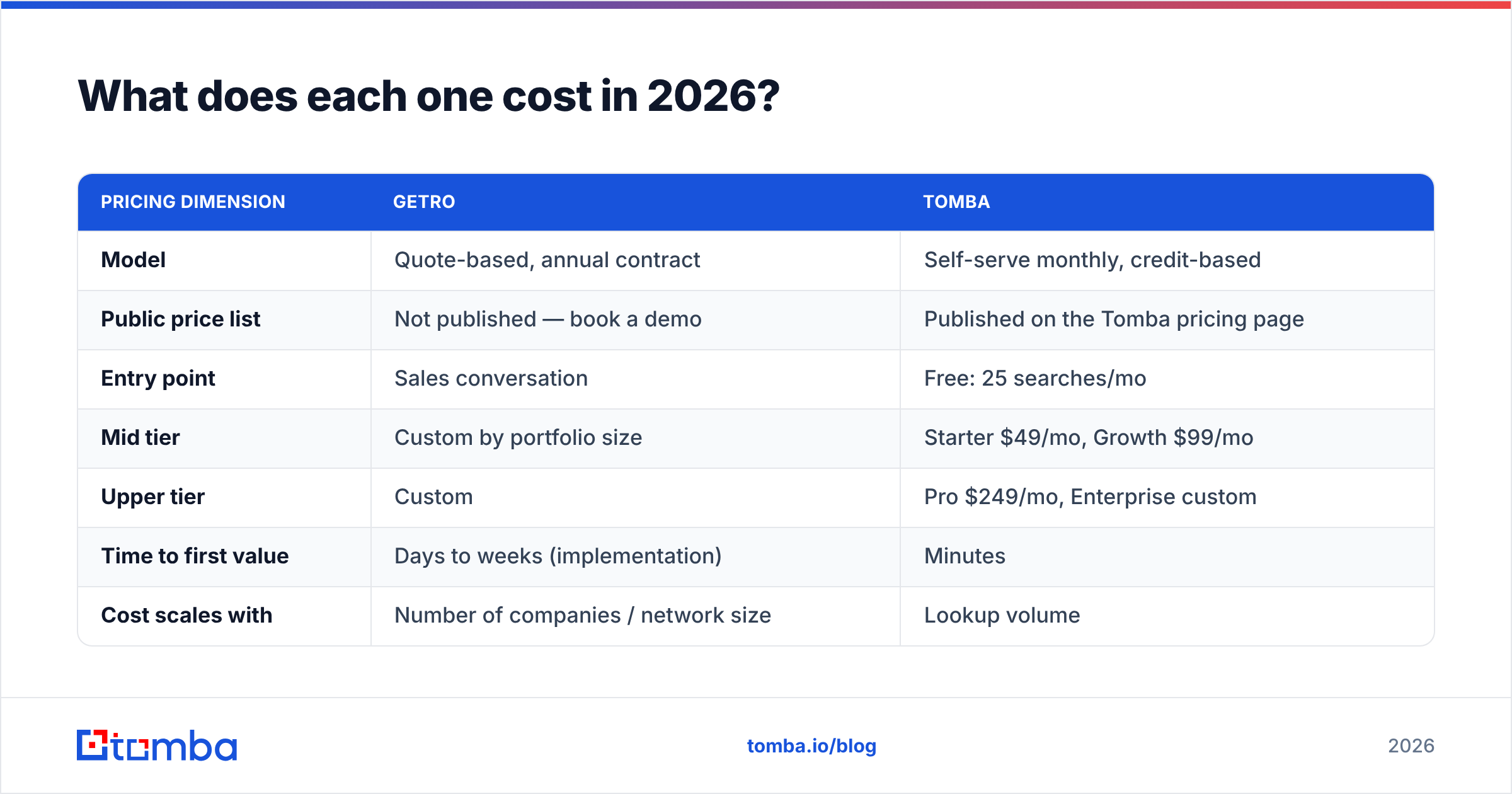
Pricing philosophies are opposite, and that matters more than the numbers.
| Pricing dimension | Getro | Tomba |
|---|---|---|
| Model | Quote-based, annual contract | Self-serve monthly, credit-based |
| Public price list | Not published — book a demo | Published on the Tomba pricing page |
| Entry point | Sales conversation | Free: 25 searches/mo |
| Mid tier | Custom by portfolio size | Starter $49/mo, Growth $99/mo |
| Upper tier | Custom | Pro $249/mo, Enterprise custom |
| Time to first value | Days to weeks (implementation) | Minutes |
| Cost scales with | Number of companies / network size | Lookup volume |
The practical read: Getro is a budget-line decision your CFO sees. Tomba is a card-swipe decision an operator makes on a Tuesday. Before committing to either, check current reviews on G2 — buyer sentiment on sales-led tools shifts faster than feature pages do.
Which one should a VC platform team choose?#
Choose Getro if your KPI is portfolio hiring and community engagement. Nothing in the email-finder category will aggregate 200 career pages, dedupe listings, and put a branded board on your domain. That's Getro's home turf and it is a genuinely hard engineering problem you should not rebuild.
Choose Tomba if your KPI is reach — sourcing candidates who never opted in, contacting LPs, filling a founder's design-partner pipeline, or building lists for a portfolio company that has no data budget yet.
Choose both if you are a platform team of one or two people who get asked for everything. This is the common case. Getro runs the always-on network; Tomba handles the ad-hoc "can you find me 50 heads of RevOps at Series B fintechs" request that lands in Slack every week.

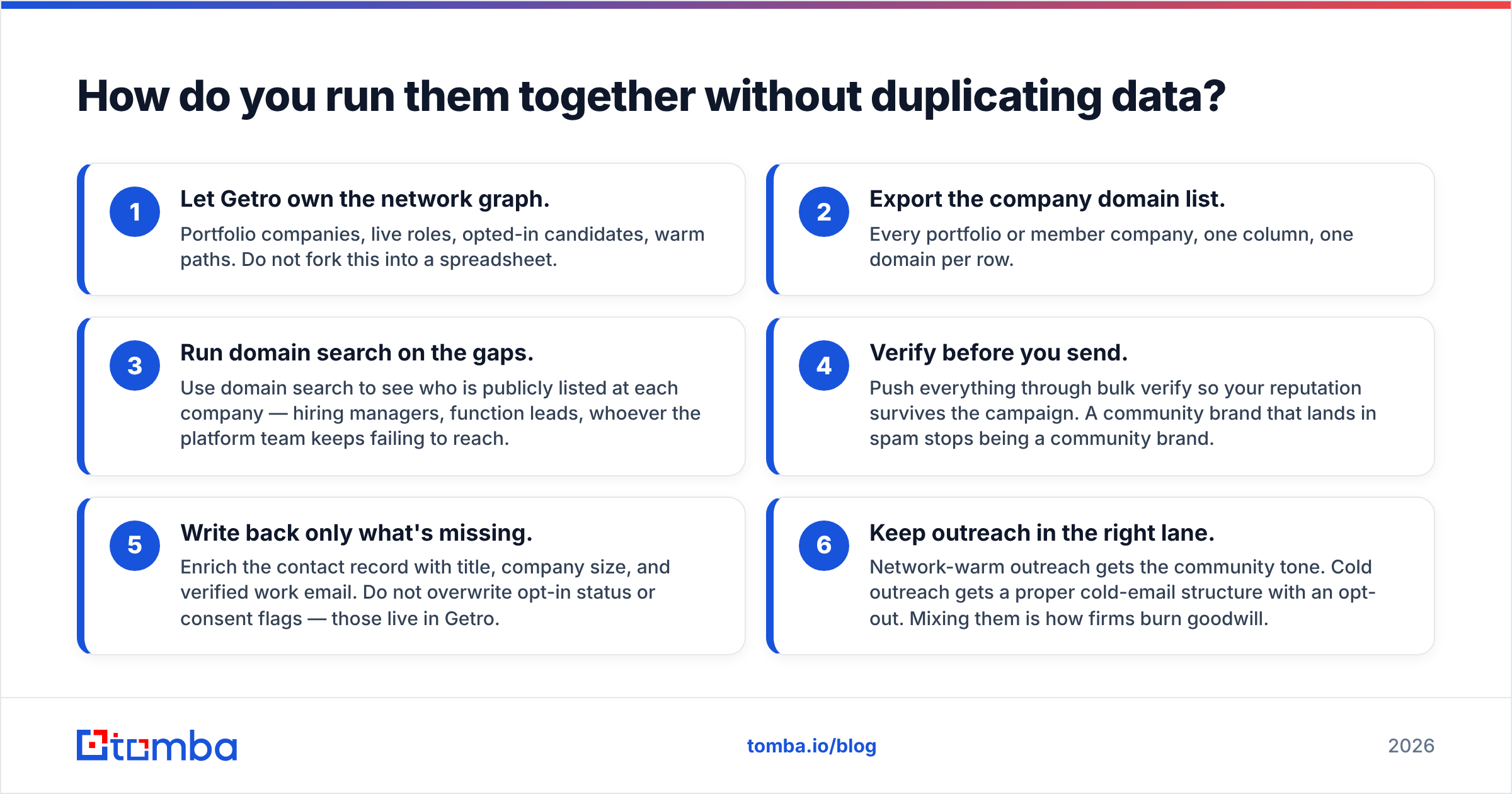
How do you run them together without duplicating data?#
A workflow that holds up in practice:
- Let Getro own the network graph. Portfolio companies, live roles, opted-in candidates, warm paths. Do not fork this into a spreadsheet.
- Export the company domain list. Every portfolio or member company, one column, one domain per row.
- Run domain search on the gaps. Use domain search to see who is publicly listed at each company — hiring managers, function leads, whoever the platform team keeps failing to reach.
- Verify before you send. Push everything through bulk verify so your reputation survives the campaign. A community brand that lands in spam stops being a community brand.
- Write back only what's missing. Enrich the contact record with title, company size, and verified work email. Do not overwrite opt-in status or consent flags — those live in Getro.
- Keep outreach in the right lane. Network-warm outreach gets the community tone. Cold outreach gets a proper cold-email structure with an opt-out. Mixing them is how firms burn goodwill.
The rule of thumb: Getro is your system of record for relationships. Tomba is your system of discovery for contacts. Never let the second silently rewrite the first.
What are the honest limitations of each?#
Getro's limitations, as a Tomba user would experience them:
- No cold contact discovery. If the person isn't in the network, the network can't help.
- Sales-led buying means you cannot pilot it on a Friday afternoon.
- Value is proportional to portfolio size. A five-company seed fund gets less from job aggregation than a 250-company platform fund.
- It is a talent product, so revenue teams will need something else regardless.
Tomba's limitations, stated plainly:
- No email finder hits 100% coverage. Small companies, privacy-heavy regions, and role-based inboxes stay hard. Anyone claiming otherwise is quoting a marketing number.
- Catch-all domains need judgement, not just a green checkmark — that's why catch-all handling is a separate step, not a boolean.
- It does not manage relationships. There is no network graph, no candidate pipeline, no job board.
- Credits are consumption-based, so a careless bulk job burns a month's allowance. Filter your list before you enrich it.
Both limitation lists are structural, not fixable by a feature request. Plan the stack around them.
What's the verdict on Getro vs Tomba?#
There isn't a single winner, and a comparison that manufactures one is lying to you.
- If someone hands you a mandate that reads "our portfolio companies can't hire fast enough and our jobs page is a Notion doc" — that's Getro.
- If the mandate reads "we need to reach 3,000 people this quarter and half our CRM rows have no working email" — that's Tomba.
- If it reads like both, buy the network layer once, annually, and add contact discovery on a monthly plan you can turn off. That sequencing keeps your options open and your finance team calm.
One last practical note: whichever way you go, test on your own data before signing anything. Pull 100 real contacts you already know are correct, run them through the tool, and measure hit rate and bounce rate yourself. Vendor-published accuracy figures — including anyone's — are measured on datasets you did not choose.
Ready to close the contact-data gap? Start with the Tomba Email Finder. The free tier gives you 25 searches a month with no card, which is enough to benchmark it against your existing list before you spend anything. If the hit rate holds up on your own data, Starter is $49/mo and the API is there when you outgrow the dashboard.
Related guides#
Ready to find emails that actually work?
Join 150,000+ professionals who stopped guessing and started sending. Free credits on signup — no credit card required.
Get the Tomba newsletter
Practical outbound tactics and product updates — once every two weeks.
About the author