Getro vs Warpleads (2026): Which One Fits Your Pipeline?
Getro and Warpleads get shortlisted together, but they answer different questions. Here is an honest breakdown of what each one actually does, what it costs, and where a dedicated email finder beats both.
TL;DR
- Getro and Warpleads are not competitors in any meaningful sense. Getro builds talent networks and job boards for VC funds, accelerators and communities. Warpleads sells bulk B2B lead exports for cold outbound.
- If your job title contains "platform," "community," or "talent," you are shopping for Getro. If it contains "SDR," "growth," or "agency," you are shopping for Warpleads.
- Pricing models are opposite: Getro is annual and quote-based with no public self-serve tier; Warpleads is self-serve monthly and leans on high-volume export limits.
- Both leave the same gap: contact-level accuracy. Bulk exports and portfolio directories give you names and companies, not deliverable inboxes.
- A realistic 2026 stack pairs one of them with a dedicated finder and verifier. Tomba starts free at 25 searches/month and $49/mo on Starter, which is cheaper than a single week of bounced sends.
What is Getro, and who actually buys it?#
Getro is a talent-network and job-board platform. Its customers are venture funds, accelerators, PE firms, alumni networks and professional communities that need to do three things: publish a live jobs board across a portfolio of companies, keep company profiles current without manual data entry, and connect vetted candidates to those companies.
The product line splits roughly into a jobs board you embed on your own site, a talent network where candidates opt in and get matched, and the connective tissue that keeps portfolio company data fresh. You can see the current packaging on Getro's site.
The buying trigger is almost always the same: a fund's platform lead is tired of maintaining a jobs page in a spreadsheet, and portfolio founders keep asking for hiring support. Getro solves that. It is a network-operations tool with a hiring surface, not a prospecting database.
What Getro is explicitly not: a cold-outbound tool. There is no "export 50,000 CFOs in fintech" button, because that is not the job it was built for. Candidates in a Getro talent network opted in. Using that data for unrelated cold sales outreach would be both a product mismatch and a bad idea from a compliance standpoint.
What is Warpleads, and how is it different?#
Warpleads sits on the other end of the spectrum. It is a B2B lead-generation platform built around volume: search a large prospect database by role, industry, geography and company size, then export the results into your sequencer.
Its main marketing hook is export volume. Where legacy sales-intelligence vendors meter every credit and cap monthly exports hard, Warpleads pitches high or unlimited export ceilings on its upper tiers, plus an on-demand path when you need leads sourced against a specific brief. Verification is bundled rather than sold as a separate SKU.
That positioning attracts a specific buyer: lead-gen agencies, outbound-heavy startups, and anyone running multi-inbox cold email at scale who has been burned by per-credit pricing. If you send 30,000 emails a month, credit math dominates your tooling decision, and Warpleads is designed to win that math.
The tradeoff is the one every volume-first database makes. Wide coverage and generous export limits usually mean you inherit more stale and unverified records than a precision tool would hand you. That is not a scandal, it is physics. Databases are snapshots, and roughly a quarter to a third of B2B contact data decays every year as people change jobs.

Why do people compare Getro vs Warpleads at all?#
Three reasons, and none of them are "these tools overlap."
1. Both surface company + people data. At a squint, a portfolio directory and a prospect database look similar: rows of companies, rows of humans, contact details attached. The similarity ends the moment you ask what the data is for.
2. Both get pitched to early-stage teams. A seed-stage founder inside an accelerator has Getro in their ecosystem by default and is simultaneously evaluating outbound tools. The two names land in the same browser tab.
3. Search engines conflated them. "Getro vs Warpleads" exists as a query largely because both rank for adjacent lead-generation terms, not because a buyer genuinely chose between them.
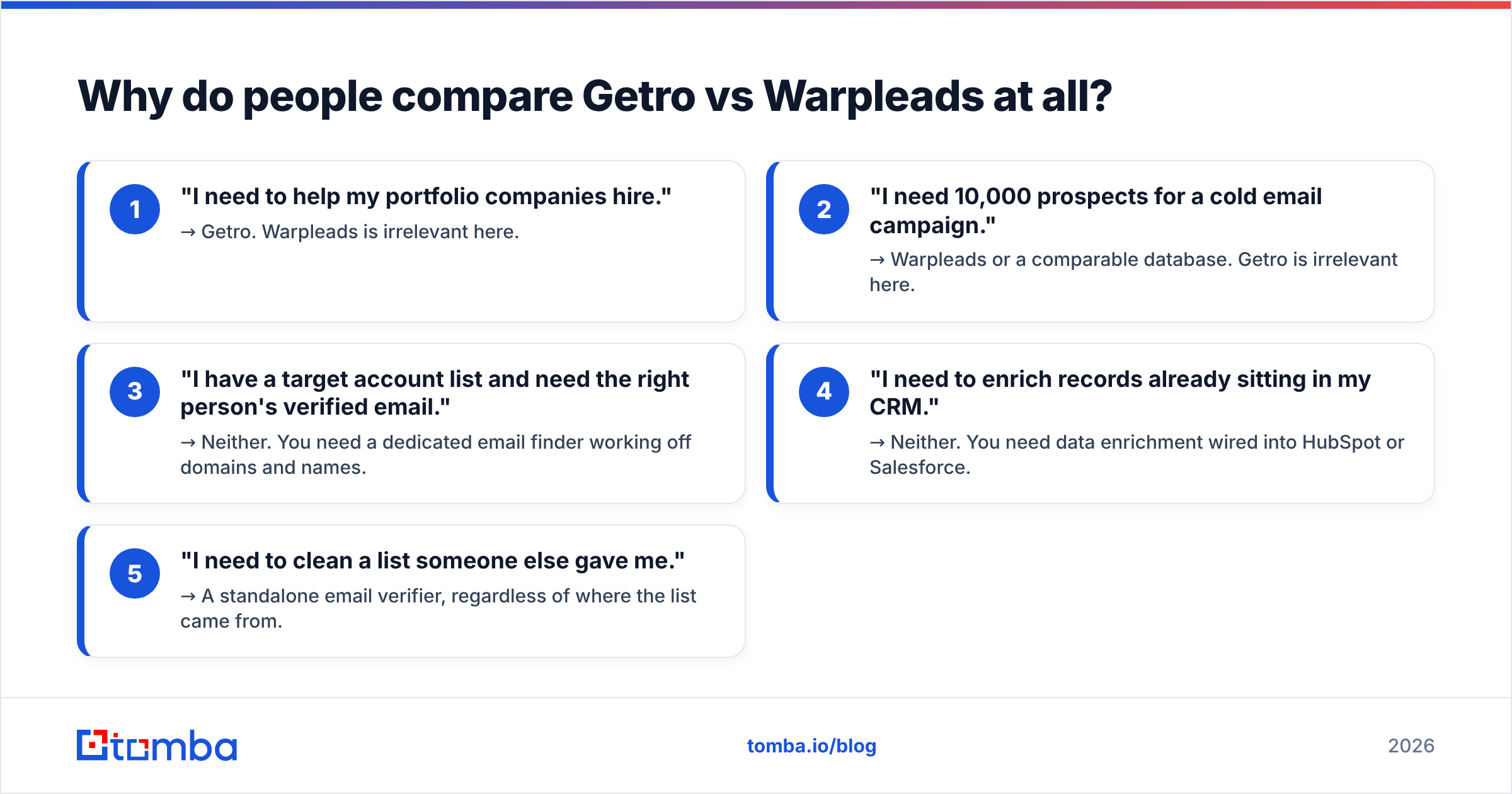
If you are running this comparison seriously, the honest first step is to name the job:
- "I need to help my portfolio companies hire." → Getro. Warpleads is irrelevant here.
- "I need 10,000 prospects for a cold email campaign." → Warpleads or a comparable database. Getro is irrelevant here.
- "I have a target account list and need the right person's verified email." → Neither. You need a dedicated email finder working off domains and names.
- "I need to enrich records already sitting in my CRM." → Neither. You need data enrichment wired into HubSpot or Salesforce.
- "I need to clean a list someone else gave me." → A standalone email verifier, regardless of where the list came from.
How do Getro and Warpleads compare side by side?#
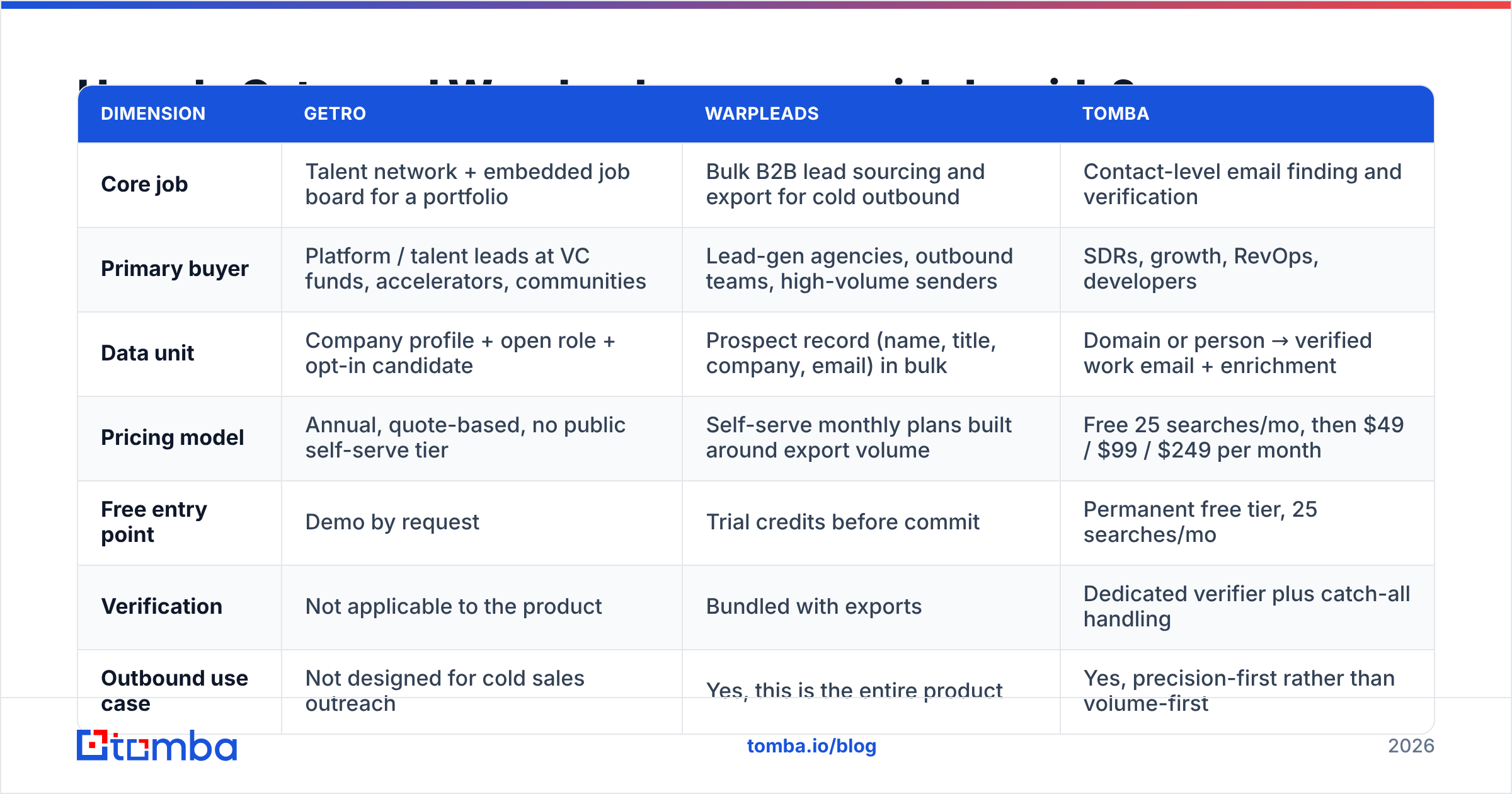
| Dimension | Getro | Warpleads | Tomba |
|---|---|---|---|
| Core job | Talent network + embedded job board for a portfolio | Bulk B2B lead sourcing and export for cold outbound | Contact-level email finding and verification |
| Primary buyer | Platform / talent leads at VC funds, accelerators, communities | Lead-gen agencies, outbound teams, high-volume senders | SDRs, growth, RevOps, developers |
| Data unit | Company profile + open role + opt-in candidate | Prospect record (name, title, company, email) in bulk | Domain or person → verified work email + enrichment |
| Pricing model | Annual, quote-based, no public self-serve tier | Self-serve monthly plans built around export volume | Free 25 searches/mo, then $49 / $99 / $249 per month |
| Free entry point | Demo by request | Trial credits before commit | Permanent free tier, 25 searches/mo |
| Verification | Not applicable to the product | Bundled with exports | Dedicated verifier plus catch-all handling |
| Outbound use case | Not designed for cold sales outreach | Yes, this is the entire product | Yes, precision-first rather than volume-first |
| Developer surface | Job/network embeds and integrations | Export-oriented workflow | REST API, CLI, MCP, Sheets and Excel add-ins |
| Contract friction | Highest (annual, sales-led) | Low (monthly, self-serve) | Lowest (free tier, monthly, cancel anytime) |
Read that table as a routing decision, not a scoreboard. Getro "loses" on outbound because it never entered that race, and Warpleads "loses" on talent networks for the same reason.
Which one gives you better data quality?#
For their respective jobs, both are defensible. The question that actually matters is what happens to your bounce rate when the data hits a sending inbox, and that only applies to Warpleads-style exports.
Here is how to audit any bulk provider before you commit budget:
- Sample before you subscribe. Pull 200 rows from a segment you know well. If you can spot five wrong titles by eye, the rest of the file is worse than the marketing page implies.
- Check the recency signal, not the record count. "500M contacts" is a vanity number. Ask when each record was last verified and whether that timestamp is exposed per row.
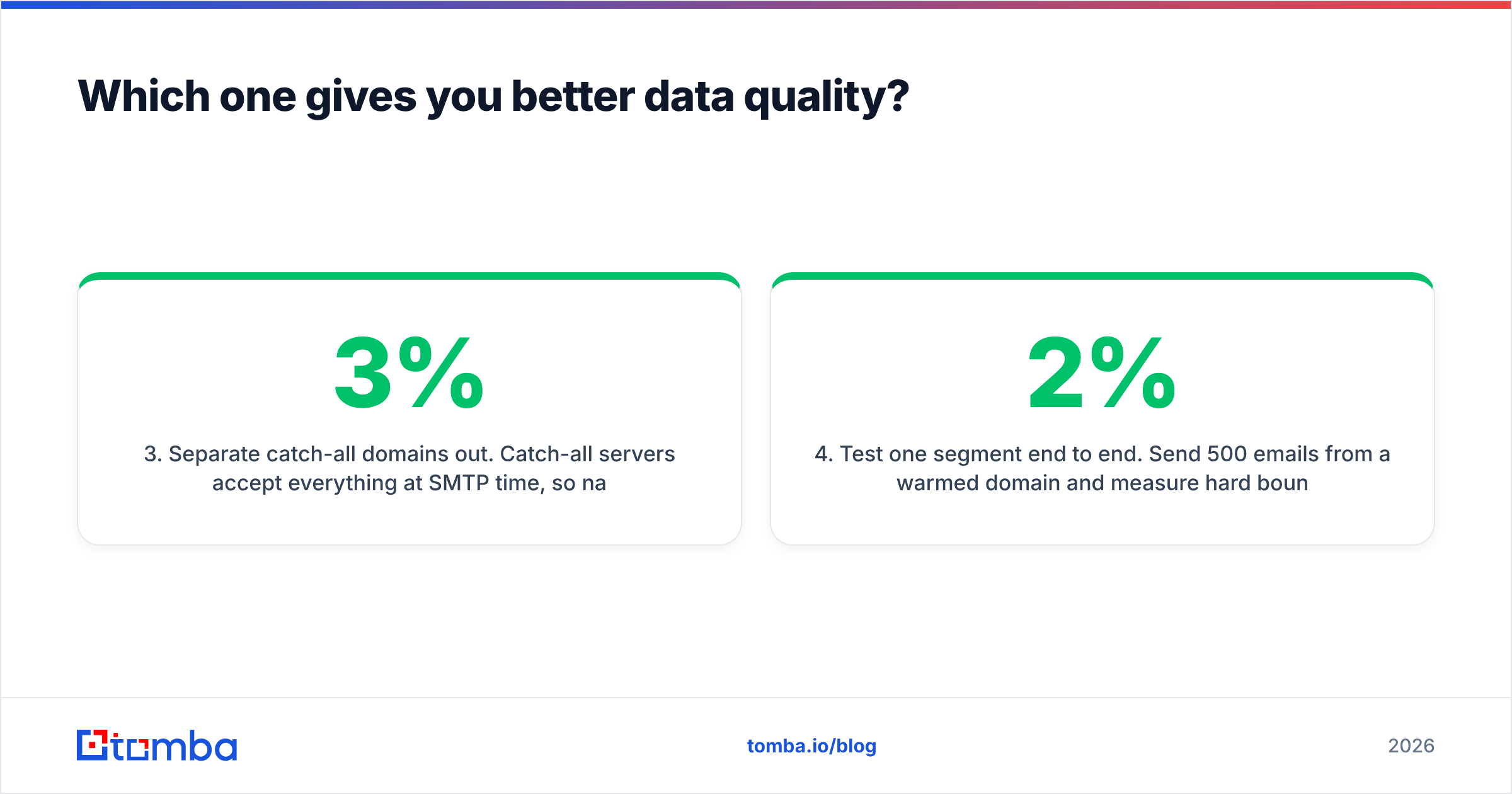
- Separate catch-all domains out. Catch-all servers accept everything at SMTP time, so naive verifiers mark them valid. A catch-all verifier that scores them properly is the difference between a 3% and a 20% bounce rate on enterprise domains.
- Test one segment end to end. Send 500 emails from a warmed domain and measure hard bounces. Under 2% is healthy, 2 to 5% is a warning, above 5% will damage your sender reputation fast.
- Re-verify at send time, not at export time. A record verified in January is a liability in June. Re-run the list through a verifier the week you send, every time.
- Deduplicate across sources. If you run two providers, overlapping rows will double-touch the same person and torch reply rates.
That checklist is provider-agnostic. Run it on Warpleads, run it on any competitor, run it on the CSV your last agency handed you. Real buyer feedback on the sales intelligence category on G2 is useful for narrowing a shortlist, but nothing replaces testing your own segment.
Who should buy Getro?#
Buy Getro if all of these are true:
- You manage a portfolio, cohort, or community of 15+ companies.
- Those companies hire regularly and you are expected to help.
- You want a jobs board that lives on your domain and updates itself.
- You are comfortable with an annual, sales-led contract.
Skip Getro if you are a single company doing cold outbound. There is no version of this product that fills your pipeline with prospects. The overlap you imagined does not exist.
The one caveat worth budgeting for: quote-based annual pricing means you cannot try before you commit in the way a $49 self-serve tool lets you. Get the number in writing, get the seat and company-count limits in writing, and ask what happens when your portfolio grows 40% mid-term.

Who should buy Warpleads?#
Buy Warpleads if all of these are true:
- Cold email is a primary channel, not an experiment.
- You send enough volume that per-credit pricing genuinely hurts.
- Your ICP is broad enough that database filters can express it.
- You have a verification and warmup process already running.
Skip Warpleads if your target list is 300 named accounts. At that scale, export volume is worthless and precision is everything. Paying for unlimited exports to use 300 of them is the tooling equivalent of buying a bulk pallet for one recipe.
Also skip it if you have no deliverability hygiene. Feeding a large unverified export into a cold domain is the fastest way to end up on a blacklist. Run a blacklist checker and confirm your SPF, DKIM and DMARC records before volume, not after.
What do both tools leave you to solve?#
Contact accuracy at the moment of send. This is where the "Getro vs Warpleads" framing quietly falls apart, because whichever you pick, the last mile is unsolved.
With Getro, you have a portfolio of companies but no systematic way to find the right operator's email at a target account outside that network. With Warpleads, you have a large file whose accuracy decays from the day it was exported.
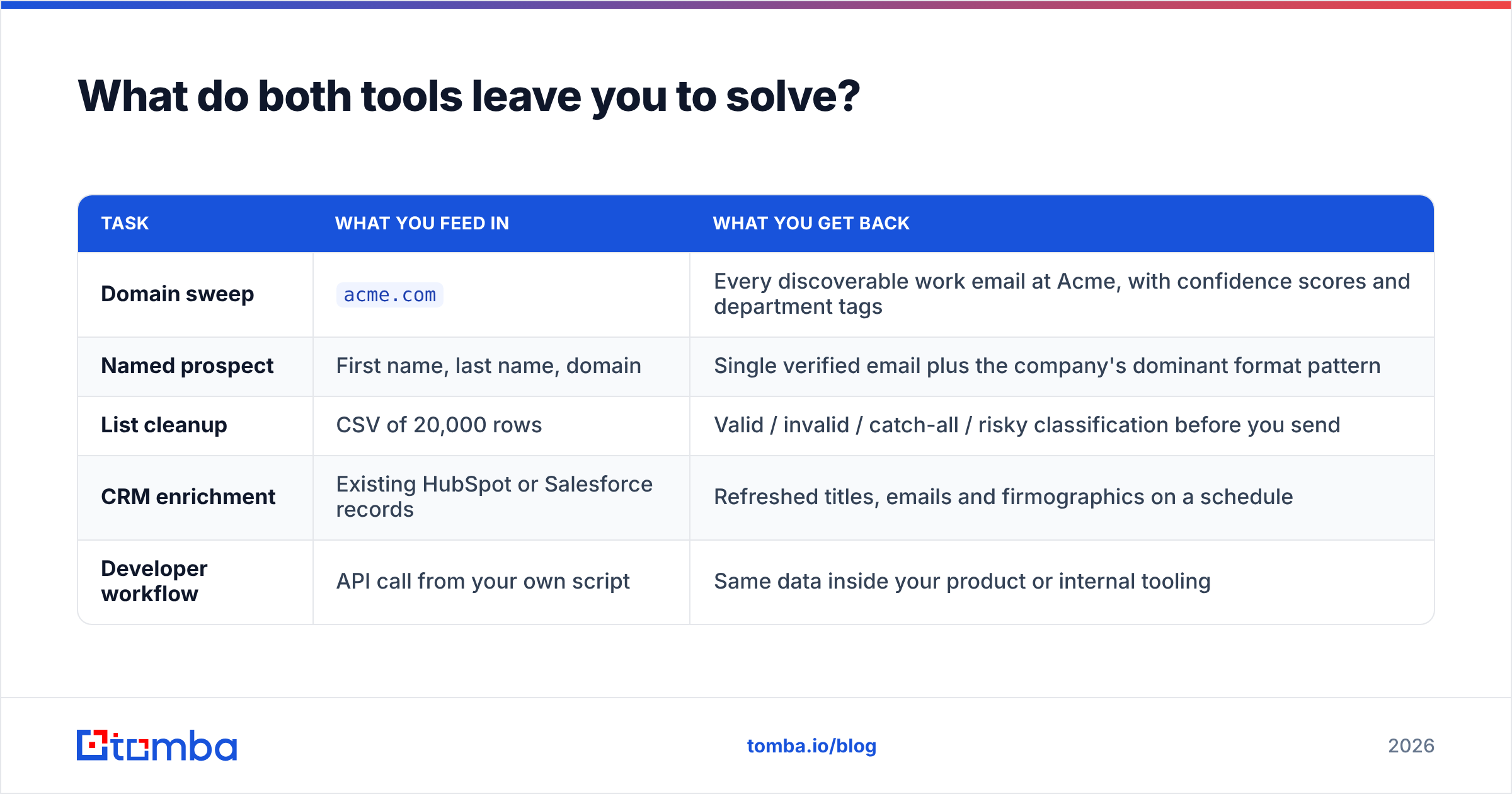
A dedicated finder-and-verifier layer closes both gaps:
| Task | What you feed in | What you get back |
|---|---|---|
| Domain sweep | acme.com |
Every discoverable work email at Acme, with confidence scores and department tags |
| Named prospect | First name, last name, domain | Single verified email plus the company's dominant format pattern |
| List cleanup | CSV of 20,000 rows | Valid / invalid / catch-all / risky classification before you send |
| CRM enrichment | Existing HubSpot or Salesforce records | Refreshed titles, emails and firmographics on a schedule |
| Developer workflow | API call from your own script | Same data inside your product or internal tooling |
For teams that want a starting universe of contacts alongside that precision layer, pay-as-you-go providers like BookYourData are a reasonable complement, since you buy a defined list rather than committing to a monthly export ceiling. The pattern that works is the same regardless: source broadly, then verify narrowly and immediately before send.
What does a sane 2026 stack look like?#
For a fund or accelerator:
- Getro for the talent network and jobs board.
- A CRM for LP and founder relationships.
- Domain search for finding the right contact when you are doing business development outside your network.
For an outbound team:
- One volume database (Warpleads or a peer) for top-of-funnel breadth.
- A finder and verifier for precision on named accounts and for cleaning every export before it enters a sequence.
- A sequencer with proper warmup and inbox rotation.
- A bulk email finder step in between the database and the sequencer, so nothing unverified ever reaches a send.
The mistake teams make is treating the database as the whole stack. The database is the raw ingredient. Verification is the step that decides whether you have a campaign or an incident.
Verdict: Getro or Warpleads?#
There is no head-to-head winner because there is no head-to-head. Pick Getro if you operate a network and need portfolio hiring infrastructure. Pick Warpleads if you run high-volume cold email and export limits are your bottleneck. If you found this comparison because you needed verified contact data for a specific list of accounts, neither is the answer, and buying either one will not fix it.
What will fix it is a purpose-built email layer. Tomba's Email Finder turns a domain or a name into a verified work email, scores catch-all domains properly instead of guessing, and ships with an API, a CLI, a Chrome extension and Sheets and Excel add-ins so it fits whatever workflow you already have. The free tier gives you 25 searches a month to test your own segment, and paid plans start at $49/mo with full Tomba pricing published up front, no annual contract required. Test it against 200 rows of your current list and let the bounce rate decide.
Related guides#
Ready to find emails that actually work?
Join 150,000+ professionals who stopped guessing and started sending. Free credits on signup — no credit card required.
Get the Tomba newsletter
Practical outbound tactics and product updates — once every two weeks.
About the author