Getro vs ZoomInfo (2026): Which Data Stack Actually Fits?
Getro builds talent networks for VC portfolios. ZoomInfo sells B2B contact data at enterprise prices. Here's where they overlap, where they don't, and the cheaper path if all you need is verified emails.
Getro vs ZoomInfo is not a fair fight. Getro runs talent networks. ZoomInfo sells contact data. Here is where the two overlap, and what to buy if you just need work emails.
TL;DR
- Getro vs ZoomInfo is a category mix-up. Getro builds job boards and talent networks for VC firms, accelerators, and communities. ZoomInfo sells B2B contact data to sales teams.
- They overlap on one thing. Both hold records about companies and people. The buyer, the workflow, and the price tag are all different.
- Getro is quote-based. Most venture platform teams pay a few hundred to a few thousand dollars a month.
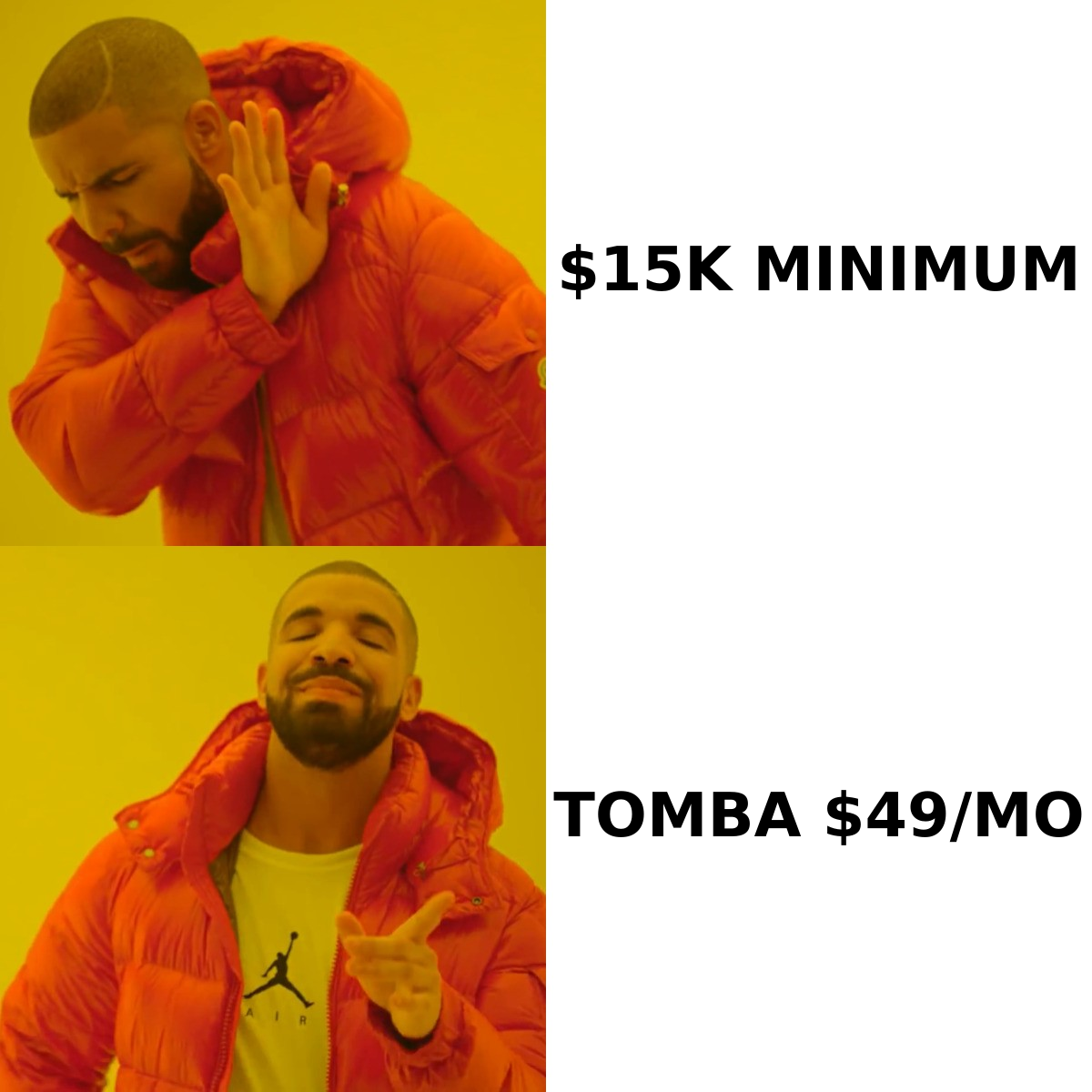
- ZoomInfo is quote-based too, but annual. Entry deals often start above $15,000 a year once seats and credits stack up.
- Need verified work emails for a list of companies? Neither tool is the smart buy. A focused email finder does that job for far less.
- Pick Getro if you run a network. Pick ZoomInfo if you run big outbound. Pick a finder if you just need emails that land.
What are Getro and ZoomInfo, actually?#
The Getro vs ZoomInfo debate only makes sense once you spot the word trap. Both camps say "network." Each one means something else by it.
Getro serves venture capital firms, accelerators, and member communities. It has two core products. The first is a job board. It pulls open roles from every company in your portfolio. The second is a talent network. Member companies search one shared pool of candidates. The buyer is a platform director or head of talent at a fund. Success means placements, not pipeline.
ZoomInfo is a B2B data platform for sales teams. It sells access to a huge database of companies and business contacts. Extras sit on top: intent signals, website visitor tracking, call analysis, and email sequences. The buyer is a VP of Sales or a RevOps lead. Success means new pipeline.
People who search "getro vs zoominfo" tend to fall into three groups:
- A VC platform team. They already run Getro, and a rep is pitching them ZoomInfo for the whole portfolio.
- A RevOps lead. They inherited both tools and want to cut one at renewal.
- Someone who just needs contact data. Both tools showed up in the same search. Only one of them is a contact database.
In group three? Skip to the pricing and alternatives below. You are about to overpay for the wrong category.
Getro vs ZoomInfo: how do they compare head to head?#
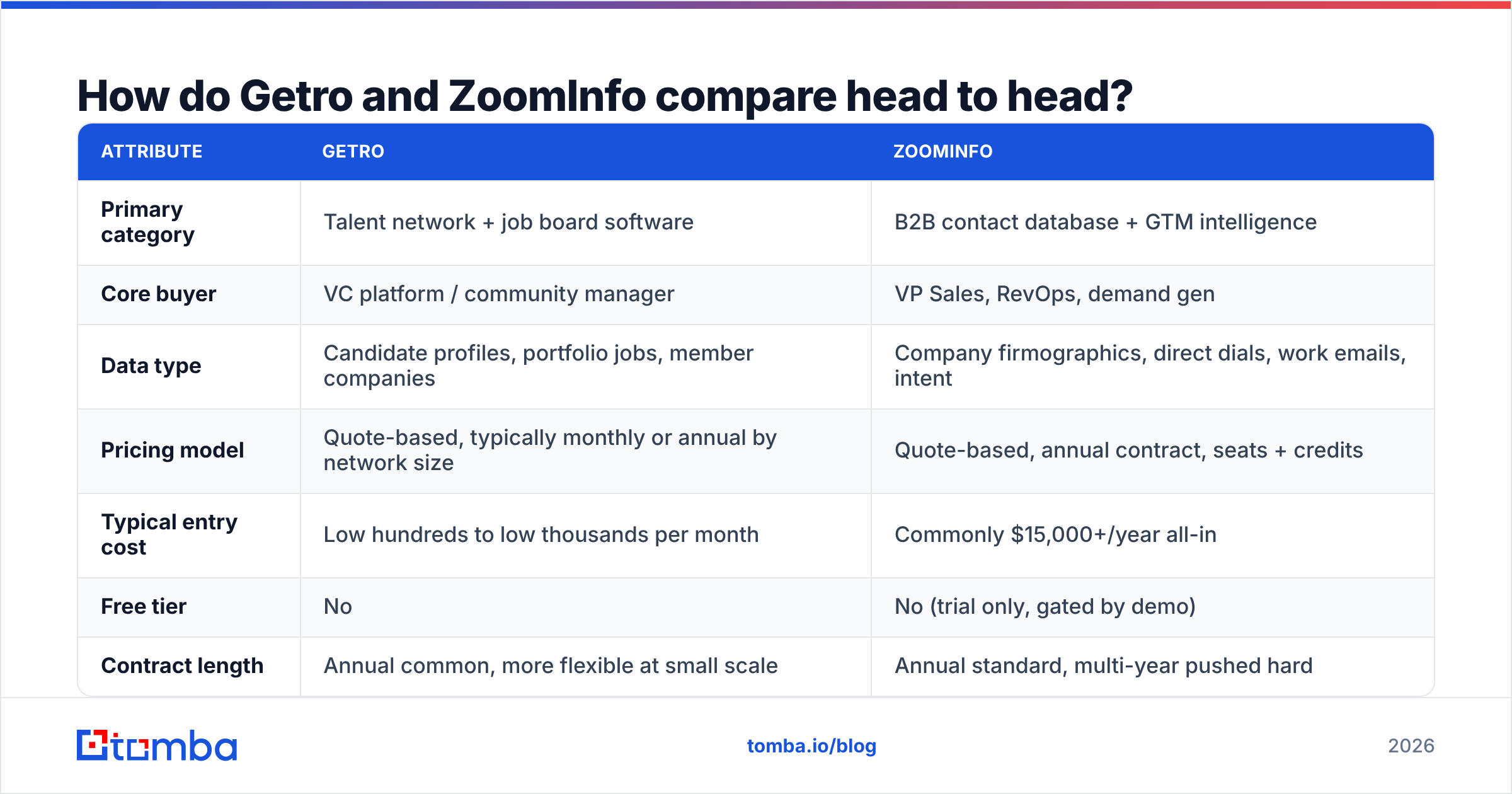
| Attribute | Getro | ZoomInfo |
|---|---|---|
| Primary category | Talent network + job board software | B2B contact database + GTM intelligence |
| Core buyer | VC platform / community manager | VP Sales, RevOps, demand gen |
| Data type | Candidate profiles, portfolio jobs, member companies | Company firmographics, direct dials, work emails, intent |
| Pricing model | Quote-based, typically monthly or annual by network size | Quote-based, annual contract, seats + credits |
| Typical entry cost | Low hundreds to low thousands per month | Commonly $15,000+/year all-in |
| Free tier | No | No (trial only, gated by demo) |
| Contract length | Annual common, more flexible at small scale | Annual standard, multi-year pushed hard |
| Email discovery | Not the product | Yes, core feature |
| Phone / direct dials | No | Yes |
| Intent data | No | Yes (a headline feature) |
| CRM sync | Limited, mostly ATS/job-board oriented | Deep Salesforce, HubSpot, Dynamics sync |
| API access | Available on higher tiers | Available, usually priced separately |
| Best at | Making a portfolio network searchable and useful | Enterprise outbound at volume |
The table makes the verdict clear. Getro vs ZoomInfo has no winner, because it is not a real fight. A fund that drops Getro for ZoomInfo loses its job board. A sales team that drops ZoomInfo for Getro loses its whole prospecting motion.
The better question is simpler. Is either tool the right spend for your job?

What does Getro cost in 2026?#
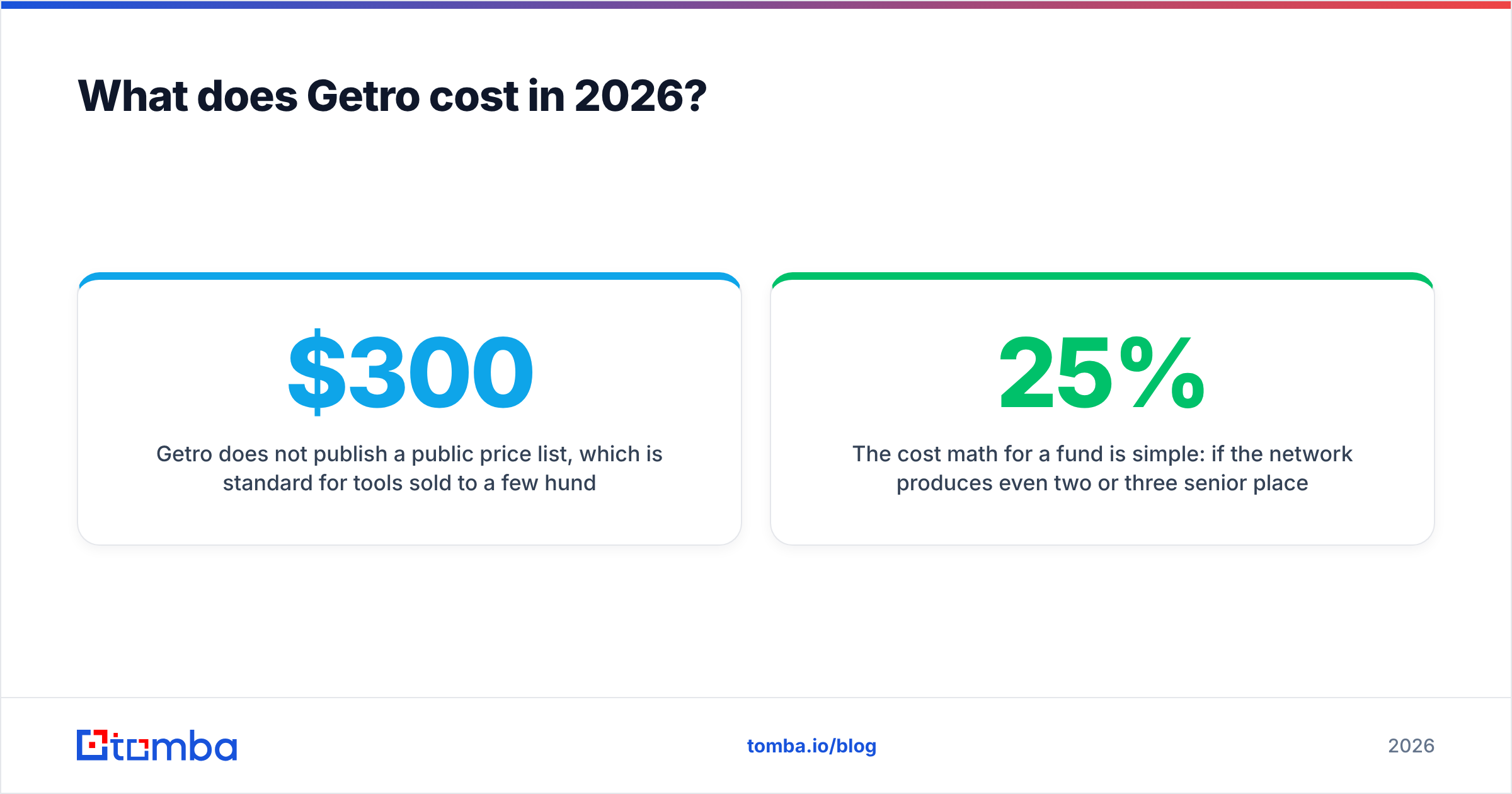
Getro does not publish prices. That is normal for a tool sold to a few hundred funds. Public deal chatter and vendor listings on G2 point to a range. Most venture platform teams pay between $300 and $2,000 a month. Two things move that number. One is how many companies sit in your network. The other is whether you add the talent module on top of the job board.
Here is what you get:
- A hosted job board. It pulls open roles from every portfolio company on its own. No more chasing founders for spreadsheets.
- A talent network. Candidates opt in once. Every portfolio company can then search them.
- Intro and matching workflows. Your platform team can play matchmaker at scale.
- Basic reporting. Track placements, board traffic, and company sign-ups.
The math is easy for a fund. Say the network lands two or three senior hires a year. A recruiter would charge 20–25% of first-year salary for each one. The tool pays for itself many times over.
What does ZoomInfo cost in 2026?#
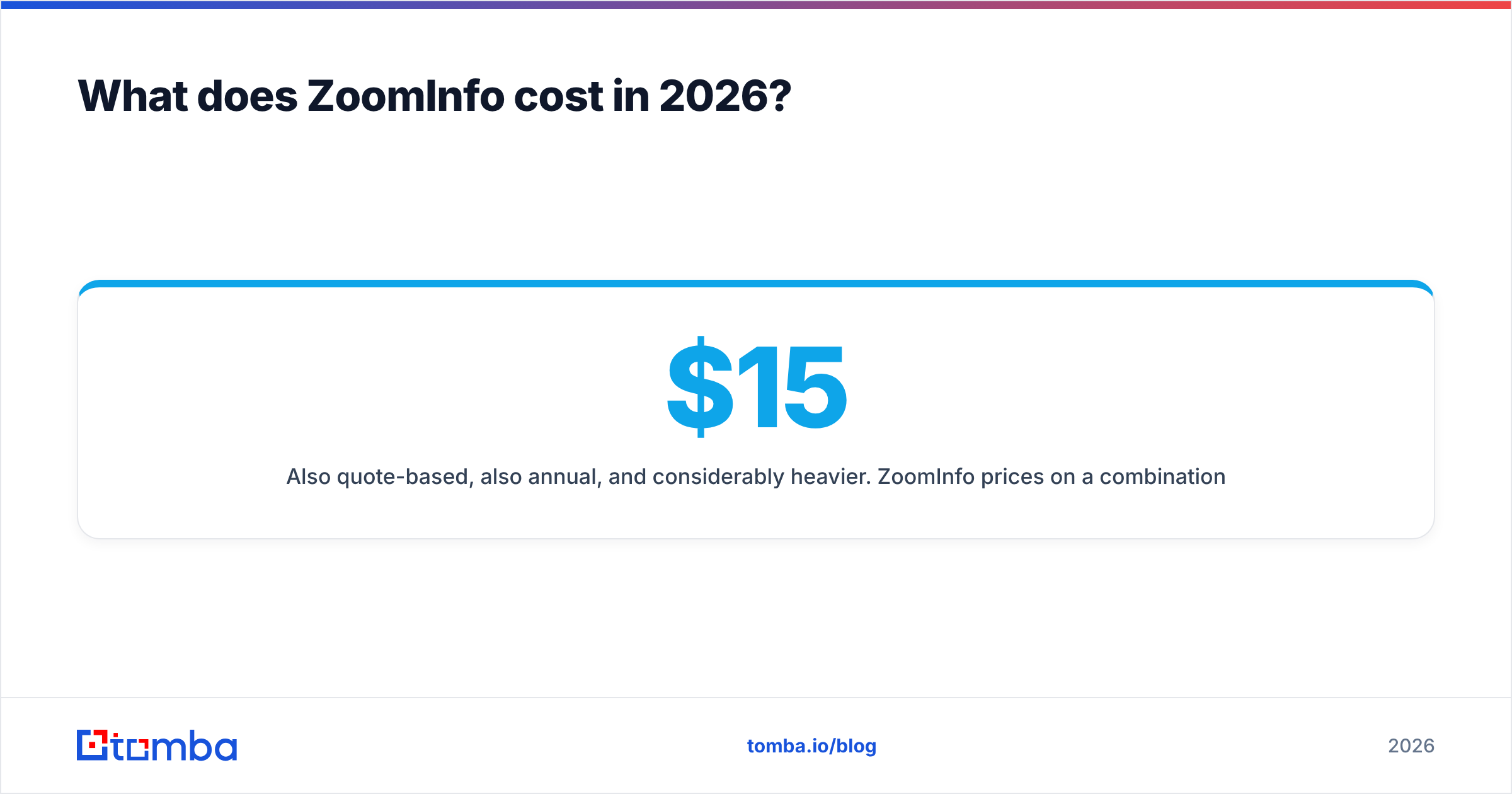
Also quote-based, also annual, and much heavier. ZoomInfo prices on seats, credits, and modules. Buyer reviews put entry packages near $15,000 a year. Mid-market deals land in the $25,000–$50,000 range. Large contracts pass six figures once Copilot, intent, and call analysis are bolted on.
Five things tend to surprise buyers at renewal:
- Credits run out mid-year. Teams burn export credits faster than they plan. Top-ups cost more per record than the first bundle.
- Seat minimums. You often cannot buy just three seats. Packages push you to a floor.
- Split modules. Intent, visitor tracking, and call analysis are often separate line items.
- Auto-renewal. Multi-year deals with yearly price bumps are common. The window to cancel is short and easy to miss.
- API fees. Code access rarely comes with the standard seat.
None of this makes ZoomInfo a bad product. Its phone coverage is strong. Its intent layer is genuinely useful. For a 40-rep sales team, the math can work. It does make ZoomInfo a big, rigid buy. Rigid gets expensive when your need is narrow.
Is Getro a ZoomInfo alternative?#
No. Be wary of any list that says it is.
Getro's data is candidate-shaped. These are people who joined a talent network because they want a startup job in one fund's portfolio. That is great for hiring. It is useless for selling software to a CFO in manufacturing.
ZoomInfo's data is buyer-shaped: job titles, teams, org charts, direct dials, and tech signals. All of it points you at someone who might buy. None of it helps you fill a Series A head of engineering role from a curated community.
There is one real overlap. A fund may want to help its portfolio sell, not just hire. Even then you do not pick one over the other. You decide whether portfolio sales support is worth an enterprise data contract at all. Most funds decide it is not. They buy something lighter and ask for a portfolio-wide discount.
Getro vs ZoomInfo when you only need verified work emails#
This is why most people land on a comparison page. It is also the case where both tools are the wrong shape.
Say your job is simple. Here are 800 companies. Get the head of marketing's email at each one. You are buying one thing. You do not need a job board. You do not need call analysis. You need a lookup that returns a good address and admits when it cannot find one.
That is what a dedicated email finder does. Give it a name and a domain, or just a domain. It returns verified addresses with a score and the sources behind them. Run them through an email verifier before you send. Your bounce rate stays low, and your mail keeps landing in the inbox.
The structure matters more than the feature list:
- You pay per lookup, not per seat. Logins are free. Data is what costs money.
- Monthly, not annual. You can walk away. That fact alone changes how a vendor treats you.
- No forced bundle. Domain search, catch-all checks, and enrichment are there when you want them. They are off your invoice when you don't.
- API first. Code access ships with the product. It is not a side deal.
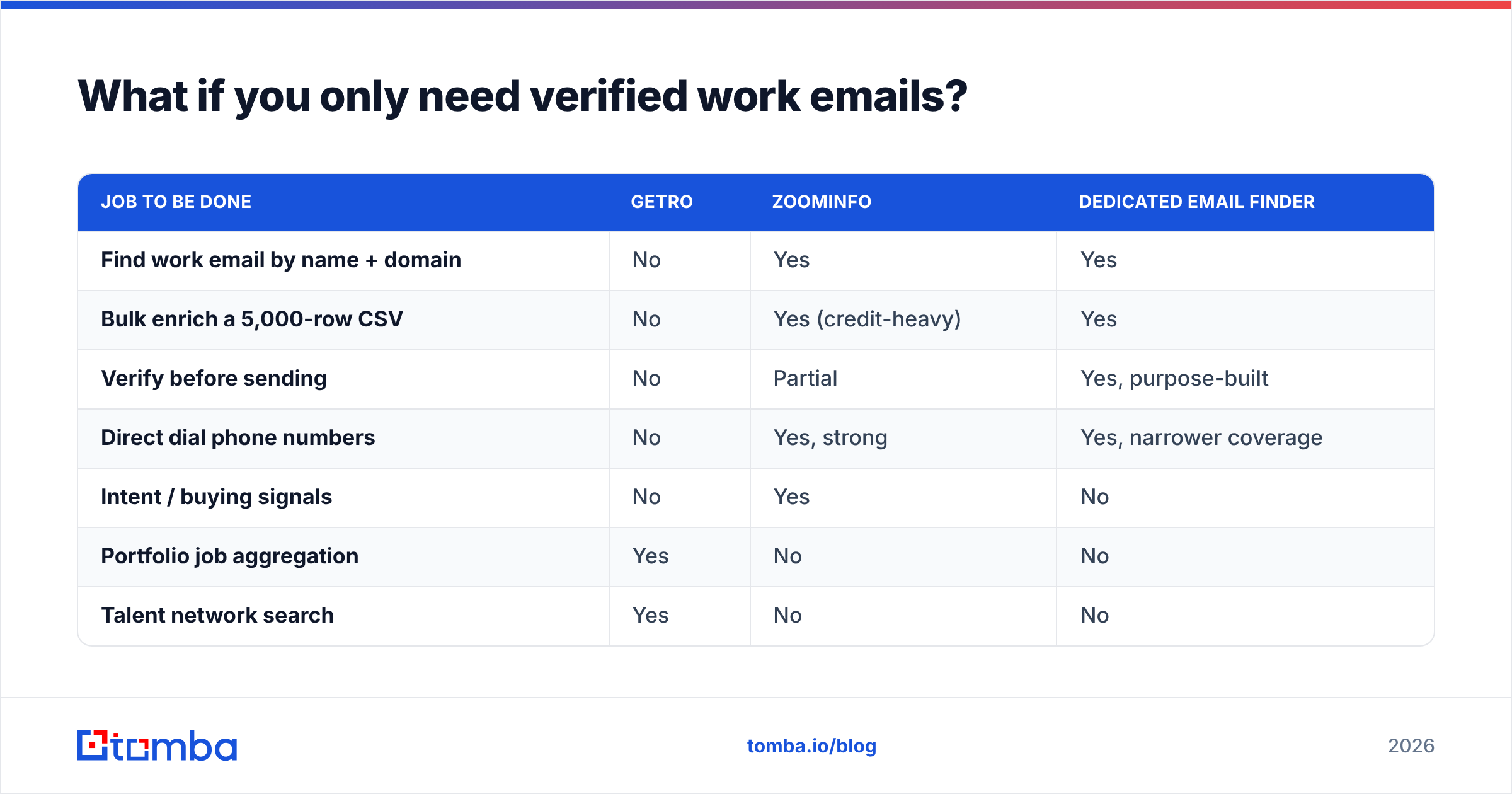
Here is how the three options compare on one job: getting contact data.
| Job to be done | Getro | ZoomInfo | Dedicated email finder |
|---|---|---|---|
| Find work email by name + domain | No | Yes | Yes |
| Bulk enrich a 5,000-row CSV | No | Yes (credit-heavy) | Yes |
| Verify before sending | No | Partial | Yes, purpose-built |
| Direct dial phone numbers | No | Yes, strong | Yes, narrower coverage |
| Intent / buying signals | No | Yes | No |
| Portfolio job aggregation | Yes | No | No |
| Talent network search | Yes | No | No |
| Start cost | Quote only | Quote only, annual | Free tier, then $49/mo |
| Cancel anytime | Negotiated | Rarely | Yes |
How accurate is the data in each?#
Accuracy means different things here. Compare like for like.
Getro's accuracy is really freshness. Job listings get scraped from career pages. The failure mode is a stale board, where roles that closed weeks ago still look open. Getro beats a manual board by a mile. Still, any aggregator inherits the mess of its sources. Ask about crawl frequency in the demo.
ZoomInfo's accuracy is contact-level. The database is huge, and huge databases decay. Job changes alone rot B2B contact data by 25–30% a year. Analysts have cited that range for over a decade. ZoomInfo spends heavily on refresh. Its direct-dial coverage is among the best you can buy. No vendor beats decay outright. Reviews on G2 show a pattern: wide coverage, uneven accuracy. Non-US and small-business records lag well behind US enterprise ones.
Email finder accuracy is a ratio. Count verified results against total lookups. That is the number to press on. A tool that guesses on every query looks great on hit rate and wrecks your sender score. Prefer one that says "not found" instead of guessing a pattern. Prefer one that shows its sources. Tomba publishes where its data comes from for that reason.
One rule holds for every vendor. Verify at send time, not at buy time. A record that was right in January is a bounce in September.
Which one should you buy?#
Match the tool to the job, not to the brand name.
Buy Getro if you run a fund, an accelerator, or a paid community. Your platform team helps portfolio companies hire. Today that job runs on a Notion page and a Slack channel. The job board alone tends to earn back the spend, because it kills recurring manual work.
Buy ZoomInfo if your sales team is big enough to use the seats. You act on intent data. Your ideal customer is US mid-market or enterprise. You have the budget and the patience for a long negotiation. Push hard on credit rollover and a one-year first term.
Buy a focused email finder if contact data is your bottleneck, not software. You want to start this week, not after a procurement cycle. You need API access without a second contract. Or a $15k floor is simply off the table. It also fits if you pay for ZoomInfo but only ever use the export button. That pattern is common and costly.
Run Getro plus a finder if you are a platform team helping the portfolio sell. Getro covers the talent side. A credit-based finder gives each portfolio company contact data. No fund-wide enterprise contract needed. It usually costs less than one block of ZoomInfo seats, and it is far easier to hand out.
What should you check before signing anything?#
Do these four things during any Getro vs ZoomInfo evaluation:
- Test on your real list. Hand the vendor 200 companies from your own target list. Include the awkward ones, the non-US ones, and the tiny ones. Sample data is always cherry-picked.
- Measure verified hit rate. Export the results. Run them through a separate verifier. Count how many can actually be delivered. That is your true coverage.
- Model year two. Ask about price bumps, credit rollover, and the cancel window. Get the answers in writing.
- Confirm the exit. Can you export your data if you leave? For Getro that means candidate records. For ZoomInfo it means the data you pushed into your CRM, plus the right to keep using it.
If a vendor gets cagey on question four, you have learned something useful.
Where does this leave you?#
Getro vs ZoomInfo is a fine debate if you are the buyer either tool was built for. The mistake is not picking the wrong one. The mistake is buying either when your problem is smaller than both.
Need verified work emails for a list of companies? Start with the Tomba Email Finder. The free tier gives you 25 searches a month, so you can test on your own list first. Paid plans start at $49/mo. That is about what one ZoomInfo seat costs in a fortnight. Check the Tomba pricing page, run 200 real target accounts through it, then compare the verified hit rate to the quote in your inbox. Let the numbers pick the winner.
Related guides#
Ready to find emails that actually work?
Join 150,000+ professionals who stopped guessing and started sending. Free credits on signup — no credit card required.
Get the Tomba newsletter
Practical outbound tactics and product updates — once every two weeks.
About the author