Global Call Forwarding Alternatives: 7 Options Compared for 2026
Global Call Forwarding sells international numbers with per-minute billing that scales badly for outbound teams. Here are seven alternatives compared on setup fees, coverage, porting and what they really cost once you dial.
TL;DR
- Global Call Forwarding is a virtual-number reseller, not a phone system. You buy DIDs in ~150 countries and forward the calls somewhere else — you still need a dialer, a CRM and clean phone data.
- The pain point that drives most switches is not the monthly number rent. It is per-minute forwarding charges, setup fees on premium numbers, and the fact that outbound calling is billed separately from inbound forwarding.
- CPaaS providers (Twilio, Telnyx, Plivo) are far cheaper per minute if you have an engineer. UCaaS suites (RingCentral, Dialpad, 8x8) cost more per seat but replace three tools.
- Coverage claims are the biggest trap. "150+ countries" usually means inbound DIDs, not two-way voice with local caller ID, and definitely not without regulatory address proof.
- Whatever provider you pick, connect rate is decided upstream: bad phone data burns minutes on every plan. Validate numbers before they hit the dialer.
What is Global Call Forwarding, and what does it actually do?#
Global Call Forwarding sells international toll-free and local virtual numbers. You rent a number in, say, Germany or Singapore, and inbound calls to that number get forwarded to a destination you control — a SIP trunk, a mobile, a call centre, a softphone. Two-way calling and outbound caller ID are available as add-ons on most number types.
That is a genuinely useful product, and it has been for two decades. If you are a US company that wants a Munich landline number on your website so German buyers do not pay international rates, this is exactly the tool.
The confusion starts when sales teams buy it expecting a phone system. It is not one. There is no native dialer, no call sequencing, no local presence rotation, no CRM logging beyond integrations you wire yourself. It is plumbing.
The pricing model reflects that. You pay a monthly rent per number, plus per-minute forwarding, and the per-minute rate depends on both the number's country and the destination. Forwarding a Brazilian toll-free number to a US mobile is not priced the same as forwarding it to a SIP endpoint. Teams routinely model the number rent, forget the forwarding minutes, and get a bill 3-4x what they projected.
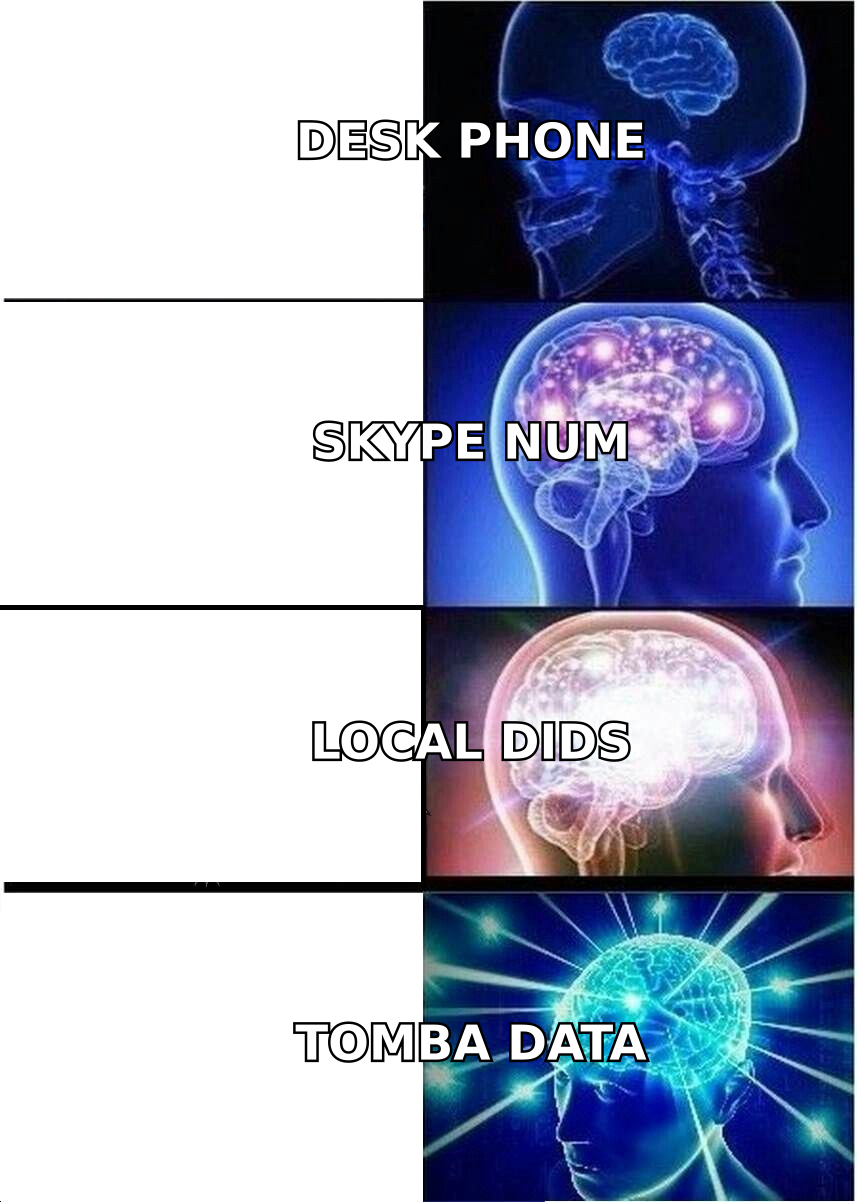
Correction on that image reference — here it is rendered properly:
Why do teams look for Global Call Forwarding alternatives?#
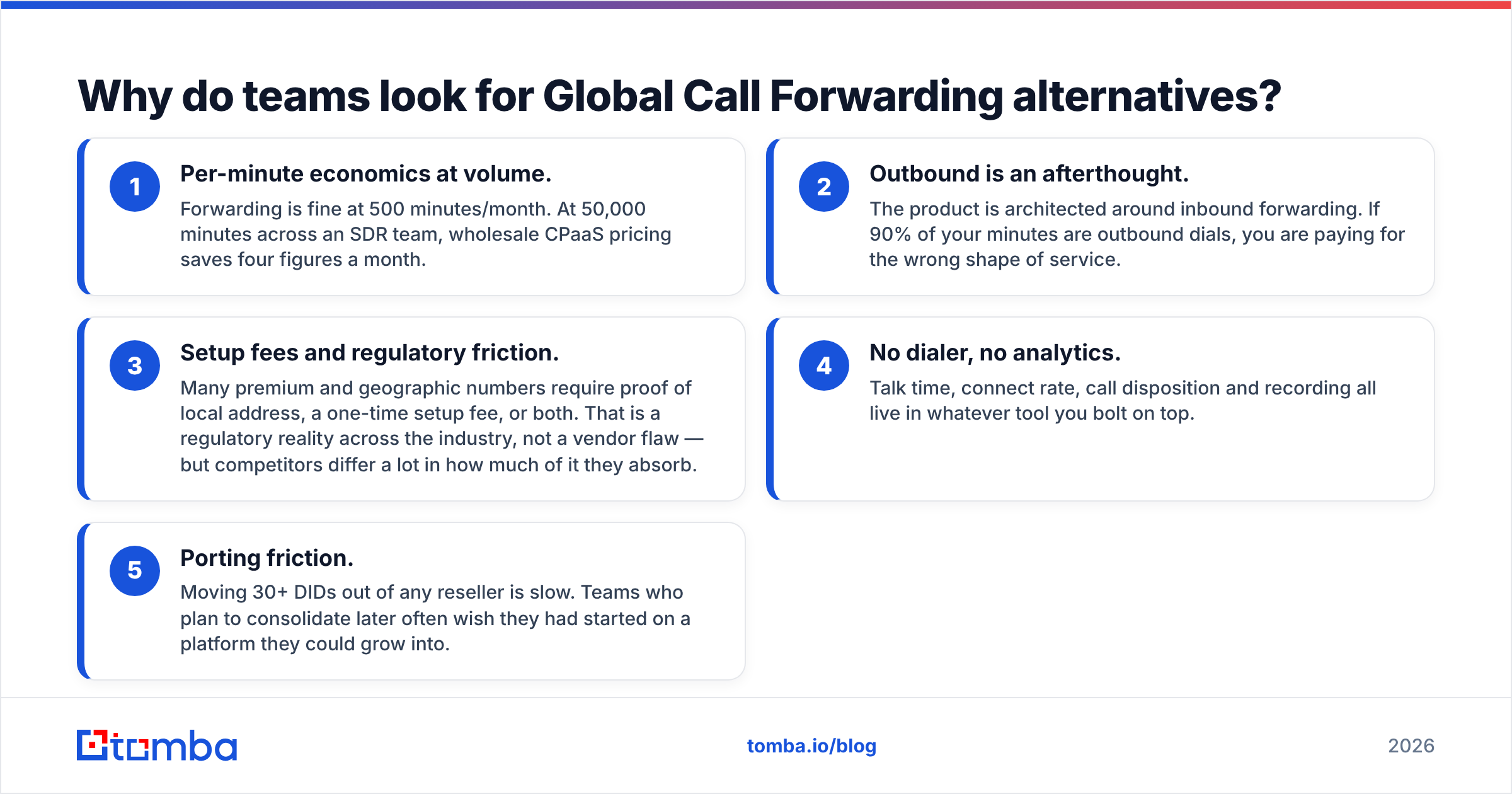
Five reasons come up repeatedly in G2 and Capterra reviews, and in conversations with outbound teams:
- Per-minute economics at volume. Forwarding is fine at 500 minutes/month. At 50,000 minutes across an SDR team, wholesale CPaaS pricing saves four figures a month.
- Outbound is an afterthought. The product is architected around inbound forwarding. If 90% of your minutes are outbound dials, you are paying for the wrong shape of service.
- Setup fees and regulatory friction. Many premium and geographic numbers require proof of local address, a one-time setup fee, or both. That is a regulatory reality across the industry, not a vendor flaw — but competitors differ a lot in how much of it they absorb.
- No dialer, no analytics. Talk time, connect rate, call disposition and recording all live in whatever tool you bolt on top.
- Porting friction. Moving 30+ DIDs out of any reseller is slow. Teams who plan to consolidate later often wish they had started on a platform they could grow into.
What should you compare before switching providers?#
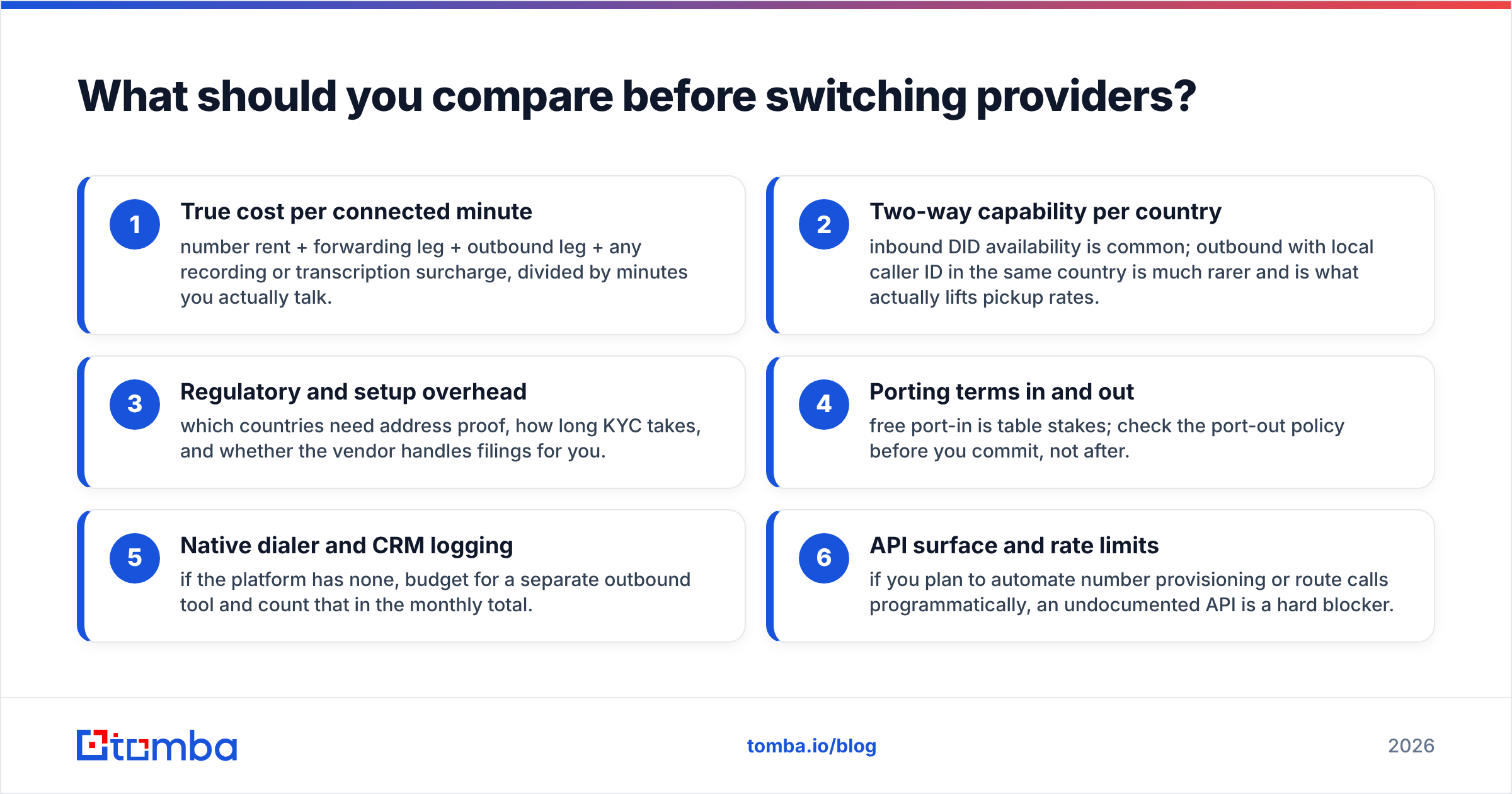
Do not compare on headline price. Compare on these six dimensions, in this order:
- True cost per connected minute — number rent + forwarding leg + outbound leg + any recording or transcription surcharge, divided by minutes you actually talk.
- Two-way capability per country — inbound DID availability is common; outbound with local caller ID in the same country is much rarer and is what actually lifts pickup rates.
- Regulatory and setup overhead — which countries need address proof, how long KYC takes, and whether the vendor handles filings for you.
- Porting terms in and out — free port-in is table stakes; check the port-out policy before you commit, not after.
- Native dialer and CRM logging — if the platform has none, budget for a separate outbound tool and count that in the monthly total.
- API surface and rate limits — if you plan to automate number provisioning or route calls programmatically, an undocumented API is a hard blocker.
Teams that score vendors on those six almost never end up back where they started.
Which alternatives are worth shortlisting in 2026?#
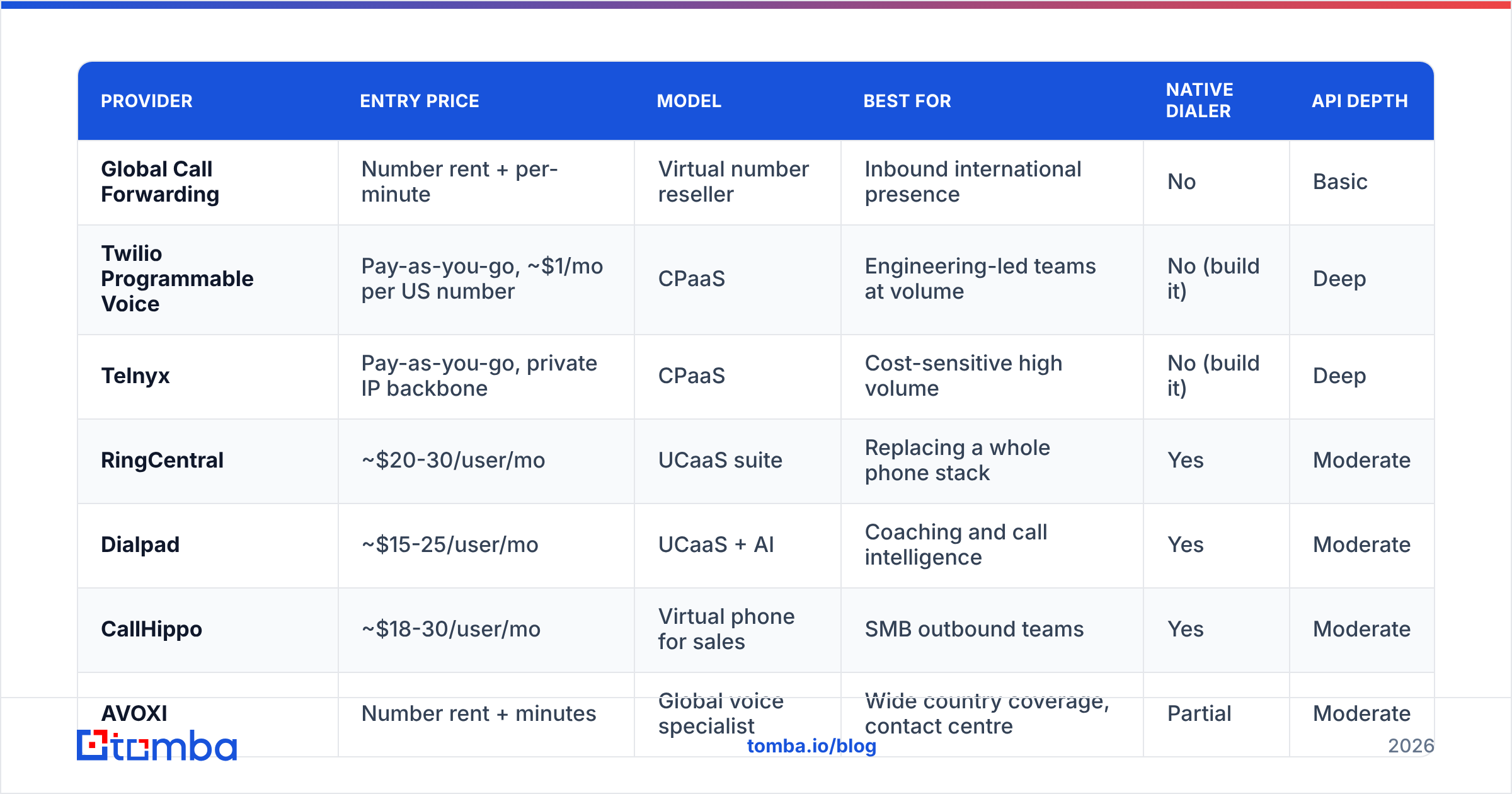
Here is the shortlist, priced on publicly listed entry tiers. Rates move — treat these as an ordering signal, not a quote.
| Provider | Entry price | Model | Best for | Native dialer | API depth |
|---|---|---|---|---|---|
| Global Call Forwarding | Number rent + per-minute | Virtual number reseller | Inbound international presence | No | Basic |
| Twilio Programmable Voice | Pay-as-you-go, ~$1/mo per US number | CPaaS | Engineering-led teams at volume | No (build it) | Deep |
| Telnyx | Pay-as-you-go, private IP backbone | CPaaS | Cost-sensitive high volume | No (build it) | Deep |
| RingCentral | ~$20-30/user/mo | UCaaS suite | Replacing a whole phone stack | Yes | Moderate |
| Dialpad | ~$15-25/user/mo | UCaaS + AI | Coaching and call intelligence | Yes | Moderate |
| CallHippo | ~$18-30/user/mo | Virtual phone for sales | SMB outbound teams | Yes | Moderate |
| AVOXI | Number rent + minutes | Global voice specialist | Wide country coverage, contact centre | Partial | Moderate |
| Zadarma | Low per-number rent | Budget virtual numbers | Cost-first, light usage | Basic | Moderate |
Twilio Programmable Voice#
The default answer for anyone with an engineer. Twilio gives you raw voice infrastructure at wholesale per-minute rates, numbers in 100+ countries, and the best-documented telephony API in the market. The catch is that "programmable" means you are building the product. There is no dialer UI, no agent console, no call queue you did not write. Budget engineering weeks, not a procurement cycle.
Choose it when: your call volume is high enough that per-minute savings pay for the build, or you are embedding calling inside your own product.
Telnyx#
Telnyx runs its own private IP network rather than leasing transit, which shows up as lower jitter on long-haul routes and, usually, lower per-minute pricing than Twilio on the same lanes. The API is close to feature parity. The ecosystem — third-party integrations, community answers, hiring pool — is smaller.
Choose it when: you are already comfortable with CPaaS and want the same capability at a lower run rate.
RingCentral#
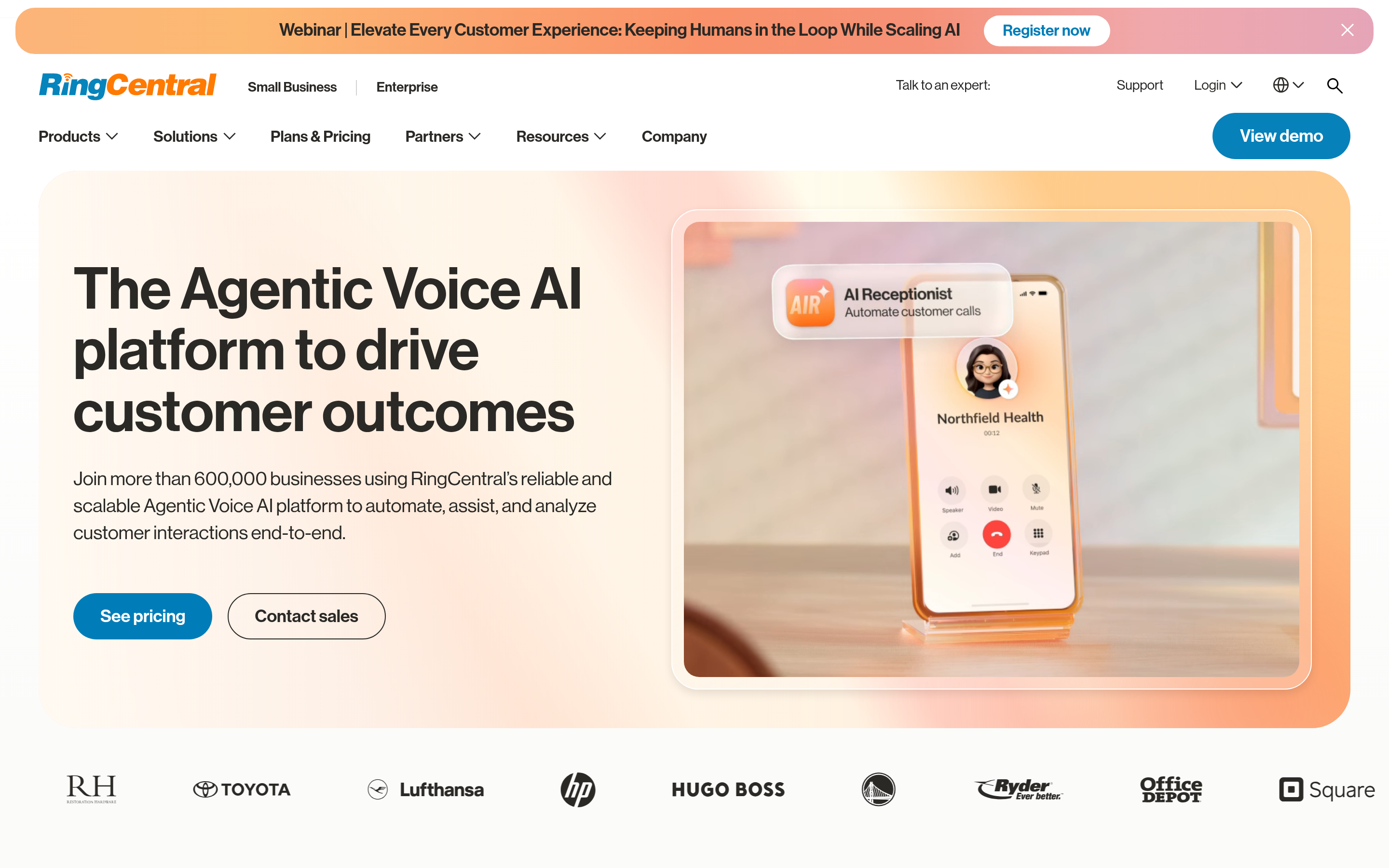
The opposite end of the spectrum. RingCentral is a full unified-communications suite: voice, video, SMS, team messaging, contact centre, admin console, compliance tooling. Per-seat pricing lands roughly in the $20-30/user/month range depending on tier and contract length, with international numbers as add-ons.
Choose it when: you are replacing a phone system, not just buying numbers, and you want one vendor for voice across the whole company.
Dialpad#
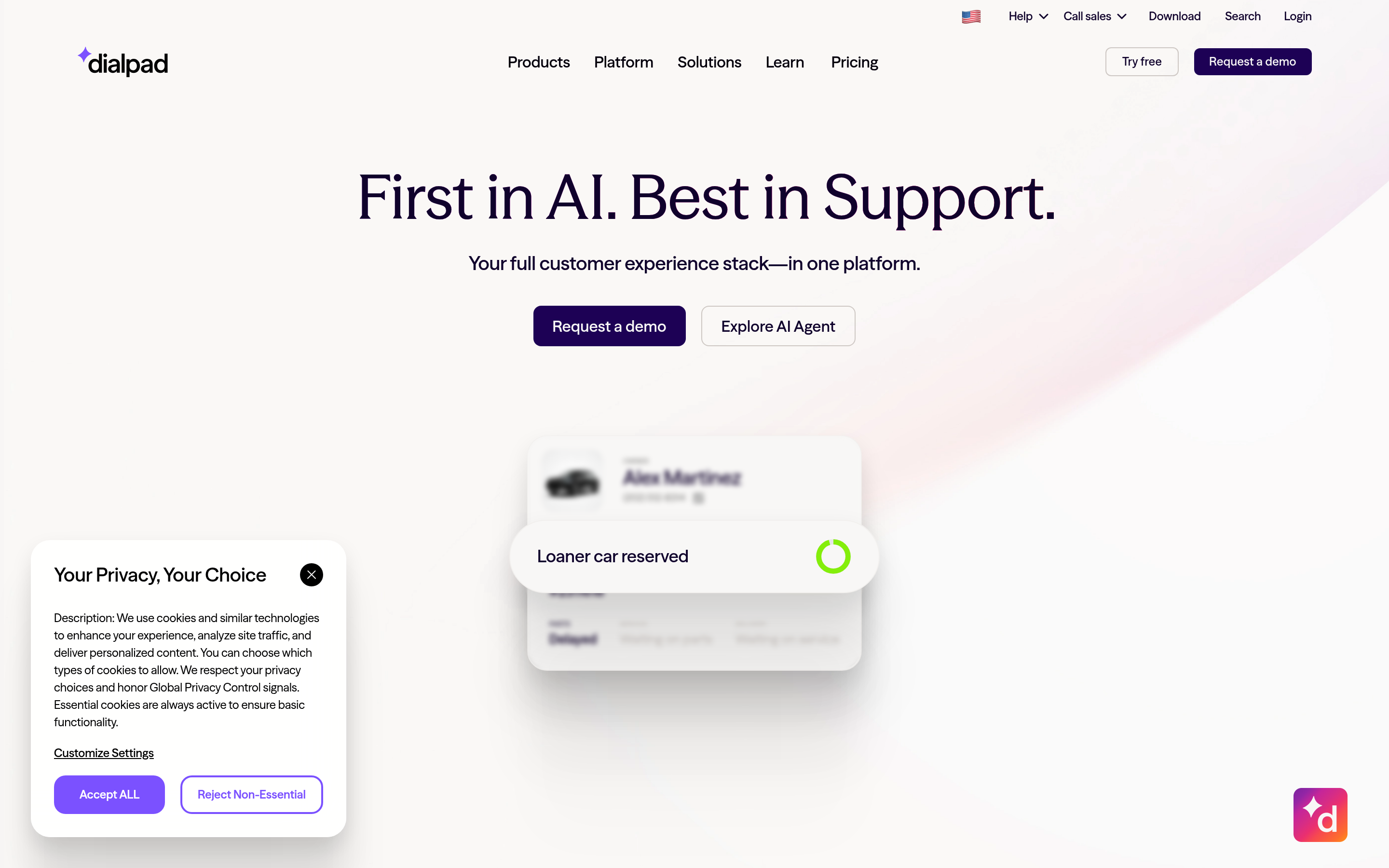
Dialpad's differentiator is real-time transcription and call intelligence baked in rather than bolted on — live coaching cards, automatic call summaries, sentiment flags. For sales managers who currently pay separately for a conversation-intelligence tool, that consolidation is the real saving.
Choose it when: coaching and call review matter as much as dial capacity.
CallHippo#
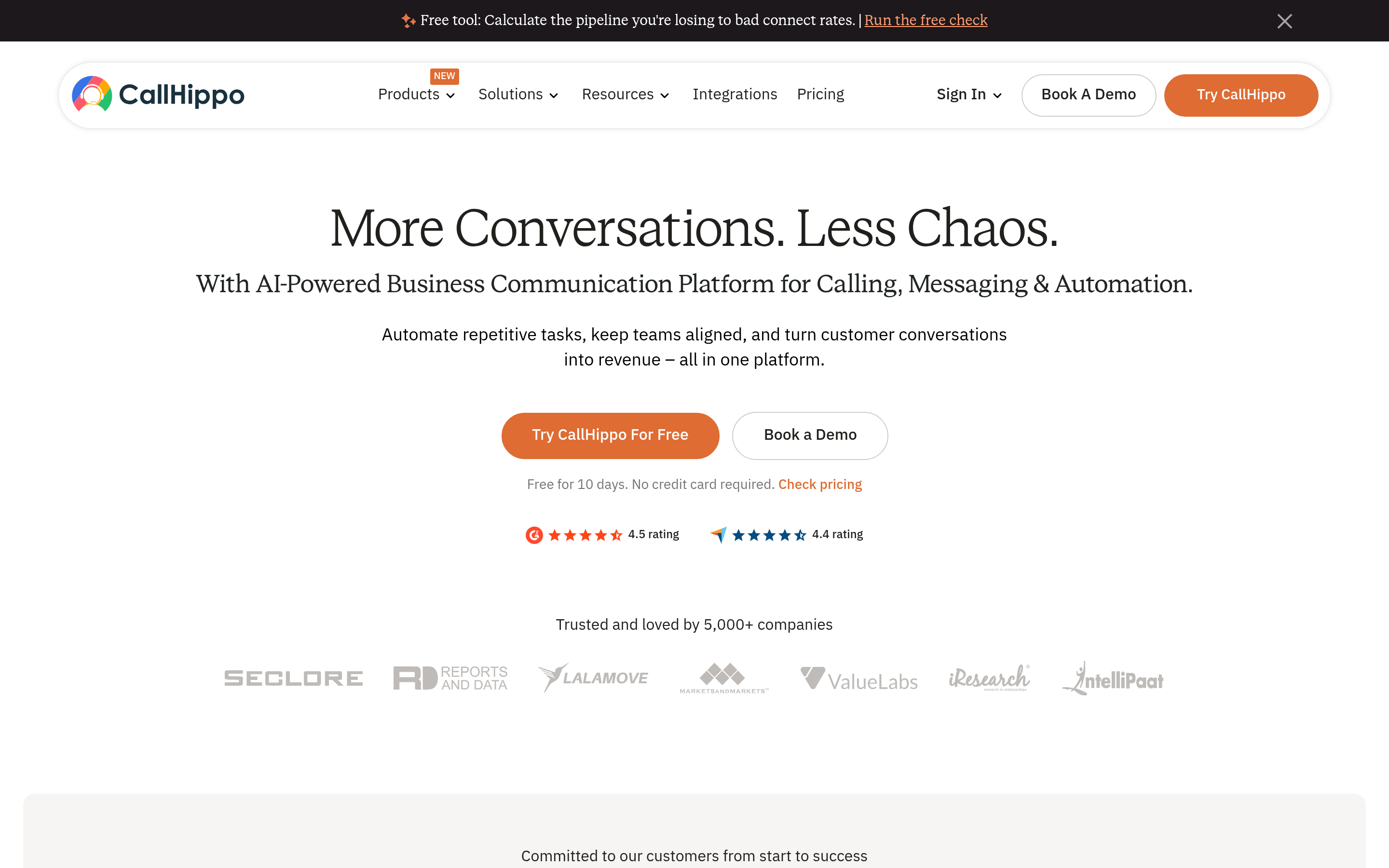
Purpose-built virtual phone for small sales teams. Power dialer, call recording, CRM integrations, numbers in 50+ countries. Cheaper than the enterprise UCaaS suites and dramatically easier to set up than CPaaS. Reviews consistently praise onboarding speed and flag occasional call-quality variance on long-haul routes.
Choose it when: you have 3-20 reps, want a dialer today, and do not have engineering to spare.
AVOXI#
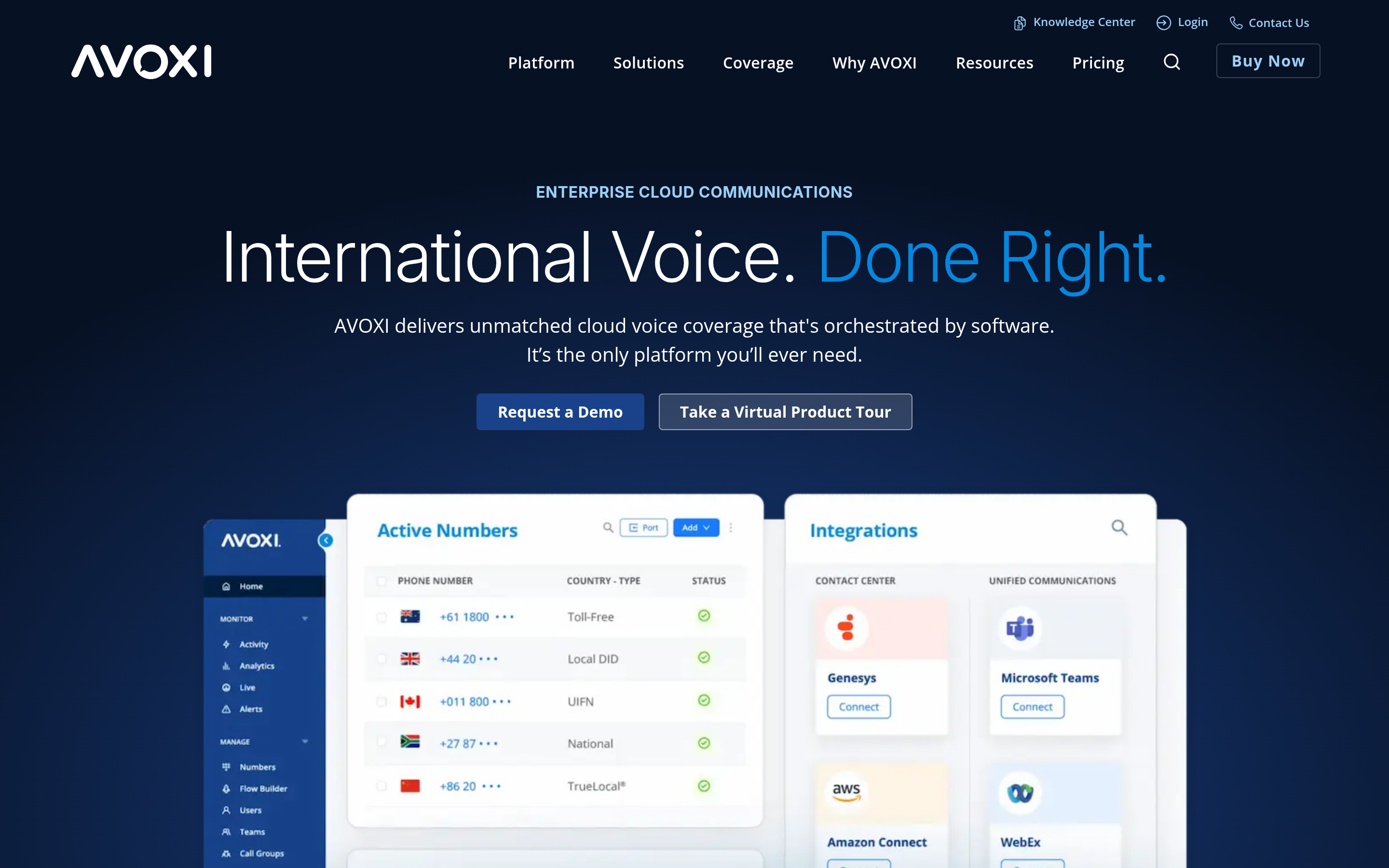
The closest like-for-like competitor to Global Call Forwarding, with a stronger contact-centre orientation. Broad international DID coverage, two-way calling in a decent subset of countries, and a management console built for teams handling regulatory paperwork across many markets.
Choose it when: your requirement really is "numbers in a lot of countries" and you want a specialist rather than a generalist.
Zadarma#
The budget option. Low monthly number rent across a wide country list, a free basic PBX, and per-minute rates that undercut most of this list. Support and console polish are correspondingly thinner.
Choose it when: cost is the binding constraint and your volume is light enough that support quality rarely gets tested.
How do you pick between CPaaS, UCaaS and a number reseller?#
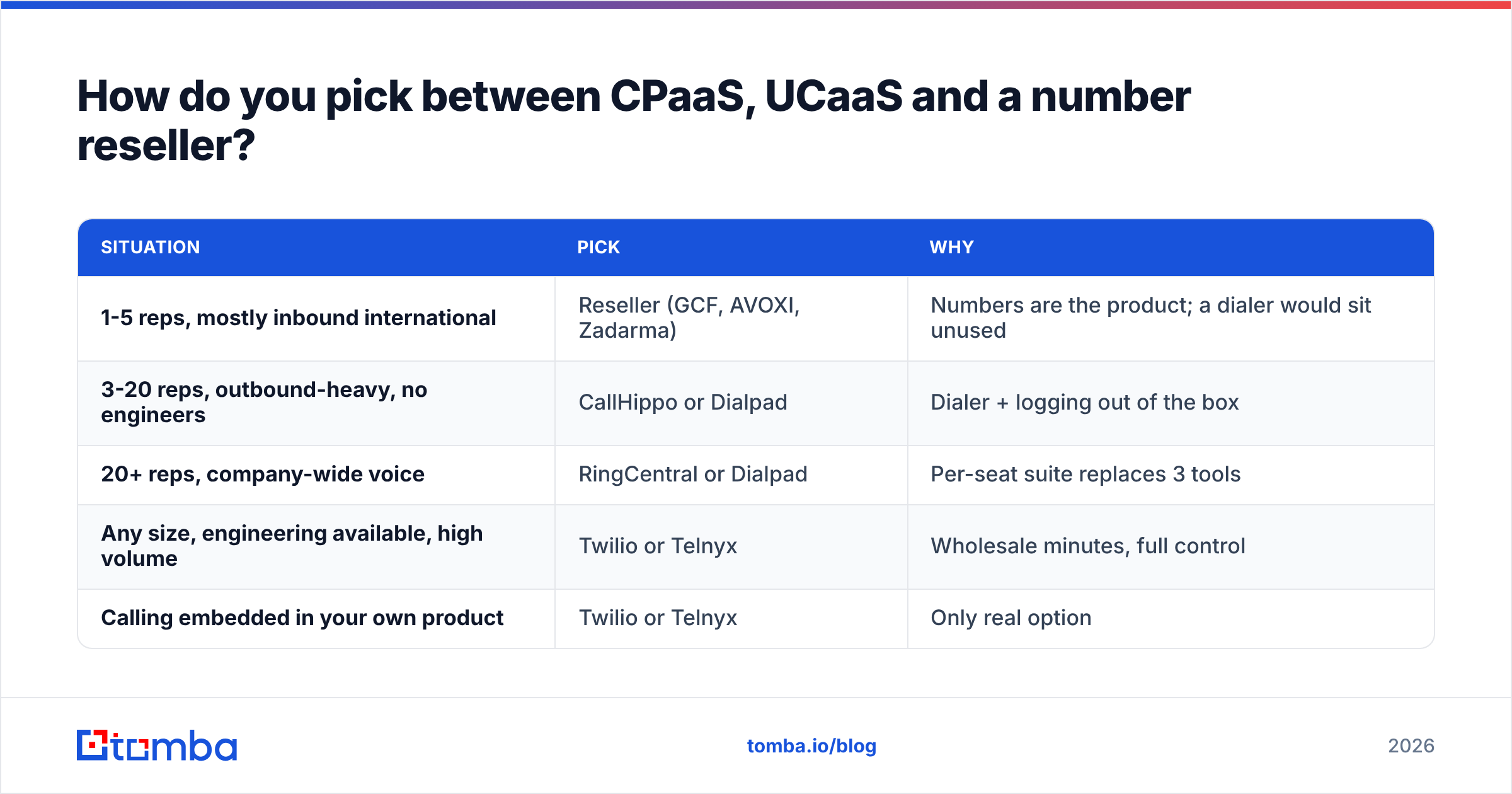
Use headcount and engineering access as the deciding variables.
| Situation | Pick | Why |
|---|---|---|
| 1-5 reps, mostly inbound international | Reseller (GCF, AVOXI, Zadarma) | Numbers are the product; a dialer would sit unused |
| 3-20 reps, outbound-heavy, no engineers | CallHippo or Dialpad | Dialer + logging out of the box |
| 20+ reps, company-wide voice | RingCentral or Dialpad | Per-seat suite replaces 3 tools |
| Any size, engineering available, high volume | Twilio or Telnyx | Wholesale minutes, full control |
| Calling embedded in your own product | Twilio or Telnyx | Only real option |
One number to sanity-check the whole exercise: take your monthly talk minutes, multiply by the blended per-minute rate, add number rent and seat licences, then divide by connected conversations. If that figure is above roughly $8-10 per conversation, the provider is not your problem — your data is.
Does the provider actually change your connect rate?#
Partly. Local caller ID measurably improves pickup versus an unfamiliar international prefix, and carrier-level spam labelling varies between providers. Those are real effects, and they are worth paying for.
But they are second-order. The first-order variable is whether the number you dialed belongs to the person you meant to reach and is still in service. Every provider on this list bills you identically for a dead number, a wrong-department switchboard, and a disconnected line. Switching from a $0.04/min provider to a $0.02/min provider halves the cost of dialing bad data. Fixing the data removes it.
Three things to fix upstream of the dialer:
- Source direct numbers, not switchboards. A main company line routed through reception converts far worse than a direct dial. A phone finder that returns direct B2B numbers tied to a named contact is worth more than a cheaper minute rate.
- Validate before you load. Line-type detection (mobile vs landline vs VoIP), carrier lookup and活 status checks catch a meaningful share of dead records before they consume dialer time. Run the list through a phone validator as a pre-flight step.
- Enrich for routing. Knowing country, seniority and timezone lets you dial the right region at the right local hour with the matching local DID. That is where data enrichment pays back against your telephony spend directly.
Independent category data on G2's VoIP category is useful for sanity-checking vendor claims, but note that reviews skew toward inbound and internal-comms use cases. Outbound sales requirements are a minority of the sample.
What does switching actually involve?#
Four steps, and the second one is where projects stall.
- Inventory your numbers. Every DID, its country, its monthly cost, and whether anything external (website, ad campaign, printed material, Google Business Profile) points at it.
- Check port-out eligibility. Some international numbers are not portable at all — toll-free numbers in particular are frequently non-portable across borders. You may have to run both providers in parallel and let the old numbers age out.
- Run a parallel pilot. One team, two weeks, both providers, same list. Compare connect rate and audio quality, not just invoice totals.
- Migrate logging last. Get calls flowing before you rewire CRM activity logging, or you will debug two systems simultaneously.
Budget six to ten weeks for a full multi-country migration. Anyone promising two is not counting regulatory approvals.
Which alternative should you choose?#
If your requirement is genuinely international inbound presence, staying put or moving to AVOXI is reasonable — the category leaders are close in capability and the switching cost is real.
If your requirement is outbound sales, the answer is almost always a dialer-first platform (CallHippo, Dialpad) or CPaaS (Twilio, Telnyx) depending on whether you have engineering. A number reseller will keep you paying for infrastructure while you buy the actual sales tooling separately.
And whichever way you go, run the connect-rate maths before you sign anything. Cheaper minutes on the same bad list is not a saving.
Before you optimise your per-minute rate, optimise what you dial. Tomba's phone finder returns direct B2B numbers tied to verified contacts, with line-type and validity checks built in — so your dialer minutes go to real people rather than dead records. Pair it with the Tomba Email Finder for multichannel sequences, start free with 25 searches a month, and scale from $49/mo on Starter. Full Tomba pricing is public, per-credit, and does not have a forwarding surcharge.
Related guides#
Ready to find emails that actually work?
Join 150,000+ professionals who stopped guessing and started sending. Free credits on signup — no credit card required.
Get the Tomba newsletter
Practical outbound tactics and product updates — once every two weeks.
About the author